"Ma'am, what exactly are you doing in here?"
"I'm shopping. It's a store."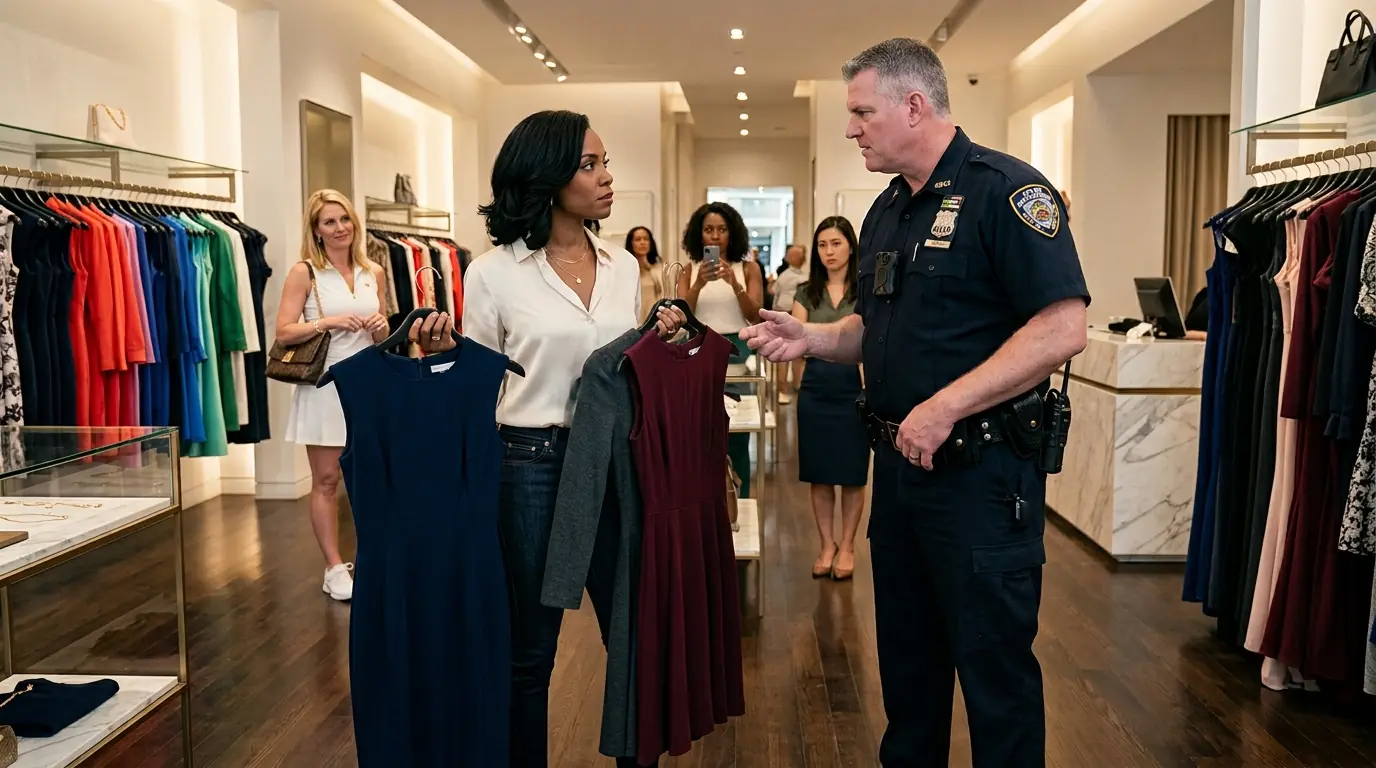
"Yeah. See, people like you don't usually hang around places like this. Why don't you put that down and head out before this becomes something?"
"Excuse me. I've done nothing wrong. She's been making—"
A white woman named Patricia Patterson saw Amara Bennett, a black woman, browsing through expensive dresses at Bellacort Luxury Boutique for 10 minutes and immediately called her husband, Officer Dennis Patterson, telling him that there was a suspicious black woman in the store who looked like she was planning to steal something and making her feel unsafe.
Officer Patterson arrived within minutes and confronted Bennett while she was selecting dresses to try on, demanding ID and telling her that someone like her didn't belong in an expensive boutique and needed to leave before he arrested her for making other customers uncomfortable.
When Bennett, the actual owner and founder of the boutique, revealed her identity and stated she built the business from nothing, Officer Patterson refused to believe her, accused her of lying and impersonation, handcuffed her in front of shocked customers, and began dragging her out of her own store while she protested that she was telling the truth.
What Officer Patterson and his racist wife didn't know was that the boutique manager, Peter Prescott, would return from his errand and immediately recognize his boss being arrested in handcuffs. That a simple internet search would instantly prove Bennett owned the luxury boutique chain, and that their racist assumption that a black woman couldn't possibly own an upscale store would cost both of them their careers and result in a $680,000 lawsuit that would expose their long pattern of targeting and harassing black people.
Amara Bennett pulled her car into the upscale shopping district on Madison Avenue just after 2:00 on a Thursday afternoon, looking forward to a few hours of browsing and shopping in the city she just moved to 2 weeks earlier.
At 38 years old, Bennett was the founder and CEO of Bellacort Luxury Boutique, a high-end women's clothing chain she'd built from absolutely nothing over the past 5 years. She'd started with a single small store funded by her life savings and a business loan, worked 16-hour days for three years straight, and turned that one location into a four-story chain worth over $3 million. She employed 42 people across her locations, and she just moved to this city to personally oversee the opening of her newest flagship store scheduled for next month.
Today, Bennett had decided to visit the original Bellacort boutique location incognito, wanting to browse quietly and observe how the staff was running things without announcing herself as the owner. She wore elegant but understated clothes, designer jeans that fit perfectly, a cream silk blouse, understated gold jewelry, and expensive leather flats. Looking exactly like the affluent customers her boutiques catered to, she walked through the glass doors of Bellacort Boutique with a small smile on her face, excited to see her first location after being away for several months focused on expansion.
The boutique was beautiful, exactly as Bennett had designed it. High ceilings, elegant lighting, carefully curated racks of dresses and separates arranged by color and style, plush seating areas for customers, and soft music playing in the background. There were about six other customers browsing through the store, most of them white women in their 30s and 40s, examining the merchandise with the careful attention that expensive clothing deserved.
One of those customers was Patricia Patterson, a white woman in her mid-40s wearing a tennis outfit and carrying a designer handbag who had been browsing the sale rack near the front of the store when Bennett walked in. Patricia glanced up at the sound of the door chime, and her eyes immediately locked onto Bennett. Patricia watched as Bennett walked past her toward the main dress displays, and something in Patricia's mind clicked into suspicion mode the moment she saw a black woman entering this expensive boutique.
Bennett was completely unaware of Patricia's attention as she made her way to a display of evening dresses near the back of the store. She ran her fingers along the fabrics, checking the quality and the way the dresses were displayed, mentally noting that the staff had done an excellent job with the merchandising. She pulled out a deep blue cocktail dress and held it up, examining the stitching and the drape of the fabric. She was genuinely shopping, but also evaluating her own inventory with the critical eye of someone who had personally selected every item in the store.
5 minutes passed. Bennett moved from the evening wear to the casual dress section, pulling out items, checking price tags, considering what might work for the business events she had coming up. She was acting exactly like any other customer in the boutique, taking her time, being thoughtful about her selections.
Patricia Patterson watched her the entire time. Patricia pretended to examine a blouse while keeping Bennett in her peripheral vision, tracking every move Bennett made through the store. In Patricia's racist mind, Bennett's careful browsing wasn't the behavior of a discerning customer. It was the behavior of someone casing the place, looking for opportunities to steal. Patricia had no evidence for this belief, no reason beyond the color of Bennett's skin to think anything suspicious was happening. But her prejudice filled in a narrative that made sense to her warped worldview.
10 minutes passed. Bennett had now moved to a third section of the store, looking at designer separates, silk blouses and tailored pants that could be mixed and matched for professional settings. She still hadn't made a final selection, just browsing and enjoying the experience of shopping in her own beautifully designed space. But to Patricia, the fact that Bennett had been in the store for 10 minutes without buying anything was proof positive that something criminal was happening.
Patricia pulled out her phone and stepped toward a quiet corner of the boutique near the dressing rooms. She kept her voice low as she dialed her husband's number, but her eyes never left Bennett.
"Dennis, it's me," Patricia said quietly when her husband answered. "I'm at Bellacort Boutique on Madison Avenue. There's a black woman in here acting very suspicious. She's been walking around for 10 minutes just looking at things and not buying anything. I think she's planning to steal something. I don't feel safe."
Officer Dennis Patterson was sitting in his patrol car 2 miles away finishing paperwork when his wife's call came through. At 48 years old, Patterson had been a police officer for 22 years and had developed the same racist worldview as his wife through decades of profiling minority communities. When Patricia told him there was a suspicious black woman in an expensive boutique, he didn't question her assessment for even a second.
"Stay where you are," Patterson told his wife. "I'm 15 minutes away. Keep an eye on her, but don't confront her. I'll handle it when I get there."
Patricia ended the call and slipped her phone back into her purse. Feeling satisfied that she'd done her civic duty by reporting suspicious activity. She went back to pretending to shop while continuing to watch Bennett like a hawk watching prey.