The six guest passes turned red before anyone at Willow Bend Estates checked the approval history. Darius Benton did not know that yet. He was standing behind the house on Aldercrest Drive, one hand resting on the lid of a charcoal grill and the other holding a pair of steel tongs above a row of chicken thighs. His daughter’s phone lay on the patio table beside six orange parking passes, each printed with a working QR code.
The passes were real. The move-in authorization was active, the address matched, and at 1:57 that afternoon, all six vehicles had shown as approved. For five quiet minutes, that should have been the whole story. Darius had arrived that morning in an old department sweatshirt, faded jeans, and running shoes marked with dust from carrying boxes through the front hall.
The Benton family had owned the house for less than a day. Half the kitchen was still packed, and a lamp stood on the living room floor without a shade. Simone Benton had found the paper plates but not the silverware, so lunch had become a backyard barbecue by necessity. Maya had registered each guest through the neighborhood portal, entered every license plate, and printed every pass.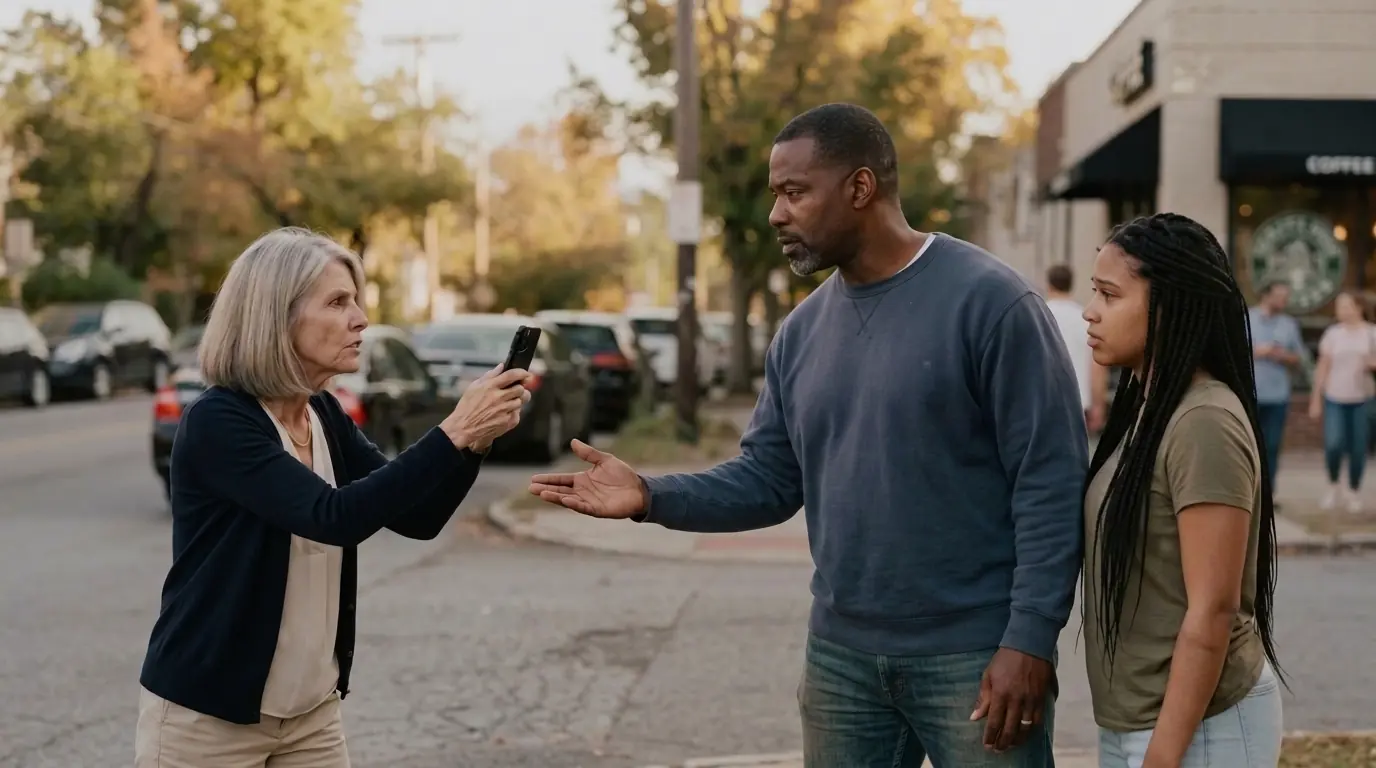
Across the street, a white family had hosted a graduation dinner the previous weekend. Cars had lined both sides of the road, and guests had carried coolers through the front door. No one had photographed their plates or demanded an occupancy review. Two houses down, a contractor’s van had remained in a driveway since sunrise with no pass at all, and Elaine Pritchard had walked past it twice.
She stopped only when she saw the Bentons’ guests. At 2:03 p.m., Elaine opened the Willow Bend administrative portal from her kitchen tablet. She selected all six approved passes and changed them to unverified. The system required a reason code, so she chose “resident safety concern.”
Then she crossed the street. She did not knock at the front door. Instead, she entered through the open side gate and stopped three feet from the grill.
“Who authorized this gathering?” she demanded.
Darius lowered the tongs. “It’s a family meal.”
Elaine looked past him at the folding chairs, paper plates, and the family members and friends gathered near the patio. “I asked who authorized it.”
“My family owns the house.”
Her eyes moved to his sweatshirt, then toward the moving boxes visible through the back door. “You moved in this morning.”
“That’s correct.”
Maya stepped away from the table. “They’re registered. I printed the passes myself.” She held up one of the orange cards.
Elaine did not scan it. “The system shows those vehicles as unverified.”
Maya unlocked her phone. The six green approval marks were gone. Each pass now carried a red warning beside the plate number. “I checked them before everyone arrived,” she said. “They were approved.”
Elaine folded her arms. “Then perhaps you entered something incorrectly.”
Maya opened the activity panel. The latest change showed an administrator override: Elaine Pritchard, 2:03 p.m. Simone saw the name before Elaine could turn away.
“You changed them,” Simone said.
Elaine’s expression remained flat. “I corrected a security concern.”
“What concern?” Simone asked.
Elaine looked around the yard again. “Unusual traffic. Excessive occupancy. A gathering that was not disclosed.”
Isaiah Von sat near the patio steps with a plate balanced on one knee. He had been with the Ridgmont Police Department for fourteen years, but his badge was locked in his car. He watched Elaine turn six invited guests into a security problem without asking a single person why they were there.
Beside the neighboring hedge, Grace Bell held a garden hose over the same patch of flowers for almost a minute. She had seen Maya place the orange passes beneath the windshields. She had also received the neighborhood notice approving the Benton move. Still, she said nothing as Elaine claimed the vehicles did not belong there.
Elaine raised her phone and photographed the nearest license plate. Then she photographed Maya. Darius stepped between them.
“Do not photograph my daughter.”
“I document violations.”
“You created the violation.”
Elaine’s jaw tightened. Before she could answer, the gate moved again. Thomas Pritchard entered the yard carrying the smell of bourbon and stale cigarettes.
He had once worn a Ridgmont badge. Six months earlier, Darius had signed the order ending that career. Thomas did not recognize him, not yet. He looked at the guests, the grill, and the orange passes on the table, then pointed toward the street.
“Clear the cars. Shut the music off. End this now.”
Darius set the tongs beside the grill. “You need to leave my property.”
Thomas took one step toward Maya. Darius moved between them. For a second, anger reached his voice.
“You will not speak to my daughter.”
Then he pulled it back. He kept his hands open and repeated the instruction once. “Leave the property.”
Elaine was already dialing emergency services. She reported a hostile gathering, possible narcotics, and possible weapons. When the dispatcher asked what weapon she had seen, Elaine paused.
“I can’t identify the exact object,” she said, “but the situation feels armed.”
On the dispatch screen, the distinction disappeared. The call summary read: possible weapons on scene.
Isaiah reached toward the pocket where he normally carried identification. Darius shook his head.
“No badges. No titles.”
In the distance, two patrol cars turned onto Aldercrest Drive. Blue light moved across the windows of the new house. On Maya’s phone, all six guest passes were still red.
Officer Leah Moreno stepped out of the first patrol car with her right hand near her holster. The dispatch note said possible weapons. It did not say what kind, who had seen one, or whether the claim came from direct observation or fear.
Leah saw a grill, folding chairs, paper plates, and a family standing beside an open patio door. She saw no one running, reaching into a waistband, or holding anything that looked like a weapon. Elaine Pritchard hurried toward her before the second officer had even cleared the cruiser.
“Thank God,” Elaine said. “They’ve been threatening us all afternoon.”
Leah held up one hand. “Stay on this side of the street.”
Elaine stopped, but she did not stop talking. “There are too many people. They changed the whole character of the block. My husband asked them to calm down, and they became aggressive.”
Leah opened the incident screen on her department phone. “What weapon did you personally see?”
Elaine blinked. “I said there may be weapons.”
“What object did you see?”
“I could tell from the way they were acting.”
“That is not what I asked.”
Thomas Pritchard stepped forward. “I spent more than twenty years on the job. You need to secure that yard before someone gets hurt.”
Leah looked at him. “Did you see a weapon?”
Thomas’s face tightened. “I know how these situations develop.”
Leah entered a note: caller and witness unable to identify observed weapon.
Across the street, Darius kept both hands visible. He did not move toward Leah or call her by rank. He waited until she approached the gate.
“Good afternoon,” she said. “We received a report involving threats, narcotics, and possible weapons.”
“There are no weapons or narcotics here,” Darius said. “The caller and her husband entered our property after being asked to leave.”
“Did anyone threaten them?”
“No.”
Maya held up her phone. “She changed our parking passes.”
Leah looked at the screen. Six passes showed red warnings. Maya opened the earlier screenshot, showing the same plates and address with six green approvals timestamped at 1:57 p.m. Then she opened the activity history: administrator override, Elaine Pritchard, 2:03 p.m.
Leah photographed both screens through the department evidence application. “Do not alter anything else in the portal,” she said.
Elaine’s voice rose from across the street. “I manage neighborhood standards. I have authority to correct improper entries.”
Leah turned. “What was improper?”
“The volume of visitors.”
“That is not a plate error.”
Elaine did not answer.
Thomas crossed the curb again. “You’re letting them control the scene.”
Leah stepped into his path. “Return to your driveway.”
“You don’t know who you’re dealing with.”
Darius looked at Thomas more carefully. The phrase was familiar, and so was the stance. Thomas had used both in three body-camera complaints Darius reviewed before signing his termination.
Isaiah Von remained beside the patio steps. His badge stayed in the car. Thomas finally noticed him.
“You,” Thomas said. “You testified against me.”
Isaiah stood. “I gave an accurate statement.”
Thomas moved toward him, and Leah blocked him again. “Do not cross the street.”
“They ruined my career,” Thomas said.
His words were no longer directed at the gathering. They were directed at active department personnel tied to his disciplinary case. Leah requested a records check on Thomas’s post-termination conditions.
Near the hedge, Grace Bell turned off the garden hose. She had watched Elaine and Thomas enter the Benton yard. Her doorbell camera faced the side gate, and she also had the HOA member portal open on her tablet. It showed the passes approved before Elaine’s override.
Grace looked toward her house, then toward Elaine. For years, Elaine had controlled inspection notices, landscaping approvals, and resale letters. Grace had told herself silence was practical. Now the weapons label was sitting inside a police record.
She crossed the lawn. “Officer,” she said, “I have video.”
Elaine turned sharply. “Grace, this does not concern you.”
Grace kept walking. “I heard the call. It concerns me now.”
Leah created a secure upload link. Grace sent the original doorbell file and the HOA screenshot without compressing either one. The video showed Elaine entering first, followed by Thomas. No one from the Benton yard crossed the street or threatened them. Thomas advanced toward Maya before Darius stepped between them.
Dispatch returned the records check. Thomas was under a no-contact condition involving active officers connected to his termination review. Isaiah Von was listed.
Leah looked at Thomas. “Turn around.”
His face changed, not with surprise, but with recognition. Only after the handcuffs closed did dispatch read the registered homeowner’s full profile: Darius Benton, Ridgmont chief of police.
Leah looked at him once, then back at the incident screen. Her preliminary finding was already entered: no observed threat, caller claims unsupported, administrative records altered before emergency report.
“Chief,” she said, “this needs to leave your chain of command.”
Darius nodded. “That should have happened whether you knew my title or not.”
Leah sent the referral to Municipal Integrity. Miles away, Celeste Warren opened a preservation order covering the emergency call, the body cameras, the doorbell file, the HOA audit trail, and Elaine’s administrator access. For the first time that afternoon, Elaine no longer controlled the only version of what had happened.
Celeste Warren did not begin the review with Darius Benton’s title. She began with six orange guest passes. The meeting took place nine days after the barbecue in a municipal records room above the emergency communications center.
There were no uniforms, no press, and no neighborhood supporters seated behind either side. Only the people responsible for the systems that had carried Elaine Pritchard’s accusation forward were present. Celeste placed the HOA audit export on the main screen.
At 1:57 p.m., all six guest passes were approved. At 2:03 p.m., Elaine used her administrator account to change every pass to unverified. No failed QR scan appeared. No resident complaint appeared. No vehicle had entered after the approvals.
The only reason entered was “resident safety concern.” Five minutes later, Elaine posted that the neighborhood system had detected unknown vehicles. Celeste stopped the display.
“The system detected nothing,” she said. “An administrator changed the record, then presented her own change as an independent warning.”
The HOA attorney lowered his eyes to the printed log. The association’s cyber-liability representative did not. She was already reading the exclusion for intentional misuse of administrative access.
The emergency call came next. Elaine’s voice was calm as she reported possible weapons, possible narcotics, and a hostile gathering. When the dispatcher asked what weapon she had directly observed, Elaine said the situation felt armed. The summary removed that distinction and became “possible weapons on scene.”
Celeste placed Leah Moreno’s body-camera note beside it: caller unable to identify observed weapon. Then Grace Bell’s doorbell recording played. Elaine entered the Benton property first. Thomas followed. No guest crossed the street, and no one threatened either of them. Thomas moved toward Maya before Darius stepped between them.
The room remained silent when the video ended. The review did not stop with that afternoon. Over fourteen months, Elaine had used the same administrator account eight times to alter visitor or occupancy records involving residents of color.
A Latino contractor became an unauthorized occupant. A Black teenager visiting his grandparents became a loitering concern. Guests at a birthday dinner became unverified vehicles after their passes had already been approved. None of those incidents produced a violation, but the labels remained in the residents’ files anyway.
Elaine had not merely complained more often than other residents. She had created the records that made her complaints appear credible. The HOA removed her from the board before the meeting ended, and her administrator access was revoked permanently.
Her name was removed from every architectural, security, and resale approval chain. The insurer declined to fund her defense because the edits had been intentional. The association was ordered to notify every household affected by one of her altered records and provide a corrected copy at its own expense.
Elaine later pleaded to misuse of emergency services and targeted harassment. She received probation, restitution for the armed response, a no-contact order protecting the Benton family, and a court restriction barring her from holding an administrative position in any residential association during the term of probation.
The punishment did not depend on Darius being chief. The same corrections were entered for every family she had targeted before him.
Thomas Pritchard faced a separate proceeding. He pleaded to trespass and violation of his post-termination contact conditions. His firearm privileges were suspended, and his pension appeal was frozen while two older use-of-force complaints were transferred to an outside review panel.
One of those cases involved a driver Thomas had called aggressive after ordering the man out of a parked vehicle. The preserved footage showed the driver’s hands on the dashboard. For years, Thomas had treated the closed complaint as proof that he had done nothing wrong. Now the closure itself became part of the investigation.
Grace Bell was not praised as a hero. Her statement recorded that she had heard Elaine’s accusation and remained silent because she feared losing influence inside the HOA. It also recorded the moment she crossed the lawn and provided the doorbell file before the false version became final.
The city later used those minutes in witness training, not to shame Grace, but to show how long silence can assist a lie before it becomes cooperation. Leah Moreno’s report became the field model, not because she recognized the chief, but because she reached the correct finding before she knew who he was.
The dispatch system changed within two months. Every serious caller claim now required one of three labels: directly observed, inferred by caller, or reported by another person. A weapons claim without an identified object, person, action, or location could still receive an emergency response, but a supervisor had to acknowledge the uncertainty before armed units were upgraded.
Repeat callers with multiple no-finding incidents now triggered a credibility review. Willow Bend changed its own platform to keep insurance coverage. No administrator could alter a guest pass and then open a complaint based on that alteration.
Every override required a reason code, a second approval, and an audit record that could not be erased. Darius gave no public speech. At home, Simone reminded him that the process had worked only because several people protected the record before his title appeared.
Maya had saved the first screenshot. Grace had stopped being silent. Leah had separated observation from assumption. Celeste had moved the case beyond Darius’s authority.
Months later, after a smaller family dinner, Darius folded the last chair near the patio. Maya found one of the old orange passes beneath it. The corner was bent, but the printed status still read approved.
A gust lifted the edge of a paper plate on the table. Darius placed the pass on top and carried the chairs inside. The orange card stayed beneath the plate. This time, no one needed it to prove they were allowed to be there.