She said my charger was for the public good, that I was selfish, entitled. She didn't know my last job was designing digital fortresses, and she just declared war on the one man in this town you don't ever want to cross. She thought she was stealing electricity, but she was about to lose so much more. The first time it happened, Marcus assumed it was a mistake, an honest, albeit bizarre misunderstanding. He'd pulled his graphite gray sedan into the driveway after a grueling ten-hour shift at the cybersecurity firm, his mind still untangling the knots of a particularly nasty ransomware attack.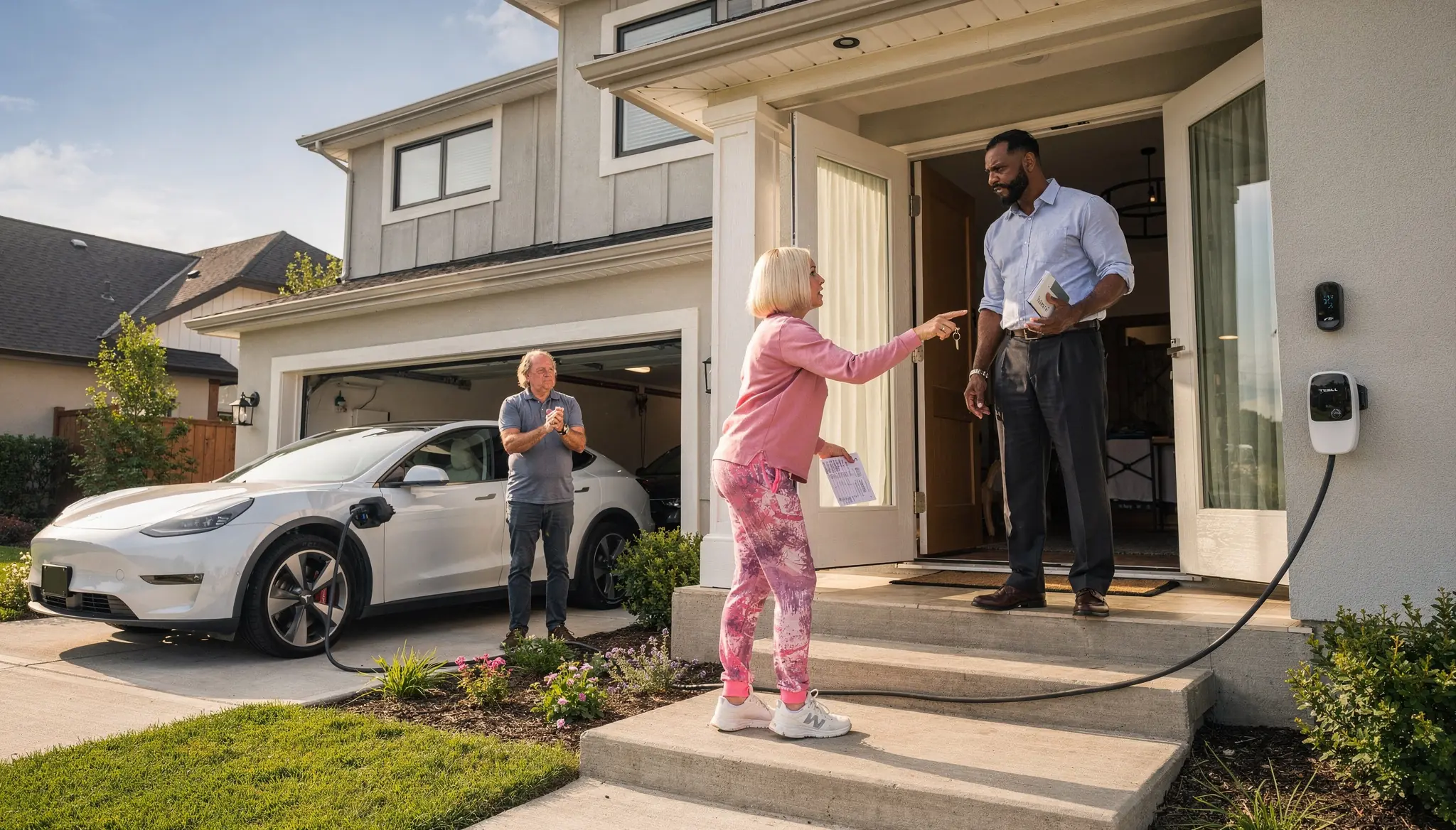
He was already calculating the minutes until he could plug in his car, pour a glass of bourbon, and let the day dissolve. That's when he saw it: a gleaming pearl white SUV identical to his own model parked at a slight angle next to his garage. It was brazenly unapologetically occupying the very spot where his wife Sarah usually parked. But the real violation was the thick black cable snaking from the high-end charging station he had installed just last month. The glowing green light on the unit indicated a successful connection.
Someone was stealing his electricity right in his own driveway. He killed the engine, a slow burn starting in his chest. This was Westmere Heights, a neighborhood of manicured lawns and unspoken rules where the fiercest conflicts were usually waged over the precise height of a hedge. This was a different level of audacity. He got out, the quiet suburban street amplifying the soft crunch of his dress shoes on the pavement.
He walked over to the offending vehicle, peering through the tinted window. Empty. A resident parking sticker on the windshield confirmed the car belonged to someone in the neighborhood. He followed the cable back to his charger, a top-of-the-line WallPulse Pro he had paid a small fortune for. It was his.
He'd spent a full weekend trenching the line and wiring it into his home's main panel. A flicker of movement from across the street caught his eye. A woman was wrestling a ridiculously large inflatable flamingo from her front lawn. Her face was a mask of suburban determination. He recognized her from the HOA welcome email.
It was Carol from two houses down. Marcus took a deep breath, forcing a neutral expression. "Excuse me," he called out, his voice calm but firm. Carol looked up, her hand on the flamingo's plastic neck. She was in her late forties, with a severe blonde bob that looked like it could cut glass and an athleisure outfit that probably cost more than his first car. "Can I help you?" she asked, her tone suggesting he was interrupting something of grave importance. "Hi. Marcus Weaver, from number 84," he said, gesturing toward his house. "I think you may have accidentally parked in my driveway and plugged into my charger." He expected a flush of embarrassment and a flurry of apologies.
He got a blank stare. "Oh, that's yours," she said, without a hint of remorse. "I saw it from the street. It's a fast charger, isn't it? A Level 2." "It is," Marcus said, his politeness starting to fray, "and it is connected to my private electrical panel." Carol let go of the flamingo, which immediately listed to one side, brushed off her hands, and sauntered across the street. She moved with an air of unearned authority, as if the entire block were her personal fiefdom. "Well, that's wonderful," she said, stopping beside her SUV and patting the hood like a prized stallion. "It is about time someone in this neighborhood invested in the community's green infrastructure." Marcus blinked. "The community's infrastructure? This is my house. I paid for this." "And we all appreciate it," she replied with a saccharine smile that did not reach her eyes. "I was on my way home, saw my battery was nearly empty, and thought, why let a perfectly good charger sit idle? It is for the good of the planet, after all." The sheer entitlement was breathtaking. Marcus felt as though he were observing a species with no concept of social cues or private property. "I need to charge my own car," he said, his voice dropping an octave. "I have an early meeting two hours away tomorrow." Carol sighed theatrically. "Fine," she clipped, popping the trunk to retrieve her purse. "But really, you should be more open to sharing. It is the responsible thing to do." She unlocked the car, disconnected the cable, and let it fall to the concrete with a thud that made Marcus wince. Then she backed out of his driveway and drove the short distance to her own house. Marcus picked up the cable, dusted it off, and inspected the connector before plugging it into his own car. The careless thud against the concrete bothered him almost as much as the stolen electricity. The charger was not communal infrastructure or a public convenience. It was part of his home, purchased with his money, installed through his labor, and wired directly into the panel behind his walls.
The light on the unit blinked, then turned a steady, reassuring green. He went inside, the story already forming in his mind for Sarah, convinced it was a one-time fluke. It seemed like an encounter with the neighborhood eccentric. He was wrong. Three days later, it happened again.
This time, it was worse. He and Sarah were coming home from a dinner out, looking forward to a quiet evening. The white SUV was there once again, leeching power from his wall, but this time it was blocking his car in, his sedan was still in the garage, and the SUV was parked directly behind it, leaving him no way to get out. "You have got to be kidding me," Sarah said, her voice a low hiss. "Did you talk to her?"
"I did. I thought we had an understanding," Marcus said. The slow burn in his chest roared back to life. "An understanding that private property is, you know, private." He stormed across the street, Sarah trailing behind him.
He did not bother with pleasantries this time, rapping his knuckles sharply against Carol's ornate front door. A moment later, Bill, Carol's husband, opened it. He was a harried-looking man with a kind face and a defeated posture. "Oh, hello, Marcus," he said, forcing a weak smile. "Everything okay?" "No, Bill, it is not," Marcus replied, pointing a thumb over his shoulder. "Your wife has parked in my driveway again. She is blocking my car in, and she is using my charger." Bill's face fell. "Oh, dear. She said the two of you had worked something out. A sharing arrangement."
Carol appeared from behind Bill, wiping her hands on a dish towel. "What is all the shouting about? You are making a scene, Marcus." "I am making a scene?" he shot back. "You have trapped my car in my own garage. I could have an emergency. I could need to get out of here." "Oh, do not be so dramatic," she scoffed, pushing past her husband. "I was just getting a top-up. I would have been gone in an hour. If you had an emergency, you could have come over and asked me to move. It is called being a neighbor."
"Being a neighbor does not mean you get to use our home as your personal gas station," Sarah said, folding her arms. "What you are doing is illegal. It is theft and trespassing." Carol's eyes narrowed.
"Do not lecture me about legality," Carol snapped. "This is a community. We look out for one another. I see you installed high-speed internet. Are you sharing the Wi-Fi password?"
"No," Marcus said. "And it is exactly this kind of selfish attitude that is ruining this country," Carol replied. "People like you, with your gates, your passwords, and your private property." Marcus felt a vein throb in his temple. He was arguing with someone whose reality was built on a foundation of unassailable self-interest.
Logic was useless. "Move your car, Carol," he said, his voice dangerously low. "Now." "Or what?" she challenged, a smirk playing on her lips. "Or I call the police and a tow truck." Her smirk vanished. "You would not dare." "Try me." For a tense moment, they stood in a silent standoff on her perfectly manicured lawn.
Bill looked like he wanted the earth to swallow him whole. Finally, with a dramatic huff, Carol spun around. Fine, but I'm reporting you to the HOA for creating a hostile environment. She snapped, stomping back to her car. She moved it, peeling out of his driveway with a squeal of tires that was deliberately, performatively loud.
That night, Marcus couldn't sleep. He lay in bed staring at the ceiling, the woman's words echoing in his head. Or what? She had challenged him. She believed there were no consequences.
She believed she could do whatever she wanted. And the most he could do was threaten and yell. She saw his civility as weakness. A cold, precise anger began to solidify in his gut. He wasn't just a homeowner.
He was a systems architect for a living. He built digital walls and traps for people far more sophisticated than Carol. He designed systems that did more than block intruders. They identified unauthorized access, contained it, and preserved a record of what had happened. He slipped out of bed and went to his home office.
The glow of his triple-monitor setup illuminated the dark room. He pulled up the specs for his WallPulse Pro charger. It was a smart device connected to his home network with a robust API, an application programming interface, a digital back door meant for diagnostics and control. To a layman, it was a way to check his charging status on his phone. To Marcus, it was a system waiting to be configured.
His fingers flew across the keyboard, the clicks and clacks, a quiet staccato in the sleeping house. He wasn't just a victim anymore. He was a programmer. He started writing a script, a custom piece of code he named Project Nightshade. It was elegant in its simplicity.
The charger would recognize whether the connected vehicle was authorized. If it was not, the system would trigger a safe lockout and record the session. An hour passed, then another. From his office window, Marcus could see the twilight bleed into a deep suburban dark, the street lights casting lonely pools of orange onto the pavement. The white SUV sat silently, a pale ghost tethered to his garage.
He'd finished his work, filed his reports, and was now idly debugging a piece of code for a personal project. He was in no hurry. The trap was silent, patient, and absolute. The first sign of trouble was the flicker of Carol's porch light, followed by the opening of her front door. She emerged, phone to her ear, laughing about something.
She had a gym bag slung over her shoulder, late yoga class, perhaps. She walked with that same brisk self-important gait, keys jangling in her hand. Marcus minimized his work screen, pulling up the security camera feed to full screen. This was the moment. Carol clicked her key fob.
The SUV's lights flashed. She opened the driver's side door, tossed her bag onto the passenger seat, then walked to the charging port. She gripped the handle of his charging cable and pulled. It didn't budge. She frowned, a slight crack in her serene facade.
She pulled again, harder this time, jiggling it with an impatient flick of her wrist. The thick cable held fast. The connector remained firmly seated in her car's port. The little indicator light next to it, which should have been pulsing blue to show it was charging, was completely dark. What the...
Her voice was too faint for the camera's microphone to pick up, but her body language spoke volumes. Annoyance was quickly curdling into confusion. She tried the release button inside the car. Marcus knew the safety lockout would prevent an ordinary release until the fault condition was cleared. He watched her get in and out of the car three times, her movements becoming increasingly frantic.
She jabbed at the car's large touchscreen display, her face illuminated by its glow. She was searching for a software-based release. She wouldn't find one that worked. The theatrical sigh came next. She placed her hands on her hips, glared at the charger on the wall as if it had personally offended her, and then marched directly toward his front door.
Marcus muted the camera's audio feed and waited. He didn't get up. He let the doorbell ring, a sharp, insistent chime that echoed through the quiet house. He let it ring a second time, giving her a few extra moments to stew in her own self-inflicted predicament. Finally, he rose and walked calmly to the door, schooling his features into a mask of mild neighborly concern.
He opened the door to find Carol standing on his porch, her face a thundercloud. Bill hovered behind her on the walkway, looking like a man summoned to his own execution. "Your charger broke my car," Carol said without greeting. Marcus feigned surprise. "I'm sorry, what are you talking about?" "It will not release the cable," she snapped, pointing toward her immobilized SUV. "It is stuck. I have a class in twenty minutes. I pulled the handle, pressed the button, and tried the controls. It is locked in there."
"What did you do?" she demanded. "What did I do?" Marcus repeated, his voice a study in calm confusion. He leaned past her to look at the car, then at the charger. "That is very strange. It was working perfectly for me this afternoon."
"Well, it is not working now. It has damaged my vehicle, and you need to fix it immediately." Bill stepped forward, wringing his hands. "We are really sorry to bother you, Marcus. It just will not come out. We thought perhaps you knew if there was a trick to it." Marcus's tone softened slightly for the beleaguered husband. "There is no trick, Bill. Under ordinary circumstances, you press the release, the latch retracts, and the connector comes free. Unless, of course, the vehicle itself is preventing the release."
"The car was fine until I plugged it into this cheap piece of junk," Carol insisted, gesturing wildly at the WallPulse Pro. Marcus had to suppress a smile. The charger had cost more than $2,000 and was widely considered one of the best residential units on the market.
"That is one of the highest-rated residential chargers available, Carol. It has numerous safety features. Perhaps one of them was triggered." "Triggered by what?" she demanded. Here it was, the moment to tighten the snare. "It is a smart charger," he began, adopting the patient tone of a technical specialist. "It communicates with the connected vehicle, monitors the session, and protects both the vehicle and the home's electrical system if it detects an unsafe or unauthorized condition."
Carol's eyes narrowed as understanding and fear began to dawn. "What are you saying?" "I am saying that if the system detected a serious anomaly, it may have sent a fault signal to your car," Marcus replied with surgical precision. "Many high-end electric vehicles respond to a critical charging fault by locking the connector in place. It is a fail-safe designed to prevent someone from pulling out a live connection before the system has confirmed that everything is safe."
The color drained from Carol's face. Bill looked horrified. "Is it dangerous?" he asked. "Not anymore," Marcus said reassuringly. "The charger cut the power as soon as it detected the fault."
"The lock is a mechanical side effect of the safety system," Marcus continued. "Your car believes it just avoided a serious electrical problem, and it will not release the connector until the fault is cleared." Carol stared at him, her mind clearly racing as the smug superiority drained from her face. "So how do we get it out?" she asked, her voice much smaller now. "That is the difficult part. The charger must send an all-clear signal before the vehicle will release the lock."
"Trying to force it out would be a very bad idea," Marcus added. "You could damage the charging port, the onboard controller, or even the battery management system. I once read about a repair like that costing around $20,000."
Bill let out a strangled gasp. Carol looked as though she might be sick. "Then clear it," she demanded, a hint of her old fire returning. "Get on your laptop and fix it." Marcus held up both hands.
"I cannot do that blindly, Carol." "What do you mean you cannot? It is your machine." "Exactly. It is my machine, and it is reporting a dangerous fault linked to an unauthorized vehicle."
"If I manually override that warning and anything goes wrong with your car from this point forward, I assume the liability," Marcus said. "Your lawyers would argue that I bypassed a critical safety protocol. I simply cannot take that risk." He let the word liability hang in the air between them. It was a word Carol understood because she used it as a weapon. Now it was his shield.
"So what are we supposed to do?" Bill pleaded. Marcus shrugged. "You could leave the car here and call the dealership. They may need to send a certified technician or tow it to the service center for a diagnostic. An emergency house call from an EV specialist would probably be expensive."
They'd probably have to tow it to the service center to run a full diagnostic. Or you could call an EV specialist, but I imagine an emergency house call would be pricey. The silence that followed was thick with the weight of Carol's defeat. She understood now. She was completely and utterly trapped, not by a simple mechanical failure, but by a complex web of logic and liability he had expertly woven around her.
She had no recourse. She couldn't blame him without admitting she was trespassing. She couldn't demand he fix it without absolving him of all responsibility. She had boxed herself in. She stood on his porch for a full minute, her jaw clenched, her mind working furiously to find an escape route where none existed.
Finally, Carol seemed to deflate. "What do you want, Marcus?" she asked in a low whisper of surrender. Marcus kept his expression neutral, though a cold wave of victory moved through him. "I want this never to happen again. I want to park in my own driveway and use my own property without having to police it. But since we are past that point, we also need to address the immediate situation." He stepped back from the door. "Hold on a moment." He went to his office, typed a short document, printed it, and grabbed a small receipt book he used for freelance work.
When Marcus returned, he held two pieces of paper. "This is a simple trespass agreement," he said, handing the first page to Carol. "It states that you acknowledge the charger is private property, that you accessed it without permission, and that you agree never to park on my property or use any of my utilities again. Sign it." Carol stared at the paper as if it were coated in poison. Marcus held up the receipt book. "And this is the invoice." "The invoice?" Bill stammered. "Yes," Marcus said coolly. "You called me to diagnose a problem involving your vehicle after connecting it to my private equipment. The service and release fee is $500." The pen in his hand felt as heavy as a gavel. The two papers were a verdict and a sentence.
Carol stared at him, her face a canvas of warring emotions: incandescent rage, stark disbelief, and creeping humiliation. "This is criminal," she managed. "I am not paying you a cent. I am calling my lawyer." "Please do," Marcus said, utterly calm.
He pulled out his phone. "In fact, let us call your lawyer on speaker. I would be interested in hearing you and your legal counsel acknowledge that you were trespassing on my property and attempting to take electricity without permission. I am sure that will be a productive beginning to a lawsuit over my supposedly faulty equipment." He gestured toward the security camera above the garage.
"My system archives the footage. We can review all three of your visits together." Every word dismantled another part of Carol's defense. The mention of archived footage landed like a physical blow.
Carol looked up at the small dark lens. Bill, who had been a statue of misery, finally broke. "Carol, just pay the man," he pleaded, his voice cracking. "Please. Let us go home."
"Do not tell me what to do, Bill," she hissed, whirling on him. "This is the principle of the thing. He is a predator, taking advantage of a simple mistake."
"It was not a mistake the third time, ma'am," Marcus said coldly. "It was a pattern." A porch light flickered on next door, and an elderly neighbor named George Peterson peered out in his bathrobe.
"Everything all right over there?" George called. "I heard some shouting." Carol's face flushed a deep mottled red. The dispute was no longer private. It had become a neighborhood spectacle.
Her carefully curated image was shattering in real time on the doorstep of the man she had tried to bully. The thought of George carrying the story to the neighborhood bridge club frightened her more than any legal threat. Public shame became the tipping point. "Fine," she spat, snatching the pen and agreement from Marcus.
Without reading the document, Carol pressed it against the wall and scrawled a furious, jagged signature at the bottom. It looked less like a name than a wound. "There," she said, thrusting it back at him.
"Now the money," Marcus said. Carol fumbled with her phone, her hands shaking so badly she could barely unlock it. "What is your account?" He calmly recited the number for the digital payment and watched her navigate the banking app.
A moment later, Marcus's phone buzzed with a notification confirming that Carol Miller had sent $500. He looked from the screen to her face and nodded. "Payment received. Agreement signed. Now, if you will excuse me, I will see whether I can clear the fault. No guarantees. This is a delicate system."
He left them on the porch, closing the door softly behind him. He didn't do it to be dramatic, but the effect was devastating. He was in his sanctuary in control while they were left outside, supplicants waiting for his favor. He walked to his office, sat down, and brought up the diagnostic panel for Project Nightshade. He could have cleared the code with a single keystroke.
Instead, he made them wait. He let a full five minutes pass, an eternity for the two people standing in the cold night air. He pictured Carol on his porch stewing the $500 gone from her account, the signed confession in his possession. He wanted the lesson to sink in. He wanted her to understand the concept of consequences.
Finally, Marcus issued the release command and cleared the lockout. On the security feed, he watched the indicator beside Carol's charging port blink and go dark. A satisfying mechanical click sounded as the locking pin retracted. He returned to the front door. "I believe the connection has been released," he said, as neutrally as a surgeon reporting that an operation was complete. Carol stormed past him, yanked the cable from the vehicle, dropped it on the pavement, climbed into the SUV, and started the engine.
Without looking back, she peeled out of his driveway. The squeal of the tires became one final, powerless scream of rage into the night. Bill lingered. "I am really sorry about all of this," he mumbled, his eyes fixed on the ground.
Marcus nodded. "Have a good night, Bill." The man gave a sad little wave and shuffled back across the street. Marcus picked up the heavy-duty cable, coiled it neatly, and hung it on its hook. The first battle was over. He had not shouted, threatened, or touched her property. He had simply made Carol confront the cost of entering someone else's space and treating private equipment as though it existed for her convenience.
When Marcus went back inside, Sarah was waiting at the bottom of the stairs with her arms crossed. "I heard the whole thing," she said, a slow smile spreading across her face. "A digital release fee?" "It seemed appropriate," he replied, showing her the payment notification. "My God," she said, shaking her head. "You are terrifying. I am glad you are on my side." "Me too," he said, wrapping his arms around her. He had faced down a bully with patience and intellect, using her entitlement as the bait and his own skills as the trap. He had protected his home, his property, and his peace.
For the next few days, an unspoken truce seemed to settle over the neighborhood. The white SUV was never in his driveway. When he saw Carol getting her mail, she would immediately turn her back, refusing to make eye contact. The silence was a victory in itself. He had drawn a line, and she was finally respecting it, or at least pretending to. For the first time since her white SUV had appeared beside his garage, Marcus could come home without checking his driveway for an unwanted cable and an unwanted argument.
He and Sarah used the $500 to buy a ridiculously expensive bottle of scotch and a new rose bush for the front garden. It felt like justice. He started to think that was the end of it. He'd underestimated her. He'd won the battle over the charger, but he had inadvertently declared a war of attrition, and Carol was a master of that particular game.
A week later, Marcus found a thick cream-colored envelope bearing the official crest of the Westmere Heights Homeowners Association. He opened it in the kitchen while Sarah looked over his shoulder as he scanned the dense, jargon-filled page. "It is an official notice of violation," he said. "What is it?" Sarah asked, her voice tight with anxiety. Marcus read aloud: "Violation of bylaw 7.4, subsection C: unapproved aesthetic modifications to a property exterior. The color of our front door is not on the pre-approved palette. We have 14 days to repaint it or face a fine of $100 per day." Sarah stared at him. "Our front door is navy blue. It was navy blue when we bought the house, and half the doors on this street are nonstandard colors."
Marcus continued reading. "This violation was brought to the board's attention through a formal signed complaint from a concerned community member." He did not need to see the signature. He knew exactly who had filed it.
He knew exactly who had filed it. Carol hadn't just found a new angle of attack. She had weaponized the very rules of the community against him. The charger was a direct confrontation. This was different.
This was insidious. It was a bureaucratic war of a thousand paper cuts. She couldn't touch his charger, so she was coming for his door and his hedges and the placement of his garbage cans and anything else she could find. The $500 invoice had not ended the conflict. It had merely purchased him a ticket to a whole new level of suburban hell.
The navy blue door became a symbol of their defiance. For three days, Marcus and Sarah did nothing. A silent protest against the absurdity of the HOA's notice. It was a futile gesture. On the fourth day, two more cream-colored envelopes arrived.
The first new violation concerned their garden hose holder, a simple dark green plastic model that supposedly failed the landscape code's requirement for natural or earth-toned materials. The second was even more absurd: the small flag Sarah had placed in a planter for the upcoming national holiday was three inches taller than the 18-inch limit for temporary decorative accents. "She is measuring our flag," Sarah said in exhausted disbelief.
"She is walking onto our property with a tape measure," Marcus said, laying the three notices on the counter. "She is not merely attacking us. She is enjoying it." The documents looked like decrees from a petty government. "This is her new hobby. She sits at her window with the bylaws and a pair of binoculars. This is not about the charger anymore. It is a siege."
The daily fines were designed to bleed them dry. Fighting each violation individually was the path to madness, a whack-a-mole game he was destined to lose. Even if he repainted the door, replaced the hose holder, and trimmed the flag, Carol could simply move to the doormat, the hedges, the garbage cans, or some forgotten landscaping clause buried in a document no ordinary homeowner had read from beginning to end. His only option was to appeal directly to the source, the HOA board. The monthly meeting was held in the chilly, sterile community clubhouse, a room that smelled faintly of chlorine from the adjacent indoor pool. About a dozen residents were scattered.
About a dozen residents sat among the folding chairs. At the front of the room, behind a long table, sat the three-person board. President Richard Hemlock was in his late fifties, with perfectly coiffed silver hair and a condescending smile permanently fixed on his face. Brenda, the treasurer, peered over her spectacles like a hawk searching for discrepancies. The third board member, a younger man, looked as though he had been forced to attend. Carol sat in the front row with a notepad and pen.
Carol met Marcus's gaze with triumphant malice, then leaned over to whisper to Richard, who nodded sympathetically. The fix was in. When the floor opened for resident concerns, Marcus stood with the three violation notices. He explained that the front door had been navy blue when he and Sarah purchased the home and produced photographs of 15 other houses with colors outside the approved palette.
Richard did not even look at the photographs. "Mr. Weaver, the previous board's oversights do not concern us. A violation is a violation. The fact that other homes are also in violation is irrelevant to the matter of your home." "With all due respect, Richard," Marcus replied, "it demonstrates selective enforcement. I am being singled out." Richard steepled his fingers. "The board acts on the complaints it receives. We received a complaint about your door, and we are obligated to act."
Carol raised her hand in a caricature of civic duty. "If I may, Richard, as the person who filed the complaint, I want to say this is not personal. It is about maintaining the aesthetic harmony of our community, which directly affects property values. Some of us take the rules seriously because we care about our collective investment." Her speech was a masterpiece of passive aggression, painting Marcus as a rogue element threatening the neighborhood's financial stability. Marcus felt his temper fraying. "This is not about property values. This is retaliation because I stopped you from illegally using my property." The room went quiet.
Richard's smile tightened. "Mr. Weaver, this is not the forum for personal disputes. We are discussing the bylaws. Your other two violations, the hose holder and the flag, are also clear-cut. Are you disputing the measurements?" "I am disputing the harassment," Marcus said, his voice rising despite himself. "I am being targeted by a neighbor who is abusing the HOA's rules to run a campaign of intimidation." "Your tone is unacceptable," Richard replied. "The board finds all three violations valid. You have ten days to correct them before daily fines of $100 per violation begin. Next item on the agenda." Marcus stood there speechless, publicly dismissed and humiliated.
The other residents either looked away or appeared bored. No one came to Marcus's defense. Carol gave him a triumphant smirk as he returned to his seat, ears burning. On the drive home, Sarah saw the defeat on his face. "So we have to repaint the door," she said softly. "And buy a new hose holder and a smaller flag," he replied. "Then what? What does she find next week, the brand of our doormat or the chemical composition of our lawn fertilizer?" "We could sell the house," Sarah whispered. The fact that she was considering it showed how desperate she had become.
And the fact that she was even considering it told him how desperate she felt. No, Marcus said a hard edge returning to his voice. No, we are not getting chased out of our own home by that woman. That night, he couldn't sleep. He sat in his office.
The three violation notices spread out before him like a tarot reading of a miserable future. He had tried logic. He had tried reason. He had been met with a bureaucratic brick wall. Carol and Richard weren't interested in fairness.
They were interested in power. They were using the HOA rule book as a cudgel. He leaned back in his chair, staring at the complex network diagram on his wall, a relic from a past project. He thought about how he approached cyber security threats. You don't just patch one vulnerability.
You don't just block one attack. You do a full system audit. You find every weakness, every exploit, every backdoor. You expose the flaws in the entire architecture. He had been fighting the individual violations.
He had been playing their game. It was time to change the game. He swiveled to his computer and pulled up the Westmere Heights HOA website. He navigated to the governing documents section and clicked on the link, a massive 280-page PDF, downloaded the covenants, conditions, and restrictions (CC&Rs). It was the neighborhood's constitution, a dense labyrinthine document filled with archaic legal language, clauses, subclauses, and amendments.
Most residents had never read past the first page. To Marcus, it was source code, and he was about to become its most diligent debugger. He poured himself a large glass of the victory scotch, the irony not lost on him. He opened the PDF and began to read. He read every single word.
He read about acceptable fence heights and satellite dish placement. He read about the precise chemical balance required for the community pool. He read about the approved species of deciduous trees for front lawns. For the next three days, Marcus was a man possessed. He converted the entire PDF into a searchable text document.
He bought a subscription to the county's public plat map server. He cross-referenced property lines with setback requirements outlined in the bylaws. He used Google Earth's historical satellite imagery to check for unapproved sheds, patios, and landscaping modifications that had been built over the past decade. He wrote a simple script that scraped the text of the CC&Rs for every actionable rule, every measurable standard, and organized them into a categorized spreadsheet. Column A, the bylaw, column B, the specific requirement, column C, the penalty for non-compliance.
He became an expert in the arcane laws of Westmere Heights. He learned, for example, that according to bylaw 112, all residential mailboxes had to be repainted every 2 years with a specific brand and color of black paint. He learned that bylaw 9.6 prohibited visible basketball hoops unless they were transparent acrylic. He learned that bylaw 147 required all homes to have their exterior windows professionally cleaned a minimum of once per year with receipts available for inspection upon request. He wasn't just finding rules.
He was finding violations, dozens of them, hundreds on every single street. The entire neighborhood, he realized, was a minefield of non-compliance. People had been living their lives, making small changes to their homes, blissfully unaware of the petty draconian rules they were breaking. The HOA only enforced them when someone like Carol decided to weaponize them. And that was Richard's mistake.
He and Carol had shown Marcus the weapon. Now Marcus was going to show them how to use it. He spent the weekend methodically documenting his findings. He didn't just list the violations. He treated it like a professional cybersecurity audit.
For each infraction, he included the bylaw number, a clear description of the violation, a high-resolution, timestamped photograph, and the prescribed penalty. He put it all together into a sleek professional report complete with a table of contents, an executive summary, and appendices. He printed five copies and had them spiral-bound at a copy shop. On Monday morning, exactly one week after the HOA meeting, a courier delivered a thick, heavy package to Richard Hemlock's front door. Richard, enjoying his morning coffee on his immaculate back patio, signed for it with a curious frown. He took it inside, opened the cardboard mailer, and pulled out the report.
The title on the cover was stark and professional. The silence that followed the delivery of Marcus's audit was heavier and more menacing than any shouting match. For 48 hours, there was no response. No angry phone calls, no blistering emails, no one marching up his driveway. It was the unnerving calm in the eye of a storm.
The first response came as a phone call from Bill. "Marcus, it is Bill Miller," he said in a strained whisper. "Carol is going insane. She received a copy of your report and is talking to lawyers and to Richard. She thinks she can accuse you of harassment or stalking." "Everything in that report came from public records and observations made from the street," Marcus replied calmly. "It uses the exact same standard the HOA applies. Her lawyer will charge her a great deal of money only to tell her that she has no case." "I know," Bill said with an exhausted sigh.
"What do you want?" Bill asked. "Is there a number, something that will make this go away?" "This was never about money," Marcus said.
For the first time, Bill seemed to understand. "This is about being left alone. Tell Richard to call an emergency community meeting. The entire neighborhood deserves to see how its HOA is being run." When the call ended, Marcus knew he had lit the final fuse.
Richard and Carol would try to isolate him and portray him as an obsessive crank, so Marcus removed that option. He printed 200 copies of the audit's one-page executive summary. That evening, he and Sarah walked the neighborhood and placed a neatly folded copy in every mailbox. The summary was devastatingly simple.
It did not mention his personal conflict. It just stated the facts. "A recent compliance audit has revealed over 200 systemic bylaw violations across the community. The current board's enforcement has been found to be inconsistent, targeting fewer than two percent of infractions. This report has been delivered to the board for their immediate action pursuant to their fiduciary duty." The effect was instantaneous. The neighborhood's placid surface shattered. The Nextdoor app and the community Facebook group erupted. People who had never read a single bylaw were suddenly panicked about the color of their mailboxes. The legality of their basketball hoops, the unapproved azaleas they'd planted last spring.
The conversation was no longer about Marcus Weaver's blue door. It was about everyone's potential fines. Marcus hadn't just armed himself. He had deputized the entire community out of sheer self-interest. Richard was forced to call the emergency meeting.
The clubhouse was packed, with every chair filled and residents standing three deep along the walls. The air was thick with anxiety and resentment. When Marcus and Sarah entered, a hush fell over the room. He was no longer an outcast. Richard, looking haggard and drawn, sat beside Carol at the front. "As you all know," he began, his usual smug confidence gone, "Mr. Weaver has circulated an unauthorized and deeply biased report born from a personal vendetta. It is an attempt to sow discord and chaos." "Is it inaccurate?" George shouted from the back. The elderly neighbor looked sharp and angry. "It says my garden gnome is a violation. Should I start packing his little bags?" The room erupted in similar questions. Richard banged his gavel. "The board will take the report under advisement and review the alleged violations according to proper procedure."
Marcus stood, holding a spiral-bound copy of the full report. "There is no need for another review, Richard. The evidence is here: photographs, bylaw citations, and plat maps. It is accurate, and you know it." He turned to the residents. "I did not do this to cause chaos. I did it to demonstrate a point. For weeks, my family has been subjected to targeted harassment by this board, instigated by Carol Miller as retaliation for a personal dispute." "Lies!" Carol shrieked, jumping to her feet. "He is hostile and unneighborly. He thinks the rules do not apply to him." "On the contrary," Marcus said, meeting her gaze. "I may be the only person here who has actually read them."
"You and Richard used those rules to threaten my family with hundreds of dollars in fines over the color of our door. I simply applied your standard of vigilant enforcement equally. It turns out that nearly everyone in this room is violating something, including you, Carol, and especially you, Richard." The residents stopped looking at Marcus as the aggressor and began looking at Richard and Carol as hypocrites.
"We have a choice," Marcus continued. "The board can spend the next year issuing tens of thousands of dollars in fines, and we can turn on one another, measuring hedges and inspecting mailboxes until this stops being a community. Or we can choose another path."
He set the report on the front table with a heavy thud. "I make three formal motions. First, a community amnesty: every existing documented violation for every homeowner is forgiven immediately, and we begin with a clean slate."
"Second, a motion of no confidence in President Richard Hemlock, demanding his immediate resignation. Third, the creation of a volunteer bylaw review committee to amend our outdated CC&Rs so they reflect modern life rather than the suburban anxieties of 1985." Marcus looked directly at the board. "That is my motion. Is there a second?" A dozen hands rose before he finished. "I second it," George yelled. Richard sputtered, "This is out of order. There is a procedure for this."
"We are making a new procedure, Richard," someone shouted. The room became electric. The residents, armed with the knowledge in Marcus's report, had realized that the power had belonged to them all along.
The vote was a formality, a landslide. Richard's face crumpled in defeat as he was voted out of his own little kingdom. Carol sat frozen as the community she thought she commanded repudiated her completely. She looked small and powerless, her face ashen. The amnesty passed unanimously.
The review committee was formed on the spot with George volunteering to be its first chairman. In the space of 30 minutes, Marcus had not just won his war; he had rewritten the terms of peace for the entire neighborhood. In the weeks that followed, a new sense of calm settled over Westmere Heights. The blue door remained blue. The HOA, under new leadership, became a far more reasonable entity.
The audit report became the stuff of local legend, a story told over backyard fences. Marcus thought that was the end. But true karma, he learned, has a long and ironic tale. One crisp autumn Saturday about a month after the meeting, Marcus and Sarah were enjoying their coffee on the front porch. They watched as a large flatbed truck rumbled down the street and parked in front of Carol and Bill's house. "What is that all about?" Sarah wondered. They soon found out. A crew of workmen began using jackhammers to systematically demolish Carol's brand new slate-paved driveway extension. The one she had installed specifically to make it easier to park her precious white SUV.
George stopped at their fence while walking his dog. "Morning, Marcus," he said with a cheerful grin. "Justice is a beautiful thing, isn't it?" "What happened?" Marcus asked. "After our little revolution, people started taking the bylaws seriously," George explained, barely containing his delight. "Old Mr. Hemmings, the retired surveyor down the street, noticed that Carol's new driveway extension violated the property-line setback and was sending runoff into his prize-winning rose garden. He filed a formal complaint, and the new board had no choice but to enforce a clear major violation. She has to remove the entire extension at her own expense."
Marcus looked across the street at Carol, who was standing in her doorway, watching the destruction. The noise of the jackhammers was a deafening roar, the sound of her own tactics being turned back on her.
The very system of rules she had wielded like a weapon had been picked up by a community she had alienated, and it had delivered a final, devastating blow. She wasn't the victim of a targeted attack from a single man. She was now facing the impartial, unyielding consequences of a community that had simply decided to follow the rules, a world she had created and now had to live in. Marcus took a sip of his coffee. He looked at Sarah, then at his untouched blue door, and finally back at the cloud of dust rising from his neighbor's shattered driveway.
The trap he had set for her car had been a temporary fix. The trap laid by her own character, arrogance, and hypocrisy had finally produced a justice far more complete than he ever could have designed himself.