"Your daughter's car violated standards. We towed it."
"You stole my dead wife's gift. I'm arresting you."
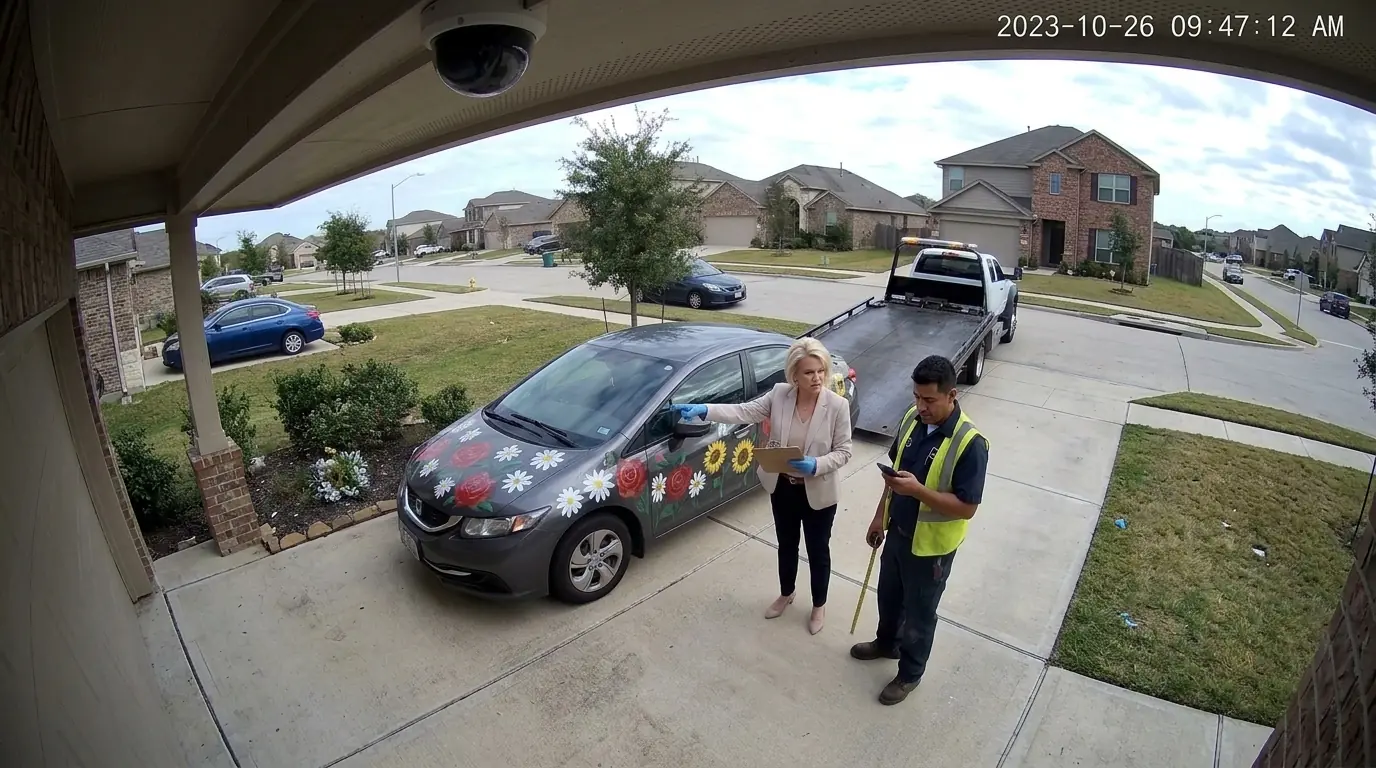
"Dad, they took Mom's car!" My daughter's voice shattered over the phone. Not "my car"—"Mom's car." Because three years after my wife Sarah died from cancer, that Honda Civic was still her mother's last gift.
I'm Marcus Chen, Police Chief. I was at the station when my 17-year-old daughter, Emma, called from our driveway, hysterical.
"Emma, slow down. What happened?"
"The car is gone. Mom's car is gone. I came home from my shift, and it's just gone."
I pulled up our security cameras. Footage from 11:47 a.m. showed a Martinez Towing truck hooking up Emma's Civic and towing it away from our private driveway. Six minutes total. No warning, no notice.
I called the tow company. "HOA President Patricia Whitmore authorized the tow for a parking violation," they told me. Patricia Whitmore had just stolen my daughter's car and called it parking enforcement.
I'm a police chief with 22 years in law enforcement, 15 years as a vehicle theft detective before my election. And I immediately recognized that what the HOA president called parking enforcement was actually Grand Theft Auto. What happened next proved that HOA presidents who commit vehicle theft face the same felony charges as any car thief.
Sarah had saved $15,000 in a college fund before cancer took her. We used that money to buy Emma her first car—the independence Sarah wanted her daughter to have. Emma spent three weeks hand-painting flowers on it: roses, daisies, sunflowers—all the flowers her mother had loved in the garden Sarah tended before she got too sick. The car wasn't just transportation; it was Emma's physical connection to her mother, and someone had stolen it from our driveway.
I called Patricia Whitmore. "You ordered my daughter's car towed from our private driveway."
"Chief Chen, Emma's vehicle displayed expired registration. Section 12.3 grants HOA parking enforcement authority."
"Her registration isn't expired. She has a valid temporary extension."
"That's irrelevant. The sticker appeared expired. She can retrieve her car after paying a $385 tow fee, $95 storage, and a $200 HOA fine."
"You don't have legal authority to tow vehicles from private property. That's vehicle theft."
"Chief, my HOA authority is clearly established."
"You ordered the removal of a legally parked vehicle from my private driveway without my consent. Under Virginia law, that's grand theft auto."
Silence. Then, "Are you threatening me over legitimate HOA enforcement?"
"I'm informing you that you've committed a felony, and I'm the police chief with authority to investigate vehicle theft in my jurisdiction, including crimes against my family."
She hung up.
The driveway where Emma's car had been stolen wasn't just a parking space; it was sacred ground. Three years ago, Sarah taught Emma to drive in that exact spot—patient, encouraging, celebrating when Emma finally mastered parallel parking. Sarah spent hours preparing our daughter for independence in that driveway. Two months later, cancer stole Sarah's ability to do anything. And now, someone had stolen the car from the place where Sarah had taught Emma freedom.
Emma needed that car for her bookstore job, saving for college expenses Sarah's fund wouldn't cover; for animal shelter volunteer work required for scholarship applications; for campus visits to schools Sarah had dreamed Emma would attend. Without the car, everything Sarah had saved for was threatened.
Patricia Whitmore thought my badge would make me too conflicted to act—that investigating the theft of my daughter's car would look like personal retaliation. She was wrong. My badge doesn't prevent me from being a victim; it gives me authority to arrest car thieves, even HOA presidents who think their position exempts them from felony charges.
After paying $680 under protest to retrieve Emma's car—her mother's last gift held for ransom—I spent Sunday evening in my office researching Patricia Whitmore's HOA enforcement history. What I found made my blood run cold.
Sterling Heights had existed as an HOA community for 14 years. In the first 11 years before Whitmore became president, three vehicles total had been towed—all from common area parking lots, all clearly abandoned or illegally parked. In the three years since Patricia took office, 27 vehicles had been towed. Twenty-seven.
I cross-referenced the tow records with property maps and resident complaints filed with the city. Twenty-three of those 27 tows were from private driveways or legal parking spots, not common areas or illegal parking. The HOA president had been authorizing vehicle thefts for three years, calling them parking enforcement.