It was a rainy evening at a small flower shop. A black woman sat quietly inside, surrounded by bills she couldn’t afford to pay. Suddenly, she saw a pale boy in a wheelchair shivering in the rain just outside her door. Without hesitation, she welcomed him in, offering him food, warmth, and a reason to believe again. What she didn’t know was that the boy's father was a millionaire, and her simple act of kindness was about to open doors she never thought possible.
The rain came down hard, slamming against the cracked sidewalk like it had a score to settle. Wind howled through the narrow streets of Maplewood, bending the rusted stop signs, rattling the loose gutters of old brick buildings. It was late, pushing 6:30, but the sky was already dark, thick with storm clouds, and Camille Brooks was still inside her flower shop, refusing to close.
The front sign of bloom and hope flickered erratically in the gray evening, casting a pale pink glow against the glass. Inside the scent of lavender and crushed eucalyptus lingered, though the heat had already begun to fade. Camille stood behind the counter, sleeves rolled up, her dark hands carefully trimming the brown edges off a cluster of hydrangeas. She moved like someone who had done this a thousand times, gently, precisely, with a kind of reverence people usually saved for prayer. She wasn’t supposed to be open this late.
Not anymore. Business had slowed to a trickle. Half the display vases were empty. The rent was 3 weeks past due. But the truth was, this shop wasn’t just about selling flowers.
It had become something more, especially for the kids. The ones from the shelter two blocks over. the ones who wandered in with wide eyes and empty stomachs. Camille made sure they left with both full, at least for a little while. She glanced at the clock, sighing softly.
The evening class had ended an hour ago. Just three little ones tonight, plus Andre, who had stuck around to sweep the back room in exchange for a sandwich. They were gone now. The rain had chased everyone away except him. She saw it out of the corner of her eye.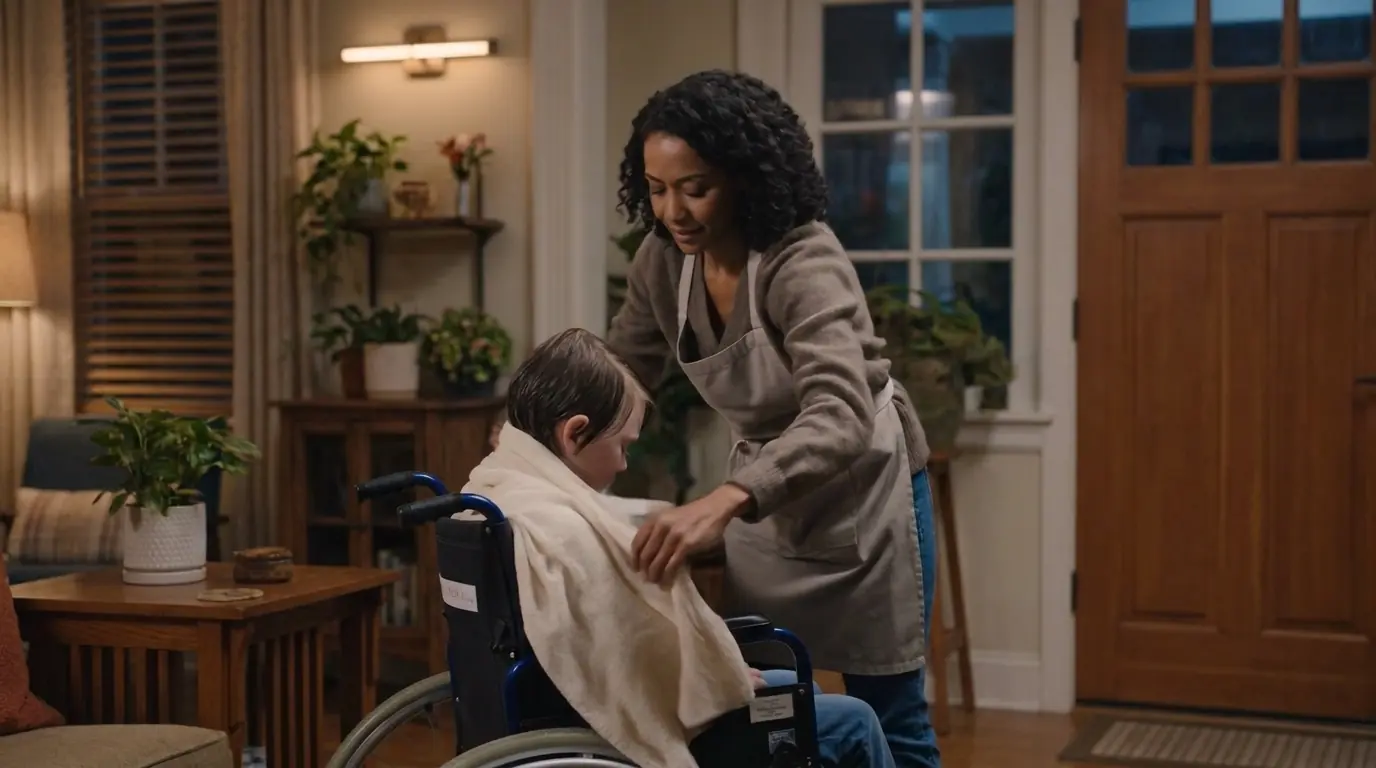
first movement near the edge of the glass door, a small shape, still and hunched beneath the awning. Camille frowned, set down her shears, and stepped toward the front. The storm hadn't let up, and she half expected to see one of her regular kids come back for a forgotten hoodie. But it wasn’t one of hers. It was a boy of about 10 years old.
His pale white skin soaked through, his dark blonde hair plastered against his forehead. He sat motionless in a wheelchair, his hands gripping the wheels so tight his knuckles looked like they might snap. The hem of his slacks was wet to the knee, and his backpack, black, monogrammed, clearly expensive, drooped under the weight of the rain. Camille’s chest tightened. He didn’t look homeless.
Didn't look like he belonged here at all, and yet he was. She opened the door. The wind pushed in first, cold, sharp, laced with the earthy smell of wet leaves. Her voice followed, gentle but steady. "Hey there," she said.
I needed I needed somewhere to sit out the storm. Camille looked down the street. Nothing. No cars, no parents, just the flickering pawn and gold sign across the intersection and the dim tail lights of a city bus turning the corner. You’re freezing, she said.
More statement than question. Come on, come inside before you catch pneumonia. The boy hesitated, then slowly he nodded. Camille stepped behind him, careful not to touch too suddenly. Mind if I help you with the door?" she asked.
He shook his head. Inside, the warmth of the shop wrapped around them like a soft scarf. The heater buzzed near the register, and the low jazz station Camille always kept on whispered through the speakers. She wheeled him to the center table, normally used for arranging centerpieces, then hurried to grab one of the thick towels from the back. "Here," she said, draping it over his shoulders.
"This should help a little." He pulled it close without looking up. Camille crouched in front of him. "I’m Camille," she said, smiling softly. "You got a name?" The boy paused, then quietly. "Elliot." She nodded like it was the most important thing she'd heard all day.
"Nice to meet you, Elliot. You hungry?" He looked up just for a second, then nodded again. Camille didn’t ask any more questions. She moved to the little kitchenet in the back, pulled out the last of the wheat bread, and toasted it until it was golden brown. She added a slice of cheddar, then warmed up some tomato soup she kept on hand for the kids.
A small plate, a simple meal. But when she set it in front of Elliot, his eyes lit up like someone had just handed him something sacred. "This is really good," he said after the first bite, voice muffled by melted cheese. Camille smiled as she leaned against the counter. It’s not gourmet, but it’s honest.
He nodded again, slower this time, like maybe it was more than just the sandwich. After a few bites, he looked around. You have a lot of flowers. Camille chuckled. Well, it is a flower shop.
No, I mean, it feels different, like they mean something. She tilted her head, then walked over to a small display near the window. She picked up a single stem of white daffodil. This one's for hope, she said, handing it to him. Tulips mean rebirth.
Hydrangeas, balance, pianies, love. Elliot turned the daffodil in his hands like it was made of glass. Do you believe in that? He asked. Camille paused, her voice lowered gentler.
Now I have to, otherwise I wouldn’t be here. For a long moment, Elliot said nothing. He just stared at the flower, then out the window, where the rain still fell in sheets, drowning the street outside. Camille didn’t ask who he was or why he was alone or what happened to his legs. Not yet.
She just stayed nearby, present, steady, like the smell of eucalyptus in the air, like the beat of the jazz drum from the speaker above, like the hope she refused to let go of even now. And when Elliot finally looked at her again, really looked, his eyes less guarded, his shoulders a little less tight, she saw something crack open. It wasn’t much, but it was enough. 3 days later, the bell above the door chimed again. Kami looked up from her notebook, half full of scribbled lists and overdue bills, and felt her breath catch for a moment.
It was still raining, though not as harshly as before. The air outside hung thick with the smell of damp pavement and budding spring. And standing in the doorway, damp again, but this time not drenched, was Elliot. He had a fresh raincoat on navy blue. His hair was dry beneath the hood, his hands gloved and resting easily on the wheels of his chair.
Camille didn’t move at first. She didn’t want to spook him, but something about the way he looked at her, quiet, expectant, like he wasn’t just passing by, told her this wasn’t an accident. "You came back," she said softly, a small smile tugging at the corner of her mouth. Elliot nodded. "You said the shop was open Tuesday to Saturday." Camille let out a soft laugh.
That I did. She crossed the room and motioned toward the long table near the front window, already prepped with a few mason jars and stems of friges in pale yellow and blush. I was just about to teach a few kids how to make spring posies. You want to join? Elliot hesitated, glancing down at his lap.
Then he wheeled forward, slow but steady, and took his place at the edge of the table. By 4:00, three more kids had trickled in, two from the shelter, one from a halfway home across town. They were younger than Elliot, rowdy in that way kids are when they are hungry and trying not to show it. Camille handed out peanut butter sandwiches set on paper towels and gently guided small hands towards scissors and stem. Elliot stayed quiet but watched everything.
Watched the way Camille crouched beside the smallest girl, whispering something about balance. How a bouquet is like a story. It needs rhythm. a beginning, a middle, and a bloom that holds the ending like a secret. He didn’t know why he came back.
Not exactly, just that the shop had stayed with him after he left. The way the heater had clicked softly, the way Camille had looked at him, not like he was fragile or broken or inconvenient, but like he mattered, like he was just there. That night, he told his dad he had gone to the library. He didn’t know why he lied. By the end of the week, he was back again and again.
Three times a week became routine. Mondays, Wednesdays, Fridays, always after school, always alone. He'd show up with his backpack slung across the back of his chair, his face flushed from the cold, his voice still quiet, but steadier now. Camille never asked questions, not about where he came from, not about why no one ever came with him. She just kept showing up for him like she did for the others, offering bowls of soup, hands-on lessons, and the kind of warmth that didn’t ask for anything in return.
The other kids grew used to him. They teased him when he got glue on his sleeves, cheered when he created his first full bouquet without help. Elliot had never felt that before, belonging that wasn’t forced, that didn’t come with whispers or pity. One Friday afternoon, Camille found him standing just barely, using the edge of the worktable for support. His legs trembled under him like old branches in wind, but he was upright, focused, trying to reach a glass vase from the second shelf.
She stepped in gently. "Hey now, don’t go breaking my vases, sugar." Elliot looked up, startled, and flushed. "Sorry, I just wanted to finish this one by myself." Camille didn’t scold him, didn’t fuss. She simply nodded and handed him the vase. All yours.
That night, after the kids had left and the lights were dimmed, Camille sat behind the counter, rubbing her tired feet, watching the rain trickle down the windows in quiet rivuulets. She thought of how Elliot had laughed earlier when one of the little boys tried to turn a bouquet into a lightsaber. Thought of the way he had lined up his flowers with exact symmetry, like he was building a blueprint. She didn’t know where he came from, but she knew where he belonged. And for now, that was enough.
The bell above the door rang one more time that week. It was Elliot again. He had something wrapped in tissue paper. He placed it carefully on the counter and pushed it toward her. "For you," he said, cheeks pink.
Camille unwrapped it slowly. Inside was a small bouquet, imperfect, lopsided, but thoughtful peonies lavender. one clumsy white daisy in the middle. She looked at him, something tight behind her ribs. "You remember what this one means?" she asked, holding up the daisy.
Elliot nodded. "Innocence." She smiled. "And hope." He looked down. "I think I think this place makes me feel like I used to before." Camille didn’t ask before what? She just reached across the counter and gave his hand a squeeze.
"You’re always welcome here, baby," she said. Outside, the rain slowed to a whisper. But inside the little flower shop on Maplewood, something else was just beginning to bloom. It was a Thursday. The air outside was warming, spring creeping in through the cracks of winter like a secret no one dared speak aloud.
The daffodils Camille had planted in the window box were beginning to peek through the soil. tiny green stalks pushing up like hope. Inside the shop, the light was soft, filtered through dusty glass, and the shelves were dressed in pink tulips and ivory peonies, leftovers from a wedding order that had fallen through. Camille stood behind the register, staring at a stack of unopened envelopes. Rent, utilities.
Final notice. Red ink screamed from the corners. Her fingers curled around the edges of the countertop, trying to steady the thrum of panic in her chest. She had known it was coming, had felt it with every slow week, every missed invoice, every time she gave away lunch to a hungry child with a thank you smile and no way to pay it back. It had never been about profit.
Not for her. It was about giving people something they didn’t get anywhere else. Beauty, softness, a place to be seen. But kindness didn’t pay bills, and now the clock had run out. The bell above the door jingled, light as always, and Elliot wheeled in, his hair windswept, his backpack strapped tight.
He looked brighter lately, more present. He laughed now without checking if anyone was watching. And every Friday he brought a new flower fact for Camille. Last week it was that sunflowers actually turned to face each other on cloudy days. She turned to greet him, but he paused midway into the shop, sensing something off.
"What's wrong?" he asked. Camille hesitated. She looked around the store at the bouquets that hadn't sold at the cooler humming low behind her, half empty now. She had promised herself she wouldn’t say it out loud, not in front of the kids. But Elliot wasn’t just one of them anymore.
He was something else now. He saw her. He noticed the cracks even when she tried to patch them over. She walked to the front table and sat on the edge of it, arms folded loosely. "I got to shut it down," she said softly.
"The shop." Elliot blinked. "What? I’ve been keeping it running with duct tape and prayers, baby, but the truth is I can’t keep up. Rents overdue, orders are slow, and I’ve been giving away more food than flowers." Elliot didn’t speak. She forced a smile, the kind she used when things were breaking.
But she didn’t want anyone else to feel it. It’s all right. I’m proud of what we did here. Proud of you. You made this place better, you know.
He stared at her like he didn’t understand the words. But it’s bloom and hope, he said quietly, almost to himself. Camille felt her throat tighten. Yeah. And hope's the thing with feathers.
But right now, it’s got nowhere to land. Elliot didn’t argue, didn’t beg her to change her mind. He just sat there, hands clenched on the arms of his wheelchair, his face gone pale, eyes fixed on the soft purple carnations beside the window. That day, he didn’t stay long. He didn’t eat, didn’t build a bouquet, didn’t speak another word.
He rolled himself out the door before the hour struck 5. Camille watched him go. Watched the way the wind pulled at his coat. Watched the way he didn’t look back once. She told herself not to feel it, not to take it personally, but she did.
That night she stayed long after the lights were out. Sat at the work table with her hands in her lap, surrounded by the soft rustle of pedals going limp. The heater clicked off for the last time at 8:00 p.m. sharp. An automatic shut off.
she'd never had the money to fix. Outside, maple wood was quiet. The street lamps flickered. She picked up a broken stem from the floor, a white freesia that hadn't made it into a bouquet. The petals were bruised, but the fragrance still held.
She pressed it to her lips, then set it in a mason jar of rainwater like it still deserved a place on the shelf. Because it did, so did she. But neither of them had one anymore. The next morning, she came in with every intention to pack up, but Elliot didn’t come back. Not that day.
Not the one after that. And somehow that hurt the most. It was Saturday morning when the knock came. Not the chime of the bell above the door, not the small footsteps of children arriving early for a sandwich and a smile, but a knock, firm, intentional, the kind that didn’t ask, but announced. Camille looked up from where she was taping a cardboard box shut.
Inside old books on floral theory, half-used spools of satin ribbon, things she couldn’t quite bring herself to throw away. The front lights were off. The closed sign hung in the window. She hadn't planned on seeing anyone today. Not until the final inventory was done.
The knock came again, slower this time. She wiped her palms on her jeans and walked toward the front. As she reached the door, she paused just long enough to glance through the fogged glass. A man stood outside, tall, late 40s, maybe older, slate gray suit, crisp coat, still beaded with rainwater, hands in his pockets like he was used to waiting, but not for long. His face was striking, not in a warm way, but in the way you remembered the edge of a knife.
Serious, calm, unmoving. Camille cracked the door just enough for her voice to slide through. We're closed. The man inclined his head slightly. I’m not here to shop.
She studied him, wary. Then what are you here for? A pause. My son, he said. Elliot.
Something caught in her chest. She opened the door all the way but kept one hand on the frame. Is he all right? He's safe, the man said. He told me about this place.
About you? Camille didn’t move. She didn’t know what she expected. Maybe a mother, maybe a social worker, someone with softer edges. Not this, not someone who looked like he belonged in a boardroom, not on Maplewood Street.
The man stepped forward just into the shelter of the awning. I’m Graeme Witmore. The name meant nothing to her. But the way he said it, like people usually recognized it, made something in her spine stiffen. I wanted to meet you, he added.
Camille folded her arms. Why? He didn’t answer right away. Instead, his gaze swept over the shop interior behind her. Half-packed boxes, the wilting bouquets, the cooler doors taped shut.
His expression didn’t change, but something flickered behind his eyes. My son hasn't smiled like he used to in a long time, he said finally. Not since the accident. Not since we lost his mother. Camille’s arms loosened slightly.
Graham continued, his voice even, but lower now. Elliot doesn’t talk much about her or the crash or what it took from him. For two years, he's gone to school, therapy, physical rehab. We gave him every tool money could buy, but nothing stuck. Nothing reached him.
He paused. Then he came home one day and said, "Dad, I made a bouquet." Camille blinked. Graham let the silence settle. He told me you taught him what each flower meant, that you don’t throw away the ones with broken stems, that here he wasn’t the boy in the chair. He was just Elliot.
Camille’s throat tightened, but she said nothing. He reached into his coat pocket and pulled out an envelope thick, sealed. He extended it toward her. She didn’t take it. What's this?
A thank you, he said. Enough to clear your debts. Keep the shop open. Keep doing what you’re doing. Camille stared at it.
Her hand stayed at her side. I don’t want charity, she said flatly. Graham nodded as if he expected that. This isn't charity. It’s acknowledgement.
You gave my son something I couldn’t. You saw him when he was invisible. Camille looked at him. Then really looked beneath the pressed collar, beneath the calm certainty. She saw a man holding his grief with both hands, not knowing where to put it.
"I appreciate what you’re trying to do," she said slowly. "But I’ve built this place on my own. I'd rather shut it down than sell it off." Graham looked at her. "Not with offense, not with disappointment, with understanding. I didn’t come here to buy anything," he said.
But I am a businessman and I know when something's working, it just needs a better foundation. Camille raised an eyebrow. He pocketed the envelope. So here's my counter offer. I help you restructure.
Build a plan that makes this place self- sustaining. Not just a shop, but a program, a center. You run it, I’ll support it. Not as a savior, as a partner. Camille didn’t answer right away.
She thought of the kids who showed up with nothing but hunger and curiosity. Of the bouquets Elliot built with trembling hands and quiet pride. Of the freesia in the jar on the shelf still standing. "What's the catch?" she asked. Graham’s smile was small, almost self-deprecating.
"You'll have to deal with me asking too many questions." And Elliot insisting on being your first assistant. At that, Camille laughed. It surprised both of them. I’ll think about it, she said. No rush, he replied.
But Elliot was worried. Thought you'd be gone before he could say goodbye. Camille’s voice softened. He didn’t need to. Graham turned to leave, then paused.
You gave him something I couldn’t name, he said. But I’m grateful just the same. He stepped back into the misting rain, disappearing into a black car parked across the street. Camille closed the door behind him and leaned against it, heart pounding. There were a thousand reasons to say no.
But suddenly, one reason to say yes didn’t seem so small anymore. The rebuild didn’t start with blueprints or bank wires. It started with Camille unlocking the shop door on a cold Monday morning, flicking on the lights, and standing in the middle of the chaos she used to call hers. Dust floated through sunbeams like pollen. Half the tables were still shoved against the wall.
The cooler hummed but sat empty. She pressed a hand against her chest and whispered, "Okay, then." It was both a prayer and a promise. Graham came by that afternoon, not with suits or spreadsheets, but with sleeves rolled, offering practical help and quiet ideas. He didn’t push, he suggested. He didn’t interfere.
He listened. Camille told him what she needed. A new cooler that wouldn’t short circuit. a community permit to run afterschool workshops, some elbow room in the back to expand into a small classroom space. He nodded and got to work.
But this time it wasn’t him fixing it for her. It was them building it together. Elliot was there too, every day after school without fail. He wasn’t the same boy who had first rolled in from the rain. He laughed more, asked questions, gave tips to the younger kids like he'd always been part of the place.
Camille gave him his own apron, stitched his name across the front. Assistant manager of positivity, it said. Elliot wore it like a badge. But the real test came two weeks later when the walls were painted, the bookshelves refilled, the doors reopened, and trouble came knocking. It started with a visit from a city inspector.
Clipboard in hand, smiled too polite. He didn’t care about tulips or children's laughter echoing from the back room. He cared about permits, crowd control, noise levels, fire codes. Technically, he said, "This isn't zoned for educational programming." He didn’t say, "Shut it down," but he didn’t have to. Then came the neighbors.
Not all, but loud enough to matter. A man from the coffee shop down the block complained about kids loitering too long. A woman from the antique store next door filed a formal notice. "The sidewalks too crowded. It disrupts traffic.
One anonymous letter said simply, "This isn't a daycare. This is a business district. Act like it." Camille read the words in her back office, hands trembling. She had expected push back. She just hadn't expected it to come wrapped in fake smiles and printed letters.
But then something happened. It started with a knock on the back door. Soft, familiar. It was Darnell, the teenager who used to sweep her floors for a sandwich. He handed her a folder filled with signatures.
67, all local, all in support of Bloom and Hope staying open. "I heard them talking," he said. "I figured they were louder, so we better be braver." "Then came Miss Mara, the retired nurse from three streets over with homemade cookies and an offer to teach a wellness workshop every Wednesday. "You made a place for them," she said. "Now we're going to help keep it." And then came the letters, handwritten ones, crayon colored ones, typed emails from parents who couldn’t afford afterschool programs, who called Camille’s shop the only safe space their kids had ever known.
Elliot even wrote one himself titled Why Flowers Matter. It ended with, "Some places don’t just grow things, they heal them." Graham forwarded the letters to a city contact. By the end of the week, the zoning board called Camille in, not to shut her down, but to discuss how to expand the shop's use classification. A small victory, but one that meant she could breathe again. three months later, Bloom and Hope reopened officially as both a flower shop and a community creative center.
A ribbon cutting ceremony drew more people than the street had seen in years. Camille wore a yellow dress and cried behind her sunglasses. Elliot cut the ribbon. The mayor showed up. So did the news.
But none of that was the real win. The real win was on a quiet Thursday evening when the shop was closed, the sun was setting, and Camille sat beside Elliot, helping him tie a satin ribbon around a bouquet made entirely by his own hands. It was for a girl in his science class. He didn’t say her name, just said she liked sunflowers and the color blue. Camille watched him work, finger steady, smile crooked, and felt something warm unfurled deep in her chest.
Not pride, not success, something deeper, voted, alive. Outside, the street lights blinked on one by one. Inside, Camille lit a single candle near the window, a tradition she started again just for her. She placed it next to the freesia in the mason jar, still blooming after all these weeks, still holding on. Because sometimes hope doesn’t come in storms.
Sometimes it arrives as a boy in a wheelchair on a rainy day, and sometimes it grows into a garden no one can tear down. Join us to share meaningful stories by hitting the like and subscribe buttons. Don't forget to turn on the notification bell to start your day with profound lessons and heartfelt empathy.