A waiter was working tirelessly to earn money for his child’s medical treatment. During one of his shifts, he noticed an elderly white couple celebrating their wedding anniversary. The husband was feeding his elderly wife while his own meal grew cold.
Without hesitation, the waiter stepped forward to help them enjoy their meal more comfortably. But just minutes later, he was scolded and fired for overstepping his duties. What he never knew was that a photo capturing that moment would reach the couple’s billionaire son, and that encounter would change his life forever.
The coffee machine at Rosy’s Diner had been making the same grinding noise for three weeks straight. It was a mechanical wheeze that sounded like it was taking its last breath. Marcus Hayes stood behind the counter in the pre-dawn darkness, wiping down surfaces that were already clean because Sharon did not tolerate idle hands, even when there were no customers to serve.
Marcus was thirty-five years old, a black man with careful movements and quiet words. He was the kind of person who had learned early that the world judged him by different rules. He had been working at Rosy’s for five months now. Five months of showing up fifteen minutes early, staying ten minutes late, never calling in sick, and never asking for favors.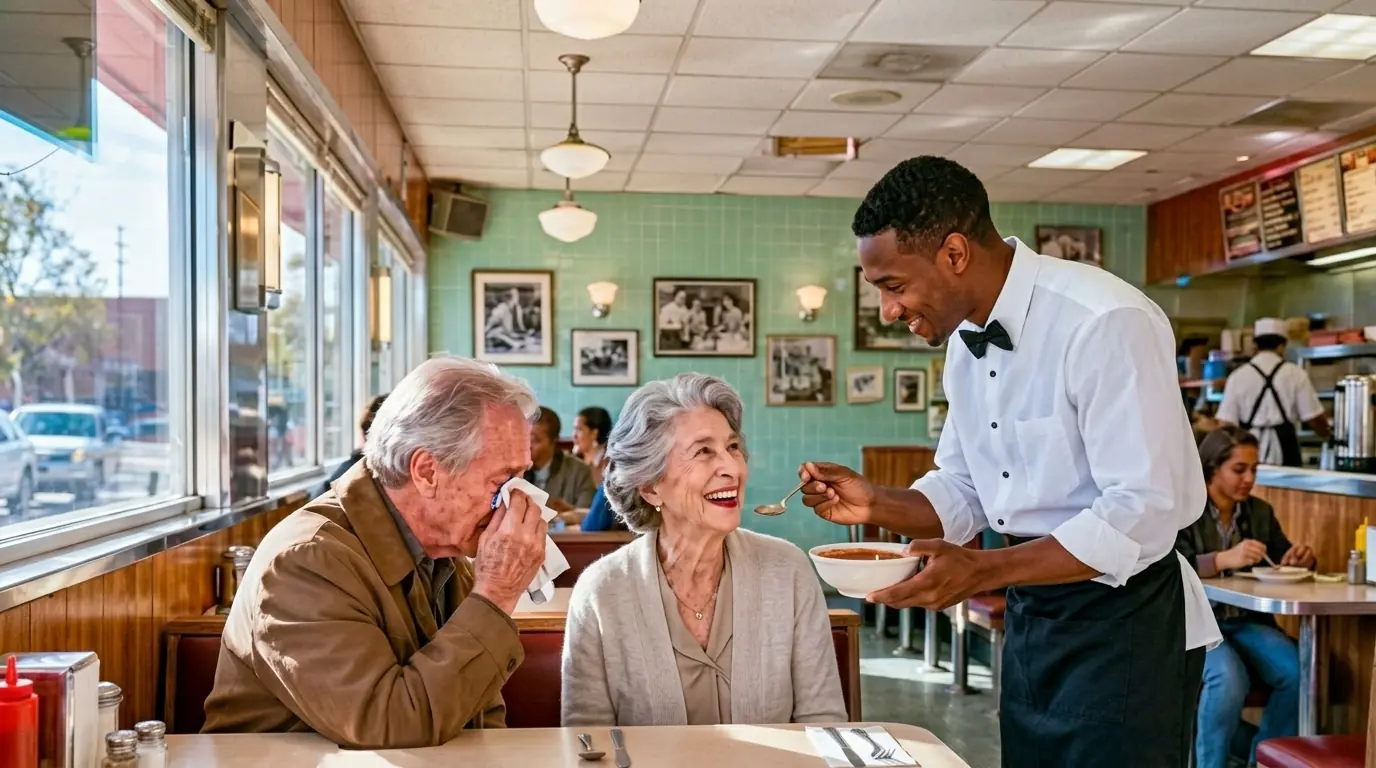
The diner was a relic from the 1950s. It was all chrome and red vinyl, checkerboard floors, and a jukebox that had not worked since before Marcus was born. It sat on the edge of Millbrook, Ohio, a town where factories had closed and hope had gotten expensive.
“Marcus,” Sharon’s voice cut through the quiet like a blade.
She emerged from the back office, clipboard pressed against her chest, eyes scanning for imperfection.
“The napkin dispensers on tables three and seven are only half full. Company policy requires them full or replaced before opening.”
“Yes, ma’am. I’ll take care of it right now.”
Sharon Mitchell was a woman in her early fifties who ran the diner like it was a military installation. Every rule mattered. Every violation was documented. Every deviation from protocol was treated like a personal affront.
She had explained her philosophy to Marcus on his first day.
“Corporate audits us quarterly. One major violation, and they dock my quarterly bonus by twenty percent. Three violations, and I’m terminated. So when I say something needs to be done a certain way, it’s not a suggestion.”
Marcus understood. Sharon was not just enforcing rules. She was protecting herself in the only way she knew how, by making everyone around her as afraid as she was.
He refilled the napkin dispensers, topped off the sugar packets, and made sure every ketchup bottle was wiped spotless. The work was repetitive and mind-numbing, but it was work. And work meant health insurance, the bare minimum kind that still left them drowning in medical bills, but it was something.
His daughter Emma needed that something.
He had been up since 4:30 that morning, same as always. Emma had woken coughing, that wet rattling sound that made his chest tight with fear. His wife, Nina, had handled the breathing treatment while Marcus made breakfast.
Oatmeal stretched thin because they were three days from payday, and the grocery money was gone.
At six, he had driven Emma to her bi-weekly checkup at the pulmonary clinic, waited in the too-bright waiting room while they ran tests he could not afford to fully understand, then dropped her back home before his seven o’clock shift.
The doctors called it idiopathic pulmonary fibrosis, a complicated name for, “We don’t know why your twelve-year-old daughter’s lungs are scarring themselves to death.” The treatment was experimental, expensive, and their only hope. Marcus carried the weight of that hope the way other men carried wallets: constant, essential, and terrifying to lose.
“The front section is ready,” he reported to Sharon.
She checked her watch. “Prep the coffee station. Morning customers start arriving in eighteen minutes.”
There was rarely much of a morning rush anymore, but Sharon maintained the schedule because the alternative was admitting the diner was dying. Marcus had seen the numbers on a report she had left on the counter last week. They were down to four servers from nine last year, and the corporate office was talking about reducing hours.
He could not afford reduced hours. He could not afford anything going wrong.
So he showed up early, worked harder, kept his head down, and made himself invisible in all the ways that mattered.
Behind him, the kitchen door swung open, and Luis Martinez came through. Luis was the morning line cook who had been at Rosy’s for twelve years.
“Morning, Marcus. You here early again?”
“Couldn’t sleep.”
Luis glanced toward the office where Sharon was reviewing inventory sheets. “She’s been extra tight lately. Corporate’s been on her about quarterly numbers.”
“I know.”
“Just keep your head down. Do your work. You’re doing fine.”
Luis headed to the grill, then added, “Better than fine, actually. Best server we’ve had in years.”
Marcus appreciated the words, but he did not let himself believe them. Being good at your job only mattered if the people measuring your performance actually cared.
By nine o’clock, the breakfast rush had come and gone. Old Pete Holloway sat in his usual booth reading the newspaper. A construction worker grabbed coffee to go. Two teenagers cut class and nursed sodas in the corner, whispering to each other and ignoring the world.
Marcus moved between tables with practiced efficiency, refilling coffee, clearing plates, and smiling politely at customers who rarely acknowledged him. He had learned the rhythm of this place, the unspoken rules that lived underneath the printed policies.
Do not make eye contact too long. Do not speak unless spoken to. Do not give anyone a reason to remember you for the wrong reasons.
In his pocket, folded into careful squares, were three envelopes. Medical bills. He did not open them anymore. He just collected them from the mailbox and carried them around like talismans of failure.
Nina said they should consider bankruptcy, but Marcus could not shake the feeling that bankruptcy would make everything more permanent somehow, like admitting they would never climb out of this hole.
His phone buzzed. A text from Nina.
“Emma’s O2 is at 90. Watching it. She’s resting.”
Oxygen saturation. Another number he had learned to track. Another measure of how close they were to the edge. Ninety was the threshold where they started worrying. Below that, they went to the ER.
“Marcus, table eight needs menus.”
Sharon’s voice again, always monitoring, always measuring.
He grabbed two menus and headed to booth eight in the back corner, the one with the best morning light.
Then he stopped.
It was William and Patricia Grant, the Tuesday regulars who came in every week like clockwork. But today was different. William wore a suit jacket, old but well-maintained, and Patricia had on a pale yellow dress with small white flowers. There was a corsage pinned to her collar, a single white rose that looked fresh from a florist.
“Good morning, Mr. Grant. Mrs. Grant.” Marcus set down the menus carefully.
“Morning, Marcus,” William said, his voice warm. He was smiling wider than usual. “Fifty years today. Half a century married to this beautiful woman right here. Can you believe that?”
Patricia looked up at Marcus with pale blue eyes that seemed to focus somewhere past his face, somewhere distant and confused. She was thinner than last week, smaller somehow, like she was slowly disappearing into herself.
“Congratulations,” Marcus said, and meant it. “That’s really something special.”
“Thank you, son.”
William helped Patricia into the booth with such careful tenderness that it made Marcus’s throat tight. She moved slowly, each step requiring visible concentration, and when she finally sat down, she looked exhausted from the simple effort of crossing ten feet.
Marcus took their order: scrambled eggs and wheat toast for both, black coffee for William, hot tea with honey for Patricia. Then he headed back to the kitchen.
Through the serving window, he watched them sitting together, William holding Patricia’s hand across the table, talking quietly about things Marcus could not hear.
Fifty years.
Marcus had been married to Nina for thirteen, and some days that felt like both forever and not nearly long enough. Thirteen years of splitting bills, sharing dreams, and holding each other when the dreams cracked apart. Thirteen years of learning that love was less about big romantic gestures and more about showing up every single day, even when, especially when, showing up was the hardest thing you could do.
He thought about Nina at home with Emma, monitoring oxygen levels, timing medications, pretending everything was fine when their daughter asked if they had money for the school field trip next month.
They did not have money for the field trip. They barely had money for groceries. But they had each other, and that was going to have to be enough.
Luis looked at him through the serving window. “You good, man?”
“Yeah. Just thinking about those folks at table eight. The anniversary couple.”
“Yeah.” Luis nodded. “Fifty years. That’s the dream, right? Finding someone and actually making it work.”
“That’s the dream,” Marcus agreed.
Then he went back to work.
Twenty minutes later, Marcus returned to table eight with their breakfast plates. The morning light streamed through the big windows, catching dust motes in the air and making everything look softer somehow.
The diner had emptied out after the brief morning activity. Only Pete was still reading his paper, and a woman in the corner booth was working on a laptop. Sharon was in the back office reviewing supply orders. Luis and Danny were cleaning the kitchen.
For a moment, the world felt suspended, quiet, like a held breath.
Marcus set the plates down carefully. “Here you go, folks. Can I get you anything else?”
“We’re just fine, thank you,” William said.
But Marcus could see the problem immediately.
Patricia was trying to pick up her fork, but her hands were not cooperating. The tremor he had noticed in previous weeks was worse today, or maybe he had simply never watched this closely. She managed to grip the handle, lifted it maybe two inches, and then it clattered back against the plate.
“Here, honey. Let me help you.”
William reached across the table, trying to cut her eggs while managing his own plate and adjusting the small vase with the single rose that kept threatening to tip over.
Marcus stood there watching this man trying to do everything at once: feed his wife, eat his own breakfast, keep their fiftieth anniversary special, and something cracked open in his chest.
He thought about Nina that morning, exhausted, handling Emma’s breathing treatment alone while he rushed out the door for work. He thought about all the times he had wanted to be in two places at once, wanted to be enough for everyone who needed him.
The diner was quiet. Sharon was in the office. His section was completely covered. There were no other customers waiting, no urgent tasks demanding his attention.
Marcus made a decision.
William looked up, surprise and something that might have been relief crossing his weathered face.
“Oh, you don’t have to.”
“I know, sir. But it’s your anniversary. You should get to enjoy it together.”
William’s eyes got wet. “That would be… that would be very kind of you.”
Marcus did not sit down. That felt too familiar, too much like he was joining their celebration uninvited. Instead, he stood beside the booth, maintaining a respectful distance. He picked up Patricia’s fork, cut a small piece of her scrambled eggs, and held it where she could reach it easily.
She looked at him with those pale blue eyes, and for a moment, there was clarity there. Full awareness cut through whatever fog usually surrounded her.
“Thank you,” she whispered.
“You’re welcome, ma’am.”
He helped her with a few more bites while William quickly ate some of his own breakfast and adjusted the vase so the rose stood straight and secure. The whole thing took maybe five minutes, no more than that.
Five minutes of standing beside a booth in a quiet diner, helping an elderly woman eat her anniversary breakfast while her husband had a moment to breathe and be present with her.
When Patricia had eaten about half her eggs and seemed tired, Marcus set the fork down gently.
“I think you’ve got it from here, Mr. Grant.”
“Thank you, son.” William’s voice was rough with emotion. “Thank you so much. You have no idea what that meant to us.”
Marcus nodded and headed back toward the kitchen, thinking that was the end of it. Thinking he had just done a small kindness that would not ripple beyond this morning, this booth, and these two people.
He was wrong.
In the corner booth, hidden behind her laptop screen, Jennifer Cole had watched the whole thing.
She was a freelance writer, barely making rent on articles about local businesses and human interest stories for regional magazines. She had been working on a piece about Millbrook’s struggling downtown, but she had looked up at exactly the right moment to see something else entirely.
She had seen genuine compassion in action. Quiet dignity. A man helping another person for no reason except that help was needed and he was able to provide it.
And she had taken a photo discreetly with her phone, capturing the moment Marcus stood beside the booth helping Patricia Grant, the morning light making everything look almost sacred.
Jennifer stared at that photo now, then looked up to see Marcus heading back to the kitchen. She felt something like anger kindle in her chest at what she knew was probably coming next. She had been in this diner enough times to know how Sharon Mitchell operated.
Marcus had just reached the kitchen when Sharon’s voice cut through the quiet like a whip crack.
“Marcus Hayes. My office. Right now.”
His stomach dropped.
Luis shot him a concerned look from the grill. Danny stopped scrubbing a pan. Everyone in the kitchen suddenly went very still.
“Yes, ma’am.”
He followed Sharon past the kitchen and the storage room into the cramped back office that smelled like stale coffee and industrial air freshener. Sharon closed the door with a decisive click and turned to face him, clipboard pressed against her chest like armor.
“What were you doing at table eight?”
“The Grants needed—”
“I saw what you were doing. You were feeding a customer.”
“Mrs. Grant was having trouble with her fork, and Mr. Grant was trying to—”
“Did that customer explicitly request feeding assistance? Did they call you over and formally ask for help eating their meal?”
Marcus opened his mouth, then closed it. “Not exactly, but—”
“Then what you did was make unauthorized physical contact with a customer without prior consent, which directly violates section four, paragraph seven of the employee conduct manual regarding appropriate customer interaction boundaries.”
She was not just reciting policy. She was building a case, documenting everything, preparing her defense.
“Ma’am, they’re an elderly couple celebrating their fiftieth anniversary. Mrs. Grant clearly has some kind of medical condition that makes it difficult for her to—”
“I don’t care if they’re celebrating their hundredth anniversary, Marcus. We have policies. Those policies exist for reasons. What if Mrs. Grant had choked while you were assisting her? What if you had accidentally caused an injury? This establishment would be legally liable. I would be personally liable.”
“That didn’t happen.”
“But it could have. That’s precisely why the policy exists.”
Sharon set down her clipboard, and her voice went harder, more controlled.
“You made an independent judgment call to override established protocol. That’s unacceptable. I can’t have employees deciding for themselves when company policies do or don’t apply.”
Marcus felt something cold and heavy settling in his chest.
“Are you writing me up?”
“No.”
For a moment, relief flooded through him.
“I’m terminating your employment effective immediately.”
The room seemed to tilt.
“What?”
“The policy is explicit, Marcus. Section four, paragraph seven, subsection C. Unauthorized physical contact with customers, including but not limited to feeding assistance, personal grooming, or medical intervention, results in immediate termination. There’s no discretion. There’s no gray area.”
“I was helping an old woman eat her breakfast on her anniversary.”
“You were creating legal exposure for this business and violating clearly stated company policy.”
Sharon’s voice went ice cold.
“I need you to clock out, surrender your name tag, and collect your personal belongings. You have ten minutes.”
Marcus stood there trying to find words, trying to make her understand what this meant. Five months of perfect attendance. Five months of showing up early, staying late, and doing everything exactly right. And now, because he had spent five minutes helping an elderly woman on her anniversary, he was being fired.
“What about my paycheck?”
“You’ll receive your final check for hours worked through today, mailed to your address on file within seven to ten business days, per standard company policy.”
“I need that money now. My daughter has a treatment appointment on Thursday.”
“That’s not my concern. Payroll is handled through corporate headquarters. I have no authority to issue checks from this location.”
He wanted to argue. He wanted to make her understand what this meant. The health insurance that would terminate immediately. The specialist appointment they would have to cancel. The medications they could not afford without coverage.
He wanted to make her see that her precious policies were crushing an actual human being.
But he could see in Sharon’s face that it would not matter. She had already made her decision. The manual had made it for her, and Sharon Mitchell followed the manual the way other people followed religion.
There was a knock on the door.
Luis’s voice came through. “Sharon, the Grants want to talk to you about what just happened.”
“Tell them I’m unavailable.”
“They said they’re not leaving until they speak with you.”
Sharon’s jaw tightened. “Fine. Marcus, wait here.”
She opened the door and walked out to the dining area.
Through the office doorway, Marcus could see William Grant standing by the register, supporting Patricia with one arm.
“Ma’am,” William’s voice carried through the diner, dignified and firm. “I understand you just fired that young man.”
“I’m sorry, sir, but I can’t discuss personnel matters.”
“He was helping my wife at our request. I asked him to help her. If anyone violated your policy, it was me, not him.”
“That’s not how it works, Mr. Grant. The employee has a responsibility to—”
“To what? Ignore people who need help? My wife has advanced dementia. She can barely feed herself. That young man showed her more dignity and respect in five minutes than we’ve received from most professional caregivers.”
William’s voice got stronger.
“You fired him for being decent to people. For being human.”
Luis had come out of the kitchen and was standing off to the side.
“Sharon, Marcus is one of the best workers we’ve got. He’s here early every day. Never complains. Customers like him.”
“This doesn’t concern you, Luis.”
“Yeah, it does. Because if you fire people for helping customers, what kind of place is this?”
Danny emerged from the kitchen, too.
“Marcus helps all of us. Covers shifts when people are sick. Trains new people. He’s solid.”
Sharon’s face flushed red.
“Everyone, return to your stations immediately, or you’ll be joining him in the unemployment line.”
Patricia Grant, who had been quiet, suddenly spoke up, her voice thin but clear.
“That young man was gentle with me. He treated me like I was still whole, like I still mattered.”
She looked directly at Sharon.
“You should be ashamed.”
“I’m following company policy, ma’am.”
“Then your company has terrible policies.”
Sharon’s hands clenched into fists at her sides.
“Mr. and Mrs. Grant, your meal today is complimentary. I apologize for any distress this situation has caused you, but my decision stands. Everyone, back to work now.”
Luis met Marcus’s eyes and gave a small, helpless shrug. Danny looked angry but said nothing. William Grant looked like he wanted to argue more, but Patricia was trembling with exhaustion from the effort of standing and speaking.
Marcus stepped out of the office.
“It’s okay. Thank you for trying. All of you.”
He walked to the break room, grabbed his jacket, and clocked out for the last time.
As he headed for the door, Luis caught up with him.
“Marcus, man, I’m sorry. That was—”
“It’s not your fault.”
“I’ll ask around. See if anyone’s hiring. Maybe Johnson’s warehouse.”
“I appreciate it.”
Marcus managed a smile he did not feel.
“Take care of yourself, Luis.”
He walked out of Rosy’s Diner into the cold November morning. Behind him, through the window, he could see William and Patricia Grant still standing by the register, watching him leave. William raised one hand in a small, sad wave.
Marcus had helped an old woman eat her eggs on her fiftieth anniversary, and it had cost him everything.
The walk home took forty-five minutes, and Marcus barely felt the cold. His mind was spinning, trying to figure out how to tell Nina, trying to calculate how long they could survive on her part-time income from the grocery store, trying to understand how everything had fallen apart so quickly over one act of simple kindness.
He thought about Emma, about the specialist appointment on Thursday that cost one hundred and fifty dollars they did not have. He thought about the rent due next week, the utility bills, and the medications that could not wait.
He thought about going back to the unemployment office, filling out applications again, hoping someone would take a chance on a thirty-five-year-old man who kept losing jobs through no fault of his own.
When he finally reached their small rental house on Maple Street, Nina’s car was in the driveway. She must have come home between shifts.
He found her in the kitchen making lunch for Emma, who was doing homework at the table despite looking exhausted.
“Hey, baby,” Nina said, turning from the counter with a smile that faded immediately when she saw his face. “Marcus, what’s wrong? Why are you home?”
Emma looked up from her math worksheet, her eyes, the same warm brown as his, widening with concern.
“Dad?”
He could not do this in front of Emma. Not right now.
“Nina, can I talk to you for a minute?”
They went into the bedroom, and he told her everything. He watched her face as she processed it. He watched hope drain away and get replaced by the same tired fear he felt in his own chest.
“They fired you for helping someone?”
“Policy violation. Unauthorized physical contact with a customer.”
Nina sat down heavily on the bed, her hands pressed to her face.
“What are we going to do?”
“I’ll find something else. I’ll go out tomorrow. Put in applications everywhere.”
“Thursday, Marcus. Emma’s appointment is Thursday.”
“I know.”
“We can’t miss it. Dr. Patterson said if we skip monitoring visits, if we let her care lapse even once, her condition could deteriorate faster than we can manage.” Nina’s voice broke. “The insurance ends tonight at midnight. By Thursday, we’ll have nothing.”
Marcus sat beside her and pulled her close.
“We’ll figure it out. We always do.”
But he was not sure he believed it anymore.
What Marcus did not know was that someone else had been in Rosy’s Diner that morning, had witnessed everything, and was already turning his personal disaster into something bigger.
Jennifer Cole had paid for her coffee and left the diner right after Marcus walked out. She had sat in her car for ten minutes, staring at the photo on her phone.
Marcus standing beside the booth, helping Patricia Grant with such gentle care, the morning light making everything look almost sacred.
Then she looked at the notes she had scribbled.
Man fired for kindness.
Policy over humanity.
Anniversary breakfast interrupted by termination.
Staff tried to defend him.
Elderly couple pleaded his case.
Manager refused to budge.
She opened her laptop and started writing.
By Tuesday evening, the story was live on her blog and submitted to four regional news outlets.
The title read: “Fired for Kindness: When Corporate Policy Punishes Human Decency.”
The photo accompanied it. Marcus’s face was partially turned away, focused on Patricia, every line of his posture showing care and respect.
Jennifer wrote about the firing, about Sharon’s rigid enforcement of policy over common sense, about William and Patricia Grant trying to intervene, and about Luis and Danny speaking up and being threatened with termination themselves.
Jennifer was not naive. She knew most of her articles got a few hundred views and disappeared into internet obscurity. But sometimes, just sometimes, people paid attention when a story captured something fundamentally wrong with the world.
By Wednesday morning, the story had been shared four thousand times. By Wednesday afternoon, it was eighteen thousand. Local news picked it up. Then regional outlets. Then national aggregators.
By Wednesday evening, Marcus Hayes’s act of kindness and the price he had paid for it was trending on social media, accompanied by the hashtag Fired For Caring.
Rosy’s Diner’s corporate office started receiving calls. Angry calls. Hundreds of them.
Sharon Mitchell’s personal email was somehow leaked online and flooded with messages ranging from thoughtful criticism to outright harassment.
The story spiraled into something bigger than Marcus, bigger than one diner, bigger than one firing. It became a symbol of everything wrong with corporate culture, with rigid policies that valued liability over humanity, with systems that punished compassion.
Marcus knew none of this.
He had spent Tuesday afternoon and all day Wednesday walking Millbrook, filling out applications at every business that might be hiring. Gas stations, warehouses, grocery stores, restaurants.
Most did not even have positions open. The ones that did took one look at his employment history, five months at the diner, seven months at a distribution center before that, six months at another warehouse before that, and told him they would be in touch.
Nobody was going to be in touch.
He came home Wednesday evening exhausted and terrified. Nina met him at the door with Emma asleep on the couch, the oxygen concentrator humming in the background.
“Any luck?”
“No.”
Nina’s face fell. “Marcus, the insurance officially ends at midnight tonight. Emma’s appointment is tomorrow morning.”
“I know, Nina. I know.”
His voice came out harsher than he intended.
“I’m sorry. I just… I don’t know what to do.”
She pulled him close, and they stood there in their tiny living room, holding each other while their daughter slept and the oxygen machine counted out breaths like a clock counting down to disaster.
Nina’s phone buzzed. She pulled back, glanced at the screen, and her expression changed.
“Marcus, you need to see this.”
She showed him Jennifer Cole’s article. She showed him the photo of himself helping Patricia Grant. She showed him hundreds, then thousands, of comments from strangers expressing outrage, offering support, and demanding justice.
Someone had started a crowdfunding campaign for his family. It had raised five thousand dollars.
Marcus stared at the screen, not quite believing what he was seeing.
“I don’t… I don’t understand.”
“People are angry about what happened to you. They think you deserve better.” Nina scrolled through comments. “Look at this. Someone found Sharon Mitchell’s LinkedIn and posted the article on her page. Someone else is organizing a boycott of Rosy’s Diner.”
But Marcus felt sick. The attention was overwhelming, invasive. All these strangers discussing his life, his daughter’s medical condition, his family’s finances. Things he had never wanted to make public.
“This doesn’t help,” he said quietly, his voice tight. “This doesn’t get me a job. This doesn’t get Emma into her appointment tomorrow.”
“Five thousand dollars helps, Marcus.”
“For how long? A month? Two? Maybe three if we’re really careful.”
He handed her back the phone.
“I need steady work. I need insurance that doesn’t end. I need—”
His voice broke.
Nina took his hand.
“The crowdfunding money can cover Emma’s appointment tomorrow. It can buy us time to find something better.”
“Time.”
Marcus laughed without humor.
“That’s all we ever need. Just a little more time.”
But he did not know how much time five thousand dollars could buy, or whether it would be enough. He did not know that four hundred miles away, someone else was reading that article and having a revelation that would change everything.
Four hundred miles away in Chicago, James Patterson was sitting in his corner office on the forty-second floor of the Sterling Tower, reviewing acquisition proposals, when his assistant knocked on the door.
“Mr. Patterson, Derek Chen from legal is here. He says it’s personal, about your parents.”
James felt his chest tighten.
“Send him in.”
Derek came in looking uncomfortable, phone in his hand.
“Hey, James. I’m really sorry to interrupt, but my wife showed me this article this morning, and when I saw the names…” He trailed off. “I thought you’d want to know.”
He handed James his phone.
It took James several minutes to piece together the whole story. His parents’ fiftieth anniversary breakfast. A waiter named Marcus Hayes helping his mother eat. The firing. The photo now being shared across every social media platform. The outrage. The fundraising. The boycott.
He stared at the image on the screen, a stranger standing beside his mother with such careful attention, helping her in a way James had not even known she needed.
James Patterson was forty-eight years old. He had spent the last twenty-five years building an investment firm that managed 3.2 billion dollars in assets. He had made his first million by thirty, his first ten million by thirty-five, his first hundred million by forty-two.
He had built this empire with a specific goal that had driven him since he was twenty-three years old.
His father had been a high school teacher. His mother had been a librarian. They had lived modestly, saved carefully, and put James through college on a combination of scholarships and his mother working a second job at a bookstore.
He had watched them stretch every dollar. He had watched them worry about property taxes and car repairs and whether they could afford to replace the water heater when it finally gave out.
And he had promised himself, Someday, I’ll make enough money that they’ll never have to worry about anything again.
So he had worked eighty-hour weeks, ninety-hour weeks, sleeping in the office during deal negotiations, sacrificing relationships and friendships and experiences because the goal was clear.
Make enough money to take care of his parents.
And he had. He had made more than enough.
He sent them money regularly for home repairs, property taxes, medical expenses, and anything they mentioned needing. Last year, he had paid off their mortgage as a surprise. When the roof needed replacing, he had sent fifteen thousand dollars. When his father’s car died, he had sent money for a new one.
This year, for their fiftieth anniversary, he had sent an elaborate flower arrangement that cost three hundred dollars and called them for eleven minutes before excusing himself for a conference call about the Melbourne acquisition.
Eleven minutes.
For their fiftieth anniversary, he had given them eleven minutes of his time and three hundred dollars worth of flowers.
And a stranger, this Marcus Hayes, who had nothing, who had just lost his job, whose daughter was sick, had given more.
James looked at the photo again. His mother struggling. His father overwhelmed. And this man stepping in to help because it was the right thing to do, knowing it might cost him, and doing it anyway.
“Derek, thank you for showing me this.”
“Of course. I just thought… well, if it were my parents, I’d want to know.”
After Derek left, James sat alone in his expensive office, looking at the city spread out forty-two floors below him.
All the wealth he had accumulated, all the success he had built supposedly for his parents’ security and comfort, had not protected them from needing help he was not there to provide.
He called his father. No answer. He tried his mother’s phone. No answer. He called the house line, and finally his father picked up on the sixth ring.
“James, this is a surprise. How are you, son?”
“Dad, I just saw… I saw something online about the diner. About your anniversary breakfast. Are you and Mom okay?”
“Oh, that.”
William’s voice went quiet.
“It’s been quite a week. That young man, Marcus, he was very kind to your mother. Very gentle. And they fired him for it right there in front of everyone. Your mother’s been upset about it all week. She doesn’t understand why they fired him. She keeps asking where the nice man went.”
“I’m coming home.”
“You don’t need to do that.”
“Yes, I do. I should have been there Tuesday. I should have been there for your anniversary.”
James was already pulling up flight information on his computer.
“I’m coming home, Dad. Tonight if I can get a flight.”
“James, we know you’re busy. We know your work is important. We don’t want you to—”
“My work can wait. You and Mom can’t.”
His voice cracked slightly.
“I should have been the one helping Mom eat breakfast, Dad. Not a stranger.”
William was quiet for a long moment.
“You’re a good son, James. You’ve done so much for us.”
“I’ve sent money, Dad. That’s not the same thing as being there.”
“We appreciate everything you’ve done.”
“I know you do, but I’m realizing I’ve been doing it wrong. I’ll explain when I see you. I’m booking a flight right now.”
After he hung up, James sat very still, staring at that photo of Marcus Hayes helping his mother.
A stranger had seen his parents’ need and stepped in to help, even knowing it would cost him his job, cost him his health insurance, cost him everything.
While their own son had been four hundred miles away in an office, making money he told himself was for them, but which had somehow become a substitute for actually being present in their lives.
He had spent twenty-five years accumulating wealth to protect his parents from hardship. And when the hardship came, the kind that could not be solved with money, he had not been there.
A stranger had been there instead and had been punished for it.
James booked the next flight to Columbus, sent a message to his team that he would be unavailable for the next few days, and started packing.
For the first time in twenty-five years, his work would have to wait.
His parents needed their son. Not his money. Him.
James caught the seven o’clock flight out of O’Hare, landed in Columbus just before nine, and drove the hour to Millbrook through darkness that felt heavier than it should.
He arrived at his parents’ house around 10:30 and let himself in with the key they had given him years ago, a key he had used maybe four times in the past decade.
The house was smaller than he remembered. The paint was peeling on the porch railings, even though he had sent money for maintenance last year. The roof looked fine, that repair had been completed, but the gutters were full of leaves. The yard was overgrown, and the whole place had an air of quiet decline.
Fifteen thousand dollars for repairs, and his father clearly had not been able to coordinate getting the work done. The money was probably sitting in their account untouched because William Grant did not have the energy anymore to call contractors, get estimates, and manage renovations.
James had sent money when what his father had needed was help.
Inside, the house was exactly as he remembered from childhood. Same furniture, same family photos on the mantle, same worn carpet in the hallway. His parents had never been ones to replace things that still worked, even when those things were forty years old.
He found his father asleep in the recliner in the living room, the TV on low volume, an empty plate on the side table. William had always been a big man, solid and strong from years of coaching high school football. But now he looked thin, almost frail, diminished by time and stress.
James walked quietly to his old bedroom, unchanged except for the boxes of his mother’s craft supplies now stacked in the corner, and lay down on the narrow twin bed, staring at the ceiling covered in glow-in-the-dark stars he had put up when he was twelve.
He did not sleep at all.
At six in the morning, his father found him in the kitchen making coffee.
“James, when did you get in? I didn’t hear you arrive.”
“Around 10:30. Didn’t want to wake you.”
William looked older in the morning light, thinner than at Christmas. The tremor in his hands was more pronounced than James remembered. There were coffee stains on his shirt, and his hair had not been cut in weeks.
“You didn’t have to fly out here in the middle of the week. I know you’re busy with—”
“Dad.” James poured two cups of coffee. “I’m not too busy for this. I should never have been too busy for this.”
William sat down at the kitchen table with a heavy sigh.
“Well, I appreciate you coming. Your mother will be happy to see you, on her good days anyway.”
“How many good days does she have?”
“Maybe two or three a week now. Used to be four or five. It’s getting worse.”
William’s voice was matter-of-fact, but James could hear the exhaustion underneath.
“The doctors say it’s a type of dementia. Some days she’s herself, sharp, funny, remembers everything. Other days she doesn’t know where she is. Doesn’t recognize me. Gets frightened and confused.”
“Why didn’t you tell me how bad it was?”
“What were you going to do from Chicago? Send money for doctors we already have? Pay for treatments that don’t exist?”
William’s tone was not accusatory, just tired.
“You’ve been so generous with us, James. The house, the repairs, the money you send. We appreciate all of it. I didn’t want to burden you with something you couldn’t fix.”
Those words hit James like a physical blow.
“You’re not a burden, Dad. You’re my parents.”
“And you’re a successful man with important responsibilities.”
“None of that matters if I’m not here when you need me.”
They sat in silence drinking coffee while upstairs Patricia slept on, oblivious to her son’s arrival, possibly oblivious to everything.
“Tell me about Tuesday,” James finally said. “Tell me exactly what happened.”
William did.
He described the anniversary breakfast they had planned for weeks. Patricia’s worsening tremors that morning. His own helplessness, trying to manage her care and their meals simultaneously. He described Marcus Hayes approaching them with quiet respect, helping Patricia eat with such gentle dignity that, for a few minutes, everything had felt normal and special and right.
“And then that manager fired him right there in front of everyone,” William finished, his voice rough with emotion. “We tried to tell her it was our fault, that we had asked for help, but she wouldn’t listen. Luis and Danny from the kitchen tried to speak up for him, too. She threatened to fire them as well.”
He looked at James.
“That young man lost his job because he was kind to us. Because he treated your mother like she was still a person worth caring about.”
“Where can I find him?”
“Marcus Hayes? I don’t know. But that article, the woman who wrote it, Jennifer Cole, she might know.”
James pulled out his phone and started searching.
Around nine, his mother came downstairs, moving slowly, gripping the railing with both hands. She looked at James with confusion.
“William, who is this man in our kitchen?”
“It’s James, honey. Our son.”
She studied his face, uncertainty flickering in her pale blue eyes.
“James lives in Chicago. He’s too busy to visit.”
The words stung more the second time he heard them.
“I’m here now, Mom,” James said gently.
His father kept talking to her, kept reminding her who James was until something seemed to click, and she smiled.
“James. Oh, sweetheart, when did you get here? Why didn’t you tell us you were coming?”
“I wanted to surprise you.”
“Well, you certainly did.”
She moved to hug him, and he was shocked by how thin she had become, how fragile she felt in his arms.
“Are you staying for breakfast?”
“I’m staying for more than breakfast, Mom.”
But an hour later, she had forgotten again. She asked his father who the stranger in their house was. She looked at James with that same confused suspicion.
James spent the day watching his parents navigate this new reality. His mother’s confusion. His father’s patient explanations. The routines they had built to manage an impossible situation.
He saw how much his father had aged, how much weight he had lost, how the simple act of caring for Patricia was consuming him.
And he understood finally what that article had meant, what that photo had captured.
A stranger had seen his parents struggling and stepped in to help, even knowing it would cost him everything. While their own son had been four hundred miles away, making money and convincing himself that money was enough.
That evening, after Patricia had gone to bed early, exhausted by the day’s confusion, James asked his father, “Do you know where I can find Marcus Hayes?”
“No. But I imagine Jennifer Cole does.”
“Why?”
“Because I need to thank him. And I need to figure out how to make this right.”
James found Jennifer Cole’s contact information through her article and called her Thursday morning. She was skeptical at first, protective of Marcus, wary of James’s intentions. But something in his voice must have convinced her he was not there to cause more problems.
She gave him Marcus’s address.
The house was in an older neighborhood on the east side of Millbrook, small houses with chain-link fences and cars that had seen better decades. James pulled up in his rental sedan, deliberately chosen to be unremarkable, and sat for a long moment, trying to figure out what to say.
How do you thank someone for showing you what you failed to see?
How do you apologize for your absence to a stranger who paid the price for caring?
Finally, he got out and knocked.
Marcus answered the door in old jeans and a faded sweatshirt, looking exhausted. Behind him, James could hear a child coughing. Deep, wet, alarming.
“Can I help you?”
“Mr. Hayes? My name is James Patterson. William and Patricia Grant are my parents.”
Marcus’s expression shifted from wary to surprised.
“I… please come in.”
The house was small but immaculately clean. Furniture that looked secondhand but well-maintained. A few family photos on the walls. Children’s toys stacked neatly in a corner. Everything organized with the kind of meticulous care that came from not having enough space or money to be careless with either.
Marcus led him to a small living room where a young girl was curled up on the couch under blankets. An oxygen concentrator hummed steadily in the corner. Medical equipment that James recognized from his research into his mother’s condition sat nearby: a pulse oximeter, a nebulizer, a medication chart on the wall tracking doses and times.
The medical bills mentioned in the article suddenly became viscerally real.
“This is my daughter, Emma. Emma, say hello to Mr. Patterson.”
“Hi,” the girl managed, before dissolving into another coughing fit that made James’s chest tight just listening to it.
Marcus moved to her immediately, checking her oxygen levels and adjusting her position, his movements practiced and efficient.
When she settled, he turned back to James.
“I’m sorry. She’s having a rough morning. The insurance lapse has made it difficult to—”
He stopped himself.
“You didn’t come here to listen to our problems.”
“Actually,” James said quietly, “maybe I did.”
They sat down. Marcus perched on the arm of the couch near his daughter. James sat in a worn armchair that creaked under his weight.
“I wanted to thank you,” James began. “For what you did for my parents. For helping my mother when…”
His voice caught.
“When I should have been there to help her myself.”
“You don’t need to thank me. I just helped her eat breakfast.”
“You did more than that.”
James gestured to Emma, to the medical equipment, to the careful organization of a family living on the edge.
“I’ve been reading about what happened. About you losing your job. About your daughter’s condition. About the crowdfunding. About all the ways doing the right thing cost you.”
“That’s just how things are sometimes. Things cost.”
“They shouldn’t cost this much.”
James leaned forward.
“I’ve been thinking about what I can do to help. The crowdfunding is good. It bought you some time, but time runs out. You need sustainable income. You need health insurance.”
Marcus’s expression went carefully neutral.
“I appreciate the thought, but I don’t need charity.”
“It’s not charity. It’s…”
James struggled for the right words.
“Look, I have business connections in this area. There’s a senior care facility about twenty minutes from here. Harmony Hills. They’re always looking for care assistants. The work is hard, the hours are long, and the pay isn’t great, but it comes with full health benefits from day one.”
“I don’t have experience in care work.”
“No, but you have something more important. You understand how to see people, how to treat them with dignity when they’re vulnerable.”
James thought about his mother, about Marcus’s gentle hands helping her eat.
“The technical skills can be taught. The compassion can’t.”
Marcus was quiet for a long moment. Emma’s breathing had settled into something more regular, though still obviously labored. The oxygen concentrator hummed its steady rhythm.
“Why would you do this?” Marcus finally asked. “You don’t know me.”
James thought about the past two days with his parents. His mother not recognizing him. His father managing everything alone. Twenty-five years of sending money instead of showing up.
“Can I tell you something?” James said. “My father was a high school teacher. Made forty-three thousand a year. My mother was a librarian. Made thirty-nine thousand. They worked extra jobs to put me through college. I watched them struggle, really struggle, with money my whole childhood. I watched them stress about bills, car repairs, and whether they could afford new winter coats for me.”
He looked around Marcus’s small house, seeing the same kind of careful management of limited resources.
“So I promised myself I’d make enough money that they would never have to worry again. That became my entire focus. Work harder, make more, build wealth so I could take care of them financially. And I did. I made millions. Paid off their mortgage. Sent money for repairs, taxes, medical bills, everything they mentioned needing.”
“That’s not nothing,” Marcus said quietly.
“No, but it’s not enough either. Because when my mother needed help eating breakfast on her fiftieth anniversary, I wasn’t there. I was in my office four hundred miles away, probably in a meeting I can’t even remember now, making money I told myself was for them.”
James’s voice got rough.
“You were there. You helped her. You treated her with dignity. And you got punished for it.”
“I made a choice.”
“So am I. I’m choosing to help, if you’ll let me.”
James pulled out a business card with Harmony Hills director’s information.
“Call them tomorrow. Tell them I referred you. They’ll want to interview you, but I think you’ll find it’s more than just a formality.”
Marcus took the card, studying it like it might disappear.
“You said the pay isn’t great. How not great?”
“Thirteen dollars an hour to start. Probably less than you were making at the diner. But there’s insurance. Full coverage from day one. Medical, dental, vision. Covers your whole family. No waiting period.”
James paused.
“And they have a partnership with the community college. If you’re interested in getting certified as a CNA, a certified nursing assistant, they’ll cover the cost of training and work around your schedule. After that, if you want to pursue actual nursing credentials, they have tuition assistance.”
Marcus looked at Emma, at his daughter breathing easier now with the oxygen support, at the medical equipment they needed and could barely afford.
“That would change everything.”
“Then change it.”
James stood to leave.
“And Mr. Hayes, thank you for showing me what I had failed to see. My parents don’t need my money. They need their son. I’m going to try to be that now. But I learned it from watching you, from seeing what it looks like when someone actually shows up for people who need them.”
Marcus stood, too.
“Your parents, they’re good people. Your mom, even when she’s confused, you can tell she was someone special.”
“Is someone special.”
“She is.”
“And she got to feel that way for a few minutes Tuesday morning because you took the time to see her. That matters more than you know.”
After James left, Marcus sat in his living room holding the business card. Nina came out of the bedroom where she had been listening.
“Did that really just happen?”
“I think so.”
“A job with health insurance from day one?”
“That’s what he said.”
Marcus looked at the card, then at Nina, then at Emma.
“What if this is real?”
“Then maybe we’re going to be okay.”
For the first time in six days, Marcus let himself believe that might actually be true.
But he did not know yet what James Patterson was going to do next, or how their lives were about to intersect in ways neither of them could predict.
The interview at Harmony Hills was scheduled for Friday morning.
Marcus spent Thursday night reading everything he could find online about elder care, about what the job would actually involve, trying to prepare himself for work completely outside his experience.
Friday morning, he put on his only dress shirt, the one he saved for interviews and funerals, and drove to the facility.
It was newer than he had expected. Clean and well lit, with common areas that looked comfortable and gardens visible through large windows. Nothing about it felt institutional.
The director, Katherine Rodriguez, was in her fifties, with kind eyes and the no-nonsense manner of someone who had been doing difficult work for a long time.
“Mr. Hayes, James Patterson spoke very highly of you.”
“He’s generous. I just did what seemed right.”
“That’s exactly what we need here. People who understand this work is about more than procedures and protocols. It’s about seeing people.”
She gestured around the facility.
“We care for seventy-two residents. Some are relatively independent and just need a safe place and occasional assistance. Others need extensive help with daily living. The work is physically demanding and emotionally exhausting. I won’t sugarcoat that.”
“I understand.”
“And I’ll be honest about the pay. It’s thirteen dollars an hour to start, forty hours a week. That’s five hundred and twenty dollars weekly before taxes. I know it’s not impressive.”
Marcus did the math quickly. That was actually slightly less than he had made at the diner after tips.
“But Mr. Patterson mentioned health benefits.”
“Full health insurance from day one. Medical, dental, vision, zero waiting period. Covers your whole family. You, your wife, your daughter. Deductibles and co-pays are reasonable.”
Katherine leaned forward.
“We also have a partnership with Millbrook Community College. If you’re interested in getting your CNA certification, we’ll cover the full cost of classes and books, and we’ll work your schedule around your class times. The program takes about four months if you go part-time. After that, you’d get a pay increase to sixteen dollars an hour. And after CNA certification, if you want to pursue an RN degree, we have a tuition assistance program. It’s a two-year associate degree, but we’ll help with costs and scheduling. An RN here starts at twenty-four dollars an hour.”
Marcus thought about Emma’s medical bills, the specialist appointments, the medications and equipment they needed, Nina working part-time at a grocery store for ten dollars an hour with no benefits, and the nights he spent awake calculating which bills to pay first.
“That would make a real difference for my family.”
“Then let me show you around. See if this feels like somewhere you could work.”
The tour took ninety minutes. Marcus met staff and residents. He saw people in various states of need and independence. He watched how the care assistants interacted with residents, some with genuine warmth and respect, some with clinical detachment, some with barely concealed impatience.
He could see immediately which approach made residents feel seen and which made them feel managed.
One woman reminded him of Patricia Grant. The same pale, confused eyes. The same trembling hands. The same look of someone lost in her own mind.
A young care assistant was trying to get her to eat lunch, speaking loudly and slowly.
“Mrs. Kaufman, you need to eat your chicken. It’s lunchtime. Lunch time to eat.”
The woman pulled away, frightened, food untouched.
Marcus watched, remembering how he had helped Patricia. Not louder. Not slower. Not treating her like a child. Just gentle, just present, just human.
At the end of the tour, Katherine brought him back to her office.
“What do you think?”
“I think I want to learn how to do this right. How to help people the way they deserve to be helped.”
She smiled.
“When can you start?”
“How soon do you need me?”
“Monday.”
Marcus thought about Emma’s appointment, which they had already had to reschedule once, about the medications they were rationing, about the insurance that had already lapsed.
“Monday would be perfect.”
“Then welcome to Harmony Hills, Marcus. I think you’re going to be good at this.”
Marcus started the following Monday.
The work was harder than anything he had done before. Second shift, three to eleven at night, which meant he could take Emma to medical appointments during the day but barely saw Nina, who worked mornings at the grocery store.
The residents were a mix. Some were grateful for help. Some were resentful of needing it. Some were too confused to understand what was happening to them. Some days Marcus went home feeling like he had made a real difference in people’s lives. Some days he went home feeling completely inadequate and overwhelmed.
Mrs. Kaufman, the woman who reminded him of Patricia, became one of his regular residents. She rarely spoke, rarely seemed to recognize anyone, and spent most of her time staring out the window at gardens she probably could not really see anymore.
But Marcus learned her patterns. He learned that she responded better to quiet conversation than loud directions, that she liked her food cut into small pieces, that she was calmer when he described what he was doing before he did it, even if she did not seem to understand the words.
One evening, about three weeks into the job, he was helping her eat dinner when she suddenly looked directly at him, her eyes clear for just a moment.
“You’re kind,” she said, her voice barely a whisper.
“Thank you, ma’am.”
“Don’t let them take that from you. The world tries to take it. Don’t let it.”
Then the clarity faded, and she was gone again, back to wherever her mind spent most of its time now.
But Marcus thought about those words constantly.
Don’t let them take that from you.
They had already tried. Sharon Mitchell had tried, had succeeded in taking his job, but not his compassion. The system had tried, had cost him his insurance and security, but not his humanity.
He was still kind. Still showed up. Still saw people.
And now he had insurance that covered Emma’s treatments.
That was day thirty-two after starting at Harmony Hills. For the first time in her life, they did not have to ration her medications, skip monitoring appointments, or lie awake calculating how long they could hold off before the next emergency room visit.
The insurance covered treatments they had been fighting to access for months. It covered medications the old plan had repeatedly denied. It covered a new pulmonologist who specialized in pediatric lung disease and had actual hope to offer them.
It was not a cure. It would never be a cure. But it was time. More time. Better time. Time when Emma could breathe a little easier and maybe, just maybe, have a chance at something close to a normal childhood.
And Marcus learned something he had not expected.
Sometimes kindness did not just cost you.
Sometimes, eventually, it saved you, too.
Three months after starting at Harmony Hills, Marcus enrolled in the CNA certification program at Millbrook Community College.
Classes were Tuesday and Thursday evenings right after his shift ended at eleven, which meant he got home around one in the morning, slept four or five hours, got up to take Emma to appointments, then went back to work.
It was brutal.
The coursework was harder than he had expected. Basic anatomy, physiology, infection control, patient rights, communication skills, vital signs monitoring. He had barely graduated high school seventeen years ago, and now he was trying to learn medical terminology and procedures that felt completely foreign.
He failed his first exam. Forty-six percent. Passing was seventy.
“Mr. Hayes, can I see you after class?”
The instructor, a retired nurse named Margaret Wilson, looked concerned.
“You’re clearly putting in effort, but you’re missing fundamental concepts. Do you need additional tutoring? We have resources available.”
“I’m working full-time. I’ve got a sick daughter who needs constant monitoring. I don’t have time for—”
“Then make time, or accept that this isn’t going to work out.”
Her voice was firm but not unkind.
“You can’t pass this program without understanding the material. Period.”
Marcus wanted to quit right there. Wanted to tell Katherine Rodriguez that he appreciated the job, but the certification program was too much. He could not handle it. He was not smart enough for this kind of work.
But he thought about Emma watching him study at the kitchen table every night, asking him questions about what he was learning, telling her friends at school that her dad was becoming a nurse.
He thought about Mrs. Kaufman telling him not to let the world take his kindness.
He thought about Patricia Grant and that anniversary morning and the choice he had made that had led him here.
So he kept going.
He attended every tutoring session Margaret offered, even when it meant getting three hours of sleep. He studied during lunch breaks at work. He practiced taking vital signs on Nina, on Emma, on anyone who would let him.
He failed his second exam. Fifty-three percent.
The night he got that grade, he sat in his car in the community college parking lot at 1:30 in the morning and cried. Thirty-five years old, exhausted, failing at something he had hoped might give his family a better future.
His phone rang.
James Patterson.
They had stayed in touch over the past few months. Not frequently, but regularly enough that it felt like more than just the transaction that had brought them together. James called every few weeks, checking in, asking about Emma, about the job, about how Marcus was adjusting to the work.
“Marcus, you sound off. Everything okay?”
“Failed another exam. Starting to think I’m not cut out for this.”
“You’re the man who helped my mother eat breakfast knowing it might cost you your job. You’re cut out for anything that actually matters.”
James paused.
“What happened?”
Marcus explained. The coursework, the exhaustion, the feeling that he was too old, too tired, too stupid to learn new things, especially medical concepts that should probably be reserved for people who were naturally good at this kind of thinking.
“You know what I see when you tell me that story?” James said. “I see a man who’s working full-time night shifts, taking college classes, caring for a chronically ill daughter, and still managing to show up every single day and try. That’s not failure, Marcus. That’s heroic.”
“Doesn’t feel heroic. Feels like drowning.”
“Then let me throw you a lifeline. One of my firm’s clients owns a medical education technology company. They have online tutoring programs specifically designed for CNA and nursing students. Let me set you up with some sessions.”
“James, I can’t afford—”
“You’re not paying. Consider it part of my ongoing education in how to actually help people instead of just throwing money at problems from a distance.”
His voice softened.
“Please let me do this.”
Marcus was tired of pride costing him opportunities.
“Okay. Thank you.”
The online tutoring made a difference. Structured lessons, practice quizzes, someone who could explain concepts in different ways until they finally clicked.
It was not magic. Marcus still had to work incredibly hard, but at least he had better tools.
He passed his third exam. Seventy-one percent. Barely passing, but passing.
He passed the certification exam on his second attempt six months after starting the program. Not impressive. Not something to brag about. But good enough to get the three-dollar-per-hour raise and the official CNA credentials.
Emma, thirteen now and breathing more easily with proper treatment, threw him a celebration dinner: spaghetti and garlic bread, his favorite.
“I’m proud of you, Dad,” she said.
“I barely passed, sweetheart.”
“But you didn’t quit. That’s what matters.”
Marcus thought about all the times he had wanted to quit. All the nights he had sat in his car too tired to drive home. All the moments he had thought this was too hard, and maybe he should just accept that some opportunities were not meant for people like him.
But Emma had been watching him try. She had seen him fail, get back up, fail again, and keep going.
And maybe that was the real lesson she needed. Not that her father was smart or naturally talented, but that he did not give up when things got hard.
Meanwhile, in Millbrook, James was learning his own version of the same lesson.
He had extended his visit from a few days to a few weeks to indefinitely. His firm could function without him. He had competent partners, established systems, and modern technology that made remote oversight possible.
His parents needed him more than his business did.
He moved into his childhood bedroom permanently, helped his father with daily routines for his mother, learned how to redirect her when she got confused, how to help her dress without making her feel diminished, how to speak calmly when she asked the same question eight times in twenty minutes.
“It’s different when it’s your mother,” William said one evening after a particularly difficult day, when Patricia had cried for an hour because she could not remember where she was or why her husband looked so old.
“When it’s someone you’ve loved for fifty years, someone who used to take care of you, who taught you how to tie your shoes and helped with your homework, and believed in you when you didn’t believe in yourself.”
He paused.
“Watching her disappear piece by piece…”
He did not finish the sentence.
James understood. All the money he had made, all the wealth he had accumulated to protect his parents from hardship, none of it could protect them from this. None of it could buy back his mother’s clarity, restore her memory, or give them more time when she was fully herself.
He had spent twenty-five years building a fortune specifically to take care of them, and the care they needed now could not be purchased.
One afternoon, about four months into his extended stay, James drove out to Harmony Hills. He found Marcus in one of the common rooms, helping an elderly man move from his wheelchair to a more comfortable armchair, slowly and carefully talking the man through every step.
“That’s it, Mr. Chen. Nice and easy. I’ve got you. Just a couple more steps. Perfect. How does that feel?”
“More comfortable,” the man said, settling into the chair with visible relief.
When Marcus took his break, James approached him.
“Got a few minutes?”
They walked out to a small courtyard, even though it was February and cold.
“How’s Emma?” James asked.
“So much better. The insurance has been life-changing. Her pulmonologist says if we can keep her stable through her teenage years while her lungs finish developing, she might have a relatively normal life expectancy.”
Marcus’s voice got thick.
“We weren’t sure she’d make it to high school a year ago. Now we’re talking about her going to college.”
“That’s incredible.”
“It’s because of you. Because you gave me a chance when I needed it most.”
“No. It’s because you were willing to take the chance, and because you kept showing up even when it was hard.”
James was quiet for a moment, watching residents through the window.
“My mom’s getting worse. More bad days than good now. Some afternoons she’s lucid enough to have real conversations, but most days she doesn’t know who I am, where she is, or what year it is.”
“I’m sorry.”
“Me too.”
James looked at Marcus.
“But I’m there. I’m present for it. That’s what you taught me. That being there matters more than fixing things, because some things can’t be fixed. They can only be witnessed, lived through, endured together.”
Marcus nodded.
“How’s your dad handling it?”
“He’s tired. Worn down. We hired a daytime aide to help, which was the right call, but Dad still does most of the care himself. Says it’s important. Says she’s his wife, and he made vows.”
James smiled without humor.
“Fifty years of vows he’s kept every single day. Meanwhile, I sent flowers and called for eleven minutes.”
“You’re there now. That’s what matters.”
They stood in the cold, two men from completely different worlds, bound together by one morning, one choice, one act of kindness that had rippled out in ways neither could have predicted.
“Marcus, I want to ask you something,” James said. “And I need you to be honest. When you helped my mother that morning at the diner, did you know you’d be fired?”
Marcus thought about it.
“I knew it was possible. Sharon was always looking for policy violations. But in that moment, watching your dad try to do everything at once, watching your mom struggle…” He shrugged. “It didn’t matter what might happen to me. What mattered was she needed help, and I could give it.”
“Even knowing the cost?”
“Sometimes things cost. You pay the price anyway because the alternative is becoming someone you don’t want to be.”
James nodded slowly.
“I’ve been thinking about starting something. A fund or foundation or something for workers who get punished for doing the right thing. People who choose compassion over policy and end up losing their jobs because of it.”
“That’s a good idea.”
“Would you help me? Not full-time. You’ve got your work here. But maybe serve on a board. Help review cases. Identify situations where we could make a difference.”
Marcus was quiet for a moment.
“Why me?”
“Because you understand what it’s like to make that choice, what it costs, and why it’s worth it anyway.”
James looked at him.
“Because you lived it. And I need people who’ve actually lived it to make sure we’re helping the right way, not just throwing money around and hoping it works.”
“Okay,” Marcus said. “I’ll help.”
They shook hands, these two men whose lives had intersected in the most unlikely way, and started building something neither had planned but both believed in.
Something that might make kindness cost a little less.
Over the next two years, both men’s lives continued to transform in ways neither had expected.
Marcus, now thirty-seven, enrolled in the nursing program at Millbrook Community College. It was harder than the CNA program. More complex coursework, longer clinical rotations, higher standards.
He failed his first semester. He had to retake anatomy and pharmacology.
Emma had a scary episode during his second semester, pneumonia complicated by her underlying lung disease. She spent three weeks in the hospital, and Marcus missed so many classes he could not catch up. He withdrew for the semester and started over the next term.
One night during his third attempt at the program, Nina found him crying in the bathroom at two in the morning, his pathophysiology textbook open to a chapter about pulmonary disorders he had read six times and still could not fully grasp.
“I can’t do this,” he said, his voice breaking. “I’m not smart enough. I’m not young enough. I’m thirty-seven years old, and I can’t memorize the components of the respiratory system, even though my own daughter has respiratory disease. What kind of father can’t even—”
“Stop.”
Nina knelt beside him on the bathroom floor.
“You are exactly the father Emma needs. You’re showing her that it’s okay to struggle, okay to fail, okay to keep trying even when it’s hard. Do you think she doesn’t notice that? Do you think it doesn’t matter to her that her dad works all night and goes to class and studies until he can barely keep his eyes open, all so he can help people like her?”
“I’m failing.”
“You’re trying. That’s what she sees. Not whether you ace every test, but that you show up even when it’s impossibly hard.”
Nina took his hand.
“Emma doesn’t need you to be perfect. She needs you to be present and persistent. You’re both of those things.”
She was right.
When Emma got out of the hospital two weeks later, the first thing she asked about was not her own prognosis. It was whether her dad had turned in his last assignment for pathophysiology.
He had.
He had stayed up all night in the hospital waiting room working on it, using Emma’s medical charts as reference materials, finally understanding the disease processes because he was watching them happen to his own daughter.
He got a B-minus on that assignment. He passed the class with a C-plus.
Not impressive by most standards, but to Marcus, it felt like a miracle.
He passed his nursing boards on the fourth attempt. Three years after starting the program, he was thirty-nine years old, exhausted, and minimally qualified.
But qualified meant everything.
Catherine Rodriguez called him into her office the day after he got his RN license results.
“Congratulations, Marcus. We’d like to offer you a position as charge nurse for the evening shift in our memory care unit.”
He stared at her.
“I just passed the boards. I don’t have any experience as an RN yet.”
“You have three years of experience caring for people with dignity and compassion. You have the ability to train staff to see residents as human beings instead of tasks to complete. The clinical expertise will develop. The character is already there.”
The pay was twenty-four dollars an hour. Enough that Nina could quit the grocery store and go back to school herself. Enough that they could finally afford the small house they had been renting, actually purchase it instead of throwing money away on rent.
Emma was sixteen now, healthy enough to be in school full-time, active in the school musical, and talking about becoming a respiratory therapist so she could help kids like herself breathe easier.
“Because you taught me,” she told Marcus. “You taught me that the best thing you can do sometimes is just help people get through the hard parts. You don’t have to fix everything. You just have to be there and help them breathe through it.”
Nina enrolled in a medical assistant program, and some nights, they studied together, quizzing each other on terminology and procedures, laughing about how much easier exams felt when you were not terrified that failure meant your child might die.
And Marcus showed up at Harmony Hills every evening shift, supervised a team of CNAs, coordinated care for thirty-six residents with various forms of dementia, and tried to teach his staff what Catherine had taught him.
See people first. Procedures second.
In Millbrook, James had fundamentally restructured his life. He had stepped back from day-to-day operations of his firm and brought in a CEO to run things. He stayed on as board chair, still involved, still invested, but no longer trying to manage everything from four hundred miles away.
His mother continued her slow decline. Fewer good days, more bad days, until eventually there were almost no good days left. But James was there for all of them. The days she recognized him and the days she did not. The days she was calm and the days she was frightened and confused.
His father aged visibly with the strain of caregiving, even with professional help. The tremor in his hands got worse. He lost more weight. But there was a peace in him that had not been there before, the peace of knowing his son had finally come home, that he was not managing this alone anymore.
“You know what I regret most?” William said one evening while Patricia slept. “All those years you were in Chicago killing yourself to make money you thought we needed, and I never told you to stop. To come home. I was so proud of your success that I forgot to tell you success isn’t the same as happiness or fulfillment or being present in the lives of people who love you.”
“You tried to tell me, Dad. I just wasn’t listening.”
“No. I enabled it. Every time you sent money instead of visiting, I accepted it and said thank you and made it easy for you to stay away. I should have demanded more of you. Should have told you we’d rather have you broke and present than rich and distant.”
James thought about that.
“Would I have listened?”
“Probably not. But I should have tried harder.”
“Well, I’m listening now.”
They sat in comfortable silence, father and son finally in the same room at the same time, finally present for what mattered.
James also did something else. He established the Hayes Foundation, a nonprofit providing financial assistance and legal support to workers who lost their jobs for acts of compassion, conscience, or moral courage.
It started small, just James’s money and Marcus’s insights into what kind of help actually mattered. But it grew steadily, funded by donations from people who had read Marcus’s story and wanted to be part of the solution.
They helped a grocery store worker fired for giving food to a homeless veteran. They helped a teacher reprimanded for buying winter coats for students whose families could not afford them. They helped a security guard terminated for letting a stranded family shelter in an office lobby during a dangerous storm.
One case at a time, they tried to make kindness cost a little less.
Marcus served on the board, reviewing applications, identifying situations where intervention could make a real difference. It was volunteer work, unpaid, but it meant something his other jobs never had.
When Marcus wanted to quit nursing school, and he wanted to quit many times, James would call him.
“Remember why you’re doing this. Remember Emma watching you try. Remember that giving up teaches her it’s okay to give up when things get hard.”
And when James felt overwhelmed by watching his mother disappear, by the exhaustion of caregiving, by the feeling that he had wasted twenty-five years and now it was too late to get them back, Marcus would remind him.
“You’re not trying to fix her or change what’s happening. You’re just trying to be there. That’s enough. That’s everything.”
They held each other up through the hard parts.
And there were a lot of hard parts.
Patricia Grant passed away on a quiet Sunday afternoon in spring. She had been disappearing gradually for months, but that final day, she woke with sudden clarity.
“Hello, my love,” she said to William, her pale blue eyes perfectly focused.
James sat beside her bed. She looked at him with complete recognition.
“You came home.”
“I’m here, Mom.”
“I’m proud of you. Not for the money or the success. For this. For being here.”
Her trembling fingers found his hand.
“This is what matters.”
She smiled, closed her eyes, and slipped away so gently that they almost did not realize she had gone.
The funeral was large. Patricia had touched more lives than James realized.
Marcus stood respectfully in the back, and afterward, William found him in the parking lot.
“That morning at the diner,” William said, gripping Marcus’s hand, “that was one of Patricia’s last really good days. You made her feel seen and respected. You gave us a few perfect minutes together.”
His voice roughened.
“And you got punished for it. But you survived. You’re thriving. That gives me hope the world isn’t completely broken.”
“I’m sorry I couldn’t do more for her.”
“You showed my son what it looked like to actually care about people. That changed his life, which changed mine, which meant Patricia’s last years had her son present instead of absent. You set all of that in motion.”
Marcus felt something shift inside him.
He had spent years believing he had simply helped someone in need. But William was showing him something deeper, how one moment of compassion could ripple outward, touching lives in ways he had never intended or imagined.
Six months later, William moved into Harmony Hills independent living apartments. Marcus checked on him regularly, and sometimes they would sit together while William told stories about Patricia.
“I still think about that morning,” William said once. “How one person’s kindness gave us something we didn’t even know we needed. That’s rare. That’s precious. Don’t ever lose that.”
Marcus promised he would not, but inside, he was beginning to understand something new about himself.
He had always thought of kindness as something you gave away.
Now he saw it as something that changed the giver as much as the receiver.
Catherine Rodriguez called Marcus into her office with an offer that stunned him.
Director of nursing at Harmony Hills.
“I don’t have an MBA,” he protested. “I barely have my RN. I failed my boards three times.”
“You have something more important than credentials,” Catherine interrupted. “You understand what this work is actually about. You don’t just manage a unit. You build a culture of care. That’s what we need.”
Marcus sat with the offer for days, wrestling with old doubts. He remembered the terrified man who had been fired from the diner, who believed he was not smart enough or good enough for anything better. That man would have said no immediately, convinced he would fail.
But Marcus was not that man anymore.
Somewhere in the struggle, in the studying and the failing and the trying again, he had become someone different. Someone who had learned that worthiness was not about never failing. It was about choosing to show up anyway.
He took the job.
The work challenged him in ways he had not expected. Managing budgets, navigating politics, making decisions that affected dozens of staff and hundreds of residents. He made mistakes. Some days he felt completely overwhelmed.
But on those days, he would walk through the memory care unit and watch his staff treating residents with dignity. He would see families who felt heard and supported. He would remember William’s words about Patricia’s last good day.
This was why he had said yes.
Not for the salary, though the sixty-eight thousand dollars changed everything for his family. Not for the title. But because he had learned what it felt like to be invisible, disposable, punished for doing right.
And he could build something different here.
James expanded the Hayes Foundation significantly. In eight years, they had helped over three hundred workers who had been punished for choosing compassion over compliance.
“We’re not changing the system,” James said during one of their regular coffee meetings. “We’re just catching the people the system crushes.”
“That’s enough,” Marcus replied. “Some is better than none.”
Sitting across from James, Marcus recognized how much they had both changed.
James had been absent from what mattered most, chasing success while his mother slipped away. Now he showed up, not just with money, though that helped, but with presence and purpose.
Marcus had been invisible, believing his kindness meant nothing because the world punished it. Now he understood that the punishment had not negated the kindness. It had tested whether his compassion was real or just convenient.
Both of them had needed to lose something to find out who they really were.
Emma graduated with honors and enrolled in respiratory therapy.
“You know why I chose this field?” she told Marcus. “Because you taught me that sometimes the best thing you can do is help someone breathe. Just get through the next breath, then the next, until they’re strong enough on their own.”
Nina finished her bachelor’s degree and became a patient advocate at Millbrook General, fighting the bureaucratic nightmares they had once faced themselves.
William lived to ninety-three, spending his final years telling anyone who would listen about the waiter who had helped his wife and changed everything.
The Patricia Grant Memory Care Center opened with funding from the Patterson Foundation.
Marcus stood at the podium, looking out at faces he never imagined would be here. Emma in her final year of school. Nina beside James in the front row. William at ninety-one, still strong enough to witness this.
“Ten years ago, I helped an elderly woman eat breakfast. And that choice cost me my job,” Marcus began. “I thought my life was over. I was wrong.”
He paused, finding the words for what he had learned.
“I had lost a job, but I had found something more important. I had learned that kindness costs something. Sometimes it costs everything you think you can’t afford to lose: your security, your income, your certainty about how the world works. But when you choose it anyway, when you decide another person’s dignity matters more than your own safety, you become someone different. Someone who can look at themselves without flinching.”
He gestured to the building behind him.
“This exists because one act of kindness created ripples we couldn’t predict. Because strangers chose to care about what happened to someone they had never met. Because James examined his life and realized presence was what mattered most.”
Marcus saw his family. Saw William. Saw the life he had built from the ashes of that firing.
“Kindness doesn’t create miracles. It didn’t cure my daughter’s disease. It didn’t prevent Patricia from losing herself to dementia. But sometimes it creates enough time, enough space, enough hope for people to keep living. It gave me time to find work that mattered. It gave James time to come home before it was too late.”
The applause washed over him. Emma’s arms wrapped around him. Nina whispered, “I’m so proud of you.” William gripped his hand.
“Patricia would have been so happy to know that helping her led to this.”
Later, Marcus stood with James, looking at the building bearing Patricia’s name.
“Do you ever regret it?” James asked quietly. “That morning at the diner. Do you ever wish you had just walked away?”
Marcus thought about the fear, the months of terror, the exhaustion and failure, and all the times he had wondered if he was good enough for any of it.
But he also thought about who he had become. About the three hundred people the foundation had helped. About residents who were seen and valued because he had built a culture insisting on their dignity. About Emma thriving. Nina fulfilled. William still telling his story.
“No,” Marcus said finally. “I don’t regret it. Not even the hard parts. Especially not the hard parts, because they taught me who I wanted to be.”
“Who’s that?”
“Someone who shows up. Someone who sees people. Someone who chooses kindness even when it costs everything.”
He smiled.
“Turns out that person was worth finding.”
They walked inside together, where staff trained by Marcus would spend their days seeing people, honoring dignity, and proving that kindness, even with a price, was always worth paying.
Because ten years earlier, Marcus Hayes had made a choice.
He had chosen to help an elderly woman eat breakfast.
That choice had cost him his job, his security, and his certainty about the future.
But it had given him something more valuable.
A purpose.
A calling.
A life that mattered.
And the knowledge that when you choose kindness, really choose it, knowing the cost, you do not just help other people.
You become someone worth being.