Sometimes doing the right thing costs you everything.
Irving Collins stood in his apartment doorway holding three pages he had never expected to see. The first words were simple enough: eviction notice, five days to leave.
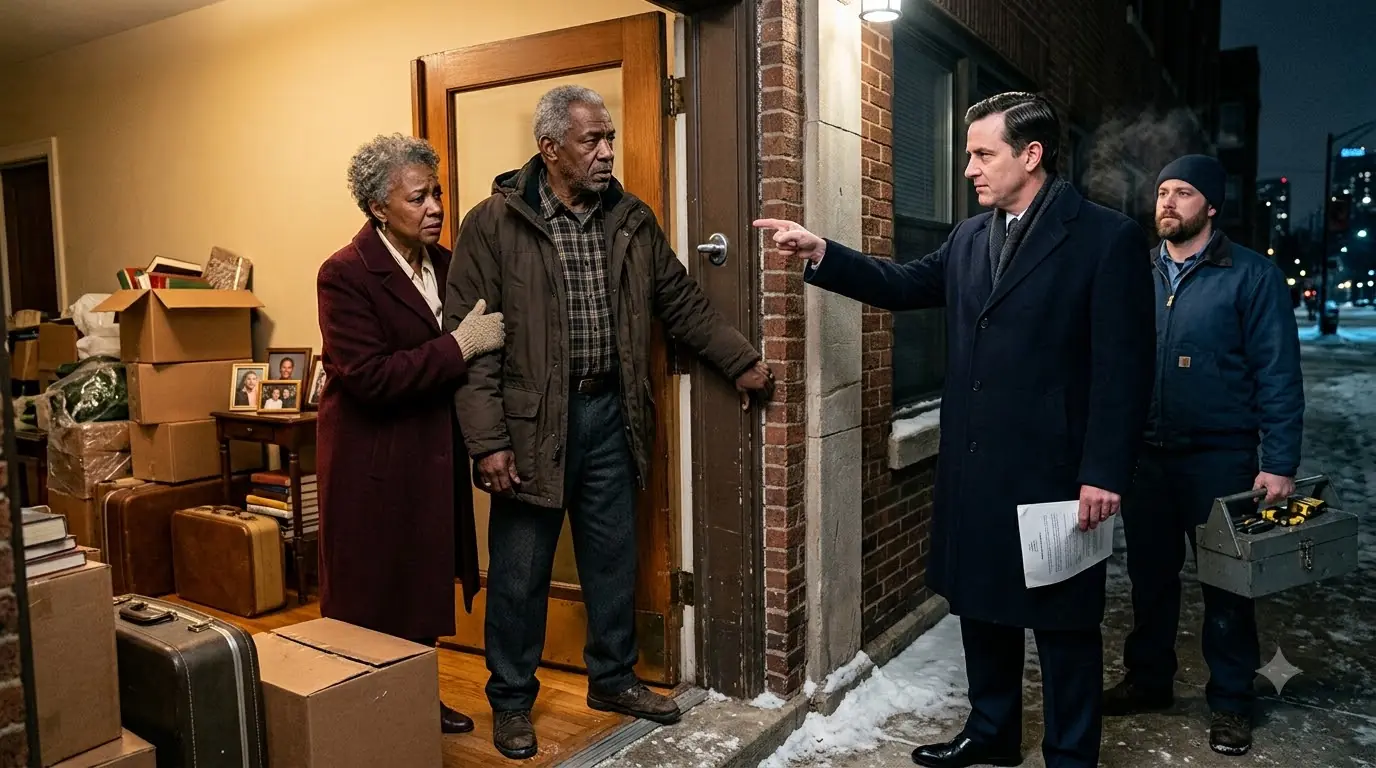
No explanation on those pages made sense. Outside, Chicago's February wind cut through Bronzeville at eighteen degrees below zero, the kind of cold that did not forgive.
Two weeks earlier, Irving had awakened at dawn and smelled something wrong. Carbon monoxide levels were high enough to kill. He knocked on his neighbor's door, got three children out before the poison took them, called 911, and saved lives. Eleven days later, his landlord wanted him gone.
His wife, Imani, stood behind him, sixty-one years old, her hands trembling, but not from the cold. Their granddaughter, Amara, slept in the next room, four years old and unaware that the home she knew was suddenly in danger. Vincent Hayes, their landlord, thought this would end with an older couple quietly packing boxes. He had never asked about their son, and he had never thought to wonder what their son did for a living.
Irving Collins was not the kind of man who made noise. At sixty-four, he had spent thirty-eight years with the postal service, working through rain, snow, and heat, rarely missing a day unless his daughter needed him. He retired two years earlier with a plaque and a pension that covered rent, groceries, and not much else. Imani had spent thirty-two years as a librarian at Bronzeville Elementary, the kind of librarian children remembered decades later because of her soft voice, patient hands, and gift for teaching them to love books.
They moved into Apartment 3C in 2002. It had two bedrooms and a kitchen window facing east, where the morning light was perfect for Imani's plants. Their rent had started at $850 a month and now stood at $1,150. They paid on time every month, every year, for twenty-two years without a single complaint from them.
Their neighbors knew them. Mrs. Johnson in 2B brought soup when the weather turned. Mr. Patterson upstairs borrowed Irving's tools and always returned them. The young couple in 4B asked Imani for book recommendations.
When Irving and Imani's daughter died from cancer in 2022 at only thirty-six, they took in her daughter, Amara. The girl was four now, bright and curious, and loved drawing at the kitchen table while Imani made breakfast. The apartment was not large, but it was home. Every Tuesday, Imani ran a book club in the building's common room for six older women from the block, mostly reading mysteries and arguing cheerfully about who had done it.
Irving fixed things for neighbors. Leaking faucets, stuck windows, and Mrs. Lane's radiator the previous winter all fell under his quiet care. He charged nothing. To him, it was simply what neighbors did for one another.
The building changed hands in 2018. The old landlord retired, and the new owner, Vincent Hayes, forty-eight, owned six buildings on Chicago's South Side and had never lived in any of them. Maintenance requests began piling up after he took over. Repairs came slower, the work got cheaper, and Hayes fixed what tenants could see while ignoring what they could not.
Irving noticed the change in smaller ways, too. Hayes smiled easily at the young white couple in 4B, but barely nodded at him. He returned Mr. Patterson's calls while letting Irving's go to voicemail. Those moments were easy to dismiss one at a time, but together they formed a pattern.
Hayes never learned their names. He called Irving "buddy" or "chief" and called Imani "ma'am" in a tone that sounded less respectful than indulgent. Irving kept his head down, paid the rent, and refused to make waves.
Their bank statements told a story Hayes never bothered to check. An account ending in 2847 showed 264 consecutive rent payments, every first of the month, in the amount due at the time. Not once late, not once short, not once skipped. They were the kind of tenants landlords claimed they wanted.
Their son, Isaac, called every Sunday. He was thirty-six, sharp, driven, and had made his parents proud in ways they rarely talked about out loud. He had graduated from law school, worked first as a public defender and then as a prosecutor, and recently taken a new position downtown.
"Can't visit this week, Dad," he would say. "Big caseload."
Irving understood. His son had worked too hard to slow down.
Irving also had a peculiar gift for noticing problems before they became disasters. He could smell gas leaks, electrical burning, and the chemical tang of refrigerant. He had already helped save the building twice over the years, once in 2009 and again in 2016, simply by recognizing that something was wrong and insisting that someone check it.
Imani used to joke about it. "My husband, the bloodhound."
On February 4 at 6:15 in the morning, Irving woke to a metallic smell that he recognized immediately as wrong. He sat up and listened. The furnace clanked below, which was normal. The smell was not.
Imani was still asleep, so he did not wake her yet. He walked to the kitchen and found the smell stronger there. It was not gas, and it was not burning wire. He checked the carbon monoxide detector on the wall. The light remained green.
His instincts disagreed with the machine. Irving kept a portable carbon monoxide meter in the hall closet, left over from safety training during his postal service years. He turned it on and watched the numbers climb: 42, 51, 63, 78, then 87 parts per million. The detector on the wall still showed green.
At 6:22 a.m., he photographed the meter with the warning light and timestamp clearly visible. Then he moved.
He went first to Apartment 2B, where Mrs. Johnson lived with three children, ages seven, five, and two. Irving knocked hard until she opened the door half asleep.
"Mr. Collins, it's six in the morning."
"Get your kids. Get out. Carbon monoxide. Eighty-seven parts per million."
She did not argue. She ran.
Irving hit the next doors. Mr. Patterson, the elderly couple downstairs, everyone he could reach. By 6:35, nine people stood in the lobby, cold, frightened, and some still in pajamas. Mrs. Johnson's two-year-old cried against her shoulder.
Irving dialed 911. "Carbon monoxide leak. 847 East Oakwood Boulevard. Three children. Level eighty-seven."
The operator told him to stay calm.
"I am calm," Irving answered. "They're not. Send the fire department now."
Mrs. Johnson's oldest child said his head had hurt all night. The five-year-old vomited in the lobby. Fire trucks arrived at 6:48, followed by paramedics and firefighters carrying their own meters.
They confirmed what Irving had found. The hallway read 87 parts per million, Apartment 2B read 72, and the furnace area read 94. The fire captain looked at Irving.
"You called?"
"Yes, sir."
"How did you know? The detector says safe."
"Smelled something wrong. Checked with my meter."
The captain nodded slowly. "You saved lives today. Another couple of hours, and those kids could have been gone."
Paramedics checked the children and confirmed mild carbon monoxide poisoning. Mrs. Johnson hugged Irving so tightly that he could feel her shaking.
"You saved my babies."
By 8:00 a.m., the furnace had been red-tagged and the building evacuated. Hayes arrived at 9:30. He did not ask whether anyone had been hurt. His first question was how much the repairs would cost.
He stood in the lobby with his jaw tight and his eyes cold. Irving was still there waiting for Imani when Hayes turned toward him.
"You called the city."
Not thank you. Not is everyone all right. Just accusation.
"I called 911," Irving said. "Three children were being poisoned."
"You should have called me first."
"There wasn't time."
"There's always time." Hayes stepped closer and lowered his voice. "You made this public. Fire trucks, paramedics, neighbors watching. You made me look negligent."
"The furnace is leaking poison."
"I don't care about your excuses." Hayes smiled without warmth. "You went over my head. That was a choice. Choices have consequences."
He looked at Irving like something stuck to his shoe. "This building has rules. You've been here long enough to know them. Maybe too long."
Then Hayes walked out, climbed into his Mercedes, and drove away without looking back. Imani touched Irving's arm.
"What did he mean?"
Irving watched the car disappear around the corner. "I don't know."
But he had heard threats before. This felt different. This sounded like a promise.
Two days later, on February 6 at 2:00 p.m., a city inspector arrived. His name was Bradley Moore, forty-nine years old, badge number 2831, and he drove a Lexus that seemed generous for a municipal salary. Hayes met him at the door like an old friend.
Irving watched from the lobby with Imani, the Johnsons, Mr. Patterson, and several other tenants who had been cleared to return temporarily. Moore carried a silver testing case but did not open it in the lobby. Hayes led him downstairs to the furnace room, and the door closed behind them.
Eighteen minutes passed. Irving checked his watch. A proper inspection should have taken far longer, especially for a building that had just been evacuated for carbon monoxide.
The door opened. Moore and Hayes came back upstairs speaking quietly. Moore did not test any apartments, did not verify carbon monoxide levels on different floors, and did not review furnace repair records in front of the tenants.
At 2:30, Moore stopped in the lobby and cleared his throat. "The furnace has been repaired. Building passes inspection. No violations found."
Irving stepped forward. "Sir, did you test carbon monoxide levels in each unit?"
Moore's jaw tightened. "I don't need to explain my process to you."
"I'm just asking if-"
Hayes cut him off. "Mr. Collins. Let the professional do his job, unless you think you know better than a city inspector."
The tenants watched. Irving kept his voice even. "I just want to make sure everyone's safe."