The asphalt smelled of stale rain and old motor oil. He thought she was an easy mark, just a tired woman walking alone to her truck. He had a black belt, a bruised ego, and a desperate need to prove his dominance. He did not know he was stepping toward someone who had spent years surviving situations far more dangerous than a diner parking lot.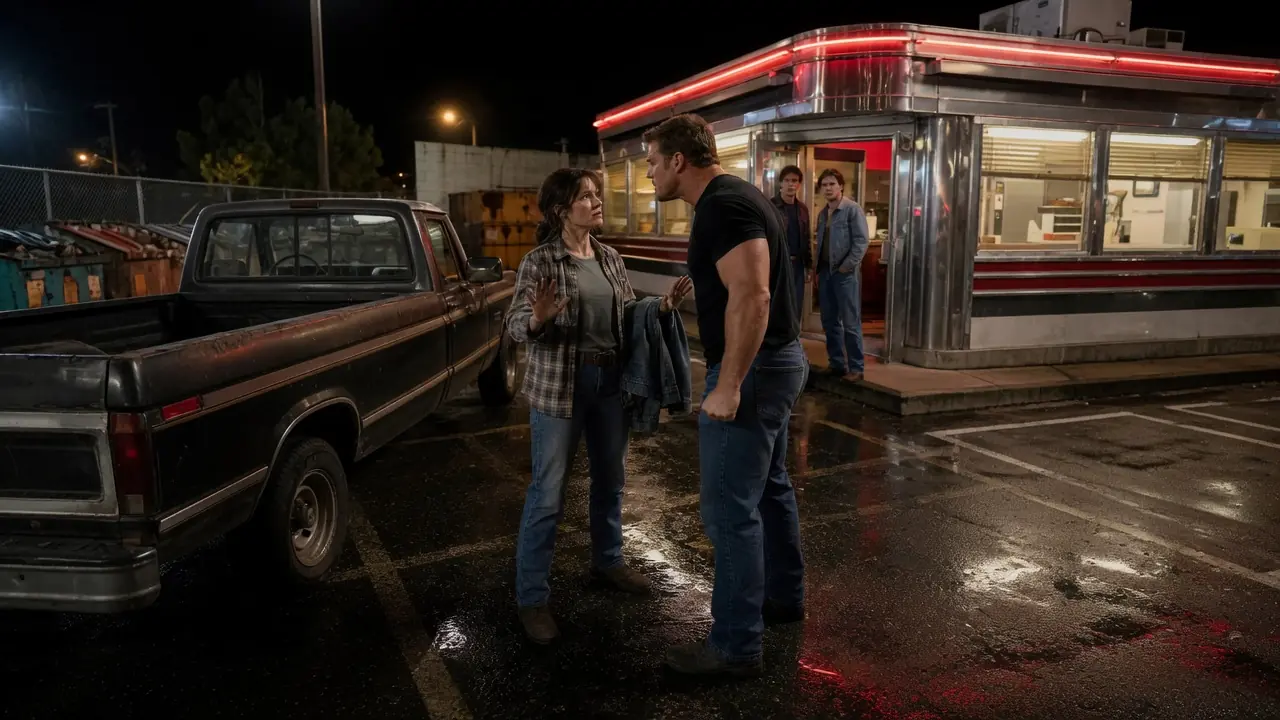
The neon sign in the window of Patty's 24-Hour Diner hummed at a high, erratic frequency. Most people tuned it out, but for Rachel, it vibrated against the permanent tinnitus ringing in her left ear. She sat in the corner booth with her back pressed against the faux-leather seat and her face angled toward the door. It was not paranoia so much as conditioning; after twelve years of entering places where maps were unreliable and danger could come from any direction, she no longer knew how to sit any other way.
She pushed a cold, greasy wedge of hash browns around her plate with the tines of her fork. The diner smelled of bleached rags, burnt coffee, and old cooking grease. It was 2:15 in the morning, and Rachel was tired in a way eight hours of sleep could never repair. Her lower back ached with a dull, rhythmic throb, a souvenir from a bad fast-rope descent from a Black Hawk five years earlier.
She took a sip of coffee. It tasted like hot dirt, but it was warm, and the heavy ceramic mug felt solid in her calloused hands. Two booths away, the atmosphere had begun to sour. Three men sat together, though only one of them appeared determined to become a problem. He was built like a fire hydrant, thick through the neck and shoulders, wearing a tight black athletic shirt that advertised his devotion to the gym.
He smelled strongly of aerosol body spray attempting to hide cheap beer. Nancy, an older waitress with tired eyes, stood at his table clutching her order pad like a shield. Her name tag hung slightly crooked above the pocket of her uniform.
“I ordered the steak medium rare,” the man said. His voice was far too loud for the nearly empty diner, carrying the forced baritone of someone performing for an audience. “This is shoe leather. Are you blind, or just stupid?”
Nancy shifted her weight. “I’m sorry, sir. The cook is alone back there tonight. I can take it back.”
“You’re right, you can take it back,” he sneered, leaning out of the booth and crowding her space. He tapped the order pad in her hands with one finger, a small but deliberately aggressive gesture. “And tell the guy in the back to do his job before I go in there and show him how.”
His two friends chuckled, though neither sounded comfortable. Rachel watched the exchange in the dark reflection of the window without turning her head. She hated this kind of ordinary cruelty, the predictable bullying of an insecure man who needed a tired waitress to feel smaller so he could feel larger. All Rachel wanted was to finish her terrible hash browns, pay her tab, and drive back to her empty apartment.
The man shoved his plate toward Nancy. It slid off the edge of the table and shattered on the linoleum floor. Gravy, steak, and ceramic fragments scattered across the aisle, and Nancy flinched backward.
“Oops,” he said with a grin. “Guess you’ve got a mess to clean up.”
“Pick it up,” she said.
Her voice was not loud or angry. It held none of the theatrical emphasis he seemed to need from every sentence. It was flat, controlled, and impossible to mistake for uncertainty.
The man stopped smiling. He turned slowly, scanning the diner before his gaze settled on Rachel. He saw a woman nearing forty, dressed in a faded flannel shirt, her dark hair pulled into a careless tie, exhaustion shadowing her eyes. He did not notice the ropy strength in her forearms or the way her attention had already mapped the distance between the booths, the tables, and the exit.
“Excuse me?” he said, his voice rising. “You talking to me, lady?”
“I am.” Rachel kept one hand around her coffee mug. “Apologize to her, pick up the plate, and pay your bill.”
A heavy silence fell over the diner. Even the cook seemed to stop scraping the grill. The man gave a short, disbelieving laugh and glanced at his friends for approval.
“Mind your own business,” he said. “You don’t know who you’re talking to.”
Rachel finally looked directly at him. Her eyes were a pale, washed-out green, and they held no visible emotion.
“I know exactly what I’m talking to,” she said. “It’s two in the morning. We’re all tired. Pick up the plate.”
He stood. He was perhaps six feet two and weighed around two hundred twenty pounds. He stepped into the aisle and inflated his chest as though size alone should settle the matter.
“Or what? You’re going to make me?” he asked. “I train five days a week at Vanguard MMA. I don’t take orders from washed-up suburban moms.”
Rachel stared at him for a long second. She felt the familiar cold release of adrenaline into her bloodstream, a response she had spent years trying to suppress. It did not feel empowering. It felt like an illness waking inside her.
Instead of answering, she reached into her jeans, pulled out a twenty-dollar bill, and placed it on the table. “Keep the change, Nancy.”
Rachel slid out of the booth, picked up her jacket, and walked toward the exit. She did not hurry. Her hands remained loose at her sides, her chin slightly lowered. She passed within two feet of him, but instead of giving him the confrontation he wanted, she moved by like a ghost.
“Yeah, that’s what I thought,” he barked after her, raising his voice to reclaim the dominance he felt slipping away. “Keep walking.”
Rachel pushed open the glass door. The night air hit her like a wet towel. A fine drizzle clung to her eyelashes and chilled her skin, while yellow parking-lot lamps cast sickly pools of light across the cracked asphalt.
She heard the diner door chime behind her before she was halfway to her truck. Heavy boots crunched over gravel, hurried and aggressive. Rachel did not stop. She drew in the damp air and let its cold settle into her lungs.
Don’t do this, she thought, directing the silent plea more toward him than herself. Go back inside. Eat your steak. Leave it alone.
“Hey! I’m talking to you.”
The voice was closer now, roughly fifteen feet behind her right shoulder. Rachel stopped beneath a burned-out light. A rusted dumpster stood to her left and a concrete retaining wall to her right, creating a narrow, poorly lit space on wet pavement.
She turned slowly. The man had followed her, while his friends hovered near the diner entrance and watched through the mist. He closed the remaining distance until only a few feet separated them. His fists were clenched, his jaw thrust forward, and up close the smell of beer, body spray, and anger was nauseating.
“You think you can disrespect me in there and just walk away?” he demanded.
“I think,” Rachel said, her voice dropping, “you’re making a terrible mistake over a broken plate.”
“I have a black belt.” He stepped even closer, trying to make her retreat. “I’ve been on the mat for six years. I could break your arm before you even knew what happened.”
Rachel looked at him carefully. His stance was meant to look relaxed, but his weight was committed forward, his balance impatient, his hands low because he believed she could not threaten him. He had learned violence in rooms with rules, coaches, padded floors, and referees. Rachel had learned it in places where a mistake could mean no one came home.
She had spent years attached to special operations units, training alongside people whose survival depended on discipline rather than bravado. She had taught men how to function when equipment failed and plans collapsed. Yet she wanted none of that life tonight. She wanted him to turn around.
“Listen to me,” Rachel said. She raised her open hands at chest height, a placating gesture to anyone watching and a ready posture to anyone who understood. “This is your last warning. Go back inside.”
He laughed. “Last warning from you?”
His pride would not allow him to leave. He swung at her, a wide, furious punch thrown with more ego than control. Rachel moved inside the arc before it could reach her. What followed was fast, economical, and far less dramatic than he had imagined a fight would be.
She redirected his momentum, struck once to stop his forward rush, and disrupted his balance before he could recover. His leg buckled beneath him, and Rachel guided him hard to the wet pavement, controlling his fall and pinning him before his friends had fully understood that the confrontation had begun. The entire exchange lasted only a few seconds.
He lay face down beneath her, gasping in shock. Rachel held him still with measured pressure, enough to prevent another attack without continuing once he was no longer a threat. The mist darkened his shirt and gathered on the asphalt around them.
“My leg,” he whimpered. The deep performance had vanished from his voice. “I can’t feel my leg.”
“Stay still,” Rachel said, her tone clinical but controlled. “You took a hard impact, and you’re disoriented. Don’t try to stand until someone checks you.”
The man groaned. His confidence had evaporated, replaced by confusion and fear. The simple equation in his mind—his size, his belt, his years at the gym—had not prepared him for someone who refused to fight on his terms.
Rachel looked toward the diner. His two friends remained frozen beside the door, making no move to come closer. One had lifted a phone but was no longer recording; his arm hung uselessly at his side, and his expression suggested that the spectacle had stopped being entertaining the moment it became real. Nancy stood behind the glass with one hand over her mouth, while the cook hovered behind her holding a dish towel, uncertain whether stepping outside would help or make everything worse.
The man on the pavement tried to push himself up, but Rachel felt the movement beneath her and told him again to stay still. She did not threaten him or add pressure. She simply waited until his struggle stopped and his breathing became less frantic. The restraint required more effort than taking him down had; every old instinct wanted the danger completely controlled, but this was not a raid, and he was no longer an active threat.
Slowly, Rachel rose. She stepped backward, leaving space between herself and the man on the ground. She looked down at him with exhaustion rather than triumph.
“I warned you,” she said quietly. “You should have gone back inside.”
Rachel turned and walked the remaining distance to her truck. She unlocked the door, climbed into the cab, and locked it again. For a long time, she sat in the darkness listening to the rain tap against the windshield, waiting for her hands to stop shaking before she touched the ignition.
The heater smelled like burning dust and old dog hair. It coughed lukewarm air against her damp face while the engine idled. Rachel gripped the steering wheel until her knuckles turned white, and the wipers scraped back and forth across the glass, squealing whenever they crossed a dry patch.
She did not shift into drive. She could not—not yet. Violence was a high-interest loan, and the body always came to collect.
During the brief altercation, her nervous system had flooded her with adrenaline. Her pupils had widened, her muscles had tightened, and every nonessential part of her body had temporarily gone quiet. Now the danger was gone, and the withdrawal hit hard.
Her fingers began to tremble. The fine movement spread into a deep shudder through her forearms and chest. Her teeth clicked together over the low rumble of the truck.
Rachel leaned her forehead against the steering wheel and closed her eyes. She did not feel like a victor. She felt like an animal that had been cornered over something small and ugly.
“I should have kept walking,” she thought. “I should have let it go.”
But she knew the thought was not entirely honest. Once he followed her outside and swung, she could not safely assume the attack would stop after one blow. She did not know whether he carried a weapon, whether his friends would join him, or whether a single lucky punch would end her life on wet asphalt.
Her training was not a switch she could turn off. It was an operating system wired deep into her instincts: recognize the danger, end it quickly, use only what was necessary, and get out. That system had kept her alive. It had also made ordinary life difficult to inhabit.
Rachel took a slow, uneven breath, tasting stale coffee at the back of her throat. Through the rain-streaked windshield, she saw Nancy emerge from the diner with a blanket while one of the man’s friends crouched several feet away and spoke into a phone. The scene no longer needed Rachel, and remaining there would only invite questions she was too exhausted to answer. When the shaking finally faded to a manageable twitch, she shifted the truck into drive and pulled out of the parking lot. She did not look in the rearview mirror.
At the first red light, her foot trembled against the brake pedal. She counted five things she could see, four she could touch, three she could hear—the grounding exercise a military therapist had taught her years earlier and that she had pretended not to need. Wet pavement. A dark pharmacy window. The green glow of the dashboard. The worn seam beneath her thumb. The rattle inside the passenger door. By the time the light changed, the present had returned enough for her to continue.
The drive home became a blur of blinking yellow signals and empty, rain-slicked intersections. Rachel lived on the second floor of a tired brick building near the industrial district, in the kind of neighborhood where people minded their own business because involvement usually came with a cost. She parked, climbed the rusted iron stairs, and unlocked her door.
The deadbolt turned behind her with a heavy, satisfying sound. Her apartment was sparse: a gray sofa, a television she rarely used, and a bookshelf crowded with dog-eared paperbacks and dense books on anatomy and movement. The rooms smelled of lemon cleaner and old drywall.
It was cold, but she did not touch the thermostat. Rachel walked directly to the kitchen sink and turned on the water. She scrubbed her hands with cheap dish soap, watching the suds circle the drain.
Her right palm was stiff and flushed where it had absorbed the impact. By morning, she knew it would be bruised. She dried her hands and walked into the bathroom, where the fluorescent light flickered and cast a green pall over the mirror.
Rachel stared at her reflection. She looked exactly how she felt: exhausted, hollowed out, and carrying a weight no one else in the room could see. Her pale eyes stared back without offering comfort.
She removed her damp clothes and let them fall to the linoleum floor. Her body was a map of old violence. A raised scar crossed her left ribs, and smaller marks dotted one shoulder. She did not study them. They were simply part of the landscape now.
She stood beneath the shower and turned the water as hot as she could tolerate. It struck her back and shoulders, but the warmth never seemed to reach her center. Part of her remained in that empty parking lot beneath the dead light.
For a moment she remembered another shower in a temporary barracks overseas, dust turning to brown rivers around her boots after a night she still refused to describe. Back then, people had been waiting outside the door—teammates, medics, someone making terrible coffee and pretending everything was normal. Here, no one waited. The comparison made the apartment feel even quieter.
Eventually the water cooled. Rachel stepped out, dried herself, and put on heavy sweatpants. She lay on her bed and stared at the shadows cast through the cheap blinds.
The silence of the apartment felt oppressive. When someone has lived for years at a hundred miles an hour, navigating life-or-death variables, the complete absence of stimulation can resemble sensory deprivation rather than peace. Every time Rachel closed her eyes, she heard the man hit the pavement and remembered the moment his arrogance became terror.
She had not taught him a lesson. He would not wake as a kinder person simply because he had lost a fight. More likely, he would wake in pain and humiliation and direct that anger toward someone smaller, someone who did not possess Rachel’s training.
Violence rarely repaired the source of a problem. It transferred fear, pain, and shame from one person to another. Rachel understood that more clearly than most, and the understanding did not make her feel better.
She rolled onto her side and pulled the quilt beneath her chin. For three more hours, she listened to distant police sirens fade through the rain and waited for daylight to wash the night away.
Morning came without grace. It did not break across the sky so much as seep through the cracks in the blinds, a flat gray light that made everything appear dust-covered. Rachel woke with a dry mouth and a dull ache at the base of her skull.
She sat up, and the joints in her lower back popped in a staccato rhythm. The heel of her right palm was swollen, a dark bruise spreading beneath the skin. She flexed her fingers carefully. Nothing appeared broken, but the injury would make work difficult.
Forty-five minutes later, Rachel pulled her truck into the gravel lot of Finch and Sons Custom Carpentry. The business occupied a cavernous corrugated-steel building that smelled of pine sap, sawdust, and hot machinery. This was Rachel’s sanctuary.
Here, the rules made sense. Measure twice, cut once. Wood did not have an ego or a need to dominate. Applied pressure with the correct tool produced a predictable result, while impatience caused splintering.
There was an honesty in carpentry that Rachel rarely found in people. She entered through the rolling bay doors as the compressors began their morning hum.
“Morning, Rach.”
Arthur Finch looked up from a massive planer. He was in his late sixties and seemed carved from an old oak stump. Half of his left index finger was missing, and he carried himself with a calm, steady presence Rachel respected.
He had never pressed her for details about the past. He cared that her cuts were square, her joinery held, and she arrived on time.
“Morning, Arthur,” Rachel said, her voice raspy.
She crossed to her workbench, where a partially assembled cherrywood dining table waited. The grain was rich and swirling, rough beneath her fingers but full of potential. Rachel reached for the orbital sander with her right hand.
The pressure of the hard grip sent pain up her forearm. She hissed, and the sander clattered onto the bench.
Arthur shut off the planer. The sudden silence in the shop felt heavy. He wiped his hands on his canvas apron and came over without saying anything, his gaze settling on the swelling and deepening color of her palm.
“Hit a stud?” he asked mildly.
Rachel looked at her hand, then at Arthur. She recognized the easy explanation he was offering, a harmless civilian lie that required no further discussion.
“Something like that,” she said.
Arthur nodded and pulled a roll of athletic tape from his apron pocket. He tossed it onto the workbench.
“Cherry is dense,” he said as he turned back toward his machine. “Takes patience to smooth it. If your hand is compromised, you’ll drive the sander edge into the grain. Tape it, or switch to hand work for the details.”
“I’ll tape it.”
“Take your time,” Arthur said over his shoulder. “We’re not building a house on fire.”
Rachel wrapped the tape around her wrist and palm, pulling it snug enough to stabilize the swollen tissue. The pressure helped. She thought about the man from the diner and wondered whether he had gone to the hospital.
She wondered whether he was seriously hurt. The question remained like a dark stain across the morning, no matter how hard she tried to push it aside.
Rachel picked up a block of sandpaper with her left hand and began the detail work manually. She pressed the abrasive surface against the cherrywood and moved it in steady strokes. Arthur restarted the planer without asking anything else, granting her the privacy of noise. That was one of the reasons she trusted him: he understood that silence could be companionship rather than absence.
Scrape. Scrape. Scrape.
The rhythm grounded her. Sweet, earthy dust rose into the air. Slowly, the rough edge beneath her hand began to soften.
Rachel was not a hero. She understood that clearly. When she had been younger and still in uniform, the lines had seemed cleaner: protect the vulnerable, stop the threat, bring people home. Civilian life was not a combat zone. It was a tangled web of frightened and damaged people colliding in the dark.
The man in the parking lot had been an arrogant bully, and he had attacked her after she tried to leave. She had warned him repeatedly, tried to disengage, and used force only after he swung. Those facts mattered, but they did not make the memories pleasant. Rachel was also an exceptionally trained instrument of force responding to a petty, ugly conflict, and the imbalance troubled her.
She imagined Nancy sweeping up the plate after the ambulance left, perhaps blaming herself for a chain of events she had not caused. She imagined the man’s friends editing the story to protect their own pride, turning Rachel into an attacker because admitting the truth would mean admitting they had watched their friend create the entire disaster. Every act of violence produced a second battlefield made of explanations, accusations, and incomplete memories.
It felt like using a sledgehammer to kill a mosquito on a glass table. The mosquito was gone, but the table might never be the same.
Rachel pressed the sandpaper against the wood and kept working. She could not erase what she knew. She could not forget how to read danger in posture, how to recognize the instant before violence, or how to take control before another person understood they had lost it.
That knowledge was embedded in her as permanently as the scar tissue on her ribs. Yet when she ran her fingers over the newly smoothed edge of the table, feeling the transition from rough to even, she made herself a quiet promise.
She would remain in the shadows whenever possible. She would keep her head down, drink terrible coffee, and work with wood that did not lie to her. She would try to be a tool that built rather than a weapon that destroyed.
The promise was not heroic. It did not erase her past, cure the ringing in her ear, or guarantee that another loud man would not mistake restraint for weakness. It was simply a direction, like following the grain instead of cutting against it. Some days that would have to be enough.
And if someone left her no other choice, she would do what survival required—then carry the cost herself.