"Leave her alone," Samuel Cole said at once, quietly. The two men standing over the woman in the snow turned around slowly, the way men do when they're deciding whether the person behind them is worth their time. Sam was already off his horse, knife already out. He didn't reach for the rifle, didn't need to. There was something in his stillness that made both men take a step back without quite deciding to.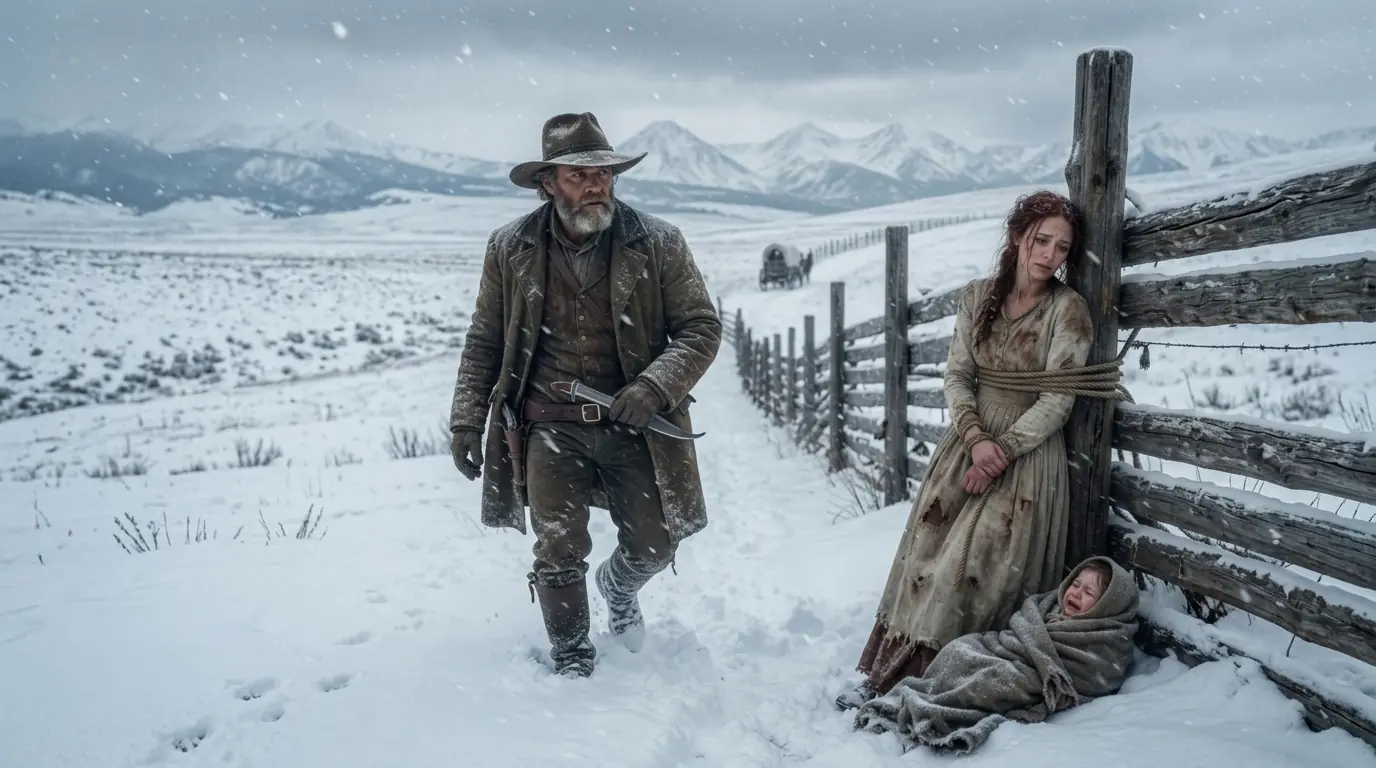
He cut the ropes, lifted the woman, picked up the little girl with his other arm, and walked away without looking back at either of them. The two men had been watching him since he came through the tree line. Samuel Cole saw them before they saw him. He had that habit, born from years in the mines where the difference between a man who noticed things early and a man who didn't was sometimes the difference between walking out and not walking out at all.
They were standing near the north fence of his property, collars up against the January wind, horses tied to the tree break behind them. Not doing anything. Just standing. The way men stand when they're waiting for something to be finished. Sam pulled his horse up, read the situation the same way he read the snow, quickly, completely, without sentiment.
There was a woman on her knees between them, her wrists bound behind her back to the fence post. Her dark red hair loose and soaked against her face. No coat. Dress soaked through at the hem. Skin the color of candle wax, and three feet away from her, a little girl, copper-haired, barefooted, screaming into the blizzard with a full force of a child who has run completely out of options.
Sam dismounted. "Leave her alone." The taller of the two men turned. He had the broad, unhurried face of someone accustomed to not being challenged. "This ain't your business, friend."
"You're on my land," Sam replied. Sam kept walking, kept his voice level. "That makes it my business." "The woman belongs to the Briggs family. We're just taking her away."
Something in the way Sam said it—not loud, not angry, just absolutely certain—made both men move. Not far, but they moved. Sam crouched in front of the woman, who flinched hard at his approach, her whole body pulling back against the post, even though there was nowhere to go. "I'm not going to hurt you," he said. "I'm going to cut those ropes.
That's all." Her eyes found his, gray-brown, fever-bright, containing an entire calculation happening behind them. Who is this man? What does he want? What will this cost me?
Can I afford not to let him? All of it in about 2 seconds. "They'll say I ran," she whispered. "You're not running anywhere in this condition." Sam pulled his knife, reached around her, found the first knot.
Whoever tied it had done it with intention, not to hold temporarily, but to hold until the cold finished what the rope started. His jaw tightened as he worked through it. "What's your name?" "Martha. Martha Briggs."
A pause, thin as paper. "Widow." The rope gave way. She gasped as her arms came forward, the circulation returning in a way that clearly hurt. He moved to the second knot.
Behind him, the taller man said, "Mister, you do not want to do this. Wade Briggs will find out you interfered." "Then go tell him." Sam didn't look up. "Right now, go tell him exactly what you saw."
A silence. Then the sound of two sets of boots moving through the snow, unhurried, but definite. Then hoofbeats heading south toward town. The second rope fell away. Martha pitched forward, and Sam caught her, and she was so light it stopped him cold for just a moment.
The particular lightness of a body that has been giving everything it had for too long, with too little coming back in return. "Lily." Her voice was barely there. "Where is she?" "Right here, Mama."
The little girl had stopped screaming the moment the two men left. She was standing at Sam's elbow now, serious and watchful. Her bare feet red from the cold. Both hands pressed flat against her own small sternum. She looked at her mother, then up at Sam with the unnerving directness of a child who has learned to make fast decisions about adults.
"Can you carry her?" she asked him, perfectly matter-of-fact. "Yeah," Sam said. "I can carry her." "Okay." She reached up and put her hand in his.
"Then I'll walk." She didn't walk for long. By the time they reached the horse, she was shaking too hard, and Sam lifted her up without asking permission. Settled her against his chest inside his coat, and felt her small hands grip the front of his shirt with surprising strength. He laid Martha across the saddle as carefully as he could manage.
She didn't lose consciousness entirely. Kept making small sounds. Kept saying Lily. Kept trying to orient herself even as her body was shutting down. He kept one hand on her back the whole two miles home and talked to her the whole way.
Not because he thought she fully heard him, but because he needed her to know there was still a voice nearby. The cabin was cold when they arrived. He got the fire built up in under 4 minutes. It was a skill earned from years of Colorado winters that don't negotiate. Then he laid Martha on the bed and covered her with everything he owned that qualified as a blanket.
He found a pair of wool socks that went to Lily's knees and put them on her feet while she sat on the hearth watching him with those grave calculating eyes. He warmed water and cleaned the rope burns on Martha's wrists which were raw and deep and would scar. He spooned warm broth between her lips when she surfaced from unconsciousness. He held her steady when the shaking got bad. He checked the door twice an hour because something in his gut told him the two men he'd sent away were not the end of it.
Around the second hour, Lily said from her spot by the fire, "Wade said Mama deserved what she got." Sam was cutting bandage cloth. His hand slowed. When did he say that? This morning.
Before the men took her outside. She was turning a wooden button over and over in her small fingers. Something she'd found in the seam of his spare coat hanging by the door. He said she wasn't a real Briggs and she never was. He said real Briggs women don't cause problems.
Sam set down the cloth. He looked at this child. Three years old. She had bare feet in enormous wool socks and sat in a stranger's cabin after watching her mother be dragged outside and tied to a fence post. She turned a button over and over in her hands with the focused calm of someone who has learned that panic doesn't help.
You're safe here, he said. Both of you. She looked up at him. Wade has a gun. So do I.
She considered this. She apparently found it satisfactory and went back to the button. Martha woke fully around midnight. Sam heard the change in her breathing and was at the bedside before she could sit up. She tried to do so immediately, swinging her legs over the edge with the automatic urgency of a woman whose body had decided sleep was a liability she couldn't afford.
Easy. He put a hand on her shoulder. His touch was careful and light. You're all right. Lily's sleeping by the fire.
You're in my cabin. You're safe. She looked at Lily. She stared at her for a long ten seconds, watching the rise and fall of her daughter's small chest. Then she pressed both hands over her mouth.
Her shoulders shook once, hard. She pulled it back. How long was I out? About five hours. She looked down at her bandaged wrists.
She turned them over, examining his work. Then she looked at him with those amber eyes that the firelight made into something startling. You didn't have to do this. I know. Most men in this county would have ridden past.
I'm aware. So why didn't you? He handed her the cup of broth he'd been keeping warm. She took it. He pulled the chair up to the bedside and sat, leaning his elbows on his knees, his voice quiet and even in the way he used when the truth needed to be said plainly.
"When I was 20 years old, I watched a man get left in a mine collapse because the foreman decided the rescue would cost too much," he said. "Man had a wife and three kids. Foreman went to church every Sunday. Entire town respected him. Nobody said a word."
Sam looked at his hands. "I said a word. Got fired the next morning. But the thing that stayed with me 30 years, it isn't the foreman. It's every other man who was standing there and looked away."
He met her eyes. "I don't look away." Martha was quiet for a moment. The fire shifted. Outside, the storm was beginning to ease.
And in the new quiet, Sam could hear the particular silence of a world buried in snow, heavy and complete. The silence of a landscape that has swallowed every sound whole. "Wade Briggs is going to come here," she said. "Probably." "He'll bring the sheriff.
He has an arrangement with Sheriff Calhoun, has for years. Harold did, too." Her voice was controlled, careful, the voice of someone presenting a case rather than expressing a fear. "He's going to tell Calhoun that I fled the Briggs household in a state of mental distress following Harold's death. That you found me wandering and brought me here with good intentions, but that I need to be returned to family care.
He'll say I'm unstable, that Harold always worried about my stability, that I've made accusations before. The steadiness in her voice didn't waver, but something behind it did. Something she was holding at arm's length with enormous practiced effort. He's thought this through. He's been thinking it through since before Harold was cold.
Sam studied her. You knew this was coming. I knew the moment Harold died that Wade would move on the house and the land. She set the cup down. I didn't know he'd use Lily.
That was She stopped and reset. I underestimated how far he'd go. What exactly does he want with her? Harold's estate doesn't fully transfer to Wade until all dependents are settled. As long as Lily is considered an unsettled dependent, a minor child without a proper guardian, Wade controls the administration of the estate.
If I retain custody, I have legal standing to contest the property transfer. If he takes custody, I have nothing. And he controls everything Harold owned until Lily turns 18. Her voice was very flat now, very precise. She's not his daughter.
She's a legal mechanism. Something hard and cold settled in Sam's chest. He thought about the little girl sleeping by the fire with her button and her enormous wool socks. And he thought about a 28-year-old man who had looked at her and seen paperwork. "He had your coat."
Sam said. It came to him suddenly. The two men. The taller one was wearing a woman's coat over his own. Martha blinked.
Then something shifted in her face. Not surprise, but the specific exhausted recognition of a cruelty so petty it hadn't even registered in the larger accounting of the night. "Yes." She said quietly. "He took it before they brought me outside.
Said I wouldn't need it for long." The fire cracked and shifted. Sam stood, moved to the window, looked out at the snow-buried dark of his property. The storm had dropped to a low, steady fall now. The kind that would be passable by morning if it held.
Which meant the road to Coldwater Creek would be passable, too. Which meant Wade Briggs would know by dawn that his plan had failed. And men like Wade Briggs, in Sam's experience, did not absorb failure quietly. They absorbed it, and they recalculated, and they came back with something worse. "There's a woman in town."
Sam said, still looking at the window. "Agnes Porter. Runs the general store on Main. She was here before the Briggs's were, and she'll be here after. She knows every piece of business in that county, and she has no patience for men who use the law like a private tool."
He paused. "She also knew Harold. Knew what he was under the reputation. She told me once that the day he died, three women she knew breathed for the first time in years." Martha was very still behind him.
You'd go to her? First thing in the morning. He turned from the window. She'll know what we're dealing with legally. She'll know what can be done.
And if nothing can be done? He looked at her steadily. Something can always be done. It just isn't always comfortable. She held his gaze for a long moment.
He could see her deciding. Not whether to trust him. Not exactly. It was more specific than that. She was deciding whether to let herself believe that what he was offering was real and not another version of the thing she'd been receiving from men her entire life.
Protection that was really control. Kindness that was really currency. Safety that came with a lock on the outside of the door. I can't go back to that house, she said. You're not going back.
If Calhoun comes here with a warrant, he can Come with whatever he likes. Sam's voice was quiet and absolute. You're not going back. Something went out of her face then. Not relief, not yet, but the beginning of the absence of a specific kind of exhaustion.
The exhaustion of being the only person in the room who was fighting. She looked at her hands, at the bandages, at the evidence of what the night had cost her. Then she looked up at him and said, very quietly, I don't know how to thank you. Don't, he said. Not yet.
Wait and see how it goes. She almost smiled. It was small and brief and a little broken. And it was the most honest thing he'd seen on a human face in years. All right, she said.
All right. He went back to the chair by the bed. She lay back against the pillow. The fire burned low and steady, and outside the snow came down in the particular silence of a world holding its breath. And Sam sat with his eyes on the door and his rifle across his knees because something in the quality of the night, some instinct honed over 3eight years of paying careful attention, told him the storm outside was not the only thing that was coming.
He was right. At 2:00 in the morning, Lily woke up screaming. Not the crying of a child startled from a dream, something sharper. Her small body bolt upright, her eyes open and focused on the cabin door with an expression that stopped Sam's heart for a full second because it was not the expression of a child reacting to a nightmare. It was the expression of a child reacting to something real.
Lily. Martha was already moving, crossing the cabin floor in bare feet, gathering her daughter against her chest. Baby, it's all right. It's Someone's outside, Lily said. She said it the way children say the truest things, plainly, without drama, as simple and certain as a fact about the weather.
Sam was already at the window. Two horses standing at the tree line, not moving, just standing there in the snow dark, maybe a hundred yards out, close enough to watch the cabin, but far enough to claim they were just passing if it came to that. He stood very still and watched them. They didn't move. Sam, Martha's voice, low and controlled behind him.
I see them. Is it I don't know yet. He stepped back from the window, checked the rifle, moved to stand beside the door. His voice was calm and even. Stay away from the windows.
Keep Lily away from the windows. Sam heard Martha pull Lily closer. Heard the soft sound of the little girl's breathing begin to slow as her mother's voice and hands did their work. Then Martha said, very quietly, whatever happens, whatever they say I did, whatever story they're telling, I need you to know that everything I told you tonight is the truth. Sam looked at her across the dark room.
The fire had burned to coals, and in the low red light, she looked like something from a painting. A woman holding her child in the dark while men on horseback waited in the snow outside. The entire weight of an unjust world pressing against the walls of a small cabin in the Colorado mountains. "I know." He said.
Outside, one of the horses shifted. Still didn't move closer. Just watching. Just waiting. Sam tightened his grip on the rifle and waited too.
The horses didn't move for forty minutes. Sam stood at the door with his rifle and counted his own breaths and watched them through the gap in the shutter slats. Two dark shapes at the tree line. Patient and still as fence posts. Martha sat on the edge of the bed with Lily pressed against her chest.
The little girl's breathing slow now. Almost asleep again despite everything. The way small children can surrender to exhaustion even in the middle of danger because their bodies simply override their fear. At some point during the second hour, Martha said quietly, "They're not going to come in tonight." Sam didn't take his eyes off the window.
"You know that?" "This is Wade's way of saying he knows where I am." Her voice was even, almost clinical. He's not ready to move yet. He wants me to know he's watching.
He wants me to spend the night afraid. A pause. He's done it before. With Harold's blessing. Sam looked at her over his shoulder.
She was sitting very straight, Lily tucked against her side, her bandaged hands folded in her lap. Not trembling. Not looking at the window. Her eyes were fixed on the middle distance with the expression of a woman running calculations. "How many times?" he said.
It wasn't quite a question. "Enough that I recognize the pattern." She finally looked at him. "By morning he'll have a story. He always has a story ready before he makes a move.
That's what tonight is. He's buying himself time to construct it properly." "What kind of story?" "The kind where he's reasonable and I'm not." She smoothed Lily's hair back from her forehead with one bandaged hand, gentle and automatic.
"Harold was the same way. The whole town thought Harold Briggs was the steadiest, most patient man in Colorado. When I tried to tell Agnes Porter what he was, what it was like inside that house, she believed me. But she was one person. Her jaw tightened.
One person doesn't change a town's mind about a man they've respected for 20 years. Sam turned back to the window. The two horses were still there. One of them moved. A small shift, a restless step.
And then was still again. "Get some sleep." he said. "I'll watch." "Sam, you can't do anything useful running on empty. Get some sleep.
I'll wake you if anything changes." A long silence. Then the sound of her settling back on the bed, drawing Lily against her. Then quiet. Sam stayed at the window with his rifle and his thoughts, and watched the tree line until somewhere around 4:00 in the morning, the two horses turned and walked away south through the snow without hurrying, without any particular drama, as if they'd simply finished a job and were heading home.
He stood there until he couldn't hear them anymore. Then he sat down in the chair by the door and closed his eyes for two hours. And that was enough because it had always been enough. Dawn came gray and cold and absolute. Sam had the fire built up and coffee on before Martha woke.
And when she came out of sleep, it was the same way she'd done everything else he'd seen from her. Quickly, completely, without the slow surfacing that most people needed. She was awake, and then she was sitting up and assessing the room in a single motion. Her eyes going immediately to the window and then to Sam. "They left around 4:00," he said, pouring coffee.
She accepted the cup. "Agnes Porter," she said. "You should go this morning." "I know." "Before Wade gets to her first."
She wrapped both hands around the cup. "He'll try. He'll go to everyone he thinks I might lean on, and he'll put his version of events in their heads before I can speak for myself. He did the same thing when Harold died. Went to Reverend Holt before I could even get dressed and told him I'd been struggling.
That Harold had worried about me. That grief sometimes made women behave in ways that weren't She stopped. Anyway, Agnes is too smart to fall for it, but he'll try. "I'll be back before noon." Sam pulled on his coat.
He looked at Lily, who had materialized from the bedroom and was sitting on the hearth rug. The wooden button from yesterday back in her hands, watching him with those serious eyes. "She know how to use a rifle?" Martha looked at him sharply. "I'm asking."
He said. "I know how to use a rifle." Martha said. "Harold insisted, actually. He wanted me to be able to defend the house if something happened while he was away."
Something flickered across her face. The particular irony of a man who had armed his wife against outside threats and never once considered that the threat was him. "There's a certain poetry in that." Sam took the smaller rifle from the rack by the door and set it on the table within reach. "Don't open the door for anyone.
Not Calhoun, not anyone who works for Calhoun, not anyone who says they have a message from me. If I need to get back in, I'll knock three times, then once." "Three and one." Martha repeated. "Three and one."
He looked at her. "You'll be all right." She met his eyes steadily. "I've been all right through worse. Go."
The ride into Coldwater Creek took forty minutes on a good road. This morning the road was neither good nor bad. The storm had softened to nothing overnight and the snow lay thick and clean and still, muffling every sound, turning the valley into something that looked peaceful in a way Sam knew better than to trust. He rode fast and kept his eyes moving. Coldwater Creek was a town of 212 people, which Sam knew because Agnes Porter had told him once, with the precision of a woman who counts things, it had a main street of packed dirt that turned to mud in spring and froze solid in winter.
A general store, a sheriff's office, a church, a livery, a saloon that tried to pretend it was something more respectable than a saloon, and enough history of powerful men doing as they pleased that the town had developed a particular posture. The collective hunch of a community that has learned to look at the ground when trouble walks past. Agnes Porter's general store was the first building on the left coming in from the east road, which was the direction Sam came from, which was not an accident. Agnes had positioned it that way deliberately, she told him once. "I want to see everything that comes into this town before it sees me."
He tied his horse at the post outside and went in. Agnes was behind the counter, her gray hair pinned back under a practical hat, her reading glasses on the end of her nose, going through a ledger with the focused attention she brought to all accounting, other people's business included. She was 5six years old, had outlasted one husband, declined two subsequent proposals, and had built the most profitable store in the county through some combination of business acumen, total recall for what every customer had ever bought or said, and a moral backbone that Sam had tested once, inadvertently, and found to be without flex. She looked up, read his face, closed the ledger. "Martha Briggs," she said, "you already heard.
Roy Callam came in an hour ago for tobacco, mentioned that Wade Briggs was at the sheriff's office first thing this morning, filing a report." She pulled her glasses off. Missing person. He claimed his stepmother fled the house in a state of distress two nights ago and hasn't been seen. Said he was deeply concerned for her welfare and the welfare of her child.
Her voice was perfectly flat. He used the word welfare four times in Roy's telling of it, which means he used it at least six in the actual conversation. Sam put both hands on the counter. She's at my cabin. I found her tied to the fence post on my north line yesterday morning.
No coat. The little girl was barefoot in the snow. He reached into his coat pocket and put the folded paper on the counter. This was nailed above her head. Agnes unfolded it, read it.
Her expression didn't change, but something around her eyes went very still in the way that meant she was deciding something. "How bad are the wrists?" she said. "She'll scar." Agnes set the paper down carefully. "Sheriff Calhoun is going to come to your cabin today, before noon most likely, because Wade will push him, and Calhoun doesn't have the backbone to push back."
She looked at Sam directly. "He's going to have a document, a petition for temporary guardianship of Lily Briggs on the grounds that Martha is an unfit and unstable custodian. Wade filed it three days ago, before Harold had even been in the ground two weeks. He was ready." "Can he get it?"
"He can get Calhoun to carry it. Whether it holds up is a different matter." She came around the counter, moved to the window, looked out at the empty main street with her arms crossed. "There's a lawyer in Denver, Thomas Garrett. He's handled cases against the Briggs family before.
Harold tried to steal water rights from the Kellerman ranch 4 years back and Garrett stopped him cold. He doesn't care about their money and he doesn't care about their reputation. She turned. I can get a telegram to him today. He could be here in three days if the roads hold. three days is a long time if Calhoun comes with a document today.
I know. Agnes pressed her lips together. Martha needs to refuse to go. Politely, clearly, in front of witnesses if possible. Calhoun can't physically remove her from your property without a full court order and a full court order takes longer than a petition.
Wade knows this. He's hoping she'll be frightened enough to comply before she understands what she's actually signing. She looked at Sam. Is she frightened? He thought about Martha sitting straight-backed on the edge of his bed at 2:00 in the morning with her daughter against her chest running calculations while men on horseback watched from the tree line.
Not in the way Wade thinks she is. Agnes studied him for a moment. You trust her. It wasn't a question, but it had the shape of one. The shape Agnes gave to things she'd already decided, but wanted to hear spoken aloud for confirmation.
Sam met her eyes. I trust her. Good. Agnes moved back to the counter, picked up the paper, folded it again, and held it out to him. Keep this.
It's evidence. Don't let it out of your possession. She was already moving toward the back room. I'm going to send that telegram now. You go back to your cabin.
When Calhoun comes, and he will come, let Martha speak for herself. Don't put yourself between her and the sheriff unless he tries to physically remove her. The moment this becomes you against the law instead of Martha against a corrupt petition, Wade wins. And if Calhoun doesn't listen to her? Agnes stopped in the doorway to the back room.
She looked at him over her shoulder with an expression that was not quite a smile and not quite something harder than a smile, but somewhere in between. Then you come get me, she said. And I'll remind Sheriff Calhoun that I have been keeping his account books for 12 years and I know every purchase he has ever made in this store. And some of those purchases would make for very interesting conversation at the next town council meeting. Sam looked at her.
Go, she said, and went into the back room. He was back at the cabin by half past nine. Three knocks, then one. Martha opened the door before he had his hand down, rifle in her other hand. Lily standing behind her knee with the button clutched in her fist.
She read his face the same way Agnes had, quickly, completely. He filed a missing person's report this morning, Sam said, coming inside. Calhoun will be here before noon with a guardianship petition for Lily. Martha's face didn't change. She set the rifle back on the table, moved Lily to the hearth rug, and stood with her arms crossed and her eyes on the middle distance, thinking.
Lily looked between them. Is the bad man coming? Lily asked. A man is coming, Martha said carefully. Sam and I are going to talk to him.
Wade says Sheriff Calhoun does what he's told. The particular matter-of-factness of it, a three-year-old reporting institutional corruption as a simple fact about the world she had been born into, hit Sam somewhere low in the chest. He crouched down in front of the little girl. "What else does Wade say?" Lily considered this with genuine seriousness as though reviewing a list.
"He says Mama doesn't know what's good for her. He says the house belongs to the Briggses and always will. He says" She paused, turned the button over in her fingers. "He says I'm a Briggs even if Mama isn't. He says that matters more than anything."
"He's wrong about that," Sam said. Lily looked at him. "Which part?" "All of it." She thought about this for a moment, then she nodded once, put the button in her pocket, and went back to the hearth rug with the gravity of someone who has closed a matter.
Martha was watching him from across the room. He stood and met her eyes, and she said quietly, "She likes you." "She's a good judge of character." "She is." Something moved in Martha's expression, briefly, carefully.
Harold used to frighten her. She'd go very quiet when he was in the room. She was only a year old when he died, but she'd already learned She stopped. "Children know." Sam said nothing.
Let the silence do its work. "Agnes," Martha said after a moment, "what did she say?" "He told her everything. He told her everything: the telegram, Thomas Garrett in Denver, the three-day window, Calhoun and the petition, and the instruction to speak for herself and let the law see her clearly. Martha listened without interrupting, her arms still crossed, her face composed and working.
When he finished, she was quiet for a moment. She said, "Let me speak for myself." Martha said. "Yes." "She's right."
Martha looked at her bandaged wrists. "I've spent ten years letting other people speak for me. Harold speaking for me to the town. Harold speaking for me to Reverend Holt. Harold deciding what I thought and felt and intended and presenting his version so many times and so confidently that I started to wonder sometimes if his version was more real than mine."
Her voice was steady and precise and utterly without self-pity. "When Calhoun comes, I want you to stand back. Let me answer his questions. Let him look at me and hear me without you in the way. Martha, I know what you're going to say."
She met his eyes directly. "That you want to protect us. I know that. I believe it. But the only way this works is if I am visibly, undeniably, a woman making her own choices.
The moment I stand behind you, Wade's story becomes true." Sam held her gaze for a long moment. Then he said, "All right. All right. You heard me."
She searched his face. Whatever she was looking for, she found it because some of the tension in her shoulders eased fractionally. "Thank you." "Don't thank me. You're right.
That's all." Calhoun arrived at 11:47 by Sam's watch. One sheriff, two deputies, and Wade Briggs himself. Which Sam had not expected, and which changed the weight of everything. Wade Briggs was 2eight years old and wore it well.
With a kind of clean-featured, well-dressed reasonableness that made it easy to believe his version of a story before you'd heard anyone else's. He sat his horse at the edge of the yard and kept his face changed into something that from a distance looked like grief-stricken concern. Martha was already on the porch when they rode up. Sam stood two steps behind her and to the left. Present, but not forward.
Visible, but not central. It cost him something to stand there instead of in front of her, but he stood there. Calhoun dismounted. He was a tall man running to softness, with the careful eyes of someone who knows exactly how much trouble any given situation could make for him, and is always calculating the minimum amount of effort required to get through it. "Mrs. Briggs," he said.
"We've been concerned about you." "I'm sure you have," Martha said. Her voice was clear and even. "I'm well, as you can see. My daughter is well.
We are both exactly where we choose to be." "Yes, ma'am." Calhoun reached into his coat. "I have a document here filed by Mr. Wade Briggs requesting temporary I know what it requests." Martha came down the porch steps.
She stopped 6 ft from Calhoun and looked at him steadily. And then she looked past him at Wade, who was still on his horse, still wearing the grief-stricken face. She looked at him for a long count of 5 seconds without speaking. And Wade's expression shifted just in a way that Sam suspected most people in that yard didn't notice. Martha noticed.
Sam could see it in the line of her back. "Sheriff Calhoun," she said, returning her eyes to him. "I am going to show you something and I want you to look at it carefully." She pulled back her sleeves, both of them. The bandages were clean and white against her skin and they ran from her wrists halfway up her forearms and even covered the shape of what was underneath them was unmistakable.
One of the deputies shifted in his saddle. The other one looked at Wade. "I was tied to a fence post on Mr. Cole's property line yesterday morning," Martha said. "In January without my coat. My 3-year-old daughter was barefoot in the snow beside me.
I was left there by two men employed by the Briggs household." She let that sit for precisely the right number of seconds. "I did not flee my home in a state of distress. I was removed from it and bound to a post and left to die. Mr. Cole found us and saved our lives."
Calhoun looked at the bandages. He looked at Sam. He looked at the document in his hand. His jaw worked. "Those could be," Wade began from his horse.
"Mr. Briggs." Calhoun's voice came out sharper than Sam had heard it before with a quality in it that suggested Calhoun was doing his own calculations and had just arrived at an answer he didn't like. "I didn't ask you to speak." Wade closed his mouth. The grief-stricken face held, but the eyes behind it went flat and cold.
"Mrs. Briggs," Calhoun said carefully. "Are you stating of your own free will that you are here by choice and wish to remain?" "I am." "And that you were not brought here against your will by Mr. Cole? Mr. Cole saved my life and the life of my daughter.
I am here because I choose to be here and because it is the only safe place available to me. She held Calhoun's eyes without blinking. If you serve that document today, Sheriff, you will be returning a woman and the three-year-old child to the custody of the man who left them to freeze. I want you to be clear that you understand that before you decide what to do next. The silence in the yard was absolute.
Calhoun looked down at the document in his hand for a long moment. Then he folded it slowly and deliberately and put it back in his coat pocket. I'm going to need to conduct a proper investigation before I can act on this petition, he said. He did not look at Wade when he said it. Mrs. Briggs, I'd ask that you remain available for questioning in the coming days.
Of course, Martha said. Mr. Cole? Calhoun looked at Sam. I expect you'll ensure she's available. She can speak for herself, Sam said, as you've seen.
Something moved in Calhoun's eyes. Not quite respect, but the precursor to it. The moment before a man revises his understanding of a situation. He nodded once. Turned his horse.
Wade did not turn his horse. He sat very still at the edge of the yard and looked at Martha with an expression that had dropped all pretense of grief or concern. What was underneath it was simpler than that and considerably colder. This isn't finished, he said, quiet even, the way a man speaks when he is absolutely certain of his own power and is simply reminding you of a fact. Martha looked up at him.
She was standing in the snow in her boots and her borrowed coat and her bandaged wrists. And she looked up at the man on horseback who had taken her coat and tied her to a post and left her daughter barefoot in a blizzard. And she said in a voice that did not shake at all, "No, but it's going to be." Wade Briggs turned his horse and rode south without another word. And that was almost worse than if he'd argued.
A man who argues is a man who still needs to convince you. A man who simply turns and leaves has already moved on to the next step. Sam watched him go. Martha watched him go. Lily, who had appeared in the doorway at some point during the confrontation with the silent, absolute timing of a child who always knows exactly when something important is happening, watched him go, too.
Her small hand gripping the doorframe. When the sound of hoofbeats faded to nothing, Martha let out a breath that she'd clearly been holding since Calhoun unfolded that document. It came out slow and controlled, not a collapse, but a release. The careful, disciplined exhale of a woman standing down from high alert. She turned and went back up the porch steps and took Lily's hand and went inside without speaking.
And Sam followed and closed the door behind them. For a long moment, nobody said anything. Lily looked between the two adults with her customary seriousness. Then she said, "He's going to come back." "Yes," Martha said.
She sat down at the table. Her hands, Sam noticed, were perfectly steady. He is. Agnes said three days for Garrett, Sam said. Calhoun bought us time today, but he won't stall forever.
Wade will find a way to pressure him. Wade has been pressuring Calhoun for years. Harold did before him. Calhoun is a man who has been leaned on so long, he's forgotten what it feels like to stand straight. Martha looked at the table.
But what happened today? Him putting that document back in his pocket. Wade didn't expect that. That's going to make him angry. She looked up.
When Wade is angry, he stops being patient. And when he stops being patient, he makes mistakes. You're counting on that. I'm planning around it. She pressed her palms flat on the table.
Wade's entire case rests on the story that I am unstable and Harold was worried about me, and the household was loving, and I fled of my own chaotic free will. The moment Calhoun saw these bandages, that story developed a problem. She turned her wrists over, looking at the white bandages with a kind of clinical assessment. Wade is going to need to explain the bandages. He can say I did it to myself.
He will say that. It's the next move. But Calhoun saw his face when I pulled back my sleeves. Calhoun is not a good man, but he is not a stupid one. And he saw Wade's face.
Sam pulled out the chair across from her and sat. What do you need from me for the next three days? She looked at him steadily. You've already done more than That's not what I asked. A pause.
She held his gaze. Then she said, I need to write a statement. Everything that happened, in order, with dates and specifics. If Thomas Garrett is going to help me, I need to give him something to work with when he arrives. She glanced toward the small writing desk in the corner.
Sam's, spare and practical, with a stub of pencil and a few sheets of paper. Do you have more paper than that? I can get it. I also need to speak to Reverend Holt. Sam frowned.
Agnes said Wade got to him first. He did. But Joseph Holt is not a corrupt man. He's a man who was given one side of a story by a very convincing person and hasn't yet been given the other side. She was quiet for a moment.
Harold used Reverend Holt the same way he used everything else in this town, as a tool, as a character witness, as a layer of respectability. Holt genuinely liked Harold, genuinely believed in him. And when a man you genuinely like dies and his grieving son comes to you with a story about a troubled widow, you believe it because you want to believe Harold Briggs chose his wife wisely. She paused. I need Holt to see my wrists.
Sam thought about that. He may not want to hear it. I know. But he is a man of conscience underneath the convenience. I have to believe that.
Her voice softened by a fraction. I have to believe someone in that town can look at what was done and call it what it is. Lily had settled on the hearth rug again, this time with a small piece of firewood she'd apparently decided was interesting, turning it over in her hands with the focused attention she brought to all objects. She looked up at Sam. Will you come with Mama to see the Reverend?
If your mama wants me to. He should come. Lily said to Martha with the definitiveness of someone closing a debate. He's big. Martha looked at her daughter.
Something shifted in her face brief and fierce and entirely maternal. He is, she agreed quietly. He is that. They went to Reverend Holt the following morning. The storm had moved fully east overnight and left behind the particular crystalline stillness of a Colorado winter after weather.
The sky a hard perfect blue. The snow so white it hurt to look at. The air so cold and clean it felt like breathing glass. Sam rode and Martha sat beside him in the wagon with Lily between them. Tucked inside Martha's coat with only the top of her copper head visible.
They didn't talk much on the road into town. Sam had learned in the past two days that Martha's silences were not the silences of a woman withdrawn or afraid. But of a woman who is thinking and thinking hard and did not need to fill the air while she did it. He appreciated that more than he could easily have said. He had spent six years in the company of a landscape that communicated entirely through action.
And found human conversation that was purely decorative to be an enormous waste of everyone's time. Once about halfway to town she said. How long have you been alone out here? Six years. By choice?
He considered the question honestly. By the time it stopped being a choice, he said. I've gotten used to it. She was quiet for a moment then. I know what that's like.
Making a cage comfortable enough that you forget it's a cage? He looked at her. She was looking straight ahead at the road, her face calm, Lily a warm weight against her side. "The difference is," she said, "you built yours yourself. Mine was built around me."
He turned back to the road. "You're out of it now." "I'm outside the walls," she said. "That's not the same thing as free. Not yet."
Reverend Holt's church sat at the north end of Coldwater Creek's main street. A modest white building with a small attached house where Holt lived alone. He was 60 years old, thin and deliberate in his movements, with the kind of face that had once been openly warm and had developed, over years of navigating a complicated town, a more careful arrangement. He answered the door at Sam's knock, took in the two of them and Lily with a single sweep of his eyes, and his expression did the thing that Wade had trained it to do. A small preemptive tightening, a readying for a version of events he'd already been given.
"Mrs. Briggs," he said. His voice was careful. "I'm glad to see you're safe. Wade has been very "I need 10 minutes, Reverend," Martha said. "That's all.
10 minutes and then you can tell me I'm wrong if you believe I am." He looked at her. He looked at Sam. He looked at Lily, who was looking back at him with those enormous, serious, blue eyes, one fist buried in the fabric of her mother's coat. Whatever Joseph Holt was, he was not a man who could look at a 3-year-old's face and close a door.
"Come in," he said. They sat in the small front room of the house, Holt across from Martha. Sam on the chair by the wall. Lily pressed against her mother's side. Martha did not ease into it, or preface it, or apologize for it.
She put her hands on the table between them, both of them, and unwound the bandages with steady, deliberate fingers, and laid her wrists open to the light. Holt looked at them. A long, still, absolute look. His face did something complicated. "Rope burns," Martha said.
"From being tied to a fence post on Mr. Cole's property line two mornings ago. My coat had been taken. My daughter was barefoot. The temperature was four degrees. She wound the bandages back without looking away from him.
Harold Briggs told you I was troubled. That I had episodes. That he worried about my stability." Her voice was steady and quiet, and utterly without accusation. "He told you that because a man who was doing what Harold did in that house needs everyone around him to have a reason to discount his wife if she ever speaks.
He was building his defense years before he ever needed it." She paused. "Wade learned from Harold. He's using the same tools." Holt was quiet for a long time.
Outside, the main street of Coldwater Creek went about its business. Bootsteps, a horse at the hitching post, the distant sound of the smithy working. Normal sounds. The sounds of a town that had been deciding for years not to look at certain things too closely. "Martha," Holt said finally.
His voice had changed. Not much, but enough. The careful arrangement had slipped. Underneath it was an older expression. Something more like the man he'd been before he'd learned to be careful.
I need you to tell me was Harold Yes. She said it simply, without drama, without tears. For ten years quietly, patiently, and in ways that left nothing visible she held his eyes. I know you liked him. I know this is difficult.
I'm not asking you to change everything you believed about Harold Briggs today. I'm asking you to look at my wrists and ask yourself whether the story Wade told you accounts for this. Another silence. Longer this time. Sam watched Holt's face work through something.
The particular painful process of a good man reconciling what he wanted to be true with what the evidence in front of him insisted was true instead. It was not a quick process. Sam had seen men go their whole lives without completing it. Holt completed it in about 3 minutes. Sam had not expected to respect him but he did.
"What do you need from me?" Holt said. Martha let out a breath. "Thomas Garrett arrives from Denver in two days. He's going to need character witnesses.
People who can speak to who I am and how I conducted myself in this community. People Wade can't buy or pressure into silence." She paused. "You married Harold and me. You baptized Lily.
You've known me for eight years, Reverend. That testimony matters. Wade will say I'm biased toward you. Wade will say whatever serves him. That doesn't mean you stay silent."
She looked at him steadily. "It just means that when you speak the truth you speak it clearly enough that the bias argument doesn't stick. Holt looked at his hands. Then he looked at Lily, who had been sitting with her customary patient silence, watching him with those eyes that apparently unsettled every adult who held them long enough. "Do you know what I remember most about your baptism?" he said to her.
Lily shook her head. "You didn't cry at all. Not once." He almost smiled. "Every baby cries.
You just looked around the church like you were deciding whether the whole arrangement met your standards." He looked back at Martha. "I'll testify." He paused. "I should have.
There were things I noticed over the years. Things I told myself had explanations." His voice was very quiet. "I should have asked more questions." "Yes."
Martha said, not cruelly, just honestly. "You should have. But you're asking now." Sam drove them back to the cabin in the late afternoon, the low winter sun turning everything golden and long shadowed. Lily fell asleep between them on the wagon bench, her head against Martha's arm, her breathing slow and even and untroubled in the way of a child who has decided, provisionally, that today was not a day that required vigilance.
They were halfway home when Martha said, "Sam?" "Yeah?" "I need to tell you something I should have told you yesterday." She was looking at the road ahead, her voice measured. "There's more to the estate than Wade told Calhoun.
Harold owned a land grant, 200 acres east of town, timber rights included. It's worth considerably more than the house and the home property combined. A pause. Harold's will, as written, leaves the land grant to his legitimate heirs. Lily is his legitimate heir.
Wade is not. He's Harold's son from a common law arrangement before the marriage, never legally formalized. Her jaw tightened. Lily stands to inherit the most valuable thing Harold ever owned. Wade knows this.
Thomas Garrett needs to know this. Sam absorbed that. That's why he wants guardianship of Lily specifically. If he controls Lily until she's 18, he controls the land grant. He can log the timber, lease the grazing rights, extract everything of value.
And by the time Lily comes of age, there'll be nothing left worth claiming. Her voice was controlled, but something underneath it was not. He's not taking my daughter out of cruelty. He's taking her out of arithmetic. Sam thought about the little girl asleep against her mother's arm.
Her copper hair and her wooden button and her enormous wool socks. The way she'd put her hand in his in the snow because she'd had no other choice. He thought about her being handed to a man who looked at her and saw a ledger entry. His hands tightened on the reins. Garrett needs to file an injunction against the guardianship petition before Wade can get it heard, Martha continued.
If Garrett can do that, it buys time for the full hearing. In a full hearing with the will presented and the circumstances of Harold's death examined, Wade's legal standing falls apart. She finally looked at Sam. But between now and when Garrett arrives, Wade is going to do something. I don't know what, but he's been too quiet today, and that means he's working.
Agnes is watching, Sam said. Agnes can only watch what's visible. Martha looked back at the road. Wade learned from a man who conducted his worst business entirely out of sight. They rode in silence for a while.
The light was failing fast in the way it did in the mountains in January, the blue deepening to purple at the edges. The cold sharpening from uncomfortable to serious. Sam was thinking about the timber rights and the will and the three days until Garrett arrived and the specific quality of Wade Briggs's face when he said, "This isn't finished." Not angry, not frustrated, but patient, recalculating. "Martha," he said it before he decided to.
She looked at him. "Whatever he does next," he kept his eyes on the road. "We don't have to wait for Garrett to protect Lily. If it comes to something happening before he arrives, anything, I want you to know that I won't let them take her. I don't care what document Calhoun is carrying."
She was quiet for long enough that he thought she wasn't going to answer. Then she said, very quietly, "Why does it matter to you? Really? Not the principle of it. Not because it's right.
You could have a perfectly clean, quiet life if we weren't in it. So, why does it matter to you specifically? Us, Lily, any of this?" Sam thought about the mine in Leadville, about the man left inside it, about all the other men standing in a row looking at the ground. He thought about Clara, who had wanted a man with ambition, and about the six years of silence after, and about what it was like to wake up every morning and realize that the quiet you'd built around yourself was indistinguishable from the quiet of a man who had simply stopped expecting anything from the world.
He thought about a 3-year-old putting her hand in his in the snow. "I've been waiting for something to matter," he said, "for a long time." He didn't look at her. "Turns out I just needed a reason." Martha didn't say anything after that, but when the cabin came into view ahead of them, its windows dark, the last light going out of the sky, she reached over Lily's sleeping form and put her hand briefly over his on the reins.
Just for a moment. Just long enough to be felt. Then she took it back and they rode the last quarter mile in silence. And the stars came out one at a time above the mountains. And inside the cabin, the fire would need to be built up and Lily would need to be carried in and the doors would need to be checked.
And in two days, Thomas Garrett would arrive from Denver and none of it was resolved. And all of it was still dangerous. But when Sam jumped down from the wagon and reached up to take Lily from Martha's arms so she could climb down, the little girl stirred without waking and turned her face into the side of his neck and made a small, settled sound. And something in Sam's chest that had been braced for a very long time quietly, carefully, released. He carried her inside.
Martha held the door. And somewhere south of town, in the lit window of a well-appointed house on the Briggs property, Wade was at his desk with a pen and a sheet of paper writing something in the careful, patient hand of a man who has moved on to the next step. Thomas Garrett arrived on the second day, not the third. Agnes had sent a second telegram after the first, apparently with a level of detail that communicated urgency in a way that moved a Denver lawyer to catch an earlier stagecoach. Sam found out because Agnes herself came with him, driving her wagon up the cabin road at just past 8:00 in the morning with a man Sam didn't know sitting beside her.
Mid-40s, compact, with the kind of face that had done a great deal of careful listening and developed the stillness that comes from it. Sam was splitting wood in the yard when they arrived. He set the axe down and waited. "Samuel Cole," Agnes said, climbing down with the efficiency of a woman who has never needed help descending from anything. "Thomas Garrett.
He came in on last night's stage." She looked at Sam with an expression that said there was more, and it wasn't good. And she was going to tell him in a moment. "Is Martha inside?" "Yes."
"Get her." He went inside. Martha was at the table writing. She had been writing for most of two days, her statement expanding as she remembered details, as things she'd filed away for survival reasons and not looked at directly came back with a cold clarity that distance sometimes provides. Lily was asleep in the back room, which was still technically Sam's room, a fact that had quietly ceased to require discussion sometime around the end of the first day.
"Agnes is here," Sam said. "She brought Garrett." "She has a look on her face." Martha set down the pencil and stood. They gathered around the table, Sam, Martha, Agnes, Garrett, and Lily slept in the back room.
And Garrett put his leather case on the table and opened it with the practiced calm of a man who has walked into a great many difficult situations and learned that calm is the only currency that spends reliably in all of them. "I'm going to tell you what I know," he said. "And then I'm going to tell you what we can do about it." "Mrs. Cole," he paused, looked at Sam, looked back at Martha. "I apologize, Mrs. Briggs."
"It's all right," Martha said. Garrett laid two documents on the table. "Wade Briggs filed an emergency guardianship petition yesterday afternoon. Not with Calhoun this time. He went over Calhoun's head to the territorial circuit judge, Judge Alderman.
The hearing is scheduled for tomorrow morning at 10:00 in Coldwater Creek." He paused to let that land. "He also filed a supplementary affidavit signed by a doctor, Ellison of Denver, whom he apparently retained sometime in the last week, attesting that based on Harold Briggs' personal correspondence, correspondence Wade provided, Martha Briggs exhibited ongoing signs of emotional instability and was considered by her late husband to be an unsuitable sole custodian for a minor child." The room was very quiet. "He had Harold's letters," Martha said.
Her voice was flat. "He had letters," Garrett said carefully. "Whether they are accurately representative of Harold's actual views or selectively chosen, or in some cases," he paused, "composed rather than found, is something we will need to address." "Harold wrote those letters," Martha said. "I don't doubt that.
Harold documented everything. He kept records of every incident he decided constituted evidence of my instability. Every time I cried, every time I raised my voice, every time I refused something he wanted." She looked at the documents with an expression that was not quite anger and not quite grief, but something between them that was older and quieter than either. "He told me once that a man should always be prepared to defend his decisions.
I thought he meant to God." A short, hard exhale. "He meant to a judge." Garrett looked at her steadily. "How much of your written statement is complete?"
"All of it." She pushed the pages across the table to him. twenty-two pages in close, clear handwriting. Dated entries going back eight years, specific and precise and entirely without the melodrama that would have made it easier to dismiss. "I wrote everything I could remember with dates attached. I wrote it the way I was taught in school to write a factual account.
No embellishment, no interpretation, just what happened and when." Garrett picked up the pages and began reading. His face remained composed, but something in his posture changed. A settling, a focusing, the way a man looks when he has walked into a fight expecting to be outnumbered and realizes the ammunition situation is better than reported. Agnes, who had been standing with her arms crossed watching Garrett read, said to Martha, "You need to understand what tomorrow means.
If Alderman grants the emergency petition, it's temporary. thirty days while a full hearing is arranged. But temporary means they can take Lily today." Martha's jaw tightened. "I know. An Alderman is not Calhoun.
He doesn't have a 20-year arrangement with the Briggs family. He doesn't know anyone in this town. He's going to walk in tomorrow and look at two sides and make a decision based on what he sees. Agnes looked at her directly. Which means what he sees has to be absolutely clear.
What do we need? Sam said. Garrett looked up from the pages. Three things. First, the original will.
Do you have access to it? Harold kept his papers in the house, Martha said. Wade has the house. Harold filed a copy with the county land office when he registered the grant, Agnes said. Everyone looked at her.
She looked back with the equanimity of a woman who finds it mildly tedious to always be the one who knows things. I was with him when he did it, 12 years ago. I witnessed the signature. The land office copy is a legal duplicate. She paused.
I went there yesterday afternoon. The copy is intact. I have it. She reached into her coat and put a folded document on the table. Garrett took it, read it, set it down with the particular deliberateness of a man placing something valuable.
Good. That establishes Lily's inheritance claim and eliminates Wade's legal standing as an heir entirely. He turned back to Martha. Second, the two men who tied you to the post, do you know their names? Roy Finch and a man called Decker.
Decker I only know by that name. Finch has worked the Briggs property for four years. Can you identify them to Alderman under oath? Yes. Will they lie?
Roy Finch will say whatever Wade tells him to. Decker, I'm less certain about. He's not a Briggs man by loyalty. He's a Briggs man by paycheck. They're different things.
Garrett made a note. Third, he looked up. Reverend Holt. Agnes tells me he agreed to testify. He did.
Wade will argue he's biased. I need to know, is there anything in Holt's history with Harold that Wade could use to suggest a personal grievance? Any dispute, any resentment? Any reason Holt might want to damage the Briggs name independent of Martha's situation? Martha thought.
Harold and Holt disagreed about the church expansion fund 3 years ago. Harold wanted the money used for a new building. Holt wanted it used for families who'd lost cattle in the drought. Harold won because Harold always won. But Holt was not happy about it.
She paused. Wade will use that. Wade will try, Garrett said. But a man who advocated using church money for struggling families is a difficult person to paint as malicious. It may help us more than it hurts.
He closed his case, looked at Sam. Mr. Cole, your testimony is critical and also the most vulnerable point in our case. Why? Because Wade's entire secondary argument behind the instability claim is that you are not a neutral rescuer, but a man with a personal interest in Martha Briggs. That you manufactured or exaggerated circumstances to create a situation where she would depend on you.
That the rope burns were pre-existing, minor, and that you embellished their severity. He held Sam's gaze. He's going to suggest, in front of a judge who doesn't know you, that you are a lonely man who saw an opportunity. The cabin was very quiet. "That's what he's going with."
Sam said. "That is what he is going with." Garrett's voice was even, without apology. The voice of a man delivering intelligence, rather than opinion. "He filed an affidavit from two men in Leadville, former colleagues of yours, stating that you had a reputation for becoming inappropriately attached to women in difficult circumstances.
A woman named Clara Hennessey, who was your fiance. Something went through Sam's face so fast it was almost invisible. Almost. Martha looked at him. He didn't look back at her.
"Clara Hennessey ended our engagement." Sam said. "11 years ago. She found someone with better financial prospects. That is the complete and accurate account of that situation."
"I know." Garrett said. "Which is why he's using it. There's nothing actionable in it. A broken engagement is not a character flaw.
But in front of a judge who doesn't know the full story, beside the image of a widow and a child in your cabin, it creates a suggestion." He paused. "The best counter is simple and consistent testimony. You found her. You helped her.
You are continuing to help her, because what was done to her was wrong. And you are a man who does not walk away from wrong. Nothing more complicated than that." "That's the truth." Sam said.
"Good. The truth is always easier to keep straight." Garrett stood. "I need to speak to Holt this afternoon and review the land office copy with Agnes. Tomorrow, I need everyone at the courthouse by 9:30."
He looked at Martha. "All of this rests on you. Your statement, your testimony, the bandages, your composure. Alderman will be looking at you every second you are in that room, and he will be deciding whether you are what Wade says you are. Everything you do tomorrow needs to communicate one thing.
"What thing?" Martha said. That you are the most reliable person in that room. She met his eyes without flinching. "I've had ten years of practice appearing composed while everything around me was not.
I think I can manage one more day." Garrett looked at her for a moment with something that was close to admiration. "I believe you," he said, and picked up his case and went out with Agnes. And then there was the sound of the wagon going back down the road toward town, and Sam and Martha were alone in the cabin, and the fire needed more wood, and somewhere in the back room Lily was starting to stir. Neither of them spoke for a moment.
Then Martha said, without looking at him, "Clara "It doesn't matter," Sam said. "It matters to me." She looked at him then, and her eyes were careful and direct in the way they always were when she was about to say something she had decided to say completely. "Not because of what Wade is implying. I don't believe that for a moment, but because she paused.
You've given up a great deal to help us. Your quiet, your clean life, your reputation apparently. And I have never once asked you whether that was something you chose or something that happened to you." He looked at her across the table. "I chose it."
"Every morning since I've been here?" "Every morning since I found you tied to that post." He held her gaze. "Before that, I was just a man waiting out the winter. After that, I had a reason to want spring to come.
He said it simply, without drama, the same way he said everything that was true. That's not complicated, Martha. She was quiet for a moment. Then, very softly, it is to me. Because I have learned to be very careful about the difference between a man who helps because it costs him nothing, and a man who helps because he has decided it is worth the cost.
Her hands were flat on the table. I need to know which one you are before tomorrow. Not for Garrett, for me. Sam thought about six years of deliberate solitude, about the mine in Leadville, about all the mornings he'd woken up and cataloged the work ahead, and not once in that entire accounting had there been anything that resembled wanting. He thought about a three-year-old in the snow, and a woman with rope burns and twenty-two pages of precise, unflinching truth, and a piece of paper nailed to a fence post that said she brought this on herself.
I know what it costs, he said. I know exactly what it costs. And I've done the accounting every day since you've been here. He didn't look away from her. The answer comes out the same every time.
Martha held his gaze for a long moment. Her hands on the table were very still. Then she said quietly, all right. All right. All right.
Something in her face settled. Not softened, not closed, but settled. The way a decision settles when it has finally been made all the way down to the bottom. I believe you. It wasn't a declaration of anything.
It was something quieter than that, and more important. It was the specific, weighted belief of a woman who has been given very good reasons not to believe. Extending belief anyway. Not from naivety. But from courage.
Sam understood the difference. He had a feeling he always would. Lily appeared in the doorway to the back room. Her copper hair going in several directions at once. The button already in her fist despite having been asleep moments ago.
Apparently retrieved as the first act of waking. She looked at both of them with her standard morning assessment. "Is today the day?" She said. "Tomorrow."
Martha said. "Come here." Lily came and climbed into her mother's lap. And Martha wrapped both arms around her and pressed her face into her daughter's hair. And Sam went to put more wood on the fire because the room had gotten cold while they sat at the table.
And because some moments are not his to occupy. That night Wade made his move. Sam was at the window. The habit had become permanent. An automatic last check before he allowed himself to sleep.
When he saw the light. Not horses this time. A single figure on foot was moving along the tree line, carrying a lantern turned low and heading toward the barn. He had his boots and coat on and the rifle in his hand before the thought was fully formed. He went out the back of the cabin moving fast and quiet through the snow.
Circling wide around the side so he was coming at the barn from the east rather than the front. The figure hadn't reached it yet. Sam stopped at the corner of the barn wall and waited. thirty seconds. Then the figure came around the corner of the fence and stopped very suddenly because Sam was standing there with a rifle and the expression of a man who has been waiting for this and is not surprised. It was Decker.
Not Roy Finch, who would have gone wherever Wade pointed him. Decker, who Martha had said was a Briggs man by paycheck rather than loyalty, was standing in the snow with a lantern and a folded paper. And the particular expression of a man who has realized, too late, that the thing he agreed to do is going to cost considerably more than the thing he was paid. Sam looked at the paper in Decker's hand. What is that?
Decker looked at the rifle. Nothing. Try again. A long pause. Decker was somewhere around 40, weathered and practical, with the look of a man who has made a long series of small bad decisions and is currently experiencing the cumulative weight of them.
"Wade wanted it left on the barn door," he said. "That's all I was told. Leave it on the barn door and go." "What is it?" Decker unfolded it himself and held it up.
Sam took it, keeping the rifle level, and read it in the lantern light. It was addressed to Martha, and it was brief. It said that the hearing tomorrow was a formality. That Alderman had already decided. That no lawyer from Denver could change what the territorial court had already agreed to grant.
That if she came to the hearing, she would leave without her daughter. And that the cleanest thing for everyone, Lily included, was for Martha to present herself at the Briggs property before 9:00 in the morning and sign the guardianship papers voluntarily. That Wade was prepared to be generous about the house and certain personal effects in exchange for her cooperation. At the bottom, in a different hand, smaller, tighter, the handwriting of someone who had learned to write under the supervision of a man who believed perfection was a moral category was a single line. Lily will be told her mother chose to leave.
Sam read that line twice. He folded the paper and put it in his coat pocket beside the original note from the fence post. The one that said she brought this on herself. And now he had two pieces of paper in his pocket and they told between them a complete and sufficient story about the kind of man Wade Briggs was. He looked at Decker.
You tied her to that post. Decker looked at the ground. You took her coat. Nothing. She has a three-year-old daughter.
Sam's voice was very quiet. And it was the quietness that made Decker look up. Because it was not the quietness of a man who is controlling his anger but of a man who has moved entirely past anger into something colder and more deliberate. Her daughter was barefoot in the snow. four degrees. I didn't know they were going to Decker stopped.
Finch said it was just to scare her. To make her compliant before the filing. And you believe that. Decker looked at the ground again. He had the face of a man who didn't believe it and tied the ropes anyway.
And who has been carrying the specific weight of that particular choice for two days and will likely carry it considerably longer. Thomas Garrett is in Coldwater Creek tonight, Sam said. Tomorrow morning he's going to ask the circuit judge to hear testimony about what happened on this property line two mornings ago. He needs two witnesses who can describe what they did and why. Roy Finch is going to lie.
Sam looked at Decker steadily. What are you going to do? Decker was quiet for a long time. The lantern between them threw long shadows across the snow. Somewhere in the dark, the cattle shifted and settled, and the cold pressed down on everything, and the mountains stood where they always stood, indifferent and enormous, and older than any of this.
Wade said Alderman was already decided, Decker said. Wade says a lot of things. You think he's lying? I think a man who writes a note saying a child will be told her mother chose to leave is a man who is running out of legitimate options and knows it. Sam held his gaze.
I think tomorrow morning, in front of a judge who has never met anyone in this town, you have a choice about who you are. And I think you already know which choice you can live with and which one you can't. Decker looked at the note in Sam's pocket. He looked at the rifle. He looked for a long moment at nothing in particular, which Sam recognized as the look of a man conducting an internal accounting.
I want it on record that I didn't know about the coat, Decker said finally. Or the baby's feet. I was told it was a warning, not He stopped. I want that on record. Tell Garrett, Sam said.
Tonight. He's staying at Agnes Porter's boarding house. Go now before you talk yourself out of it. Decker stood there for one more moment. Then he turned and walked back through the snow toward the road without the lantern, having apparently forgotten it.
And Sam watched him go and thought about the moment in a man's life when he decides, finally, which direction to face. He went back inside. Martha was awake, sitting at the table in the low firelight. She had not been asleep, Sam suspected, and would not be until morning. He put the second note on the table in front of her.
She read it. She read the last line, the handwriting that was smaller and tighter and more controlled than the rest. She sat with it for a moment, looking at those words. Lily will be told her mother chose to leave. With an expression that was beyond anger, beyond grief, in the place where a person goes when they have finally seen a thing for exactly what it is, with no remaining possibility of doubt.
"He thought this would break me," she said. "Yes." She set the paper down carefully. She looked at Sam. And in her eyes was not fear and not despair, but something that had been building for two days and three parts of a story and ten years before that.
Something that had been compressed by Harold's patience and Wade's arithmetic and every person who had looked at the ground instead of at her, and it had nowhere left to go but forward. "Let him come," she said. "Let him bring whatever he has. I will be in that courthouse tomorrow, and I will say everything I know, and I will let the judge see all of it. And if Wade Briggs has been promised a favorable decision, then he should have been more careful about which woman he chose to leave in the snow."
Sam looked at her across the table. The fire behind her made her a silhouette, and then, as it shifted, brought her back into full clarity. The red hair and the steady hands and the amber eyes that had been calculating odds since the moment she woke in this cabin and decided against every reason not to, to trust the man who had found her. "Get some sleep," he said. "Can you sleep tonight?"
"No," he admitted. "Then sit with me." She moved the papers aside. "Just for a while. I don't need anything.
I just don't want to be alone with it tonight." He pulled the second chair to the table and sat. She folded her hands on the surface between them. He put his hands beside hers, not touching, just present. The fire settled to coals.
Outside, the stars wheeled over the Colorado mountains in their ancient indifferent pattern. And somewhere south of town, a man named Decker was walking through the snow toward Agnes Porter's boarding house to make the only decision he would ever make in his life that he could be genuinely proud of. And somewhere else, in a lit room in a house that would not belong to him much longer, Wade Briggs was looking at a plan that had begun to develop the specific texture of something that is not going to work and does not yet know it. The morning of the hearing came in hard and clear, the sky a flat, pale white that meant cold without storm. The kind of January day that offers no weather as an excuse and no comfort as a consolation.
Sam had the horses ready before dawn. Martha came out of the cabin in the dress Agnes had sent over the night before. Dark blue wool, simple and well-made. The dress of a woman with nothing to prove and nothing to hide. She had Lily by the hand.
Lily was wearing her good coat and her best boots and the expression of a child who has been told this is an important day and has decided to treat it accordingly. Sam looked at them both for a moment without speaking. "How do I look?" Martha said, not vain about it, practical, the way she was practical about everything, assessing whether she presented the image that the day required. "Like the most reliable person in the room," Sam said.
She held his gaze for a beat. Then she lifted Lily into the wagon, and Sam helped her up after, and they rode toward Coldwater Creek in the cold white morning without saying much, because everything that needed to be said had been said. And everything that hadn't been said yet would have to wait. Agnes was waiting at the courthouse steps with Garrett and Reverend Holt. And beside Holt, which Sam had not expected, were four other people.
Two women from the church auxiliary that Agnes had apparently mobilized overnight, a neighboring rancher named Burris, who had known Harold Briggs for 15 years, and apparently had things to say about that acquaintance, and Decker, who stood slightly apart from the group with the specific posture of a man who has made a decision he hasn't fully made peace with yet, but intends to honor regardless. Martha saw Decker. She stopped on the bottom step. Decker looked at her. He didn't have the face for elaborate expressions.
It was a plain, weathered face that had spent most of its life arranged into neutral, but something in it now was not neutral. It was the expression of a man who tied a woman to a post in the snow and then stood outside a cabin in the dark holding a note he couldn't make himself deliver, and who has arrived through the long, hard country of his own conscience at a place he did not expect to reach. "I'll tell the truth," he said. "About what happened. About what I did."
He paused. "It won't undo it." "No," Martha said. "It won't." She looked at him steadily.
"But it's the right thing." He nodded once, looked away. Martha went up the steps. The Coldwater Creek Courthouse was a single large room with wooden benches on either side of a center aisle and a raised bench at the front where Judge Alderman was already seated when they entered reading through papers with the focused absorption of a man who does not waste time on ceremony. He was 60 years old, gray-haired, with the kind of face built from decades of hearing things that couldn't be unheard and rendering decisions that couldn't be taken back.
He looked up when the room began to fill and his eyes moved across it with the quick, comprehensive assessment of a man who has learned to read a room before the first word is spoken. Wade Briggs was already seated at the respondent's table with two lawyers in city suits. He was dressed with careful restraint. Not wealthy, not ostentatious, just a concerned and reasonable young man who wanted what was best for a child. He had the face completely assembled.
The grief-stricken concern at full performance. And when Martha walked in, he turned and looked at her with an expression of such practiced aching worry that Sam, watching from the back of the room, felt his hands tighten involuntarily. Lily, sitting beside Sam on the back bench with Agnes on her other side, looked at Wade across the room. Her face did the thing it did. The careful, rapid, absolute assessment.
Then she turned away from him and fixed her eyes on the front of the room and did not look at him again with the decisive finality of a three-year-old who has rendered a verdict and sees no reason to revisit it. Garrett opened for Martha's side without preamble, presenting the land office copy of Harold's will within the first five minutes. The will was clear, unambiguous, and entirely fatal to Wade's guardianship argument. Lily was Harold's legitimate heir to the land grant. Wade was not a named heir in any capacity, and the estate administrator had a legal obligation to the child's interests, not to an adult claimant with no inheritance standing.
Alderman read the document with his reading glasses on and his face giving nothing away, and set it down with the same deliberateness Garrett had used the night before. Wade's lead lawyer, a man named Carver who had the smooth, rolling confidence of someone paid to be convincing, immediately raised the instability argument. He presented the affidavit from Dr. Ellison. He read selected passages from Harold's letters, Harold's careful, documented, years-long construction of Martha as a woman whose judgment could not be trusted, whose emotional responses were disproportionate, who required management rather than autonomy. He presented it well.
He was good at his work, and he was working hard. And for about 10 minutes, Sam sat in the back of the room and understood exactly how someone who didn't know Martha, who had never watched her write twenty-two pages of precise and unflinching truth, who had never seen her stand in the snow with her wrists out and her chin level and tell a sheriff exactly what had been done to her. He understood exactly how someone like that could hear Carver's version and find it plausible. Then Garrett called Martha to the stand. She stood, smoothed her dress, and walked to the witness chair with a particular walk of a woman who has decided that the way she moves through this room is itself a piece of testimony.
She sat, folded her hands in her lap, and looked at Alderman directly. Not at Wade, not at Carver, at the judge. Garrett took her through it in the order she had written it. Not chronologically, which would have been easier for her, but strategically, which was harder and more effective. He started with the night in question, the coat, the men, the ropes, the four degrees temperature, the barefoot child.
He asked her to describe her wrists as they had been when Sam found her, and she described them without flinching. The color of the skin, the depth of the cuts, the loss of sensation in her hands that had lasted for two full days. He asked her to roll back her sleeves. She did. The scars were there, pink and definite against her skin, and Alderman looked at them for a long moment before Garrett moved on.
Then he took her back eight years, not to Harold's worst moments. Those would have been easy to dismiss as the subjective account of a grieving, unstable woman. Instead, Garrett asked her to describe the specific, documented incidents she had written in her statement. The dates, the words that were used, the way a particular kind of man constructs, slowly and patiently, over years, the architecture of a woman's doubt in herself. Martha answered every question in the same voice, controlled, precise, without embellishment, without tears, with the absolute reliability of someone who has nothing to prove because the facts themselves are sufficient.
Carver cross-examined her for forty minutes. He tried every angle. The instability argument, the emotional distress narrative, the suggestion that her account was shaped by her attachment to Sam. The implication that a woman willing to accept the hospitality of a man she barely knew demonstrated exactly the kind of poor judgment Harold's letters described. Martha answered every question with the same steady precision.
Not cold, not robotic, present, human, and completely unshakable. At one point, Carver said, "Mrs. Briggs, isn't it true that you left the Briggs household voluntarily on the night in question?" Martha said, "I was removed from the Briggs household by two men employed by Wade Briggs, taken to a fence post on a neighboring property, and tied there with rope. My coat was taken from me. My daughter was left in the snow without shoes.
That is the complete and accurate account of what occurred." "But you could have called for help. You could have "My hands were tied behind a fence post," Martha said, "in January, at four degrees, who would you suggest I call?" There was a sound from the gallery, not laughter, something more complicated than that. Alderman looked up from his notes.
His face, which had given nothing away all morning, did something brief and complicated of its own. Garrett called Decker next. Decker took the stand with a walk of a man carrying something heavy on his back that is not going to get lighter, no matter where he goes. He sat. He was sworn in, and then, without Garrett needing to ask more than two questions, he said everything.
He said it plainly and without ornament in the flat, factual voice of someone who has decided that the only way to say a thing is to say it entirely. He had been instructed by Roy Finch on Wade Briggs's orders to take Martha to the fence post and secure her there. He had taken her coat because Finch said to. He had seen the child's bare feet. He had done it anyway because he had told himself it was temporary.
It was a warning. It was just to make her compliant before the hearing. "Did you believe it was temporary?" Garrett asked. Decker was quiet for a moment.
"No," he said, "I didn't." "Why not?" Another pause. "Because Finch was smiling." The room was absolutely still.
Carver went at Decker with everything he had, his employment record, his wages from the Briggs property, his obvious motivation to shift blame away from himself by implicating Wade. Decker sat through all of it with the stolid endurance of a man who expected this and prepared himself for it. At the end of Carver's cross, he said, unprompted, with the flat certainty of a man making a final statement, "I tied those ropes. I did it. That's what I'm here to say.
Whoever else is responsible, I did that, and it was wrong, and I'm saying so." Carver sat down. Garrett called Reverend Holt. Holt took the stand with the careful, deliberate movements of a man who knows the weight of what he is about to do and has decided to do it fully. He described his eight years of knowing Martha Briggs.
He described Harold Briggs with a particular precision of a man who is not willing to slander the dead but is not willing to protect them, either. Harold was respected. Harold was influential. Harold was a man who constructed his standing in this community with great care and Holt had admired him and Holt had believed the account of Martha's instability because Harold had given him every reason to believe it and he had not looked closely enough. He said that last part looking at the judge and not at Martha because it was a statement of record, not an apology.
An apology could come later in private, where it belonged. Then he said, "I have known Martha Briggs for eight years. I have watched her manage an impossible household with grace and silence. I baptized her daughter and I have never, in eight years, seen one moment of the instability Harold described. What I saw was a woman surviving a situation that would have broken most people."
He paused. "What I should have done was ask why she looked like someone surviving instead of someone living. I didn't ask. I'm asking now in the only way I have left." Wade's lawyers called two character witnesses of their own, long-standing friends of Harold, men who testified warmly and confidently to Harold's character and Martha's supposed difficulties.
They were believable in the way that men who have known the public face of a private person are always believable. Completely sincere. Completely limited. Garrett did not demolish them. He simply asked each one quietly and pleasantly whether they had ever been inside the Briggs home, whether they had ever spoken to Martha directly about her experience of the marriage, whether their knowledge of Harold Briggs' character derived from what Harold had told them or from what they had witnessed themselves.
Each man, in his own words, admitted it was the former. Garrett sat down. Alderman called a recess of 30 minutes. Sam spent it standing in the yard outside the courthouse with his back against the wall and Lily beside him, her hand in his, both of them watching the street go about its business. Martha sat with Agnes on the courthouse steps, and they spoke in low voices, and Sam didn't try to hear what they said because it wasn't for him.
It was for them. Two women in a town that had been deciding for years whether to see what was in front of it, finding each other on the steps of the building where the decision was finally being made. After about twenty minutes, Martha looked up and found his eyes across the yard. He held her gaze. She nodded once, small, precise, the nod of someone who has done everything that could be done and is now in the only place a person can be after that, which is the plain, clean place of waiting.
He nodded back. They went inside for the verdict. Alderman came back to the bench and arranged his papers and set his glasses on the exact center of the document in front of him and looked at the room. The room looked back. Wade was very still at his table.
His lawyers were professionally composed. Martha sat beside Garrett with her hands folded in her lap and her back straight and her eyes on the judge. "I have reviewed the petition for emergency guardianship filed by Wade Briggs." Alderman said. "The supplementary affidavit regarding Mrs. Briggs' fitness as a custodial parent, the testimony presented this morning, and the land office copy of the last will and testament of Harold Briggs."
He paused. "I have also reviewed the written statement provided by Mrs. Martha Briggs, which is twenty-two pages in length, specific, dated, and consistent with the physical evidence presented in this courtroom." A pause. Sam was aware of his own heartbeat. "The emergency guardianship petition is denied."
Alderman said. "In its entirety." Wade made a sound, small, involuntary. The sound a man makes when he's been so certain of an outcome that its absence is physically registered before it is mentally processed. His lead lawyer put a hand on his arm.
"Furthermore," Alderman continued. "Based on the testimony of Mr. Decker and the corroborating physical evidence, I am referring this matter to the territorial prosecutor for investigation of charges including criminal abandonment, child endangerment, and conspiracy to commit the same. Mr. Briggs, you are advised not to leave the territory pending that investigation." He looked at Wade over his glasses with the expression of a man who has seen a great many things in his years on the bench and has not yet run out of the capacity to be clearly and specifically displeased by certain categories of them. "I am also issuing a permanent injunction preventing you or any representative of the Briggs family from pursuing any further custody or guardianship claim against Lily Briggs.
The child's custodial parent is her mother. That is not a matter that will come before this court again. He closed the folder. We're done here. The room moved all at once, sound and breath and the scrape of benches.
Sam was on his feet. He saw Martha's back the exact moment her composure released. Not collapsed, released. The way a thing that has been held under enormous tension releases when the tension is no longer required. Her shoulders dropped by a fraction of an inch.
Her chin came down. She pressed both hands flat on the table in front of her and held them there for a moment, steadying herself against the reality of what had just happened. Garrett was speaking to her. Agnes appeared at her side. Holt was there.
The two women from the church auxiliary were embracing each other with the uncomplicated joy of people who have watched the right thing happen and are not too dignified to show it. Sam moved through the crowd to Martha. She turned as he reached her and she looked at him with those amber eyes that had been calculating odds for ten years and had finally, in this room on this January morning, run the last number and arrived at a positive result. And there was something in them he had not seen before. Not happiness exactly, not yet.
But the luminous and fragile thing that precedes happiness in a person who has forgotten it was possible. The first real light before the full dawn. She stepped forward. He opened his arms. She walked into them.
She pressed her face against his shoulder, and she held on. And he held her. And neither of them said anything. Because there was nothing to say that the holding didn't already contain. Around them, the room continued its business.
And at the door, Wade Briggs was being spoken to by one of Alderman's bailiffs in the tone that means, "Your freedom of movement is now a managed thing." And Agnes was directing traffic with her customary efficiency. And somewhere in the dispersing crowd, Lily was looking for them, her copper head turning this way and that. She found them. She pushed through two adults' legs and arrived at Sam's knee and grabbed his pant leg.
He reached down and picked her up without breaking contact with Martha. And Lily inserted herself between them in the way of small children who refused to acknowledge that they are not the center of every arrangement. And Martha laughed. A real laugh. Sudden, and unguarded, and entirely human.
The laugh of a woman coming back to herself from a very long way off. "You're squishing me," Lily announced. "Good," Martha said, and held them both tighter. Outside, the January sky was still hard and pale and cold. But the sun had gotten above the ridge and was doing what sun does even in January in the mountains.
Which is to remind you that warmth exists and is coming. Sam stood on the courthouse steps with Martha beside him and Lily on his hip. And Agnes shook his hand with her firm, no-nonsense grip and said, "Well done." And moved off to organize the next thing. Because Agnes Porter was always already organizing the next thing.
Garrett stopped beside Sam on his way down the steps. "The injunction holds permanently," he said. "Wade will face charges based on Decker's testimony and the evidence, the prosecutor will move forward. It will take months, possibly longer, but the case is strong." He looked at Martha.
"You built that case, Mrs. Briggs. twenty-two pages of dated, specific, consistent testimony is not something a judge can set aside. You made it impossible to set aside." "I learned from Harold," Martha said quietly. "He taught me that a person should always document their position. He meant it as a threat.
It turns out it works both ways." Garrett almost smiled. He picked up his case, shook Sam's hand, and walked down the steps toward Agnes's wagon, where the next conversation was already waiting. Reverend Holt stopped last. He stood in front of Martha on the steps, and he looked at her with a face of a man who has done the hard thing, and knows that the hard thing is only the beginning of the reckoning, not the end of it.
"I owe you more than a morning's testimony," he said. "You owe me the truth when it matters," Martha said. "You gave that today. It should have been years ago." "Yes."
She held his gaze without cruelty. "But it wasn't, and we can't go back. What we can do is make sure the next woman in this town who is living inside a story someone else is telling about her has somewhere to take the real one." She paused. "That is something you can actually do, Reverend.
Every Sunday for the rest of your ministry." Holt was quiet for a moment. Then he nodded once, with the gravity of a man accepting a commission. He put his hat on and went down the steps. They rode back to the cabin in the afternoon light, Martha and Sam and Lily, the same road they had ridden that morning, but completely different because the thing they had been carrying toward the courthouse they were not carrying back.
And the absence of it changed the quality of the air itself. Lily fell asleep between them again, her head against Sam's arm this time, her button clasped in her sleeping fist. Martha looked at the mountains, at the blue-white sky, at the land going gold in the late afternoon, the way Colorado land does in January when the sun is low. Everything ordinary and extraordinary at exactly the same time. "What happens now?" she said.
"Whatever you want," Sam said. She was quiet for a moment. "I want to stay," she said. "Not because I have nowhere else to go. Not because it's safe or practical or the logical next step.
Because" she paused, finding the exact true words the way she always did, carefully and without settling for approximate. "Because for the first time in my adult life I am somewhere I chose with someone I chose. And I want to know what that feels like when the emergency is over. When it's just a life." "It feels like work," Sam said.
"And coffee in the morning and a kid who interrogates strangers in the snow." Martha laughed. "She gets that from me." "I know." He kept his eyes on the road.
"I figured that out around day two." She put her hand on his arm. Left it there. He didn't move. The horses found the road home the way horses do when they know the way without needing to be told, without needing guidance, just following the knowledge of where warmth and rest and belonging are located at the end of a long day.
The cabin came into view as the sun went behind the ridge. Sam had left a banked fire that morning with enough wood to keep coals through the day, and the chimney had a thin thread of smoke still rising from it. And the windows were dark, but would not be dark for long. It was a small cabin, nothing grand, the kind of place a man builds when he expects to occupy it alone and doesn't plan for anything more. It would need expanding.
The back room would need to become a proper bedroom. There were things to build and things to repair, and the spring coming that would bring its own category of work. And after that, a summer. And after that, another winter. And all of it together was the particular texture of a life being lived rather than endured.
Sam jumped down from the wagon and reached up for Lily, who woke just enough to transfer from the seat to his shoulder without fully surfacing from sleep. And then he reached up for Martha. And she put her hands on his shoulders, and he lifted her down. And for a moment, they were standing in the snow in front of the cabin with Lily asleep between them. And the last light going out of the sky overhead.
Close enough that he could see the exact color her eyes were in this light. Not amber, not brown, something warmer and more complicated than either. "Sam," she said. "Yeah?" "Thank you for stopping."
He knew she meant the fence post, the knife, the decision made in a fraction of a second on a frozen morning when two options presented themselves, ride past or not. And he had not ridden past, and everything that followed had followed from that. "You would have been found," he said. "Maybe," she said, "but not by you." He held her gaze and understood what she was saying.
Not gratitude for survival, she'd offered that already and moved past it. But something more specific. Gratitude for the particular shape of who had stopped. For the man who read notes nailed to fence posts and put them in his pocket as evidence. Who sat up all night watching a door.
Who stood two steps behind a woman in a courthouse because she asked him to and it was right. Who spent six years learning how to wait without knowing what he was waiting for. He put his free arm around her. She leaned in. Lily shifted in her sleep and made a small sound and settled again.
They stood like that in the snow while the stars came out one at a time above the Colorado mountains and the cabin waited behind them with its banked coals and its cold rooms that would be warm again in twenty minutes and the road that had brought so much trouble south of them was empty and quiet and still. There was a trial coming. There was a spring. There was a life to build from materials that included everything lost and everything found and the specific irreducible truth that some mornings a man rides out to check his fence line and the world rearranges itself entirely around a single decision to stop, to look, to cut a rope, to say, "Leave her alone." With a quiet certainty that moves men who outweigh you in numbers but cannot outweigh you in the thing that actually matters.
Samuel Cole had spent six years believing that solitude was the shape of his life. He had been wrong. Solitude had been the waiting. This woman, this child, this cabin with smoke still rising from the chimney—this was the life. He carried Lily inside.
Martha held the door. And behind them, the winter settled over Coldwater Creek the way it always had. Cold and complete and without mercy for those who faced it alone. They were not alone. They would not be alone again.
And that, in the end, was the whole of it. The only thing that had ever mattered. The only thing that the long, hard American winter had never been able to take from the people brave enough to reach for it. That was the truth Sam Cole had found tied to a fence post in the snow. And he intended to keep it for the rest of his life.