Winter, 1876. A lone cabin deep in the Colorado mountains. Firelight trembling in the dark. Clara clutches a blanket to her chest, eyes red, flinching from the three men kneeling around her bed. Don’t look at me, she chokes out.
I know what I look like. Gideon leans in, his voice rough with feeling. Let us feel you once, he whispers, eyes never leaving the scars on her back. This isn’t lust talking.
It’s a confession from three men the world called broken to the only woman who ever looked at their wounds and stayed. Clara Vance stepped off the train and the cold hit her like a hand across the face. Colorado Territory did not welcome her. It just tolerated her the way it tolerated everything that wasn’t already dead.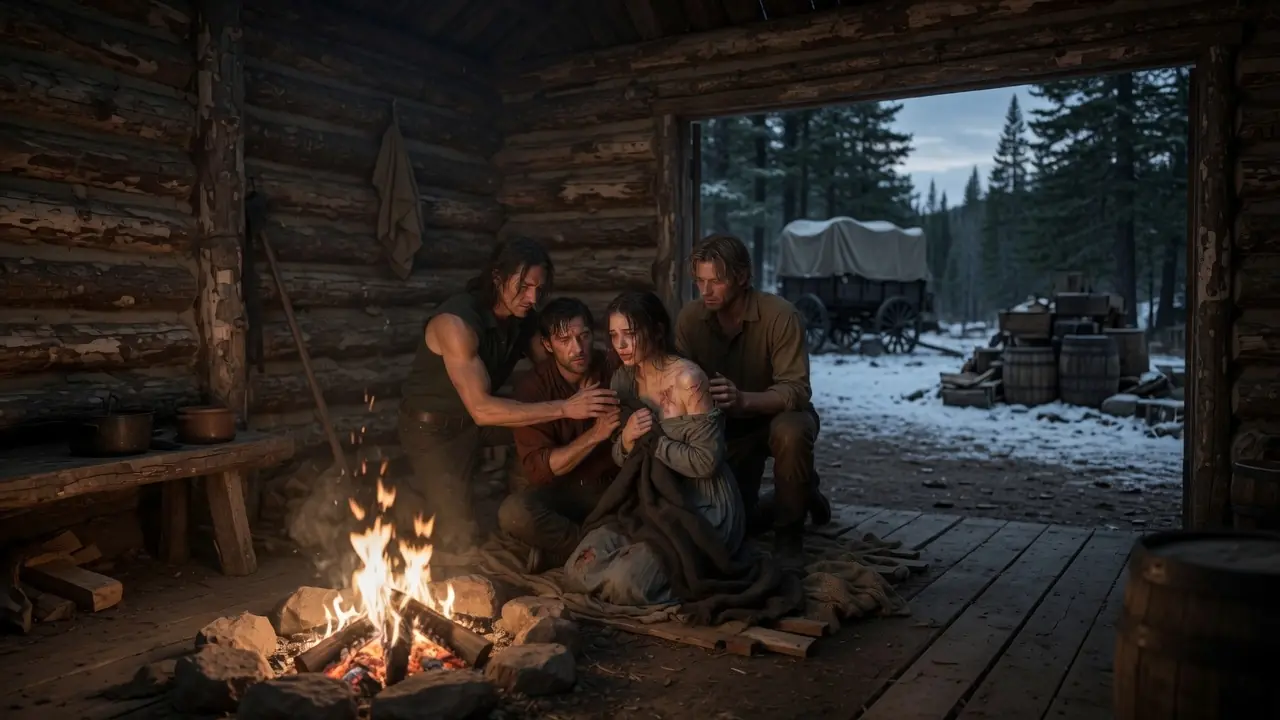
She pulled her coat tight and looked around the platform. No crowd, no brass band for the mail-order bride from New York. Just wind and snow starting to come down sideways and a station house with one lamp burning in the window. She held her satchel against her chest like it was a child.
Inside it sat a ledger worn soft at the corners from handling. That ledger was the reason she’d run three states west with a stranger’s letter in her pocket and a made-up story on her lips. It was the only proof left that Cornelius Vance had locked a factory door on 60 women and let them burn. She still smelled smoke sometimes when she wasn’t careful.
She was being careful now. A wagon rolled up out of the gray and three men climbed down from it. and Clara understood right away that nobody had exaggerated in their letters. If anything, they’d left things out.
The oldest one walked with a hitch in his stride, favoring his left leg. And he didn’t try to hide it. He had a face like a closed door. Gideon, she guessed before anyone said a word.
Miss Vance, he said, not a question, just a fact, stated once, the way he probably said everything. Beside him stood a younger man with black hair loose past his collar and eyes that moved over her like he was cataloging threats. He didn’t offer his name. He didn’t offer anything.
Elias, she thought the letter had mentioned, he kept to himself. The third one was the tallest of the three and the quietest. Though quiet wasn’t quite the word, because none of them had said much of anything. This one simply didn’t speak at all.
He looked at her satchel, then at her face, then away. Like looking too long cost him something. Levi, mute since he was a boy. The letter had explained in careful handwriting that seemed almost apologetic.
Nobody reached for her bag. Nobody offered an arm. Gideon turned toward the wagon and said, Storm’s coming in fast. We should go.
That was the whole welcome. Clara had pictured a lot of things on the train ride out. She hadn’t pictured this, three strangers looking at her like she was one more chore added to a hard winter. But she climbed up into the wagon bed anyway, because there was nothing behind her worth turning back for.
The ride out of town was rough, and the snow kept coming, and by the time the horses were fighting the wind in earnest, nobody had said 10 words total. Clara watched the back of Gideon’s neck, the set of his shoulders, the way he held the reins like he expected them to fight him too. Then the wagon lurched hard to the left and stopped, Wheel’s caught, Elias said, the first full sentence out of him. He swung down into snow that came past his knees.
Gideon followed, cursing low, testing his bad leg against the drift. Clara looked at the two of them, struggling with a wheel buried in frozen mud. And she looked at Levi, who’d already jumped down to help without being asked, and she thought about the factory floor, the machines, the ropes and pulleys she’d learned to rig before before she’d learned much else in that city. She climbed down, too.
Ma’am, get back in the wagon, Gideon said, not even looking at her. She ignored him. She tore the hem of her skirt where it had already started freezing stiff, ripped it clean to the knee so she could move and waded into the mud beside them. Elias stared at her like she’d grown a second head.
She didn’t explain herself. She just took the tow rope out of Levi’s hands, ran it under the axle, and tied it off with a weaver’s knot tight and fast. The same knot she’d tied a thousand times over a spinning frame back east. Pull, she said. They pulled.
The wheel groaned, then broke free of the mud with a sucking sound, and the wagon rocked forward onto solid ground. For a second, nobody moved. Gideon looked at the knot. Then he looked at her.
Really looked like he was seeing something he hadn’t accounted for in whatever plan he’d made about this arrangement. Elias’ss mouth twitched. Not quite a smile, but close. Levi just watched her hands, the mud drying on her knuckles like he was trying to work out what kind of woman did that without being told to.
Clara pulled her torn skirt back down over her boots and climbed into the wagon without waiting for help. Didn’t figure you for that, Gideon finally said once they were moving again. You didn’t figure me for much of anything, she answered. That’s fine. Neither did I about you.
He didn’t argue. Elias huffed something that might have been a laugh. Levi kept looking at her, steady, unreadable. The way he’d keep looking at her for a long while, yet behind them, the storm swallowed up the tracks they’d made.
Snow filling in every mark, as if the wagon had never passed that way at all. Clara watched it happen and thought that maybe that was the whole point of coming here, a place cold enough and far enough that even her own footprints wouldn’t survive the night. She just didn’t know yet how much these three men were going to make her want to stay anyway. The cabin ran on rules nobody spoke out loud.
Gideon rose first before light and started the stove without a word. Elias took the traps out at dawn and came back with his kills already dressed, like he couldn’t stand the idea of bringing raw death across that threshold. Levi split wood in the yard for an hour longer than anyone needed wood split, swinging that axe until his shoulders shook, and only then would he come inside and sit. Clara watched all this from the corner where she’d set up her cot, and she understood something about them within three days.
These men weren’t living together. They were surviving next to each other in the same four walls, taking turns being the strong ones so the others could rest. Nobody talked at meals. Gideon gave orders about firewood and fence lines.
Then she started filling it. Small things. She hummed while she worked the stove. She asked Levi questions he could answer with a nod or a shake of his head. She told Gideon flat out that his stew needed salt.
And he looked at her like she’d insulted his mother. and then he added salt. By the fourth morning, Elias announced they were riding into town for supplies, and he looked at her and said, You’re coming. Not a question either.
She was starting to notice that about all of them. The town sat in a shallow valley two hours out, a scatter of buildings that hadn’t decided yet whether they were a real settlement or just a wide spot in the road. Elias rode beside her the whole way and said almost nothing, but she caught him watching her out of the corner of his eye more than once, like he was still working out what she was. You don’t talk much, she said.
Mostly just to break the wind whistling past them. Talking gets a man in trouble out here, Elias said. Not talking hasn’t done wonders for you either. From what I can tell, he almost smiled at that. Almost.
The general store had a bell over the door that rang cheap and thin when they walked in. The man behind the counter was heavyset, balding with the look of someone who had decided long ago exactly who deserved his time and who didn’t. He nodded at Clara. He did not nod at Elias.
They gathered what they needed: flour, coffee, nails, a length of rope, a salve for Gideon’s leg that Elias picked out without being asked, which told Clara more about that particular brother than any conversation could have. When they set it all on the counter, Elias reached into his coat and laid down his money. The shopkeeper looked at the coins like they’d crawled there on their own. Don’t take money from half breeds, he said, said it plain, like he was commenting on the weather.
Girl can pay, or you can leave the goods. The store went quiet in a way that had weight to it. Clara felt the air change and felt Elias go still beside her. The particular stillness of a man clamping down hard on something before it got loose.
She didn’t reach for her own coin purse. She reached past him instead into the small leather pouch at Elias’ss belt where she’d seen him keep a few loose cartridges for his rifle, and she pulled one free, a.44 round, heavy and cold in her palm. She set Elias’ss silver dollar on the counter first, then slow and deliberate, she set the cartridge down right beside it, standing it on its base like a tiny brass tower. The shopkeeper’s eyes dropped to it that there’s Winchester, she said.
conversational as anything, Like she was discussing fabric. Loaded. Same as the rifle strapped to his saddle outside. Now you can take that dollar he’s offering. Same as you’d take mine.
Same as you’d take anybody’s. Because money doesn’t have a color when it’s sitting on your counter. Or you can keep being difficult about it. And one of these days somebody’s going to walk in here who isn’t half as patient as this man beside me.
and you’ll be needing that bullet just to keep your teeth in your head. The store stayed silent long enough that she could hear the wind pushing at the shutters. The shopkeeper’s jaw worked. His eyes flicked to Elias to the rifle visible through the window to Clara’s face, which she kept flat and pleasant the whole time like she’d just offered him a fair trade on eggs.
Finally, he swept the coin off the counter and started bagging the goods. Hands moving fast now, eager to have them gone. Nobody said another word until they were outside and mounted up again. You didn’t have to do that, Elias said once they were clear of town. I know.
Could have made trouble for us. Could have, Clara agreed. But he was already making trouble for you. I just decided whose trouble it was going to be from here on out.
Elias rode quiet after that, longer than usual, and Clara let him have the silence, because she’d learned enough about the Thorn brothers by now, to know that silence wasn’t always empty. Sometimes it was just a man working something loose inside himself, turning it over, deciding what to do with it. Halfway back to the homestead, he spoke again. Folks around here have been looking at me like that since I was 7 years old, he said.
My mother was Cheyenne. My father was a fool who loved her and a bigger fool who died before he could raise me proper. So the town raised me instead, and the town never let me forget what I was. What are you?
Clara asked, he looked at her, surprised by the question. Or maybe surprised that she’d asked it like there was a real answer worth hearing. A man, he said finally. Same as any other man out here, trying to keep his family fed.
That’s what I saw in that store, Clara said. That’s all I saw. Elias didn’t answer that. He just rode a little closer to her.
The rest of the way home, close enough that their stirrups nearly touched, and when they came up over the last ridge, and the cabin came into view, with smoke curling out the chimney. He reached over without a word, and took her hand off the res, held it, let it go. It wasn’t much. It was everything coming from him.
That night at supper, Elias told Gideon and Levi what happened in town. In more words strung together than Clara had heard from him in four days combined. And when he got to the part about the bullet on the counter, Levi’s hands moved fast and sharp, signing something at his brother that made Elias laugh out loud. A real laugh, rough from disuse.
Gideon looked at Clara across the table for a long moment. wasn’t in the letter you sent. He said that you’d be handy in a fight. Wasn’t much use for it back east, Clara said until suddenly there was.
She didn’t explain further, and he didn’t push, but something had shifted in the room, and everybody at that table could feel it. She wasn’t a stranger sleeping in the corner anymore. She was becoming part of the rhythm of the place. One more set of hands the brothers had started without quite meaning to, counting on.
The storm rolled in on the ninth night, and it was nothing like the snow that had greeted her at the station. This one came with thunder, which nobody had warned her was possible in a Colorado winter. Great rolling cracks of it that shook the windows in their frames, followed by lightning that turned the whole cabin white for half a second at a time. Clara had never much minded storms.
She’d grown up with them rattling the tenement windows, and by the time she was 10, she’d learned to sleep through worse. She woke instead to the sound of something breaking. It was Levi’s chair, knocked backward, and Levi himself on the floor beside the hearth, curled in on himself with his hands pressed hard over his ears, and his whole body shaking like a man trying to hold himself together by main force. Gideon was already moving, favoring his bad leg, calling Levi’s name low and steady.
Elias came out of the back room half-dressed, took one look, and went still in the doorway. Helpless in a way Clara hadn’t seen from him yet. Thunder, Gideon said, mostly to Clara, his voice tight. Since he was a boy.
Storm took the barn down around him when he was seven, pinned under it for two hours before anybody found him. He doesn’t hear thunder like the rest of us hear thunder. Levi rocked on the floor, eyes open, but seeing something that wasn’t the cabin anymore. Some other night, some other collapse.
Gideon crouched beside him and tried to speak him through it. But the thunder came again, another rolling crack, and Levi curled tighter and made a sound low in his throat. The closest thing to a voice Clara had heard out of him yet, and it broke something open in her chest to hear it. She crossed the room and knelt down in front of him.
Gideon started to warn her off, but she was already reaching for Levi’s hands, prying them gently away from his ears, and instead of letting go, she pulled them down and pressed both his palms flat against her chest, right over her heart, holding them there with her own hands over his. Feel that, she said quiet, steady. That’s a heartbeat, Levi. Nice and slow.
Nothing’s caving in. Nothing’s coming down on you. Just feel that and breathe when I breathe. He fought her for a second, chest heaving, eyes wild.
Then his hands stopped shaking quite so hard, and his breathing started to catch the rhythm of hers. Slow and deliberate. In and out, and by the time the next crack of thunder rolled through, he flinched, but he didn’t come apart. Gideon backed off, watching.
Elias sank down in the doorway like his legs had given out. They stayed like that a long while. Clara kneeling on the floor with Levi’s hands pressed over her heart. The storm working itself out overhead until finally the thunder faded off into distant grumbling, and Levi’s breathing evened out into something almost normal.
He didn’t let go of her hands right away. He looked at them instead at where they lay against her chest and then up at her face, something raw and grateful and a little bit wondering in his eyes. Gideon cleared his throat and said something about checking the stock and took Elias with him out into the tail end of the storm, and Clara understood without being told that he was giving them the room. She got Levi up off the floor and into a chair by the fire, and she found the slate they used for cabin figures and a stick of chalk, and she sat down across from him.
You never had proper words for any of this, did you? she said, Not written words. I mean, not past what you needed for chores. He shook his head.
Well, she said, we’ve got a fire and a storm that isn’t done with us yet, so we might as well use the time. She wrote his name first. big and clear, Levi and pointed at him and he traced it with one thick finger careful like the letters might break. She wrote Clara next and he copied that too.
Then fire and storm and home his hand steady over hers as she guided the chalk. His calluses rough and warm against her knuckles. When she ran out of words she knew he’d want. He set the chalk down and took her hands in his instead and started showing her something of his own.
He touched two fingers to his lips and moved them outward and made a sound in his throat like he was trying, like he wanted her to understand, even without the word for it. Thank you, she guessed. He nodded hard, relieved she’d gotten it. He kept going after that.
A closed fist tapped twice against his chest, a hand sweeping flat through the air, calm like smoothing water. He was patient with her, more patient than she’d been with anybody in longer than she could remember, correcting her clumsy attempts, with a gentleness that had nothing to do with the size of his hands or the width of his shoulders. The fire burned low. The storm rumbled off toward the mountains, and somewhere in the middle of all that quiet teaching, Clara realized his hands hadn’t left hers in a while, and she hadn’t moved to take them back.
Gideon stood outside the cabin longer than the stockwork required. Watching through the window at an angle he probably thought was subtle. He saw his youngest brother’s face lit up by firelight, unclenched for the first time in longer than Gideon could easily remember. and he saw Clara watching Levi’s hands like they were saying something worth hearing.
He’d spent three years since the war, convinced that what was broken in his family stayed broken. That Levi’s silence was a wall, not a door. That Elias’ss anger at the world was a wound that would never close over. That his own leg and everything that had gone wrong in him alongside it was just the shape of things now, permanent as scar tissue.
Watching Clara Vance sit on that floor and press a mute man’s hands to her heart until his shaking stopped. Gideon started to wonder if he’d had it wrong the whole time. Maybe broken wasn’t the only word for what they were. Maybe it just took the right person sitting patient in the firelight to prove there was still a whole man in there worth reaching.
He didn’t go back inside for another 20 minutes, he figured they’d earned the quiet. The trouble came into town three days later, and Elias was the one who spotted it. He’d ridden in alone for a spool of wire, and he came back faster than he’d left. His horse lathered despite the cold, and he was off the saddle and through the cabin door before Gideon had even risen from his chair.
Two men in town, Elias said. City clothes. Asking after a woman with burn scars said she might be traveling under a different name. The room went cold in a way that had nothing to do with the weather. Clara felt her stomach drop straight through the floor.
She’d known somewhere in the back of her mind that this day was coming. Her uncle had money enough to hire men who didn’t stop looking. Not for anyone, not ever. And she’d let herself get comfortable in this cabin.
Let herself believe four weeks of snow had bought her more distance than it had. Pinkertons, Gideon said it wasn’t a question. Clara nodded. Throat too tight for words. They say anything else. Gideon asked. Elias.
Said they’d pay for information. Said the woman’s uncle. Wants her found quiet. No mention of the law getting involved.
Elias’ss eyes moved to Clara. Which means whatever you’re running from. Your uncle doesn’t want it in front of a judge. She could have lied then.
She’d been lying for weeks. telling herself the story about a modest inheritance and a longing for a fresh start. But the fear on her face must have told the truth plainer than any words could have because none of the brothers pushed her for the rest of it right then. They just started making plans.
Low voices, practical the way men do when trouble is close enough to smell. Clara sat by the fire and listened to them talk about defenses and watches and how many days out those men might be. And all she could think was that she’d brought this here. She’d brought her uncle’s cruelty and his hired killers right to the doorstep of three men who had already survived enough.
She waited until the cabin went quiet that night until Gideon’s breathing settled into sleep. And Elias’ss did the same. and she pulled on her boots and her coat and slipped out into a night gone bitter and black. She didn’t have much of a plan beyond putting distance between herself and the Thorn homestead.
If the Pinkertons were tracking a scarred woman traveling under a false name, then the woman needed to keep moving. Needed to lead the danger somewhere else, anywhere else, so long as it wasn’t here. The cold hit differently once she was well clear of the cabin. It got into her boots first, then crawled up through her coat.
And within an hour, her hands had gone numb enough that she’d stopped noticing the satchel strap cutting into her shoulder. Then the scars started. They’d never fully healed right. The burns across her back and shoulders had never healed properly, not with the rush treatment she’d gotten in New York from a doctor paid to keep quiet and work fast.
In deep cold, they flared up something fierce. An infection that never quite left her. And tonight, out in weather that would have tested a healthy person, her body simply gave out. She felt the fire of it spread down her spine, worse than anything since the factory itself, and her legs stopped answering her properly, and the last thing she remembered clearly was the snow coming up to meet her.
Soft as a bed, terribly cold. Levi found her. He’d woken first, some instinct pulling him out of sleep, and he’d checked her cot and found it empty, and gone straight for his brothers without a sound, shaking them awake, signing frantic and fast, until Gideon understood. They found her half buried in a drift less than a mile out, barely breathing, her lips gone the color of ash.
Elias carried her the whole way back, running through snow that came past his knees. Levi close behind with a lantern. Gideon limping hard but keeping pace, cursing every step of the way. They laid her on the bed nearest the fire.
And Gideon, whose hands had steadied more men on more battlefields than he cared to count, went to work fast. Her dress had frozen stiff against her skin, and there was no gentle way to get her out of it. in time to treat what was underneath. He took his knife to the fabric instead, slicing it open down the back, careful and quick.
What he uncovered stopped him cold for half a second, longer than he wanted anyone to see. The scars ran from her shoulders down across her back. Thick ridges of ruined skin, some of it still angry and inflamed, clearly reopened by the freeze. It told a story of fire and suffering plainer than any words she’d ever offered them.
And Gideon understood all at once exactly what she’d survived and exactly what she’d been hiding beneath every high collar she’d worn since the day she stepped off that train. Clara came back to herself slowly, the warmth of the fire pulling her up out of the cold. And the first thing she felt was air against her bare back. And the second thing she understood was that they’d seen.
She grabbed for the blanket, pulled it hard against her chest, curled away from all three of them with a sob tearing loose before she could stop it. Don’t, she said, voice cracking. Don’t look at me. Clara Gideon’s voice low. Careful.
I know what it looks like. She kept her face turned to the wall. I know what I look like. You didn’t sign on for a woman who’s ruined like this.
So just just don’t. Nobody spoke for a moment. Then she felt the bed shift as someone sat down beside her, and it was Elias, and he didn’t try to turn her around or pull the blanket away. I’ve got a scar behind my ear from where a man hit me with a bottle when I was 9 years old, Elias said quietly.
For the crime of buying bread in the wrong store. Gideon’s leg will never work right again for the rest of his life. Levi hasn’t spoken a word since a barn came down on top of him. We are not exactly whole men in this house, Clara.
Never have been. She didn’t answer, but her shoulders had stopped shaking quite so hard. You didn’t run because you were ashamed of us finding out you’re hurt. Gideon said from the other side of the bed.
You ran because you were trying to protect us. That’s not the same as ruined. That’s not even close to the same thing. Levi didn’t say anything at all.
He just reached out slow, giving her every chance to pull away, and rested one hand flat against her shoulder above the worst of the scarring, gentle as anything, like he was asking permission just by the weight of his touch. Clara lay there between the three of them, raw and exposéd in every way a person could be. And for the first time since the fire, she didn’t feel like something to be hidden away. She felt like something they intended to keep.
The fever broke on the third night, and Clara woke to find all three brothers still in the room. Gideon sat in the chair by the bed, elbows on his knees, watching her with the kind of stillness that told her he hadn’t slept much these past days. Elias leaned against the wall near the window, arms crossed, and when her eyes opened, his whole posture changed, straightened, came alive. Levi sat on the floor by the hearth, close enough to reach her.
A half-finished carving forgotten in his lap. You’re back, Gideon said. Was I gone? Her voice came out rough, unused for three days, Elias said.
Fever had you talking in your sleep. Said things about a fire, about your uncle. Clara went still. She’d known this moment was coming.
Ever since Gideon had cut her dress open and found the scars, ever since she’d sobbed into that blanket, convinced they’d never look at her the same way again. But she hadn’t expected to lose control of her own story while unconscious. Hadn’t expected them to piece it together from fever ramblings instead of her own mouth. How much did I say?
Enough, Gideon said. Your uncle owns a garment factory in New York. There was a fire. He’d locked the doors, some ordinance about theft, kept the girls from getting out.
You’ve got a ledger that proves he knew the locks would kill people if the building ever burned, and you’ve been running west with it ever since, trying to stay ahead of the men he’s paying to get it back. She closed her eyes. There it was, laid bare. No room left to keep pretending.
She was just a woman answering a marriage advertisement for a fresh start. I should have told you before I ever stepped off that train, she said. I brought danger to your door and I let you take me in blind. You brought a ledger that could see 60 dead women get justice.
Elias said, pushing off the wall. That’s not danger, Clara. That’s a debt the world owes you the chance to collect. I ran because I was scared you’d see me different, she admitted, and her voice cracked on it.
Not just because of the ledger. Because of this, she gestured weak toward her own back, toward the scars still healing beneath her nightclothes. I’ve been engaged once before, back east. He saw them by accident before the wedding.
Called off the whole thing inside a week, said no man wants a wife who looks like she’s been through a war. The room went quiet in a way that had weight to it. Gideon stood up from the chair slow, favoring his bad leg the way he always did, and he came to sit on the edge of the bed instead. Up close, his eyes had lost every trace of the cold, closed-off look she’d first met at the train station.
I’ve got a leg that’ll never march straight again, he said. Spent two years after the war thinking no woman worth having would want a man who couldn’t walk across a room without every step reminding her he was broken. Turns out that’s not what breaks a marriage. What breaks it is a person who can’t see past the wound to the man underneath.
That’s not the same, Clara whispered. It’s exactly the same, Elias said, moving closer now, crouching by the bed so he was eye level with her. You think we haven’t all got something we’ve been told makes us less. I’ve spent my whole life hearing what a half breed is worth in this territory.
Levi’s spent his hearing what a mute man’s worth. Gideon spent his hearing what a cripple’s worth. We know precisely what it costs a person to be looked at and found wanting. None of us are fixing to do that to you.
Levi set his carving aside and crossed the room, kneeling on the other side of the bed. He reached out and took her hand the way he had the night of the storm. But this time he didn’t press it to his own chest. He turned it over in his palm and traced one finger along her open hand.
Slow, deliberate, like he was writing something only she was meant to read. What’s he saying? She asked Gideon since Elias had been teaching her the signs same as she’d been teaching him letters. But she hadn’t learned enough yet to catch the meaning.
Gideon watched his brother’s hands. His voice went low. He’s telling you the fire didn’t ruin you. It’s part of the story your body carries.
Same as his silence is part of his. Same as my leg. He’s saying he doesn’t want a woman without a story. He wants you.
Clara felt her eyes go hot. Felt the tears come before she could stop them. Not from grief this time, but from something else entirely, something she hadn’t let herself feel in longer than she could remember. Safe. That was the word for it.
She felt safe. Sitting in that bed with three ruined men who didn’t think ruined was the right word for any of them. Let us feel you once, Gideon said. The words landed soft, but they carried weight enough to still the room.
He wasn’t asking with any hunger in his voice. Not the kind she’d been warned about back east, not the kind that took without giving thought to what it cost. His voice had gone rough and quiet. The voice of a man laying down every wall he’d built since the war.
Not to prove anything, he went on. Not because we doubt what you told us. Just once, let us feel that you’re really here, that you’re whole and warm and staying. Elias’ss hand found hers on the other side, and he didn’t say anything more than her name.
But the way he said it carried the same plea. Levi’s hand tightened gently around hers, and his eyes, always so careful, so guarded around strangers, held nothing back. Now Clara looked at the three of them, at Gideon’s steady patience, at Elias’ss fierce and quiet devotion, at Levi’s silent, overwhelming tenderness, and she understood that this wasn’t a request born out of anything small. These were men who had spent years convinced that what they carried, the limp, the silence, the blood that made the town look at Elias sideways, made them less than whole.
And here they were, kneeling around a woman covered in her own scars, asking not to take from her, but to prove to themselves and to her that broken things could still be worth cherishing. She let the blanket fall from her shoulders. Gideon’s breath caught, but he didn’t look away, and neither did his brothers. He reached out first, slow enough that she could have stopped him at any point, and pressed her hand flat against his bad leg, over the place where the old wound still ached whenever weather turned.
He held it there, let her feel the uneven muscle beneath the fabric. The permanent reminder of a battlefield. He still dreamed about some nights. This is what I am, he said.
Every part of it. Elias took her other hand and laid it over his heart instead. his pulse quick and strong beneath her palm. This beats the same as any man’s, he said.
Doesn’t matter what color they say my skin is when the sun sets on it. Levi didn’t have words to offer the way his brothers did. So he offered his hands instead, tracing gentle lines across her collarbone, down along the edge of the worst scarring on her shoulder, not flinching, not hesitating, mapping every ridge like a man, reading a story he found precious, rather than a wound he found pitiable. Then his hands moved in the shape she’d learned days before by the fire.
Survivor, he signed it once, then again, softer, like he wanted the word to sink all the way into her. The fire in the hearth had burned down to embers, casting the room in a low amber glow, and in that light, the walls the four of them had built around themselves out of fear and grief, and years of being told they were lesser, finally came down all at once. What passed between them that night wasn’t rushed, and it wasn’t careless. It was slow and it was patient.
The way three men who’d spent their lives being told they weren’t enough finally let themselves believe otherwise in the hands and mouths and gentle weight of people who saw every part of them and stayed anyway. Clara wept at first, not from pain, but from the sheer unfamiliar relief of being wanted exactly as she was, scars and all. And by the time the night wore toward morning, there was no part of her left that doubted where she belonged. When dawn finally broke pale and gold across the snow outside, Clara lay tangled between the three of them.
Gideon’s arm heavy across her waist, Elias’ss hand still loosely holding hers even in sleep. Levi curled close at her back like he meant to stand guard against the whole world in his sleep if he had to. She looked at the ceiling of that little cabin, listened to the brothers breathing slow and even around her, and thought about how far she’d come from a burning building in New York to this quiet room in the mountains. She thought about the ledger still hidden beneath the floorboards, about the men her uncle had sent to find her, about the danger that hadn’t gone anywhere, just because she’d finally found a place to rest.
But for the first time since the fire, she wasn’t afraid of what came next. She had three reasons now to fight for whatever future was left to find, and she intended to keep every one of them. The storm came down out of the mountains two days later, and it came down mean. Gideon had been watching the sky since sunup, jaw tight, and by midafternoon he’d called all three of them in from their chores.
This isn’t a snow flurry, he said, looking out the window at a sky gone the color of a bruise. This is a whiteout coming. We lose the trails in an hour, maybe less. Nobody’s getting in or out of this valley till it breaks.
Elias came in from checking the traps with frost already crusting his eyebrows, and he confirmed it. Visibility past 50 feet was already going soft and gray, and the wind had a bite to it that promised worse before it promised better. They battened down what they could. Shutters closed and braced.
Stock brought in close to the barn, where the walls would break the worst of the wind. Extra wood stacked by the hearth. Clara worked right alongside them, hauling what she could carry, and nobody told her to sit this one out, which was its own kind of answer to a question she hadn’t needed to ask anymore. It was Levi who spotted the riders first.
He’d gone out to check the horses one last time before the whiteout closed in completely, and he came back through the door faster than any of them had ever seen him move, hands flying, face pale. Gideon read the signs and went rigid. Riders, he said, coming up the south trail. Six of them, maybe seven.
Levi says they’re armed. Clara’s stomach dropped straight through the floor. That’s not the storm scaring off, she said. That’s my uncle’s man using the storm to get close before we’d see them coming.
Gideon was already moving, pulling the rifle down off the wall, checking the load with hands that had done this a hundred times before, back when the stakes were a war instead of a home. How many men does he usually send? I don’t know exactly. Enough that he’s confident.
He’s not a man who likes uncertain odds. Well, he picked a fool time to come calling, Elias said, already at the window, watching the tree line where the snow was starting to blur everything into gray. Nothing. Another hour and this whiteout will bury every trail up here. They’ll be as blind and stuck as we are, which means they know it, too, Gideon said.
Which means they’re planning to finish this before the storm locks everybody in place. Clara looked between the three of them and she saw something settle over each of their faces. Something she recognized from that morning in the mud with the wagon wheel. Not panic, calculation.
These were men who’d survived worse than this in their own ways. And they weren’t about to let six strangers with guns take away the first real piece any of them had found in years. There’s a root cellar, Gideon said, turning to her deep reinforced good and hidden under the floorboards in the back room. You’re going down there, and you’re staying down there until this is finished.
Clara felt something in her go hard and certain. No. Gideon blinked. Like the word hadn’t quite registered as a real answer. Clara, this isn’t a discussion. Those men are coming for you specifically.
The safest place for you is out of sight. I didn’t survive a factory fire so I could hide in a basement while three men I love fight for my life without me, she said, and the word love landed in the room with a weight. None of them had spoken aloud yet, though it had been sitting there plain as day since that night by the fire. I know how to load a rifle.
I know how to hit a target. My father taught me to shoot before he died. Back when we still had a farm before the city took everything else from us. put me at a window same as anybody else.
She’s not wrong that hiding her doesn’t necessarily keep her safest, Elias said slowly, watching Clara with something like respect blooming plain on his face. If they get past us and find that cellar, she’s trapped down there with no way out and no way to defend herself up here. At least she’s got a fighting chance. Gideon looked at her for a long moment, weighing it, and Clara held his gaze steady, refusing to look away first.
Finally, he exhaled hard, and reached for the second rifle hanging by the door. You do exactly as I say the second I say it, he told her, pressing the weapon into her hands. No hesitating, no arguing mid-fight. Are we understood? Understood.
He nodded once, satisfied, and something in his eyes shifted from reluctant to something closer to pride. Then let’s get this cabin ready to hold. They worked fast after that. Gideon assigned positions.
The front window with the clearest line down the trail. The back door, where the woodshed offered cover for anyone trying to slip around. The loft window that looked out over the whole approach. Levi took a logging axe from the shed and set it by the reinforced front door, testing the bar that held it shut, making sure it would hold against anything short of a battering ram.
Elias disappeared out the back with barely a word to anyone, sliding out into the whiteout like he was born to it. And Clara understood, watching him go, that this was exactly the kind of fight he’d trained his whole life for without ever wanting to. A man raised half in two worlds. Taught to move silent and see clear when everyone around him assumed he couldn’t be trusted with either skill.
He was about to prove every one of them wrong. The snow outside had gone from heavy to blinding. A wall of white that swallowed the treeline, the fence posts, everything past 30 feet from the cabin. Clara took her position at the loft window, rifle loaded, and watched that wall of white for any shape that didn’t belong to it.
Gideon crouched by the front window, watching the same nothing she was watching. His breathing slow, and even in a way that told her this wasn’t his first siege, not by a long stretch. Whatever ghosts followed him home from the war, they taught him this much at least how to hold steady when everything in a man wanted to run. They’ll come slow, he said mostly to himself.
Storm’s their cover, but it’s also their enemy. They’ll want to close the distance without losing each other in the whiteout. How do you know that? Because that’s what I do, he said.
And your uncle’s paying professional men, not fools. They’ll have a plan. The first shot came almost 40 minutes later, and it didn’t come from the trail Gideon had been watching. It came from the side of the cabin near the woodshed, glass shattering somewhere in the back room, and the whole cabin seemed to hold its breath for one terrible second before everything broke loose at once.
Levi was already moving toward the back door, axe in hand, a wall of silent muscle, placing himself directly between the breach and the rest of the house. Gideon shouted something about flanking positions, and Clara, heart hammering so loud she could barely hear her own thoughts, sighted down the loft window at a shape moving fast through the snow near the barn. She didn’t hesitate. She fired. The shape dropped, and whether it was a kill or just a wound, she couldn’t say for certain through the blinding snow.
But it was enough to send the others scattering for cover. enough to buy Gideon the half second he needed to return fire from the front window at a second attacker trying to circle wide. The cabin had become a fortress, and for the first time in her life, Clara Vance understood what it meant to be trusted as part of the wall that held. The fight that followed lost all shape within minutes, the way Clara imagined real battles always did.
Nothing like the clean lines she’d pictured from dime novels back east. Just noise and snow, and the terrible flat crack of rifles somewhere out past the white. Gideon commanded the defense from the front window with the same cold clarity he probably carried onto every battlefield he’d survived. Calling out positions, calling out targets, his voice cutting through the chaos, steady as a rope thrown to a drowning man.
Clara found herself listening for that voice the way sailors probably listened for a lighthouse, using it to orient herself in the blind white confusion outside. Movement, west fence line, he called, and Clara swung her rifle that direction, and caught the shape of a man half crouched behind a post, and she fired before he could bring his own weapon level. And he went down into the snow and didn’t get back up. Her hands were shaking, but her aim wasn’t, and she understood in some distant part of her mind that she’d just killed a man that she’d carry.
that the same way she carried the scars on her back. And she also understood that she’d carry it easier than she’d carry, losing any of the three men fighting to keep her alive. Elias had gone somewhere out into that whiteout the moment the first shot rang out. For a long while, nobody inside the cabin could say where he was or what he was doing.
And that silence scared Clara worse than any of the gunfire. Then, faint through the wind, She heard a cry cut short out near the treeline and another one a few minutes later closer to the barn. And she understood that Elias was doing exactly what he’d been trained his whole life to do without ever wanting the reason for it. He moved through that storm like he belonged to it.
using the blindness that crippled the Pinkertons as his own weapon. Closing distance silent as falling snow and taking men down before they even knew he was near enough to threaten them. He didn’t waste bullets when a knife would do the job quieter. He didn’t leave a man breathing behind him who might put a shot in his back on the way past.
It wasn’t cruelty. It was survival, sharpened over 28 years of a town that had never once given him the benefit of the doubt. And tonight that survival belonged entirely to protecting the family that had. At the back door, Levi held his ground with the axe in both hands.
And when the first man came crashing through the shattered window frame near the woodshed, Levi met him without a single sound, and it was over fast and brutal and final. He dragged the body clear of the doorway with the same silent efficiency he brought to splitting firewood. And then he took up his position again, watching the breach, waiting for the next one. An immovable wall of muscle and quiet fury that none of Cornelius Vance’ss hired men had been prepared to face.
Clara reloaded, hands moving faster now. muscle memory from her father’s lessons years ago. Finally paying a debt she’d never expected to collect. She caught movement near the barn again.
Two men this time. Moving in a low crouch toward the side of the cabin where Gideon’s window didn’t quite cover. Gideon, your flank, she shouted, and he twisted just as one of the men brought his rifle up through the gap in the shutter. and Clara fired first, catching the man’s shoulder and spinning him off his aim.
And Gideon finished it a half second later. Good eye, he called up to her, breathless. And even in the middle of all that chaos, she felt something warm bloom in her chest at the simple, plain approval in his voice. The fighting seemed to stretch on forever and end almost too fast.
The way Clara imagined all violence probably did once a person had lived through it. One moment the air was full of gunfire and shouting and the next the wind was the only thing left making noise. The whiteout swallowing up whatever remained of the assault same as it had swallowed everything else. Elias came back through the front door 20 minutes later.
Snow crusted thick across his shoulders. A shallow cut along his jaw, the only visible mark on him, and Clara’s whole body sagged with relief at the sight of him standing there alive. That’s the last of them I could find, he said, voice rough from the cold. Four dead out by the treeline and the barn.
Two more wounded and running. Probably won’t make it far in this storm without shelter. How many total? Gideon asked. Seven, near as I could count tracks before the snow covered them over.
Elias’ss eyes found Clara’s rifle, still smoking faintly in her hands. Found the position at the loft window. She hadn’t left the entire fight. Looks like the lady accounted for at least one of them herself.
Clara set the rifle down carefully, her hands finally starting to shake now that the danger had passed, now that her body had room to feel everything it had been holding back. Levi crossed the room and pulled her into his arms without a word. Holding her steady while the shaking worked itself out, and over his shoulder she watched Gideon and Elias share a look. Some silent conversation passing between brothers, who’d learned to read each other without needing words at all.
Seven men, Gideon said finally, that’s not a scouting party. That’s everything your uncle’s got left to send, which means whoever’s left of Cornelius Vance’ss hired guns, Elias added, isn’t coming back for a second try. Not after this. Clara pulled back from Levi’s arms enough to look at all three of them, snow-covered and blood-spattered and utterly, impossibly alive, and she felt something settle deep in her chest that had nothing to do with fear.
He’ll come himself, she said quietly. My uncle. He’s not a man who sends other people to fail twice on something this important. When he hears his hired guns didn’t come back, he’ll come see the job finished with his own eyes. Outside, the whiteout showed no sign of breaking.
Wind screaming past the shuttered windows. But inside the cabin, four survivors stood together in the fading light of the hearth, bloodied and exhausted and entirely unwilling to be anything less than ready for whatever came through that door next. Then let him come, Gideon said, and for the first time since Clara had known him, There was something almost like anticipation in his voice. The readiness of a man who’d years waiting for a fight worth having.
This mountain’s already shown his men what it does to trespassers. Let’s see what it does to the man who sent them. The whiteout broke on the fourth day, and it left behind a silence so complete that Clara found herself straining to hear anything at all. The brothers spent the morning checking the yard, the fence lines, the barn, cataloging the damage the storm and the siege had both left behind.
Four bodies had to be dealt with, buried where the frozen ground would allow or wrapped and set aside until spring made the digging easier. It was grim work, and nobody spoke much while they did it. But there was a grim satisfaction underneath the silence, too. The quiet certainty of men who had defended what belonged to them, and meant to keep doing so.
It was Levi who spotted the rider first, coming up the south trail alone, moving slow and deliberate through snow that hadn’t fully settled yet. Gideon watched through the spyglass he kept by the front window, and his jaw tightened in a way Clara had already learned to read his trouble. One man, he said, riding easy, not sneaking. He wants us to see him coming.
Clara crossed to the window and took the spyglass when he offered it, and her stomach dropped the moment she found the writer’s face. Cornelius Vance rode a fine gray gelding, dressed in a wool coat, too heavy for a man who spent his days behind a desk, and even from this distance, Clara could see he’d lost weight since she’d last laid eyes on him. Running an empire from behind a mahogany desk hadn’t prepared him for a winter spent chasing his niece across half a continent. And it showed plain in the way he sat that horse stiff and uncertain.
A city man playing at something he didn’t understand. That’s him, she said. That’s my uncle alone. Elias said joining them at the window.
No hired guns left to send ahead of him. Whatever pride he’s got left, he’s carrying it into this himself. Gideon set the spyglass down and looked at Clara. You don’t have to face him, he said.
We can meet him at the gate. You can stay inside. Clara thought about that offer for exactly as long as it took to remember every woman who’ died behind those locked factory doors. Every name she’d carried west in that ledger.
Every reason she’d run three states just to survive long enough to see this moment come. No, she said he spent months hunting me down like I’m something that belongs to him. I want him to see my face when he finally understands he failed. Nobody argued with her this time.
Gideon nodded slow and reached for his coat, and Elias checked the rifle by the door out of habit more than necessity, and Levi simply moved to stand beside her, steady as a fence post, the way he always did when trouble came calling. They walked out onto the porch together as Cornelius Vance reigned his horse in at the edge of the yard, close enough to speak, but far enough to keep some measure of distance between himself and the men flanking his niece. Up close, Clara could see the exhaustion carved into his face. The fine lines gone deeper, the confidence that had always defined him, worn thin as old cloth.
Clara, he said her name, like it cost him something. You look well. Better than I expected, given the company you’ve been keeping. Better than the men you sent, she said.
Four of them are buried in that field behind you. The rest ran off into a storm that likely finished what we started. His jaw tightened, but he kept his composure. The same cold control she remembered from every negotiation she’d watched him conduct across that mahogany desk back in New York.
I’ll be direct since we’re clearly past the point of pleasantries, he said. I want the ledger. I’m prepared to pay handsomely for it. Enough money to see you settled anywhere in this country.
You like with these three gentlemen or without them. No questions asked, no further trouble sent your way. You think this is about money? Clara said everything is about money eventually.
Cornelius said, you’ll learn that given time. Clara reached into her coat and pulled out the ledger, worn soft now from months of carrying it across half a continent, and she held it up so he could see it plain. See the water-stained cover, the corner scorched from the fire that had nearly taken it, and her along with it. 63 women worked that factory floor the night you locked those doors, she said.
I know because I counted the names myself, cross referenced against the payroll you kept in this very ledger. The one you were fool enough to let me handle your books with back when you thought a niece too grateful for a roof over her head would never think to question her uncle’s arithmetic. 41 of them didn’t walk out. I did because I happened to be near the window that didn’t jam.
She stepped down off the porch, closing the distance between them, and tossed the ledger into the snow at the gelding’s feet. Keep it, she said. The cold doesn’t take bribes. Something in Cornelius Vance’ss face cracked.
Then the composure was finally slipping to reveal the fear underneath. The understanding that no amount of money was going to buy his way out of this particular reckoning. You don’t understand what you’re doing, he said, voice rising now. Panic creeping in around the edges.
That ledger destroys everything. The factory, the family name, everything I’ve built. You’d see your own blood ruined over dead seamstresses nobody in this world will remember in a decade’s time. I’ll remember them.
Clara said, I remember every one of their faces. I remember the smoke and the doors that wouldn’t open, and I remember exactly whose signature authorized locking them. Cornelius looked past her then to the three brothers standing silent and immovable on that porch. Gideon with his ruined leg planted steady as bedrock.
Elias with eyes that had already tracked seven armed men through a blizzard. And one Levi with an ax within easy reach and a look on his face that needed no words at all to communicate its meaning. I have money, Cornelius said, and his voice had gone thin now. frayed with a fear, he couldn’t quite hide anymore.
Whatever price you name, whatever it takes. I’ll pay any of you to simply let me leave this valley with what’s mine. Nothing here belongs to you, Gideon said, and it was the first thing he’d spoken since they’d stepped onto the porch. But his voice carried the same weight it always did, flat and certain and impossible to argue with.
Cornelius Vance looked at the three men at his niece standing between them with nothing left in her hands but empty air and every ounce of resolve she owned and something in him finally broke. He wheeled his horse hard, spurring it into a run, fleeing back the way he’d come, except the trail behind him had gone soft and treacherous in the thaw, and the storm hadn’t fully finished with the mountain yet. Nobody moved to stop him. Nobody fired a shot or gave chase.
Let him go, Gideon said quietly, watching the gelding disappear over the ridge in a spray of loose snow. This mountain’s already claimed seven men this week who thought they could take what wasn’t theirs. It doesn’t much care about adding an eighth. They didn’t need to explain what they meant by that.
Clara understood it plain enough, standing there in the trampled snow, with the ledger at her feet, watching the last of her uncle’s silhouette vanish into weather that had already proven itself merciless to men who underestimated it. By morning, one of the ranch hands from the neighboring spread found what was left of Cornelius Vance half a mile past the ridge, frozen solid against a rock outcrop where his horse had thrown him in the dark. The animal itself found wandering riderless near the valley floor. The cold had done what neither bullets nor blades had needed to.
The mountain had rendered its own verdict, swift and absolute, and left no one with blood on their hands to answer for it. The storm broke fully within the week, and the valley settled into the particular hush that comes after. violence has passed through and left the world quieter than it found it. Clara retrieved the ledger from where it had lain buried under fresh snow, brushing the ice from its cover with careful hands, and she sat with it at the kitchen table that evening.
While the brothers worked around her, each one finding some excuse to stay close, to check on her without making a production of checking. What happens now? Elias asked, settling into the chair across from her. Now I finish what I started, Clara said.
This ledger doesn’t do any good sitting on a shelf out here. It needs to go back east into hands that can actually use it. Gideon looked up from where he was working oil into the leather of his boots. You’re not thinking of going yourself.
No, Clara said, and she meant it. The certainty of that answer, surprising her even as she said it out loud. months ago, she’d have said the opposite without hesitation, would have insisted on carrying the fight all the way back to New York herself, seeing it through to the end with her own eyes. But something had shifted in her since the night in that firelit room, since the siege, since watching three broken men prove themselves whole in every way that mattered.
She had a home now. She wasn’t leaving it. I’ll send it. She’s copies actually.
One to the New York Labor Board since they’ve been investigating factory conditions since before the fire and never had proof solid enough to act on. One to a newspaper editor I used to know, a man who ran an exposé on tenement conditions two years back and lost half his advertisers for the trouble, but never once backed down on a story he believed in and one to the district attorney’s office. In case anyone left in that company thinks my uncle’s death lets them off the hook for what they built together. You’ve thought this through, Gideon said something like admiration threading through his voice.
I’ve had months on a train and a wagon and a cot in the corner of your cabin to think about very little else, Clara said, and the small joke earned her a real smile from him. Rare enough that she’d started keeping count of them without quite meaning to. They rode into town together three days later, all four of them, the brothers flanking her the same way they had since that very first ride out from the station, except now it felt like something entirely different. Not strangers thrown together by a letter and a desperate arrangement, a family riding together, because that was simply what families did.
The postmaster raised his eyebrows at the thickness of the packages Clara handed across his counter, but he didn’t ask questions. Not with Gideon Thorne standing at her shoulder and a look on his face that discouraged idle curiosity. New York, Clara said, sliding the first package across. And this one to Chicago, care of the editor listed there, and the last back to New York as well. Different address.
The postmaster weighed each one, calculated the postage, and Clara paid it out of coin she’d earned herself these past months, mending clothes for neighboring ranches, and trading her needle work skills for whatever the territo’s cash poor economy could offer. It felt important somehow that she paid for this herself, that the final blow against her uncle’s empire came from money she’d earned with her own two hands. out here in a life entirely of her own making. They watched the stagecoach load up an hour later, watched the driver secure the mail pouch alongside the passenger luggage, and Clara stood on that dusty street with three men she loved on either side of her, and felt something in her chest.
finally settle, after months of running. It’s done, she said, mostly to herself. Not quite, Elias said. There’s still the small matter of what happens once that ledger lands where it’s going.
Could be months before anything comes of it. Could be a trial. Could be your uncle’s partners try to bury the whole thing quiet. Same as they buried those women behind locked doors. Maybe. Clara agreed.
But it’s out of my hands now. And that’s its own kind of freedom. I spent a year of my life running because I was the only thing standing between that ledger and the fire that would have destroyed it forever. Now it’s on its way to people with the power to actually do something with it.
Whatever comes next, it doesn’t fall on my shoulders alone anymore. They watched the stagecoach pull out of town. dust kicking up behind its wheels despite the lingering snow at the roadside. Carrying with it the last thread connecting Clara Vance to the life she’d fled and the truth she’d risked everything to protect.
Word came back slower than any of them expected. But it came. A letter arrived in late February, forwarded through three different post offices before it finally found the Thorn homestead. and it carried news from the New York Labor Board confirming they’d opened a formal investigation into Vance Garment Works, citing evidence provided by an anonymous source that corroborated survivor testimony collected in the weeks following the fire.
A month after that, a newspaper clipping arrived sent by the editor Clara had trusted with her story detailing the collapse of the Vance manufacturing empire under the weight of public outrage and mounting legal pressure. The factory floor manager, who’d actually turned the key on those doors the night of the fire, acting on Cornelius Vance’ss explicit instructions documented plainly in his own handwriting, had been arrested and charged. the first real measure of justice any of the surviving families had seen since the tragedy. Clara read that clipping by the fire with all three brothers gathered close, and when she finished, she folded it carefully and set it aside, and she let herself cry, not from grief this time, but from the particular relief of watching a wrong finally begin writing itself.
months and miles away from the place it had happened. Carried there by nothing but her own stubborn refusal to let it go unanswered. They’ll remember them now, she said quietly. The women who died, somebody will finally have to answer for what happened to them out loud in a courtroom where the whole city can hear it.
Gideon reached over and took her hand, his thumb tracing slow circles against her knuckles, and he didn’t say anything because there wasn’t really anything left to say. Elias sat close on her other side. And Levi settled at her feet the way he so often did, resting his head against her knee. And the four of them stayed like that a long while, watching the fire burn low, letting the weight of a long fight finally finished settle over the cabin like something warm instead of something heavy.
Spring came to the Colorado Territory the way it always did in high country. Slow at first and then all at once. The snow retreating up the mountainsides in patches, the meadows around the homestead breaking out in wildflowers that Clara had never seen back east. Blues and yellows spreading out across ground that had been buried under white.
For so long she’d nearly forgotten what color looked like underneath it. The ranch had grown busy with the season. Calving and fence mending and the hundred small chores that came with land waking up after a hard winter, and Clara found herself busier than she’d ever been in her life, and happier for every bit of it. She’d learned to ride properly by then.
Learned the names of every head of stock on the property. Learned to read weather the way the brothers did. Watching the sky for signs the way a person back east might watch a clock. It was Gideon who brought up the land office first.
One evening at supper, mentioning almost offhand that the ranch’s original boundary filing needed updating now that they’d expanded grazing rights into the eastern meadow. Purchased fair and square from a neighboring family. looking to sell off before they moved further west themselves. I’ll ride in Thursday, he said.
Get the paperwork settled before planting season gets fully underway. I’ll come with you, Clara said, and it wasn’t a question. Same as so much of what she said around that table these days wasn’t a question. And Gideon looked at her with something warm passing behind his eyes.
Figured you might. They rode into town together that Thursday, the four of them, same as they always traveled now, and the land office sat at the far end of the main street. A squat brick building that had replaced the old wooden one after a fire two winters back. An irony, none of them mentioned out loud, but all of them noticed just the same.
The clerk behind the counter was a thin, precise man named Whitfield, who’d handled the Thorn family’s paperwork for years. Going back to when Gideon’s father had first filed claim on the original homestead acreage, expanding the boundary, You said, Whitfield asked, pulling out the appropriate forms. That’s right, Gideon said. eastern meadow, the old Hutchins parcel.
We closed on it last month, Whitfield nodded, filling in the details with the careful, unhurried penmanship of a man who took genuine pride in his work. And when he reached the section, requiring the names of all parties with legal interest in the property, he paused, same as before, Still filed under your name alone, same as the original claim. Gideon glanced at Clara standing beside him at the counter, and something passed between them, unspoken, but entirely clear. The same understanding that had been building between all of them since that first ride out from the train station through the storm and the siege and everything that had come after.
No, Gideon said, not the same as before. He reached for the pen resting on the counter, and instead of signing where Whitfield had indicated, he held it out to Clara instead. Add her name, he said. Full legal partner, co-owner of the Thorn Ranch, same standing as myself and my brothers.
Same claim to the land and everything on it. Whitfield blinked, clearly unaccustomed to this particular arrangement. You understand that grants her equal legal standing in any future sale, inheritance, or dispute regarding the property. This isn’t a dower right we’re discussing.
This is full ownership. I understand it plain, Gideon said. That’s precisely what we’re asking for. Clara felt her throat tighten as she took the pen from his hand.
Felt the weight of what he was offering settle over her. Not a wife tucked safely under a husband’s legal shadow, dependent and secondary, but a partner standing equal before the law, with a claim to the land as real and unshakable as any of theirs. She thought about the factory floor back in New York, about women who’d owned nothing, not their labor, not their safety, not even the right to walk out a door that should never have been locked in the first place. She thought about how far she’d traveled from that life.
Not just in miles, but in every measure that actually mattered. She signed her name, Clara Vance Thorne, clear and steady across the line Whitfield indicated. And when she set the pen down, Elias and Levi both stepped up to add their own signatures as witnesses, formalizing something that had already been true in every way that counted for months now. Congratulations, Whitfield said, somewhat bemused, but clearly deciding it wasn’t his place to comment further.
You’re all officially co-owners of record effective today. They rode home in the late afternoon light, the meadows on either side of the trail, bursting with new growth, and Clara found herself laughing for no particular reason at all. just the sheer unburdened lightness of a life that finally belonged entirely to her, shared freely with three men who’d never once asked her to be smaller than she was. That evening, they gathered on the porch as the sun dropped low over the western ridge, painting the sky in shades of orange and violet that Clara still hadn’t gotten used to, still stopped to watch every single time, like it might be the last one she ever saw.
Levi had built her a rocking chair over the winter, working on it in stolen hours by the fire, sanding and shaping the wood with the same patient care he brought to everything. And she sat in it now, settled deep into cushions Elias had helped her stuff, watching the horizon stretch out gold and endless in every direction. Gideon lowered himself into the chair beside her, resting one hand lightly on her knee, the gesture easy and familiar now. After months of learning each other’s rhythms, Elias leaned against the porch post nearby, arms crossed, watching the treeline out of old habit, even in a moment as peaceful as this one.
Always the protector, always keeping watch, even when there was nothing left to guard against. Levi settled on the porch step at her feet, leaning back against her chair, and she reached down without thinking, and rested her hand against his shoulder, feeling him relax under the simple weight of her touch. Four people who’d each arrived at this porch, carrying wounds the world had told them made them less. a crippled soldier, an outcast son, a silent survivor, a scarred fugitive.
Somewhere along the road that had brought them all together. None of them had managed to fix what was broken in the others. Not entirely, not in the way story books like to promise. Gideon still limped on cold mornings.
Elias still met wary looks in town some days that never fully went away. Levi still went silent, still carried his history in his hands instead of his voice. Clara still bore the scars across her back and likely always would. But broken, she’d learned, wasn’t really the right word for any of them anymore.
Maybe it never had been. What they carried wasn’t ruin. It was simply the shape their lives had taken. The particular history written into muscle and skin and silence.
And somewhere along this long, hard winter, all four of them had found the one thing that made carrying it bearable: each other. Clara looked out at the vast stretch of land, now legally, officially undeniably hers, watched the sun finish its slow descent behind the mountains that had once seemed so cold and unforgiving, and now simply felt like home, and she smiled, wide and unguarded. The ashes of everything she’d once been finally settling behind her for good. Ahead of her lay nothing but open country and three men who’d never once asked her to be anything other than exactly who she was.