Ethan Miller counted the money three times before admitting it was not enough.
The first time, he counted quickly.
The second time, he separated the bills from the coins.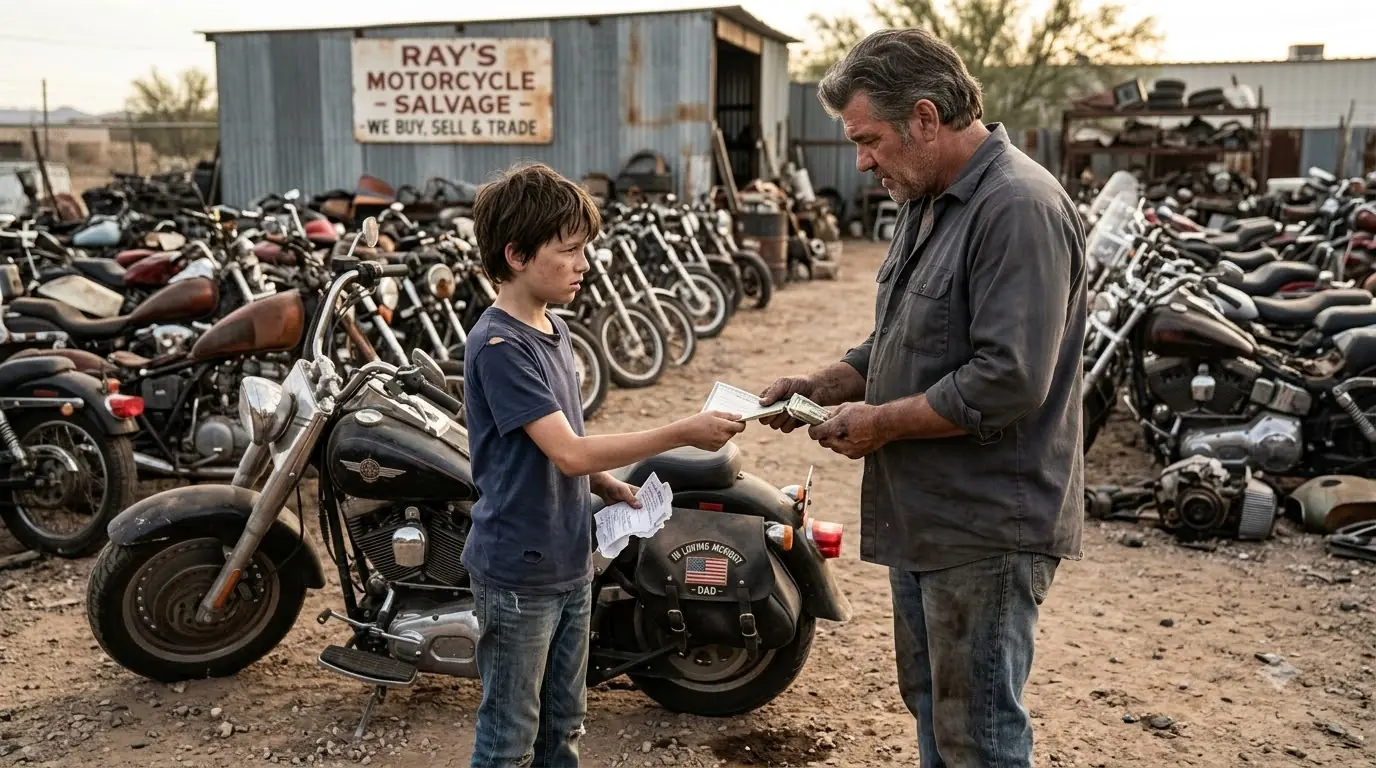
The third time, he placed everything in neat little rows across the kitchen table because his father had once told him numbers looked less frightening when they were organized.
It did not work.
Twenty-three dollars.
Four quarters.
Seven dimes.
Two nickels.
Three pennies.
Ethan stared at the money until the numbers blurred.
Beside it lay a pharmacy receipt folded twice down the middle.
AMOUNT DUE: $186.40
He did the subtraction in his head.
Then again on the back of an old grocery envelope.
Still impossible.
His mother was asleep in the bedroom at the end of the hall.
At least Ethan hoped she was sleeping.
For the last three nights, sleep had not really looked like sleep.
Sarah Miller would close her eyes for twenty minutes, wake coughing, shift against the pillows, then pretend she felt better whenever Ethan appeared at the door.
She smiled too much when she was sick.
That frightened him.
Healthy Mom complained.
Healthy Mom told him his shoes did not belong in the living room.
Healthy Mom asked why a cereal bowl was apparently incapable of finding the sink by itself.
Sick Mom smiled and said everything was fine.
Nothing was fine.
The doctor had changed her prescription two days earlier.
The pharmacy had filled it.
But Sarah's insurance situation had become complicated after her hours at the motel were cut.
There was a deductible Ethan did not understand.
A temporary coverage gap.
Words adults used when the actual meaning was simpler.
The medicine cost money they did not have.
Sarah had told the pharmacist she would come back Friday.
Friday was tomorrow.
But she had gotten worse during the night.
Ethan folded the receipt.
Put it into his pocket.
Then looked through the kitchen window toward the shed.
His father's motorcycle was inside.
Even thinking about it made something tighten in his chest.
The black Harley-Davidson had not moved in fourteen months.
Not since Daniel Miller died.
Cancer had taken Ethan's father slowly enough that everyone had time to prepare and quickly enough that nobody actually did.
For most of Ethan's childhood, Daniel had seemed indestructible.
He was six feet tall, broad through the shoulders, with a thick dark beard and hands that smelled faintly of motor oil no matter how hard he scrubbed them.
He fixed diesel engines for a trucking company outside town.
On weekends, he rode.
Not every weekend.
Sarah had rules.
Family breakfast first.
Lawn if it needed cutting.
Anything Ethan had going on.
Then Daniel could disappear for a few hours with the motorcycle.
Sometimes alone.
Sometimes with men Ethan knew only by road names.
Bear.
Moses.
Preacher.
Knuckles.
Doc.
And Ray.
Ray Callahan had been around more than the others when Ethan was little.
Huge man.
Loud laugh.
Gray beginning in his beard even then.
He always brought Ethan something useless.
A plastic compass.
A miniature wrench.
A bandana too large for his head.
Once, a tiny leather vest that Sarah refused to let Ethan wear to kindergarten.
Daniel thought that was hilarious.
Ray stopped coming after Daniel became sick.
At least Ethan thought he did.
Adults became quieter during illness.
Friends visited when children were sent outside.
Phone calls happened after bedtime.
Ethan never really knew which people stayed and which people vanished.
After Daniel died, Sarah rolled the motorcycle into the shed.
She covered it with an old canvas tarp.
Then she never touched it again.
Neither did Ethan.
Until that morning.
He stood from the kitchen table.
Twenty-three dollars and change returned to the old jar above the refrigerator.
The pharmacy paper remained in his pocket.
Ethan walked down the hallway.
His mother's bedroom door was open.
Sarah lay on her side beneath a thin quilt.
Thirty-eight years old.
Brown hair damp against her forehead.
Her face pale.
A glass of water stood on the nightstand.
“Mom?”
Her eyes opened.
“Hey, baby.”
Ethan hated when she called him baby now.
He was eleven.
But today he did not correct her.
“How do you feel?”
“Better.”
Lie.
“You were coughing.”
“Just a little.”
“You need the new medicine.”
Sarah shifted.
“I'll get it.”
“When?”
“Tomorrow.”
“You said that yesterday.”
She smiled.
“Did I?”
“Yes.”
“I must be getting predictable.”
Ethan stepped closer.
“Do we have the money?”
Sarah's smile changed.
Adults believed children could not recognize fear when adults softened their voices.
They were wrong.
“I'm handling it.”
“How?”
“Ethan.”
“How?”
She closed her eyes briefly.
“I'm going to call the pharmacy again.”
“They already said no.”
Her eyes opened.
“You heard that?”
“You were in the kitchen.”
“You were supposed to be doing homework.”
“I can hear while doing homework.”
Sarah sighed.
“Unfortunately.”
Ethan looked at the water.
Then at her.
“Dad would fix it.”
The words came out before he meant to say them.
Sarah became very still.
Ethan regretted it immediately.
“I'm sorry.”
“No.”
She reached toward him.
“Come here.”
He sat on the edge of the bed.
Sarah took his hand.
“Your dad couldn't fix everything.”
“He fixed almost everything.”
She smiled weakly.
“He certainly believed that.”
Ethan looked down.
“He'd know what to do.”
Sarah squeezed his fingers.
“He'd tell me to stop being stubborn.”
“You are stubborn.”
“You sound exactly like him.”
For a moment, both smiled.
Then Sarah coughed.
The cough bent her body.
Long.
Deep.
Ethan held her shoulder.
When it ended, she looked exhausted.
“I'm okay.”
He said nothing.
“Ethan.”
“Okay.”
But he did not believe her.
He returned to the kitchen.
Waited until Sarah's bedroom became quiet.
Then walked outside.
The shed door stuck near the bottom.
He kicked it the way his father used to.
It opened.
Dust floated inside thin morning light.
Tools hung along one wall.
Most had not moved since Daniel died.
A red metal cabinet.
Two empty gas cans.
Old fishing rods.
And beneath the canvas cover, the Harley.
Ethan stood there for a long time.
Then pulled the tarp.
Dust rolled off.
Black tank.
Chrome dulled.
Leather seat cracked along one edge.
Faded skull-and-wings patch attached to the old saddlebag.
Ethan ran one hand across the tank.
The metal felt cold.
He remembered sitting in front of his father when he was six while the motorcycle idled in the driveway.
Sarah stood with both hands on her hips.
“No road.”
Daniel laughed.
“Just driveway.”
“No road, Daniel.”
“Yes, ma'am.”
He moved the motorcycle twenty feet.
Ethan thought they had crossed the country.
The engine shook through his whole body.
His father's arms surrounded him.
That sound became one of Ethan's clearest memories.
Deep.
Heavy.
Alive.
Now the motorcycle was silent.
Ethan looked toward the house.
Then back.
His father had said something a week before he died.
Ethan remembered because Daniel had been very weak.
The motorcycle keys rested in a hospital tray beside him.
He pressed them into Ethan's hand.
“That's yours someday.”
Ethan shook his head.
“No.”
“Someday.”
“You're riding it.”
Daniel smiled.
“Maybe.”
“You are.”
Daniel did not argue.
He just closed Ethan's fingers around the keys.
“Don't let anybody tell you it's only a machine.”
Ethan remembered asking:
“Why?”
Daniel looked tired.
“Because some machines remember things.”
At eleven, Ethan still did not know whether that made sense.
But the Harley remembered his father.
That was enough.
Ethan pulled the pharmacy receipt from his pocket.
$186.40.
He looked at the motorcycle.
Then whispered:
“I'm sorry, Dad.”
Ray Callahan's salvage yard sat three miles outside Mesa Crossing, Arizona, behind a chain-link fence and a sign that read:
CALLAHAN MOTORCYCLE REPAIR & RECOVERY
Underneath, someone had spray-painted:
NO, WE DON'T BUY STOLEN BIKES
Ray left the graffiti because he thought it was funny.
Most people called the place a scrapyard.
Ray hated that.
“Motorcycle recovery yard,” he corrected.
Nobody cared.
Rows of damaged motorcycles filled the property.
Some had been wrecked.
Some abandoned.
Some were parts donors.
Others waited for owners who never returned.
Ray repaired what could be repaired.
Sold what could not.
He had been doing it twenty-two years.
At fifty-six, his back hurt every morning.
His left knee predicted rain.
His hands were permanently stained with grease.
He claimed retirement would kill him faster than work.
Nobody had proven otherwise.
That Thursday morning, Ray was arguing with a carburetor when he heard a small voice near the gate.
“Sir?”
He ignored it initially.
“Sir?”
Ray looked up.
A boy stood outside.
Thin.
Dark messy hair.
Dirty jeans.
Scuffed sneakers.
A navy-blue T-shirt torn at the left shoulder.