The first thing Jackson Cole noticed about the little girl was not that she was afraid.
It was that she wasn’t.
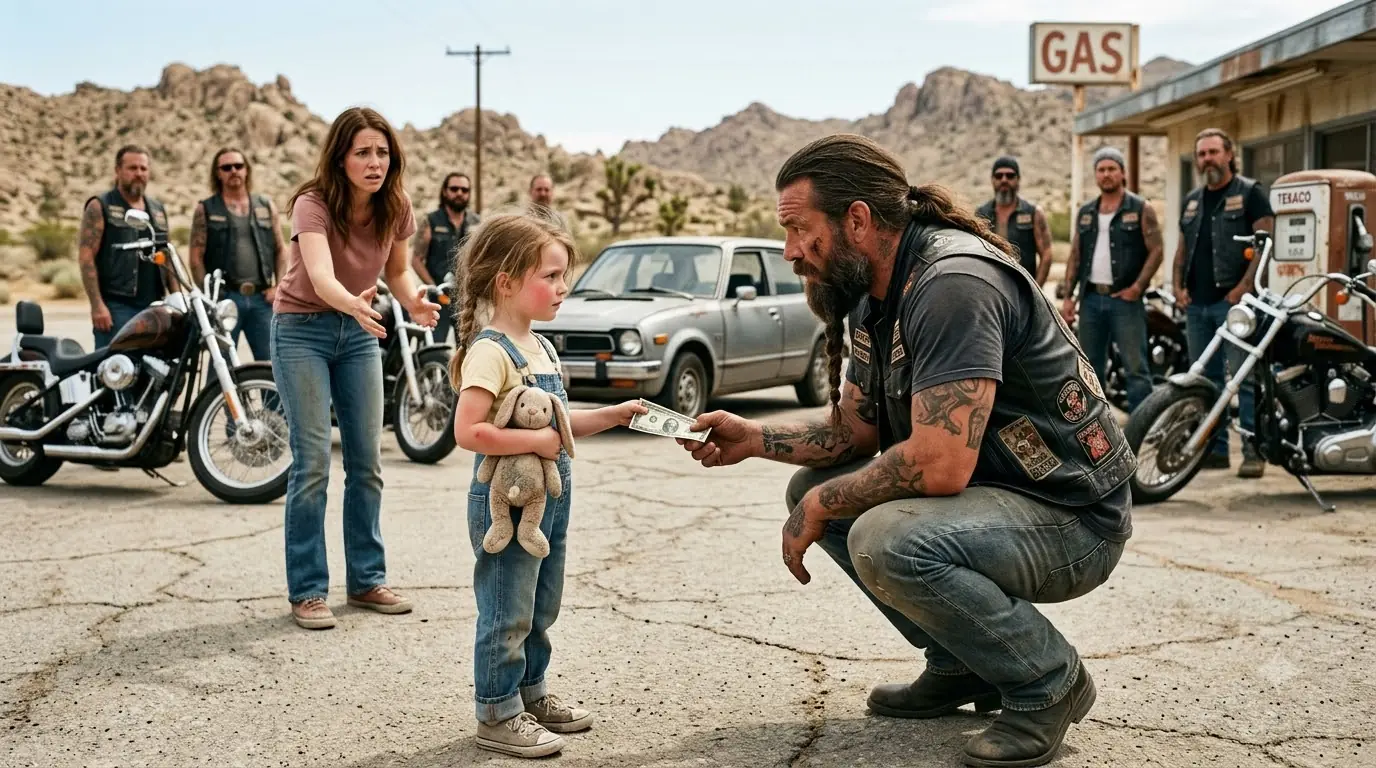
A six-year-old child stood beneath the merciless Mojave Desert sun, barely reaching the waist of the enormous leather-clad biker towering over her, and held out a carefully folded two-dollar bill as though offering money to a stranger twice her size was the most natural thing in the world.
Behind her, the girl’s mother had gone completely still.
Abigail Weston knew enough about survival to recognize danger before it announced itself, and everything about the fifteen motorcycles filling the cracked parking lot of the old Sunoco station told her to take Chloe, get into the Honda, and disappear.
Except the Honda had no gas.
Her bank account had no money.
And the men they were fleeing were somewhere behind them.
So Abigail could do nothing except watch as her daughter extended the most valuable thing she owned toward a man whose weathered leather vest, scarred hands, and six-foot-four frame made him look like someone most adults would cross a street to avoid.
“You can have it,” Chloe said.
The biker looked down.
For several seconds, no one moved.
Then the giant slowly crouched.
And everything Abigail thought she understood about dangerous people began to change.
Three hours earlier, she had been gripping the steering wheel of her battered 2008 Honda Civic so tightly that her fingers hurt.
The car’s air-conditioning had stopped working the previous summer, so every window was down despite the waves of desert heat pouring inside. A cardboard box containing most of Chloe’s clothes sat in the back seat beside a grocery bag filled with cereal bars, two bottles of water, and whatever else Abigail had been able to grab before leaving San Bernardino.
Everything else they owned was packed into the trunk.
That was how quickly a life could shrink.
Twenty-four hours earlier, Abigail had still technically had a home.
A small rent-controlled duplex on Valencia Street.
Two bedrooms.
One bathroom.
A kitchen where one cabinet door never closed properly.
A patch of dirt behind the house that Chloe called her garden because she had successfully grown three sunflowers there the previous spring.
It had never been beautiful.
But it had been theirs.
Then Richard Bowman decided the block was worth more without people like Abigail living on it.
Bowman Development Group had purchased several adjoining properties through shell companies over the previous eighteen months. The plan, according to glossy architectural renderings Abigail later found online, was to tear down the aging duplexes and replace them with luxury townhomes advertised as “modern urban living minutes from downtown.”
There was one inconvenience.
Tenants.
Families who had lived there for years.
Older residents paying controlled rents.
Workers who could not simply move because a developer wanted cleaner architectural lines and higher margins.
California law provided procedures.
Notices.
Compensation.
Relocation assistance in certain circumstances.
Bowman apparently considered procedures inefficient.
At first, tenants received letters offering small cash payments if they left voluntarily.
Some accepted.
Others could not.
Abigail was one of them.
She worked thirty-two hours a week as a receptionist at a pediatric dental office. She had no savings worth mentioning and no family nearby except an aunt in Modesto whom she had not seen in almost two years.
Moving required deposits.
First month’s rent.
Application fees.
Truck rental.
Childcare.
Money Abigail simply did not have.
So when Bowman’s representative offered her fifteen hundred dollars to leave within seven days, Abigail refused.
The man stared at her across the small kitchen table.
“You should think carefully.”
“I have.”
“This property is going to be redeveloped.”
“Then follow the law.”
The man smiled.
It was not a friendly smile.
“You really want to make this difficult?”
“I want what I’m legally entitled to.”
That was the beginning.
Two nights later, someone smashed the small side window beside her kitchen.
Police came.
Took a report.
Nothing was stolen.
The following week, one of her tires was slashed.
Then another.
The landlord’s management company claimed ignorance.
A handwritten note appeared beneath her windshield wiper.
MOVE WHILE YOU CAN.
Abigail showed it to police.
Another report.
Still nothing directly tied to Bowman.
Then a man followed her from the grocery store.
Not close enough to confront.
Just close enough that she noticed the same black Chevrolet Tahoe three turns in a row.
She drove to a busy shopping center.
The Tahoe disappeared.
That night, Abigail put Chloe into bed and sat beside her until she fell asleep.
The little girl hugged a worn stuffed rabbit named Button.
“Mommy?”
“Yes?”
“Are the bad men coming back?”
Abigail’s entire chest tightened.
“There are no bad men.”
Chloe looked at her.
Children always knew when adults lied badly.
“The ones who broke our window.”
Abigail touched her daughter’s hair.
“We’re safe.”
“Promise?”
She hesitated for less than a second.
Chloe noticed.
Abigail forced a smile.
“I promise I’m going to keep you safe.”
That promise was all she had left.
The final warning came on Thursday night.
A knock at the door.
Not loud.
Three slow taps.
Abigail did not open it.
Through the peephole she saw two men standing under the porch light.
One broad and heavy.
One thinner.
Neither looked like neighbors.
“Ms. Weston,” the larger man called.
She said nothing.
“We’re here on behalf of the property owner.”
“Come back during business hours.”
The man laughed softly.
“Business hours are flexible.”
Chloe appeared behind Abigail.
Abigail motioned frantically for her to return to the bedroom.
The man outside lowered his voice.
“Take the offer.”
Abigail’s stomach turned.
“You have a little girl.”
Silence.
“Would be a shame if she had to keep living around all this stress.”
Abigail’s hand began shaking.
The sentence could be interpreted a hundred ways.
That was the point.
Nothing specific enough to prove.
Everything clear enough to understand.
Abigail waited until the men left.
Then she called police.
By the time an officer arrived, the street was empty.
Another report.
Another promise to document future incidents.
At two in the morning, Abigail stopped pretending the system would move quickly enough to make her feel safe.
She packed.
Clothes.
Birth certificates.
Medication.
Chloe’s school paperwork.
Her laptop.
A folder containing every notice and police report.
Button the rabbit.
And one framed photograph of Abigail’s father holding Chloe when she was a baby.
Her father, Thomas Weston, had died two years earlier after a sudden stroke.
Chloe barely remembered him.
But she remembered one thing clearly.
The two-dollar bill.
Thomas had given it to her on her fifth birthday.
It had been crisp then.
He folded it once and slipped it into the tiny front pocket of Chloe’s overalls.
“This one’s lucky,” he told her.
“Why?”
“Because two-dollar bills are special.”
“Is it magic?”
Thomas pretended to consider.
“Only if you use it for something important.”
“What’s important?”
He had looked at Abigail.
Then back at Chloe.
“You’ll know.”
After Thomas died, Chloe kept the bill.
She never spent it.
Not on candy.
Not on toys.
Not even when Abigail once offered to trade her five ordinary dollars for it.
“It’s Grandpa’s luck,” Chloe would say.
That bill came with them when they fled San Bernardino.
Abigail drove north because north felt like away.
She had no sophisticated plan.
Her aunt lived near Modesto.
If they could reach her, they could at least sleep somewhere Bowman’s people did not know.
But fear had made Abigail careless about something basic.
Fuel.
By the time the Honda reached the outskirts of Barstow, the gas needle had been pinned on empty for twenty miles.
The car began hesitating.
Abigail whispered, “Please.”
The engine did not care.
Then she saw the Sunoco sign.
The station looked abandoned from a distance.
Up close, it was merely neglected.
Two pumps were covered in plastic.
One fluorescent sign flickered despite the daylight.
The convenience store windows had faded advertisements taped inside.
Abigail rolled beside the last functioning pump and shut off the engine.
Her wallet contained no miracle.
Four dollars and thirty cents.
That was all.
Her debit card had been declined that morning.
Credit card maxed.
She stared at the cash.
Four dollars would buy less than a gallon.
Enough to move the car.
Not enough to solve anything.
“Mommy?”
Chloe sat on the curb beneath the thin shadow cast by the building.
“Yeah, baby?”
“It’s hot.”
“I know.”
Button rested in Chloe’s lap.
Her cheeks were pink.
Abigail gave her the last half bottle of water.
“Small sips.”
“Aren’t you thirsty?”
“I’m okay.”
Another lie.
Abigail looked through the convenience-store window.
The attendant sat behind the register reading something on his phone.
She could ask.
She hated the idea.
Pride was a ridiculous luxury when your child was thirsty.
She started toward the store.
Then the sound came.
At first, Abigail thought it was distant construction.
A vibration.
Low.
Heavy.
Growing.
Chloe stood.
“Mommy?”
Abigail turned toward the highway.
Motorcycles appeared in formation.
One.
Then five.
Then ten.
Then more.
They exited together.
The sound rolled through the station like thunder trapped inside metal.
Abigail instinctively moved toward Chloe.
The motorcycles swept into the lot with practiced spacing and lined up near the pumps.
Chrome flashed under the desert sun.
Heavy engines idled.
Then stopped one after another.
The silence afterward felt even larger.