The first person to laugh was a man wearing a watch worth more than the piano in Lila Grant’s apartment.
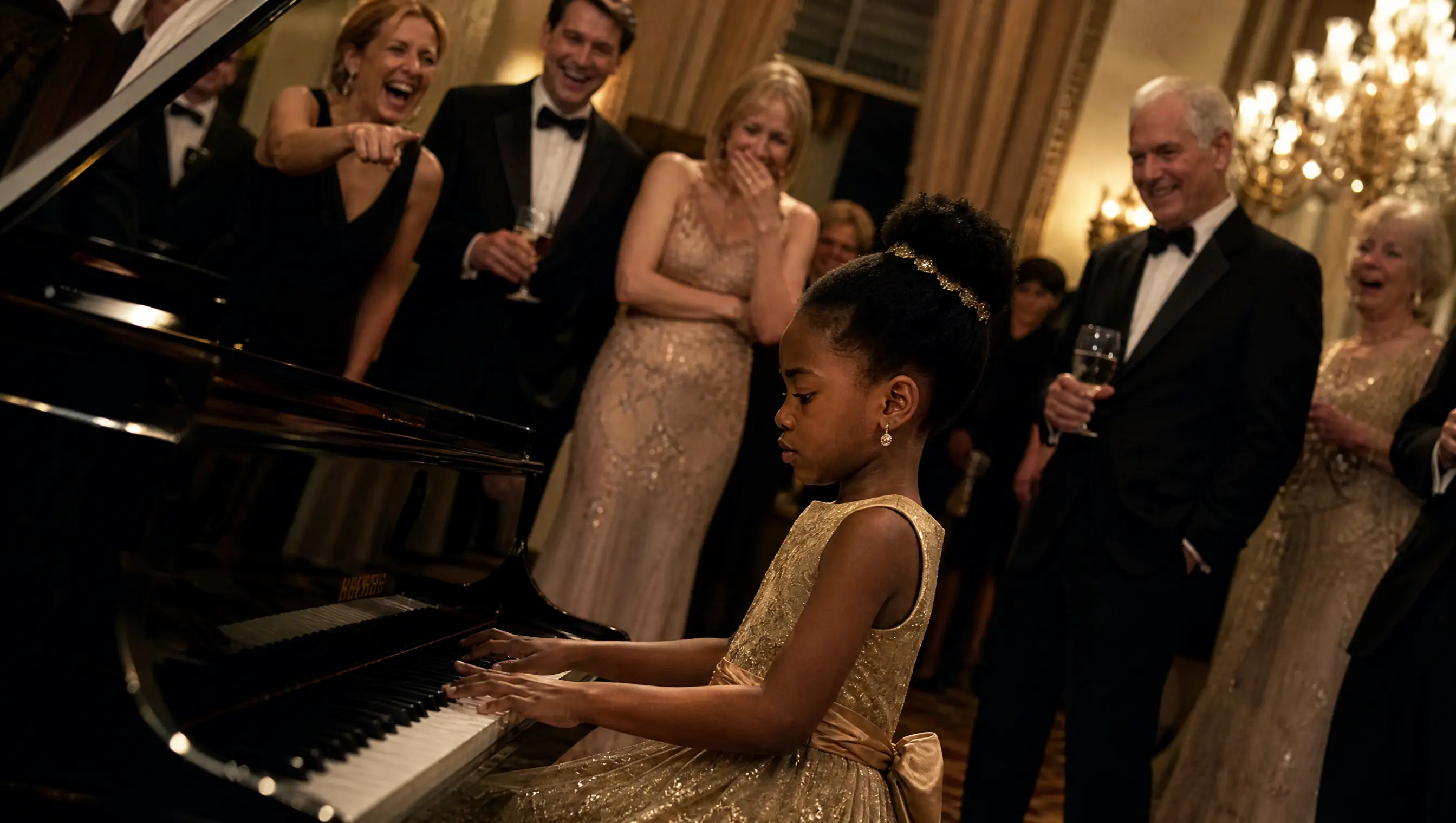
The second was a woman who had spent the previous twenty minutes telling everyone at her table how deeply she cared about music education.
Lila heard both.
She kept playing.
It was a cold December evening in Philadelphia, and nearly three hundred guests had gathered inside the ballroom of the St. Avery Society for its annual winter benefit.
The building sat just off Rittenhouse Square, an old stone mansion converted into a private arts club decades earlier. Crystal chandeliers hung above parquet floors. White roses crowded silver vases. Servers in black jackets moved between tables set with gold-rimmed china, and a twelve-foot Christmas tree glittered beside the marble staircase.
At the front of the ballroom stood a Steinway concert grand.
Nine feet of polished black wood beneath a spotlight.
Lila was eleven years old.
Her feet barely reached the pedals properly.
She wore a simple dark green dress her mother had bought from a department store clearance rack two weeks earlier. The hem had been shortened by hand because Lila was small for her age. Her shoes were black flats with scuff marks near the toes, and her hair was arranged in two neat braided twists pinned behind her head.
There was nothing about her appearance that resembled the children usually photographed in St. Avery fundraising brochures.
No custom dress.
No expensive bow.
No famous surname.
She looked exactly like what she was.
A sixth grader from West Philadelphia whose mother worked in a public-school cafeteria and whose father repaired heating systems for the city.
And at 5:42 that afternoon, before the gala officially began, she was sitting alone at a piano most of the guests believed she had no business touching.
Lila pressed one low E-flat.
Listened.
Then another.
She played a scale slowly.
Stopped.
Played the same notes again.
Across the room, Gregory Winslow laughed.
“Someone’s daughter found the piano.”
The woman beside him looked over.
Celeste Whitmore.
Sixty-two.
White.
Widowed.
Beautiful in the polished, expensive way of someone whose clothes never seemed to wrinkle even when she sat.
Celeste had donated nearly $1.3 million to the St. Avery Society over fourteen years.
Her name appeared on a rehearsal room upstairs.
A scholarship fund carried her husband’s surname.
She had once funded the replacement of forty-seven music stands because she found the old ones visually depressing.
She looked at Lila.
“Oh dear.”
Gregory smiled.
“Maybe we’re getting Chopsticks before cocktails.”
Celeste covered a laugh with two fingers.
“Be nice.”
“I am being nice.”
Another guest joined them.
Margaret Sloan, whose family owned a pharmaceutical distribution company.
She looked toward Lila.
“Is she one of the outreach children?”
Celeste frowned slightly.
“I assume.”
“She’s very early.”
Gregory glanced at his watch.
“Or very lost.”
The three laughed softly.
Not cruelly enough to attract attention.
Cruelly enough for Lila to hear.
Her hands stopped.
Only for a second.
Then she continued.
Across the ballroom, Dr. Helena Park heard it too.
Helena was forty-nine, Korean American, a pianist and conservatory professor who had spent twenty-seven years teaching children with enough talent to frighten adults into making bad decisions around them.
She was also Lila’s teacher.
Helena started toward the donor table.
Lila caught her eye.
Slight shake of the head.
No.
Helena stopped.
She knew that look.
Lila did not want rescue.
Not yet.
So Helena remained near the stage entrance and watched.
Lila played another passage.
This one faster.
Her fingers moved lightly through broken chords in the right hand while the left tested repeated octaves.
Not performance.
Warm-up.
Gregory looked over again.
His expression changed slightly.
“That’s not Chopsticks.”
Celeste listened for perhaps four seconds.
Then shrugged.
“Children memorize astonishing things now.”
Margaret nodded.
“My granddaughter can play half of a Mozart sonata from YouTube.”
Gregory smiled.
“Technology.”
Lila’s shoulders tightened.
She stopped playing.
Closed her eyes.
One breath.
Then another.
The ballroom had been empty when she began.
Now guests were arriving faster.
People walked around the edges of the room holding champagne.
Some noticed her.
Most did not.
A server approached the piano.
“Miss?”
Lila looked up.