The dawn light broke through the Montana pines like golden fingers reaching for something sacred. Five Harley-Davidson motorcycles circled the old farmhouse. Their chrome gleaming with menace, their engines rumbling low and hungry like wolves waiting for the kill command. Jackson River stood on the weathered front porch, a Remington 870 shotgun cradled in his callous hands. At 52 years old, he had learned to read violence the way other men read weather patterns.
The morning air tasted of gasoline fumes and coming bloodshed. His finger rested alongside the trigger guard. Not on it. Not yet. Behind him through the screen door, Margaret Hartwell gripped her late husband's Korean War M1 carbine.
She was 73 years old. Her hands marked with arthritis and age spots, but steady as mountain stone. The rifle had killed men in frozen valleys half a world away. It would kill again if necessary. The lid biker killed his engine.
The sudden silence felt louder than the roar had been. He removed his helmet slowly, deliberately, revealing a face carved from hard miles and harder choices. Vince Carver, Jackson had ridden with him for 20 years. Last chance, Hawk. Vince's voice carried across the gravel driveway like a funeral bell.
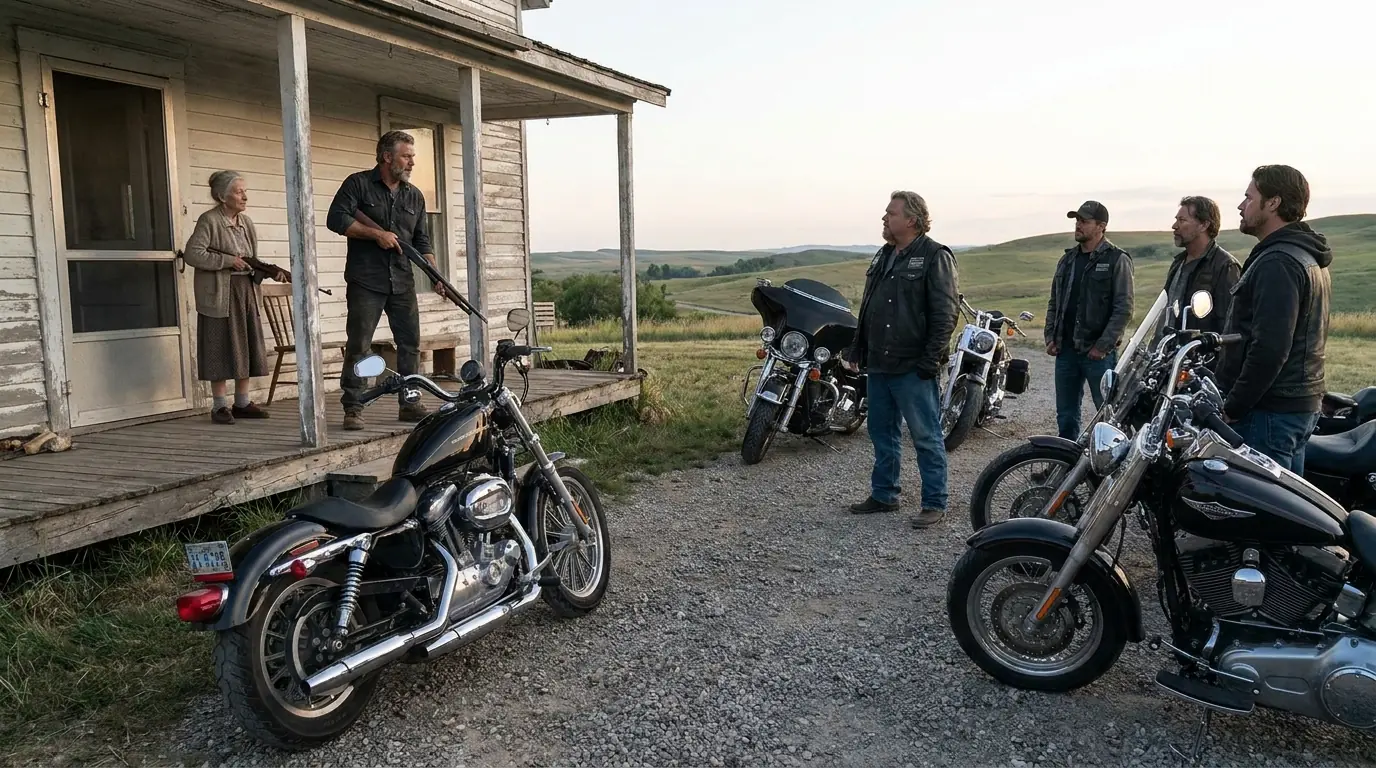
Walk away or we burn it down with the old lady inside. Jackson felt the shotgun's weight, familiar as prayer. You boys picked the wrong house, the wrong man, the wrong day. One of the younger bikers, Derek Stone, reached toward the pistol tucked in his waistband. His hand moved with meth fueled confidence.
The kind of stupid bravery that got people killed before breakfast. Jackson chambered around. The sound cut through the mountaineer with mechanical finality. Cha chunk. Five bikers against one man and one woman should have been simple mathematics.
But mathematics did not account for will, for fury, for the kind of love that made dying seem reasonable. The moment stretched, hung, crystallized. To understand how a decorated Gulf War hero ended up in a standoff with the most dangerous motorcycle gang in Montana, we need to go back 3 months ago to the day Jackson Rivers stopped running from his past. October painted Montana in colors that hurt to look at. Gold aspens against pine green frost making the morning grass crunch beneath the tires of Jackson's 1984 Harley-Davidson FXST soft tail.
The bike was black and chrome, evolution engine rumbling with the particular note only old Harley's make. He had been riding for 3 days straight. No destination, no plan, just movement, just distance. The leather vest he wore carried no patches anymore, no club colors. He had cut them off with kitchen scissors in a Motel 6 outside Reno, standing over a trash can that already held two empty whiskey bottles and the last shreds of who he used to be.
He almost rode past her. Almost. Margaret Hartwell stood in her driveway, wrestling with an impossible task. A stack of split oak logs rose taller than her diminished height, balanced precariously on a makeshift dolly whose wheel had given up sometime during the Eisenhower administration. She was trying to move Winter's warmth from woodpe to porch, one arm load at a time, her body betraying the determination her spirit still commanded.
Jackson saw her and something in his chest caught. A memory surfaced. Kuwait, 1991. A family fleeing burning oil fields. The sky turned black at noon.
The mother carrying water jugs too heavy for her frame. He had helped them. The village got hit by Iraqi artillery the next day. He never knew if they made it. His foot touched the brake almost before his brain registered the decision.
The Harley's engine grumbled to idle, then silence. Jackson sat there for 30 seconds, hands still on the grips. Every instinct screamed to ride away. Getting involved meant complications, meant staying, meant caring. But another voice spoke beneath the fear.
The voice that still remembered who he had been before the war broke him. That voice said four words that changed everything. Leave no one behind. Jackson killed the engine completely. Dismounted.
His knee protested. The one that still carried a rocky shrapnel too deep to remove. He walked toward the woman, each step feeling like walking towards something he could not take back. Ma'am, he said, his voice emerged rougher than he wanted. Looks like you could use a hand.
Margaret straightened slowly, one weathered hand pressed to her lower back. Her blue eyes, sharp as broken glass, studied him completely. She took in the leather vest, the graying beard, the road map of violence written across his knuckles. Most 73-year-old women would have hurried inside and locked the door. She smiled instead.
That's very kind of you, young man. Jackson almost laughed. 52 years old and no one had called him young in decades. I'm afraid I bit off more than I can chew today. Margaret continued, gesturing at the wood pile.
Jackson crossed the yard. Up close, he could see the arthritis gnarling her fingers, the careful way she favored her left leg. Let me take that, ma'am. He transferred the logs from her arms to his. Where do you want these?
Just inside the front door would be wonderful. There's a wood box right by the hearth. Jackson followed her through a door that had welcomed 47 years of Montana seasons. Inside, the house hit him like sensory memory, copper pots hanging from ceiling hooks, mason jars lined with dried herbs, the smell of fresh baked bread, the kind his grandmother had made in a Tennessee kitchen that existed now only in memory. Family photographs covered the mantle.
Three children at various ages. A wedding photo. One photograph stood separate. A young man in Marine Corps dressed blues, eyes bright with certainty. Jackson stacked the wood neatly, aware of Margaret watching him.
"Thank you," she said when he turned. "I don't get many visitors out here, especially ones willing to lend a hand without being asked." He started toward the door, toward his bike, toward the road that had no memory. But Margaret's voice stopped him. I've got coffee on the stove, apple pie cooling on the counter, my grandmother's recipe.
You're welcome to stay for a piece if you have time. The offer caught him completely unprepared. When was the last time someone had invited him to share a meal without wanting something in return? Jackson looked back at this woman, seeing something he could not quite name. Not pity, not fear, just simple human kindness offered without conditions.
I don't want to impose. No imposition at all. I made the whole pie and there's only me to eat it. Seems a shame to let it go to waste. Jackson hesitated.
Every instinct told him to decline. But the afternoon was growing cold and something about this woman made him want to remember what it felt like to be treated like a human being instead of a threat. All right, just for a few minutes. Those few minutes would become hours, then days, then something that looked remarkably like home. Margaret's kitchen existed outside of time.
The wood burning stove radiated heat that seemed to seep into bones that had been cold for years. She moved through the space with practice efficiency, pulling down ceramic mugs that had survived children and grandchildren and the general entropy of living. The apple pie sat cooling on a wire rack, steam still rising from the golden crust. "Cream or sugar?" Margaret asked, pouring coffee from a blue enamel percolator.
Black's fine. The coffee was strong and rich. Real coffee. Jackson wrapped his hands around the mug's warmth. This is real good coffee, ma'am.
Margaret, she corrected gently. And thank you. I grind the beans myself every morning. Old habits. Jackson took a bite of the pie and had to suppress a groan.
This is incredible. Margaret's eyes crinkled with pleasure. My mother's recipe. She taught me when I was barely tall enough to see over the counter. She studied his face.
You look like a man who's been living off diner food for a while. Jackson found himself smiling. Guilty as charged. Been on the road for a few days. Where are you headed?