Before that summer ended, Clara Miller would ask a lonely cowboy one simple question: "Have you eaten?" She thought she was offering him a bowl of stew. She did not know she was offering him the first real home he had known in twenty years. Before winter came to Wyoming, that quiet cowboy would change her life forever.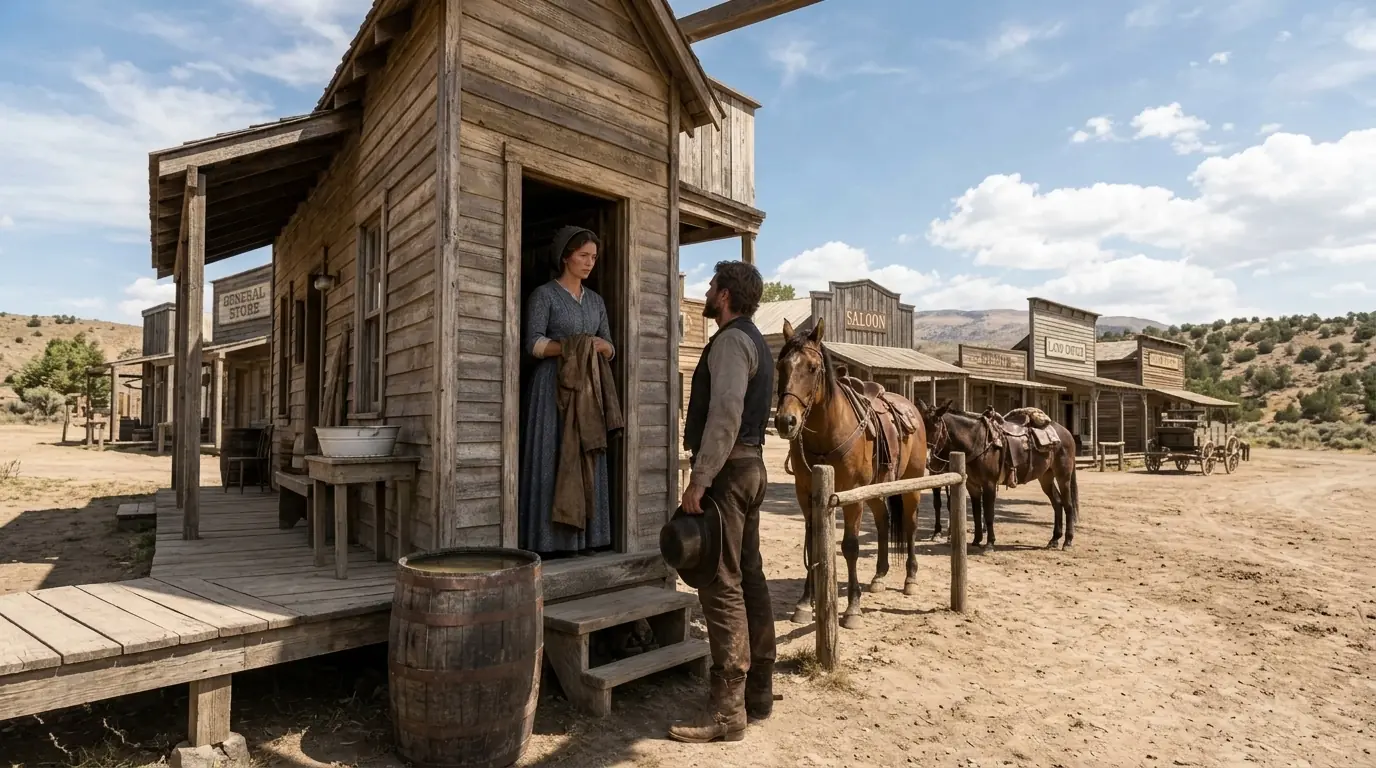
The Wyoming sun was a relentless furnace in the late summer of 1888. Clara Miller stood in the doorway of her small mending shop and smoothed the front of her blue calico dress. The fabric was worn thin, but it was spotless. Her shop sat at the very edge of town beneath a hand-painted sign that simply read, "Miller's Mending."
Clara had been a widow for three long years. The fever had come like a thief in the winter of 1885. It took her husband, Thomas, on a Tuesday, and it took their seven-year-old son, Samuel, by Friday. Since then, Clara had lived in the hollow silence of their memories.
She worked with a needle and thread to keep hunger at bay. Her hands were never idle. Her fingertips were calloused, but her grip was steady as a rock. She watched the road with the patient eyes of a woman who expected nothing from the world.
Then she saw him.
He rode a buckskin horse that looked as broken as he did. The man wore a dark, sweat-stained vest over a gray shirt, and his hat was pulled low, shading a face etched with the lines of too many miles. He did not look like a local ranch hand or a town gossip. He looked like a man who had forgotten the name of his last home.
The cowboy pulled his horse to a stop near Clara's porch and dismounted with a slow, stiff motion. His boots hit the dry earth with a heavy, hollow thud. He did not speak right away. Instead, he reached into his saddlebag and pulled out a bundle of leather and cloth.
He walked toward her, his spurs jingling softly in the stagnant heat, and stopped at the bottom of the wooden steps.
"Ma'am," he said, touching the brim of his hat. His voice was like gravel moving over silk. "I was told you were the best with a needle in the territory."
Clara looked at him, really looked at him. She saw the profound loneliness in his gray eyes before he could mask it.
"I do my best," she replied softly.
He handed her the bundle. It was a heavy duster coat, torn deeply along the shoulder.
"Caught it on a thorn thicket near the Medicine Bow River," he explained.
Clara took the coat, feeling the weight of the canvas. The material was expensive, but neglected.
"I'm in no hurry," the cowboy replied.
He looked past her into the cool, dim shadows of the shop. The scent of dried lavender and old wood drifted out to him. He stood there a moment too long, simply breathing in the air of a real home.
"My name is Silas Thorne," he said.
Clara nodded. For reasons she could not explain, the stranger's name lingered in her thoughts.
"Clara Miller."
Silas looked down at his dusty, worn boots. He seemed unsure of what to do with his hands now that they were empty. Clara noticed his thin frame and the way his vest hung a little too loosely.
The town of Laramie was growing, filled with strangers every day. Yet this man did not feel like a stranger to her. He felt like a ghost searching for a place to finally rest his head.
"Have you eaten, Mr. Thorne?" she asked.
The question was simple. It was the basic law of the frontier: you fed the hungry. But it hit Silas like a physical blow to the chest. He looked up, startled by the kindness in her voice.
"I had some hardtack this morning, ma'am."
Clara shook her head, a small frown appearing.
"Hardtack is for the trail, not for a guest in this town." She stepped back and held the door open. "I have a pot of beef stew on the stove. There is more than enough for two souls."
Silas hesitated. He looked at his horse, then back at the woman in the blue dress.
"I wouldn't want to be a burden to you," he muttered.
"A meal is never a burden in this house," Clara said firmly.
Silas stepped onto the porch. The wood creaked under his weight, a familiar, grounded sound. He entered the shop, removing his hat as he crossed the threshold. He looked massive and yet strangely small among the bolts of fabric and the spinning wheel.
Clara led him to the little kitchen in the back. The table was scrubbed white, clean enough to pray over. The stove gave off a gentle, comforting heat.
She ladled the stew into a ceramic bowl. The steam smelled of onions, carrots, and precious salt. She set it down with a thick, buttered slice of bread.
Silas sat slowly, his joints protesting. He ate with quiet, desperate intensity. He did not talk, and Clara did not force him. She sat across from him, picked up her sewing basket, and let the rhythmic click of her needle fill the room.
Silas finished the bowl and looked at the empty bread plate.
"Thank you," he whispered. "That's the first proper hot meal I've had in a month."
For a moment, Clara looked away. No one had sat at that table since Thomas died. The empty chair across from her had been untouched for three years. Now it no longer looked empty.
For the first time in three years, Clara did not feel ashamed of hearing another person breathe in her kitchen. She had grown used to silence: silence in the morning, silence at supper, and silence when the wind moved against the windows at night. But Silas brought no noise that disturbed her. He brought a quiet that seemed to sit beside her own.
Across the table, he looked down at the bowl as though it had been a gift too fine for a man like him. Clara noticed the way his hands lingered around the warmth of the ceramic, not because he was hungry anymore, but because he was remembering what it felt like to be welcomed.
Clara smiled, a small, sad movement of her lips.
"You're welcome, Silas."
He stayed in the kitchen for an hour, watching her nimble fingers work. He told her about cattle drives in Texas and the absolute silence of the high desert. He did not tell her why he was alone. He did not have to. Clara knew the weight of an empty bed and a silent house.
That night, Silas did not go to the hotel in town. He slept in the livery stable across the road, curled in the hay. The next morning, he was on Clara's porch before the sun was high. He was not holding more mending. He was holding a heavy bucket of water from the town well.
"Thought you might need this," he said.
Clara looked at the water, then up at him.
"I usually get my own, Silas."
"You shouldn't have to," he replied.
He spent the morning fixing a loose board on her porch. He tightened the hinges on her front door so it no longer whined. He did it all without being asked once.
By noon, town gossip had already begun to swirl like a dust storm. Mrs. Gable, the banker's wife, walked past with her silk parasol. She stared at the cowboy working on the widow's porch and whispered to her companion, her eyes narrowed in sharp judgment.
Clara saw them and felt a sudden spark of anger. Wyoming prided itself on strong women, but even on the frontier, gossip could cut deeper than winter wind.
She walked onto the porch with a glass of cool lemonade.
"Ignore them, Silas," she said loudly.
He looked up, a hammer in his calloused hand.
"I've been looked at worse by better people," he said with a quick wink.
Clara laughed, and it felt like a bell ringing in a dusty, forgotten room. It was the first time she had laughed since the fever took her world.
Over the next week, a routine established itself. Silas found work around the shop and the small barn. He rode out to the larger ranches to help with branding, but he always came back to Clara's for supper.
He told her stories of the great blizzard of 1886. He described the way cattle froze where they stood, becoming statues of ice. He spoke about the resilience of the land and the people who worked it.
Clara shared stories of her husband, Thomas. She told Silas how they had come from Missouri with nothing but a dream. She showed him the small wooden horse Thomas had carved for their son.
One evening, Silas found the toy on the shelf. He picked it up with trembling, rough fingers and saw the faint tooth marks in the wood. A single tear escaped his eye and disappeared into his beard.
"I had a daughter once," he whispered.
Clara stopped sewing, her needle poised in the air.
"What happened, Silas?"
"The plains are beautiful, but they are cruel," he said. "Scarlet fever doesn't care about a father's love or his prayers."
Clara walked over and placed her hand on his broad shoulder. It was the first time they had touched. The warmth of her hand soaked through his vest like a balm.
They stood there in the growing dark, two broken people holding on to the same ghost.
"I'm so sorry," she whispered.
Silas turned and looked at her. The grief in the room was heavy, but it was no longer suffocating. It was shared, and because it was shared, it was finally lighter.
Suddenly, there was a loud, arrogant knock at the front door. Clara wiped her eyes and answered it.
Mr. Sterling, a wealthy land speculator from the East, stood outside. He was dressed in a suit that cost more than Clara's entire house.
"Mrs. Miller," he said, tipping his hat with false, oily politeness. "I've come to give you one last chance to sell this lot. The railroad needs a warehouse right here, and it will have it."
Clara stiffened, her spine turning to iron.
"My answer is the same as it was last month, Mr. Sterling. This is my home. My husband's blood and sweat are in this wood."
Sterling sneered, looking past her at Silas standing in the kitchen.
"I see you've found yourself a protector. A drifter won't help you when the law comes to evict you. This town is changing, Mrs. Miller. There is no room for small shops and old, dusty memories."
Silas stepped forward, his long shadow falling over Clara. He did not draw a gun. He did not even raise his voice. He simply stood there, tall and solid as a mountain.
"The lady said no," Silas said quietly.
Sterling laughed, a cold, dry sound like dead leaves.
"And who are you?"
"A man with no land and no future," Silas replied. "But I'm also a man who knows how to hold his ground, and I suggest you leave before you find out how well I hold it."
Sterling looked into the cowboy's eyes and saw something dangerous and ancient. He backed away, muttering about progress and expensive lawyers.
Clara shut the door and leaned against it, her breath hitching. She was shaking from the rush of fear.
"He won't stop, Silas," she said.
Three days later, a formal notice appeared on Clara's door. Mr. Sterling was challenging her property claim in court. For the first time in years, Clara felt fear settle deep in her chest.
"Men like that never stop until they take everything," she said.
Silas walked to her and took her small hands in his.
"Then we won't stop, either."
Over the following weeks, the case quietly fell apart, but those weeks were not easy. Mr. Sterling sent men to stand across the street and stare at the shop. One afternoon, Clara found a broken fence rail behind the barn. Another morning, a customer told her she should sell before trouble found her doorstep.
Clara said nothing at first. She simply went back inside, picked up her needle, and kept working. Silas watched from the porch. He saw that she was not weak. She was tired, and there was a difference.
That evening, he sat beside her while she mended a torn sleeve by lamplight.
"You don't have to pretend you're not afraid," he said.
Clara's hand paused over the cloth.
"I'm not pretending," she answered softly. "I'm just not letting fear make my decisions anymore."
Silas looked at her, and something in him settled. He had seen courage in gun smoke, storms, and cattle drives, but Clara's courage was quieter and somehow stronger.
Several longtime residents testified that the property had belonged to the Miller family for years. Mr. Sterling eventually withdrew his claim and turned his attention elsewhere.
"I'm not going anywhere, Clara," Silas said.
That night, the air in the shop felt different. Their friendship had shifted into something deeper, something sacred. It was a promise whispered without the need for words.
The weeks turned into months, and the season changed. The golden heat of summer gave way to the crisp, sharp air of October. Cottonwood trees along the creek turned a brilliant, fire-like yellow.
Silas became a fixture in Laramie. He was no longer the drifter or the stranger. He was Silas, the man who worked at Miller's.
He built a small, sturdy room onto the back of the barn for himself. He refused to sleep in the house out of respect for Clara's reputation, but he spent nearly every waking hour with her. He helped with the heavy bolts of cloth, carried her groceries from the general store through the mud, and even began learning how to repair heavy leather saddles.
The town began to accept them, though the gossip never truly died. Some said it was a scandal for a widow to keep such company. Others called it a miracle sent straight from God.
Clara no longer cared what the banker's wife thought. For the first time in years, she felt a profound sense of peace. She had a reason to wake up and light the stove each morning.
One afternoon, a formal letter arrived for Silas. It was from a wealthy rancher far north in Montana, offering him a prestigious job as a foreman. It was a good position with high pay and a permanent house of his own.
Silas sat on the porch holding the letter in his scarred hand. Clara saw it and felt her heart sink into her stomach. She knew he was a man of the trail, born to move, and she knew the wandering spirit could be hard to break.
"Is it a good offer?" she asked, her voice trembling slightly.
Silas looked out at the vast, open horizon. The sky was a deep, bruised purple as the sun went down.
"The best I've ever had," he admitted honestly.
Clara nodded, her eyes filling with tears she refused to shed.
"You should take it, Silas. A man like you shouldn't waste his time fixing porch boards in Laramie."
Silas stood and walked toward her, closing the distance. He took her face in his rough hands.
"Clara, look at me."
She looked up, and the love in his eyes was absolutely blinding.
"I've spent twenty years looking for the next horizon," he said. "I've seen everything this hard country has to show a man, but I never saw a real home until I saw you standing in this doorway. I don't want Montana."
Silas looked down at the letter one last time. Then he folded it carefully and tossed it into the stove. The paper curled black in the fire.
For a long moment, neither of them spoke. The stove crackled softly, swallowing the final corner of the letter. Clara stared at the ashes as if she had just watched his whole past disappear.
"Silas," she whispered, "you don't have to give up a life for me."
He smiled, but his eyes were wet.
"Clara, that wasn't a life."
He looked around the little shop, at the worn table, at the blue dress she wore, and at the place where he had first tasted stew and mercy in the same hour.
"That was just moving from one empty place to another. This is the first place that ever asked me to stay."
He reached for her hand.
"I don't want the trail anymore. I want the seat at your table every night."
He reached into his pocket and pulled out a small, simple ring. It was not gold. It was a plain silver band hammered from an old coin.
His hands trembled slightly, not from fear, but from hope.
"I'm a poor man, Clara. All I have is my horse and my word. But if you'll have me, I'll stay here forever."
Clara did not hesitate for even a second. She threw her arms around his neck and pulled him close to her heart.
"Stay," she whispered into his shoulder. "Please, just stay."
The wedding was small and quiet, just like their love. They held it in the little parlor of the mending shop. The preacher from the Methodist church spoke the sacred words.
Silas wore a new suit, and Clara wore the same blue calico dress. She said it was her lucky dress because it was what she had worn the day they met.
Mr. Sterling did not bother them again. The town saw Silas standing on that porch and understood that the widow was no longer alone. He was a man who would not be bullied by money or power, and he was finally a man who belonged somewhere.
Years passed, and the small shop grew into a thriving business. They added a section for custom leatherwork and fine saddles. Silas became known for making some of the best saddles in Wyoming.
Clara continued her mending, but she also began making quilts. Each quilt told a story of the frontier and the people who lived there.
They never had more children of their own, but they were not alone. They became aunt and uncle to every orphan in Laramie. Their kitchen was always warm and filled with light, and there was always a pot of beef stew simmering on the stove.
Silas never forgot that first day in the dust. Every evening, before they closed the shop, he looked at Clara and asked with a gentle smile, "Have you eaten, Clara?"
She would laugh and lead him to the table they shared.
The lonely cowboy had finally found the end of his trail. The dust of the road had been replaced by the warmth of a steady hearth.
Their story became a legend in the streets of Laramie, a story of how a widow's kindness saved a man's broken soul and how a man's strength gave a woman her life back. Home was not always a place. Sometimes, home was a person who understood your silence. Sometimes, it was a question asked at exactly the right time.
Dignity was not found in the money they possessed, but in the people they protected. The spirit of the West lived on in those who chose kindness.
In 1890, Wyoming became a state, the first to give women a voice in elections. Clara and Silas stood together as that history was made. They knew that justice was built one act of love at a time.
Their legacy remained in the soil of Laramie, a testament to the power of a second chance. No matter how far a person had wandered, it was never too late to find the way home.