The first laugh came before Miss Elinor Vale had even stepped fully out of the carriage.
It drifted across the pale stone courtyard of Ravenshire Park, light, polished, and cruel enough to wound without leaving anything visible. Elinor paused with one gloved hand on the carriage door and the other clutching the folded invitation in her lap.
Outside, late summer sunlight poured over the sweeping lawns, the white steps, the clipped hedges, and the bright cluster of guests gathered before the house. Ladies in muslin and silk stood beneath parasols like painted flowers. Gentlemen in riding coats laughed easily, their boots polished, their gloves spotless, their confidence older than memory.
Elinor did not belong among them.
That fact was obvious before anyone spoke.
She was twenty-three years old, the daughter of a widowed schoolmaster from a small village near the northern border of Hampshire. Her gown was dark green cotton, carefully washed and altered twice to keep it respectable. Her gloves had been mended at the fingers. The ribbon at her bonnet had been pressed flat with a warm iron that morning and had lost its discipline somewhere along the road.
She had done her best.
At Ravenshire Park, her best looked like poverty trying to behave.
The laughter came again.
This time, she saw who had caused it.
Lord Adrian Wycliffe stood at the foot of the steps, one shoulder resting against a carved stone balustrade, surrounded by three gentlemen who looked as though they had never had to worry about the price of anything except perhaps boredom.
He was the eldest son of the Earl of Ravenshire, handsome in an effortless, aggravating way. Tall, broad-shouldered, dark-haired, with a face that seemed designed to make apologies unnecessary. His coat fit perfectly. His smile came slowly, as if he knew people waited for it.
His eyes moved over Elinor.
The plain gown.
The small trunk.
The worn gloves.
The bonnet that had clearly surrendered to the journey.
Then he leaned toward the gentleman beside him and said something too quiet for her to hear.
The gentlemen laughed.
Elinor felt heat rise beneath her skin.
For one sharp moment, she wanted to climb back into the carriage and order the driver to return her to Wrenford before any more of Ravenshire Park could see her.
But she had not traveled four hours over rough roads merely to be defeated by a beautiful man with poor manners.
Her father had taught her many useful things. How to read Greek slowly but correctly. How to stretch a household account until it almost became a miracle. How to stand upright in a room where people wanted her to feel small.
And how to hold a bow.
That last lesson had been her mother’s.
Elinor stepped down from the carriage, thanked the driver, and crossed the courtyard with her chin lifted as though Ravenshire Park had been waiting for her arrival all season.
She had been invited by Lady Margaret Dain, her late mother’s cousin, who served as a quiet but influential companion to the Countess of Ravenshire. Lady Margaret had written that the countess wished for “pleasant young company of sense and modesty” during the annual summer house party.
Elinor understood the truth beneath the polite words.
Lady Margaret remembered her mother and wished to help her daughter.
Elinor accepted because help was rare, and pride did not pay for winter coal.
The Ravenshire house party was to last eight days. There would be dinners, card games, music, morning walks, a boating party on the lake, and, most importantly, the annual archery match on the south lawn.
Ravenshire Park was famous for its archery tournament. The countess called it a graceful amusement for ladies and gentlemen. Elinor had always found that description absurd.
There was nothing merely graceful about a bow.
A bow required strength.
Patience.
Control.
A steady breath.
A still mind.
The body had to obey before the arrow ever left the string.
Elinor had learned to shoot at eleven. Her mother, once the daughter of a minor military officer, had taught her in the meadow behind their cottage. The first bow had been too large for her, the arrows rough, the target an old sack stuffed with straw and tied to an apple tree.
Her mother had laughed when Elinor missed by six feet.
Then she taught her again.
By fifteen, Elinor could hit a hanging ribbon at twenty yards. By nineteen, she could split a reed at thirty. By twenty-three, she had become so good that the local gamekeeper no longer praised her. He simply grunted, which from him meant admiration of the highest order.
At Ravenshire, Elinor said nothing of this.
There was power in being underestimated.
It allowed people to speak freely.
And careless people always revealed where they were weakest.
Lady Margaret met her in the entrance hall, her kind face tightening for a moment as she took in Elinor’s expression.
“You heard them,” she said softly.
“I heard laughter,” Elinor replied. “I chose not to collect it.”
Lady Margaret’s mouth curved.
“I hope that is a compliment.”
“It is the best one I know.”
Lady Margaret led her into the blue drawing room, where the Countess of Ravenshire sat among guests like a queen who had forgotten she was mortal. She was not unkind, exactly. Her manners were perfect. Her voice was warm. But her gaze had the habit of measuring everything before granting it value.
“So this is Miss Vale,” the countess said.
Elinor curtsied.
“My lady.”
“Lady Margaret speaks fondly of your family.”
“She is generous to do so.”
“And your father is a schoolmaster?”
“He is.”
“How useful.”
Elinor smiled.
“Very. Especially for people who wish to learn.”
The countess paused.
Lady Margaret looked briefly toward the window.
A gentleman near the tea table coughed into his hand.
The countess smiled again, more carefully this time.
“I trust you will enjoy your stay.”
“I shall endeavor to deserve it.”
“Such modesty.”
“Such pressure.”
This time, the countess did laugh. Not unkindly. Perhaps even with interest.
Elinor decided she might survive the week.
The first evening, however, tested that confidence.
At dinner, she was placed near the lower end of the table between an elderly clergyman who spoke only of his digestion and Miss Helena Pryce, a pale young lady who asked whether village life was “very muddy.”
“In winter, yes,” Elinor said.
“How unfortunate.”
“For the mud, perhaps.”
Miss Pryce blinked and returned to her soup.
Farther up the table sat Lady Arabella Crane, the acknowledged beauty of the house party. She wore white muslin with pearls at her throat and had the kind of golden loveliness that made every candle appear to exist for her benefit. It was said that Lord Adrian’s mother favored the match.
Lady Arabella clearly believed so too.
She laughed at everything Lord Adrian said, and Lord Adrian, to his discredit, gave her ample opportunity.
Elinor tried not to watch him.
That became difficult when he chose to address her across the table.
“Miss Vale,” he said, his voice carrying with casual ease. “Is Ravenshire Park much grander than you expected?”
A few heads turned.
Elinor set down her spoon.
“Yes, my lord.”
His smile deepened.
“And does it impress you?”
“Less than it might have if I had not seen the drainage problem near the west terrace.”
A silence followed.
Lord Adrian blinked.
“The drainage problem?”
“The stones are sinking near the lower fountain. Water gathers there after rain. If the frost is hard this winter, the paving will crack.”
The elderly clergyman brightened.
“I noticed that.”
Lord Adrian looked toward his father, who looked toward the countess, who looked mildly displeased that her paving had been discussed at dinner.
Elinor returned to her soup.
Lady Arabella smiled sweetly.
“How practical you are, Miss Vale.”
“Thank you.”
“I meant it as praise.”
“I accepted it as such.”
The gentlemen near Lord Adrian laughed.
This time, not entirely at Elinor.
Lord Adrian studied her for a moment longer than politeness required.
That was the beginning of his attention.
Elinor was not grateful for it.
Over the next two days, she learned the rules of Ravenshire Park.
Beauty sat closest to power.
Money walked through every room before its owner entered.
Title excused dullness.
Confidence, if worn elegantly enough, could be mistaken for intelligence.
Elinor also learned that Lord Adrian Wycliffe was not foolish.
That made his earlier cruelty less forgivable.
A stupid man might mock what he did not understand.
An intelligent man knew better and chose not to act better.
On the third morning, Elinor found herself alone in the orangery, admiring a row of lemon trees that had been coaxed into health with more patience than several of the guests deserved.
“You are hiding, Miss Vale.”
She turned.
Lord Adrian stood in the doorway, hat in hand, sun catching in the dark waves of his hair.
“I am observing lemons.”
“Is that a common village pastime?”
“No. Usually we observe people who think they are better than lemons.”
His brows lifted.
“Do you find lemons superior?”
“They have more use and less vanity.”
A slow smile touched his mouth.
“You dislike me.”
“I know too little of you to dislike you properly.”
“That is oddly encouraging.”
“Do not overindulge in hope, my lord. It rarely improves men.”
He stepped inside the orangery.
“I owe you an apology.”
“Do you?”
“For laughing when you arrived.”
“Yes.”
“And for encouraging others to laugh.”
“Yes.”
“And for attempting to make sport of you at dinner.”
“That too.”
His smile faded.
“I am sorry.”
Elinor looked at him carefully.
The apology was unexpected. Its timing even more so. She had thought men like him apologized only when publicly forced.
“You apologize early,” she said.
“I am trying it as an experiment.”
“Does it pain you?”
“Less than I expected.”
“Then perhaps there is hope.”
He laughed, and this time it was not cruel. It came easily, almost warmly, and Elinor found that more dangerous than mockery.
Mockery she could resist.
Warmth was less simple.
“I should like to begin again,” he said.
“Then begin by not asking me whether my village has roads.”
His mouth twitched.
“Does it?”
“My lord.”
“Forgive me.”
“I have not decided to.”
“Fair.”
He looked at her then, not at her gown, not at her gloves, but at her face.
It unsettled her.
“I had assumed,” he said slowly, “that you were timid.”
“Many people confuse economy of speech with lack of thought.”
“I am discovering that.”
“You are discovering very late in life that women may think?”
“I am discovering that I have often failed to notice when they do.”
It was too honest an answer to mock.
Elinor disliked that too.
Before she could reply, Lady Arabella appeared at the far end of the orangery with two other ladies.
“Lord Adrian,” she called, smiling brightly. “Your mother is looking for you.”
Her gaze flicked to Elinor.
Just once.
Enough.
“Miss Vale,” she said. “How industrious of you to inspect the fruit.”
“How generous of the fruit to receive me,” Elinor answered.
Lord Adrian covered his mouth with one hand.
Poorly.
Lady Arabella’s smile cooled.
By the fourth day, the mockery had changed shape.
No one laughed openly at Elinor’s bonnet anymore. That would have seemed unoriginal. Instead, remarks came wrapped in sweetness.
“How refreshing not to care for fashion.”
“How brave to travel with so little luggage.”
“How fortunate that a plain gown lets one’s character be seen.”
Elinor endured them because endurance was less tiring than constant battle.
But she stored every remark.
Not for revenge.
For accuracy.
The archery match was announced at breakfast on the fifth morning.
The contest would be held the following afternoon on the south lawn. Ladies and gentlemen would compete separately at first, then the best two from each group would shoot in a final round.
Lady Arabella declared that she adored archery but had “such weak wrists.”
Several gentlemen immediately offered instruction.
Lord Adrian looked amused.
Then the steward read the list of competitors.
“Miss Elinor Vale.”
The room quieted.
Lady Arabella turned slowly.
“You entered?”
“Yes.”
“How brave.”
“How repetitive that word has become.”
Miss Helena Pryce looked confused.
Lord Adrian glanced across the table.
“You shoot, Miss Vale?”
“When I hold a bow.”
“That is generally when one does.”
“Then yes.”
A few guests laughed.
Lady Arabella smiled.
“I do hope you enjoy yourself.”
“So do I.”
But Elinor’s stomach tightened.
She had not entered to impress them.
That would have been beneath both her skill and her self-respect.
She had entered because when Lady Margaret showed her the old bow rack in the morning room and asked softly whether she still shot, Elinor had felt her mother’s memory rise like a hand at her back.
Yes, she had said.
Then shoot, Lady Margaret replied. Not for them.
That night, Elinor slept poorly.
She dreamed of the meadow behind the cottage, of her mother’s voice, of arrows flying wide, of laughter not cruel but loving.
In the morning, she woke before the house stirred and walked alone to the south lawn.
The targets had already been set up.
Round white faces against the green.
Distances marked by ribbons.
A light wind moving from west to east.
Elinor stood at the line and studied the field.
“You are serious about this.”
She did not turn.
Lord Adrian came to stand several feet away.
“Yes.”
“I did not mean that as an insult.”
“I did not receive it as one.”
The sky was pale, the grass damp with dew.
For once, he did not speak quickly.
“Who taught you?” he asked.
“My mother.”
“She shot?”
“Better than anyone I knew.”
“And your father allowed it?”
Elinor looked at him.
“My father was wise enough not to believe women require permission to be capable.”
Adrian bowed his head slightly.
“Another lesson I arrive at late.”
“You do arrive eventually. That is something.”
He smiled faintly.
Then his expression sobered.
“Will you be nervous?”
“Yes.”
The honesty surprised him.
“You admit that?”
“Nerves are not shameful. They are simply the body preparing to do something important. Panic is different. Panic is when the mind interferes.”
“And you do not panic?”
“Not with a bow.”
She looked toward the targets.
“With people, occasionally.”
The admission seemed to strike him softly.
He did not answer with wit.
That was perhaps the first time she truly began to like him.
The archery field filled after luncheon.
Servants arranged striped awnings. Ladies gathered beneath parasols. Gentlemen examined bows with the solemn confidence of men about to be humbled by physics. The countess sat beneath a canopy with Lady Margaret beside her. Lord Ravenshire stood near the judges, speaking to the steward.
Elinor wore her green cotton gown again.
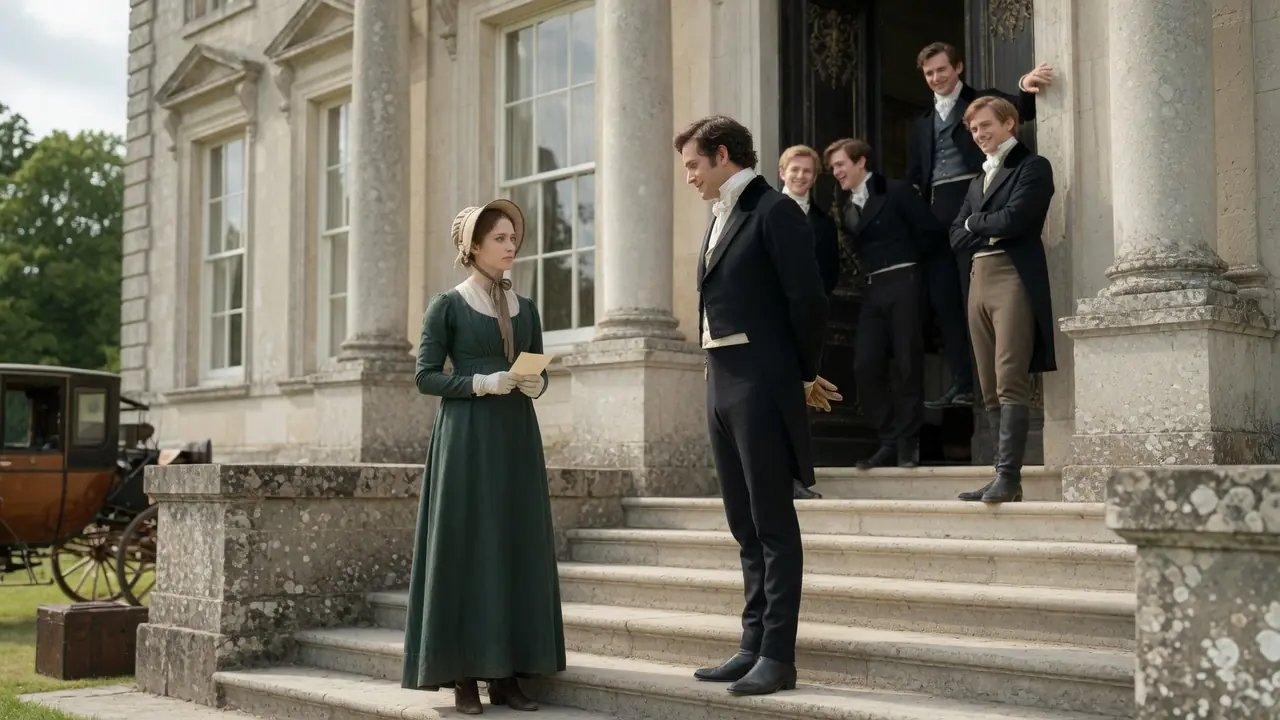
Lady Margaret had lent her a darker ribbon for her waist, which improved the dress enough to make it seem intentional rather than merely practical. Elinor had pinned her hair more securely than usual. Her gloves were too worn for shooting, so she removed them and held them folded in her hand.
Lady Arabella noticed.
“How rustic,” she murmured, not quite softly enough.
Elinor looked at her own bare fingers.
“Yes. Hands are common among country people.”
The nearest gentleman coughed.
The first rounds began.
Several ladies shot prettily and poorly. A few shot reasonably well. Lady Arabella, despite her weak wrists, managed to strike the outer ring and received more applause than accuracy warranted.
Lord Adrian shot among the gentlemen and did well. Annoyingly well. His stance was elegant, his draw clean, his arrow close to center.
He looked briefly toward Elinor afterward.
Not boasting.
Not this time.
Watching.
Then the steward called her name.
“Miss Elinor Vale.”
The lawn changed.
Not dramatically. No one said anything unkind aloud. But expectation shifted into the pleasant anticipation of embarrassment.
Elinor stepped to the mark.
A footman handed her the bow.
It was heavier than the one she preferred, but balanced well. She tested the string once, not for display, but from habit. The sound was good.
The world narrowed.
The guests remained. She could feel them: Lady Arabella waiting to smile, the gentlemen waiting to be amused, the countess curious, Lady Margaret still as prayer, Lord Adrian somewhere beyond the line, silent.
But they moved far away.
There was the grass beneath her shoes.
The bow in her hand.
The target.
Her breath.
Her mother’s voice, clear from years gone.
Do not fight the bow, Elinor. Ask it properly, and it will answer.
She set her feet.
Lifted the bow.
Drew.
The strain moved through her shoulders and back like an old memory. The wind touched the loose hair near her temple. She waited one heartbeat.
Two.
Then released.
The arrow flew straight and struck the center.
The sound was small.
The change it caused was not.
Silence.
Absolute silence.
Even the birds seemed briefly tactful.
Then Lord Ravenshire said, “Good God.”
Applause broke open across the lawn.
Lady Margaret laughed aloud. The countess sat straighter. The deaf old aunt near the lemonade table asked what had happened, and when told, clapped enthusiastically in the wrong direction.
Lady Arabella’s smile froze.
Elinor lowered the bow.
She did not look at Lord Adrian.
Not yet.
The steward handed her the second arrow, his fingers slightly less composed than before.
Elinor stepped back into position.
The murmurs died.
Now they were not waiting for failure.
They were waiting for proof.
That was a different pressure.
She drew.
Held.
Released.
The second arrow struck so close to the first that the two shafts trembled together.
This time the applause came slower, because surprise had turned into awe.
Someone whispered, “Impossible.”
Elinor almost smiled.
The third arrow mattered most.
Anyone could be lucky once.
Skill began where luck ended.
She took the final arrow.
As she raised the bow, the breeze shifted. The ribbon markers fluttered slightly toward the east.
She waited.
The lawn waited with her.
A nervous archer would have released.
An impatient one would have overcorrected.
Elinor held steady until the air settled.
Then she loosed.
The arrow struck the center.
Perfect.
Unanswerable.
The south lawn erupted.
This time, no one remembered to be subtle.
Applause rose from every side. Gentlemen shouted approval. Ladies stood. The countess clapped with open delight. Lady Margaret had tears in her eyes.
Elinor turned then.
Lord Adrian was staring at her.
Not smiling.
Not laughing.
Not performing admiration for the crowd.
He looked as though the entire world had rearranged itself and placed her at its center.
She looked away first.
Not because she was shy.
Because victory tasted better when not swallowed too quickly.
The final round placed Elinor against Lady Arabella, Lord Adrian, and Mr. Cresswell, a cheerful gentleman who had the good sense to admit he was outmatched before beginning.
The distance was increased.
The target narrowed.
The crowd pressed closer.
Lady Arabella shot first and did well enough to earn polite applause. Mr. Cresswell missed the center by a handspan and bowed dramatically to his own defeat.
Lord Adrian shot next.
His arrow struck near the center. A fine shot.
He stepped back and looked at Elinor.
This time, there was no doubt in his face.
Only respect.
Elinor stepped forward.
Her palms were dry.
Her breath steady.
She lifted the bow.
For one moment, the whole lawn disappeared.
She released.
The arrow struck dead center.
Not near.
Not close.
Center.
The match was over.
Everyone knew it before the judges announced it.
The countess herself rose to present the prize: a small silver arrow pin that had belonged to Lord Ravenshire’s grandmother.
“My dear Miss Vale,” she said, with genuine warmth now, “you have astonished us.”
Elinor accepted the pin.
“How fortunate,” she replied, “that astonishment remains possible.”
The countess laughed.
Lady Arabella did not.
Lord Adrian approached only after the others had offered congratulations.
He waited until she had room to breathe.
That mattered.
“Miss Vale,” he said.
“My lord.”
His gaze moved to the targets, then back to her.
“I was wrong.”
She tilted her head.
“About the paving near the west terrace?”
A reluctant smile touched his mouth.
“Among other things.”
“Name them.”
He looked surprised.
Good.
“I was wrong to laugh when you arrived,” he said.
“Yes.”
“Wrong to mistake plainness for lack of consequence.”
“Yes.”
“Wrong to assume your silence meant uncertainty.”
“Continue.”
His mouth twitched, but he obeyed.
“Wrong to imagine birth gives anyone the right to measure another person’s worth.”
That answer reached her more deeply than expected.
She looked away toward the target.
The three arrows still stood clustered at the center.
“You apologize better than you flirt,” she said.
“I suspect I have had more need of practice.”
“With apologizing?”
“With deserving rebuke.”
That was nearly charming.
She refused to reward it.
“At breakfast tomorrow,” she said, “you may ask how I learned to shoot.”
“I would like that.”
“You may ask because you wish to hear the answer, not because one surprising talent has made me suddenly interesting.”
His expression softened.
“You were interesting before. I was simply too vain to notice.”
Elinor had no answer.
That annoyed her.
“Breakfast,” she said.
“Breakfast.”
“And Lord Adrian?”
“Yes?”
“If you laugh at me again, I shall assume you are volunteering to hold the target.”
He stared at her for one second.
Then he laughed.
Not cruelly.
Not for anyone else.
A real laugh.
Warm.
Unplanned.
Elinor found, to her considerable inconvenience, that she liked it.
The morning after the archery match, Lord Adrian arrived at breakfast without his usual companions.
He did not sit immediately. He stood beside the chair near Elinor and asked, “Is this seat free?”
“It is empty,” she said. “Freedom is another matter.”
“May I attempt it?”
“You may sit, my lord.”
He did.
Lady Margaret watched from across the table with visible amusement.
Adrian did not begin with compliments. That was wise.
“How did your mother teach you?” he asked.
So Elinor told him.
She told him about the meadow behind the cottage. The ash bow. The first arrow that missed the target and landed in a cabbage bed. Her mother laughing until she cried. The old gamekeeper who corrected her stance and never praised her unless absolutely forced by conscience.
She told him that archery had taught her more than accuracy.
It taught her patience.
It taught her to breathe through being watched.
It taught her that aim was not desperation toward a target, but the quiet certainty that the target could be reached.
Adrian listened.
Truly listened.
That unsettled her more than mockery ever had.
Over the last days of the house party, Lord Adrian did not become perfect.
Elinor would have distrusted perfection.
He remained proud. He remained handsome in an inconvenient way. He still carried the habits of a man praised too often and corrected too rarely.
But he tried.
He introduced her properly when others reduced her to Lady Margaret’s poor relation. He asked questions and waited for answers. When Lady Arabella remarked that Elinor’s skill was “remarkable for someone of such limited opportunities,” Adrian replied, “Opportunity often reveals talent. Its absence never proves the talent was not there.”
The drawing room went quiet.
Elinor did not thank him.
Later, as they walked near the lake, she said, “I did not need defending.”
“I know.”
“Then why speak?”
“I was correcting the room.”
She looked at him.
“And yourself?”
His answer came after a pause.
“Yes.”
That pleased her more than it should have.
On the final evening, the countess hosted a small dance in the long gallery. Candles burned in mirrored sconces. The windows stood open to the warm dark. Guests who had laughed at Elinor on the first afternoon now sought her conversation with eager politeness.
Society, she had discovered, could rearrange its opinion very quickly once embarrassment made the old arrangement inconvenient.
Lady Arabella avoided her.
Elinor did not mind.
Lord Adrian approached as the second dance ended.
He bowed.
“Miss Vale, would you do me the honor of the next dance?”
Elinor looked at his hand.
“You understand that dancing with the schoolmaster’s daughter may damage your reputation.”
His eyes warmed.
“Then it was in need of damage.”
“And if people laugh?”
“I will remember I once deserved it and hope I no longer do.”
It was a good answer.
Not perfect.
But good.
She placed her hand in his.
They danced.
Elinor caught her reflection in the tall mirror as they turned: green cotton gown, borrowed ribbon, mended gloves tucked away because she preferred her hands free. A woman who had arrived as an object of amusement and would leave as someone no one at Ravenshire Park would ever again measure by fabric alone.
Years later, people would say Lord Adrian Wycliffe fell in love with Miss Elinor Vale when she placed three arrows in the center of the target and silenced an entire lawn.
Elinor would always correct them.
“No,” she would say. “That was merely when he looked.”
Then, because accuracy mattered, she would add, “He began to change when he learned how to see.”
And Adrian, if nearby, would smile and admit, “She had very good aim.”
To which Elinor would reply, “And you made a very obvious target.”
That, she decided, was the only kind of romance worth keeping.
One in which a woman did not have to become someone else to be chosen.
Only herself.
Steady hand.
Clear eye.
Arrow ready.
And no apology for where it landed.