The letter arrived on a wind that smelled of dust and dry grass, carried by a mailman who had long ago learned not to linger at Eli Carter's ranch. Eli stood on the porch when he saw him coming, broad shoulders hunched slightly, as if bracing for news he already knew would not be kind. The envelope was thin, too thin to contain hope, folded once and sealed with the neat efficiency of an agency that had no time for sentiment. Eli did not open it right away. He turned it over in his hands, tracing the inked return address with a thumb hardened by years of rope and rest. The plains stretched endlessly behind him, a land that had given him everything he owned and taken nearly everything else.
When he finally tore the envelope open, the words inside confirmed what his heart had suspected for weeks. The woman had been rejected. Clara Whitmore, 34 years old, deemed unsuitable, too old. The phrase sat on the page like a quiet cruelty, polite and final. Eli read the letter twice, then a third time, as if repetition might change its meaning. He felt the familiar ache of loneliness rise in his chest, sharper this time, because it had been interrupted by something dangerously close to anticipation.
He had not ordered a bride, not truly. He had filled out the forms half-heartedly, encouraged by neighbors who spoke of marriage as if it were a practical tool, no different from a plow or a fence. A man needed a wife, they said. A ranch needed a woman's hands. Eli had told himself it was sensible, not hopeful. Yet now, standing alone with the wind tugging at his coat, he realized how deeply he had allowed the idea of her to settle into him. Clara Whitmore was no longer just a name on a page. She was a possibility that had been dismissed without ceremony.
Eli folded the letter carefully and slid it into his pocket, the paper pressing against his heart like a quiet accusation. He told himself it did not matter. He had lived alone for years, long enough to convince himself that solitude was a form of strength. The ranch woke with him each morning and slept when he did. It demanded his attention and rewarded him with survival. But that afternoon the land felt emptier than it ever had.
When the distant whistle of the train echoed across the plains, Eli stiffened. He knew the schedule by heart. The eastbound train passed through town just before sunset. He told himself Clara would already be on it, sent back like a returned parcel, her worth measured by a number written beside her name. He told himself he had no reason to go to the station. Yet his boots were on his feet, and his horse was saddled before he allowed himself another thought.
The ride into town passed in a blur, the rhythm of hooves matching the pounding of his heart. He arrived at the station just as steam began to curl into the cooling air. Clara Whitmore stood alone on the platform, a single suitcase at her feet, her gloved hands folded neatly in front of her, as if she were waiting to be judged. She wore a faded blue dress that had once been fine, the fabric softened by time and careful mending. Her hair was pinned back simply, strands catching the light as the sun dipped low.
Eli saw her before she saw him, and in that instant every justification he had made for staying away dissolved. She did not look old. She looked tired, yes, but it was the tiredness of someone who had learned endurance, not defeat. An agent stood beside her, speaking in hushed tones, his body angled away as if embarrassed by the transaction he was completing. Eli dismounted slowly, his presence unnoticed, until the agent glanced up and cleared his throat.
Clara turned then, her eyes lifting to meet Eli's. There was a flicker of curiosity, quickly masked by something more guarded. She had learned not to expect kindness from strangers. The agent spoke first, explaining the situation with rehearsed sympathy. The intended groom had declined. The agency had determined Clara did not meet the requirements. Arrangements had been made for her return. Clara nodded politely at each point, as if she were hearing news about the weather rather than her own life.
Eli listened, his jaw tightening. He watched Clara's fingers curl around the handle of her suitcase, knuckles whitening as the words settled into her. When the agent finally mentioned the evening train, something inside Eli snapped into clarity. He thought of the letter in his pocket, of the quiet nights on the ranch, of the way the land had begun to feel like a cage rather than a refuge. He stepped forward, interrupting the agent mid-sentence. "She doesn't have to go," he said. The words hung in the air, startling in their simplicity.
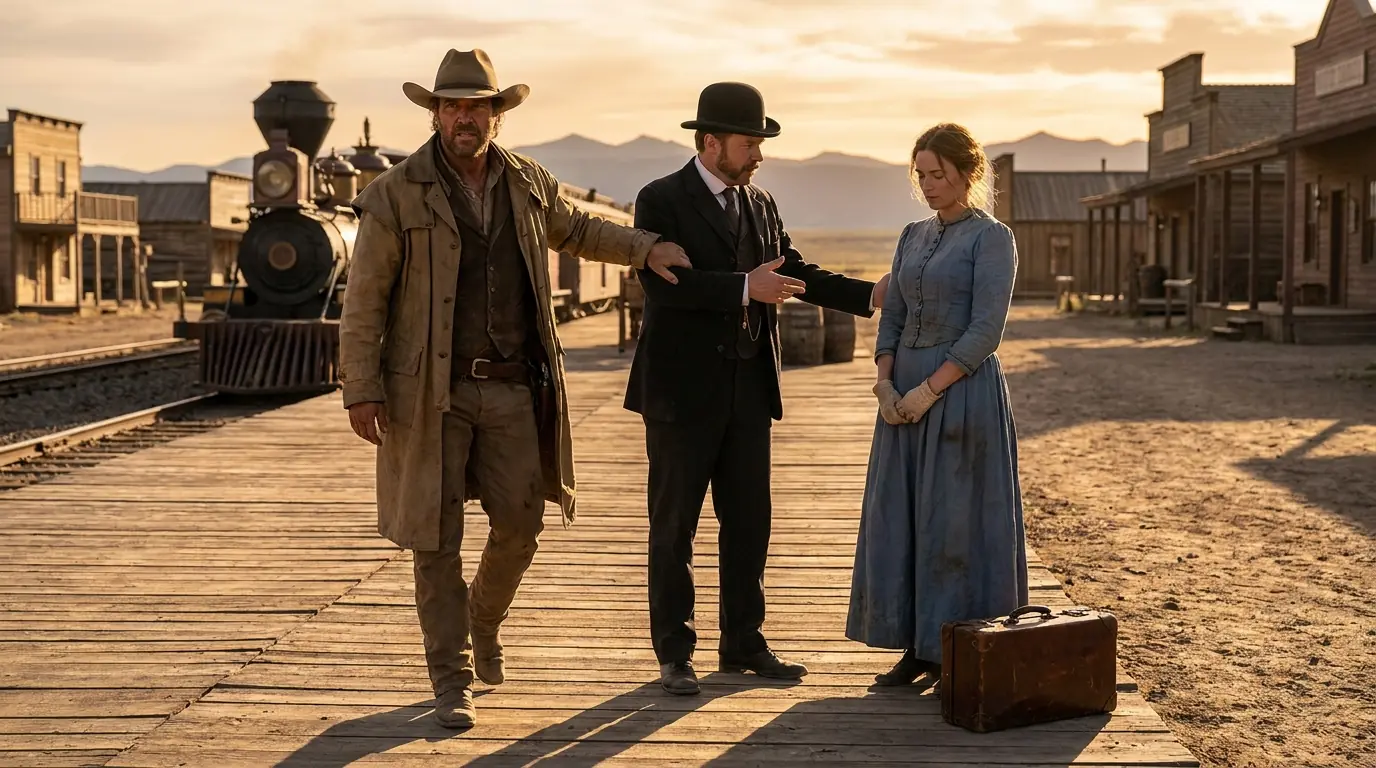
The agent frowned, confused. Clara looked at Eli, then truly looked, as if seeing him for the first time. There was no pity in his expression, no condescension, only resolve. Eli took another step closer, his voice steady despite the tremor he felt beneath his ribs. "If she was sent back for being too old," he said, eyes never leaving Clara's face, "then let her be mine." The platform fell silent. Even the train seemed to pause, its steam drifting lazily as if waiting for the moment to pass.
Clara's breath caught. She searched his face for a joke, a bargain, some hidden condition. She found none. What she saw was a man offering something rare: choice without obligation. Eli was not rescuing her. He was inviting her. The agent stammered something about paperwork and procedures, but Eli barely heard him. His world had narrowed to the woman standing before him, her eyes bright with unshed tears.
Clara swallowed, the weight of the past months pressing down on her. She had crossed miles of land and expectation, only to be told she was no longer wanted. And now here was a stranger asking her to stay, not because she fit a requirement, but because he wanted her to choose. The decision did not come easily. Clara had learned caution the hard way. Promises had been made to her before, always with conditions she discovered too late.
She looked down at her suitcase, at the life she could return to, familiar and lonely in its own way. She thought of the future she had imagined, modest but hopeful, and how quickly it had been dismissed. When she looked back up, Eli was still there, waiting, not rushing her. The respect in that simple act undid her. Clara nodded once, a small movement that carried the weight of a lifetime. "I'll stay," she said softly. The words felt strange and powerful on her tongue.
Eli exhaled, a breath he had not realized he was holding. The agent, flustered but relieved to be rid of responsibility, muttered about arrangements and left them standing together as the sun slipped below the horizon. Eli helped Clara lift her suitcase, his hands careful, as if the moment might break if handled too roughly. They did not touch beyond that, did not speak much on the ride back to the ranch. Words felt unnecessary, inadequate. The plains stretched around them, bathed in twilight, and for the first time in years, Eli did not feel alone riding through them.
When they reached the ranch house, Clara paused, taking in the wide porch, the sturdy beams, the life she had stepped into with a single word. Eli showed her inside, offering her the spare room without assumption. His manners were old-fashioned and sincere. That night, as Clara lay awake listening to the unfamiliar sounds of the ranch, she felt fear, yes, but also something she had nearly forgotten: possibility.
And miles away in an office filled with ledgers and rules, Clara Whitmore was already forgotten. But on a quiet ranch under a vast western sky, her life was just beginning. Clara stayed. The decision was not loud or dramatic. It was a quiet nod, a breath let out slowly, a suitcase set down instead of lifted again.
Life on the ranch was not easy. Clara learned the rhythm of dawns that came too early and nights that fell too fast. She cooked, cleaned, and worked beside Eli, her hands growing calloused, her heart slowly unarmoring. The townsfolk watched with curiosity, some with judgment, others with hope. Whispers followed them into church and the general store, but Eli never wavered. He introduced her as Clara. Nothing more, nothing less, as if that alone was enough. And it was.
Over time the ranch filled with laughter that startled even Eli. Clara spoke of her past, of dreams deferred and letters unanswered. Eli spoke of his parents, of the silence that had grown after they passed, of how he once believed love had an expiration date. Together they proved each other wrong. When winter came harsh and unforgiving, they faced it side by side. When spring returned, so did the certainty that what they had chosen was real. Clara was not too old. She was right on time.
On the day Eli asked her to marry him, there was no audience, no agency, no approval needed, just a promise spoken under an open sky.