In the middle of a crowded office branch operations manager Vanessa Whitmore publicly screamed at Caleb Brooks to get out of her company. She called him a nobody in a worn flannel shirt and threatened to have security drag him out like trash. Caleb did not argue with her. He calmly took out his phone, dialed one number, and smiled. Vanessa was still laughing with no idea that within seconds that single call would cost her everything, long before the security team ever reached the 31st floor.
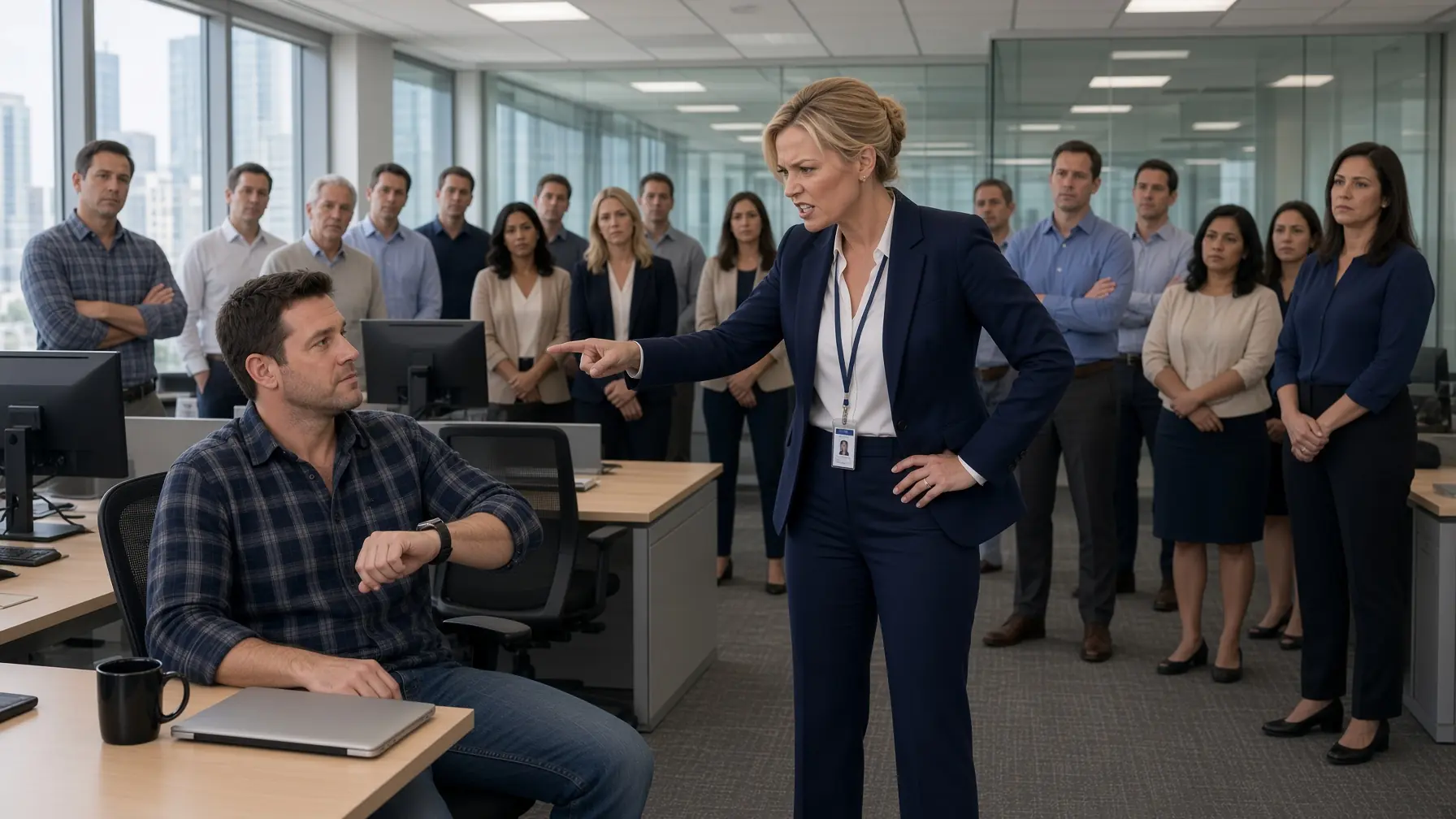
So, who was Caleb Brooks really? The elevator doors opened on the 31st floor of Sterling North Technologies at 7 minutes 8 on a Monday morning, and the man who stepped out drew no attention at all. The floor was still filling up. Coffee cups were being set down on desks. Monitors were waking and somewhere near the east windows, a printer was already jammed and already being sworn at.
The man walked past all of it without slowing, without looking for a receptionist, without the small hesitation people have when they arrive somewhere for the first time. His name was Caleb Brooks. He was about 38, built like someone who had spent real years doing physical work before he ever sat behind a desk. And he was dressed in a way that made him invisible in a building where invisibility was rare. Dark flannel shirts slightly wrinkled at the sleeves.
Old jeans, brown boots that had been resold at least once. No visible title badge clipped to his chest. No assistant trailing him with a tablet. No attempt whatsoever to introduce himself to anyone. He chose an empty desk in the open work area, the kind of desk that belonged to nobody in particular. set his laptop down and started working.
Sterling North Technologies occupied 11 floors of the tower, a technology and logistics corporation in the middle of a major restructuring that everyone talked about and almost nobody understood. Divisions had been merged. Reporting lines had been redrawn twice in 14 months. New faces appeared constantly and old ones stopped appearing without explanation. and the staff had learned to absorb both without asking questions. In an environment like that, a quiet man at an empty desk was the least interesting thing in the room.
Most of the employees on the floor assumed he was a new contractor. The assumption made sense. Contractors came through in waves during restructuring. They dressed however they wanted because nobody had bothered to tell them otherwise. and they usually kept to themselves because they knew they would be gone in 6 weeks. A junior analyst named Grant Feny was the only person who noticed something that did not fit.
He passed the desk twice on his way to the copy room and saw the same thing on the screen. Both times operational reports pulled straight from the internal system. Not the summary dashboards that anyone could open. the underlying reports, including attrition figures broken down by manager, which Grant had personally requested nine months earlier, and been denied. He said nothing about it to anyone. He assumed there was an explanation and went back to his own work, which was what almost everyone at Sterling North had learned to do.
Caleb offered no explanation either. He did not volunteer who he was or why he was there. He read scrolled occasionally, typed a short note into a separate window, and drank black coffee out of a paper cup he had brought up with him from the lobby. Two rows away near the glass partition that separated the open floor from the small conference rooms. Clare Bennett was watching him without meaning to, Clare had been with the company for 4 years.
She was good at her job in a way that had never quite translated into authority. the kind of employee who got handed the difficult accounts and never got handed a title to go with them. She noticed the man in the flannel shirt because she noticed most things on the floor and because there was something in the way he sat that did not match the way contractors sat. Contractors sat like guests. He sat like someone who had been in the building a long time. She did not approach him.
She had learned that on this floor, Curiosity had a cost, and the cost had a name. Vanessa Whitmore ran branch operations for the 31st floor and four floors below it, and she ran them the way a certain kind of manager always has, on fear, and on the careful maintenance of two entirely separate faces. The first face went upward. with regional leadership with anyone whose title outranked hers. Vanessa was warm, prepared, agreeable, and impossible default. She sent follow-up emails within the hour.
She remembered names. She had a laugh she used only in meetings with executives, and the people who worked under her could identify it through a closed door. The second face went downward, and it was the one the floor actually knew. It came out when a report was late, when a question was asked in front of the wrong person, when someone was slow to agree with her in a meeting. It came out as public correction, as the deliberate use of someone's mistake in front of an audience, as a tone that made the room go quiet and made everybody in it grateful for a moment that they were not the one standing there.
Clare had seen it happen more times than she could count. She had seen a scheduling coordinator named Rachel Doyle corrected so thoroughly in the middle of the floor over a mislabeled shipment file that Rachel had gone down to the parking garage and not come back for an hour. She had seen a systems technician told in front of 11 people that his job existed because Vanessa allowed it to exist. She had never once been in a position to stop any of it. That was the part she thought about most.