"Why won't you just let me buy it?"
"We don't serve filthy poor people."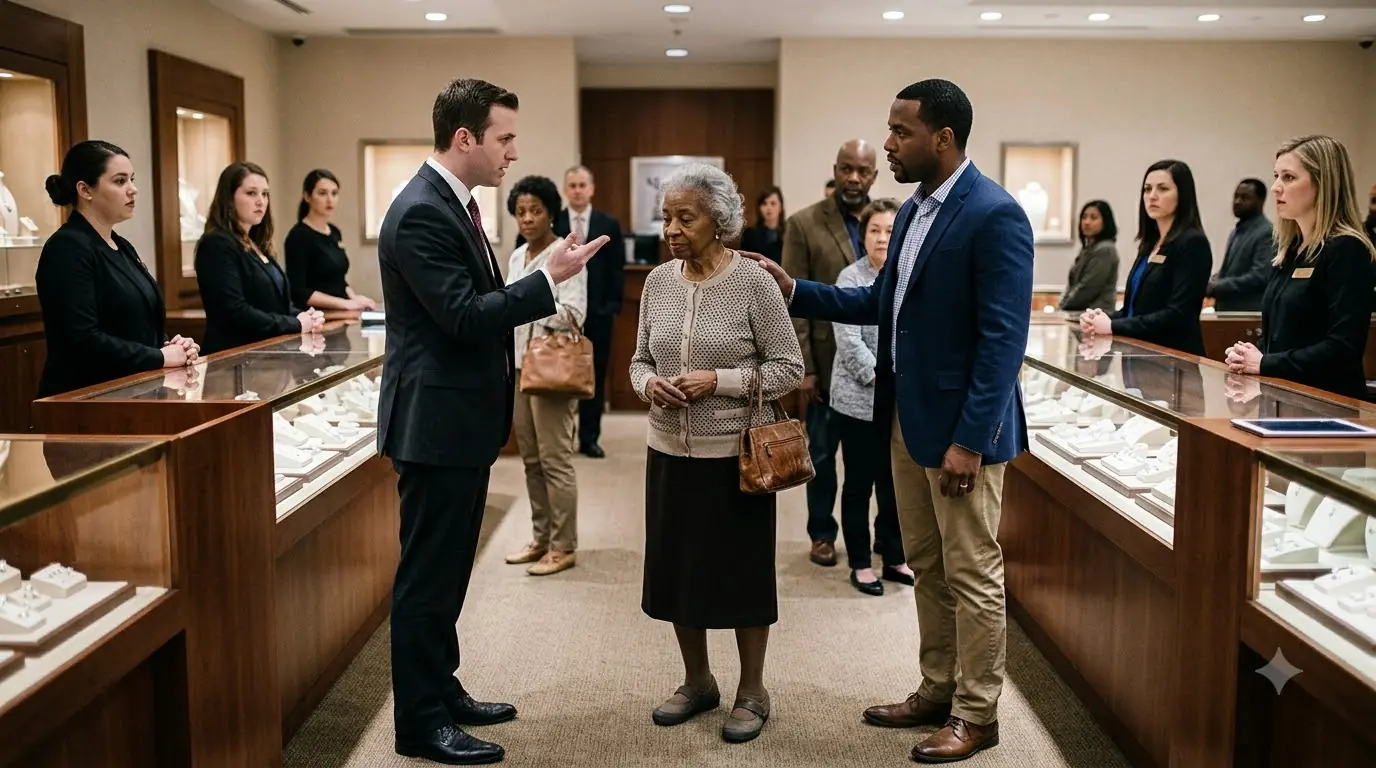
"Please, I'm buying it."
"I told you to get out, filthy old hag. Are you stupid or do you just not understand human speech?"
He slapped her hand off the counter, open palm across thin, veined knuckles. The crack echoed across marble.
"Poor trash like you trying to act big with me, you're worthy."
A frail black woman in a faded blouse, cradling her struck hand against her chest in a wheelchair she could not leave by herself.
"I haven't—"
He kicked the wheel. A young woman screamed and caught the handles.
"Lesson one for daring to talk back to me."
She remained calm. She reached for her phone and made one call. In just a few minutes, everything would change completely.
But before any of that happened, let's rewind to earlier that morning.
6:14 a.m. A small brick row house on Charlotte's East Side. The alarm did not go off because Willa Saunders had been awake since 4:00. Pain does that. Lupus does that. Two years of it eating through her joints, her muscles, her ability to stand or walk. She could not lift a glass of water without her fingers locking.
Nadine Coleman came into the bedroom at 6:30. 26 years old, Willa's live-in home health aide for the past 14 months. She lifted Willa out of bed the way she did every morning: one arm under her knees, the other behind her back. Willa weighed 91 lbs. Lifting her felt like lifting a child.
"I can brush my own hair," Willa said.
"I know you can."
"Then let me."
Nadine handed her the brush. Willa's hand shook the entire time. It took her 4 minutes to pull her white hair into a knot. She did not ask for help. She never asked for help.
The house was small but clean. Framed photos lined the hallway. One showed a young black woman standing in front of a tiny storefront on Trade Street, Charlotte, 1980. A hand-painted sign above the door read, "Beaumont Gallery." The woman in the photo was smiling. She had her whole life ahead of her. That woman was Willa, 46 years ago, the day she opened her first store with $8,000 saved over 14 years of sewing other people's clothes.
Nobody walking through that hallway today would connect the woman in the photo to the woman in the wheelchair. The photo showed someone strong, upright, radiant. The wheelchair held someone the world had folded down to almost nothing.
In the back hallway, a faded newspaper clipping from the Charlotte Observer. The headline read, "Local seamstress opens luxury boutique, bets everything on a dream." Next to it, a photo of Willa cutting the ribbon on the 10th Beaumont location. Then the 20th. Then the 40th. She built a 1,200-square-foot shop into a 42-location luxury empire worth $1.2 billion dollars.
Then her body failed. She stepped down as chairwoman 8 years ago. Two outside CEOs came and went. The company she built kept running without her.
"Nadine," Willa said that morning, "we're going to Beaumont today."
Nadine looked at her. "Which one?"
"Tryon Street."
"That's the flagship. I can go for you."
"No, I want to pick it myself. Amara deserves that."
Amara, Willa's granddaughter, turning 18. Willa wanted to buy her a sapphire pendant, the one Amara had circled in a catalog 3 months ago with a purple marker and a smiley face.
They called Paratransit. The wait was 40 minutes. Nadine folded a blanket over Willa's legs because the morning air still bit. Willa stared out the window and said nothing. She was gathering herself. Every trip outside cost her something: energy she did not have, dignity she had to fight for. She knew what people saw when they looked at her—a frail black woman in a wheelchair who looked like she had nothing. She knew. She went anyway.
The Beaumont Gallery flagship on Tryon Street occupied the ground floor of a limestone building in uptown Charlotte. Marble floors polished to a mirror finish. Crystal chandeliers casting soft gold light. Classical music drifting from hidden speakers. The air smelled like leather and jasmine. Every surface whispered money.
At 8:45 that morning, Derek Caldwell held his daily staff briefing in the back office. 6'3", charcoal Tom Ford suit tailored to the millimeter, a silk pocket square, Italian leather shoes polished to a mirror shine, a Breitling on his wrist he was still paying off but wore like an inheritance, ice blue eyes under dark brows, a jawline that belonged on a billboard. He was stunning—the kind of handsome that made people trust him before he opened his mouth.
He opened his mouth. "Brand alignment," he told his team. "Discretion. You see someone who doesn't fit the room, you redirect. You don't engage. You protect the experience for the clients who actually spend."
He did not say the word "black." He did not say the word "poor." He did not have to.
Patricia Ellis, his senior associate, nodded. Curtis Boyd, the new security guard, stood in the doorway. 28, Black. He heard every word. His stomach turned, but he said nothing.
The paratransit van arrived at 10:15. Nadine lowered the ramp. She wheeled Willa through the front door of the store Willa had built from nothing 46 years ago. Willa did not announce herself. She never did.
On the way to the jewelry counter, Nadine slowed the wheelchair. A young sales associate, maybe 22, new hire, was on her hands and knees. She had dropped a tray of display earrings. Small gold pieces scattered across the marble floor. Her hands were shaking. Her eyes were wet.
Derek Caldwell stood over her, arms crossed, that perfect jaw clenched. "Do you have any idea what those cost? This is exactly why I said we needed experienced staff. Pick them up. Every single one. If one is missing, it comes out of your check."