Sir, I'm going to need you to leave. The young manager crossed his arms, clipboard, black slacks, hair gelled back. The old man didn't move. He looked at the manager. Then he looked up slowly at the sign above the door.
Garretts est 1987. I built this room. I painted these walls. I laid this floor. I signed the lease on a Thursday in February, 37 years ago.
I'm going to have to ask you to leave or I'll call someone. The old man nodded once. He picked up his cap, walked to the door, stopped, pulled out a flip phone, dialed a number he hadn't called in years. Duke, I need a favor. 5 minutes later, the manager who just threw out the owner of Garrett's diner had no idea his career was already over.
And the story that followed would take down three people, expose a scheme 2 years in the making. Some men walk into a room and everybody stops. You know the type. Big voice, sharp suit, the kind of man who makes sure you know he's important before he even says his name. Ray Garrett was not that man.
Not anymore. He drove a 1998 Ford F-150. Blue. The kind of blue that used to be a color and was now just old. The kind of truck that mechanics look at and think.
Somebody actually takes care of this thing. Not because it's pretty, because it matters to them. The engine was original. He'd rebuilt it twice by hand in his driveway with a flashlight clamped to his shoulder because he didn't have a third arm. That was Rey, 62 years old, 6'1.
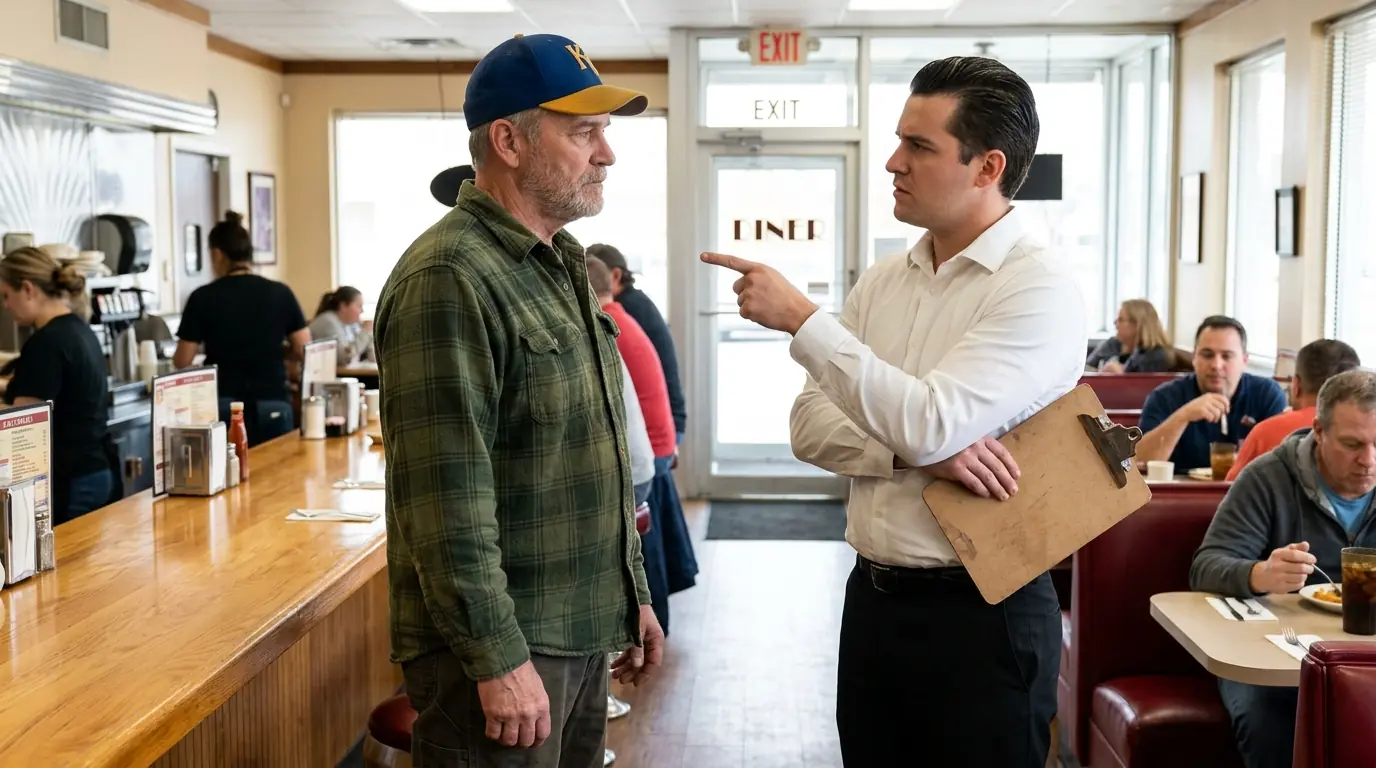
Shoulders that used to carry more weight than any man should and still hadn't forgotten how. Hands that were rough in a specific way. Not from laziness, not from carelessness, but from work. Real work. The kind that leaves a mark.
He had a beard he hadn't shaved in 4 days. He was wearing a green flannel shirt, the left elbow slightly worn through, and a Kansas City Royals cap from probably 2009. He looked like a man who might ask you for directions or change your oil for $10 and a cup of coffee. He did not look like a man who owned four restaurants. That Tuesday morning in October, Ray pulled into the parking lot of a hardware store on East Douglas Avenue in Witchah.
He needed 3/4in screws. Deck work at the house. Simple errand. He was in and out in 4 minutes. But on the way back to his truck, he stopped.
There was a woman in the parking lot standing next to one of those collapsible wire shopping carts. The kind older folks use instead of carrying bags. The front left wheel had popped off its axle. Her groceries were tilting. She was gripping the handle with both hands, trying to figure out her next move.
She was 78, maybe 80, dressed nicely, church coat, small gold earrings, the kind of woman who still irons her clothes on Sunday night. Ry walked over. He didn't say much. Crouched down, which took a second longer than it used to, pulled his folding knife from his pocket, used the tip to press the wheel cap back onto the axle, gave it two taps with his palm, 30 seconds, maybe less. The woman looked at him like he'd performed surgery.
"Well," she said. Thank you. Ray stood up, tucked the knife back in his pocket. Yes, ma'am, he said. That was it.
He walked back to his truck. He didn't give her his name. Didn't wait for more thank yous. Didn't pull out a business card. He just drove away.
Her name was Ruth Callaway. She'd lived four blocks from his main street restaurant for 31 years, and he didn't know it yet. But Ruth Callaway was about to change everything. Narrator Ray Garrett grew up in a small town 40 miles outside Witchah. His father's name was Earl.
Earl Garrett was a mechanic, the kind of mechanic who ran his own shop, knew every customer by first name, and fixed your car for what it actually cost, not what he could get away with charging. Earl had a saying. He said it often enough that Rey could hear it in his sleep. A man who can fix what's broken is never useless, son. Ry heard that sentence about a thousand times before he turned 18.
It took him about 30 years to really understand it. By the time Rey was nine, he could name every part of a carburetor. By 12, he was doing oil changes on his own. By 16, he had rebuilt a 1971 Harley-Davidson shovelhead engine from the crankcase up. Not with a kit, not with YouTube, with a factory service manual, a set of borrowed tools, and enough stubbornness to make his father proud and his mother nervous.
That Harley mattered, not just because of what it was, but because of what it opened. We'll get there. The drive from the hardware store to Main Street took 11 minutes. Ry knew because he'd driven it about 3,000 times. He parked half a block down, Habit, and walked toward the restaurant.
He stopped on the sidewalk across the street and just looked at it for a moment. Garrett's Diner, red lettering on a cream background. Same sign since 1989. A couple of the letters had been repainted over the years, but the shape was the same. The font was the same.
His wife Karen had drawn it by hand on a napkin one Sunday afternoon in 1988, and they'd taken it to a sign painter on Hillside Avenue. The man was long gone. The sign was still here. Est 1987 in smaller letters underneath. 37 years.
Rey looked at the building the way a man looks at something he built with his hands. There's a particular kind of ownership in that look. Not pride exactly. Not arrogance. Something quieter.
Something that says, "I know every flaw in this thing because I made them and I fixed most of them. And the ones I didn't I learned to live with." He crossed the street, pulled the door open, and walked in. The first thing he noticed was the music. It wasn't bad music exactly.
It was just dot wrong. Some kind of low volume acoustic playlist. The kind that plays in coffee shops in airports. Neutral. Inoffensive.
Garretts used to play country. Not the new stuff. The real stuff. Whan, Merl, Willie on Friday afternoons. The kind of music that assumed you'd had a hard week and didn't need to pretend otherwise.
Ray stood just inside the door for a moment. Six tables occupied out of 22. Tuesday at 9:45 in the morning. That used to be a busy hour. Not packed, but busy.
Farmers stopping in after the early market. Contractors getting breakfast before a job site. Retired men who had nowhere else to be but preferred company to an empty kitchen. Six tables. He took a stool at the counter.
The counter itself was original, dark wood, worn smooth in all the right places. The stools had been recovered twice since 1987. Karen's doing both times, but the bases were original cast iron. They didn't make things like this anymore. A young woman came over, maybe 23.
Brown hair pulled back. Her eyes were slightly red at the corners. The way eyes get after crying and then trying to look like you didn't. Coffee? She asked.
Please, Ry said, and a slice of the apple pie. If it's fresh, she nodded and went to the back. Ray turned his coffee mug over and waited. He looked at the menu card propped up in front of him. He picked it up, looked at the prices, put it back down, didn't say anything, but something moved behind his eyes.
The apple pie at Garretts had been on the menu since the f first week they opened. Karen made the original recipe. Granny Smith apples, brown sugar, a/4 teaspoon of cardamom that was Ray's edition. His mother used to put cardamom in everything. Double crust brushed with egg wash and a little turbanado sugar on top so it crackled when you cut into it.
For the first eight years, Karen made every pie herself. When they expanded, she trained every baker personally. There was a laminated card handwritten by Karen, laminated at a Staples on Kellogg, pinned inside every Garrett's kitchen. It said at the top, "This is not a recipe. This is a promise.
The pie came out." Ray looked at it. The crust was pale, not golden. Pale. The filling was thin.
You could tell because the slice didn't hold its shape the way it should have. It slumped a little to the left. He took a bite, chewed, swallowed. The young woman was watching him from the far end of the counter, trying to pretend she wasn't. Ray set the fork down, took a sip of coffee.
Good coffee, actually. That part was still right. What's your name? He asked. She walked back over a little cautious.
Cassie, she said. How long have you worked here, Cassie? About two years. You like it? She paused just slightly too long before answering.
It's a good job, she said. Rey nodded. Used to be a great one, he said quietly, not accusing her of anything. He looked at him for a moment. Then she looked away.
From the kitchen behind the closed service door, there was a sound, not clattering pans, not the controlled noise of a busy kitchen. A voice raised, sharp. The words were muffled through the door, but the tone was clear enough. Someone was dressing someone down. Cassie's jaw tightened slightly.
She picked up a cloth and started wiping the counter that didn't need wiping. The kitchen door swung open. A man came through it. 29 years old, maybe 30. He moved like someone who'd been told at some point in his life that confidence was a performance.