Get out of my shop, homeless man. Brandon's voice was icy. He stepped closer, towering over the elderly black man. I only came to look at coats. Take your filthy, stinking hands off the counter.
You homeless beggar, do you think you can just walk in here? Go back to the foothills. Fletcher didn't move. He was 60 years old, wearing a worn, tattered coat, a ragged cloth bag with a white peony peeking out. He slowly straightened his shoulders, his voice turning sharp and cold.
Your shop? Brandon was stunned, just for a moment. Then his face flushed red. You piece of trash. People like you shouldn't be shopping here.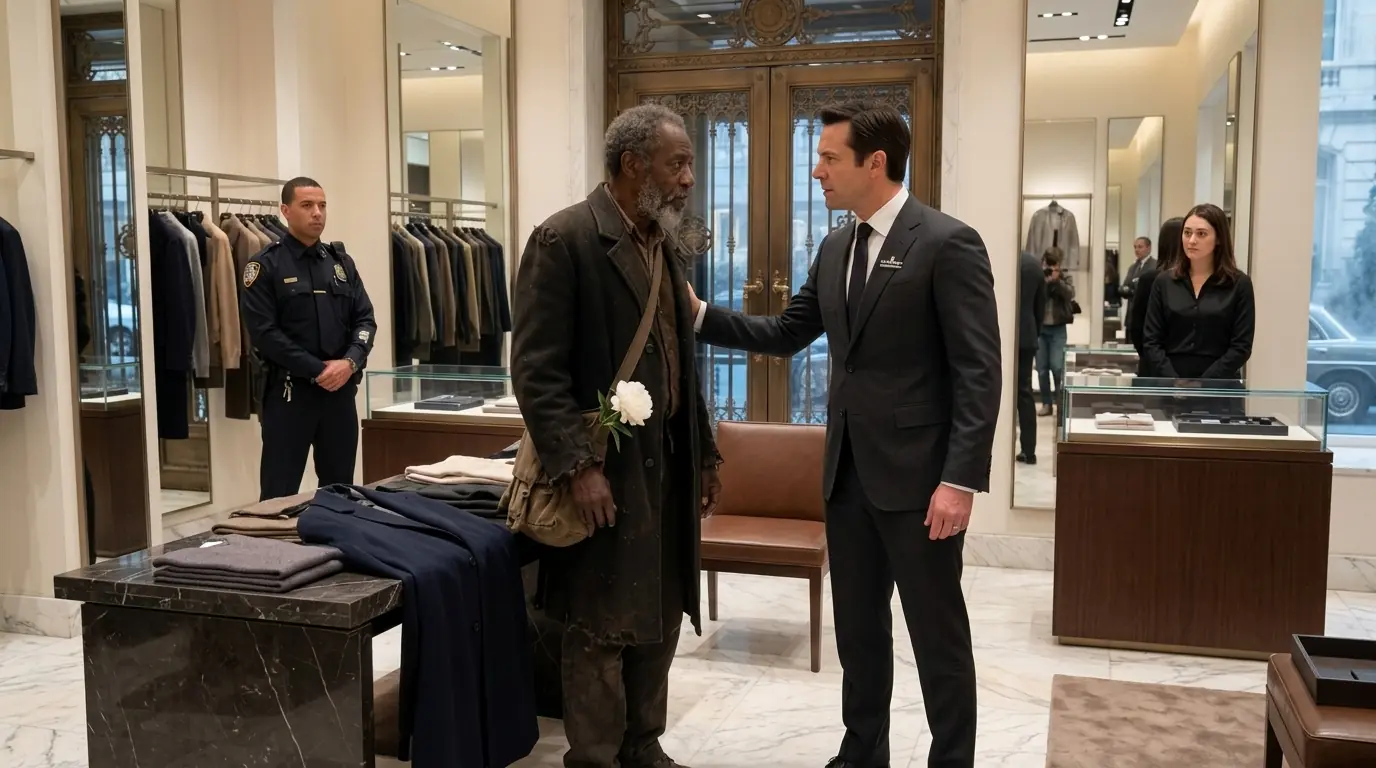
Kick him out. The floor went dead silent. Brandon had no idea whose face was hanging on the office wall, right above his desk. Five hours earlier, the sky over the Bronx was still black. A single yellow taxi pulled up to the gates of Woodlawn Cemetery.
Fletcher Sterling stepped out alone. He paid the driver in crumpled bills. No briefcase, no assistant, just a torn canvas bag over his shoulder, and a single white peony wrapped in old newspaper. The morning air bit through his coat. He didn't seem to notice.
You sure this is the right place, sir? the driver asked, frowning at the address. Yes, son. My wife is here. Fletcher walked through the iron gates as the taxi drove away.
Frost crunched under his cracked leather shoes. He had done this walk every Tuesday for 18 months. He could find her grave with his eyes closed. The headstone was simple, polished granite, just her name and two dates. Vivian Sterling, beloved wife.
Fletcher knelt down. His knees ached. He set the white peony at the base of the stone and brushed away a few dead leaves with the back of his hand. Hey, baby, he whispered, happy birthday. He sat there a long time.
He talked to her the way he always did, about the company, about Jonathan, about how the Harlem studio still smelled like her perfume, even though he had thrown out the bottle months ago. From his coat pocket, he pulled out a small photograph in a cracked silver frame. Their wedding day, 35 years ago. He held it up so she could see. I'm still wearing the ring, you know.
By the time he stood up, his coat was damp with cemetery dew. His beard was gray and uneven. He hadn't shaved in weeks. He hadn't really cared. After Vivian died, Fletcher had walked away from everything.
He sold the Park Avenue penthouse. He moved into a small studio in Harlem, just two blocks from the apartment where they had started out. He stopped using the company driver. He wore the same old coats he had kept from his 20s, because new clothes felt like a betrayal. Most days, he just walked.
This morning, he walked 12 miles down from the Bronx, through Harlem, through the early sunlight that turned the East River silver, past coffee carts, past men hosing down sidewalks, past doormen who didn't recognize him in the slightest. A cold cup of bodega coffee warmed his hand. The white peony from a flower cart on Fifth Street sat tucked beside the photo frame in his bag. By the time he reached Midtown, the city had woken up. He stopped on the corner of Fifth Avenue and 53rd Street and looked up.
Sterling Maison, four stories of cream limestone, bronze doors polished like mirrors, a small gold monogram by the entrance, the same one Vivian had sketched on a napkin back in 1992. He had built this place with her. From a tailoring shop in Harlem to a global luxury house. 300 employees, stores in Paris, Tokyo, Milan. But last week, Jonathan had mentioned something quietly over the phone.
A few complaints. Customers feeling uncomfortable. Nothing official. Fletcher had said nothing at the time, but the words had stayed with him. A street vendor named Mateo waved from across the sidewalk.
They had shared coffee for weeks. Mateo only knew him as Fletch. Cold one today, my friend. Bone cold, Mateo. How's your boy?
Still studying. Still broke. They laughed. Fletcher dropped a folded $20 into Mateo's tip jar without making a show of it. Mateo pretended not to see.
That was their routine. From the window of Sterling Maison, Brandon Whitfield watched the exchange. He saw an old man in a tattered coat laughing with a street vendor holding a cheap bodega cup. Beard untrimmed, bag hanging from one shoulder, shoes cracked. Brandon's mouth curled.
He turned to the salesgirl behind him. Watch the door. We've got a vagrant about to try his luck. Inside the store hummed with quiet jazz. Marble floors, cashmere folded into perfect squares.
The scent of leather and expensive cologne drifted through the air. A young security guard named Tyler Anderson stood near the back wall, hands behind his back, eyes scanning. He had been with the company 3 years. Ex-Marine. Two kids in Queens.
He noticed Brandon's body language tighten. The way it always did when the wrong kind of person approached. Tyler had seen this look before. Too many times. He didn't like where it was going.
The bronze door opened. A bell chimed. Fletcher Sterling stepped onto the marble floor of his own store. And no one in the building recognized him. Before Fletcher even reached the bronze doors, Brandon had already stepped outside.
Sir, this isn't a shelter. This sidewalk isn't a rest stop. Move along. Fletcher paused. He glanced at the clean stretch of concrete under their feet, then back up at Brandon.
I'm a customer. I'm going inside. You're not a customer. You're a problem. And if I see you loitering on my sidewalk one more minute, I'm calling someone to come move you along.
Are we clear? A taxi pulled up to the curb. A woman in a fur coat stepped out, designer bag swinging. Brandon's entire face transformed, the snarl gone, replaced by sunshine. Welcome to Sterling Maison, ma'am.
Right this way. He held the door for her like she was royalty. The woman smiled, walked past him into the warmth. Brandon let the door swing shut. Fletcher caught the door before it closed.
Brandon spun around, his face darkening again. Sir. Sir, what did I just tell you? You told me I'm not a customer. I'd like to prove you wrong.
Brandon's jaw twitched. He glanced through the glass at the wealthy customer now wandering inside. He didn't want a scene on the sidewalk. He stepped aside, just barely. Fine.
You get 60 seconds, then you're out. Fletcher walked past him into the store. His polished Oxfords clicked sharply against the marble behind Fletcher. Brandon moved fast, like a man defending a fortress. He cut Fletcher off near the entrance display, blocking the path to the navy cashmere coat in the window.
Sir. The word came out clipped, cold, not a greeting. Fletcher stopped. He blinked slowly, the way tired old men blink, and looked up. Good morning.
Sir, you need to step back outside. I just walked in. And you're going to walk right back out. Brandon's smile was the smile of a man who already knew how this conversation ended. This isn't a warming station.
We don't let people loiter inside the store. The young saleswoman behind the counter looked away. She had seen this scene play out before. So had Tyler Anderson, standing quietly by the back wall. Tyler's jaw tightened, but he didn't move yet.
A wealthy couple drifted past the front window, peering in. Brandon's whole posture shifted when he saw them. Shoulders back, chin up. He waved them in with a wide plastic smile. Welcome to Sterling Maison, sir, ma'am.
Please, come right inside. He held the bronze door open for them like a butler. Then he let it swing shut in Fletcher's face. Fletcher said nothing. He just watched.
This was lesson number one. The door opened for some people, not for others. He stepped to the side and let the couple pass. Then, calm as morning, he turned back to the navy coat in the window. Excuse me, can I ask the price of this coat?
Brandon let out a short laugh through his nose. Sir? Yes? Look at yourself. Fletcher looked down at his own coat, the worn wool, the missing button, the cracked leather at his cuffs.
What about it? That smell. Brandon waved a hand in front of his face theatrically. When was the last time you washed that coat? Our customers don't appreciate it.
There's a community shower at the YMCA on 63rd Street. Walk east. He turned to the saleswoman behind the counter, raising his voice loud enough for the whole floor to hear. Get the air freshener from the back, the lavender one. We're going to need it.
The saleswoman didn't move. She just stared at the floor. A nearby customer, a thin young woman in a denim jacket, flinched. She had been browsing scarves. Her name was Hannah.
She was a journalism student at NYU in the store running an errand for her mother. She slowly pulled her phone out of her pocket. She started recording. Brandon didn't notice. Brandon was too busy enjoying himself.
Sir, that coat looks like it crawled out of a Goodwill dumpster. I mean, Salvation Army. Maybe? The fabric is shedding on my floor. It was my father's coat.
Then your father had terrible taste. Tyler's hands curled into fists behind his back. He took one step forward. Brandon caught the movement, snapped his head toward him. Stay there, Anderson.
I've got this. Tyler stopped. But he didn't go back to the wall. Fletcher turned slowly toward the navy cashmere again. How much is the coat?
Sir, I'm not telling you the price. You can't afford it. You can't even afford to be standing here. Try me. Brandon laughed, loud.
The sound bounced off the marble and the glass. Try you? Sir, we work by appointment only here. Private clientele. Walk-ins of your type, we redirect to our website.
There's free Wi-Fi at the public library if you need it. That's not the store policy. Excuse me? Sterling Maison has never operated by appointment only. Not at this location, not anywhere.
Brandon's smile flickered just for a half second, then it came back, wider, meaner. And how exactly would you know that, sir? I read. You read? Brandon repeated it, savoring the absurdity.
You read? Yes. What, the Wall Street Journal on your way out of the subway grate this morning? A short, cruel laugh from one of the other staff members. Brandon turned his head toward the sound, smiled, then turned back to Fletcher.
Sir, I'm the manager of this store. I think I know our policy better than some homeless man who wandered in off Fifth Avenue. Now, I'm going to ask you nicely one more time. Please leave before I have to call somebody. I'd like to see your store policy in writing.
Brandon's jaw clenched. I don't owe you a policy document. I owe you the door. The marble floor was very quiet now. Two other customers had stopped pretending not to listen.
Hannah's phone was still recording, tucked low against her hip. A second customer, Margaret Davis, 70 years old, a Sterling client of 22 years, had walked in through the bronze doors during the exchange and was now standing very still by the scarf display. Margaret's lips had gone thin and pale. She slowly set down the cashmere scarf she had been holding. 22 years she had been coming to this store.
She had bought her late husband's last suit here. She had bought her daughter's wedding gift here. She had never, not once, seen a customer treated like this. She watched Brandon, and she felt something old and tired wake up inside her chest. Fletcher took a slow breath.
He had built this company from one rented storefront in Harlem. He had hired the architect to design these marble floors. He had personally interviewed every regional manager Sterling Maison had hired for two decades. He had never been spoken to like this in his own house. Sir, he said quietly, I came in here to look at a coat.
I have not touched anything. I have not raised my voice. I have not threatened anyone. You are refusing to serve me because of how I look. Do you understand that this is illegal?
Brandon stepped closer. He lowered his voice into something almost intimate, the way a bully whispers to a smaller kid. What's illegal, he hissed, is you wasting my morning. Now walk, or I make you walk. Tyler Anderson took another step forward.
Brandon. Anderson, I told you to stay out of this. He hasn't done anything. He's loitering. He's harassing customers.
He's making the store smell like a homeless shelter. That's enough. Sir, Tyler said carefully, looking at Fletcher, do you want me to walk you out? No, son. Fletcher's voice was steady.
I'd like to finish my conversation with your manager. Conversation! Brandon barked. There is no conversation. You don't get a conversation.
You don't get a coat. You don't get a chair. You don't get anything in this building. You get out. He raised his voice on the last two words.
The other customers turned to stare. Margaret Davis took one slow step closer. Fletcher just stood there. He looked at Brandon for a long moment, really looked. He looked at the slick haircut, the expensive watch, the pressed lapels, the little Sterling Maison pin on his collar.
He thought, very quietly, that this was the man he had been paying a six-figure salary to for the last four years. Son, Fletcher said softly, what is your name? Excuse me? Your name. Brandon Whitfield.
Why? I'll remember it. Something passed across Brandon's face, not fear, just the briefest flicker of confusion, like a man hearing a sound he couldn't quite place. Then he laughed it off. Remember whatever you want, old man.
Just remember it from outside. Fletcher had been standing for almost 20 minutes. His knees ached. His back ached. He was 60 years old, and he had walked 12 miles since dawn.
There was a leather waiting chair near the fitting rooms, soft, low, the kind of chair Sterling Maison kept for spouses who got tired of watching their partners try on suits. Fletcher took three slow steps toward it. Brandon was on him in a heartbeat. Sir, sir, what do you think you're doing? I'm going to sit down.
No. No, you are not. Brandon moved between Fletcher and the chair, planting himself like a wall. His hand came down hard on the back of the leather seat. Those chairs are for paying customers, customers who are actually here to spend money.
Not for warming up, not for resting. If you need shelter, sir, there's Grand Central, five blocks south, or Bryant Park, plenty of public benches. I'm not asking for shelter. I'm asking to sit. And I'm telling you no.
Margaret Davis crossed the marble floor, slowly, deliberately. Her cane tapped a soft rhythm against the stone. Hannah, the journalism student, lifted her phone a little higher. Excuse me, Margaret said, but is there a problem here? Brandon turned, ready with his customer smile.
Ma'am, please don't concern yourself. I'm handling You are not handling anything. Margaret's voice was thin, but steady. You are bullying an old man. Brandon's smile cracked.
Ma'am, with respect, you don't know the situation. I have eyes. This man is loitering. This man is 60 years old and asked to sit down. Brandon's neck flushed a deep, ugly red.
He glanced at Hannah's phone, finally noticing the camera angle, and his shoulders pulled tight. He pivoted back to Fletcher with a new edge in his voice. Sir, you have two choices. You walk out the door on your own, or my security carries you out. Your call.
Fletcher didn't sit. He didn't leave. He just looked at Brandon, very calm, the way a man looks at a child throwing a tantrum. You won't even give an old man a chair. Not you.
No. Why? Because you don't belong here. Tyler Anderson stepped forward again. This time he didn't stop.
He walked all the way up to Brandon. Brandon, I'm not removing this man. Excuse me? He hasn't broken any law. He hasn't broken any store policy.
I'm not putting hands on him. Anderson, this is your job. My job is to keep this store safe. He isn't a threat to anyone. You want to keep your job or you want to defend this guy?
Tyler held Brandon's stare. I'll defend him. Something shifted in Brandon's face. Pure, hot rage. He shoved past Tyler and walked straight toward Fletcher.
Fine, I'll do it myself. He grabbed Fletcher by the elbow. The whole store inhaled. Fletcher didn't resist. He let Brandon turn him.
He let Brandon march him toward the bronze door, one hand clamped tight on his arm like a cop with a suspect. Brandon's other hand jabbed in the air, pointing at the exit, narrating loudly for the whole store. This is what happens when you don't listen, sir. This is what happens. I gave you chances.
I gave you choices. You picked this. They reached the door. Brandon did not open it. He stood there with his hand still clamped on Fletcher's elbow and waited.
Actually waited for Fletcher to push the door himself. Like he was a piece of garbage being dragged to the curb. Like opening the door for him was beneath the manager's dignity. Margaret made a small, broken sound from across the room. That was when Fletcher stopped.
He turned his head very slowly. He looked down at Brandon's hand on his arm. Then he looked up at Brandon's face. Take your hand off me. Brandon didn't.
Take your hand off me, Mr. Whitfield. The use of his last name hit Brandon strangely, like a door clicking shut somewhere he couldn't see. But he doubled down. He always doubled down. Open the door, sir.
Open it. Walk. I'd like to see your store policy in writing. The one that lets you put hands on a paying customer who has not threatened anyone. I'm not showing you a damn thing.
Then we have a problem. No, sir. You have a problem. Brandon's free hand grabbed the strap of Fletcher's canvas bag and yanked. The strap snapped against Fletcher's shoulder.
The bag swung. The contents tumbled across the marble floor. A small silver picture frame skittered across the stone and stopped face up at Brandon's feet. The white peony rolled 3 ft and came to rest under the leather waiting chair. For 1 second, the entire store was silent.
Fletcher's eyes locked onto the frame on the floor. His chest tightened in a way he hadn't felt since the morning Vivian stopped breathing. 18 months of grief, of long walks, of one-sided conversations with a granite headstone. And now this stranger was about to lay hands on the one piece of her he carried with him. Then Brandon laughed.
He bent down and picked up the picture frame with two fingers, the way a man picks up a piece of garbage. He held it up to the light. A young black couple smiled out of the photograph. The man wore a tuxedo, and the woman wore white lace. Their hands were entwined.
Behind them, a small Harlem church. What's this? Brandon said loudly. A wedding photo? Yours?
Put it down. Sir, no offense, but this woman is gorgeous. You couldn't possibly He laughed again. Where did you steal this from? Some donation bin?
Broke into someone's house last night, did we? Put it down. This is what we deal with on Fifth Avenue now. Homeless men carrying stolen wedding photos. Unbelievable.
He held the frame higher, like a trophy. He tilted his head, mock studying the photograph. Then he tapped the glass with one polished fingernail, right on the woman's face. What was her name, old man? Or did you forget?
Maybe she's the one who threw you out on the street. Fletcher's hands trembled at his sides, just barely. Margaret Davis was crying now, quietly behind her glasses. Her hand was at her throat, gripping a string of pearls she had owned since her wedding day. She had stopped breathing for a moment, and now she couldn't seem to start again properly.
Other customers had stopped pretending to browse. A man in a charcoal suit had his phone out now, too. So did the woman in the fur coat, the one Brandon had personally welcomed earlier. Her face was twisted in something close to disgust. That's enough, Margaret's voice cracked.
That is enough. Brandon ignored her. He was looking at Fletcher's face. Fletcher's face had gone very, very still. The kind of still that comes before something breaks.
Brandon tossed the frame onto a glass display case. The silver edge clanged against the glass. The wedding photo lay face down. He pulled out his phone. That's it.
I'm done playing nice. He dialed three numbers. Hello? Yes, I need an officer at Sterling Maison, 53rd and Fifth. We have an aggressive homeless trespasser refusing to leave.
He's threatening staff. Yes. Yes. Hurry. Fletcher said nothing.
He didn't move. He looked at the picture frame face down on the glass. He looked at the white peony lying under the chair. He thought of Vivian. He thought of how he had told her, 2 hours ago, that the house they built together still stood.
He wasn't sure that was true anymore. Hannah was still recording. Her hands were shaking. Margaret crossed the marble floor and picked up the picture frame from the glass case. She turned it right side up.
She wiped the glass gently with the cuff of her cashmere coat. She walked back to Fletcher and placed it carefully in his hands. Then she bent down, slowly, painfully, with her cane, and picked up the white peony from under the chair. She handed it to him, too. I'm sorry, she whispered.
I'm so sorry. Fletcher closed his fingers around the flower. He tucked the photograph back into his coat, pressed flat against his chest, right above his heart. Outside, a siren bloomed in the distance. The woman in the fur coat finally spoke.
Her voice was sharp, cultured, used to being obeyed. You should be ashamed of yourself. She was looking right at Brandon. Brandon's smile flickered. He opened his mouth to answer and didn't have one.
He turned to Tyler with a smug, sharp smile instead. Police are coming, Anderson. You want to be on record defending a homeless trespasser when they walk in here? Last chance. Tyler didn't answer Brandon.
Tyler was looking at his phone. He had quietly texted Jonathan Williams, the company's COO, the moment Brandon had grabbed Fletcher's elbow. It was the protocol. Any 911 call from a flagship store required immediate executive notification. Jonathan had replied with two words, On my way.
Tyler put his phone away. He didn't tell Brandon a thing. The siren grew louder. Blue and red lights began to wash across the bronze doors. The store had gone completely silent.
The jazz had stopped. The customers had stopped pretending to browse. Even the saleswomen at the back stood frozen. Brandon adjusted his suit, smoothed his hair, smiled the smile of a man about to be vindicated. He had no idea what was actually about to walk through his door.
Two officers stepped through the bronze doors. The first one was older, tall, salt and pepper mustache. His name tag read Bennett. Brandon practically jogged toward him. Officer, thank God.
This man has been harassing my customers, refusing to leave, threatening my staff. Officer Bennett held up one hand. He was looking at Fletcher. His face went slack. His shoulders dropped.
The clipboard in his hand froze halfway up. Mr. Sterling? The store went still. Brandon blinked. What?
Mr. Sterling, sir. Bennett took off his cap, actually took it off, held it against his chest. Sir, are you all right? Fletcher's voice was quiet. Hello, Harold.
How's your daughter? She finished at Spelman. She did, sir. Graduated with honors. She still talks about that scholarship letter you wrote her.
Tell her I'm proud. Brandon's mouth opened, closed, opened again. Wait. Wait. Hold on.
Officer, you know this homeless guy? Bennett turned his head slowly. The look he gave Brandon could have cut glass. Son, who do you think you're talking to right now? He's He's a vagrant.
He wandered in here. He Son, I'm going to ask you very, very carefully. Do you know whose store you are standing inside? Of course I know. I'm the manager.
The bronze doors swung open again. A tall, sharply dressed black man in a navy suit walked in fast. Haircut close, glasses. He scanned the room in one motion. Fletcher, Brandon, the picture frame, the broken bag strap, Tyler's tense posture, and his face went hard.
He crossed the marble floor in seven strides. Fletcher, my god, I came as fast as I could. He took Fletcher by both shoulders, looked him over. Are you hurt? No, Jonathan, I'm fine.
You're not fine. Look at you. Jonathan turned around, his eyes locked onto Brandon. The temperature of the room dropped 10°. You, Jonathan said.
What is your name? Brandon Whitfield, sir. I I'm the chief operating officer of Sterling Maison. I sign your paychecks, and the gentleman you've been screaming at for the last 30 minutes. He paused just long enough.
Is the man whose name is on the building. Brandon's face went white, then green, then a color that doesn't really exist. What? Fletcher Sterling, founder, owner, majority shareholder, the man on the dedication plaque you walk past every single morning. That's That's not He's homeless.
He's grieving, you idiot. His wife died 18 months ago. He walks. He doesn't shave. He buried his routine with her.
Brandon's knees buckled. He caught himself on the edge of the glass display case. The same case he had thrown the wedding photo onto five minutes ago. His hand left a sweat print on the glass. Margaret Davis made a sound that was somewhere between a sob and a laugh.
Hannah's phone was steady now, rock steady. She had stopped trembling. She was filming history. Fletcher took one slow step forward. Mr. Whitfield, I'd like you to come upstairs with me.
Sir, Mr. Sterling, sir, please. I had no idea. If I had known Come upstairs. Tyler Anderson stepped to Fletcher's side. Quiet.
Steady. He walked with Fletcher toward the elevator. Margaret followed. So did Officer Bennett, hat still in his hand. So did Jonathan.
Brandon stumbled behind them like a man being marched to his own funeral. The elevator opened. The owner's office. Floor-to-ceiling glass on one side. Manhattan stretching beyond it.
A long mahogany desk. And on the wall behind the desk, the wall every person who entered that office faced first, two framed objects. On the left, the Sterling Maison Code of Conduct, printed in gold lettering on cream parchment, 3 ft tall. Signed at the bottom by every flagship manager since 1995. Brandon's signature was the last one.
Dated 4 years ago. On the right, a massive black-and-white photograph, 8 ft tall. A young black couple cutting a red ribbon in front of the Fifth Avenue store. The man wore a tailored suit. The woman wore white lace.
Behind them, the same bronze doors Brandon had refused to open for Fletcher this morning. The brass plate beneath read, Fletcher and Vivian Sterling, founders, May 1992. Brandon walked into the office and his entire body just stopped working. He stood there, mouth open, eyes moving from photo to plaque to photo, like a man whose brain was buffering. Fletcher walked behind the desk.
He didn't sit. He picked up the framed Code of Conduct off the wall and turned it around so Brandon could see. He pointed at the third line. Read it. Brandon couldn't speak.
Read it out loud, Mr. Whitfield. Brandon's voice was a whisper. Barely. Every guest is treated equally, regardless of appearance, background, or means. Now read the signature at the bottom.
A long, agonizing pause. Brandon Whitfield. Was that your signature? Yes, sir. Did you read this document before you signed it?
Yes, sir. Did you mean it? Silence. Fletcher set the frame down very gently on the desk. He looked at Brandon for a long moment.
Then he spoke quietly, the way a father speaks to a son who has broken something that cannot be replaced. Mr. Whitfield, I did not hire you to protect this brand from people who look like me. I hired you to serve every person who walks through that door. Just like you signed your name to 4 years ago. Today, you didn't fail me.
You failed the job I paid you to do. Brandon's legs gave out. He sat down hard on the office floor. Brandon stayed on the office floor. He didn't try to stand up.
He didn't try to brush off his suit. His knees just folded under him and he stayed there on his hands and knees, breathing in short, shallow gasps like a fish out of water. Mr. Sterling, sir, please. I'm begging you. If I had known That's the problem, Mr. Whitfield.
Fletcher's voice was calm, almost gentle. You only would have treated me with dignity if you'd known I was rich. That's not a misunderstanding. That's the whole thing. Sir, I have a wife.
I have a mortgage. You have a code of conduct that you signed 4 years ago. Brandon's face crumpled. Tears now, real ones. The kind that come from finally understanding what you have done.
Fletcher turned to Jonathan. Bring HR up here. Already on the way, Fletcher. 2 minutes later, the elevator chimed again. The head of HR stepped off.
A sharp woman in a charcoal blazer named Diane Brown, who Fletcher had personally hired 12 years ago. Behind her came a man with a folder. Termination paperwork. Diane didn't waste time. Mr. Whitfield, please stand up.
Brandon dragged himself off the floor. His tie was crooked. His face was wet. Effective immediately, your employment with Sterling Maison is terminated for cause. Breach of the code of conduct, filing a false police report, public discrimination.
Sign here. Brandon's hand shook so hard he could barely hold the pen. He signed. Officer Bennett stepped forward. Quietly, professionally, Mr. Whitfield, I'll also need to speak with you about your 911 call this morning.
Filing a false police report is a misdemeanor. We'll be opening an investigation. Brandon's knees almost gave out again. Diane added one more thing. Your access card is deactivated.
You will not be permitted back into any Sterling Maison location, ever. Brandon nodded numbly. Tyler Anderson opened the office door. He stood there, tall, steady. Mr. Whitfield, let's go.
Brandon walked past him with his head down. The elevator carried him down like a man already buried. The office went quiet. Fletcher sat down behind the mahogany desk for the first time in 18 months. The leather was cool.
Manhattan glittered beyond the glass. He could see the corner of 5th and 53rd from here. He could see the bronze doors he had walked into this morning. He turned to Tyler. Mr. Anderson.
Yes, sir. How long have you been with Sterling Maison? Three years, sir. What did you do before this? United States Marine Corps, sir.
Two tours. Why did you refuse to remove me from the floor this morning? Tyler hesitated. Then he answered simply, Because you hadn't done anything wrong, sir. And because my mother raised me to know the difference.
Fletcher nodded once, slowly. Effective today, you are no longer security staff. You are the new head of floor operations for this location. Triple your current salary, full benefits. You report directly to Jonathan.
I want you to rebuild the culture on that floor from the ground up. Tyler's mouth opened, closed, opened again. Sir, I I don't know what to say. Say yes. Yes, sir.
Good. Get to work. Tyler walked out of the office on legs that didn't quite feel like his own. Margaret Davis was still standing in the corner of the office, still holding her cane, still pale. Fletcher rose from behind the desk and walked over to her.
He took both of her hands in his. Her hands were small and cold. Mrs. Davis, Mr. Sterling, I I'm so sorry I didn't say something sooner. I should have spoken up the moment he started You did speak up. You spoke up before anyone else in that store.
You stood up for a stranger when it would have been easier to walk out the door. Her eyes filled. I just I just couldn't watch it. And that, Fletcher said quietly, is the difference between a person and a bystander. He walked her to the elevator himself.
He pressed the lobby button. As the doors closed, he made her one promise. You'll hear from my office, Mrs. Davis. There is something I would like to do, and I would like your help to do it. She nodded.
The doors slid shut. Fletcher turned to Jonathan. Pull the personnel file. I want every complaint Sterling Maison has received about Brandon Whitfield in the last four years. Every one.
And I want the name of whoever buried them. Jonathan was already on the phone. Fletcher walked over to the wall, to the photograph of him and Vivian cutting the red ribbon in 1992. He stood there a long time. We've got work to do, baby.
Six months passed. In the days after the incident, Hannah's video crossed 3 million views in a weekend. Margaret's footage hit cable news by Tuesday morning. The fur coat woman, whose name turned out to be Eleanor Caldwell, a retired federal judge, gave a single devastating interview to the New York Times. The 14 earlier complaints came out next.
Every single one had been filed by a black customer. Every single one had been quietly dismissed by Brandon's direct supervisor, a regional manager named David Wright, who was suspended within 72 hours and later terminated. The NAACP Legal Defense Fund filed a class action on behalf of the original 14 complainants. The DA's office, led by Eleanor Hayes, brought criminal charges against Brandon for civil rights violations under New York state human rights law. For filing a false police report and for federal claims under Section 1981, Sterling Maison filed its own civil suit.
Brandon had signed a binding code of conduct. He had violated it on camera, in front of multiple witnesses, while drawing a six-figure salary. The trial took 11 days. On the morning of the verdict, the Manhattan courtroom was packed. Reporters stood in the back.
The 14 original complainants sat in the front row. Brandon Whitfield sat at the defense table. His suit hung loose on him now. He had lost weight. He had lost his job.
He had lost the rented brownstone in Brooklyn his salary used to pay for. His wife had filed for divorce in month three. Both his parents had stopped returning his calls. He didn't look at anyone. The first major witness was Margaret Davis.
She walked to the stand with her cane tapping softly against the wood. 71 years old now, pearls at her throat, hands steady on the rail. D. A. Hayes was gentle with her. Mrs. Davis, why did you start recording? Margaret paused.
She looked across the courtroom, past the jury, past Brandon, all the way to where Fletcher was sitting in the third row. Then she looked back at the D. A. Because I've been a Sterling Maison customer for 22 years. The first thing they ever taught me was that dignity comes before profit. And that morning, I watched a manager refuse a 60-year-old man a chair to sit in. She paused again.
And I knew that wasn't the Sterling I had known. That was the store of one man. A long silence in the courtroom. I have stood quietly too many times in my life, Ms. Hayes. If I had done nothing that morning, then I would have been just as guilty as the man doing it.
Brandon's head finally dropped. For the first time during the trial, his shoulders shook. The 14 original complainants, sitting together in the front row, were holding hands. One woman was crying quietly. Another was nodding, slowly, the way people nod when they have waited a very long time to hear what was just said.
A juror in the back row took off her glasses and pressed her hand to her mouth. The second witness was Fletcher Sterling. He walked to the stand in a charcoal suit, beard trimmed now, haircut, steady on his feet. He carried two folders. D. A. Hayes did not ask many questions.
She did not have to. Fletcher opened the first folder. This is the Sterling Maison code of conduct, document number 0009-A, signed and dated four years ago by the defendant. He signed it on the day he was hired. He held it up so the jury could see the signature line.
He read the third clause out loud, slowly. Every guest is treated equally, regardless of appearance, background, or means. He set the document down. Then he opened the second folder. This is the defendant's annual performance review, signed by his regional supervisor every year for four consecutive years.
Every single review uses the same phrase, Excellent customer service standards. He held that document up, too. Then he turned to the jury. Four years. Four years he signed his name to that code.
Four years he was praised in writing as excellent. Four years my company received 14 complaints I was never told about because every single person who filed one looked like me. That morning— The jury did not move. I am not asking the court to punish a man for one bad day. I am asking the court to recognize what four years of a job done backwards actually costs.
The defendant did not fail me as a person. He failed the job he was paid to do every single day for four years until the morning he picked the wrong customer. He closed the second folder. He sat back in his chair. DA Hayes had no further questions.
The defense had no cross. The jury deliberated for less than 3 hours. When they returned, Brandon Whitfield was found guilty on all counts. Civil rights violation, false police report, breach of contract. Judge Katherine Morrison delivered the sentence the following Monday.
36 months in state prison, mandatory civil rights education, a six-figure fine, permanent ban from the retail industry. In the civil judgment that followed 2 weeks later, Brandon was ordered to pay damages he would never recover from. The class action settlement to the 14 original complainants totaled $4.5 million. His remaining savings were garnished. The little he had left was taken by his divorce.
When the bailiffs led him out of the courtroom, his ex-wife was already gone. She had collected her things and walked out before the verdict was read. Brandon shuffled toward the side door in handcuffs. He passed within 6 ft of Tyler Anderson, who was sitting in the second row in a sharp Sterling Maison suit. Brandon glanced up.
Tyler didn't look at him. Tyler was looking past him toward Fletcher. That was the last face Brandon saw before the door closed. Outside the courthouse, the cameras were waiting. Fletcher did not speak to them.
He walked past the microphones with Jonathan at his right shoulder and Tyler at his left. Margaret Davis walked beside them, leaning lightly on her cane. At the bottom of the courthouse steps, Fletcher stopped and turned to the press for exactly one sentence. Sterling Maison is announcing the Vivian Sterling Dignity Fund starting today. Then he kept walking.
Behind him, the cameras flashed. But what the photographs caught was not a vindicated billionaire. It was an old black man, a young black veteran, an older black executive, and a tiny white grandmother with a cane walking together down the courthouse steps in the gray Manhattan light. That photograph ran on the front page of every major American newspaper the next morning. The headline was the same in almost every one.
Every guest equal, always. Another 6 months passed. On a Tuesday morning in late spring, Fletcher Sterling walked through the bronze doors of his own store again. He was wearing the same coat, the same worn wool, the same missing button, the same cracked leather shoes. He had not shaved in weeks.
He carried a torn canvas bag and a single white peony wrapped in newspaper. He had come straight from Woodlawn. He looked exactly like he had on the morning of the incident. The bronze door swung open. Marble floors caught the morning light.
Tyler Anderson stepped forward immediately. Good morning, Mr. Sterling. Good morning, Tyler. Just here to shop today. Tyler smiled.
Fletcher smiled back. He walked into the store. None of the new sales associates recognized him. They had only ever seen old photos of a younger Fletcher in tailored suits. What they saw this morning was an older black man in a tattered coat, beard untrimmed, holding a wilting flower.
And they greeted him the way the code of conduct required them to greet every single human being who walked through those doors. A young woman behind the cashmere counter looked up and smiled. Good morning, sir. Welcome to Sterling Maison. Can I get you anything?
Just water, please. She brought it on a small silver tray. She did not flinch at his coat. She did not glance at his bag. She offered him a seat on the leather waiting chair near the fitting rooms.
The same chair Brandon had refused to let him sit in a year ago. Fletcher sat down. After a while, he walked through the aisles. He picked up the same navy cashmere coat from the window display. He turned it over in his hands.
Then he carried it to the counter. I'd like to buy this one. Of course, sir. Will that be cash or card? He paid in cash.
He walked out of the store carrying the bag himself. Tyler held the bronze door open for him. The morning sun caught the gold monogram by the entrance. Out on the sidewalk, Mateo waved from his cart. Fletch, you look fancy today, my friend.
Just bought myself something new, Mateo. They both laughed. Fletcher walked back uptown with the new coat over his arm and the white peony in his bag. He went back to Woodlawn. He knelt at Vivian's headstone.
He set the peony down. He laid the new cashmere coat carefully across the cold granite. He whispered very quietly, The house still stands the way we built it, baby. In the months that followed, the Vivian Sterling Dignity Fund began funding civil rights legal aid in 15 states. Sterling Maison mandated quarterly anonymous shopper audits at every location worldwide.
Tyler Anderson became director of internal conduct, training staff between stores. The 14 original complainants used their settlements to start small businesses and send children to college. Hannah, the journalism student, graduated and got a job at The New York Times. Her first major byline was on a piece called The Bystander Effect, Why Margaret Davis Pressed Record. Margaret was named the first honorary trustee of the Dignity Fund.
She refused a salary. She accepted only one thing, a small brass nameplate on the board's office door. It read simply, Margaret Davis, Witness. And Brandon Whitfield served his sentence in upstate New York, quietly, anonymously.
After his release, he applied for 32 jobs in retail, security, and customer service. He was rejected by every single one. The videos followed him. So did the federal civil rights case.
He moved to a small town in Ohio. He works the night shift at a warehouse now. The brownstone in Brooklyn was sold long ago. He is the reason every Sterling Maison employee now signs the code of conduct in front of a camera, reading it aloud, line by line, so that no one ever again can claim they didn't know what they were promising.