"Please, sir. Just one song for a meal."
"Do you think this is a charity kitchen or a garbage dump?"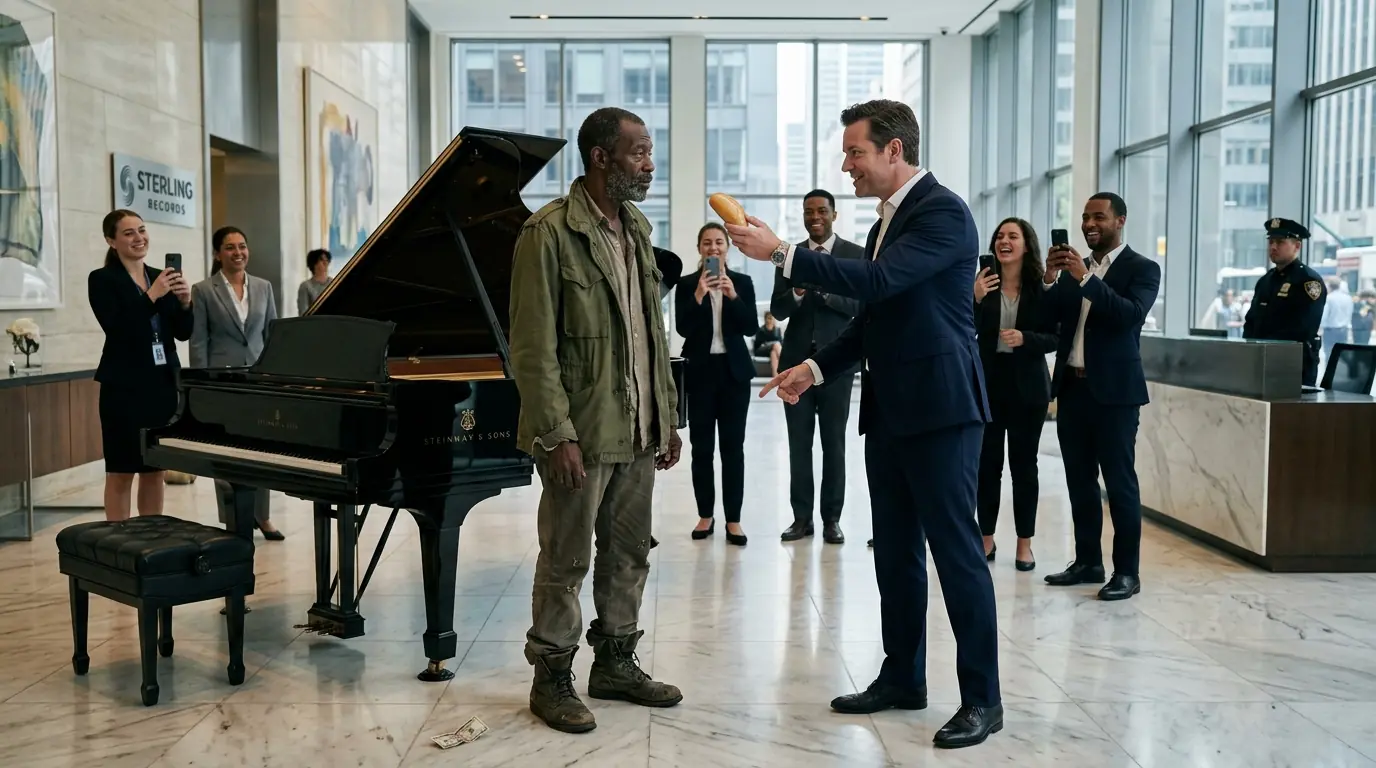
"I can play. Just one song."
"Play."
Grant Prescott's laugh cut through the Sterling Records lobby. "Who do you think you are? You want to touch a piano worth more than your whole life?"
Grant stepped closer. "You're a bum, a stinking filthy bum begging for food in my building. God, the smell." He pinched his nose.
Vincent Turner's cracked hands hung still at his sides.
Grant reached into his bag, pulled out a bread roll, held it just out of Vincent's reach, waving it slowly. "Here, boy. Sit. Play. Maybe I'll let you eat."
The whole lobby laughed. But not one person in that room knew who they were laughing at.
The morning Vincent Turner walked into Sterling Records, he hadn't eaten in 3 days. Not because he hadn't tried. He'd stood outside a deli on 8th Avenue the night before, watching a woman toss half a sandwich into the trash. He waited until she was gone. Then he reached in, pulled it out, and ate it standing over the bin. That was Tuesday. By Thursday, even the trash cans had nothing left.
Vincent was 59 years old. He walked with a slight limp from a piece of shrapnel that never fully left his right knee. His coat, olive green military issue, fraying at every seam, was the only thing he still owned from his service. Everything else was gone. The medals, the discharge papers, the photographs of a life that used to be his.
But before the war, before the streets, before the hunger, there was music.
Vincent Turner had been a prodigy. At 7 years old, he played his first Chopin etude on a second-hand upright piano in his grandmother's living room in Detroit. She cleaned houses for three white families on the north side of the city. She couldn't read sheet music. But she heard something in the way that boy played, something that made her stop mopping and stand in the doorway with her hand over her mouth.
By 12, Vincent had won every youth competition in Michigan. By 15, a professor from the University of Michigan drove 2 hours to hear him play and offered a full scholarship on the spot. By 19, he was at Juilliard, one of only three black students in the entire piano program.
He didn't just survive Juilliard, he owned it. His senior recital became the most attended in the school's history, standing room only. Faculty members who hadn't shown up to a student performance in a decade stood in the back row. When Vincent played the final note of Rachmaninoff's Piano Concerto No. 3, the auditorium didn't clap, it erupted. His professor, a man named Harold Whitfield, who had trained two Pulitzer winners, turned to a colleague and said five words: "I've never heard anything better."
At 22, Vincent Turner performed at Carnegie Hall. The New York Times review called him "the most gifted pianist of his generation, a voice that transcends technique and speaks directly to the human condition." The Chicago Tribune ran a front-page feature. Record labels circled.
And then, the doors closed. Not because Vincent couldn't play, because Vincent was black.
The first label told him directly. A senior executive at Whitmore Classical Records sat across from him in a mahogany office and said, "Vincent, you're extraordinary, but our core audience doesn't expect to see a face like yours on an album cover. It's not personal. It's the market."
The second label said the same thing with softer words. The third didn't bother with words at all, just silence. No returned calls, no follow-up meetings, no contracts.
Vincent did what no one expected. He spoke up. At a nationally broadcast awards ceremony for classical music, Vincent took the microphone during his acceptance speech and named every label that had rejected him. He read the Whitmore executive's words out loud. He asked the audience, a sea of white faces and black ties, whether excellence had a color.
The room went silent, then cold, then hostile.
Within 6 months, Vincent Turner was blacklisted. Every major label, every concert hall, every festival. The word traveled fast. Difficult, ungrateful, political. The invitations stopped. The phone stopped ringing. His agent dropped him with a two-line email.
He tried teaching. Schools wanted credentials, not controversy. He tried performing independently. Venues canceled after receiving calls from people he'd never met. He tried busking, playing on street corners in New York for coins. But even that felt like a performance for a world that had already turned its back.
At 28, with no income, no savings, and no prospects, Vincent walked into a military recruiting office on Fulton Street in Brooklyn. The recruiter looked at his hands, long, elegant fingers built for keys, and asked him what he did for a living.
"Nothing," Vincent said. "Not anymore."