At 10:08 on a cold Tuesday morning in Manhattan, Amara Sterling stepped through the revolving glass doors of Sterling House Fifth Avenue carrying a handbag worth more than the first car she had ever owned.
Nobody recognized her.
That was intentional.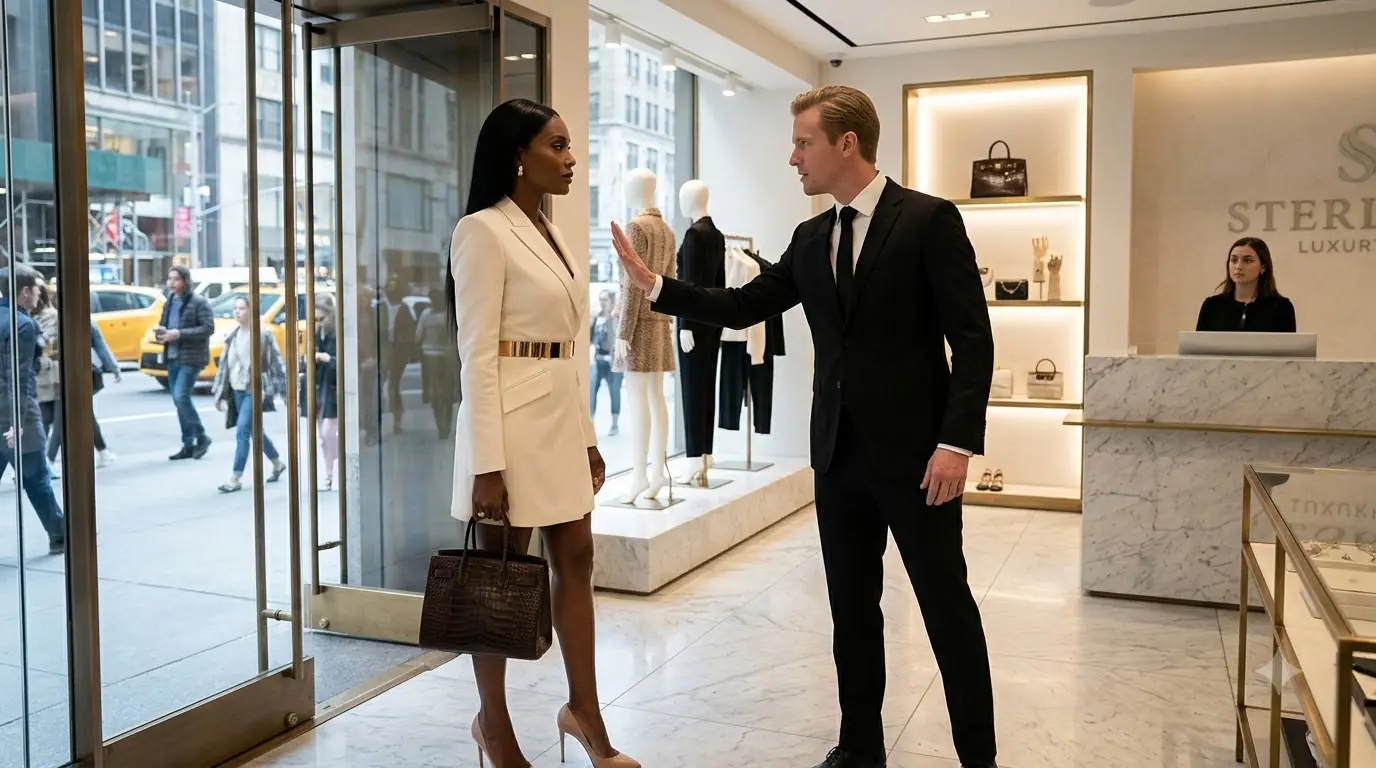
Six weeks earlier, Sterling Luxury Group had acquired the boutique through a quiet transaction that had barely reached the financial press.
The store had operated for decades under another ownership structure, selling European couture, custom handbags, rare jewelry, private-client accessories, and made-to-order collections to some of the wealthiest customers in New York.
The name on the brass plaque beside the entrance had not changed yet.
Neither had the uniforms.
Neither had most of the senior staff.
Only the legal ownership documents knew the truth completely.
Sterling Luxury Group now controlled the business.
And Amara Sterling controlled Sterling Luxury Group.
At forty-one, Amara had spent nearly two decades building a company that began with one small luxury-consignment showroom in Atlanta and grew into a sophisticated retail and investment group operating across fashion, hospitality, private travel, and specialty real estate.
She was not famous in the celebrity sense.
She preferred it that way.
In financial circles, her name carried weight.
In boardrooms, people knew her.
In photographs distributed with acquisitions, she usually appeared in sharply tailored suits, hair pulled back, surrounded by attorneys, executives, and people whose job titles mattered enough to be printed beneath their names.
That morning she wore none of that.
No assistant.
No driver waiting visibly outside.
No corporate pin.
No security detail.
She wore a cream-white long blazer dress with sharp shoulders and a fitted waist, cinched by a polished gold belt.
Long sleek black hair fell straight down her back.
Large dark sunglasses covered part of her face.
Gold earrings.
Nude heels.
A structured handbag.
Elegant.
Expensive.
But not accompanied by anything that announced who she was.
Amara wanted to know what happened when people had to make decisions without being told where she sat in the hierarchy.
She had a reason.
For three months, customer-experience reports from the Fifth Avenue location had been inconsistent.
Revenue remained excellent.
Average transaction value was among the highest in the group.
Private-client retention looked strong.
Yet anonymous customer complaints had begun reaching corporate headquarters through channels that bypassed store management.
Different people.
Similar descriptions.
Ignored at the entrance.
Asked immediately whether they had appointments.
Redirected toward lower-priced items without requesting them.
Refused access to private rooms.
Followed too closely by security.
Asked to provide proof of purchase intent before being shown certain collections.
Some complaints mentioned age.
Some race.
Some accent.
Some clothing.
Some simply described a feeling that store employees had decided, before conversation, whether someone deserved attention.
The official store data told a completely different story.
Customer satisfaction:
97.2 percent.
Complaint closure:
98 percent.
Private-client conversion:
Excellent.
Security incidents:
Minimal.
Too clean.
Amara disliked numbers that looked cleaner than human beings.
So she came herself.
Her appointment with regional operations director Claire Whitfield was scheduled for eleven.
Claire knew Amara would be in the building.
Nobody else did.
That gave Amara almost an hour.
She stepped beyond the revolving door.
Polished stone.
Brushed brass.
Glass displays.
Soft cream walls.
Perfume barely noticeable in the air.
A sculptural arrangement of white flowers sat near the reception desk.
Three employees stood within twenty feet of the entrance.
None greeted her.
Amara continued walking.
A man in a dark suit approached a white couple who entered several seconds behind her.
“Good morning. Welcome.”
The woman smiled.
“Thank you.”
“May I offer you coffee or sparkling water?”
Amara kept walking.
She passed a display of handbags.
Then another of limited-edition evening pieces.
She checked the time.
10:09.
A sales associate looked directly at her.
Young woman.
Brown hair.
Black suit.
She glanced at Amara's bag.
Then shoes.
Then face.
Her posture changed.
She did not approach.
Interesting.
Amara stopped beside a glass cabinet containing a hand-finished clutch priced at $21,500.
No one came.
10:11.
She walked toward the private couture corridor.
That finally produced movement.
A man stepped into her path.
Thirty-four.
White.
Blond hair swept neatly back.
Slim.
Black suit.
White shirt.
Narrow black tie.
Silver name badge.
ETHAN COLE
BOUTIQUE MANAGER
Amara recognized him.
She had reviewed his personnel file the previous evening.
Five years with the company.
Three promotions.
Excellent revenue numbers.
Strong relationship with several top clients.
High staff turnover beneath him.
One written HR complaint eighteen months earlier.
Resolved locally.
Ethan lifted one hand.
Palm outward.
“Ma'am.”
Amara stopped.
“Yes?”
“This area is reserved.”
“For?”
“Private clients.”
Amara looked past him.
The corridor contained two seating rooms and a glass door leading toward couture suites.
“I have an appointment.”
“With whom?”
“Claire Whitfield.”
Something flickered.
Claire was his regional superior.
But Ethan recovered quickly.
“Ms. Whitfield doesn't take walk-in appointments.”
“I didn't say it was walk-in.”
He looked at her.
Then toward the reception desk.
“I wasn't notified.”
“You weren't required to be.”
That irritated him.
Amara saw it immediately.
He stepped slightly closer.
“Your name?”
“Amara Sterling.”
He stared.
No recognition.
Good.
“Do you have confirmation?”
“Yes.”
“Show me.”
Amara looked at his raised hand.
“Why?”
“Because you're attempting to access a restricted section.”
“I gave you my name.”
“That doesn't prove anything.”
Amara nodded slowly.
“Then check the appointment system.”
Ethan's mouth tightened.
“I manage this floor.”
“Good.”
“Then you should have access.”
He gave a small laugh.
Not friendly.
“Ma'am, people come into this store every day claiming connections to executives.”
“I haven't claimed a connection.”
“You just claimed an appointment with the regional director.”
“I have one.”
“Then show me confirmation.”
Amara considered.
She could.
Her phone contained the calendar entry.
Claire's message.
Corporate credentials.
Everything necessary.
But that would end the test early.
She said:
“Check the system.”
Ethan's expression changed.
“You're refusing?”
“No.”
“I am asking you to perform the normal verification.”
“Normal verification assumes an appointment is plausible.”
Amara looked at him.
“What makes mine implausible?”
He hesitated.
There.
Tiny.
Enough.
Then he smiled.
Controlled.
Professional-looking if you did not listen carefully.
“Ms. Whitfield's schedule is extremely limited.”
“So is mine.”
Ethan looked her over again.
Longer this time.
Amara felt the insult before he spoke.
“I’m sure.”
She lowered her sunglasses slightly.
“Is there a problem?”
“No.”
“Then check the appointment.”
Ethan dropped his hand.
Not because he agreed.
Because he had decided to change tactics.
“Why don't we start with what you're here to purchase?”
“I’m not here to purchase.”
His eyebrows rose.
“Then you are not a client.”
“I never said I was.”
He gave a little nod, as though she had finally admitted something.
“Exactly.”
Amara almost smiled.
There were many bad assumptions in the world.
The most revealing were the ones people became proud of too soon.
She said:
“I’m here for a meeting.”
“With Claire Whitfield.”
“Yes.”
“About?”
“Business.”
“What kind of business?”
“Not yours yet.”
Ethan's face hardened.
Behind him, one of the associates looked over.
The white couple from earlier had been seated.
They now had beverages.
Nobody had offered Amara anything.
Ethan stepped closer again.
“Let me make something clear.”
Amara waited.
“This is not a hotel lobby.”
“I noticed.”
“We don't have people waiting around for meetings they cannot verify.”
“I can verify it.”
“Then do it.”
“You have the system.”
He stared.
She continued:
“You can resolve this in less than thirty seconds.”
“I don't take instructions from strangers.”
Amara's expression changed slightly.
“That sounds inconvenient for retail.”
The associate nearby looked down quickly.
Probably hiding a reaction.
Ethan noticed.
His ears reddened.
He moved one step nearer.
“We protect the privacy of serious clients.”
Amara said:
“You've used that phrase twice.”
“What?”
“Serious clients.”
“Yes.”
“What makes someone serious?”
He frowned.
“Purchase history.”
“Appointments.”
“Relationship with the store.”