“Stop right there. Men dressed like you do not belong in a place like this.”
The sharp voice cut through the elegant lobby of Sterling House, one of the most expensive restaurants in downtown Chicago. Conversations softened. Glasses paused halfway to lips. Even the pianist near the bar missed a note.
At the entrance stood an older man, somewhere in his late sixties, maybe older. His coat was faded and damp from the cold rain outside. The sleeves were worn thin at the elbows. His shoes had been polished many years ago but had long since surrendered to time. He carried no umbrella, no watch of status, no sign that he belonged among marble floors and crystal lights.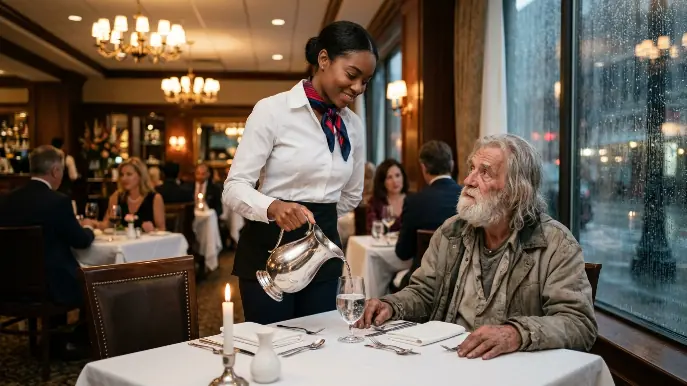
Yet he stood calmly, shoulders straight, eyes steady, one hand resting on a cane carved from dark wood.
In front of him stood Vanessa Collins, the front manager of Sterling House. She was known for impossible standards, expensive perfume, and the habit of treating people according to what they wore. Her black tailored suit fit perfectly, and the gold pin on her collar reflected the chandelier light.
She looked the old man over again with open contempt.
“Did you hear me?” she asked. “This is a private establishment for paying guests. Men dressed like you do not belong here.”
The old man answered quietly.
“I’m meeting someone.”
Vanessa gave a short laugh.
“Meeting someone? Here?”
Several guests nearby smirked into their drinks.
The man said nothing.
Vanessa stepped closer.
“Look at his clothes,” she announced loudly enough for half the room to hear. “He probably cannot even afford water.”
Near the service station, a young waitress froze. Her name was Maya Thompson, twenty-six years old, working double shifts to help support her mother and younger brother. She wore the restaurant uniform neatly pressed, though her shoes had been repaired twice with glue.
She looked at the old man’s tired face and then at Vanessa.
Without asking permission, she took a clean glass, filled it with cold water, and walked toward the entrance.
“Sir,” Maya said gently, offering the glass. “Please drink some water while you wait.”
The man looked at her with mild surprise. Then he accepted it.
“Thank you,” he said.
Vanessa turned sharply.
“What do you think you are doing?”
Maya kept her voice respectful.
“He looked thirsty.”
“I did not ask for your opinion,” Vanessa snapped. “Stop serving this man immediately.”
The room became quieter.
Vanessa pointed toward the door.
“This is a luxury restaurant, not a shelter for people who cannot pay.”
She opened her purse, pulled out several bills, and held them toward the old man.
“Take the money and leave.”
A few people looked embarrassed now. Others watched with the strange excitement people sometimes feel when cruelty happens to someone else.
The old man did not touch the money.
“I don’t need it,” he said.
Vanessa’s jaw tightened.
“Then what do you need?”
“To keep my appointment.”
She laughed again.
“With whom? The dishwasher?”
Maya felt anger rise in her chest.
“Manager Collins, please. There’s no need for this.”
Vanessa turned on her instantly.
“Be careful, Maya. People in your position should remember their place.”
Then she faced the old man once more.
“People like you do not belong in a place like this.”
The old man slowly looked around the room. He took in the polished brass railings, the imported flowers, the spotless floors, the expensive art on the walls.
Then he looked back at her.
“Yes,” he said calmly. “I am inside the restaurant now.”
Vanessa frowned, not understanding.
Before she could respond, the main doors opened.
A tall man in a navy suit entered quickly, carrying a leather portfolio. Two attorneys followed him, then another man many guests recognized instantly.
Harold Benton.
Chairman of Benton Hospitality Group, the company that owned Sterling House and twelve other luxury restaurants across the Midwest.
Every employee straightened at once.
Vanessa’s expression changed so fast it was almost painful to watch.
“Mr. Benton!” she said brightly. “What a surprise. If we had known—”
Harold walked past her as if she did not exist.
He approached the old man directly and extended both hands.
“Arthur,” he said warmly. “Sorry to keep you waiting.”
The room froze.
Vanessa blinked twice.
The old man shook Harold’s hand.
“No harm done,” he replied. “I was being educated.”
Harold’s eyes moved slowly toward Vanessa.
“That so?”
Arthur gave a small nod.
The suited attorney stepped forward and opened the portfolio.
“Sir, the documents are ready.”
Harold took the papers, then turned so the room could hear him clearly.
“This man is now the owner of this restaurant.”
A fork dropped somewhere in the dining room.
Someone near the bar whispered, “What?”
Vanessa’s face lost all color.
Arthur slowly removed his old coat. Underneath was a crisp white shirt, dark wool vest, and a posture that suddenly made him seem ten years younger and twice as powerful.
Harold continued.
“Arthur Bennett founded the original Sterling House forty-two years ago. He sold his shares years ago and retired. This morning, he reacquired majority ownership of this location.”
No one spoke.
Arthur looked around the room.
“I wanted to visit quietly,” he said. “To see how guests are treated when no one thinks they matter.”
His gaze stopped on Vanessa.
“Now I know.”
Vanessa rushed forward.
“Sir, I am so sorry. I didn’t realize who you were.”
Arthur’s expression did not change.
“That sentence explains everything.”
She swallowed hard.
“I was only trying to protect the standards of the restaurant.”
“No,” Arthur said. “You were protecting your vanity.”
“Please, sir. Give me a chance to explain.”
Arthur glanced at Harold.
“Do you see any explanation worth hearing?”
Harold answered flatly.
“No.”
Arthur faced Vanessa.
“You are fired immediately.”
She stared at him as if waiting for someone to laugh.
“No... no, please. I’ve given years to this company.”
“And took dignity from others every day,” Arthur replied.
Harold nodded to security near the hallway.
“Escort Ms. Collins to her office. She may collect her personal items.”
Vanessa looked around the room for support. No one moved. Several guests who had smiled earlier now avoided eye contact.
As security led her away, Arthur spoke one final sentence.
“And never look down on others.”
The doors closed behind her.
Silence remained.
Arthur turned toward Maya.
She nearly dropped the tray in her hands.
“What is your name?” he asked.
“Maya Thompson, sir.”
“How long have you worked here?”
“Three months.”
“Have you supervised staff before?”
“At a neighborhood café in Detroit. Small team, sir.”
Arthur nodded.
“Why did you bring me water?”
Maya hesitated.
“Because you were being treated unfairly.”
“No,” Arthur said gently. “Many people saw that and did nothing. Why did you help?”
She took a breath.
“Because thirsty is thirsty, sir. It shouldn’t matter what someone wears.”
For the first time, Arthur smiled.
Harold smiled too.
Arthur said, “You are the new manager.”
Maya’s eyes widened.
“Sir... I’m not qualified for this place.”
“Then you are more qualified than most who think they are.”
The room stirred softly.
“I don’t know if I can do it,” Maya admitted.
Arthur stepped closer.
“People who chase power often misuse it. People who respect responsibility usually grow into it.”
Maya swallowed hard.
“Thank you, sir.”
Arthur gestured toward the dining room.
“Then begin. We have guests waiting.”
That night, the story spread across Chicago faster than any advertisement could buy.
Customers posted online about the elegant manager who insulted a poor old man, only to learn he had just purchased the restaurant. Staff texted friends. Drivers told passengers. By midnight, half the city seemed to know Sterling House by a new reputation.
Not for luxury.
For justice.
Maya barely slept. At sunrise she returned wearing the same uniform, unsure if the previous evening had been real.
When she entered, Harold Benton was already there with Arthur at a corner table.
“Maya,” Harold said. “Good. Sit down.”
She obeyed nervously.
Arthur slid a folder toward her.
“Temporary management contract. Six months probation. Full salary starts today.”
Maya stared.
“I’ve never earned money like this.”
Arthur replied, “Then perhaps you’ll remember what money is for.”
She signed with shaking hands.
By ten o’clock, every employee had been called into the dining room for a mandatory meeting.
They gathered in uneasy silence.
Maya stood at the front.
“I know yesterday shocked everyone,” she began. “It shocked me too. But what happened did not begin yesterday. It began every time someone was judged by clothes, accent, skin, age, or wallet.”
Some staff lowered their heads.
“This restaurant will change starting now.”
She looked around the room carefully.
“Guests are not interruptions. They are the reason we exist.”
No one moved.
“If someone enters tired, we offer rest. If someone enters hungry, we offer dignity. If someone enters celebrating, we share joy. If someone enters grieving, we offer peace.”
Arthur watched quietly from the back.
“If anyone here cannot accept that,” Maya said, “today is the easiest day to resign.”
No one stepped forward.
“Good,” she said. “Then let’s get to work.”
The changes began immediately.
The velvet rope at the entrance was removed first. Maya hated the way it made the lobby feel like a checkpoint instead of a welcome.
Next, she retrained the host staff. No more scanning shoes before smiles. No more whispering over reservations. Every guest would be greeted with the same warmth, whether they arrived in designer coats or work boots.
Several longtime employees resisted quietly.
One server complained, “This place built its reputation on exclusivity.”
Maya answered, “Then we’re building something better.”
Arthur visited often but interfered rarely. He would sit in the dining room, order simple soup or coffee, and observe everything.
One afternoon he asked Maya, “Do you know why most businesses fail after success?”
She shook her head.
“They begin serving themselves.”
Weeks passed.
Customers noticed the difference immediately.
The wealthy still came, but so did people who had once felt intimidated by the polished doors. Anniversaries were celebrated beside business dinners. Teachers sat near lawyers. Retired factory workers dined beside investors. The room became livelier, warmer, human.
And profits rose.
Harold reviewed the numbers in disbelief.
“You increased reservations thirty-two percent,” he said.
Maya blinked.
“How?”
Arthur answered for her.
“People return where they feel respected.”
One snowy evening, a man entered wearing a janitor’s uniform after work. He hesitated just inside the door, glancing at the chandeliers as if expecting to be told he was in the wrong place.
Maya crossed the room before anyone else could.
“Good evening,” she said. “Table for one?”
The man looked startled.
“Yes, ma’am.”
“Right this way.”
Arthur watched from a corner booth and smiled into his tea.
Later, Maya learned the man had been saving for six months to celebrate paying off his daughter’s nursing school debt.
Another night, a woman in scrubs arrived exhausted after a hospital shift. She apologized for her appearance before sitting down.
Maya comped her dessert.
The woman cried quietly at the table.
Stories like that spread faster than marketing campaigns.
Sterling House became famous not only for food, but for how it made people feel.
Months later, a glossy magazine requested an interview with Maya.
The reporter asked, “What is your secret formula?”
Maya answered, “Remembering people are people before they are customers.”
The quote went viral.
Vanessa Collins, meanwhile, found no easy landing. Her reputation had followed her. Managers in the industry talked. Videos circulated. Applications went unanswered.
One afternoon she appeared outside Sterling House in a plain coat, thinner and far less polished than before.
Maya saw her through the glass and stepped outside.
Vanessa looked ashamed.
“I’m not here to cause trouble,” she said.
“What do you want?”
“I wanted to apologize.”
Maya waited.
“I thought status was everything,” Vanessa continued. “I thought if I controlled who entered the room, I mattered.”
Maya said nothing.
“I was wrong.”
“Yes,” Maya replied gently. “You were.”
Vanessa lowered her eyes.
“I don’t expect forgiveness.”
“That’s honest,” Maya said. “It’s a start.”
Vanessa nodded and walked away.
Arthur had watched the exchange from inside.
“You handled that well,” he said later.
“I’m still angry,” Maya admitted.
“You can be angry without becoming cruel.”
She remembered that sentence for years.
By spring, Arthur’s health began to fade. He never complained, but Maya noticed the slower steps, the longer pauses, the untouched desserts.
One quiet afternoon he asked her to sit.
“When I first built Sterling House,” he said, “I was poor. My mother washed dishes. My father repaired shoes. We opened a tiny place where everyone was treated like royalty because no one had ever treated us that way.”
“What changed?”
“Success,” he answered. “Then distance. Then pride.”
He looked around the bright dining room.
“You gave it back its soul.”
Maya’s eyes filled.
“You did that yourself. You came back.”
Arthur smiled faintly.
“No. I only bought walls and furniture. You rebuilt the house.”
That summer he stopped visiting daily.
Then weekly.
Then one morning Harold called Maya before opening.
“Arthur passed peacefully last night.”
She stood alone in the office for a long time.
The funeral filled a historic chapel downtown. Former employees, executives, cooks, dishwashers, and hundreds of customers attended. Many had never met him personally, yet somehow felt they had.
Harold spoke first.
“He taught me that numbers matter in business. But people matter more.”
Then Maya stepped forward.
She unfolded a note Arthur had once handed her and never explained.
Inside was a single sentence.
“If someone enters tired, offer rest.”
Her voice shook as she read it aloud.
“He reminded us that kindness is not decoration. It is structure. Without it, everything beautiful eventually collapses.”
There was not a dry eye in the room.
After the service, Harold approached Maya outside.
“There’s something else.”
He handed her another envelope.
Arthur’s final will named Maya Thompson chief operating partner of Sterling House and trustee of a new foundation that would train low-income workers for careers in hospitality management.
She stared in disbelief.
“He trusted you,” Harold said.
“I was just a waitress.”
He smiled.
“That was never all you were.”
Years passed.
The Sterling Foundation opened training kitchens across Chicago, Detroit, Cleveland, and Milwaukee. Thousands graduated. Former dishwashers became managers. Single mothers became chefs. Veterans found second careers. Teenagers from struggling neighborhoods found mentors and steady work.
Every new manager learned the same first lesson:
Never judge a guest by appearance.
At the flagship Sterling House, a framed glass sat near the entrance.
Simple. Clear. Filled with water.
Below it, a plaque read:
The first act of true service.
Tourists often asked about it.
Veteran servers would smile and tell the story of the old man in worn clothes who was told he did not belong.
Then they would point toward the office overlooking the dining room.
Inside worked Maya Thompson, now one of the most respected leaders in the industry.
She still greeted guests when she could. She still carried plates when the room got busy. She still noticed nervous people entering for the first time.
One rainy evening, decades after the day everything changed, an elderly woman in a faded coat stepped uncertainly through the doors.
Before the host could move, Maya herself approached with a warm smile.
“Good evening,” she said. “Welcome. Would you like to start with some water while you wait?”
The woman’s shoulders relaxed instantly.
“Yes,” she whispered.
Maya handed her the glass carefully.
Across the room, the chandelier light caught the plaque near the entrance.
And in that moment, Arthur Bennett’s lesson lived on again.