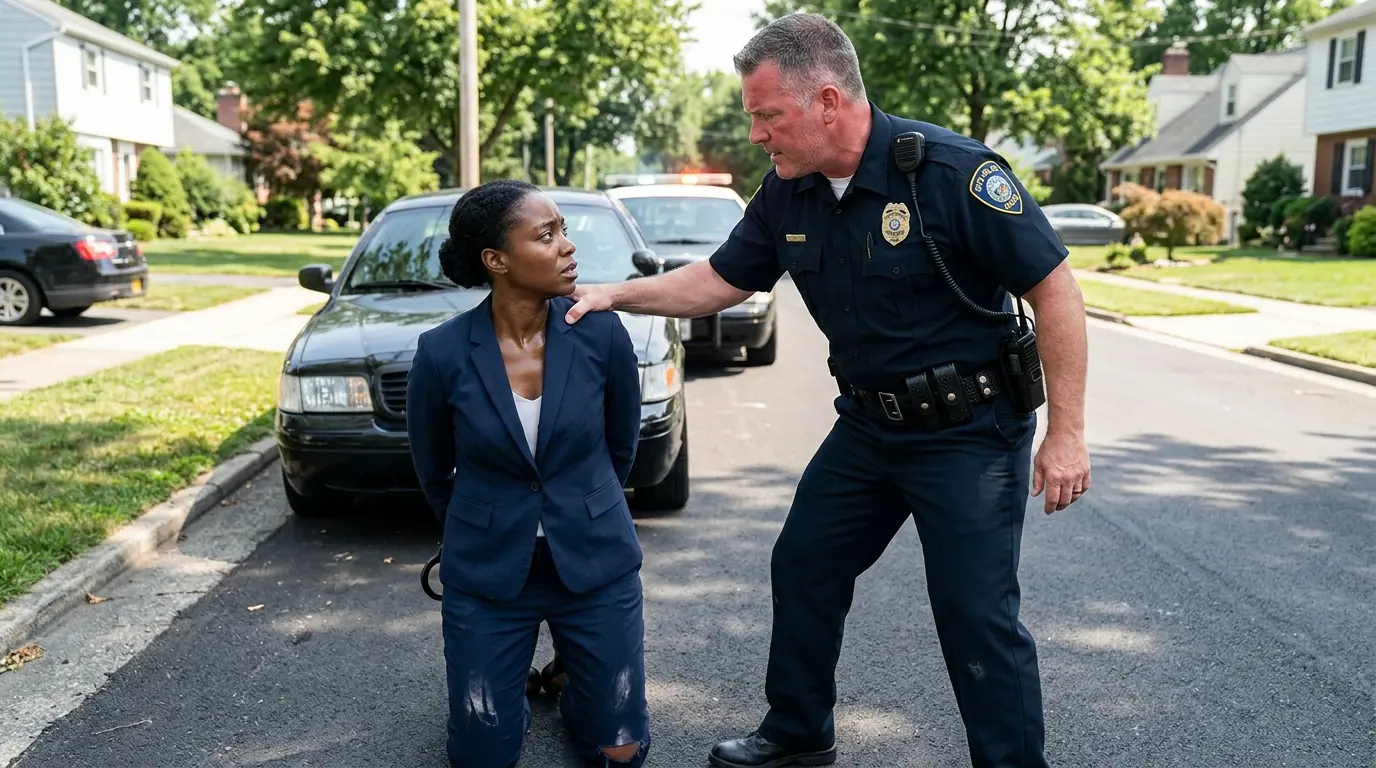
Get on your knees, girl. Now.
“Sir, I just need to explain.”
“Did I ask you to talk? Kneel. Dogs kneel, you kneel.”
“Please, I haven’t done anything wrong.”
“Fifteen years on this badge. I decide what’s wrong. You? You’re nothing. Just another thug in a nice car you probably can’t afford.”
The July asphalt burned through her pants. Her knees screamed, hands zip-tied so tight her fingers went numb. A 7-year-old boy watched from the sidewalk.
“Mommy, why is that lady on the ground?”
The officer leaned down. His breath was hot against her ear.
“Maybe this will teach you to respect authority. People like you never learn.”
No one said a word. No one stepped forward.
One woman alone on her knees in the July heat. She didn’t cry, didn’t beg, just looked straight ahead and remembered everything.
But what Officer Callahan didn’t know, what none of them could possibly imagine, was that in just a few weeks, he would be the one begging, and she would be the one deciding his fate.
Three weeks later, Courtroom 4B of the federal courthouse buzzed with tension. Officer Derek Callahan walked to the witness stand like a man who owned the room. Fifteen years on the force, two commendations for community service. His dress uniform was immaculate, every button polished, every crease sharp. He placed his hand on the Bible, swore to tell the truth, and sat down with the confidence of someone who had done this dozens of times before.
His attorney, a slick man named Richard Brennan, stood up with a reassuring smile.
“Officer Callahan, please describe what happened on July 14th.”
Callahan nodded, his voice steady and rehearsed.
“It was approximately 2:47 p.m. I was conducting routine patrol in the Maple Ridge area when I observed a vehicle with heavily tinted windows. Upon closer inspection, I noticed the registration tag appeared to be expired.”
He paused, letting the words sink in.
“I initiated a standard traffic stop, approached the vehicle, identified myself as a police officer.”
“And what happened next?”
Callahan’s jaw tightened slightly.
“The subject, the driver, immediately became verbally combative, refused to provide identification, started making erratic movements toward the glove compartment.”
A murmur rippled through the gallery.
“I repeatedly instructed the subject to keep her hands visible. She refused to comply. At that point, for my own safety and the safety of the public, I asked her to exit the vehicle.”
“And did she comply?”
“Reluctantly.”
Callahan shook his head slowly, as if recalling a difficult memory.
“She continued to argue, raised her voice, made threatening gestures.”
Attorney Brennan nodded sympathetically.
“What did you do then?”
“I executed a standard compliance procedure. I instructed her to kneel on the ground while I secured the scene. Backup arrived within four minutes.”
He looked directly at the jury, his eyes wide and earnest.
“Everything I did was by the book. I followed protocol to the letter. My body camera was rolling the entire time. I have nothing to hide.”
From her seat at the plaintiff’s table, Maya Richardson watched him without expression. Her hands rested calmly on the table. Her breathing was slow and measured. If Callahan’s lies bothered her, she didn’t show it.
Attorney Brennan continued building his narrative.
“Officer Callahan, in your fifteen years of service, have you ever been disciplined for misconduct?”
“No, sir. Never.”
“Any complaints filed against you?”
Callahan hesitated for just a fraction of a second.
“There have been a few complaints over the years. All unfounded. All dismissed.”
“And on that day, did you use any racial slurs or inappropriate language toward the plaintiff?”
“Absolutely not.”
Callahan’s voice was firm.
“I treated her the same way I would treat anyone who refused to comply with a lawful order. Race had nothing to do with it.”
He turned toward Maya, and for the first time, a hint of smugness crept into his expression.
“I don’t see color when I’m doing my job. I see compliance or non-compliance. That’s it.”
Several people in the gallery nodded. An older white woman in the third row whispered to her husband, “He seems so professional.”
Attorney Brennan smiled.
“No further questions at this time, Your Honor.”
The judge, a stern woman in her sixties named Judge Patricia Coleman, turned to the plaintiff’s table.
“Mr. Woo, your witness.”
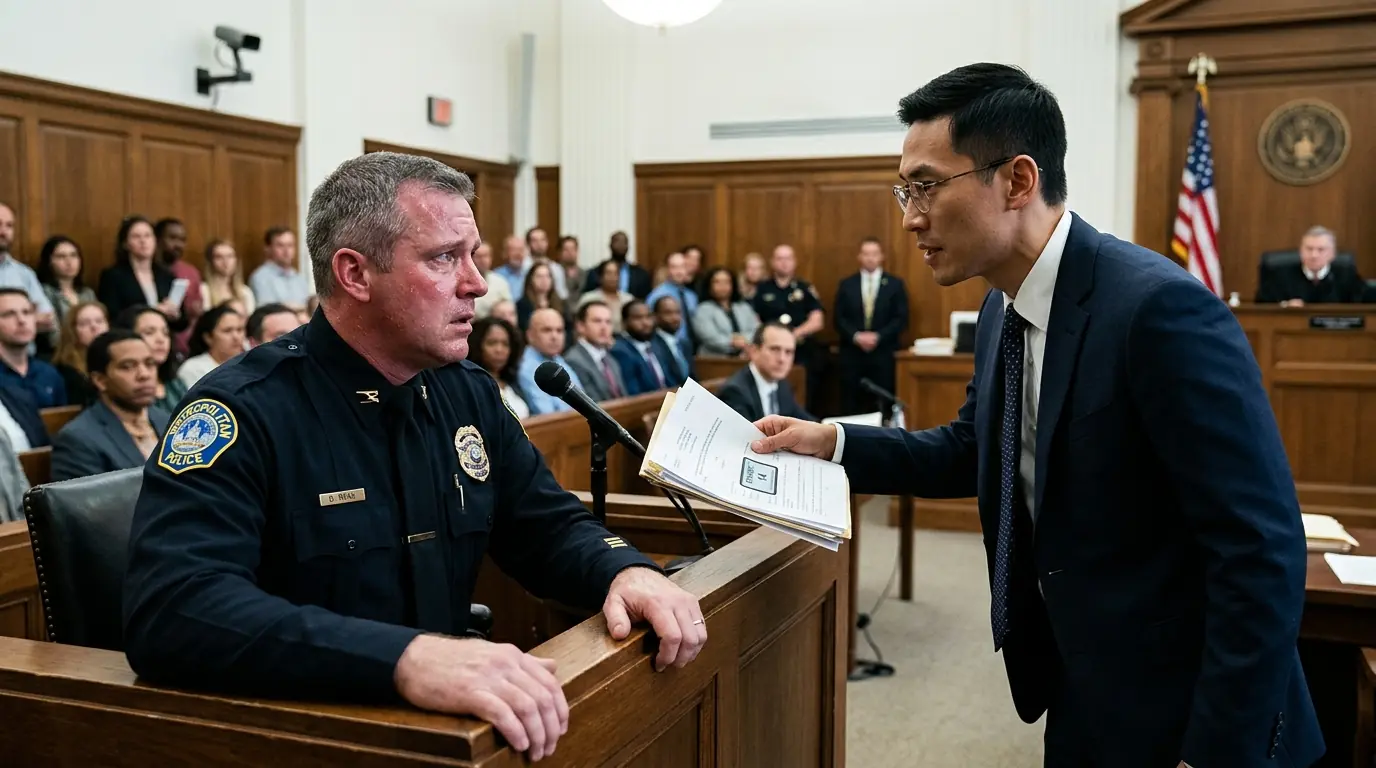
James Wu, Maya’s attorney, rose slowly. He was young, mid-thirties, with sharp eyes behind wire-rimmed glasses. He approached the witness stand with a yellow legal pad in his hand.
Callahan shifted in his seat.
“I don’t have the exact number.”
“Would it surprise you to learn that our research found forty-seven formal complaints filed against you in the past three years alone?”
The courtroom stirred. Callahan’s attorney half rose from his seat but didn’t object. Callahan’s smile faltered.
“Complaints don’t mean anything. Anyone can file a complaint.”
“Forty-seven complaints,” Woo repeated slowly. “And how many resulted in disciplinary action?”
“None, because they were all unfounded.”
“We’ll return to that.”
Woo made a note on his pad.
“Now, you testified that Ms. Richardson was verbally combative. Can you give us a specific example of what she said?”
Callahan paused.
“She was arguing, asking questions, refusing to follow instructions.”
“Asking questions is combative when you’re in a tense situation?”
“What questions did she ask, Officer?”
Another pause. Longer this time.
“She asked... she asked why I pulled her over. Asked if she was being detained or arrested.”
Woo raised an eyebrow.
“So she asked for clarification about her legal status. And you interpreted that as combative.”
“It was the way she said it.”
“I see.”
Woo glanced at his notes.
“You also mentioned she made erratic movements toward the glove compartment, but you had your body camera running, correct?”
“Yes.”
“And in that footage, which we’ve reviewed extensively, Ms. Richardson clearly states, and I quote, ‘Officer, I’m going to reach for my registration in the glove compartment. Is that okay?’ Does that match your recollection?”
Callahan’s face reddened slightly.
“I don’t recall her exact words.”
“You don’t recall? But the camera does.”
Woo let the statement hang in the air.
“Officer Callahan, you used the phrase ‘compliance procedure’ to describe forcing Ms. Richardson to kneel on hot asphalt in July. Is that the official term?”
“It’s a standard technique for maintaining control of a scene.”
“How many times have you used this compliance procedure in the past three years?”
“I’d have to check my records.”
“We checked for you. Forty-seven times, the same number as your complaints. Interesting coincidence, don’t you think?”
Brennan finally stood.
“Objection, Your Honor. Counsel is badgering the witness.”
“I’ll rephrase.”
Woo stepped closer to Callahan.
“Of those forty-seven uses of your compliance procedure, how many resulted in actual arrests?”
Callahan swallowed.
“I don’t have that number off the top of my head.”
“Eleven. Less than twenty-five percent.”
Woo turned to face the jury.
“That means thirty-six people were forced to their knees, humiliated in public, and then released without any charges.”
He turned back to Callahan.
“What did those thirty-six people have in common, Officer?”
“I don’t understand the question.”
“Let me be clearer. Of the forty-seven people you forced to kneel, forty-three were Black or Hispanic in a district that’s sixty percent white.”
Woo paused.
“Can you explain that statistical anomaly?”
Callahan’s hand moved to his collar, loosening it slightly.
“I don’t choose who I pull over based on race. I respond to suspicious behavior.”
“Suspicious behavior?” Woo repeated. “Like driving with tinted windows? Like asking questions about your legal rights?”
“Objection.” Brennan’s voice was sharp. “Argumentative.”
“Sustained.” Judge Coleman looked at Woo. “Move on, counselor.”
Woo nodded, but he wasn’t finished. He picked up a sheet of paper from his table.
“One final question for now, Officer Callahan. During the incident with Ms. Richardson, your partner, Officer Elena Rodriguez, arrived as backup. Correct?”
“Yes.”
“And on your body camera audio, we hear her say, and I quote, ‘Derek, maybe we should just...’ before you cut her off. What was she about to suggest?”
Callahan’s eye twitched.
“I don’t remember.”
“You don’t remember a lot of things.”
Woo gathered his notes.
“That’s all for now, Your Honor, but we’ll have more questions for Officer Callahan later.”
As Woo returned to his seat, Callahan exhaled slowly, his composure cracked, but not broken. He still believed he would win. After all, he always had before.
“The plaintiff may call her next witness.”
James Wu stood.
“Your Honor, we call Maya Richardson to the stand.”
The courtroom shifted as Maya rose from the plaintiff’s table. She moved with quiet deliberation, no rushing, no hesitation. Her navy blue suit was simple but elegant. No jewelry except a thin gold watch. Her natural hair was pulled back neatly. She placed her hand on the Bible, swore the oath, and took her seat in the witness stand.
For a brief moment, her eyes swept across the courtroom, past the jury, past the gallery filled with reporters and curious onlookers, past Officer Callahan, who sat with his arms crossed, a faint smirk still lingering on his face. Then her gaze settled on her briefcase, still resting beside her empty chair at the plaintiff’s table, the worn leather, the faded government seal. She looked away.
James Wu approached with a gentle smile.
“Ms. Richardson, can you tell the court what happened on July 14th?”
Maya nodded slowly. When she spoke, her voice was calm and measured, like someone recounting facts, not reliving trauma.
“I was driving home from a work meeting. It was around 2:45 in the afternoon. I was on Maple Ridge Drive, about three blocks from the intersection where the incident occurred.”
“And what happened next?”
“I noticed a patrol car behind me. The lights came on. I pulled over immediately, as any law-abiding citizen would.”
She paused, her hands resting still on her lap.
“I turned off the engine, rolled down my window, placed both hands on the steering wheel where they could be clearly seen.”
“Why did you do that?”
A sad smile crossed her face.
“Because I’m a Black woman in America. I’ve been taught since I was sixteen years old exactly how to behave during a traffic stop. Hands visible. No sudden movements. Yes, sir. No, sir. Stay alive.”
A heavy silence fell over the courtroom.
“What happened when Officer Callahan approached your vehicle?”
“He was aggressive from the first moment. He didn’t greet me. Didn’t explain why he pulled me over. He just said, ‘License and registration.’”
“Now, did you comply?”
“I tried to. I said, ‘Officer, my registration is in the glove compartment. I’m going to reach for it slowly. Is that okay?’”
“And his response?”
Maya’s jaw tightened almost imperceptibly.
“He shouted at me, ‘Did I say you could move?’ Then seconds later, ‘Get your documents.’ Then when I moved, he said, ‘Don’t move.’”
She shook her head slowly.
“There was no way to comply. Every action was wrong. Every answer was wrong. I realized very quickly that this wasn’t about a traffic stop.”
“What do you mean?”
“I mean, he had already decided how this encounter would end before he even reached my window.”
From the defense table, Officer Callahan shifted in his seat, his smirk fading slightly. Woo continued.
“What happened after that?”
“He ordered me out of the car. I complied. He told me to put my hands on the hood. I complied. It was hot. The metal burned my palms. I didn’t complain.”
She looked directly at the jury.
“Then he told me to kneel on the asphalt. On the asphalt in the middle of the street at 2:47 p.m. on a July afternoon. The surface temperature was over 130 degrees.”
“Did he give you a reason?”
“No. He just said, ‘Get on your knees, girl. Maybe this will teach you some respect.’”
A woman in the gallery gasped. A juror in the front row, a middle-aged Black man, closed his eyes briefly.
“I knelt. The asphalt burned through my pants. I could feel my skin blistering, but I stayed still.”
“Why didn’t you protest? Demand to know your rights?”
Maya was quiet for a moment.
“Because I wanted to survive. In that moment, that was all that mattered. Survive first. Justice later.”
Woo nodded.
“What happened while you were on your knees?”
“Officer Callahan stood over me. He made a phone call, casual, unhurried. He talked about picking up dinner on his way home, laughed about something with whoever was on the other end.”
Her voice remained steady, but something flickered in her eyes.
“Meanwhile, a woman across the street was recording on her phone, not to help, to watch. A group of teenagers rode by on bicycles. One of them laughed and shouted something I couldn’t hear. A couple walked past with their dog. They looked at me, looked away, and kept walking.”
She paused.
“Seven minutes. I was on my knees for seven minutes. No one said a word. No one asked if I was okay. No one questioned why a woman in business clothes was kneeling on the street in handcuffs.”
“What were you thinking during those seven minutes?”
Maya was silent for a long moment. The courtroom waited.
“I was thinking about my daughter. She’s fifteen. I was thinking, what would I tell her? How would I explain that her mother was treated like a criminal for driving while Black?”
She took a slow breath.
“And then I started doing what I was trained to do.”
Woo tilted his head slightly.
“What do you mean?”
“I observed. I memorized Officer Callahan’s badge number. I noted the timestamp on his body camera, 2:47:33 p.m. when he ordered me to kneel. I watched his partner arrive and saw her hesitate. Saw the discomfort on her face. I listened to every word he said, logged every detail in my mind.”
She looked at Callahan for the first time.
“And I asked him a question. ‘Am I being detained or am I being arrested?’ He didn’t answer. He just laughed and said, ‘You’re being taught a lesson.’”
Something flickered across Callahan’s face. The first crack in his armor.
Woo glanced at his notes, then back at Maya.
“Ms. Richardson, you mentioned you were driving home from a work meeting. What kind of work do you do?”
Maya paused. Her eyes drifted to her briefcase again.
“I’m in law. I work in law.”
“Could you be more specific?”
A faint smile crossed her lips, there and gone in an instant.
“I’d rather let my credentials speak for themselves at the appropriate time.”
Callahan’s attorney, Brennan, frowned, but didn’t object. The answer was strange, but not technically evasive. Judge Coleman made a note. Wu nodded as if expecting this answer.
“No further questions for now, Your Honor, but we reserve the right to recall Ms. Richardson later in these proceedings.”
As Maya stepped down from the witness stand, she paused briefly beside her briefcase. Her fingers brushed the worn leather, the faded seal. She didn’t pick it up. Not yet, but soon.
Three weeks before the trial, the clock on Maya’s home office wall read 11:47 p.m. She sat at her desk, surrounded by stacks of files, legal pads covered in handwritten notes, and a laptop glowing with dozens of open tabs. The room was quiet except for the soft hum of the air conditioner and the occasional rustle of paper. On the wall behind her hung three framed diplomas: Harvard Law School, Yale University, a certificate from the Department of Justice.
But those were turned to face the wall tonight. She didn’t need reminders of who she was. She needed to focus on what she had to do.
A soft knock on the door.
“Mom?”
Maya looked up. Her daughter Zoe stood in the doorway, fifteen years old, wearing pajamas, holding two cups of tea.
“You’re still awake, baby.”
“So are you.”
Zoe walked in and set one cup on the desk.
“Chamomile. You need to sleep eventually.”
Maya smiled and took the cup.
“Eventually.”
Zoe lingered, her eyes scanning the files spread across the desk, photos of Officer Callahan, incident reports, complaint records, witness statements.
“Is this all about him? The cop who...?”
“Yes.”
Zoe was quiet for a moment. Then she asked the question that had clearly been weighing on her.
“Mom, why don’t you just tell them who you are right at the beginning? End it fast.”
Maya sat down her tea. She looked at her daughter, so young, so impatient for justice.
“Because when I reveal who I am, it has to matter. It has to mean something. Timing is everything, sweetheart.”
“But he’s lying. Everyone can see he’s lying. Why let him keep talking?”
Maya leaned back in her chair.
“Because every lie he tells is another nail in his coffin. Every exaggeration, every ‘I don’t recall,’ every smug smile. I want him to feel safe, confident. I want him to believe he’s winning.”
She picked up a file and opened it.
“And then, when he’s at his most arrogant, when he thinks he’s untouchable, that’s when the truth comes out. That’s when it hurts the most.”
Zoe considered this. A slow smile spread across her face.
“That’s cold, Mom.”
“That’s justice.”
After Zoe went to bed, Maya returned to her work. Eight months of investigation. That’s what this desk represented. It had started with anonymous complaints forwarded to her office at the Department of Justice, multiple reports from the same police precinct, allegations of racial profiling, excessive force, systematic targeting of Black and Hispanic residents. Her team had been quietly gathering evidence, interviewing victims, analyzing patterns, building a case. And then, on a hot July afternoon, she had decided to see for herself. She wasn’t working that day, not officially. She had simply driven through the neighborhood, watched, observed. She never expected to become part of the investigation.
Maya opened a thick folder labeled “Callahan, D. Incident History.”
Forty-seven documented cases. Forty-seven people forced to their knees, cuffed, humiliated, and then released without charges.
Forty-three of them Black or Hispanic. All of them had filed complaints. None of the complaints had resulted in any disciplinary action.
She turned to another stack. Witness statements. Twelve victims had agreed to testify. Twelve people willing to stand in front of a courtroom and relive their worst moments.
But one name was missing.
Jasmine Torres, nineteen years old, nursing student.
Eight months ago, Callahan had pulled her over on the highway for a broken tail light. He had forced her to kneel on the median. Cars rushed past at sixty miles per hour. She had knelt there shaking, crying for twelve minutes. The trauma had broken something inside her. She had dropped out of nursing school, couldn’t drive without panic attacks, couldn’t sleep without nightmares. When Maya’s team had contacted her, Jasmine had wanted to testify desperately. But when the day came, she couldn’t do it, couldn’t face him again. Maya had held her hand and told her it was okay, that others would speak for her.
But that night, alone in her office, Maya had made a decision.
This ends now.
She opened her briefcase, the same worn leather briefcase she would carry into the courtroom. Inside was her Department of Justice credentials. Her official title: Senior Special Prosecutor, Civil Rights Division, United States Department of Justice.
For eight months, she had been investigating Callahan’s precinct from the outside. Now, she would tear it apart from the inside.
She closed the briefcase, ran her fingers over the faded government seal.
Not yet, but soon.
Day three of the trial. The courtroom was packed. Word had spread that today would be different. Today, the evidence would speak.
James Wu stood before the jury, a remote control in his hand.
“Your Honor, the plaintiff would like to submit Exhibit A, the unedited dash cam and body camera footage from Officer Callahan’s patrol vehicle on July 14th.”
Judge Coleman nodded.
“Proceed.”
The lights dimmed. The large screen at the front of the courtroom flickered to life, and for the next four minutes and thirty-seven seconds, the jury saw exactly what happened on Maple Ridge Drive.
Maya’s sedan pulling over smoothly. Her window rolling down. Her hands placed calmly on the steering wheel. Callahan’s voice harsh from the first syllable.
“License and registration. Now.”
Maya’s response soft and measured.
“Officer, my registration is in the glove compartment. I’m going to reach for it slowly. Is that okay?”
“Did I say you could move?”
“I’m just trying to—”
“Out of the car. Now.”
The footage showed everything. Maya stepping out slowly, hands visible. Callahan grabbing her arm, spinning her around, shoving her against the hood of her own car.
And then the moment everyone had been waiting for.
“Get on your knees.”
“Officer, I haven’t done anything.”
“Kneel, girl.”
Maya sinking to the hot asphalt. Her face tight with pain, her hands being zip-tied behind her back, and Callahan standing over her, pulling out his phone, making a casual call while a woman knelt bleeding in the July heat.
“Yeah, I’m thinking tacos tonight. What? No, just dealing with a situation here. Nothing serious.”
The video ended. The lights came back on.
Several jurors looked physically ill. One woman in the back row of the gallery was crying silently.
Officer Callahan sat frozen at the defense table, his face a mask of barely controlled fury. Woo let the silence hang for a moment. Then he spoke.
“Your Honor, I’d like to call our first independent witness, Dr. Thomas Carter, forensic video analyst.”
A small, precise man in his fifties took the stand. He adjusted his glasses and spoke with the careful authority of someone who had testified in hundreds of cases.
“Dr. Carter,” Wu began, “you’ve analyzed the footage we just watched. What were your findings?”
“Several significant discrepancies between Officer Callahan’s testimony and the video evidence.”
Dr. Carter clicked a remote, bringing up a still image.
“First, Officer Callahan claimed the plaintiff’s registration was expired. This frame, taken as he approached the vehicle, clearly shows the registration tag. It’s valid through September of next year.”
A murmur rippled through the courtroom.
“Second, Officer Callahan testified that the plaintiff was verbally combative and made threatening gestures. Audio analysis of the footage shows Ms. Richardson’s voice never exceeded sixty-two decibels, conversational volume. Officer Callahan’s voice, by contrast, peaked at eighty-nine decibels on multiple occasions.”
He clicked another slide.
“Third, Officer Callahan claimed Ms. Richardson made erratic movements toward the glove compartment. Frame-by-frame analysis shows her hands remained on the steering wheel for the first forty-seven seconds of the encounter. When she did move, it was after clearly stating her intention to retrieve her registration.”
Woo nodded.
“In your professional opinion, Dr. Carter, does the video evidence support Officer Callahan’s account of events?”
“No. It directly contradicts it in multiple material ways.”
“Thank you. No further questions.”
Brennan’s cross-examination was brief and ineffective. The video had said everything.
Woo stood again.
“Your Honor, the plaintiff calls Officer Elena Rodriguez to the stand.”
A ripple of surprise went through the courtroom. Callahan’s own partner.
Officer Rodriguez walked to the stand slowly, as if each step required enormous effort. She was younger than Callahan, early thirties, with tired eyes and a tense jaw. She wouldn’t look at her partner as she took the oath.
“Officer Rodriguez,” Wu began gently, “you arrived as backup on July 14th. What did you observe when you reached the scene?”
Rodriguez took a deep breath.
“When I arrived, Ms. Richardson was already on the ground on her knees. Her hands were secured behind her back.”
“Was she resisting?”
“No.”
Rodriguez’s voice was barely above a whisper.
“She was completely still, completely silent. She was... she was compliant.”
“Did you observe any threatening behavior from Ms. Richardson?”
“No, sir.”
“Any aggressive language?”
“No, sir.”
“Any reason at all for her to be restrained on the ground?”
Rodriguez was quiet for a long moment. When she spoke, her voice cracked.
“No, sir, I did not.”
Woo paused, letting the answer settle over the courtroom.
“Officer Rodriguez, on the body camera audio, we hear you say, ‘Derek, maybe we should just...’ before being cut off. What were you going to suggest?”
Rodriguez closed her eyes briefly.
“I was going to suggest we let her go, that there was no reason to hold her.”
“And what did Officer Callahan say?”
“He said, ‘I’ve got this.’ And he told me to secure the perimeter.”
“Officer Rodriguez, in your four years partnering with Officer Callahan, how many times have you seen him use this compliance procedure?”
She swallowed hard.
“At least twenty times.”
“And what did these individuals have in common?”
Tears welled in Rodriguez’s eyes. She looked down at her hands.
“They were... they were mostly people of color. Mostly women.”
The courtroom erupted in whispers. Judge Coleman banged her gavel.
“Order. Order in the court.”
Woo waited for silence. Then quietly he asked his final question.
“Officer Rodriguez, why are you testifying today? You know this could end your career.”
Rodriguez finally looked up. Her eyes found Maya’s across the courtroom.
“Because I should have said something that day. I should have stopped him. I didn’t.”
A tear rolled down her cheek.
“I can’t change what happened, but I can tell the truth now. And maybe... maybe that counts for something.”
Woo nodded.
“No further questions, Your Honor.”
As Rodriguez stepped down, Woo called his next witness, Dr. Patricia Holmes, a statistician from Georgetown University. Her testimony was devastating in its precision.
“I analyzed Officer Callahan’s enforcement records over three years. Forty-seven use-of-force incidents. Forty-three, ninety-one percent, involved Black or Hispanic individuals. The demographic composition of his patrol area is sixty percent white.”
She looked at the jury.
“The probability of this distribution occurring by chance is less than 0.001 percent. This represents a statistically significant pattern of discriminatory enforcement.”
The final witnesses of the day were civilians. Mrs. Beatrice Washington, sixty-seven, a retired teacher who had watched from her porch. Marcus Carter, twenty-eight, a software engineer who had recorded the incident on his phone. And Denise Torres, Jasmine’s aunt, who had walked past with her seven-year-old son.
“My boy asked me why that lady was on the ground,” Denise said, her voice trembling. “I didn’t know what to tell him. How do you explain something like that to a child?”
She looked at Callahan, her eyes burning.
“How do you explain that the people who are supposed to protect us are the ones hurting us?”
Callahan stared straight ahead, his jaw tight, his face red. But for the first time, something else flickered in his eyes.
Fear.
Day four of the trial. The courtroom was standing room only. Every seat filled. Reporters lined the walls. Camera crews waited outside. Something was coming. Everyone could feel it.
Officer Callahan sat at the defense table, his confidence visibly shaken, but not yet broken. He had weathered bad days before. He would weather this.
His attorney, Richard Brennan, stood for what he hoped would be a turning point.
“Your Honor, the defense would like to remind the court that the plaintiff, Ms. Richardson, has presented herself as an ordinary citizen, a victim, but she has offered no expert testimony on police procedure, no professional credentials to support her interpretation of events.”
He gestured dismissively toward Maya.
“She is simply a woman who was inconvenienced by a routine traffic stop and is now seeking a payday. Her emotional testimony, while compelling to some, does not constitute evidence of wrongdoing.”
Brennan straightened his tie, pleased with himself.
“The defense maintains that Officer Callahan followed standard protocol and that this lawsuit is nothing more than—”
“Objection, Your Honor.”
James Wu rose slowly, a thin smile playing at the corner of his lips.
“Counsel is making assumptions about Ms. Richardson’s qualifications without foundation. I’d like to correct the record.”
Judge Coleman raised an eyebrow.
“Proceed, Mr. Woo.”
“The plaintiff requests permission to recall Maya Richardson to the stand for the purpose of establishing her credentials.”
Brennan frowned.
“Your Honor, this is irregular.”
“I’ll allow it.”
Judge Coleman nodded toward Maya.
“Ms. Richardson, please retake the stand.”
Maya rose from the plaintiff’s table. The courtroom fell silent. She walked to the witness stand with the same calm, measured steps as before, but something was different now. There was a weight to her presence, a gravity that hadn’t been there before. She sat down, folded her hands, and waited.
James Woo approached, his voice clear and steady.
“Ms. Richardson, would you please state your full name and credentials for the court?”
Maya looked at the jury, then at Judge Coleman, then finally at Officer Derek Callahan. Their eyes met, and then she spoke.
“My name is Dr. Maya Richardson.”
A murmur swept through the gallery.
“I hold a Juris Doctor from Yale Law School and a PhD in criminal justice and police accountability from Harvard University.”
The murmur became a wave. Callahan’s face went pale.
“For the past twelve years, I have served as Senior Special Prosecutor in the Civil Rights Division of the United States Department of Justice.”
Brennan shot to his feet.
“Your Honor—”
“Sit down, Mr. Brennan.”
Judge Coleman’s voice was ice.
Maya continued, her voice never rising, never wavering.
“My office is responsible for investigating civil rights violations by law enforcement officers across the country. We handle cases of excessive force, racial profiling, and systemic abuse of power.”
She paused, letting the words sink in.
“For the past eight months, my team has been conducting a federal investigation into this police precinct, including Officer Callahan, based on multiple complaints of discriminatory enforcement.”
The courtroom erupted. Reporters scrambled for their phones. The gallery buzzed with shocked whispers. Judge Coleman banged her gavel.
“Order, order in this court.”
But Maya wasn’t finished.
“On July 14th, I was driving through Maple Ridge as part of an unofficial observation. I wanted to see firsthand how officers in this precinct interacted with Black residents.”
She looked at Callahan. He was gripping the edge of the table, his knuckles white.
“I never expected to become a victim myself. But when Officer Callahan forced me to my knees, he didn’t just assault a citizen. He handed me evidence. He made himself Exhibit A in his own federal investigation.”
Dead silence.
Maya’s voice dropped, but every word carried to the farthest corner of the room.
“Officer Callahan, when you ordered me to kneel, you saw a Black woman you thought you could humiliate without consequence. You thought I was powerless. You thought no one would believe me.”
She leaned forward slightly.
“You were wrong.”
Callahan’s mouth opened. No sound came out.
Maya straightened in her seat.
“You forced me to kneel for seven minutes. I will ensure you spend the next seven years answering for what you’ve done, not just to me, but to every person you’ve brutalized under the color of law.”
From the gallery, someone began to clap, then another, then another. Judge Coleman let it continue for five full seconds before calling for order.
At the defense table, Officer Derek Callahan sat motionless. The hunter had become the prey.
The recess had lasted fifteen minutes. Fifteen minutes for Callahan’s attorney to desperately strategize. Fifteen minutes for reporters to flood social media with the bombshell revelation. Fifteen minutes for Officer Derek Callahan to sit in a small conference room staring at the wall, realizing his world was collapsing.
When court resumed, the energy in the room had shifted completely.
Judge Coleman addressed the courtroom.
“Given Dr. Richardson’s credentials and her direct involvement in the federal investigation, I’m permitting her to conduct a portion of the cross-examination of Officer Callahan. Mr. Wu will remain co-counsel.”
Brennan started to object, but one look from the judge silenced him.
Maya rose from the plaintiff’s table. She didn’t carry notes, didn’t need them. Eight months of investigation. Forty-seven case files, twelve victim interviews. Every detail was etched into her memory.
She approached the witness stand where Callahan sat, his earlier smugness replaced by barely concealed panic.
“Officer Callahan.”
Her voice was calm, almost gentle.
“During your earlier testimony, you referred to me as ‘ma’am’ several times. Very respectful.”
Callahan nodded cautiously.
“Yes, ma’am.”
“Interesting.”
Maya tilted her head.
“Because on July 14th, on that roadside, you called me ‘girl.’ You told me to kneel where I belong.”
Callahan’s jaw tightened.
“I don’t recall using those exact—”
“The body camera recording confirms it. Would you like me to play it again?”
Silence.
“I’ll take that as a no.”
Maya clasped her hands behind her back.
“Let’s talk about your compliance procedure. You’ve used it forty-seven times in three years, correct?”
“If that’s what the records show, it is.”
“And of those forty-seven times, you made arrests in only eleven cases. That means thirty-six people were forced to their knees, handcuffed, and humiliated, then released without any charges.”
She paused.
“Thirty-six people, Officer. What was the purpose of forcing them to kneel if not to arrest them?”
Callahan shifted in his seat.
“Officer safety. Scene control.”
“Scene control,” Maya repeated the words slowly. “Let’s examine that.”
“Mrs. Dorothy Patterson, sixty-eight years old, retired librarian. You pulled her over for a broken tail light, forced her to kneel on the sidewalk for nine minutes. She has arthritis in both knees. She couldn’t walk properly for two weeks afterward.”
Callahan said nothing.
“Was a sixty-eight-year-old woman with arthritis a threat to your safety, Officer?”
“Every situation is assessed individually.”
“Tyrell Washington, sixteen years old, honor student. You stopped him for riding his bicycle in what you called a high-crime area. That high-crime area was three blocks from his own home, where he’d lived his entire life. You forced him to kneel on gravel. His mother found blood on his jeans when he came home.”
Maya stepped closer.
“Was a sixteen-year-old on a bicycle a threat to your safety?”
Callahan’s face reddened.
“I don’t remember every—”
“You don’t remember? That’s been your answer to a lot of questions.”
Maya’s voice hardened.
“Let me refresh your memory about someone you should remember. Jasmine Torres, nineteen years old, nursing student.”
Something flickered in Callahan’s eyes.
“Eight months ago, you pulled her over on Highway 12 for a broken tail light. You forced her to kneel on the highway median. Cars passing at sixty miles per hour. She knelt there for twelve minutes, crying, begging you to let her stand. You laughed.”
Maya’s voice dropped lower.
“Jasmine Torres was supposed to be here today. She wanted to testify, but she couldn’t. Do you know why?”
Callahan stared at the floor.
“She has PTSD. She dropped out of nursing school. She can’t drive anymore. She can’t sleep without nightmares. A nineteen-year-old girl with her whole future ahead of her. And you broke her for a broken tail light.”
Tears were visible in several jurors’ eyes.
“You don’t remember her, do you, Officer Callahan?”
Silence.
“But she remembers you every night. Every time she closes her eyes.”
Maya turned to face the jury.
“Forty-seven people, forty-three of them Black or Hispanic, exposed. Exposed not by some outside investigation, but by Officer Callahan’s own records, his own body camera, his own words.”
She looked back at Callahan one final time.
“You called your procedure ‘maintaining control,’ but we both know what it really was. It was punishment, humiliation, a reminder of who holds the power.”
She leaned in slightly.
“But power shifts, Officer Callahan. Today it shifted.”
Maya straightened.
“No further questions, Your Honor.”
As she walked back to the plaintiff’s table, the courtroom remained utterly silent. Callahan sat frozen in the witness chair, a broken man who had not yet realized the full extent of his destruction. But he would soon.
Day five, closing arguments.
The courtroom was suffocating with tension, every seat taken, people standing three deep against the back wall. Outside, news vans lined the street. Helicopters circled overhead. This was no longer just a trial. It was a reckoning.
Richard Brennan rose first for the defense. His voice lacked its earlier confidence.
“Ladies and gentlemen of the jury, Officer Derek Callahan has served this community for fifteen years. Fifteen years of putting his life on the line. Fifteen years of difficult decisions made in split seconds.”
He gestured weakly toward his client.
“Has he made mistakes? Perhaps. But mistakes are not crimes. A traffic stop that became uncomfortable is not a civil rights violation. We ask that you consider the difficulty of police work, the impossible situations officers face daily, and return a verdict that recognizes Officer Callahan’s years of service.”
He sat down. The silence that followed was damning.
James Woo approached the jury box.
“Fifteen years of service,” he repeated softly. “That’s what the defense wants you to focus on. But I want you to focus on seven minutes. Seven minutes on hot asphalt. Seven minutes of humiliation. Seven minutes that represent not an isolated incident, but a pattern. Forty-seven incidents over three years. Exposed. Exposed by video. Exposed by statistics. Exposed by his own partner.”
Woo turned to look at Callahan.
“Officer Callahan didn’t make a mistake. He made a choice. A choice to abuse his power. A choice to humiliate. A choice to treat human beings as less than human because he believed there would be no consequences.”
He faced the jury again.
“Today you decide whether he was right.”
Woo sat down.
Judge Coleman turned to Maya.
“Dr. Richardson, as the plaintiff, you may make a personal statement before we proceed to deliberation.”
Maya stood slowly. The courtroom held its breath. She walked to the center of the floor, standing between the jury box and the gallery, between Callahan and the judge. She stood where everyone could see her.
“Fifteen years,” she began, her voice quiet but carrying to every corner. “For fifteen years, I’ve prosecuted cases like this one. I’ve sat across from victims, broken, traumatized, afraid. I’ve heard their stories. I’ve fought for their justice.”
She paused.
“But I never truly understood. Not really. Not until July 14th.”
Her eyes swept across the jury.
“When Officer Callahan forced me to my knees, I felt something I’d only read about in case files. The helplessness, the humiliation, the absolute certainty that nothing I said or did would matter, because to him I wasn’t a person. I was just another Black woman he could control.”
Her voice remained steady, but the weight of her words was immense.
“He didn’t see my degrees, my career, my fifteen years of service to this country’s justice system. He saw the color of my skin, and he made his decision.”
Maya turned to look at Callahan directly.
“But this isn’t about me. I had resources. I had knowledge. I had the ability to fight back. What about the people who don’t?”
She turned back to the jury.
“Dorothy Patterson, sixty-eight years old. Her knees still ache when it rains. Tyrell Washington, sixteen. He flinches now when he sees a police car. Jasmine Torres, nineteen. She wanted to be a nurse. Now she can barely leave her house.”
Her voice cracked almost imperceptibly.
“They didn’t have law degrees. They didn’t have federal investigations behind them. They just had their dignity. And Officer Callahan took that from them because he could. Because no one stopped him. Because for fifteen years, the system protected him.”
Maya straightened.
“I’m not asking for vengeance. I’m asking for accountability. I’m asking you to say clearly and unequivocally that this is not acceptable, that badges do not grant immunity, that power must answer to justice.”
She took a breath.
“Forty-seven people knelt because of this man. Today, I’m asking you to stand for them.”
Maya returned to her seat.
Silence.
Then Judge Coleman spoke.
“The jury will now deliberate.”
Three hours and seventeen minutes. That’s how long it took.
When the jury filed back in, their faces revealed nothing. The foreperson, a middle-aged white woman with graying hair, stood with a folded paper in her hands.
“Has the jury reached a verdict?”
“We have, Your Honor.”
Judge Coleman nodded.
“Please read the verdict.”
The foreperson unfolded the paper.
“In the matter of Richardson versus Callahan, on the count of unlawful detention, we find the defendant guilty.”
A gasp rippled through the gallery.
“On the count of excessive force, we find the defendant guilty.”
Callahan’s head dropped.
“On the count of civil rights violation under color of law, we find the defendant guilty.”
The courtroom erupted. Cheers, tears, reporters rushing for the exits. Judge Coleman banged her gavel until order was restored.
“Officer Callahan, please rise.”
Callahan stood on shaking legs.
“This court awards the plaintiff five hundred thousand dollars in compensatory damages. Additionally, I am formally referring this case to the state attorney general for criminal prosecution.”
Maya stood.
“Your Honor, if I may.”
The judge nodded.
“That referral won’t be necessary. My office has already prepared federal indictments. Officer Callahan will be charged under 18 U.S.C. Section 242, deprivation of rights under color of law.”
She paused.
“Along with twenty-three other officers from his precinct.”
The courtroom exploded again.
Two federal marshals approached Callahan with handcuffs.
“Derek Callahan, you are under arrest.”
As the cuffs clicked around his wrists, Maya watched in silence.
Justice.
Finally.
Six months later, the federal courthouse in Washington, D.C., was quiet on that winter morning. But inside Courtroom 1, history was being made. Officer Derek Callahan stood before a federal judge, handcuffed, wearing an orange jumpsuit instead of his pristine dress uniform.
“Derek Anthony Callahan, you have been found guilty of eighteen counts of civil rights violations under color of law. This court sentences you to seven years in federal prison with no possibility of early parole.”
Callahan said nothing. His shoulders slumped. The man who had once stood over Maya Richardson with such arrogance couldn’t even lift his head.
His wife had filed for divorce three months earlier. His adult children refused to visit. His name had become synonymous with abuse of power. Seven minutes on his knees would have been merciful compared to what awaited him.
The ripple effects spread far beyond one man. Twenty-three officers from Callahan’s precinct were indicted. Fourteen pleaded guilty. The chief of police resigned in disgrace. The entire department was placed under federal oversight for ten years, the longest such supervision in state history. New policies were implemented nationwide: mandatory bias training, independent review boards, automatic upload of body camera footage to external servers, a complete ban on compliance procedures used for intimidation.
The Callahan case became required study in police academies across the country, not as an example to follow, but as a warning of what happens when power goes unchecked.
Maya Richardson was promoted to Deputy Assistant Attorney General for Civil Rights, the highest-ranking position in the division’s history for a Black woman. But titles weren’t what mattered to her.
What mattered was Jasmine Torres.
Six months of therapy. Six months of healing. Six months of slowly rebuilding what Callahan had destroyed.
On a warm spring afternoon, Jasmine walked through the doors of her nursing school. She was behind. She had missed a year, but she was back.
Maya was there to see it.
“Thank you,” Jasmine whispered, hugging her. “Thank you for not giving up.”
“You didn’t give up,” Maya replied. “I just made sure someone was listening.”
One year after the incident, Maya drove through Maple Ridge. She stopped at the intersection where it had all happened. The asphalt had been repaved. A small community garden now stood on the corner, and on the wall of the building across the street, a mural had been painted, bright colors depicting hands of different shades reaching upward toward the word dignity.
Maya stepped out of her car. She stood on the spot where she had knelt, and she smiled.
“A year ago, I was on my knees here. Today, justice stands.”
This story is real. The names have been changed. But the pain and the triumph are real. Every day, people are underestimated, dismissed, humiliated by those who think power makes them untouchable. But power without accountability is borrowed time. Because sometimes the person they choose to kneel becomes the one who makes them answer.