Exhausted from a grueling night shift, Matthew, a single black father, was rushing down the street to make it to his second job when he suddenly heard sobbing nearby. He found an elegant elderly woman standing soaked in the middle of a storm, clutching her coat like a lifeline.
Without hesitation, Matthew stepped forward, took off his only jacket, helped her to her feet, and quietly walked her to safety. Little did he know that this simple act of kindness was about to become the turning point of his life, because the very next morning, three sleek black SUVs pulled up right outside his door, carrying a message that would change everything.
Friday morning, 8:47 a.m. The kind of morning where the air feels heavy before anything even happens. Matthew Vance stood in front of his apartment building, one hand gripping the handlebars of his bike, the other checking his phone for the third time. He was already running late for his second shift, the warehouse job that paid just enough to keep the lights on.
His work uniform, stained with yesterday’s concrete dust, hung loose on his frame. Thirty-five years old, and he felt fifty. He was about to push off when he heard it, the low rumble of engines. Expensive engines.
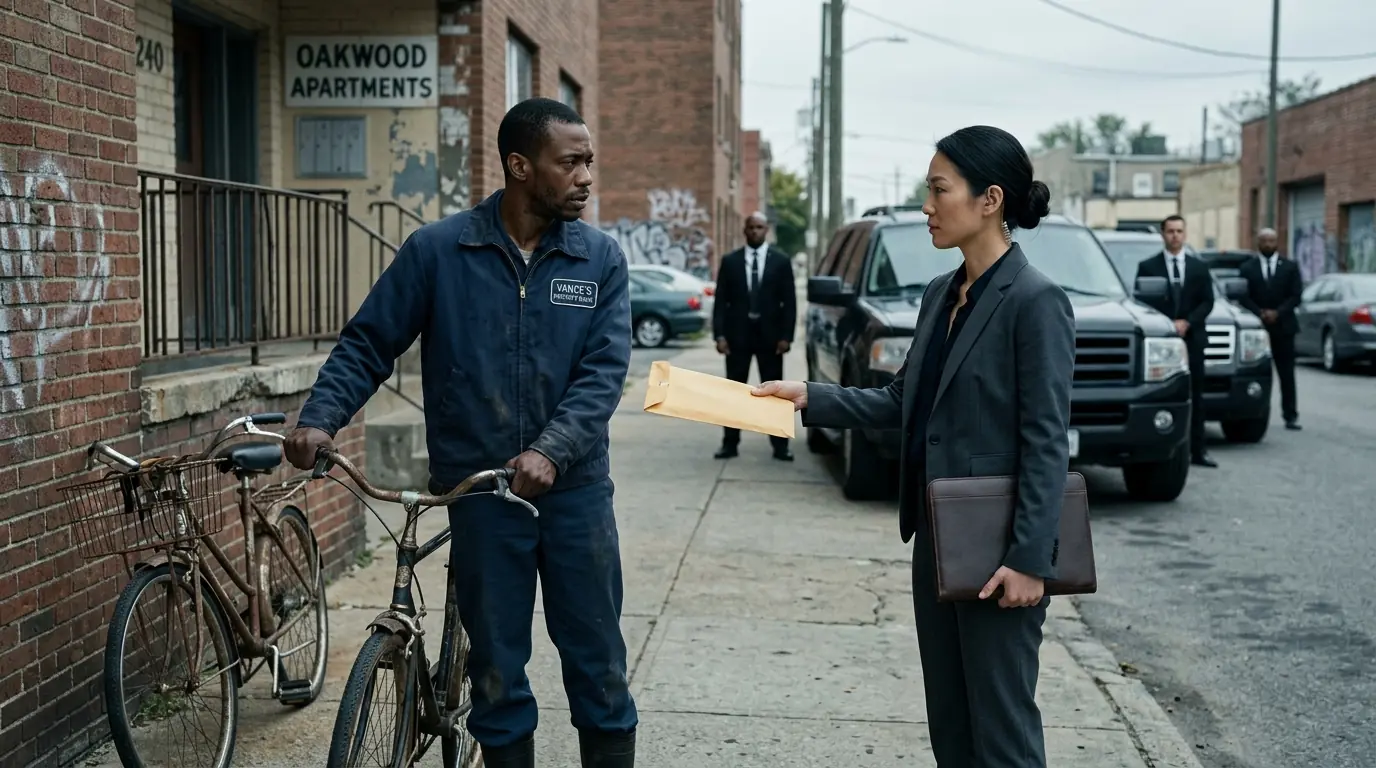
Three black SUVs rolled down the narrow street like a funeral procession, their tinted windows reflecting the cracked sidewalk and peeling paint of the buildings. Matthew’s neighborhood didn’t see cars like this ever, unless someone died or someone was about to get arrested.
His stomach dropped.
The vehicles stopped directly in front of his building, forming a perfect blockade. Doors opened in unison, four of them. Out stepped men in dark suits, earpieces visible, hands clasped in front of them like secret service agents. They moved with precision, scanning the area with cold, practiced eyes.
Matthew’s grip tightened on his bike. His heart started hammering against his ribs.
Around him, neighbors began to emerge. Mrs. Patterson from 2B cracked her door open, eyes wide. Old man Jenkins stopped sweeping his stoop. The guys who usually hung out by the corner store went silent, backing up slowly.
“That’s undercover,” someone whispered.
“They finally coming for Matthew,” another voice hissed.
“I told y’all he was into something.”
“Lord have mercy. What about his poor mama?”
Matthew heard every word. He’d lived in this neighborhood his whole life, and he knew how fast rumors spread, how fast a man could go from hardworking to criminal in people’s minds, how a black man standing still could look guilty to the wrong eyes.
One of the security men, the tallest one with a jawline that could cut glass, stepped forward. His shoes were polished to a mirror shine. Everything about him screamed authority, money, power. Things Matthew had never had.
The man’s eyes locked onto Matthew.
“Are you Matthew Vance?”
Matthew’s throat went dry. His mind raced through possibilities. Parking tickets. He didn’t own a car. Old debts. He was behind on everything, but they didn’t send private security for that.
His pulse thudded in his ears, drowning out the street noise. He wanted to run. Every instinct screamed at him to drop the bike and bolt, but he had nowhere to go. And even if he did, his mother was inside, sick, helpless.
“I asked you a question.” The man’s voice was flat, emotionless. “Are you Matthew Vance?”
Matthew’s hand slowly rose, palms out. It was instinct, the kind drilled into black men from childhood. Show your hands. Don’t make sudden moves. Don’t give them a reason.
“Yeah,” Matthew said, his voice steadier than he felt. “That’s me.”
The security team exchanged glances. The tall one stepped closer, and Matthew’s heart rate spiked. He could see the outline of something under the man’s jacket. Maybe a weapon, maybe just a phone, but in that moment, Matthew’s imagination filled in the worst.
“We need to come inside,” the man said.
“Inside?” Matthew’s voice cracked slightly. He cleared his throat, fighting to keep his composure. “Look, man, I don’t know what this is about, but my mother’s in there. She’s sick. Real sick. She’s got a heart condition, and if y’all come storming in there with all this—”
“Mr. Vance.”
Another person stepped forward. A woman this time, younger, wearing a charcoal pantsuit and carrying a leather portfolio. Her expression was softer, but still unreadable.
“We’re not here to cause alarm. We just need a few minutes of your time.”
“For what?” Matthew’s jaw clenched, his shoulders squared up, even though he knew it was pointless. These people could do whatever they wanted. But he wasn’t going to just roll over, not when his mother was ten feet away, probably already scared by the commotion outside.
From inside the apartment, he heard it, the sound he dreaded most. A wet, rattling cough, deep and painful.
His mother.
“Please,” Matthew said, and he hated how the word came out almost like begging, but he didn’t care anymore. “Please, just whatever this is, let me go check on her first. Five minutes. She’s seventy-three. She’s on oxygen half the day, and she gets scared easy.”
The woman with the portfolio glanced at the tall security man. Some silent communication passed between them. Finally, she nodded.
“You have five minutes,” she said. “But we’re coming in with you.”
“Like hell you are.”
The words were out before Matthew could stop them. He saw the security team’s hands stiffen slightly toward their jackets, but he stood his ground, even as his legs trembled.
“You want to talk to me? Fine, but you’re not going into my mama’s home looking like the damn FBI. You’ll give her a heart attack.”
The neighborhood had gone completely silent now. Even the traffic seemed to pause. Matthew could feel dozens of eyes on him, judging, waiting, expecting him to either get arrested or beaten down. Maybe both.
The tall security man’s expression didn’t change, but something flickered in his eyes. Respect, annoyance. Matthew couldn’t tell.
“Mr. Vance,” the woman said carefully, “I understand your concern, but we have explicit instructions.”
“I don’t care about your instructions.” Matthew’s voice rose, echoing off the buildings. He immediately regretted it, but the frustration was boiling over.
“I work two jobs. Two. I leave at 6:00 a.m., and I don’t get home until midnight most days. The only time I got with my mother is right now, these few minutes before I leave. And you’re telling me I got to let strangers in suits march into her home? For what? What did I do?”
Another cough from inside. Longer this time. More painful.
Matthew’s resolve cracked. His eyes stung, but he blinked hard. He couldn’t cry. Not here. Not in front of these people. Not in front of his neighbors who were already convinced he’d done something wrong.
“Please,” he said again, quieter. “Just tell me what this is about. If I’m in trouble, fine. Arrest me. But let me make sure my mama’s okay first. Let me call someone to check on her. She can’t be alone.”
The woman studied him for a long moment. Then she did something unexpected. She smiled, small, almost sad.
“Mr. Vance, you’re not in trouble.”
Matthew blinked. “What?”
“You’re not being arrested. We’re not law enforcement.”
She opened the portfolio and pulled out an envelope, thick, cream-colored, expensive-looking.
“We’re here on behalf of Beatrice Whitmore. She sent us to find you.”
The name meant nothing to him. Matthew’s confusion must have shown on his face.
“I don’t… I don’t know any Beatrice Whitmore.”
“She knows you,” the woman said, “and she asked us to deliver this personally. She was very specific. We had to make sure it was you, and we had to see that you and your mother were taken care of.”
Matthew stared at the envelope like it might explode. Nothing about this made sense. Rich people didn’t send private security to his neighborhood unless someone was getting evicted or sued.
“Taken care of,” he repeated slowly.
Another cough, this one weaker.
“I got to go,” Matthew said, already turning toward the door. “I don’t know what this is, but I got to check on my mama.”
“We understand,” the woman said. “May we wait inside, just in the hallway? Mrs. Whitmore was very clear that we shouldn’t leave until we’ve explained everything.”
Matthew hesitated, his hand on the door handle. Every instinct told him to slam the door in their faces. But something in the woman’s voice, something genuine, made him pause.
“Hall only,” he said finally. “And you tell your guys to stop looking like they’re about to raid the place. You’re scaring people.”
The woman nodded to the security team, and they visibly relaxed their stances. It didn’t make them look any less intimidating, but it was something.
Matthew pushed open the door and led them inside.
The building’s hallway was dim, lit by a single flickering fluorescent bulb. The walls were covered in faded floral wallpaper from the 1970s, peeling at the corners. It smelled like old cooking oil and cleaning products that never quite did their job.
Matthew walked quickly to apartment 3, his apartment, and unlocked the door with shaking hands.
“Mama,” he called out, stepping inside. “Mama, it’s me. Everything’s okay.”
The apartment was small, just two bedrooms, a cramped kitchen, and a living room barely big enough for a couch and TV, but it was clean. Matthew made sure of that. Every surface wiped down, every dish put away, every piece of mail stacked neatly on the counter.
His mother, Clara Vance, sat in her wheelchair by the window, an oxygen tube running to her nose. She looked so small in that chair, nothing like the strong woman who’d raised him alone after his father died.
Her hands trembled as she tried to turn toward his voice, her eyes clouded with cataracts that made her squint at everything.
“Baby!” Her voice was hoarse from coughing. “What’s all that noise outside? Sounded like the police.”
“It’s nothing, mama.” Matthew knelt beside her, taking her cold hands in his. “Just some people here to talk to me about something. Don’t worry about it.”
“You in trouble?” Fear crept into her voice, and it broke his heart.
“No, mama. I promise I didn’t do nothing wrong.” He squeezed her hands gently. “How you feeling? You take your medicine?”
“Took it an hour ago.” She coughed again, her whole body shaking with the effort. “Don’t feel like it’s working much today.”
Matthew grabbed the small towel from the armrest and held it to her mouth until the coughing subsided. When he pulled it away, he pretended not to see the fleck of red.
“You need to go back to bed,” he said softly. “Get some rest.”
“You supposed to be at work,” Clara said, her cloudy eyes trying to focus on his face. “It’s Friday. You got the warehouse shift.”
“Can’t be late, baby. They’ll dock your pay again, and you still need $400 for my surgery.” Her voice cracked. “Dr. Morrison said if we don’t get it by Monday, they got to push it back another three months. I can’t see nothing no more, Matthew. I just want to see your face clear one more time before I don’t.”
Matthew’s voice was firm. “Don’t talk like that. We’re going to get the money. I picked up an extra overnight shift next week, and I’m asking for an advance on my paycheck. We’ll figure it out.”
He was lying.
He’d already asked for an advance twice this year. They’d said no the last time, and the overnight shift paid minimum wage, nowhere near enough to cover what they needed. But he couldn’t tell her that.
Clara reached up with a trembling hand and touched his cheek.
“You’re such a good boy. Your daddy would be so proud.”
Matthew closed his eyes, fighting back the pressure building behind them.
“I got to talk to these people real quick, okay? Then I’ll make you some tea before I go.”
“What people want with you?”
“I don’t know yet,” he admitted. “But I’ll find out.”
He stood up, kissed her forehead, and walked back to the door where the woman and one security guard waited in the hallway.
“Okay,” Matthew said, crossing his arms. His work uniform was still dirty, his hands still rough from years of manual labor. He probably looked exactly like what he was, a broke man living paycheck to paycheck.
“Talk.”
The woman handed him the envelope. Matthew took it slowly, turning it over in his hands. His name was written on the front in elegant cursive. Inside, he could feel something thick. Maybe papers. Maybe—
He tore it open.
And stared.
16 hours earlier. Thursday, 4:32 p.m. Matthew sat at the small kitchen table, the kind with a wobbly leg that he’d been meaning to fix for six months. Spread out in front of him were bills. So many bills. They covered every inch of the scratched surface. White envelopes, yellow envelopes, some with red FINAL NOTICE stamps that made his chest tight.
His hands moved slowly, sorting them into piles. Urgent. Very urgent. We’re screwed if we don’t pay this.
The “we’re screwed” pile was getting bigger.
He picked up his wallet, brown leather held together by duct tape at the seams, and pulled out the cash from his last paycheck. Forty-three dollars. He’d already paid rent, bought groceries, refilled his mother’s prescriptions. This was what remained of two weeks of work.
Forty-three dollars.
The surgery cost four hundred.
Matthew’s jaw clenched as he counted the bills again, like maybe he’d missed a twenty hiding in there somewhere. One by one, he smoothed each bill flat on the table, lining them up perfectly. It was something his father used to do.
“Treat your money with respect,” he’d said. “Even when there ain’t much of it. Especially when there ain’t much of it.”
“Baby, you don’t have to do that every night.”
Matthew looked up. His mother was in her wheelchair by the doorway, oxygen tank humming beside her. She must have wheeled herself out while he was lost in thought.
“Mama, you should be resting,” he said, standing quickly and moving toward her.
“I rest all day.” Clara waved him off with a weak hand. “Only thing I got to do is rest. Gets boring.”
Matthew knew she was lying. She was in pain. He could see it in the way her shoulders hunched forward, in the tightness around her mouth. But Clara Vance had never been one to complain. Not when his father died and left them with nothing. Not when she worked three jobs to keep food on the table. Not now, when her own body was betraying her.
“Come on,” Matthew said gently. “Let me get you back to bed.”
“I can wheel myself.”
“Mama.”
She sighed, but didn’t argue further. Matthew pushed her wheelchair back to the bedroom, the wheels squeaking on the worn linoleum. The apartment was small enough that you could see from one end to the other. Kitchen, living room, two tiny bedrooms, one bathroom with a shower that only worked when it felt like it. But it was clean. Matthew made sure of that.
Clara’s bedroom was the bigger of the two. Matthew had given it to her when she got sick, moving his own stuff into what used to be a storage closet. Her room had the good window, the one that caught morning light. On the dresser sat photos in mismatched frames. Matthew as a baby. His father in his army uniform. Clara on her wedding day, looking young and full of dreams.
Matthew helped her transfer from the wheelchair to the bed, supporting her weight like she weighed nothing. She’d lost so much weight over the past year. He tried not to think about it.
“There you go,” he said, adjusting the pillows behind her back. “Comfortable?”
“Matthew James Vance.” His mother’s voice was stern, even though she was smiling. “Stop fussing over me like I’m made of glass.”
“You kind of are right now, mama.”
“Hush.” She swatted at him playfully, but her hand barely made contact. “Now tell me the truth. How short are we?”
Matthew’s stomach twisted. “We’re fine.”
“Boy, don’t lie to your mama.” Clara’s cloudy eyes searched his face. She couldn’t see clearly, but she could read him like she always had. “I heard you on the phone with the hospital yesterday. They pushing back my surgery again, ain’t they?”
He wanted to lie. God, he wanted to tell her everything was handled, that she didn’t need to worry, that he had it all under control. But he couldn’t.
“We need four hundred more,” he admitted quietly, sitting on the edge of her bed. “By Monday.”
Clara’s face fell. “Four hundred?”
“I know. I’m working on it. I picked up extra hours at the warehouse, and I’m going to see if Garcia needs help with that construction job on Fifth Street, and I got that security shift Saturday night.”
“You working yourself to death.” Clara’s voice cracked. “Baby, you can’t keep doing this. You barely sleep. You barely eat. When’s the last time you did something for yourself?”
“I’m fine.”
“You’re not fine. Look at you.” She reached out, and Matthew took her hand. Her skin was paper-thin, spotted with age and IV marks from hospital visits. “You’re thirty-five years old and you look fifty. You got no life, no friends.”
“No, I got everything I need right here,” Matthew interrupted firmly. “You and Zoe.”
At the mention of his daughter, Clara’s expression softened. “How is my grandbaby?”
“She’s good. Growing like a weed.” Matthew pulled out his phone and showed her a photo. Zoe, six years old, gap-toothed smile, hair in two puffs. “Her mama sent this yesterday. She made honor roll again.”
“Smart as a whip. That girl gets it from you.”
Matthew shook his head. “Gets it from you, mama. You’re the one who made sure I stayed in school. Made sure I studied.”
“And you threw it all away to take care of me.” The sadness in her voice was unbearable.
“I didn’t throw anything away.” Matthew’s grip tightened on her hand. “You raised me by yourself after Dad died. You worked three jobs so I could go to college. You think I’m going to let you suffer now? You think I’m going to put some degree above making sure you’re okay?”
“That architecture degree could have changed your life.”
“You are my life, mama.”
Clara’s eyes filled with tears. “I just wanted better for you. I wanted you to build those buildings you used to draw. Remember? You’d sit at this very table for hours, sketching and dreaming about skyscrapers and museums.”
“And I remember.” Matthew’s throat felt tight.
He did remember. He remembered staying up late with graph paper and pencils, designing impossible structures, imagining a future where he wore a suit instead of work boots, where his hands were soft instead of calloused, where he made enough money that his mother never had to worry about bills again.
That future died the day his father had a heart attack on the job. No life insurance, no savings, just debt and a widow with a teenage son. Matthew had dropped out in his junior year, got a job at a warehouse, never looked back. Except sometimes, late at night when he couldn’t sleep, he’d pull out his old sketchbook from under his bed just to remember what it felt like to dream.
“I’m going to go make you some tea,” Matthew said, standing up before the conversation could get heavier.
“You want the chamomile or the peppermint, baby?”
“Don’t change the subject.”
“Chamomile it is.”
He kissed her forehead and headed for the kitchen. As he filled the kettle with water, his phone buzzed. A text message.
Riverside Nursing Home: Your account is 60 days past due. Payment of $847 required by December 15th or services will be suspended.
Matthew stared at the message.
Eight hundred forty-seven dollars.
That was for the deposit on the assisted living facility where he’d planned to move his mother after her surgery. A place with nurses on staff, proper medical equipment, other people her age to talk to. Another dream that was slipping away.
His phone buzzed again.
Little Stars Daycare: Second notice. Zoe’s tuition payment of $320 is overdue. Please remit payment to avoid enrollment cancellation.
Three hundred twenty for his daughter’s daycare. Her mother, Chenise, was doing her best, but she was working two jobs too. They split costs when they could, but there was never enough to go around.
Matthew set the phone down on the counter and gripped the edge of the sink. His knuckles went white.
He was drowning. Slowly, quietly drowning.
The kettle started to whistle. He poured the hot water over a tea bag in his mother’s favorite mug, the one with World’s Best Mom that he’d bought her fifteen years ago with his first paycheck.
When he brought it to her, she was trying to eat dinner. Trying being the key word. Her hands shook so badly that the spoon kept missing her mouth. Soup dribbled down her chin.
“Mama, let me.”
“I can do it.” Her voice was stubborn, proud.
Matthew watched her struggle for another minute before he gently took the spoon from her hand. “I know you can,” he said softly. “But let me help anyway.”
She didn’t protest this time, just sat there, tears rolling down her wrinkled cheeks as her son fed her like she’d once fed him.
When she finished, Matthew helped her lie down, adjusted her oxygen tube, and pulled the blanket up to her chin.
“Get some sleep, mama,” he whispered. “I got to head to my night shift, but I’ll be back by morning. You need anything, Mrs. Patterson next door has her key. Just bang on the wall.”
“You coming right home after?” Clara’s voice was already getting drowsy from her medication.
“Yeah, mama. Right home.”
Another lie.
He had the warehouse shift until 2:00 a.m. Then he’d promised to help unload a truck at Garcia’s site for cash under the table. He wouldn’t be home until dawn.
“Love you, baby.”
“Love you too.”
Matthew stood in the doorway until he heard her breathing even out into sleep. Then he grabbed his work bag and headed for the door.
Before leaving, he stopped at his own bedroom, really just a closet with a twin mattress on the floor. He kept meaning to get a proper bed frame, but there was always something more important to spend money on. His clothes hung on a tension rod across one corner. Three work uniforms, two pairs of jeans, a button-up shirt for church that he hadn’t worn in months because he was always working Sundays.
But at the back, hidden behind everything else, was a cardboard box. Matthew pulled it out and opened the lid. Inside were his old architecture textbooks, his sketchbooks, his drafting tools.
He ran his fingers over the cover of the top sketchbook, feeling the worn edges. He flipped it open. Page after page of buildings he’d designed. Modern museums with curved glass walls, apartment complexes with rooftop gardens, community centers with atriums full of light.
On one page, he’d written: Michael Vance Architecture, Making Dreams Real. Michael was his father’s name. Matthew had planned to name his firm after him.
He closed the sketchbook and put it back in the box, shoving the whole thing back into the corner. Those dreams belonged to a different person, a person who had the luxury of dreaming. Matthew Vance didn’t have that luxury anymore.
He had bills to pay.
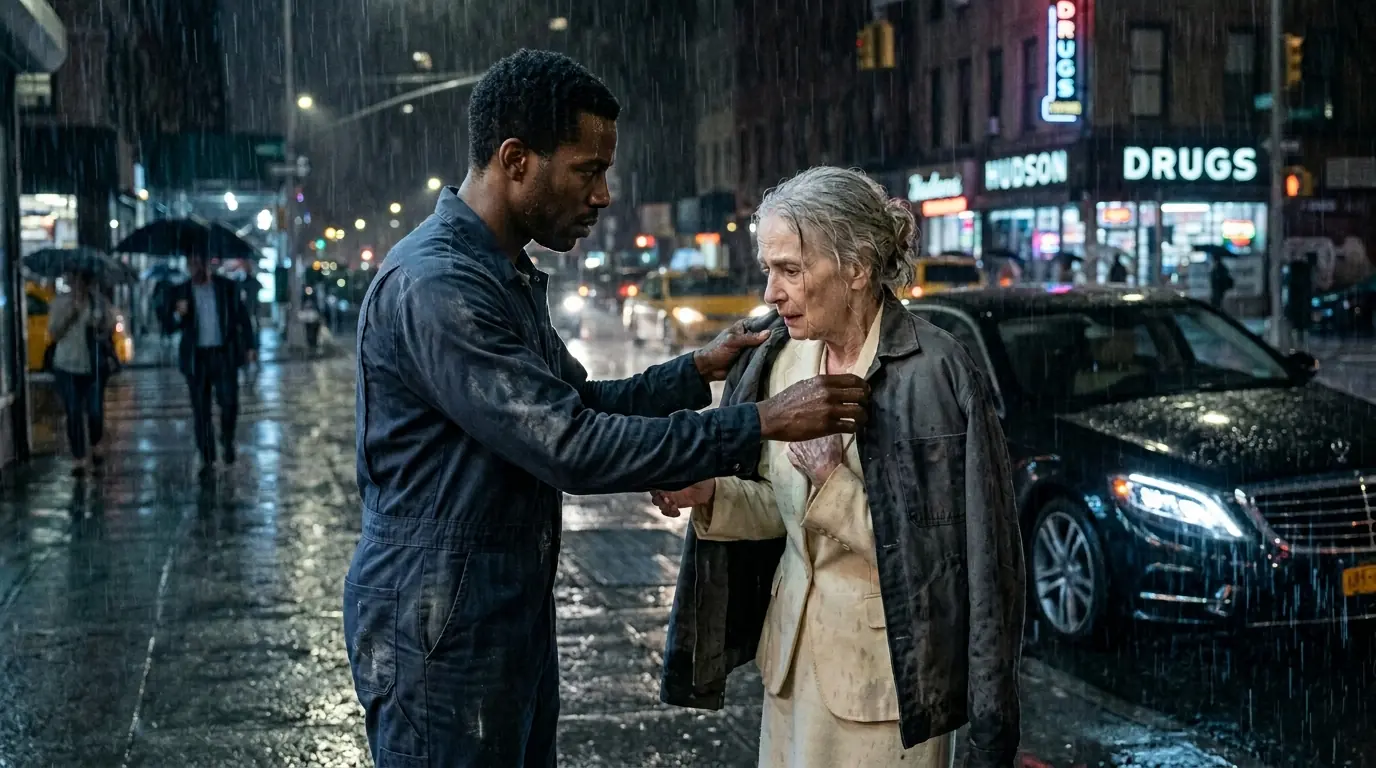
Thursday, 6:47 p.m. The warehouse shift had been brutal. Eight hours of lifting, hauling, stacking. Matthew’s shoulders ached. His back screamed with every movement, and his hands were covered in small cuts from the rough edges of cardboard boxes. The supervisor had pushed them hard, a big shipment that needed processing before tomorrow’s truck arrived.
When Matthew finally clocked out, the sky had turned an angry gray. He stepped outside and felt the first drops of rain hit his face. Within seconds, it became a downpour.
“Damn it,” he muttered, pulling his thin jacket tighter.
It wouldn’t do much good. The jacket was old, the waterproofing long gone, but it was all he had. The bus stop was three blocks away. Matthew started walking, head down, concrete dust from the warehouse mixing with rain to create a grimy paste on his clothes. Other workers scattered for cover, ducking into stores, huddling under awnings. But Matthew couldn’t wait it out. He had to get to the construction site by 8:00 p.m. Garcia paid cash, but only if you showed up on time.
He was halfway to the bus stop when he saw her.
An old woman stood on the corner of Fifth and Madison, completely exposed to the rain. She wore a cream-colored suit, Chanel though Matthew didn’t know designers. Her gray hair was styled in an elegant bun that was rapidly coming undone. She stood perfectly still, staring at something across the street with an expression Matthew couldn’t quite read. Anger. Grief. Both.
A luxury sedan was parked at the curb nearby, hazard lights blinking. A driver in uniform stood beside it holding an umbrella and trying to approach the woman.
“Mrs. Whitmore, please,” the driver called over the sound of rain. “You’ll catch pneumonia.”
The woman, Misses Whitmore apparently, waved him away sharply without looking at him. “Leave me alone, David.”
“Ma’am, I really must insist.”
“I said leave me alone.” Her voice cracked like a whip.
The driver stopped, clearly torn between obeying and protecting his employer.
Matthew should have kept walking. He was already late, already soaking wet, already exhausted. But he couldn’t. Something about the way she stood there, proud, stubborn, alone, reminded him of his mother, of the way Clara refused help even when she desperately needed it, of the dignity people clung to when it was all they had left.
Matthew changed direction, walking toward the woman. She was shivering now, her expensive suit plastered to her thin frame. Her makeup was running, mascara creating dark tracks down her pale cheeks. Up close, he could see she was probably in her early seventies, with the kind of refined features that came from a lifetime of good nutrition and excellent healthcare. Everything about her screamed money, old money, which made her presence on this corner, in this neighborhood, in this weather completely bizarre.
“Ma’am,” Matthew’s voice was gentle. “You okay?”
She didn’t turn. “I’m fine.”
“You’re standing in the rain.”
“Observant.”
Matthew almost smiled despite himself. “Your driver’s worried about you.”
“David worries too much.” Her voice was clipped, Boston accent clear even through the emotion. “I pay him to drive, not to worry.”
“Still.” Matthew glanced at the driver, who was watching nervously. “You’re getting soaked, and it’s cold.”
“I’m aware of the weather conditions, young man.”
This wasn’t going well.
Matthew tried a different approach. “My mom is about your age,” he said. “She’s stubborn, too. Won’t let anybody help her with nothing. But sometimes...” He paused, choosing his words carefully. “Sometimes being strong means knowing when to get out of the rain.”
Finally, she turned to look at him. Her eyes were red-rimmed, either from crying or cold or both. But they were sharp, intelligent, taking in every detail of his appearance. The dirty work uniform, the concrete dust, the cheap soaking jacket.
“Your mother sounds wise,” she said quietly.
“She is. And she’d kill me if she knew I walked past somebody standing in a storm without offering help.”
A ghost of a smile flickered across the woman’s face. “Would she now?”
“Yes, ma’am.”
They stood there for a moment, rain hammering down around them. Matthew’s phone buzzed in his pocket, probably Garcia asking where he was. He ignored it.
The woman’s shivering got worse. Her lips were starting to turn blue.
Matthew made a decision. He shrugged off his jacket. It was already soaked, already dirty, already smelled like sweat and warehouse dust. But it was thick, quilted on the inside, designed to keep out cold.
“Here,” he said, holding it out.
She stared at the jacket like he’d offered her a dead rat. “I can’t accept that. You’re freezing.”
“It’s filthy.”
“Yeah, I know. I’m sorry. It’s been a long day. But it’s warm, and it’s better than nothing.”
“I have a car right there with heat.”
“Then why aren’t you in it?”
The question hung between them. The woman’s face crumpled for just a second before she pulled herself together, jaw clenching with visible effort.
“Because I’m angry,” she said finally. “And I needed to be angry outside where I could breathe, where I didn’t have to pretend everything was fine.”
Matthew understood that. He understood it so completely it made his chest ache.
“That’s fair,” he said. “But you can be angry inside my jacket until you’re ready to be angry in that heated car. Deal?”
She looked at the jacket again, then at his face, then back at the jacket. “It really is quite dirty,” she said, but her voice had lost its edge.
“Yes, ma’am. Won’t argue with that.”
“And it smells like...”
“Like a man who’s been working since 6:00 a.m.”
“Yeah.”
Despite everything, she laughed. It was a short, surprised sound that seemed to catch her off guard.
“You’re very persistent.”
“I got that from my mama too.”
The woman reached out with a trembling hand and took the jacket. Matthew helped her drape it over her shoulders. It was comically large on her small frame, hanging nearly to her knees, but she stopped shivering.
“Thank you,” she said softly.
“You’re welcome, ma’am.”
“Beatrice.” She extended her hand formally. “Beatrice Whitmore.”
Matthew shook it. Her hand was ice-cold, small and delicate in his rough, calloused one.
“Matthew Vance.”
“Well, Mr. Vance, it seems I’m in your debt.”
“No debt, ma’am. Just...” He shrugged. “Just couldn’t walk away.”
Beatrice studied him for a long moment. “Where were you headed before you stopped?”
“Work. Another job. Down on 17th.”
“In this weather?”
“Bills don’t care about the weather.”
She nodded slowly, like that made perfect sense to her, which was strange because Matthew doubted this woman had worried about bills in her entire life.
“Let me give you a ride,” she said.
“Oh, no, ma’am. I couldn’t.”
“Mr. Vance.” Her voice regained some of its earlier authority. “You gave me your jacket. The least I can do is ensure you don’t catch pneumonia getting to your second job.”
“David,” she called to the driver without waiting for Matthew’s response. “We’re taking Mr. Vance to 17th Street.”
“Ma’am, I really appreciate it, but—”
“Are you refusing an old woman’s request?”
Matthew opened his mouth to argue, then closed it. He recognized that tone. It was the same one his mother used when she’d made up her mind.
“No, ma’am.”
“Good. Get in the car.”
The interior of the sedan was like entering a different world. Leather seats. Soft lighting. Warmth that felt like heaven after the cold rain. Matthew sat stiffly, trying not to get the seats dirty, but it was pointless. He was leaving wet marks everywhere.
“I’m sorry,” he said. “I’m messing up your car.”
“It’s a car, Mr. Vance. It can be cleaned.”
Beatrice settled into her seat with a sigh, pulling his jacket tighter around her shoulders. “Tell David where to go.”
Matthew gave the address, and the car pulled smoothly into traffic. For a few minutes, neither of them spoke. The only sounds were the rain on the roof and the quiet hum of the engine.
“You said you have two jobs,” Beatrice said finally.
“Yes, ma’am. Warehouse during the day, construction or security at night. Depends on what’s available.”
“That’s quite a schedule.”
“It’s necessary.”
“Because of your mother?”
Matthew tensed. “How’d you—”
“You mentioned her twice.”
“She’s sick.”
He didn’t want to talk about it. Didn’t want to explain his life to this stranger in her designer suit and luxury car. But something about Beatrice’s expression, genuinely curious, not pitying, made him answer.
“Heart problems. And her eyes. She needs surgery. Cataracts.”
“That’s treatable, if you can afford it.”
“Yeah.”
Beatrice looked out the window. “So you work yourself to exhaustion to pay for her care.”
It wasn’t a question.
“She raised me alone after my dad died,” Matthew said quietly. “Worked three jobs so I could stay in school. Never complained. Never asked for anything. Now it’s my turn.”
“You have siblings?”
“No, ma’am. Just me.”
“And your mother’s husband? Your father?”
“Died when I was seventeen. Heart attack. He was working construction, pushing himself too hard because we needed the money.” Matthew’s jaw clenched. “I’m not going to let that happen to my mama. I’m not going to let her suffer because I can’t come up with enough money.”
Beatrice was quiet for a long moment.
“I had a son,” she said finally. “Michael. He was an architect.”
Was. Past tense.
“I’m sorry,” Matthew said.
“He died two years ago. Car accident. Drunk driver ran a red light.” Her voice was steady, but Matthew could hear the pain underneath. “He was brilliant. Talented. He designed buildings that made people stop and stare. He was going to change skylines, leave a legacy.”
“I’m sure he did, ma’am, even if he didn’t finish everything he wanted.”
Beatrice looked at him sharply. “You sound like you understand.”
Matthew hesitated. He didn’t usually talk about this. But something about this strange moment, sitting in a luxury car with a grieving stranger, both of them soaked and exhausted, made him honest.
“I was studying architecture,” he admitted, “before I dropped out.”
“Why did you drop out?”
“My dad died. No insurance, lot of debt. My mama couldn’t work three jobs forever, so I got a job, helped pay bills, never went back.”
“Do you regret it?”
“Every day.”
The words came out before Matthew could stop them.
“But I’d do it again. Because she’s my mother, and she deserves to be taken care of.”
Beatrice reached over and patted his hand. Her touch was gentle, almost motherly.
“My son would have liked you,” she said softly.
The car slowed, pulling up to the construction site. Matthew could see Garcia waiting under a tarp, checking his watch.
“This is me,” Matthew said, reaching for the door handle. “Thank you for the ride, ma’am. And I hope... I hope you feel better. Whatever made you angry.”
“Mr. Vance, wait.”
Beatrice held up a hand. “My jacket. You’ll need it.”
“Keep it. You need it more than I do right now.”
“I can’t.”
“Please.” Matthew smiled. “It’s warm. And maybe when you’re angry inside that heated house of yours, you can remember that sometimes the best thing to do is ask for help, even from strangers with dirty jackets.”
Before she could argue, he opened the door and stepped back into the rain.
Thursday, 7:15 p.m.
Actually, Matthew hadn’t gotten in that car. That was how it could have gone, how it should have gone if Beatrice Whitmore was the type of woman who let things happen easily. But she wasn’t.
What really happened was this.
When Matthew offered the jacket, Beatrice took it with trembling hands. But then David, the driver, made a crucial mistake. He stepped forward again with the umbrella.
“Mrs. Whitmore, we really must get you home.”
“I told you to leave me alone.”
The sharpness in her voice made David freeze. Then, quieter, laced with something broken, she said, “I’m not ready to go home.”
The driver looked helplessly at Matthew, as if this stranger could somehow fix what months of employment hadn’t taught him, that Beatrice Whitmore, when grieving, could not be reasoned with.
“Ma’am,” Matthew said carefully, “it’s getting worse.”
The rain was indeed intensifying, wind picking up.
“At least let him drive you somewhere warm.”
“I want to walk in this storm.”
“Yes?” She looked at Matthew with red eyes. “My house is twelve blocks away. I want to walk those twelve blocks and feel something other than...” She trailed off, jaw working. “Other than nothing.”
Matthew understood nothing.
Nothing was worse than pain, sometimes. Nothing meant you’d cried so much you’d run dry. Nothing meant you were exhausted from pretending.
“Then I’ll walk with you,” he heard himself say.
Garcia was going to be furious. Matthew was now officially twenty minutes late. That probably meant no cash tonight, which meant no money for his mother’s medication refill tomorrow. But looking at this woman, this stranger who reminded him so much of his own mother’s stubborn pride, he couldn’t leave her alone.
“You have work,” Beatrice said.
“I got time.”
“You said you couldn’t be late.”
“I lied.” Matthew managed a small smile. “Well, not lied. But sometimes people are more important than schedules.”
Beatrice studied him for a long moment. Then she nodded.
“David,” she said to her driver, “go home. I’ll call when I need you.”
“Ma’am, I can’t possibly—”
“That’s an order.”
The driver looked agonized, but didn’t argue further. He got in the sedan and drove away slowly, clearly reluctant.
Then it was just Matthew and Beatrice on a street corner in the rain.
“Twelve blocks is a long walk in heels,” Matthew observed, looking at her expensive shoes.
“I’m aware.”
“Just saying. If you need to—”
“I’ll manage.”
But on the very next step, her heel caught a crack in the sidewalk, and she stumbled. Matthew’s hand shot out, steadying her by the elbow.
“Ma’am,” he said gently, “there’s no shame in accepting help here.”
He extended his arm formally, like a gentleman from an old movie. “Hold on.”
After a moment’s hesitation, Beatrice slipped her small hand through the crook of his elbow.
They walked.
For the first block, neither spoke. Rain pelted them from every direction. Matthew’s uniform was soaked through, water squishing in his work boots with every step. Beatrice still had his jacket, but her hair was plastered to her head, mascara running freely now. She didn’t seem to care.
“Why are you really doing this?” she asked as they turned onto Sixth Avenue. “You don’t know me. You’re missing work. You’re getting drenched.”
Matthew thought about it. “You ever feel like the universe puts someone in your path for a reason?”
“I don’t believe in the universe having plans.”
“Then maybe it’s just luck. Bad luck that you’re in a storm. Good luck that someone walked by who couldn’t leave you there.”
“Because I remind you of your mother.”
“Yes, ma’am.”
“Stop calling me ma’am. It makes me feel ancient.”
“What should I call you?”
“Beatrice.”
“Okay, Beatrice.” He liked the way it sounded. Formal but friendly. “You want to tell me why you’re really out here? You mentioned being angry.”
She was quiet for so long, Matthew thought she wouldn’t answer. They passed a bodega where the owner was pulling down metal shutters, trying to protect his windows from the storm. A couple ran past laughing and soaked like the rain was an adventure instead of a misery.
Finally, Beatrice spoke.
“Today is my son’s birthday. Would have been his forty-third.”
Matthew’s chest tightened. “I’m sorry.”
“David took me to the cemetery. I put flowers on his grave. White roses, his favorite. I stood there for an hour trying to feel something, anything. But there was nothing.” Her voice cracked slightly. “Two years, and I still can’t accept that he’s gone. That I’ll never hear his voice again. Never get another phone call with him excitedly explaining his latest design. Never.”
She stopped walking, pressing a hand to her mouth. Matthew stopped too, not pushing, just waiting.
When she continued, her voice was steadier but hollow.
“I came home to that massive empty house. All those rooms he’ll never fill. All those holidays with one less person at the table. And I just... I couldn’t go inside. I stood outside my own home like a fool, getting soaked. And all I could think was that I’d give every dollar I have to hear him laugh one more time.”
“Must have been a good son,” Matthew said quietly.
“The best.”
Beatrice looked up at him. “Do you have children, Matthew?”
“A daughter. Zoe. She’s six.”
“Then you understand. You’d do anything for her.”
“Yes, ma’am. Beatrice. Anything.”
They started walking again. The next few blocks passed in silence, but it was a different kind of silence now. Companionable. Two people who understood loss in different ways.
“Tell me about your mother,” Beatrice said. “What’s her name?”
“Clara. Clara Vance.”
“And she needs surgery for cataracts.”
“Yeah. Without it, she’ll go completely blind in the next year. She’s already mostly there. Can’t see faces clearly anymore. Can’t read. Can’t watch her TV shows she loves.” Matthew’s throat tightened. “She keeps apologizing like it’s her fault she’s sick, like she’s a burden. But she’s not. Hell no. Sorry. I mean, no.”
Beatrice.
He shook his head. “She gave me everything. Every opportunity, every chance. When Dad died, she could have given up, could have let me drop out of school to work full-time, but she worked triple shifts instead. She came home so tired she could barely stand, but she’d still sit with me while I did homework, still made sure I had clean clothes and hot meals.”
His voice broke. He cleared his throat hard.
“She’s the strongest person I know,” he finished. “And now she can’t even feed herself without shaking so bad the spoon falls. And I can’t fix it fast enough.”
Beatrice squeezed his arm gently. “How much do you need for the surgery?”
“Four hundred by Monday. After that, it’s a three-month wait for the next available slot. And I don’t think she has three months. Her heart’s getting worse. The doctor says stress from not being able to see is making it deteriorate faster.”
“And you’re working two jobs to raise four hundred.”
“Working three when I can get it. But rent’s due, utilities, her medications, my daughter’s daycare, groceries. It all adds up faster than I can make it.”
“What about the father of your child? Does he help?”
“She.” Matthew gave a tired half-smile. “Zoe’s mom, Chenise. We’re not together, but she’s a good mom. She helps when she can, but she’s in the same boat as me. Two jobs, barely making it.”
They’d reached a nicer neighborhood now. The buildings were taller, better maintained. Trees lined the street instead of broken concrete. Even the rain looked prettier here somehow, catching light from elegant street lamps instead of harsh fluorescent bulbs. Beatrice’s heels clicked differently on the cleaner sidewalk.
“You said you studied architecture,” she said.
“For two and a half years. University of Illinois. Had a scholarship and everything.”
“Were you good at it?”
Matthew felt his face warm. “My professors thought so. I got an internship offer from a firm in Chicago for after graduation. But then Dad died, and...” He shrugged. “Doesn’t matter now.”
“Of course it matters. You had dreams.”
“Dreams don’t pay bills.”
“No,” Beatrice agreed. “But they make life worth living.”
“My son used to say that architecture wasn’t just about buildings. It was about creating spaces where people could dream.”
“He sounds like he was really talented.”
“He was. He designed a community center on the South Side that won awards. He was working on an arts complex when he died. Plans were finished, permits approved, funding secured. It’s been sitting in limbo ever since because I can’t bring myself to move forward without him.”
They turned onto a street where the houses weren’t just houses. They were estates. Sprawling lawns, iron gates, circular driveways. Matthew had never been in this part of the city before. Couldn’t afford to even window-shop here.
“Is that your project?” he asked. “The one that made you angry today?”
“Part of it. The board wants to cancel it. They say it’s not financially viable without Michael’s vision to guide it. They’re probably right. But the thought of abandoning his last dream...” She took a shaky breath. “I stood in his office today looking at all his sketches and models, and I got so angry. At the board. At the drunk driver. At God. At Michael for leaving me. At myself for not being strong enough to finish what he started.”
“You are strong enough.”
“How could you possibly know that? You met me twenty minutes ago, standing in the rain like a madwoman.”
“Because you’re still standing. Because you walked twelve blocks in a storm rather than give up. Because you’re talking about your son even though it clearly hurts like hell.” Matthew stopped walking and turned to face her. “Strong people don’t stop grieving, Beatrice. They just keep moving even while they’re broken.”
Beatrice’s face crumpled, tears mixed with rain on her cheeks. “He would have been forty-three today,” she whispered. “I baked a cake. I lit candles. I sang happy birthday to an empty chair. Does that sound strong to you?”
“Yes,” Matthew said simply. “That sounds like a mother who loves her son. Nothing stronger than that.”
They’d reached the final block. At the end stood a mansion that looked like something from a movie. Three stories, white columns, perfectly manicured hedges visible even in the dark and rain. Lights glowed in tall windows.
Matthew whistled low. “That’s your house.”
“Unfortunately.”
“Why unfortunately? It’s beautiful.”
“It’s empty.” Beatrice’s voice was flat. “Twelve thousand square feet of empty rooms and memories. I rattle around in there like a ghost haunting my own life.”
They approached the front steps, wide marble stairs leading to double doors that probably cost more than Matthew made in five years. Beatrice released his arm and turned to face him. Her makeup was completely ruined now, hair hanging in wet strands. The expensive suit was plastered to her thin frame. But her eyes, those sharp, intelligent eyes, were clearer than they’d been when he first saw her.
“Thank you,” she said, “for walking with me, for listening, for not treating me like I’m crazy.”
“You’re not crazy. You’re hurting. That’s different.”
Beatrice looked down at the jacket still around her shoulders, his dirty, wet work jacket. She started to take it off.
“Keep it,” Matthew said. “At least until you get inside and warm up.”
“I can’t keep your jacket. You’ll freeze.”
“I got another one at home.”
A lie. This was his only jacket, but he’d manage.
“Matthew, please let me do this one thing.”
She studied his face, and Matthew got the sense she was really seeing him now. Not just a stranger who’d helped her, but a person. Someone struggling just like she was, just in different ways.
“Can I at least...”
Beatrice reached for her purse, a designer bag that had somehow survived the rain. She pulled out a wallet.
Matthew stepped back immediately. “No, ma’am.”
“Please, let me give you something. For your time. For the jacket.”
“No.” His voice was firm. “I didn’t help you for money.”
“I know that, but you said you need four hundred, and—”
“I’ll get it by working. By earning it.” Matthew’s jaw set stubbornly. “If I took your money right now, I’d feel like I sold you my kindness. And kindness ain’t for sale.”
Beatrice’s eyes widened slightly. “Even when you desperately need it?”
“Especially then.” Matthew thought of his mother, of the lesson she taught him about dignity and self-respect. “My mama raised me better than that. I helped you because it was the right thing to do, because you needed help and I was there. Taking money for it would make it transactional, and that’s not what this was.”
“Most people would take the money.”
“Maybe. But I’m not most people.” He smiled tiredly. “I’m just a guy who couldn’t walk past someone in pain. That’s all.”
Beatrice looked like she might cry again. Instead, she did something unexpected. She hugged him.
It was brief, awkward. This tiny elderly white woman in designer clothes hugging a large black man in a filthy work uniform. They were both soaking wet, both exhausted. To anyone watching, it probably looked bizarre. But Matthew hugged her back gently, carefully, the way he’d hug his own mother.
When she pulled away, Beatrice reached into her purse again. This time, she pulled out a business card.
“At least take this,” she said, pressing it into his hand. “In case you ever need anything. A reference for a job, a contact, anything.”
Matthew looked at the card. Heavy card stock. Embossed lettering.
Beatrice Whitmore, CEO, Whitmore Enterprises.
There was a phone number and an address for an office building downtown.
“You’re a CEO?” Matthew asked, surprised.
“Unfortunately.” But she smiled slightly. “My husband started the company. When he died, I took over. When Michael died, I became the sole board member, majority shareholder, and very tired old woman who doesn’t know when to retire.”
“What does the company do?”
“Real estate development. Mostly commercial buildings, mixed-use spaces, some residential. We’re one of the larger firms in the state.” She paused. “That arts complex I mentioned, that’s a Whitmore project.”
Matthew handed the card back. “I can’t take this.”
“Why not?”
“Because I don’t want you to think I helped you to network or get something from you later. I just wanted to make sure you got home safe.”
“Matthew Vance, you are possibly the most stubborn man I’ve ever met.”
“I learned from the best.” He grinned. “My mama.”
Beatrice laughed. Really laughed this time. It sounded rusty, like she hadn’t done it in a while, but genuine.
“Keep the card anyway,” she said, closing his fingers around it. “Not as payment. As friendship. Is that acceptable?”
Matthew hesitated, then nodded. “Yeah. That’s acceptable.”
“Good.”
Beatrice walked to her front door, then turned back. “Your mother is very lucky to have you.”
“I’m lucky to have her.”
“And Matthew, that dream of becoming an architect... don’t give up on it completely. The world needs more people who design spaces where others can dream.”
Before he could respond, she slipped inside the massive door, closing it softly behind her.
Matthew stood there for a moment in the rain, holding a business card worth more than his entire net worth. Then he tucked it carefully into his wallet, not because he’d ever use it, but because tonight had been strange and sad and somehow beautiful, and he wanted to remember it.
His phone buzzed. A text from Garcia.
You’re fired. Don’t bother showing up.
Matthew sighed. There went tonight’s money.
He started the long walk home, already calculating how many extra hours he’d need to make up for the lost income. The rain had eased to a drizzle, and the streets were mostly empty. But somehow, despite everything, Matthew felt a little less alone.
Friday, 8:52 a.m., back in the present moment, Matthew stood in his apartment hallway staring at the contents of the envelope.
A check.
Ten thousand dollars, made out to Clara Vance, and a handwritten note on expensive stationery.
For the eyes of a mother who raised a true gentleman, with deep gratitude and respect.
BW
Matthew’s hand started shaking. His vision blurred.
Ten thousand dollars. Not four hundred, not barely enough. Ten thousand.
His mother could get her surgery. He could pay off the nursing home deposit, catch up on Zoe’s daycare, fix the car that had been sitting broken in the lot for three months, buy groceries without calculating every dollar, sleep without waking up panicked about which bill to pay first.
Ten thousand dollars.
“Mr. Vance?”
The woman in the pantsuit, she’d said her name was Sarah Chen, executive assistant to Mrs. Whitmore, was watching him carefully. “Are you all right?”
Matthew couldn’t speak. His throat had closed up completely. He just stood there holding the check, trying not to break down in front of these strangers.
“Baby?” his mother’s voice called from the bedroom. “Baby, who’s there? Why are you still home?”
Matthew quickly wiped his eyes and walked back into the apartment. His mother was trying to wheel herself toward the door, her hands weak on the chair’s wheels.
“Mama, no, don’t.” He rushed over, pushing her chair back toward the bedroom. “It’s okay. Everything’s okay.”
“Why are there so many people? I heard voices. Are you in trouble?”
“No, mama. I’m not in trouble.”
Matthew knelt beside her wheelchair, taking her frail hands in his. “Mama, do you remember I told you about helping an old lady yesterday, walking her home in the rain?”
Clara’s cloudy eyes tried to focus on his face. “The rich lady with the sad story?”
“Yeah. That one.” Matthew’s voice cracked. “Mama, she... she just sent someone here to thank me.”
“Thank you, baby? What do you mean?”
Matthew held up the check so she could see it, even though he knew her vision was too poor to read the numbers.
“She sent money, mama. For your surgery. For your eyes.”
Clara went very still. “How much money?”
“Ten thousand.”
His mother gasped. Her hands flew to her mouth, trembling violently. “Ten thousand, Matthew? That’s not possible. People don’t just give away that kind of money.”
“She did.” Matthew was crying now, not even trying to hide it. “She wrote a note. Said it’s for the mother who raised a gentleman. Mama, she’s paying for your surgery. All of it, and then some.”
Clara started sobbing, deep, painful sobs that shook her whole body. Matthew moved from his knees to sit on the edge of her bed, pulling her into his arms. She felt so small, so fragile, but her grip on his shirt was fierce.
“Thank you, Jesus,” she kept whispering. “Thank you. Thank you. Thank you.”
Sarah Chen appeared in the doorway, her expression soft. “Mrs. Vance, I’m Sarah Chen. I work for Mrs. Whitmore. May I come in?”
Clara pulled back from Matthew, trying to compose herself, wiping uselessly at her tears. “Yes, of course. I’m sorry. I’m just—”
“Don’t apologize, ma’am.”
Sarah entered the room, her expensive heels clicking softly on the worn floor. Despite the luxury of her appearance, there was genuine warmth in her eyes.
“Mrs. Whitmore wanted me to tell you something personally.” She pulled out her phone and read from a message. “Please tell Clara Vance that her son restored my faith in humanity at a moment when I had none left. Tell her that she did a remarkable job raising him. Tell her that the world needs more Matthews, and we’re all grateful she gave us one.”
Clara’s tears started fresh. “Tell her... tell her I don’t know what to say.”
“Tell her she knows,” Sarah said gently. “But there’s more.”
Matthew looked up sharply. “More?”
Sarah nodded to someone in the hallway. Another person entered, a professional-looking woman in scrubs carrying a medical bag.
“This is Elena Rodriguez,” Sarah explained. “She’s a registered nurse. Starting today, she’ll be visiting daily to help care for Mrs. Vance. Medical care, basic needs, monitoring her condition. All covered by Mrs. Whitmore.”
“Wait, what?” Matthew stood up. “No. No, that’s too much. The money for the surgery is already—”
“Mrs. Whitmore was very clear,” Sarah interrupted firmly. “She doesn’t want you to worry about your mother’s care. She wants you free to focus on other things.”
“What other things?”
Sarah smiled. “We’ll get to that. But first, Mrs. Vance, the nurse will stay with you this morning while we speak with your son. Is that acceptable?”
Clara looked overwhelmed, but nodded. “Yes. Yes, of course.”
Elena immediately moved to Clara’s side, her manner professional but kind. “Hello, Mrs. Vance. Why don’t we start by checking your vitals and making sure you’re comfortable?”
Matthew watched the interaction, his mind reeling. This was too much. Way too much. He’d walked an old lady home in the rain. That was it. That was all he’d done.
“Mr. Vance,” Sarah said, “can we speak in the other room?”
Matthew followed her numbly to the living room. The security team had left, replaced by just Sarah and one guard who stood respectfully by the door.
“I need to give this back,” Matthew said immediately, holding out the check. “I can’t accept it.”
“Mrs. Whitmore anticipated you’d say that.”
“Then she knows I can’t take this much money. It’s not right.”
“Why not?”
“Because I didn’t earn it. I walked her twelve blocks. That’s all I did. That’s not worth ten thousand dollars.”
Sarah tilted her head, studying him. “Mrs. Whitmore disagrees. She says you gave her something she hasn’t felt in two years. Hope. How much is hope worth, Mr. Vance?”
“That’s not... I mean, I can’t...” Matthew ran a hand over his face, frustrated. “Look, I appreciate what she’s trying to do, but I helped her because it was right, not because I wanted money. If I take this, it makes everything transactional.”
“It makes you a man who accepted help when he needed it,” Sarah suggested gently. “There’s no shame in that.”
“There is when I take advantage of someone’s grief.”
“You’re not taking advantage of anything. Mrs. Whitmore is an extremely intelligent businesswoman. Trust me, she doesn’t part with money unless she wants to. And she wants to help you.”
Sarah paused. “But if the money really bothers you that much, think of it as helping your mother. Clara deserves this surgery, doesn’t she?”
That hit hard. Matthew’s resistance wavered. “Of course she does.”
“Then let someone help her. Let Mrs. Whitmore honor your kindness by taking care of the woman who taught you to be kind.”
Matthew looked at the check again. His mother’s name in elegant script. Ten thousand dollars that could change everything. But it felt wrong. It felt like he was selling something that shouldn’t have a price.
“I need to think about it,” he said finally.
“That’s fair.” Sarah pulled out a folder from her bag. “While you think, Mrs. Whitmore asked me to discuss something else with you.”
“What else could there possibly be?”
Sarah opened the folder and pulled out several documents. Architectural drawings, detailed, professional, beautiful.
“Do you recognize these?” she asked.
Matthew leaned closer. There were plans for a building, a modern structure with clean lines, lots of glass, open spaces. It was gorgeous. Exactly the kind of design he used to dream about.
“No,” he said. “What is it?”
“The Michael Whitmore Arts and Community Center. Mrs. Whitmore’s son was designing it when he died. The project has been stalled for two years because no one could quite capture his vision to complete it.”
Matthew traced his fingers over the drawings, professional hunger stirring despite his confusion. “It’s beautiful. Whoever finishes it is going to do something amazing.”
“Mrs. Whitmore wants that person to be you.”
Matthew’s head snapped up. “What?”
“She looked into your background last night. Found out you were two and a half years into an architecture degree before you had to leave. Found out you had a 3.8 GPA and multiple professors who wrote glowing recommendations.” Sarah pulled out more papers. “She’s offering you a position as project coordinator for the arts center. You’d work directly with the lead architect, oversee construction, contribute to final design decisions. Full salary, benefits, and—”
“Stop.” Matthew held up his hand. “Just stop. This is insane.”
“Is it?”
“I have the education? I have two and a half years of an incomplete degree from over a decade ago. I’m not qualified to coordinate a major construction project.”
“Mrs. Whitmore believes you are. And honestly, your practical experience might be more valuable than another degree. You’ve worked construction, warehouse, security. You understand how buildings actually function from the ground up. That’s rare in architects fresh out of school.”
Matthew shook his head, backing away. “No. No, I can’t. This is... She’s trying to pay me back for helping her, and it’s too much. Way too much.”
“She’s trying to give you an opportunity. There’s a difference.”
“An opportunity I didn’t earn.”
“You earned it by being a decent human being when most people would have walked past her.” Sarah’s voice was firm now. “You earned it by having the skills and knowledge. You earned it by caring about your mother enough to sacrifice your own dreams. Matthew, you’ve been earning this for fifteen years. You just didn’t know it.”
It was too much. All of it. The money, the job offer, the nurse for his mother. The hope that maybe, just maybe, his life could be something other than endless work and worry.
“I need air,” Matthew said, moving toward the door. “I need to think.”
He didn’t mean to shout, but the walls were closing in. “Please. Just give me some time.”
Sarah nodded slowly. “The offer stands. Take all the time you need. Here’s my card. Call me when you’re ready to talk.”
Matthew took the card, another expensive piece of card stock joining Beatrice’s in his wallet, and practically fled the apartment.
He made it three blocks before he had to stop, leaning against a building, trying to breathe.
His phone rang. Garcia.
“Yeah,” Matthew answered.
“You coming in today or what? I got another guy lined up, but he’s not as good as you.”
“I thought I was fired.”
“Yeah, well, I was pissed. You still want the work?”
Matthew almost laughed. Twelve hours ago, losing this job would have been devastating. Now he was supposedly being offered a position at a major development company, a salary with benefits, a chance to finish what he’d started all those years ago. It felt like a dream. Or a trap. Or both.
“Can I let you know this afternoon?” Matthew asked.
“Fine, but I need an answer by three.”
“You’ll have it.”
Matthew hung up and started walking. No destination, just movement. His mind spun in circles, trying to process everything. Ten thousand dollars. A job. A chance to be an architect again. All because he’d walked an old lady home in the rain.
His phone buzzed. A text from an unknown number.
Mr. Vance, this is Beatrice Whitmore. I apologize for the overwhelming morning. I tend to be efficient to a fault. I’m having lunch at Marello’s at 1:00 p.m. Would you join me? I’d like to explain properly. No pressure, just conversation.
BW
Matthew stared at the message.
He should say no. Should give back the money, decline the job, go back to his normal life where things made sense. But normal meant working himself to death. Normal meant watching his mother slowly go blind. Normal meant giving up on every dream he’d ever had.
Maybe it was time to stop being normal.
He typed a response. I’ll be there.
Friday, 1:00 p.m. Marello’s restaurant.
Matthew had never been to a place like this. The hostess had looked him up and down when he arrived, still in his work uniform, still smelling like warehouse dust, with barely concealed disdain. But when he’d mentioned Beatrice Whitmore’s name, her expression had transformed instantly into professional warmth.
“Of course, Mr. Vance. Right this way.”
The restaurant was all white tablecloths, crystal glasses, and soft classical music. Other diners wore suits and designer dresses. Matthew felt like he’d walked onto a movie set where he definitely didn’t belong.
Beatrice sat at a corner table, wearing a different expensive suit, navy blue this time, and reading something on a tablet. When she looked up and saw him, her face broke into a genuine smile.
“Matthew. Thank you for coming.”
“I almost didn’t,” he admitted, sitting down carefully. The chair probably cost more than his rent.
“I wouldn’t have blamed you. I came on rather strong this morning.” She set the tablet aside. “How is your mother?”
“Still crying. Happy crying, but still.” Matthew’s throat tightened. “She can’t believe someone would do all this for her.”
“Then we have something in common. I couldn’t believe someone would give a stranger their only jacket in a rainstorm.”
Beatrice folded her hands on the table. “Matthew, I need you to understand something. What I’m offering isn’t charity. It’s not even repayment. It’s recognition.”
“Of what?”
“Of potential being wasted. Of talent going unrecognized. Of a good man being ground down by a system that doesn’t value goodness.”
A waiter appeared, poured water, took their orders. Matthew ordered the cheapest thing on the menu, still twenty-eight dollars for a sandwich. Beatrice ordered absently, clearly not caring about the food.
When the waiter left, she continued.
“My son Michael was a lot like you,” she said quietly. “Brilliant. Kind. Always putting others first. He volunteered at community centers, designed low-income housing pro bono, used his privilege to lift others up. When he died, I was devastated. But I was also angry. Angry that the world lost someone so rare while drunk drivers and corrupt businessmen kept thriving.”
“I’m sorry,” Matthew said.
“Don’t be sorry. Let me finish.” Beatrice’s eyes were intense. “Last night, standing in that rain, I was ready to give up. On the arts center, on Michael’s legacy, on everything. I thought maybe the universe was telling me to let go. Then you appeared, a stranger with no reason to help me. No expectation of reward. Just simple human decency. And you reminded me that Michael’s kind of goodness still exists in the world.”
“I’m not—”
“Let me finish,” she repeated firmly.
“When I got home, I looked you up. I have resources, Matthew. I found your college records, your employment history, interviews with your former professors. Did you know Professor Chen from the University of Illinois still has your final project on display in his office?”
Matthew blinked. “He does?”
“He called you one of the most naturally talented students he’d ever taught. Said you had an intuitive understanding of space and form that can’t be taught.”
Beatrice leaned forward. “You had a future, Matthew. A real future. And you gave it up to take care of your mother. That’s not weakness. That’s strength. But it’s also a tragedy.”
“It’s not a tragedy. It’s life.”
“It doesn’t have to be.”
Their food arrived, but neither of them touched it.
“The arts center needs someone who understands what Michael was trying to create. Spaces that serve communities, that uplift people, that make beauty accessible to everyone, not just the wealthy. I’ve interviewed a dozen architects. They’re all technically qualified, but they don’t understand the heart of it.”
“And you think I do.”
“I know you do, because you’re living it. You understand what it means to struggle, to sacrifice, to keep fighting even when the odds are impossible.”
Beatrice pulled out her tablet and showed him more drawings. “Look at these. These are Michael’s preliminary sketches for the community wing. What do you see?”
Matthew studied them. Open floor plans, natural light, flexible spaces that could serve multiple purposes. “He was thinking about families. About kids who need safe places to play. About adults who need spaces for classes or meetings. It’s not just beautiful. It’s functional.”
“Exactly.” Beatrice’s voice filled with emotion. “You got it immediately. The last architect I showed these to said the community wing was wasted square footage that should be converted to luxury condos.”
Matthew felt anger flare. “That completely misses the point.”
“Yes, it does. But you didn’t, because you’re the kind of person this building is meant to serve.”
She pulled up another document. “This is the formal job offer. Project coordinator for the Michael Whitmore Arts and Community Center. Salary is eighty-five thousand annually, full benefits, education stipend if you want to complete your degree, and the opportunity to actually use your training.”
Eighty-five thousand.
Matthew’s warehouse job paid thirty-two. His night security job paid maybe another fifteen if he was lucky.
“That’s... that’s more than twice what I make now.”
“It’s market rate for the position. Actually slightly below, but we can negotiate.”
“Beatrice, I can’t.”
“Before you say no, let me tell you what happens if you decline.” Her voice was matter-of-fact. “The board will vote to cancel the project next month. Michael’s vision dies. The community that would have benefited loses out. And I’ll probably sell the company and retire, because I won’t have the heart to keep fighting.”
That wasn’t fair. “You’re putting this on me.”
“I’m being honest with you. This project needs someone who cares. Someone who will fight for Michael’s vision. I’m too old and too tired. But you...” She gestured at him. “You’re young enough to see it through, skilled enough to do it right, and kind enough to care about the people it’ll serve.”
Matthew rubbed his face. “What if I fail? What if I’m not good enough? It’s been over ten years since I was in school.”
“Then you’ll learn. We’ll get you mentors, additional training, whatever you need. But I don’t think you’ll fail, Matthew. I think you’ll exceed every expectation.”
The certainty in her voice was terrifying and thrilling in equal measure.
“Can I think about it?” he asked. “Not long, just a day or two. This is my whole life changing.”
“Of course. Take all the time you need.” Beatrice finally picked up her fork. “But the check for your mother’s surgery? That’s not contingent on anything. Whether you take the job or not, whether we ever speak again or not, that money is hers. Please don’t feel obligated.”
“That makes it harder, not easier.”
“Good. Because charity should make you uncomfortable. It means you have dignity. I’m not trying to strip you of that. I’m trying to honor it.”
They ate in silence for a few minutes. The food was incredible, probably the best sandwich Matthew had ever had, but he barely tasted it.
“My mama always told me,” he said finally, “that when someone shows you kindness, the best way to pay them back is to pass it on. To be kind to the next person. To keep the cycle going.”
“Wise woman.”
“Yeah.” Matthew set down his fork. “If I take this job, and I’m not saying I am, but if I do, I want something in writing.”
“What’s that?”
“That the community wing stays exactly as Michael designed it. That it’s free or affordable for local families. That this project actually helps people, not just your company’s bottom line.”
Beatrice’s smile was the warmest he’d seen from her. “Done. I’ll have it added to your contract.”
“You don’t even know if I’m saying yes yet.”
“Don’t I?”
Matthew met her eyes. This woman, this grieving, lonely, incredibly wealthy woman, was offering him a chance at a different life. A chance to be more than a body that lifted and carried and broke itself down for minimum wage. A chance to dream again.
“I need to talk to my mother first,” he said.
“Of course.”
“And I need to know, really know, that you’re not doing this out of guilt or grief or some misplaced sense of obligation.”
“I’m doing it because I’m a pragmatist,” Beatrice said simply. “And pragmatically speaking, you’re the best person for this job. Everything else, the gratitude, the sentiment, that’s just the bonus that helped me see what was already true.”
Matthew nodded slowly. “Okay. Okay. I’ll think about it. Seriously think about it.”
“That’s all I ask.”
Beatrice raised her water glass. “To new possibilities.”
Matthew clinked his glass against hers, the crystal ringing softly. “To new possibilities.”
Two years later. Friday, 11:00 a.m. The Michael Whitmore Arts and Community Center stood on the corner of Fifth and Madison, glass and steel gleaming in autumn sunlight. Matthew stood across the street, staring at it like he had every morning for the past six months since construction finished. He still couldn’t believe it was real.
“Stop gawking and get inside. Your speech starts in an hour.”
Beatrice’s voice came from beside him.
“I know. I know.” But Matthew didn’t move. “I just... I built that.”
“We built that,” Beatrice corrected gently. “You, me, the construction team, the community members who gave input. But yes, you were the vision behind getting it done.”
The building was beautiful. Three stories of flowing space and natural light, exactly as Michael had dreamed. The ground floor held the community wing, free classrooms, a library, a café run by local vendors. The second floor housed art studios and performance spaces. The third floor was administrative offices.
But it was the details that made Matthew proudest. The wheelchair ramps that didn’t look like afterthoughts. The sensory-friendly quiet room for kids with autism. The rooftop garden maintained by neighborhood volunteers. The sliding fee scale that meant everyone could access programs regardless of income.
This wasn’t just a building. It was a promise kept.
“Matthew!”
Someone called from across the street. Elena Rodriguez, the nurse who’d been taking care of his mother, waved enthusiastically. “We’re here!”
Matthew’s face split into a huge grin.
His mother, Clara Vance, walked carefully beside Elena. Walked, not wheeled. Her surgery two years ago had been successful, her vision restored. Physical therapy had strengthened her enough that she only needed the wheelchair on bad days. But what made Matthew’s throat tight was that she could see. See his face clearly. See the building he’d helped create. See everything she’d thought she’d lost.
“Baby,” Clara called, crossing the street with Elena’s supportive arm. “We’re not late, are we?”
“You’re early, mama.” Matthew swept her into a careful hug. At seventy-five, she was still fragile, but so much stronger than two years ago. “How you feeling?”
“Proud.” Her eyes, clear now, bright and sharp, scanned his face. “So proud I could burst. Look at you in that suit.”
Matthew glanced down at himself. The navy suit had been Beatrice’s gift when he’d officially completed his architecture degree six months ago. Night classes, online courses, mentorship from the firm’s senior architects. It had taken two years of grinding, but he’d finished what he’d started.
“You look handsome,” Clara continued, reaching up to adjust his tie. “Your father would be so proud.”
“I hope so.”
A small voice piped up. “Daddy, can I see inside?”
Zoe, now eight years old, taller and missing different teeth, bounced excitedly. Her mother, Chenise, stood beside her, smiling.
“In a bit, baby girl,” Matthew said, kneeling to Zoe’s level. “But yeah, Daddy will show you everything. There’s a whole art room just for kids. With paint. So much paint.”
“Cool!”
Chenise laughed. “Come on, Zo. Let’s let your dad get ready.” She caught Matthew’s eye. “Congratulations. Really. This is amazing.”
“Thanks.”
He and Chenise had managed to build a good co-parenting relationship over the past two years. Her financial situation had improved too. Matthew had helped her get a better job through Whitmore Enterprises’ hiring program, passing it on like his mother taught him.
Inside the building, the main atrium was filled with people. City council members, local residents, reporters, donors. A stage had been set up with a podium and a huge photo of Michael Whitmore smiling in a hard hat at a construction site.
Matthew felt the familiar pang. He’d never met Michael, but he felt like he knew him. Every design choice, every detail of this building was a conversation with a man who died too young.
“You ready?” Sarah Chen appeared, now promoted to VP of Community Development. She’d been instrumental in every phase of the project.
“As ready as I’ll ever be.”
“Don’t be nervous. You’ve earned this.”
Had he? Some days, Matthew still felt like an impostor, like someone would realize he was just a warehouse worker playing dress-up as an architect. But then he’d look at the building, at the kids using the playground, at the seniors taking art classes, at the teenagers studying in the library, and he’d remember why it mattered.
The ceremony began. The mayor spoke. Beatrice spoke, her voice strong despite the emotion when she talked about Michael. Several community members shared how the center had already impacted their lives.
Then it was Matthew’s turn.
He walked to the podium, looking out at the crowd. His mother in the front row, beaming. Zoe making silly faces to make him laugh. Beatrice nodding encouragement.
“Two years ago,” Matthew began, his voice echoing through the atrium, “I was working two jobs and had given up on my dreams. I thought that was just how life worked, that some people get to build things and some people just work to survive. I thought I was in the second category permanently.”
He paused, gathering his thoughts.
“Then I met a woman standing in a rainstorm, and everything changed. Not because of money or opportunity, though those came later, but because someone saw potential in me that I’d stopped seeing in myself.”
Matthew looked at Beatrice. “Mrs. Whitmore didn’t just give me a job. She gave me back my dream. And then she trusted me with her son’s dream. That’s a responsibility I don’t take lightly.”
He gestured to the building around them. “Michael Whitmore believed architecture wasn’t just about buildings. It was about creating spaces where people could thrive. Where a kid from a tough neighborhood could take a free art class and discover they’re talented. Where a senior citizen could learn to paint and find purpose. Where families could gather without worrying about cost.”
His voice grew stronger. “This building isn’t mine. It’s not even Mrs. Whitmore’s. It belongs to this community. It’s a promise that good things are possible, that people care, that we can build something beautiful together.”
Matthew’s eyes found his mother’s. “My mama taught me that we’re never too poor to be kind. That dignity matters more than dollars. That strength isn’t about never falling down. It’s about getting back up and keeping going.”
His voice cracked slightly. “This building stands because of those lessons. Because kindness matters. Because investing in people pays dividends no spreadsheet can measure.”
He took a breath. “So thank you. Thank you to Mrs. Whitmore for trusting me. Thank you to every person who worked on this project. Thank you to the community for welcoming us. And thank you to Michael Whitmore, who I never met, but whose vision guides every inch of this place.”
Matthew stepped back from the podium as applause filled the space. Real applause, not the polite kind. His mother was crying. Zoe was jumping up and down. And Beatrice Whitmore was smiling a sad, proud, peaceful smile.
After the ceremony, people flooded forward to see the building. Matthew gave tour after tour, showing off the art studios, the performance space, the rooftop garden.
“Mr. Vance?”
A young woman approached hesitantly. She looked about nineteen, nervous. “I just wanted to say thank you. I’m a student at City College studying design, and I couldn’t afford portfolio classes, but I saw this center offers them free, and I enrolled. It’s already changed everything for me.”
Matthew felt his chest swell. “What’s your name?”
“Angela. Angela Rodriguez.”
“Well, Angela, keep working hard. And when you finish school, if you need a reference or an internship or anything, you can find me.”
Her eyes widened. “Really?”
“Really.”
As she walked away grinning, Beatrice appeared at his elbow. “Still gawking?” she teased.
“Always.” Matthew looked at her. “Thank you. For all of this. For believing in me when I didn’t believe in myself.”
“You did the work, Matthew. I just opened a door. You’re the one who walked through it.”
They stood in comfortable silence, watching people explore the building.
“You know what the best part is?” Matthew said. “In five years, ten years, kids who use this center won’t know my name or your name. They’ll just know this is a place that’s always been here, always welcomed them. That’s legacy.”
“Michael would have liked you,” Beatrice said softly. “Very much.”
“I wish I could have met him.”
“In a way, you did. Every day you work on this building, you’re collaborating with him.”
Later, as the sun set and the center’s lights came on, Matthew found himself back outside on the street where he’d first met Beatrice. It had been raining that night too. He’d been exhausted, broke, hopeless. Now he stood in an expensive suit, watching the building he’d helped create glow against the evening sky.
His phone buzzed. A text from his mother.
So proud of you, baby. Come home for dinner when you’re done. I made your favorite.
Matthew smiled and typed back. On my way, mama.
As he started walking, he saw someone ahead, an elderly man struggling with grocery bags in the light rain that had started. Matthew didn’t hesitate.
“Sir, need some help with those?”
The man looked up, surprised. “Oh, I couldn’t.”
“Please. It’s on my way.”
Matthew took the bags, and they walked together, the man chatting about his grandchildren. It was only three blocks, but it mattered. Kindness always mattered.
When he finally made it home to the new apartment he could afford now, the one with heat that worked and windows that didn’t leak, his mother was waiting. The table was set, food was ready, and Zoe was there too, having come for dinner.
“Look what I drew at the new center today!” Zoe shoved a painting at him. Abstract splashes of color that might have been anything.
“It’s beautiful, baby girl.”
“It’s our family. See? That’s you. That’s me. That’s Mama. That’s Grandma Clara.”
Matthew looked closer. She was right. The colors formed rough figures holding hands.
“I love it. Can I keep it?”
“Duh, Daddy. I made it for you.”
As they sat down to dinner, Clara said grace. But at the end, she added something extra.
“And thank you, Lord, for second chances, for kind strangers, for dreams that don’t die, and for my son, who never stopped being good even when being good was hard. Amen.”
“Amen,” Matthew echoed.
Later, after Zoe had gone home with Chenise, after his mother had gone to bed, Matthew sat in his living room and pulled out his old sketchbook, the one he’d kept hidden for so long. He flipped to a blank page and started drawing.
Not a building this time. A memory. A woman standing in the rain. A man offering his jacket. Two strangers becoming friends. A moment of kindness that changed everything.
Under the sketch, he wrote: We build buildings, but kindness builds lives. And sometimes, if we’re lucky, we get to do both.
Matthew closed the sketchbook and smiled. He was lucky indeed.
Five years later, the security guard at the Michael Whitmore Arts and Community Center was new. Young guy, maybe twenty-five, conscientious, but clearly nervous about doing a good job. Matthew Vance, now senior architect at Whitmore Enterprises, showed his ID at the entrance during a late evening visit to check on some renovation plans.
“Mr. Vance. Sorry, sir. I didn’t recognize you.” The guard straightened up.
“Don’t worry about it. You’re doing good. I like seeing someone actually check IDs instead of waving everyone through.” Matthew smiled. “What’s your name?”
“Marcus, sir. Marcus Johnson. First week. Third day, actually.”
“How you liking it?”
Marcus hesitated, then seemed to decide honesty was okay. “It’s good work. Good people. Better than my last three jobs combined.”
“What were you doing before?”
“Warehouse mostly. Some construction when I could get it. Whatever paid.” Marcus shrugged. “Got a kid on the way, so I needed something steadier.”
Matthew felt something familiar stir in his chest. He’d heard this story before. He’d lived this story.
“Congratulations on the baby,” he said. “Boy or girl?”
“Girl. Due in March.”
“Daughters are something special.” Matthew thought of Zoe, now thirteen and already talking about architecture school. “They keep you humble.”
Marcus laughed. “That’s what everyone keeps telling me.”
As Matthew headed toward the elevator, he paused and turned back. “Hey, Marcus. You said you did warehouse and construction?”
“Yes, sir.”
“You know anything about building systems, HVAC, electrical, that kind of thing?”
“Some. I mean, I’m not certified or nothing, but I picked up a lot working sites.”
Matthew made a mental note. “Stop by my office tomorrow if you have time during your break. Third floor, corner office. I might have something that could use your expertise.”
Marcus’s eyes widened. “Really?”
“Really. We’re always looking for people who understand how buildings work from the inside. Your practical experience might be exactly what we need for our new community housing project.”
“Thank you, sir. I’ll definitely come by.”
Matthew rode the elevator up, smiling to himself. Beatrice had taught him that. Look for potential. Invest in people. Create opportunities. Pass it on.
His office was exactly as he’d left it, organized chaos of blueprints, models, and sketches. But pride of place on the wall was a framed photo, him and Beatrice at the ribbon-cutting for the center. Both of them grinning despite the rain that had started just as the ceremony ended.
Beatrice was eighty now, officially retired, but still meddling in company decisions whenever she felt like it. She’d moved into a smaller house, donated most of Michael’s trust fund to scholarships, and somehow seemed happier than she’d been in years.
Matthew’s phone buzzed. A text from her.
Did you find Marcus yet?
He laughed and typed back. Sarah told me.
Good kid. Remind you of anyone?
Very funny.
Give him a real chance, Matthew. Not everyone gets one.
I know. I won’t forget.
He never would. Every person he hired, every opportunity he created, every time he stopped to help someone struggling, it was all rooted in that night standing in the rain, offering a jacket he couldn’t afford to lose.
Matthew pulled up the plans for the new project, affordable housing with community spaces designed to serve families like his own used to be. Families where parents worked multiple jobs and kids needed safe places to dream.
His mother’s voice echoed in his head. We’re never too poor to be kind.
And Beatrice’s addition. We’re never too successful to remember where we came from.
Matthew picked up his pencil and got to work. Outside, the rain started again, a soft, steady drizzle. But inside the Michael Whitmore Arts and Community Center, the lights stayed bright, welcoming anyone who needed shelter.
Beauty, hope, buildings stood. But kindness endured. And sometimes, if you were very lucky, you got to do both.