What if the man you saved was the only one who could save you? Camila Jenkins was a waitress drowning in debt, working at a five-star restaurant where she was invisible. He was Arty, a homeless man who stumbled in from the rain, visible to no one but her. She risked her job to show him kindness, offering him food and a warm place to sit, all while her ruthless manager Martin watched her with contempt. But in this world of polished silver and hidden agendas, nothing was as it seemed. The moment she was fired for her compassion was the moment her entire life changed because Arty stood up and the world held its breath when he said, “I’m the billionaire owner here.”
The Gilded Spoon wasn’t just a restaurant. It was a performance. Located on one of Chicago’s most expensive streets, it was a monument to minimalist luxury. Tables were spaced for privacy. Lighting was engineered to make everyone look younger. And the flatware was so heavy it felt like a commitment. For Camila Jenkins, it was just a paycheck, a vital, soul-crushing paycheck.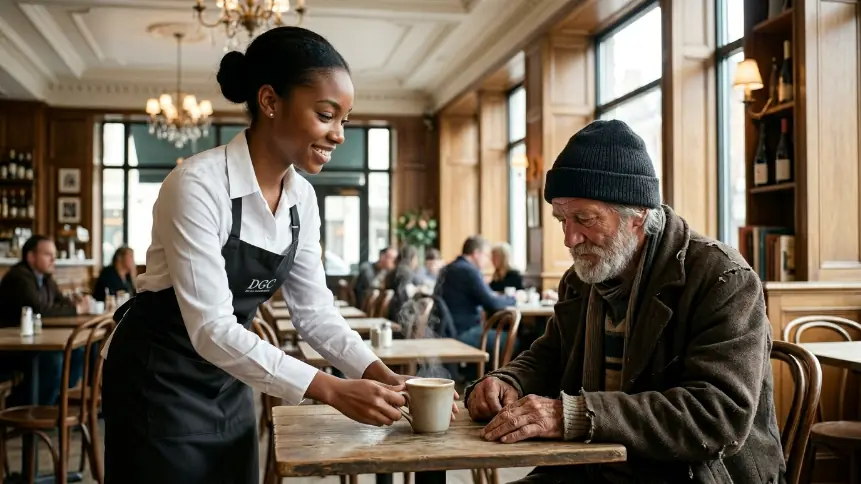
At 26, her life was a holding pattern. Her dreams of art school, of pigments and canvas, were packed away in a dusty portfolio under her bed. They had been replaced by the stark reality of her mother’s mounting medical bills. Multiple sclerosis was a cruel, expensive disease, and Camila was the only line of defense. So she tied the starched black apron around her waist, pulled her auburn hair into a severe bun, and painted on a smile that rarely reached her tired green eyes.
The shift, a brutal Tuesday double, was already dragging. Her section was full of look-at-me types, men in suits that cost more than her car, women who picked at $80 salads.
“Jenkins, table four needs their check, and they’ve been waiting.”
A sharp voice cut through the low din. Camila didn’t have to look. Martin Brewer, the Gilded Spoon’s manager, a man who seemed to glide rather than walk, his thin smile as artificial as the silk plants in the lobby. He lived for ambiance, a word he used to justify his cruelty.
“On it, Martin,” Camila said, balancing three plates on her forearm.
“And try to look like you want to be here,” he hissed, straightening a fork that was already perfectly straight. “Our clientele pays for an experience.”
Camila just nodded, her jaw tight. The experience apparently didn’t include basic human warmth.
An hour later, the first drop of rain hit the vast plate-glass window. Within minutes, it was a deluge, the kind of cold, driving October rain that feels personal. The restaurant’s heavy oak door swung open, bringing with it a gust of wind and a small, hunched figure.
He was an old man, thin as a rail, wearing a frayed wool coat that was soaked through. A gray beanie was pulled low over his face, and his shoes, or what was left of them, squelched on the marble floor. He looked lost, cold, and utterly out of place.
Every head in the dining room turned. Conversations paused. A woman at table two visibly recoiled.
Martin Brewer materialized instantly, his face a mask of polite fury.
“Sir,” he said, his voice dangerously smooth, “I’m afraid you’ve taken a wrong turn. This is a private establishment.”
The old man flinched. He looked up, his eyes a surprisingly clear pale blue.
“Please,” he whispered, his voice raspy. “It’s so cold. Just… just a coffee. I can pay.”
He fumbled in his pocket, pulling out a small handful of damp coins.
“We don’t serve just coffee in the main dining room,” Martin said, his eyes flicking to the door. “Now, if you’ll please—”
“Martin, wait.”
Camila stepped forward, her tray still in hand. Martin’s head snapped toward her, his eyes narrowing.
“Jenkins, this doesn’t concern you. Handle your section.”
“He’s a customer,” Camila said, her voice low but firm. “He wants a coffee. I’ll take him.”
“We have an image to maintain,” Martin seethed.
“And he’s freezing,” Camila shot back.
She turned to the old man, her smile suddenly genuine.
“Come with me, sir. I have a small table in the back of my section. It’s warm.”
The old man looked from Martin’s furious face to Camila’s outstretched hand. He nodded almost imperceptibly and let her guide him to a tiny two-top near the service station. It was the worst table in the house, but it was out of the main line of sight.
“This is coming out of your paycheck, Jenkins,” Martin spat as she passed. “The coffee, the table, the problem.”
“Fine,” Camila said.
She seated the old man, who was shivering so hard the chair rattled.
“I’ll be right back.”
She returned with a steaming mug of the restaurant’s expensive house blend.
“Here you are, sir.”
He wrapped his gnarled, red hands around the mug, soaking in the warmth.
“Thank you, miss. Thank you.”
“My name is Camila,” she said, refilling his water glass.
“I’m Arty,” he said, taking a sip. He sighed, a sound of profound relief.
Camila left him to his drink, but she could feel Martin’s eyes on her for the rest of the night. She didn’t care.
Arty did come back. He returned two days later during the dead zone between the lunch and dinner rush. He was cleaner this time, his coat dry, but still unmistakably a man living on the margins. He stood at the entrance, not entering until he saw Camila. He gave a small, questioning wave. Camila, who was rolling silverware, waved him in.
“Jenkins, what do you think you’re doing?” Martin’s voice echoed from his office.
“Serving a customer, Martin,” she called back, not breaking stride.
She led Arty to the same small table in her section.
“The usual, Arty?”
“Please, Camila.”
He smiled, and it was a real smile, lighting up his weathered face.
This became their routine. Arty would come in three, sometimes four times a week. He always sat at table 14. He always ordered a black coffee and, sometimes, if he had a few extra dollars, a bowl of the soup of the day. He always paid in cash and always tipped exactly 20%, calculated down to the penny.
Martin Brewer seethed. He couldn’t technically throw Arty out. He was a paying customer. He was quiet. He didn’t bother anyone. But his presence was an affront to Martin’s curated “experience.”
So Martin retaliated in smaller, meaner ways.
He “forgot” to turn on the heat lamp near table 14. He scheduled Camila for back-of-house cleaning right when Arty usually arrived, forcing him to be served by someone colder, quicker, less human. He reassigned her section without warning. He watched.
But Camila adapted.
If she was stuck in the back, she’d prepare Arty’s coffee ahead of time and leave instructions. If pastries were going to be thrown out at the end of the night, she quietly saved one or two.
“These are amazing,” Arty said one afternoon, biting into a slightly stale croissant.
“A crime to throw them away.”
“That’s what I think,” Camila said, leaning against the service station, polishing a glass. It was a slow day.
“This is a beautiful place,” Arty mused, looking around.
“But cold.”
“You get used to it,” Camila shrugged. “The tips are good… usually.”
“Is that why you’re here? The tips?”
Camila paused. She didn’t usually talk about her life. Not here. Not to anyone.
But Arty didn’t feel like “anyone.”
“It’s my mom,” she said quietly. “She’s sick.”
He didn’t interrupt.
“MS. The good medication… the kind that actually works… costs more than a mortgage. I had to drop out of art school to cover it.”
“Art school?” Arty’s eyes lit up. “You were a painter?”
“Wanted to be,” she said with a small, tired laugh. “Now I paint smiles on my face for eight-hour stretches.”
“A painter…” Arty repeated, nodding slowly. “That means you see things differently.”
“I see that Martin is about to lose his mind because I’m talking to you,” Camila said, nodding toward the office where Martin was watching through the glass.
“Tell me about him,” Arty said, unfazed. “Does he own this place?”
“Him? No,” Camila scoffed. “He’s just the manager. Acts like he owns it. This whole place is just one tiny piece of some giant corporation. Kensington Hospitality Group. Based in New York.”
“Kensington…” Arty repeated.
“Yeah. I think the real owner, some billionaire named Adrien Kensington, probably doesn’t even know this restaurant exists. He’s probably on a yacht somewhere.”
Arty didn’t respond right away. He just nodded slowly.
“And you think he wouldn’t care?” he asked.
“I think billionaires don’t care about waitresses and cold old men,” Camila said simply. “They care about profits. And Martin… for all his faults… makes the numbers look good.”
“The numbers…” Arty murmured.
That night, Camila got the call.
She stood in her tiny apartment, one hand braced against the sink as her phone pressed against her ear.
“Camila…” her mother’s voice was weaker than usual. “The new infusion… the cost went up again.”
Camila closed her eyes.
“How much?”
“Almost 20% more. The insurance… they’re pushing back.”
A familiar cold panic crept into her chest.
“I’ll handle it,” she said quickly. “Don’t worry, Mom. I’ve got it.”
“You work too hard, baby.”
“I’m fine.”
She hung up and rested her forehead against the cold tile.
For a moment, a brief, dark moment, she hated everything.
The customers.
The restaurant.
Martin.
Even Arty, just for a second, for making her care in a place where it was easier not to.
But the next day, when he came in, she still brought him coffee.
Still slipped him a pastry.
Still treated him like he mattered.
Because he was the only person in her day who said “thank you” and meant it.
Then everything changed.
An email came down from corporate.
The Gilded Spoon had been selected as a finalist for the Golden Summit Award for Excellence in Hospitality. A mystery judge would be visiting within the next two weeks.
Martin Brewer lost his mind.
Pre-shift meetings multiplied. Every detail was inspected. Fingernails. Glassware. Table spacing. Tone of voice.
“This is it,” Martin announced, pacing like a general before battle. “Nothing goes wrong. Nothing.”
His eyes locked on Camila.
“Jenkins, your little charity case… he’s done. If he shows up, you call security.”
“He’s harmless,” Camila said.
“Am I clear?” Martin snapped.
She hesitated.
“He’s a paying customer.”
Martin paused, calculating.
“…Fine,” he said finally. “But you hide him. Table 14. One complaint, one look from the wrong person, and he’s gone. And so are you.”
Camila nodded.
A small, dangerous victory.
For a week, tension filled the air.
Every new guest was a suspect.
Every table, a test.
Then came Friday night.
The restaurant was packed. A private party upstairs. Full floor downstairs. Camila was overwhelmed, juggling trays, orders, voices.
And then—
The door opened.
Arty walked in.
But something was wrong.
He was soaked. Mud streaked his face. He was muttering, disoriented, unsteady.
“Arty?” Camila said, rushing toward him.
“They took it…” he mumbled, grabbing her arm. “I can’t find it…”
“Hey, get your hands off her!” a customer shouted.
Martin appeared instantly.
“This is over,” he snapped. “Out!”
“Martin, wait—”
But Martin shoved him.
Hard.
Arty fell.
The sound of his body hitting marble echoed through the restaurant.
Silence.
Absolute silence.
Camila looked at Arty.
Then at Martin.
Something broke.
She stepped forward and shoved Martin back.
“You don’t touch him!” she shouted.
The room froze.
Martin stared at her, stunned, then furious.
“You’re fired, Camila!”
“I don’t care,” she shot back, kneeling beside Arty.
“He’s a human being.”
“Take him and get out!”
Camila helped Arty stand. Her hands were shaking. Her future was gone.
But for the first time in years…
She felt right.
Camila helped Arty to his feet, her arm wrapped firmly around his shoulders as the entire restaurant watched in stunned silence. The weight of what had just happened hadn’t fully landed yet. She had just shoved her manager. She had just been fired. And somehow, none of that mattered as much as the man trembling beside her.
“It’s okay,” she whispered. “I’ve got you.”
Martin straightened his jacket, his face flushed with rage and humiliation.
“Get them out,” he barked toward the hostess stand. “Call security. Now.”
But no one moved.
Because Arty, who had been slumped against Camila just a second ago, suddenly went still.
Not weak.
Still.
He slowly pulled away from her grip and stood up on his own.
The trembling stopped.
The muttering stopped.
He reached up and adjusted his coat, then his beanie, in one smooth, deliberate motion that didn’t belong to a confused old man.
Camila blinked.
“Arty…?”
He didn’t answer her.
Instead, he looked at Martin.
And smiled.
Not the soft, grateful smile she knew.
This was different.
Controlled.
Sharp.
“Martin Brewer,” he said, his voice no longer shaky, no longer frail. It was calm, clear, and carried across the entire dining room without effort.
Martin froze.
“How do you know my—”
“General Manager of the Gilded Spoon Annex,” Arty continued, stepping forward. “Employee ID 4472. Promoted three years ago based on operational efficiency metrics.”
A ripple of confusion moved through the room.
Camila felt her heart begin to pound.
What was happening?
Martin’s face shifted from anger to uncertainty.
“Who… who are you?”
Arty reached up and removed the beanie.
His gray hair, once messy and flattened, seemed suddenly deliberate. He rolled his shoulders slightly, as if shedding something invisible.
“I asked you a question,” Martin snapped, but there was no real force behind it now.
Arty reached into his coat.
Camila’s breath caught.
He pulled out a small, slim phone.
Not old.
Not broken.
New.
Sleek.
He tapped the screen once.
And everything changed.
At the hostess stand, the main system terminal flickered.
Then the large digital display above the bar—used for wine lists and reservations—went black for a split second.
Then it lit up again.
Not with wine.
Not with reservations.
With a single name.
KENSINGTON HOSPITALITY GROUP — EXECUTIVE ACCESS VERIFIED
Below it.
ADRIEN KENSINGTON — ACTIVE SESSION
The room went dead silent.
Completely.
Camila felt like the ground tilted under her feet.
Martin’s mouth opened.
Closed.
Opened again.
“That’s not—”
“It is,” Arty said calmly.
No.
Not Arty.
Not anymore.
He stepped forward again, and now the presence was unmistakable.
The air shifted around him.
“You mentioned earlier,” he said, glancing briefly at Camila, “that the owner of this company wouldn’t care about a waitress or a cold old man.”
Camila’s stomach dropped.
Her own words.
Echoing back.
“I wanted to test that theory,” he continued.
Martin took a step back.
“You’re lying.”
Adrien Kensington—because there was no doubt now—tilted his head slightly.
“Am I?”
He tapped his phone again.
Martin’s phone buzzed violently in his pocket.
So did the hostess’s.
So did the bartender’s.
Emails.
All at once.
Martin fumbled his out, hands shaking.
He opened it.
His face drained of color.
Camila couldn’t see the screen, but she didn’t need to.
He whispered,
“No…”
Adrien spoke again.
“You were concerned about the ‘experience,’ Martin,” he said. “Let’s talk about it.”
He turned slowly, looking around the restaurant.
At the frozen customers.
At the staff.
At the polished silver.
“At Kensington Hospitality, we measure experience very carefully,” he said. “Service quality. Emotional engagement. Staff treatment. Guest dignity.”
His eyes returned to Martin.
“Tonight, you failed every category.”
Martin shook his head rapidly.
“This is a misunderstanding. I didn’t know—”
“You didn’t know I was watching,” Adrien corrected.
Silence.
“Because if you had known, you would have behaved differently,” he continued. “And that’s the problem.”
Camila felt her pulse in her ears.
This wasn’t real.
This couldn’t be real.
Adrien turned slightly toward her.
“And you,” he said.
Camila froze.
“I’m sorry,” she said instinctively. “I didn’t know—”
“Exactly,” he said.
He stepped closer.
“And you still chose kindness.”
Her throat tightened.
“I… I just didn’t want him to be cold.”
“That’s not what you did,” Adrien said quietly. “You chose to see someone when it cost you something.”
The room was still holding its breath.
Adrien turned back to Martin.
“Security isn’t necessary,” he said. “You’re done here.”
Martin’s eyes widened.
“You can’t just—”
“I can,” Adrien said.
Flat.
Final.
“You are terminated, effective immediately. HR will contact you regarding final processing.”
Martin staggered back.
“You can’t fire me in front of—”
“In front of witnesses?” Adrien said. “I find it appropriate.”
A few customers shifted uncomfortably.
No one spoke.
No one dared.
Martin looked around, desperate for support.
He found none.
Because everyone had seen it.
Everyone had heard it.
And everyone knew.
He grabbed his jacket and left.
Fast.
The door slammed behind him.
The sound echoed.
And then…
Nothing.
Adrien took a slow breath.
Then turned to the room.
“Dinner is on the house tonight,” he said. “For the inconvenience.”
A murmur of disbelief spread.
“But more importantly,” he added, “we will be conducting a full review of management practices across this location.”
His gaze moved across the staff.
“Starting now.”
Then he turned back to Camila.
Everything else faded.
“I believe you’re currently unemployed,” he said.
Camila blinked.
“I… I think so.”
A small, almost amused breath left him.
“Then we should fix that.”
“I don’t understand.”
“You don’t need to,” he said. “Not yet.”
He gestured toward the dining room.
“Walk with me.”
Camila hesitated.
Then followed.
Every step felt unreal.
They moved past the tables.
Past the staff.
Past the place that had just fired her.
Now silent.
Watching.
At the center of the room, Adrien stopped.
“This restaurant,” he said, “is part of a network worth billions.”
Camila swallowed.
“I figured.”
“But it only works if the people inside it do,” he continued.
He looked at her directly.
“You saw a man no one else wanted to see.”
She said nothing.
“You defended him when it cost you your job.”
Still nothing.
“You didn’t know who I was.”
“No,” she said softly.
“And you still chose who you were.”
Her eyes stung.
“I just did what felt right.”
Adrien nodded once.
“That’s exactly why you’re standing here.”
A pause.
Then—
“I want you to work for me.”
The words landed heavier than anything else that night.
Camila stared at him.
“Doing what?”
“Learning,” he said. “Observing. Fixing what’s broken.”
“I don’t have any experience.”
“You have the only experience that matters.”
She shook her head.
“This doesn’t happen to people like me.”
“It just did.”
Silence.
Her phone buzzed in her pocket.
She knew what it was.
Bills.
Reality.
Fear.
But for the first time…
Something else was louder.
“What about my mom?” she asked.
Adrien didn’t hesitate.
“We take care of it.”
Her breath caught.
“Why?”
He looked at her for a long moment.
“Because the right person in the wrong place is a waste,” he said. “And I don’t waste assets.”
It wasn’t soft.
It wasn’t sentimental.
But it was real.
Camila looked around one last time.
At the restaurant.
At the life she had been living.
At the version of herself that had survived everything up to this moment.
Then back at him.
“Okay,” she said.
One word.
Everything changed.
Adrien nodded.
“Good.”
And just like that…
The girl who served coffee to strangers…
Stepped into a world she didn’t even know existed.