The glass shattered on the marble floor, but the sound was lost in the arrogant laughter of the dining room. Carmen Jenkins, a waitress with $42 in her bank account and a world of debt on her shoulders, watched as the city’s wealthiest diners mocked her. Her crime was helping a disheveled old woman who had collapsed by the door. As her manager hissed, “You’re fired,” and the restaurant’s queen bee filmed her humiliation, Carmen felt her future end. But what none of them knew, as they sneered at the homeless woman, was that they weren’t just insulting a stranger. They were insulting Eleanor Hayes, the mother of the most powerful billionaire in the country. And he was about to get a phone call.
The Gilded Spoon wasn’t just a restaurant. It was a statement. It was a three-Michelin-star fortress of arrogance perched on the 54th floor of the city’s most expensive skyscraper. Its windows didn’t just overlook the city. They judged it. And inside this fortress, Carmen Jenkins was a nobody.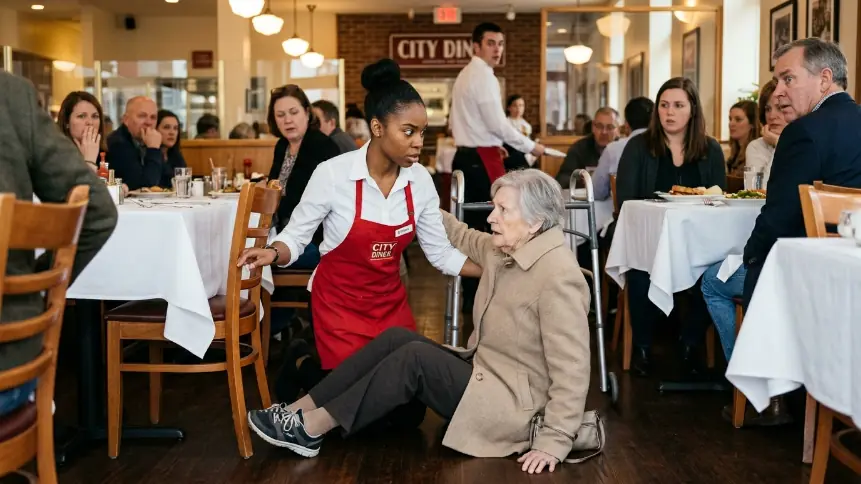
Her day began at 5:00 a.m. in a peeling-paint apartment in a neighborhood the diners at the Gilded Spoon paid to fly over. Her alarm was a shrill, cheap buzz. Her coffee was bitter instant and tasted like despair. On her cracked phone screen, a picture of her younger brother, Leo, beamed from his medical school orientation. He was her why. He was the reason she endured the six-inch heels, the uniform that was one size too small, and the soul-crushing condescension.
She took two buses to get to the downtown tower. By the time she clocked in, she had already been shoved twice and had her optimism ground down to a fine, polite powder.
The shift began, as it always did, with Mr. Harrison’s inspection. Mr. Harrison was a man who looked like he’d been perpetually sucking on a lemon. His suits were too tight, his cologne too strong, and his power was absolute. He walked the line of servers, his eyes darting.
“Reed,” he said, tapping Tiffany’s shoulder. “Impeccable. Your manicure is the exact shade of neutral we discussed.”
Tiffany Reed beamed. She was the restaurant’s unspoken queen bee, a woman who moved through the dining room like a shark smelling weakness. She glanced at Carmen and smirked.
“Jenkins,” Harrison snapped.
Carmen flinched. He leaned in, his gaze fixed on her collar.
“Is that a hand-sewn button?”
Carmen’s face flushed.
“My old one fell off on the bus, sir. I replaced it this morning. It’s the same color.”
“It’s not the same. It’s a millimeter off center, and the thread is a fraction too dull. It screams poverty, Miss Jenkins. Fix it, or I’ll fix your employment status.”
“Yes, Mr. Harrison.”
“Now, brace yourselves,” Harrison announced to the room. “The Brimleys are here, table 7, and they specifically requested Tiffany. Carmen, you will be on water and bread duty for her section. Do not speak to the guests. Do not make eye contact. You are furniture.”
Carmen’s stomach tightened. The Brimleys. Chadwick “Chad” Brimley III was an heir to a fortune he’d done nothing to earn. He treated service staff like gum on his shoe. He, his fiancée, and two other couples settled into the best table by the window, their laughter already too loud.
Carmen’s first task: pour the water. She approached the table, her hands steady, her gaze fixed on the glasses.
“Ugh. Finally,” the fiancée, a woman named Muffy, drawled. “I’m parched. Is this water imported, or is it that dreadful local tap?”
“It’s filtered Icelandic volcanic—” Carmen began.
She spoke. Chad Brimley interrupted, not even looking at her. He was scrolling through his phone.
“Tiffany, I thought we requested the silent model.”
Tiffany, standing nearby, rushed in with a fake laugh.
“Chad, you are terrible,” she giggled. “Carmen, dear, you’re fogging up his stock portfolio. Just pour and disappear.”
Carmen bit the inside of her cheek until she tasted copper. She poured the water. She set down the bread basket.
“No, no, no,” Muffy said, waving a hand dripping with diamonds. “I don’t eat carbs. Take it away. And bring me a single-origin, half-caf, oat-milk latte with one grain of raw sugar, not two. One.”
“The espresso machine is on the bar floor, ma’am,” Carmen said politely. “We don’t typically—”
“Are you telling me no?”
Muffy’s voice rose to a dangerous pitch.
“She’ll get it,” Tiffany snapped, pushing Carmen aside. “Right now. Go, Carmen. Run. Try not to trip.”
Carmen fled to the station, her face burning. She could hear them laughing as she went. She spent the next two hours in a state of high-alert humiliation. She was a ghost, a pair of hands, an object. She refilled water glasses for people who wouldn’t look at her. She cleared plates holding half-eaten $300 steaks. She listened to Chad Brimley loudly describe his new yacht.
Outside, the glorious sunny day had turned, as it often did, into a sudden, violent thunderstorm. Rain lashed the 54th-floor windows. The sky turned a bruised purple.
It was in this chaos, as the wind howled against the glass, that the front doors of the Gilded Spoon slid open and the old woman entered.
She didn’t walk in. She stumbled.
She was the antithesis of the Gilded Spoon. Her gray hair was matted by the rain. She wore a simple, slightly worn beige coat that might have been expensive thirty years ago. In her hand, she clutched a worn leather handbag as if it were a lifeline. She looked lost, disoriented, and completely out of place. She dripped water onto the pristine white marble floor.
Mr. Harrison, who was schmoozing a food critic at table two, spotted her first. His face, which had been a mask of pleasantry, contorted into pure, unadulterated horror.
“Security,” he hissed into his lapel mic. “We have a… a situation at the hostess stand.”
The hostess, a young woman named Bianca, looked terrified.
“Ma’am, ma’am, can I help you? Do you have a reservation?”
The old woman looked up, her blue eyes wide with confusion.
“I… I’m here to meet my son, Damian. He… he told me to meet him.”
The Brimley table heard this. Chad let out a braying laugh.
“Damian? Is she looking for Damian the dishwasher? She looks like she smells of old cheese.”
The old woman, startled by the laugh, took a step back. Her worn-out shoe hit the puddle of rainwater she had created. Her arms flailed.
It happened in sickening slow motion.
She went down hard.
There was a sharp, wet thack as her side hit the marble, followed by the clatter of her handbag spilling its contents. A pair of reading glasses, a tube of lipstick, a small framed photo, and a handful of hard candies.
A collective gasp went through the dining room.
And then silence.
A heavy, judgmental silence.
Mr. Harrison was frozen, his face ashen.
“Don’t touch her,” he commanded the staff. “She might sue. She’s a vagrant. A grifter. Security is on its way.”
Tiffany Reed pulled out her phone, her thumb hovering over the record button.
“Oh, this is tragic,” she whispered to Muffy, her eyes sparkling with malice. “She’s going to ruin the floor.”
The food critic at table two was watching, his pen poised over his notebook.
The old woman just lay there, groaning softly, rain and floor water soaking into her coat. She was clutching her wrist, her face pale with shock and pain.
“Please,” she whispered. “My… my wrist.”
Carmen was holding a tray of empty champagne flutes from the Brimley table. She saw the old woman’s face. She saw the fear. She saw the humiliation. And in that moment, she didn’t see a vagrant. She saw her own grandmother, who had fallen in the grocery store last year.
“Carmen, don’t you dare,” Harrison hissed, seeing the look in her eye. “That is a $10,000 floor. You are not to engage.”
Carmen looked at her boss. She looked at the smirking diners. She looked at the woman on the floor.
She made her choice.
She dropped the tray.
The sound was like a gunshot. A dozen crystal flutes exploded on the marble. Harrison shrieked.
Carmen didn’t care.
She was already on her knees, rushing to the old woman’s side.
“Ma’am. Ma’am, are you okay?”
Carmen’s voice was gentle. She carefully, professionally, began to gather the woman’s scattered belongings, ignoring the broken glass.
“My… my picture,” the woman whimpered, pointing with her good hand.
Carmen picked up the small silver-framed photo. It was of a young, smiling man in a graduation gown. She tucked it back into the handbag.
“Don’t move,” Carmen said, her voice full of an authority she never used. “Let me look at your wrist. I have basic first-aid training.”
“Miss Jenkins!” Harrison was apoplectic. “You are fraternizing with a… a solicitor. You are contaminating the dining room.”
“She’s hurt, Mr. Harrison,” Carmen shot back, her eyes flashing.
“I am so posting this,” Tiffany whispered, her phone’s camera light glowing red. “Waitress attacks old lady. The clicks.”
Carmen gently shielded the old woman from the stares.
“It’s okay. We’re going to get you up. Can you stand?”
“I… I think so,” the woman said, her voice trembling.
Carmen put her arm around the woman’s waist, taking her full weight.
“On three. One… two… three.”
With a grunt, Carmen helped the woman to her feet. The woman was wincing, cradling her left wrist, which was already beginning to swell.
“She’s getting grime all over your uniform, Carmen,” Tiffany called out, filming the whole thing. “That’s so unsanitary. I’m going to be sick.”
“Chad,” Muffy whined, “I’ve lost my appetite. This is a disaster. I’m going to give them one star on Yelp.”
“I’m going to get you somewhere warm,” Carmen said, ignoring every single voice.
She began to lead the old woman, step by painful step, not toward the exit, but toward the staff-only kitchen entrance.
“Where do you think you’re going?” Harrison bellowed, his face a mask of rage.
“I’m taking her to the breakroom. I’m calling a paramedic, and I’m getting her a warm, dry towel.”
“That is a direct violation of health code and restaurant policy.”
“Then I guess you’ll have to write me up,” Carmen said, not breaking her stride.
She kicked open the employees-only door and guided the shaken woman into the warmth and chaos of the kitchen, leaving a stunned, silent dining room and one incandescently furious manager in her wake.
The kitchen was a blast of heat, steam, and shouting. The moment Carmen entered, the head chef, a brute named Marco, barked,
“This is not a hospital. Get her out.”
“She’s injured, Chef. I need the first-aid kit now.”
Carmen’s voice was steel.
The kitchen staff, used to her quiet demeanor, stared. She settled the old woman onto the only chair in the tiny, windowless breakroom, a wobbly metal stool. The woman was shaking, either from cold or shock.
“Here,” Carmen said, grabbing her own staff locker sweater, a faded blue cardigan, and wrapping it around the woman’s shoulders. “Let me see that wrist.”
It was definitely sprained, possibly broken. Carmen was gentle as she wrapped it with a compression bandage from the kit.
“Thank you, dear,” the woman whispered. Her voice was surprisingly refined despite her appearance. “You are very kind. They are very not.”
“Don’t mind them,” Carmen said, getting a bottle of water from the staff fridge. “They’re just loud.”
“They called me a vagrant.”
The woman’s blue eyes were sharp, intelligent. They weren’t clouded with confusion anymore. They were filled with a cold, clear appraisal.
“They assumed. You didn’t.”
“My grandmother taught me you don’t judge a person by the coat they wear, but by the character they show,” Carmen said, kneeling. “I’m Carmen, by the way. Carmen Jenkins.”
“I’m Elanora,” the woman said, managing a small, pained smile. “Just Elanora. I was… I was supposed to meet my son, Damian, for a surprise lunch. He works in this building. I think… I think I must have gotten the address wrong. He’s very busy. I probably just confused him.”
“It’s an easy building to get lost in,” Carmen said reassuringly. “Do you have a phone? We can call him.”
“Oh.” Elanora looked flustered. “It’s in my bag. But the battery died. Silly me.”
The breakroom door slammed open.
Mr. Harrison stood there, flanked by two large security guards. His face was no longer red. It was a terrifying pale white.
“Miss Jenkins, your services are no longer required.”
Carmen stood up slowly.
“What?”
“You are fired. Effective immediately. You caused a scene. You destroyed restaurant property. You brought an unsanitized person into a food prep area. You insubordinately spoke to me and to our premier guests. Pack your locker now.”
“Mr. Harrison, she was hurt.”
“She is a trespasser,” Harrison spat. “And you are a liability. Security, please escort Miss Jenkins and this… off the premises.”
Elanora tried to stand.
“Sir, this is my fault. This young woman was only—”
“Silence,” Harrison barked at her. “You have no right to speak here. You are lucky I’m not having you arrested for trespassing.”
The two guards, big men who usually dealt with drunk stockbrokers, looked uncomfortable.
“Sir, maybe we should just—”
“Do your job,” Harrison ordered. “Get them out through the service exit. I don’t want them walking through my dining room again.”
Carmen felt a cold dread wash over her.
Fired. Fired for helping someone.
The rent. Leo’s tuition. It all crashed down on her. Tears of pure, hot rage welled in her eyes, but she refused to let them fall. She grabbed her thin coat from her locker. She had $42 in her bank account and her next paycheck, which she now wouldn’t get.
“Come on, Elanora,” Carmen said, her voice thick. “Let’s get you out of this horrible place.”
“Carmen, your job…” Elanora looked devastated. “Because of me…”
“It’s just a job,” Carmen lied, her heart breaking.
They were marched through a maze of back hallways, past steaming dumpsters and prep stations, to a cold metal service elevator. The ride down was silent. The security guards deposited them into a concrete loading dock, the rain still pouring down outside the bay doors.
“Have a nice day, ladies,” one of the guards said, not unkindly, before the door closed, leaving them in the damp, cold garage.
Carmen was shaking. Elanora looked at her, her face a mask of guilt.
“My child, what have I done?”
Carmen took a deep breath, pushing her own panic down.
“It’s not your fault. He’s a monster. Are you okay to get home? Can I call you a cab?”
“I… I don’t have any cash on me, just my card,” Elanora murmured.
Carmen looked at the older woman. She looked at the rain. She thought of her $42.
She reached into her pocket and pulled out a crumpled $20 bill. It was her bus money for the rest of the week.
“Here,” Carmen said, pressing it into Elanora’s good hand. “This will get you part of the way. Please go home and get that wrist looked at.”
Elanora stared at the $20 bill as if it were a brick of gold. She looked up, her piercing blue eyes searching Carmen’s.
“You’ve just been fired. This is… this is your grocery money. I can’t.”
“Kindness doesn’t have a price tag,” Carmen said, echoing her grandmother. “Just go. Please be safe.”
Carmen then did something else. She took off her own thin coat and draped it over Eleanora’s shoulders on top of her own sweater.
“My uniform is under this. They’ll charge me for it if I don’t return it. But you’re soaked. Take this.”
Now standing in just her black-and-white uniform in a cold loading dock, Carmen turned to leave.
“Carmen Jenkins,” Elanora called out, her voice suddenly strong.
Carmen turned.
“You are a good person, a rare person. This… this will not be forgotten. I promise you.”
Carmen just nodded, unable to speak, and walked out into the pouring rain, her humiliation and fear a cold, heavy blanket. She had a five-mile walk home.
As she disappeared around the corner, Eleanor Hayes stood up straight.
The pained, confused vagrant disappeared.
In her place was a woman of absolute, cold authority.
She pulled her dead smartphone from her purse. It was a $5,000 custom-built encrypted device. She pressed one on her speed dial. It was answered on the first ring.
“Mr. Graves.”
“Elanora, are you safe? I was alerted you left the perimeter.”
“I’m fine, Mr. Graves, but I need you to do several things for me. First, pick me up at the service entrance of the Hayes Tower. Second, I need you to find every piece of information you can on a young woman named Carmen Jenkins. And third, I need you to find out who owns the controlling stake in the Gilded Spoon restaurant group.”
“I already know the answer to that, ma’am,” the voice on the phone replied. “We do. A subsidiary of Hayes Corp acquired it six months ago.”
Elanora looked at the $20 bill in her hand. A slow, dangerous smile spread across her face.
“Oh,” she said. “How perfect.”
The following two weeks were not just a decline. They were a freefall.
Carmen’s first act after walking home in the rain and shivering for three hours was to check her bank account. $42.50.
After she returned her uniform, Mr. Harrison deducted a $50 “garment restocking fee,” leaving her with a final check of $12.14. Her total worldly assets were $54.64.
Rent was $800, due in 10 days. Leo’s next tuition payment was in three weeks.
The first day she was fueled by righteous anger. She applied for every waitress job on LinkedIn, Craigslist, and in the local paper.
By the third day, the anger had chilled into gnawing anxiety.
She had her first interview at a respectable Midtown bistro, the Carillon. The manager, a kind-looking woman, smiled at her.
“Your resume is excellent, Carmen. You’re experienced. You’re poised.”
“Thank you. I’m a very hard worker,” Carmen said, hope fluttering.
“Well… I made a call to your last employer for a reference. Mr. Harrison at the Gilded Spoon.”
Carmen’s stomach turned to ice.
“Oh.”
“He said you were, and I quote, emotionally unstable, insubordinate, and a physical danger to the clientele. He also mentioned an assault.”
“That’s not what happened. An old woman fell, and I helped her. He fired me for it.”
The manager’s kind smile tightened.
“Carmen, I understand, but the Gilded Spoon is a name. I can’t risk drama. I’m so sorry. The position has been filled.”
Carmen left, her ears ringing.
It was the same story everywhere.
At a high-end steakhouse:
“We can’t hire someone who was fired for insubordination.”
At a casual family restaurant:
“We’re looking for someone with a cleaner record.”
Mr. Harrison hadn’t just fired her. He had blacklisted her. He had scorched the earth.
Then the video surfaced.
Tiffany Reed, having edited the footage to her liking, had posted it to her popular foodie Instagram account. The video, set to a ridiculous dramatic “oh no” song, was titled: crazed waitress at the gilded spoon attacks poor old woman and smashes glasses. so unprofessional. It was expertly cut. It showed Carmen dropping the tray, making it look intentional, then rushing toward Elanora, making it look aggressive. It cut out the fall. It showed Carmen arguing with Harrison, and Tiffany’s caption spun it as Carmen screaming at our manager who tried to save the poor woman.
The video had 50,000 views. The comments were brutal.
She should be arrested.
What a psycho.
I hope she never works again.
I was there. That waitress was a menace. The Gilded Spoon official. Harrison handled it perfectly.
That comment was from Chad Brimley.
Of course.
Carmen was no longer just unemployed. She was infamous.
She tried applying for jobs outside of food service.
At a receptionist job:
“We saw the video. We need someone with a calm temperament.”
At a coffee shop:
“Sorry, you’re not a good fit for our brand.”
The $54.64 was gone, spent on a single bag of groceries: ramen, white bread, and peanut butter. The eviction notice was a flash of bright, offensive orange taped to her door.
72-HOUR NOTICE TO PAY OR QUIT
She sat on her threadbare sofa, the notice in her hand, and for the first time, she broke. She didn’t just cry. She sobbed, a deep, gasping, hopeless sound that echoed in the tiny, empty apartment. She was going to be homeless. Leo would have to drop out of school. It was over.
That night, Leo called. She wiped her eyes and answered, forcing her voice to sound bright.
“Hey, Lee. How’s school?”
“It’s incredible, Carmen. We just started our cardiology rotation, and I aced my midterm. I’m actually doing it. All thanks to you.”
“Oh, Leo, that’s… that’s amazing.”
She choked out a fresh wave of tears, streaming down her face.
His voice changed.
“Carmen, are you okay? You sound off.”
“No, I’m fine. I’m just so proud of you. I’m… I got a little bonus at work. That’s all. Tears of joy.”
It was a pathetic lie.
“You’re sure? Is that monster Harrison treating you okay?”
“He’s fine. Everything’s perfect,” she whispered. “Listen, I’ve got to go. Double shift. I love you, Lee.”
“Love you too, Carmen. You’re the best.”
She hung up the phone and slid to the floor. She had 48 hours left. She looked at the eviction notice, then at the bottle of generic-brand sleeping pills in her medicine cabinet. For a terrifying second, she wondered if that was the only way out.
She was at her absolute rock bottom.
The next morning, with 24 hours to go, there was a knock on her door.
Carmen froze.
It was him. The landlord or the sheriff. It was over.
She wiped her hands on her jeans, took a deep breath, and opened the door, ready to beg for one more day.
It was not the landlord.
Standing in the dim, peeling hallway of her apartment building was a man who looked like he had been carved from granite and dressed by Armani. He was tall, severe, and held a sleek black iPad. His face was completely impassive. Behind him in the hallway stood two more men in identical black suits. Her nosy neighbor, Mrs. Petro, peered out her door, her eyes wide.
“Carmen… are you in trouble with the mob?”
The man ignored Mrs. Petro. His eyes, the color of slate, met Carmen’s.
“Ms. Carmen Jenkins.”
“Y-yes.”
“My name is Mr. Graves. I am the chief of staff for Mrs. Eleanor Hayes.”
Carmen’s mind went blank.
“Eleanor… the woman from the… is she okay? Her wrist?”
“Mrs. Hayes has made a full recovery. Thank you for asking,” Mr. Graves said, his voice betraying no emotion. “She has been insistent on speaking with you. She has sent me to retrieve you.”
“Retrieve me? I… I can’t go anywhere. I have… I have problems.”
“Yes,” Mr. Graves said, glancing at the orange eviction notice still taped to the door. “We are aware of your problems. Mrs. Hayes would like to propose a solution.”
Carmen stared.
“I… I don’t understand.”
“You don’t need to. Not yet. All you need to do is come with me. We have already spoken to your landlord. Your arrears have been settled.”
Carmen’s jaw dropped.
“You… you paid my rent?”
“It was a minor transaction,” Mr. Graves said, as if discussing the weather. “Now, if you’ll please come. A car is waiting.”
Carmen looked back at her tiny, sad apartment. She looked at the severe, imposing Mr. Graves. She had no money, no job, and no hope. She had absolutely nothing left to lose.
“Okay,” she whispered. “Let me get my… my keys.”
“You will not be needing them, Jenkins,” Mr. Graves said. “Your old life is effectively over.”
Carmen felt like she was in a dream. She was guided not to a simple car, but to a vehicle that looked more like a moving vault, a black, impossibly sleek custom Rolls-Royce Phantom. One of the suited men opened the door for her, and she slid into a leather interior so soft it felt like sinking into a cloud. The car didn’t make a sound as it pulled away.
Mr. Graves sat opposite her, silent, working on his iPad.
Mrs. Petro was still staring from her doorway, her mouth wide open.
They drove out of her neighborhood, past the Midtown bistro that had rejected her, past the glittering spire of the Gilded Spoon, and kept going. They drove to a part of the city Carmen had only ever seen in magazines, a private gated community called Eagle’s Crest, where the houses were estates and the hedges were taller than buses. The Rolls-Royce passed through three separate security checkpoints before pulling up a long gravel driveway to a house that looked more like a modern museum. It was all glass and stone and sweeping vistas of the ocean.
Mr. Graves led her inside. The interior was not gaudy. It was tasteful, filled with breathtaking modern art and floor-to-ceiling bookshelves.
“Please wait here,” Mr. Graves instructed, gesturing to a vast two-story library.
Carmen stood in the center of the room, feeling smaller than she ever had in her life. She was still wearing her only interview outfit, a simple black skirt and a white blouse she’d washed in the sink last night.
“I see you’re admiring my husband’s collection of first editions.”
Carmen spun around.
Eleanor Hayes stood in the doorway, but it was not the Elanora from the restaurant. This woman was dressed in an elegant cashmere lounge set the color of cream. Her gray hair was perfectly coiffed. Her left wrist was in a discreet black medical brace. But the hand on that arm was adorned with a sapphire ring the size of a robin’s egg.
She was no longer a vagrant.
She was a queen.
“Elanora,” Carmen breathed. “You’re… you’re okay. Your home is beautiful.”
“Thank you, Carmen. Please sit. Don’t look so terrified.”
Elanora smiled a warm, genuine smile.
“Mr. Graves, please bring us some tea and those scones Carmen likes.”
Carmen blinked.
“The scones I like?”
“From the Daily Rise Bakery,” Elanora said, settling into a plush armchair. “The ones with the lemon-curd filling. You used to buy one every Friday. A little treat for yourself. I know because I’ve been… well, I’ve been studying you, Carmen.”
A chill went down Carmen’s spine.
“Studying me?”
Mr. Graves reappeared with the tea tray and the exact scones, then vanished as silently as he’d come.
“Carmen,” Elanora began, her tone gentle, “I owe you an apology and an explanation.”
“I am not a poor, confused woman. I am, as I said, Elanora Hayes. My son Damian does indeed work in that building. He doesn’t just work there. He owns it. He owns Hayes Corp.”
Carmen’s face drained of all color.
“Damian Hayes? The Damian Hayes? The reclusive tech billionaire? The man who owns half the city?”
“Your son is Damian Hayes?”
“He is.”
Elanora nodded.
“And he is a good man, but he is surrounded by vipers. By Mr. Harrisons and Tiffany Reeds and Chad Brimleys, people who smile to his face and cheat him behind his back. People who value a dollar but not a human.”
“So the fall,” Carmen whispered. “Was that a test?”
“Not at first,” Elanora admitted. “I was genuinely going to surprise him for lunch. I often dress down. I find it’s the best way to see the world as it really is. The fall… that was genuine. My shoe, the water. It was an accident. But the aftermath, that was the test. A test that every single person in that restaurant failed. Except for you.”
Carmen’s hands were shaking.
“You… you let me get fired.”
The words hung in the air.
Elanora’s face grew serious.
“Yes, I did. I had to. Carmen, if I had stood up and announced who I was, what would have happened?”
“They… they would have apologized. They would have fawned all over you,” Carmen said.
“Exactly. And Mr. Harrison would have praised you. What a wonderful, attentive employee helping my most cherished guest. And you… you would have kept your job, and I would have learned nothing. Instead, I let it play out. I saw a manager who valued image over humanity. I saw a coworker who valued clicks over compassion. And I saw you, a young woman who had nothing and who was willing to lose everything for a stranger.”
Elanora leaned forward.
“I saw you give me your last $20. I saw you give me the coat off your back in a loading dock after you had just lost your entire life. Do you know how rare that is, Carmen? In my world, it’s non-existent.”
“So, what happens now?” Carmen asked, her voice small.
“Now we begin.”
“First,” Elanora said, her voice calm but carrying a quiet authority, “Mr. Graves has been very busy.” She gestured to the tablet placed neatly on the table between them. “The Gilded Spoon. As of this morning, Mr. Harrison has been terminated for cause. The board has accepted his resignation.” Carmen’s breath caught, her fingers tightening around the edge of her seat as if the ground might shift again beneath her. “What about Tiffany?” she asked, her voice barely above a whisper. “Ah, Miss Reed,” Elanora replied, her tone sharpening slightly. “Her Instagram post, along with the full unedited security footage from that evening, has already been sent to several major news outlets. Our legal team has also filed a multi-million-dollar defamation lawsuit. Her little career is… finished.” Carmen stared, her mind struggling to keep up with the scale of what she was hearing. It wasn’t just consequences. It was precision. “And Mr. Brimley?” she asked, almost afraid of the answer. Elanora’s lips curved into a faint, controlled smile. “My son made a call to his father. It turns out young Chadwick’s entire company depended on a contract with Hayes Corp. That contract has been canceled.” Carmen exhaled slowly, the weight of everything pressing down on her. It was swift. Absolute. Ruthless. But it was also… just.
“But that is not why I brought you here,” Elanora continued, her voice softening again. “I did not bring you here for revenge. I brought you here for your future.” Carmen swallowed hard. “My future?” “Yes,” Elanora said, leaning back slightly. “I paid your rent, Carmen, not as a gift, but as an advance.” Carmen blinked, confused. “An advance for what?” “For a job.” The words landed with quiet force. “You see, I am the head of the Hayes Foundation, our family’s philanthropic division. We manage billions of dollars in charitable initiatives. But I am surrounded by people who know how to optimize numbers, not people who understand humanity.” She leaned forward again, her gaze locking onto Carmen’s. “I need someone who understands what it means to give. Someone who knows that sometimes the most important act of generosity is not a million-dollar donation, but a twenty-dollar bill given at the right moment.” Carmen’s throat tightened. “Someone who sees people,” Elanora continued, “not statistics.”
“I want to offer you a position, Carmen Jenkins,” she said. “As my special projects coordinator.” Carmen froze. “I… I’m a waitress,” she said instinctively. “I don’t have a degree in business. I don’t know anything about philanthropy.” “You know everything that matters,” Elanora replied firmly. “You have integrity. You have instinct. You have compassion. The rest can be taught.” She slid a thick file across the table. “This is your contract.” Carmen hesitated, then slowly opened it. The numbers inside didn’t feel real. Her breath hitched. “This… this can’t be right.” “It is,” Elanora said calmly. “That is your annual salary. It also includes a corporate residence inside Hayes Tower.” She then opened a second folder and placed it gently in front of Carmen. “And this,” she added, “is your brother’s future.” Carmen’s hands trembled as she looked down. It was a tuition statement. Paid in full. All four years. Including housing and living expenses. Leo Jenkins. Balance: zero.
Carmen couldn’t hold it together anymore. The tears came fast, uncontrollable, breaking through everything she had been holding in for weeks. She dropped her head into her hands and cried, not from fear, not from anger, but from a release so deep it hurt. For the first time, the weight lifted. Elanora didn’t interrupt. She simply placed a steady hand on Carmen’s shoulder. “Welcome to the family,” she said quietly. “Your new life starts now.”
The next two days passed in a blur that Carmen could barely process. She moved out of her apartment and into a sleek, modern unit high above the city inside Hayes Tower. Everything felt unreal. The silence. The space. The absence of fear. The refrigerator stocked with food she didn’t have to ration. The bed that didn’t creak. The windows that showed a world she had never been part of. The first thing she did was call Leo. When she told him his tuition was paid, he didn’t respond at first. Then his breathing broke, and he started crying. And for the first time in her life, Carmen was the one listening, letting someone else feel relief.
Her introduction to the Hayes Foundation was immediate and overwhelming. Mr. Graves became her guide, her instructor, and in many ways, her reality check. “This is your tablet,” he said, handing her a sleek device. “It is synced with Mrs. Hayes’s schedule and the foundation’s financial network.” “And this,” he continued, placing a card in front of her, “is your corporate account. There is no limit. You will use it responsibly.” Carmen stared at it. “No limit?” “Correct.” “That’s… terrifying.” “It should be,” Graves replied.
He then handed her a thick stack of documents. “This is the complete operational file of the Gilded Spoon.” Carmen looked up sharply. “Why do I need this?” Graves met her eyes. “Because your first assignment is something you understand.” Carmen spent the rest of the day reviewing financial reports, internal complaints, expense abuse logs, and staffing structures. By the time she reached the end of the file, something inside her had shifted. She wasn’t reading as a waitress anymore. She was reading as someone responsible.
At 4:30 p.m., a stylist arrived. “Ms. Jenkins, we’re here for your fitting.” “My fitting?” Carmen asked. “Your new uniform,” the stylist said with a smile. An hour later, Carmen stood in front of a full-length mirror, barely recognizing herself. The cheap fabric was gone. In its place was a perfectly tailored navy suit that fit her like it had been made for her entire life. Her posture changed. Her expression changed. But her eyes stayed the same. Grounded. Real.
At 6:30 p.m., Mr. Graves returned. “It’s time.” “Where’s Elanora?” Carmen asked. “Mrs. Hayes prefers not to enter that building again,” Graves said. “You’ll be handling this.” He handed her a small velvet box. Inside was a simple gold pin shaped like an “H.” “For your lapel.” Carmen pinned it on. “And Damian?” she asked. “He is already there,” Graves replied. “He is very interested in meeting the woman who impressed his mother.”
Carmen took a breath.
“Let’s go.”
The Gilded Spoon was alive again. The same laughter. The same arrogance. The same illusion of control. But this time, it wasn’t the same story. The doors opened. And everything stopped.
Damian Hayes stood at the entrance.
And behind him—
Carmen Jenkins walked in.
Not as a waitress.
But as the one in control.
The doors didn’t just open. They parted. Conversations died mid-sentence, forks paused halfway to mouths, and the low hum of curated luxury collapsed into a silence so complete it felt staged. Damian Hayes stepped forward first, not loudly, not theatrically, but with the kind of presence that bent attention without asking for it. Cameras weren’t allowed in the Gilded Spoon, but if they had been, every lens would have turned to him in that instant. He wore a charcoal suit cut so precisely it seemed to move with him, not on him. His expression was neutral, controlled, the eyes scanning the room once, cataloging everything. Then he stopped. And he didn’t need to say a word. Because the second figure crossing the threshold behind him made the room inhale all at once.
Carmen Jenkins walked in.
Not in heels that pinched and a blouse that betrayed her at the collar, but in a tailored navy suit that fit like certainty. The fabric caught the light differently, not glossy, not loud, just right. The gold “H” pin at her lapel caught a single beam and held it there. Her hair was pulled back, but softer, intentional. The same green eyes that had swallowed insults now held something steadier. Not arrogance. Not even confidence in the way the diners used it. Something quieter. Ownership of self.
For a heartbeat, no one moved.
Then the whispers started.
“Is that—”
“Wait, isn’t she—”
“That’s the girl from the video—”
Tiffany Reed felt it before she saw it. That shift. That subtle tightening in the air that meant something important had just changed. She turned, phone already in hand out of instinct, and when her eyes landed on Carmen, her mouth opened before her brain caught up.
“Oh my God,” she breathed, then louder, because Tiffany never did anything quietly, “are you kidding me?”
Carmen didn’t look at her.
Not yet.
Mr. Harrison’s replacement, a temporary acting manager named Collin, stood near the host stand, his posture collapsing in real time as he realized he was about to be the least important person in a very important moment. He smoothed his tie, stepped forward too quickly, then stopped because Damian Hayes had shifted his gaze.
“Good evening,” Collin managed, voice thin. “Mr. Hayes, we weren’t informed—”
“That’s the point,” Damian said.
Three words.
Flat.
Controlled.
Collin swallowed.
“Of course, sir. How can we assist you?”
Damian didn’t answer immediately. He let the silence stretch just enough to make every second count. Then he turned slightly.
“Ms. Jenkins,” he said, and the way he said her name made the entire staff straighten as if they’d been called to attention, “this is your review.”
Carmen stepped forward.
Every step echoed, not because it was loud, but because no one else dared make a sound.
She stopped at the center of the dining room, right where the marble had been polished back to perfection after the night she’d shattered glass across it. She looked down once, a flicker of memory, then lifted her gaze.
“I recognize a lot of faces,” she said.
Her voice wasn’t raised.
It didn’t need to be.
At table seven, Chad Brimley went pale.
Muffy shifted in her chair, suddenly very aware of the room watching.
Tiffany, to her credit, recovered first. She lifted her phone again, thumb already moving.
“This is insane,” she said, a brittle laugh in her voice. “You can’t just walk in here like you own the place—”
Carmen turned.
And for the first time, she looked directly at Tiffany.
“No,” she said calmly. “I can’t.”
A beat.
“We can.”
Damian didn’t move, but the weight of his presence shifted just enough to make the meaning land.
Tiffany’s smile faltered.
“That video you posted,” Carmen continued, her tone even, “was missing context.”
“Oh, please,” Tiffany scoffed, louder now, trying to reclaim control, “everyone saw exactly what happened. You lost it. You attacked—”
“The full footage has been reviewed,” Damian said.
Tiffany’s voice died in her throat.
“Unedited,” he added.
A ripple went through the room.
“You… you can’t just—”
“We can,” Damian said again.
Same tone.
Same finality.
Mr. Graves stepped forward from the edge of the room, tablet in hand, movements precise.
“Miss Reed,” he said, “your account has been flagged for defamation and malicious misrepresentation. Legal documentation has already been filed.”
Tiffany blinked.
“What?”
“Your brand partnerships have been notified,” Graves continued. “Your sponsorship contracts include morality clauses. They are being reviewed.”
“That’s—this is harassment,” Tiffany snapped, but there was no conviction left in it.
“Your content monetization has been temporarily suspended pending investigation,” Graves finished.
The phone slipped in Tiffany’s hand.
“Wait—no, that’s not possible—”
Carmen watched her for a moment.
Not with satisfaction.
Not with cruelty.
Just with clarity.
“At any point,” Carmen said quietly, “you could have stopped filming and helped.”
Tiffany said nothing.
Because there was nothing to say.
Carmen turned away.
That was the worst part.
Being dismissed.
At table seven, Chad Brimley shifted again, sweat gathering at his hairline.
“Look,” he said, forcing a laugh that didn’t land, “this has gone far enough. This is a restaurant, not some corporate courtroom. Let’s just—”
“Your father’s contract with Hayes Logistics,” Damian said, not looking at him, “has been terminated.”
The room went still again.
Chad froze.
“What?”
“Effective this afternoon,” Damian continued. “Pending review of performance and conduct.”
“You can’t do that,” Chad said, voice rising, panic bleeding through, “you have no idea what that deal is worth—”
“I do,” Damian said.
A beat.
“And I still ended it.”
Chad’s face drained completely.
Muffy reached for his arm.
“Chad—”
He pulled away, standing too fast, chair scraping loudly against marble.
“This is ridiculous,” he said, but it sounded smaller now. “You’re making a mistake.”
Damian finally looked at him.
“No,” he said. “You did.”
Chad didn’t argue again.
He left.
Fast.
Muffy followed, heels clicking unevenly, head down.
The table sat empty.
Carmen let the silence settle.
Then she turned, slowly, taking in the rest of the room.
“This place,” she said, “is beautiful.”
A few heads nodded, unsure.
“It’s also broken.”
No one nodded at that.
But no one disagreed either.
“Service isn’t about perfection,” she continued. “It’s about people.”
She paused.
“Somewhere along the way, that got lost here.”
Collin swallowed hard.
“We—we can fix that,” he said quickly.
Carmen looked at him.
“Maybe,” she said.
Then she turned to Damian.
He gave the smallest nod.
Permission.
Authority.
Both.
Carmen faced the room again.
“Effective immediately,” she said, “the Gilded Spoon is closed.”
Gasps.
Actual gasps this time.
“For a full operational review and restructuring,” she finished.
Collin’s mouth dropped open.
“But—we have reservations—private events—”
“You had opportunities,” Carmen said.
Quiet.
Final.
Mr. Graves stepped forward again.
“Staff will receive full compensation during the closure period,” he announced. “Further instructions will be distributed electronically.”
The tension shifted.
Not gone.
But changed.
Because for the first time, the people who worked here weren’t being punished for someone else’s decisions.
Carmen exhaled slowly.
It was done.
The room that had broken her…
Was no longer in control.
Damian stepped closer, just enough that only she could hear him.
“You handled that well,” he said.
Carmen glanced at him.
“I wasn’t sure I could,” she admitted.
“You already did,” he replied.
She looked around one last time.
At the tables.
At the floor.
At the place where everything had fallen apart.
And then…
She turned away.
Not running.
Not escaping.
Leaving.
On her terms.
For the first time in her life.
And as the doors closed behind her, the silence inside the Gilded Spoon wasn’t empty anymore.
It was… waiting.
For something better.