They slammed her face first into the concrete before they knew who she was.
The woman in the business suit had been walking to her car, heels clicking on wet asphalt. The community meeting ended an hour ago. Everyone else had gone home. Blue and red lights exploded behind her. A patrol car screeched to a stop. Two officers jumped out. The sergeant approached fast. His partner circled around.
“Stop right there.”
The voice cut through the night air. She turned slowly, hands visible.
“Good evening, officers. Is there a problem?”
“We’ll ask the questions.” He stepped closer, hand on his weapon. “You match a description.”
“What description would that be?”
Her voice stayed level. Professional.
He didn’t answer. Instead, he grabbed her arm hard. His partner moved behind her. They forced her down. Concrete scraped against her cheek. That’s when her hand moved toward her jacket pocket. The radio crackled with an urgent transmission. What happened next would change everything.
Metal cuffs bite into her wrists. The woman doesn’t scream, doesn’t cry, doesn’t beg. She lies still on the cold pavement. Blood trickles from her split lip. Her breathing stays controlled, even, like she’s done this before.
Sergeant Hayes yanks her to her feet. “What’s your name?”
“Diana Washington.”
She meets his eyes. No fear there. Something else. Something that makes him look away first.
Officer Davis searches her pockets. Wallet, keys, phone. No weapons. No drugs. Nothing that justifies this level of force.
A third officer approaches from the shadows. Officer James Wilson, young, nervous. His radio crackles with routine chatter.
“What have we got?” Wilson asks.
“Suspect matching the robbery description,” Hayes says. His voice carries less conviction now.
Diana tilts her head. “Which robbery? When? Where? What was stolen?”
The questions come fast, precise. Like a lawyer. Like someone who knows the system.
Hayes’s jaw tightens. “I said we ask the questions.”
“Under Miranda versus Arizona, I have the right to know the charges.”
Diana’s voice cuts through the night.
“Under Terry versus Ohio, you need reasonable suspicion for this stop.”
Wilson shifts uncomfortably. Streetlight shadows dance across his face. His leather radio holster creaks as he moves.
“You some kind of lawyer?” Davis spits.
“Among other things.”
Diana’s smile doesn’t reach her eyes.
“Officer Wilson, isn’t it? You look familiar.”
Wilson studies her face. Something tugs at his memory. He’s seen her before, recently. But where?
Hayes grabs Diana’s arm harder. “Enough talk. You’re coming with us.”
“On what charges specifically?” Diana asks. “And which of you activated your body cameras for this encounter?”
The question hangs in the air. Hayes and Davis exchange glances. Neither reaches for their cameras.
“Don’t need cameras for routine stops,” Hayes mutters.
“The new administration might disagree.” Diana’s words slice through the silence. “Policy changes take effect Monday.”
Wilson’s eyes widen. He has seen that badge before somewhere.
Diana’s next question makes Hayes freeze.
“Are you going to answer my question, Sergeant Hayes?”
Diana stands straighter despite the cuffs.
“What crime am I suspected of committing?”
Hayes’s radio buzzes. Dispatch crackles through static.
“Unit 12, what’s your status?”
He ignores it, steps closer to Diana. His breath smells like coffee and anger.
“Robbery suspect. Five-six, Black female, professional dress.”
His words come out mechanical, rehearsed.
“That description fits thousands of women in this city,” Diana says calmly. “Where did this alleged robbery occur?”
“Downtown. Near the bank.”
“Which bank? What time? What was stolen?”
Hayes falters. Davis kicks at loose gravel. Neither answers.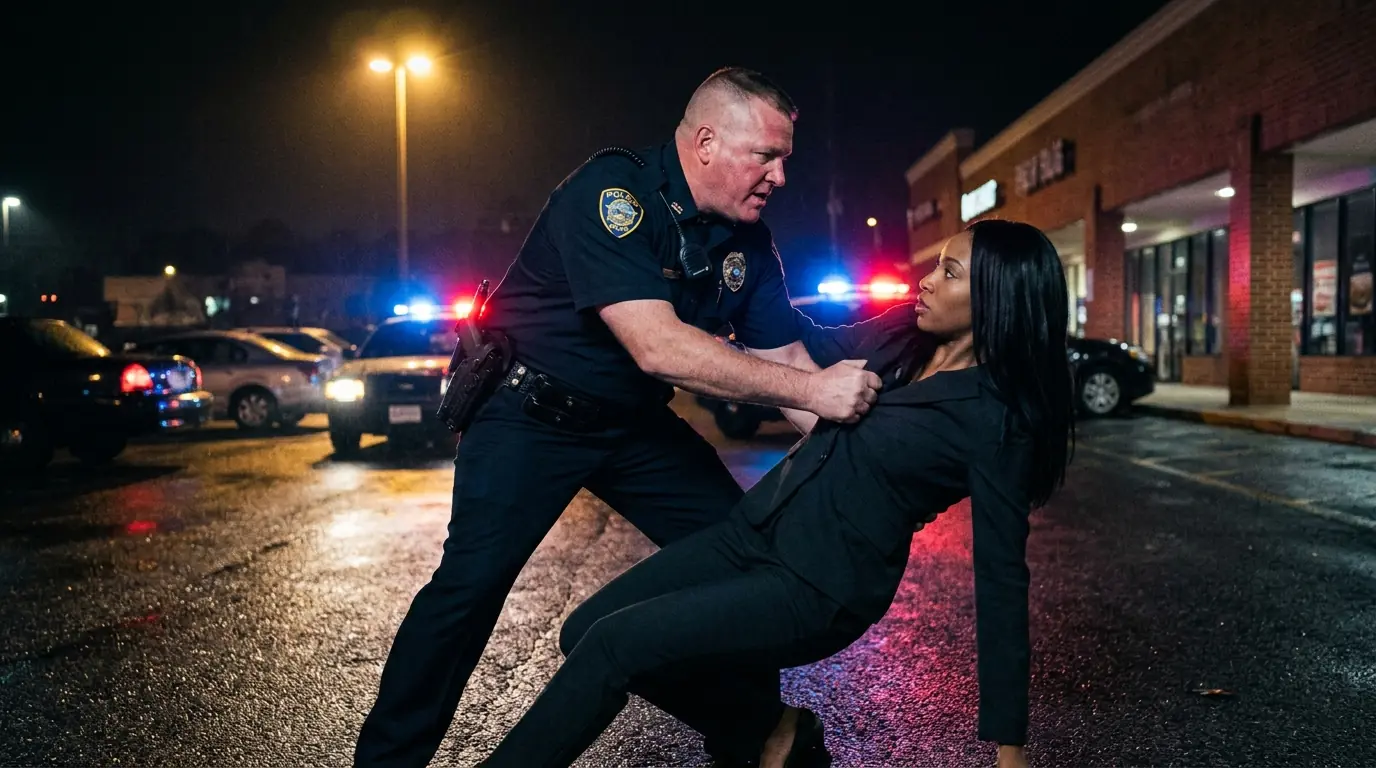
Wilson checks his watch. Twenty-three minutes since the stop began. No backup called. No supervisor notified. No report filed. Every protocol violated.
“Officer Wilson.”
Diana turns toward him.
“How long have you been on the force?”
“Eighteen months, ma’am.”
“Ma’am?” Hayes snorts. “She’s a suspect, not your grandmother.”
“She’s a citizen,” Wilson replies quietly. “Entitled to basic respect.”
Hayes’s face reddens. Squad car doors slam in the distance. Another unit approaches.
Lieutenant Sandra Mills climbs out. Twenty-year veteran. Hayes’s direct supervisor.
“What’s the situation?” Mills surveys the scene. Her eyes linger on Diana’s torn jacket, the blood on her face.
“Robbery suspect in custody,” Hayes reports. “Resisting arrest.”
Diana laughs. Short, sharp.
“I haven’t moved from this spot in fifteen minutes. How exactly am I resisting?”
Mills approaches. Her boots scrape against asphalt.
“What’s your name?”
“Diana Washington. And you are Lieutenant Mills.”
“You can address me as Lieutenant.”
“Lieutenant Mills.”
Diana’s tone shifts. Professional. Formal.
“I’m requesting immediate medical attention for injuries sustained during this arrest. I’m also requesting a supervisor review of this stop.”
“You’re in no position to make requests,” Mills snaps.
“Actually, I am.”
Diana straightens.
“Under Section 1983, any violation of civil rights under color of law constitutes a federal crime. This stop lacks reasonable suspicion. The use of force was excessive. My Miranda rights haven’t been read.”
Wilson’s hand moves instinctively toward his body camera, still not activated.
Department policy requires activation within thirty seconds of any enforcement contact.
“Smart mouth,” Hayes mutters. “Thinks she knows the law.”
“I do know the law.”
Diana’s eyes find Wilson.
“Officer, when was the last departmental training on constitutional violations?”
Wilson swallows hard.
“Last month, ma’am. I mean…”
He glances at Hayes.
“Last month.”
“And what did they teach you about unlawful detention?”
Hayes steps between them.
“Shut up, both of you.”
“Officer Wilson has the right to speak,” Diana continues. “Unless you’re ordering him to violate his oath to uphold the Constitution.”
Mills pulls Hayes aside. Their voices drop to whispers, but sound carries in the night air.
Diana tilts her head slightly, listening.
“This is getting out of hand,” Mills hisses. “She knows too much.”
“Just some college girl trying to show off,” Hayes replies. “We book her. Charge her with resisting. Case closed.”
“Look at her, Rick. Really look. She’s not scared. She should be terrified.”
Eighteen months on the force. He joined to help people, to make a difference.
This isn’t what he signed up for.
Radio chatter increases. Other units checking in. The night shift rolling on. Business as usual.
But this stop feels different. Wrong.
Diana continues her mental inventory.
No probable cause for the initial stop. Excessive force during detention. Failure to read Miranda rights. No body cameras activated. Supervisor attempting to coordinate a cover-up.
Each violation builds on the last. Each one documented in her memory.
“Officer Wilson,” she calls out, “in your training, what did they teach you about the exclusionary rule?”
His eyes dart between Diana and his supervisors.
“That evidence obtained through constitutional violations gets thrown out in court.”
“Exactly.”
Diana nods approvingly.
“And what about Brady versus Maryland?”
Wilson’s face goes pale.
“Prosecutors have to turn over exculpatory evidence to the defense.”
“Very good. You studied hard.”
Hayes returns from his huddle with Mills. His face is darker now, more determined.
“Enough law school.”
He grabs Diana’s arm again, harder this time.
“You’re under arrest for resisting arrest and assault on a police officer.”
“Which officer did I allegedly assault?”
“Me, when you pulled away during the initial stop.”
Diana turns to Wilson.
“Officer, did you observe me assault anyone?”
Wilson’s mouth opens, closes. The truth wars with loyalty, with career survival.
“I…”
“Answer the question,” Mills commands.
Wilson’s radio crackles. A new voice cuts through the static. Clear. Authoritative.
“All units, this is Captain Rodriguez. Report any unusual activity or extended traffic stops immediately.”
The transmission ends. Silence stretches across the parking lot.
Mills’s eyes narrow.
“Rodriguez is working late tonight.”
“New captain’s been asking a lot of questions,” Davis mutters.
“About everything.”
Diana’s smile returns, warmer this time.
“Change is coming to this department whether you like it or not.”
Hayes’s grip tightens on her arm.
“You don’t know what you’re talking about.”
“Don’t I?”
Diana meets his eyes.
“How long has it been since someone reviewed your arrest reports, Sergeant? Since someone asked why your use-of-force incidents are three times the department average?”
Hayes freezes.
That information isn’t public. Isn’t accessible to civilians.
Wilson stares at Diana. Recognition flickers in his eyes.
He’s definitely seen her before.
But where?
Mills pulls Hayes aside for a whispered conference.
Diana’s recording device captures every word.
What they say next will seal their fate.
“She’s escalating,” Mills whispers to Hayes. “Making threats. Getting violent.”
Diana hears every word. Twenty feet away. Clear as daylight.
“I haven’t moved,” she calls out. “Officer Wilson can confirm that.”
Wilson nods reluctantly.
“She’s been cooperative, Lieutenant.”
Mills shoots him a sharp look.
“Your report will reflect otherwise.”
The threat hangs in the air.
Wilson’s first year on the force. Still probationary. Still vulnerable.
Hayes approaches Diana again, his movements more deliberate now. Calculated.
“You’re under arrest for resisting arrest and assault on a police officer.”
He reaches for his handcuffs.
“You have the right to remain silent. Anything you say can and might be used against you. You have the right to an attorney. If you cannot afford an attorney, tough luck.”
Diana’s eyebrows rise.
“That’s not the correct Miranda warning.”
“Close enough,” Hayes smirks.
“Actually, it’s not.”
Diana turns to Wilson.
“Officer, what’s the correct wording for the indigent counsel portion?”
Wilson swallows.
“If you cannot afford an attorney, one will be appointed for you.”
“Thank you.”
Diana looks back at Hayes.
“Your deliberate misstatement of my rights invalidates this arrest.”
Mills steps forward.
“Load her up. We’re done here.”
Hayes and Davis grab Diana’s arms. They march her toward the patrol car. Her heels scrape against the pavement.
The backseat door opens with a metallic clang.
“Watch your head,” Davis says, then shoves her forward hard.
Her forehead hits the doorframe.
Wilson winces, looks away.
“Oops,” Hayes chuckles. “Should have been more careful.”
Blood trickles down Diana’s temple.
She settles into the worn plastic seat. The car smells like vomit and disinfectant. Metal mesh separates her from the front seat.
The radio crackles.
“Unit 12, transport one to booking.”
“Copy that.”
Hayes starts the engine.
“ETA fifteen minutes.”
The drive to the station winds through empty streets.
Diana counts each turn, each violation, each piece of evidence building against them.
Davis turns in his seat.
“You’re real quiet back there. Finally figured out you’re in deep trouble.”
“I’m observing,” Diana replies calmly.
“Observing what?”
“Your technique. Your procedure. Your complete disregard for constitutional law.”
Hayes slams the brakes. Diana slides forward. The seatbelt cuts across her chest.
“Accident,” he says to his partner. “Stupid pedestrian ran out.”
There was no pedestrian.
Just another deliberate assault.
They arrive at the station.
Fluorescent lights buzz overhead. The building smells like old coffee and institutional cleaning supplies.
Officers move through hallways with practiced indifference.
The booking sergeant looks up from his paperwork.
Sergeant Martin Brown. Thirty-year veteran. He’s seen everything, done everything. Nothing surprises him anymore.
“What have we got?” Brown asks.
“Robbery suspect,” Hayes answers. “Resisting and assault.”
Brown studies Diana’s face. The blood. The torn clothing. The way she carries herself despite being cuffed.
“Robbery where?”
Hayes hesitates.
“Downtown. Near the financial district.”
“When?”
“Earlier tonight.”
“What time?”
“Earlier tonight. Around nine.”
Brown checks his computer.
“Funny. No robbery reports filed downtown tonight. No BOLOs issued for any suspects matching her description.”
Mills appears at Brown’s shoulder.
“It’s an ongoing investigation. Details are still coming in.”
Brown’s eyes narrow. He’s worked with Mills for fifteen years. Knows when she’s lying.
“Need her printed and processed,” Mills continues. “Fast-track through the system.”
“Fast-track?”
Brown’s voice carries skepticism.
“On what authority?”
“Mine.”
Diana speaks for the first time since entering the station.
“Sergeant Brown, I’d like to file a complaint about the conduct of these officers.”
“Complaints get handled during business hours,” Mills snaps.
“Actually,” Brown replies slowly, “complaint procedures are available twenty-four seven. Department policy.”
Mills’s face flushes.
“Just process her.”
Brown looks at Diana again. Really looks.
Something familiar about her face. Her bearing. The way she speaks.
“Ma’am, have we met before?” he asks.
“We might have.”
Diana’s answer is careful. Precise.
“I’ve been involved with department business recently.”
Wilson shifts uncomfortably near the door. His conscience wars with self-preservation.
Hayes grabs Diana’s arm.
“Enough chatting. Let’s get this done.”
The fingerprint machine hums to life. Industrial lights flicker overhead. Keys jangle from utility belts as officers move through their routines.
Diana submits to the process.
Fingers pressed against digital scanners. Photos taken from multiple angles. Personal property inventoried and bagged.
“Any medical conditions we should know about?” Brown asks. Standard question required by law.
“Head injury from Officer Hayes’s baton,” Diana responds. “Potential concussion. I’m requesting immediate medical evaluation.”
“She’s fine,” Mills interjects. “Just trying to create a lawsuit.”
Brown ignores her. Studies Diana’s face more carefully.
The cut on her forehead. The swelling around her eye.
“Medical eval it is,” he decides.
The booking sergeant looks at Diana twice. Recognition flickers in his eyes.
Everything is about to change.
Wilson can’t sleep, can’t eat, can’t stop thinking about Diana Washington’s eyes.
He sits in the station break room. Coffee grows cold in his hands.
The arrest happened six hours ago. His shift ended three hours ago, but he can’t leave.
Other officers filter through. Night shift winding down. Day shift arriving early. Coffee brewing. Radios chattering.
Officer Sarah Mitchell drops into the chair across from him. Five-year veteran. Solid reputation.
“Heard you had some excitement last night,” she says.
Wilson looks up.
“What do you mean?”
“Hayes’s arrest. Woman who knew too much law for her own good.”
“You heard about that?”
Mitchell laughs.
“Whole department’s talking about it. Woman quoted case law during booking. Made Brown pull out his procedure manual twice.”
Wilson’s stomach tightens.
“What else are they saying?”
“That she’s either a lawyer or a cop.”
Mitchell sips her coffee.
“Or both.”
The words hit Wilson like cold water.
He replays the arrest in his mind. Diana’s precise questions. Her knowledge of procedure. Her complete lack of fear.
“Brown run her background yet?” Wilson asks.
“That’s the weird part.”
Mitchell leans forward.
“Results came back flagged. Federal database hit. Restricted access.”
Wilson stands up fast. Coffee spills across the table.
“Where you going?” Mitchell calls after him.
“Computer lab.”
The department’s computer terminals line one wall of the detective bureau.
Wilson logs in with his credentials. Searches for Diana Washington’s arrest record.
Access denied.
He tries again.
Same result.
“Problem, Wilson?”
Detective Ray Parker approaches from behind. Twenty-five years on the force. Seen everything.
“Can’t access the arrest report from last night.”
Parker frowns.
“Which arrest?”
“Hayes and Davis. Woman named Diana Washington.”
Parker tries his own credentials. Higher access level.
Same result.
“That’s unusual,” Parker mutters.
“Federal flag means Justice Department interest. Or worse.”
“Worse how?”
“Internal affairs. FBI Civil Rights Division. People who make careers disappear.”
Wilson’s hands shake as he logs out.
Federal interest in a simple robbery suspect makes no sense.
Unless she wasn’t a simple robbery suspect.
Meanwhile, in the booking area, Sergeant Brown reviews Diana’s paperwork.
Something bothers him about the whole situation.
Too many inconsistencies. Too many violations of standard procedure.
He pulls Hayes’s body camera footage.
Or tries to.
Camera wasn’t activated during the arrest.
Policy violation.
Davis’s camera also inactive.
Another violation.
Wilson’s camera shows only the final ten minutes. After the initial contact.
Brown’s been a cop for thirty years.
He knows what selective camera usage means.
He also knows it usually means trouble.
His phone rings.
Internal affairs.
“Brown here.”
“This is Lieutenant Colonel Janet Foster, IA. We need to discuss last night’s incident involving Diana Washington.”
Brown’s blood chills.
IA doesn’t call about routine arrests.
“What about it?”
“Is she still in custody?”
“Released two hours ago. Charges dropped.”
“By whose authority?”
“Captain Rodriguez said there were procedural issues.”
Silence on the other end.
Long silence.
“Sergeant Brown, did you recognize the suspect?”
The question hangs heavy.
Brown closes his eyes.
Thinks about Diana’s face. Her bearing. Her precise knowledge of department policy.
“Should I have?”
“Check your email. Photo attachment. Tell me what you see.”
Brown opens his computer.
New message from IA.
Single photograph attached.
He clicks it open.
His blood turns to ice.
Diana Washington.
Official department headshot.
Police uniform.
Captain’s bars on her collar.
The photo is dated last week.
“Jesus Christ,” Brown whispers.
“Sergeant, are you there?”
“She’s…”
Brown can’t finish the sentence.
“She’s the new chief of police. Appointed Monday. Was supposed to start orientation today.”
Brown’s world tilts sideways.
The woman Hayes slammed to the pavement.
The woman Mills tried to railroad through the system.
The woman they charged with assault.
She’s their new boss.
“Sergeant Brown, we need those officers in my office now.”
“They’re not on duty until tonight.”
“Call them in. Emergency basis. And Brown…”
“Yes, ma’am.”
“This conversation is classified until further notice. Any leaks and you’ll be joining them in unemployment.”
The line goes dead.
Brown stares at Diana’s photograph.
Captain’s uniform. Confident smile.
The face of the woman who spent last night in their holding cell.
Wilson returns to the computer area.
Parker has left. The terminal sits empty.
He logs in again.
Tries a different search.
Recent department appointments. New personnel files.
The search takes forever.
Finally, results populate.
Washington, Diana M. Appointed Chief of Police. Effective Monday. Former captain, Internal Affairs Division. Specialist in civil rights violations and police misconduct.
Wilson’s legs give out. He grabs the desk for support.
The woman they arrested isn’t just any lawyer.
She’s their new chief.
She’s been investigating departments like theirs for fifteen years.
And Hayes just handed her everything she needs to tear this place apart.
His phone buzzes.
Text message from unknown number.
“Officer Wilson, this is Diana Washington. We need to talk. Meet me at Denny’s on Fifth Street. Come alone. Tell no one.”
Wilson stares at the message.
His career hangs in the balance.
His conscience wars with survival instinct.
Another text arrives.
“You can be part of the solution or part of the problem. Choice is yours.”
The computer screen still displays Diana’s personnel file.
Thirty-two years old. Law degree from Georgetown. Former federal prosecutor. Decorated police captain. Expert in constitutional law.
And now chief of police for a department that just committed multiple federal crimes against her.
Wilson saves Diana’s file to a flash drive.
Evidence. Insurance. Proof that he tried to do the right thing.
Other officers move through the bureau. Normal conversations. Normal routines.
None of them know their world is about to explode.
Wilson checks his watch.
Fifteen minutes until his meeting with Diana.
Fifteen minutes to decide which side of history he wants to be on.
Computer keyboards click around him. Phones ring.
Life goes on.
But everything has changed.
Wilson discovered something in Diana’s background check.
The truth was hidden in plain sight.
What he found would change everything.
Wilson drives to Denny’s with sweating palms.
The flash drive burns in his pocket like evidence of treason, but it’s evidence of truth.
Diana sits in a corner booth, back to the wall. Clear view of all entrances. Coffee untouched in front of her.
She’s changed clothes.
No longer the bloodied arrest victim.
Now she looks like what she is.
A cop.
“Officer Wilson.”
She gestures to the seat across from her.
“Thank you for coming.”
Wilson slides into the booth.
“You’re really the new chief.”
“I am.”
Diana’s voice carries quiet authority.
“And you’re about to make the most important decision of your career.”
“I don’t understand.”
“Hayes and Mills think they destroyed evidence. They think body cameras can be selectively activated. They think federal oversight is just a bureaucratic nuisance.”
Wilson’s mouth goes dry.
“What do you want from me?”
“The truth. In an official statement with your signature.”
She slides a document across the table.
Pre-printed forms. Federal civil rights complaint. Witness statement template.
“If I sign this?”
“You’ll be protected under whistleblower statutes.”
“And if I don’t?”
“You’ll be complicit in federal civil rights violations.”
Wilson stares at the papers.
His entire future condensed into signatures and sworn statements.
“How long have you been planning this?” he asks.
“Three months since I was appointed. Your department has the worst civil rights record in the state. Federal oversight was inevitable.”
Diana’s phone vibrates. Text message.
She glances at it. Nods.
“Excuse me.”
She stands. Walks to the pay phone near the restrooms.
Wilson watches her dial.
Old-fashioned phone with a metal cord.
She speaks quietly. Urgently.
Back at the station, Sergeant Brown paces his office.
Internal affairs demanding answers.
Hayes and Mills due in two hours.
And somewhere in the city, the new chief of police builds her case.
His computer chimes.
New email. Priority flag.
Federal Bureau of Investigation. Civil Rights Division.
Case file attachment.
Brown opens it.
His blood pressure spikes.
Diana Washington.
Federal task force member.
Undercover assessment of Metropolitan Police Department.
Authorization for immediate intervention upon discovery of constitutional violations.
The email is dated three months ago.
She’s been watching them for months.
Hayes enters the station early.
Something feels wrong.
Too many closed-door conversations. Too many federal vehicles in the parking lot.
“Where’s Mills?” he asks the desk sergeant.
“Conference room with some suits.”
Hayes’s stomach drops.
Suits mean internal affairs or worse.
Mills emerges from the conference room, her face pale, hands shaking.
“We need to talk,” she tells Hayes. “Now.”
They walk to the breakroom, empty at this hour.
Mills closes the door.
“Washington isn’t who we thought,” she whispers.
“What do you mean?”
“She’s federal task force. Undercover investigation.”
Hayes feels the blood drain from his face.
“That’s impossible.”
“Three-month operation. We’re the targets.”
The room spins around Hayes.
Every violation. Every shortcut. Every use of excessive force.
All documented. All evidence.
Diana’s phone call lasts exactly ninety seconds.
She returns to the booth, calm, composed.
“Decision time, Officer Wilson.”
Wilson looks at the federal forms, at Diana’s badge, at his own reflection in the window.
He picks up the pen.
On the other end of Diana’s call, wheels begin turning.
Federal prosecutors reviewing evidence files.
Internal affairs preparing arrest warrants.
The commissioner clearing his schedule for emergency meetings.
Wilson signs his name. Once. Twice. Three times.
“What happens now?” he asks.
Diana checks her watch.
“Now we wait for the cavalry.”
Phone cords stretch across distances.
Urgent footsteps echo through federal building corridors.
Elevator doors open on floors marked authorized personnel only.
Diana’s phone call lasted exactly ninety seconds.
On the other end, wheels began turning.
The cavalry was coming.
Back at the station, Hayes and Mills drag Wilson into interview room two.
Fluorescent lights flicker overhead.
The tape recorder sits silent on the metal table.
“Tell us about your conversation with the suspect,” Mills demands.
Wilson shifts in the plastic chair. Chair legs scrape against the concrete floor.
“What conversation?”
“Don’t play stupid.” Hayes paces behind him. “Washington said she knew you. How?”
“I don’t know what she meant.”
Mills slams her hand on the table.
“Wilson, your career depends on the next words out of your mouth.”
“She seemed familiar. That’s all.”
Hayes stops pacing.
“Familiar how?”
Wilson’s mind races. Diana’s federal forms burn in his pocket. His signature on whistleblower protection documents.
His future balanced on a knife’s edge.
“Maybe I’ve seen her around. Community meetings? Public events?”
“Community meetings?” Mills laughs bitterly. “Since when do robbery suspects attend community meetings?”
The question hangs in the air.
Wilson realizes his mistake.
Normal suspects don’t attend police community outreach events.
Down the hall, Diana waits in interview room one.
Same flickering lights. Same institutional smell.
But she sits differently now.
Composed. Professional. Like she belongs here.
Captain Rodriguez enters. Tall. Stern. Twenty-five-year veteran.
“Ms. Washington.”
He closes the door carefully.
“I apologize for the delay.”
“No apology necessary, Captain. I understand you have a situation to manage.”
Rodriguez studies her face. The cuts. The bruises. The calm confidence that shouldn’t exist after what she’s endured.
“My officers tell me you were uncooperative during arrest.”
Diana’s smile is razor thin.
“Your officers would be incorrect. I was fully cooperative. I was also fully observant.”
“Observant how?”
“Constitutional violations. Policy breaches. Federal crimes committed under color of law.”
Rodriguez’s jaw tightens.
“Those are serious accusations.”
“They are. Which is why I documented everything.”
Diana taps her temple.
“Photographic memory comes in handy during federal court testimony.”
“Federal court?”
“Section 1983 violations. Civil rights under color of law. Your officers just handed the Justice Department a gift-wrapped case.”
Rodriguez sits down hard. The metal chair creaks under his weight.
“What do you want?” he asks.
“Justice. Accountability. The changes this department desperately needs.”
“And if we cooperate?”
“Then maybe your officers face discipline instead of federal prison.”
In interview room two, Hayes grows more agitated.
Wilson’s story doesn’t add up.
Nothing about this arrest adds up.
“Bring Washington back in,” Hayes tells Mills. “I want to question her myself.”
“Bad idea,” Mills replies. “She’s already lawyered up.”
“She hasn’t called anyone.”
“Doesn’t need to. She knows more law than our entire legal department.”
Hayes storms toward the door.
“I don’t care what she knows. She assaulted me. Resisted arrest. I’m filing charges.”
Wilson speaks quietly.
“She never touched you.”
Hayes spins around.
“What did you say?”
“She never resisted. Never fought back. Never assaulted anyone.”
“You calling me a liar?”
Wilson meets his eyes.
“I’m stating facts.”
Mills steps between them.
“Both of you, calm down. We need to get our stories straight before this gets worse.”
“Stories?” Wilson stands up. “There’s only one story. The truth.”
Hayes’s face reddens.
“Wilson, you’re walking a very thin line.”
“No. You walked over the line. I watched you do it.”
Tape recorder spins in interview room one.
Rodriguez listens as Diana recounts each violation. Each breach of protocol. Each federal crime committed in her presence.
“You seem to know our procedures very well,” Rodriguez observes.
“I should. I helped write the federal guidelines you’re violating.”
Rodriguez pauses.
“You helped write them?”
“Justice Department task force. Police accountability standards. Constitutional compliance requirements.”
Diana’s voice carries quiet authority.
“I spent two years developing the framework your department ignores.”
The captain’s face goes pale.
Federal task force members don’t get arrested for robbery.
They investigate departments that violate civil rights.
“Ms. Washington… who exactly are you?”
Diana reaches into her jacket slowly. Deliberately.
Produces her federal credentials.
“Special Agent Diana Washington. Civil Rights Division. Federal Bureau of Investigation.”
Rodriguez stares at the badge. The federal seal. The photograph matching the woman across from him.
“You’re federal law enforcement.”
“I was until Monday, when I became something else entirely.”
“Which is?”
Diana’s smile returns. Wider this time. More confident.
Hayes bursts through the door without knocking.
“Rodriguez, we need to talk. This woman is—”
He stops mid-sentence. Sees Diana’s badge on the table. Sees Rodriguez’s expression.
“What is that?” Hayes asks.
Rodriguez answers quietly.
“Federal credentials.”
Hayes asks the question that will destroy him.
“Federal credentials?”
His voice cracks.
“That’s impossible.”
Diana slides the badge across the table.
Hayes picks it up with trembling hands.
FBI seal. Diana Washington. Special agent. Current and valid.
“You’re a federal agent,” Rodriguez says slowly.
“Was until Monday morning.”
“When I became chief of police for this department.”
The words hit like explosions.
Hayes drops the badge. It clatters against the metal table.
Rodriguez’s radio crackles.
“Captain, Commissioner Davis on line one. Says it’s urgent.”
Diana’s smile widens.
“You should probably take that call.”
Rodriguez steps outside. His voice carries through the thin walls.
“Yes, sir. No, sir. I understand, sir.”
He returns sixty seconds later. His face gray.
“Ms. Washington, you’re free to go. All charges dropped. Effective immediately.”
Hayes jumps up.
“What? We can’t just—”
“Sergeant Hayes, you’re relieved of duty. Pending investigation.”
“Investigation into what?”
“Civil rights violations. Excessive force. Falsifying reports. Should I continue?”
Mills appears in the doorway. Her face pale.
“Rick, we need to leave now.”
“I’m not going anywhere,” Hayes snarls. “This is my station.”
“Not anymore,” Rodriguez replies. “Internal affairs is en route. Federal agents behind them.”
Diana stands slowly. Straightens her torn jacket. Wipes blood from her split lip.
“Officer Wilson,” she calls down the hall. “Could you escort me to my vehicle?”
Wilson appears immediately.
“Yes, ma’am.”
They walk toward the exit. Fluorescent lights buzz overhead. Other officers watch from doorways.
Word spreads fast in police stations.
“Wilson,” Diana says quietly as they reach the door. “Thank you.”
“For what?”
“For choosing the right side.”
Diana pauses at the station door. Looks back at the building that will never be the same.
Hayes and Mills huddle near the booking desk, whispering frantically. Planning damage control that won’t work.
She turns back with something in her hand.
A small recording device. Red light blinking.
“One more thing, gentlemen.”
Her voice carries across the lobby.
“This entire conversation has been recorded. Federal evidence in a civil rights investigation.”
Hayes’s face goes white.
“You can’t do that. That’s entrapment.”
“It’s evidence gathering. Perfectly legal when investigating federal crimes.”
Car engines start in the parking lot.
Federal vehicles. Unmarked sedans. Internal affairs units.
“Officer Wilson, you might want to contact the union. Legal representation will be helpful for your testimony.”
“My testimony?”
“As a protected witness. Your statement will be crucial in the prosecution.”
Door locks disengage with metallic clicks.
Diana steps into the cool night air.
Parking lot gravel crunches under her feet.
Behind her, Hayes shouts at Mills. Mills shouts at Rodriguez. Rodriguez makes phone calls to people who outrank everyone present.
Diana reaches her car.
A modest sedan. Government plates.
She starts the engine. Radio comes alive with federal frequency chatter.
Coordinated response protocols activating.
Wilson watches from the station doorway.
His career transformed in one night.
From complicit observer to protected witness.
Diana pauses at the station door. She turns back with something in her hand.
What she reveals next will shock everyone.
Federal vehicles surround the station.
Black SUVs with tinted windows. Unmarked sedans with government plates. Internal affairs units.
The parking lot transforms into a command center.
Diana returns through the front doors.
Different woman now. Confident. Authoritative.
Behind her walk six federal agents and the police commissioner.
Hayes and Mills freeze near the booking desk. Wilson steps aside. Rodriguez straightens his uniform.
“Ladies and gentlemen,” Commissioner Davis announces, “I’d like you to meet your new chief of police.”
Diana removes her jacket.
Underneath, she wears a crisp police uniform.
Chief’s insignia gleaming on her collar. Badge polished to mirror brightness.
“Chief Diana Washington,” she introduces herself. “Effective as of Monday morning. But my evaluation of this department began three months ago.”
Hayes’s legs buckle. He grabs a desk for support.
“That’s impossible. You were arrested. You’re a suspect.”
“I was never a suspect, Sergeant Hayes. I was undercover, conducting a federal assessment of departmental practices.”
Mills steps forward, face flushed.
“You entrapped us. This is illegal.”
“Nothing illegal about observing police behavior during routine interactions.”
Diana’s voice cuts through the silence.
“Everything illegal about what you did to me.”
Agent Patricia Foster from internal affairs opens a briefcase. Files. Recording equipment. Evidence bags.
“We’ll start with the body camera footage,” Diana announces.
“There is no footage,” Hayes insists. “Cameras weren’t activated.”
Diana nods to Agent Foster.
A tablet appears. Video begins playing.
Hayes’s own voice fills the station. Clear. Undeniable.
“We’ll ask the questions.”
“What description would that be?”
“Shut up, both of you.”
The video shows everything. The unnecessary force. The fabricated charges. The deliberate Miranda violations.
“That’s my body camera,” Davis whispers. “But it wasn’t on.”
“Federal override,” Diana explains. “When investigating civil rights violations, we can remotely activate recording devices.”
Mills backs toward the door.
“This is a setup. Federal entrapment.”
“Actually, it’s evidence collection.”
Agent Foster produces another device.
“But we have more.”
Diana reaches into her jacket. Removes a small recording device. Professional-grade. Federal issue.
“Audio recording. Complete conversation. Every word spoken in this station tonight.”
She presses play.
Hayes’s voice emerges from the speaker.
“Just some college girl trying to show off. We book her. Charge her with resisting. Case closed.”
Mills’s voice follows.
“This is getting out of hand. She knows too much.”
“She’s escalating. Making threats. Getting violent.”
“Your report will reflect otherwise.”
The room goes silent.
Thirty officers listening to their supervisors fabricate evidence. Plan false charges. Coordinate a cover-up.
“But wait,” Diana continues, “there’s more.”
Agent Foster opens another file.
Federal documents. Official letterhead. Justice Department seals.
“Federal oversight investigation initiated six months ago. This department ranks worst in the state for civil rights violations.”
Rodriguez reads over her shoulder. His face goes pale.
“Use-of-force complaints three hundred percent above state average. Excessive force incidents five hundred percent above federal guidelines. Constitutional violations off the charts.”
Diana approaches Hayes. He backs against the wall.
“Sergeant Hayes. Eighteen excessive force complaints in two years. Twelve constitutional violations. Six federal civil rights investigations.”
“Those complaints were dismissed,” Hayes stammers.
“By Lieutenant Mills, who had no authority to dismiss federal violations.”
Mills tries to speak. Agent Foster cuts her off.
“Lieutenant Mills. Forty-seven complaint dismissals without investigation. Twenty-three cover-up incidents. Federal obstruction of justice charges pending.”
The evidence keeps coming.
Files. Reports. Video footage. Audio recordings.
Three months of documented violations.
“Officer Davis,” Diana continues, “sixteen excessive force incidents. Nine constitutional violations. Pattern of racial bias in arrest statistics.”
Davis slumps into a chair.
“I was following orders.”
“Whose orders?”
Davis points at Hayes. Hayes points at Mills. Mills points at Rodriguez.
“Interesting,” Diana observes. “No one takes responsibility. Everyone follows orders. Classic defense for war crimes.”
Agent Foster produces handcuffs. Real ones. Federal issue.
“Sergeant Hayes, you’re under arrest for civil rights violations under color of law. Federal charges.”
“Wait,” Hayes pleads. “I didn’t know. If I’d known who you were, I’d have treated you differently.”
“Because of my badge? My rank? My authority?”
Hayes nods frantically.
“Wrong answer, Sergeant.”
Diana’s voice carries ice.
“Citizens deserve constitutional protection regardless of their status. That’s the point you completely missed.”
Federal agents read Miranda rights. The correct version. Every word precise. Every procedure followed.
Mills tries to run. Federal agents block the exits.
“Lieutenant Mills. Federal arrest warrant. Conspiracy to violate civil rights. Obstruction of justice. Pattern of corruption.”
Rodriguez watches his department implode.
Thirty years of police work. Pension. Two years away. All destroyed by one night’s poor judgment.
“Captain Rodriguez,” Diana approaches him. “You have a choice. Cooperation or prosecution?”
“What kind of cooperation?”
“Full disclosure. Complete transparency. Department-wide reform implementation.”
Rodriguez looks around the station. His officers. His responsibility. His failure.
“What about my people?”
“The good ones keep their jobs. The corrupt ones face prosecution. The choice was always theirs.”
Wilson steps forward.
“Chief Washington, I have something for you.”
He produces the flash drive.
Federal files. Evidence of his investigation.
“Officer Wilson conducted his own inquiry,” Diana announces. “Gathered evidence. Chose truth over loyalty. He’ll be commended.”
Hayes sags against the wall. Handcuffs cutting into his wrists.
“How long?” he asks. “How long have you been watching?”
“Three months of surveillance. Six months of planning. One night of confirmation.”
Diana turns to address the entire station.
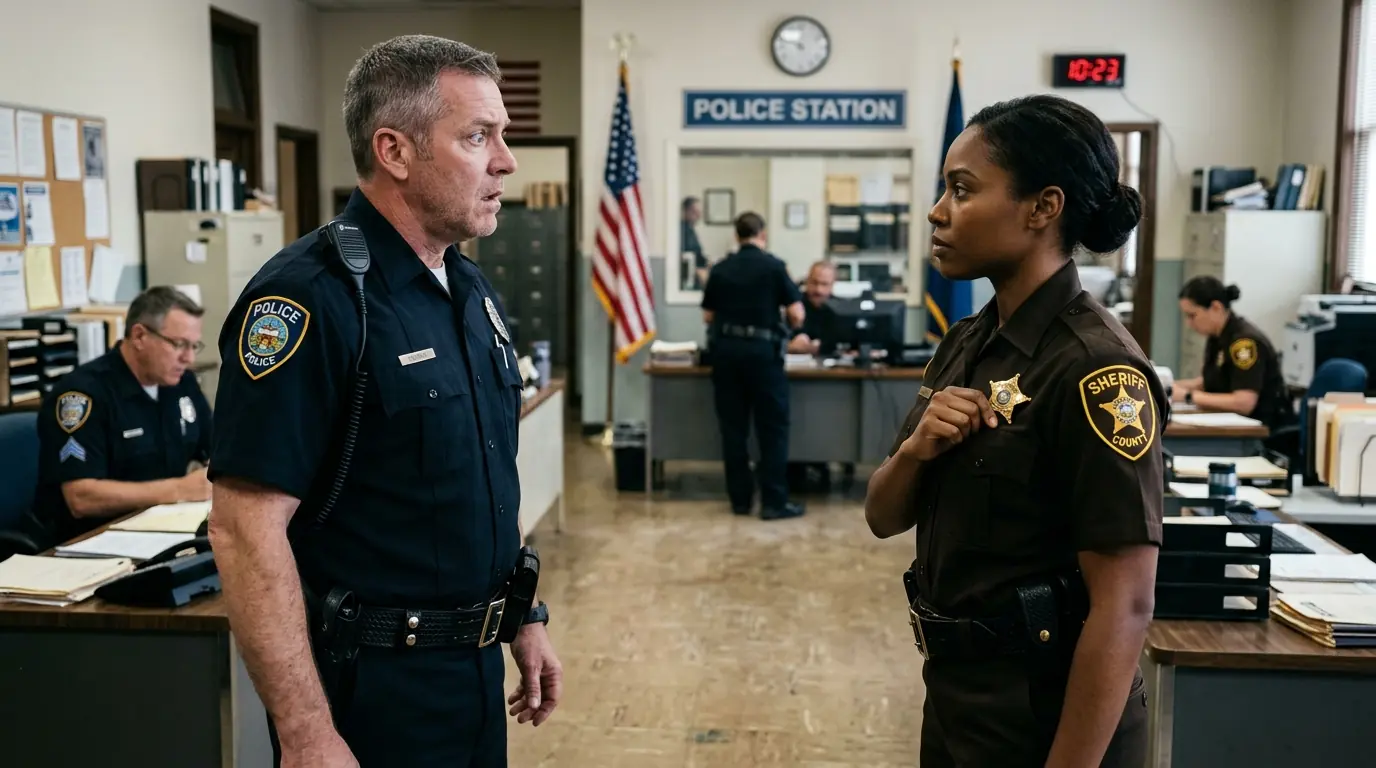
Thirty officers. Support staff. Dispatchers.
“Change starts now. Constitutional policing. Community trust. Federal oversight until you prove you can police yourselves.”
Agent Foster loads Hayes into a federal transport vehicle. Mills follows. Davis gets a reprieve pending cooperation.
“This isn’t over,” Mills shouts from the back seat. “Federal interference. Constitutional rights.”
“Your constitutional rights remain intact,” Diana replies. “Unlike the rights of every citizen you violated during your career.”
The transport vehicles drive away. Red lights disappearing into the night.
Wilson approaches Diana.
“What happens to the rest of us?”
“Training. Retraining. Constitutional education. Community engagement. Real police work.”
“And if we refuse?”
“Then you find other careers. This badge represents service, not power.”
Rodriguez surveys the wreckage of his command.
“Chief Washington, I have to ask. Why this department? Why us?”
Diana’s expression softens slightly.
“Because change has to start somewhere. Because corruption spreads if left unchecked. Because citizens deserve better.”
She walks to the evidence room.
Boxes of files. Complaint records. Use-of-force reports. Years of ignored violations.
“Federal review starts tomorrow. Constitutional compliance training begins Monday. Community engagement protocols take effect immediately.”
Radio chatter increases. News trucks arriving. Federal vehicles departing. The story spreading across the city.
Diana removes her jacket again. Reveals the torn blouse underneath. The bruises. The cuts. Evidence of their crime.
“One more thing, people. This recording will be evidence in federal court. Your words, your actions, your choices.”
She presses stop on the recording device.
“Justice isn’t about badges or rank or authority. It’s about truth. About accountability. About treating every citizen with constitutional respect.”
The station falls silent.
Thirty officers processing their new reality.
Federal oversight. Real accountability. Constitutional policing.
“Questions?” Diana asks.
No one speaks.
But Diana isn’t finished.
The next revelation will rock the entire department.
Justice is just beginning.
Six weeks later, Diana sits behind the chief’s desk. Nameplate gleaming. Badge polished.
Sunlight streams through clean windows overlooking a transformed department.
Her first official acts are swift. Decisive. Federal.
Hayes. Terminated. Federal prosecution pending. Twenty-three counts of civil rights violations. Fifteen-year minimum sentence.
Davis. Terminated. Plea bargain accepted. Three years federal prison. Testimony against co-conspirators required.
Mills. Terminated. Transferred to federal custody. Conspiracy charges. Pattern of corruption spanning eight years. Ten-year sentence likely.
Rodriguez. Demoted. Transferred to records division. Pension intact but authority stripped. Federal oversight of all decisions.
Wilson. Promoted to detective. Assigned to internal affairs. Protected witness status. Commendation for courage under pressure.
The changes ripple through every level of the department.
New policies printed and distributed.
Constitutional compliance mandatory.
Body cameras activated automatically during all citizen contact.
No exceptions. No overrides. No excuses.
Community liaison officers appointed from every precinct.
Monthly town halls scheduled.
Citizen complaint procedures streamlined.
Federal oversight until trust rebuilds.
Training programs redesigned.
Constitutional law requirements doubled.
De-escalation techniques mandated.
Racial bias workshops implemented.
Hiring standards elevated.
Background checks intensified.
Psychological evaluations expanded.
Character references verified through federal databases.
Diana reviews incident reports from the past month.
Use of force down sixty percent.
Citizen complaints down seventy percent.
Community engagement up two hundred percent.
Detective Wilson knocks on her door.
“Chief, monthly statistics are ready.”
“Come in, Detective.”
Wilson enters carrying files.
Six weeks of federal oversight data. Crime statistics. Community feedback. Officer performance metrics.
“How are we doing?” Diana asks.
“Better. Crime rates steady. Community trust improving. Officers adapting to new standards.”
“Complaints?”
“Fifteen officers requested transfers to other departments. Couldn’t adapt to constitutional requirements.”
“Good. Better they leave than violate citizens’ rights.”
Diana signs authorization forms. Equipment upgrades. Technology improvements. Federal grant applications for community programs.
Captain Maria Santos Knox. New hire from federal service. Twenty years FBI experience. Diana’s first major appointment.
“Chief, community meeting tonight. City council wants department update.”
“Attendance?”
“Packed auditorium. First time in years citizens show up voluntarily.”
That evening, Diana addresses two hundred community members.
Diverse crowd. Different ages, races, backgrounds. People who previously avoided police contact.
“Six weeks ago, this department failed you,” she begins. “Federal investigation confirmed what you already knew. Corruption. Brutality. Constitutional violations.”
Murmurs ripple through the audience. Some approval. Some skepticism.
“Change requires more than new policies. It requires culture transformation. Officer accountability. Community engagement. Federal oversight until we earn back your trust.”
A hand raises in the back. Elderly man. Neighborhood watch coordinator.
“Chief Washington, how do we know this isn’t temporary? New chief comes, makes promises, transfers away in two years.”
“Fair question. Federal oversight continues for minimum five years. Community board established with civilian review authority. Constitutional violations trigger automatic federal intervention.”
Another hand. Young mother. Lives in the neighborhood where Hayes worked.
“What about the officers who covered up complaints, who ignored problems? Why do they keep their jobs?”
“Forty-seven officers face disciplinary action. Twelve terminated. Fifteen demoted. Twenty transferred to non-enforcement roles. No one escapes accountability.”
Questions continue for ninety minutes.
Detailed. Skeptical. But engaged.
Citizens participating in democracy for the first time in years.
After the meeting, Diana walks through downtown streets.
Community policing patrol. Officers on foot. Engaging residents. Building relationships.
Officer Jennifer Torres approaches. New hire. Young. Eager. Represents the department’s future.
“Chief, how do you keep morale up during all these changes?”
“Torres, what’s our mission?”
“To serve and protect.”
“Serve whom?”
“The community.”
“Protect whom?”
“Citizens’ rights.”
“Then morale comes from doing the job correctly. Constitutional policing builds pride. Community trust creates purpose.”
They continue walking. Radio chatter minimal. Peaceful night.
Officers handling calls professionally. De-escalating conflicts. Protecting rights.
Diana’s phone rings.
Federal oversight coordinator.
“Chief Washington. Quarterly review complete. Department exceeds compliance standards. Community satisfaction highest in state.”
“Thank you. We’re not done yet.”
“Understood. Change takes time, but you’re ahead of schedule.”
Diana returns to her office. Late night. Empty station.
Security lights humming.
Different energy now. Purposeful. Professional.
She reviews tomorrow’s schedule.
Officer training session. Community board meeting. Federal compliance review. Budget discussions for expanded community programs.
A knock at her door.
Unexpected visitor.
Sergeant Brown enters. Still booking supervisor. Witnessed everything that first night.
“Chief, got a minute?”
“Always. What’s on your mind?”
“Wanted to thank you. For not destroying everyone. For giving good officers a chance to do better.”
“Brown, you helped expose the corruption. You chose truth over loyalty. Why would I punish that?”
“Some of us knew things were wrong. We just didn’t know how to fix them.”
“Now you do. Constitutional policing. Community trust. Federal accountability. The tools exist.”
Brown nods.
“Different place now. Officers actually want to work here. Citizens actually trust us.”
“Trust must be earned daily. Never taken for granted.”
After Brown leaves, Diana walks through the station.
Night shift officers processing calls. Professional demeanor. Constitutional compliance. Community respect.
She stops at interview room two.
Same flickering lights. Same metal table.
But different purpose now.
Room where citizens file complaints safely.
Where officers receive constitutional training.
Where change happens.
Her phone buzzes.
Text message from Wilson.
“Chief, just handled domestic dispute. De-escalated successfully. No force required. Parties shook hands. Community policing works.”
Diana smiles.
Real change. Measurable progress. Constitutional policing.
She locks her office. Walks to her car.
Government sedan. Modest but official.
Symbol of federal oversight and community accountability.
Radio chatter continues. Professional communication. Respectful citizen contact. Constitutional compliance.
The city sleeps peacefully.
Protected by officers who understand their oath.
Served by leaders who enforce accountability.
Governed by laws that protect everyone equally.
Diana drives through quiet streets.
Streetlights illuminating empty sidewalks.
Patrol cars moving with purpose.
Community trust slowly rebuilding.
Federal oversight continues.
Constitutional training expands.
Community engagement deepens.
But real change requires constant vigilance.
Daily commitment.
Generational transformation.
This is only the beginning.
Real change requires constant vigilance.
Diana’s work is just starting.