You people never listen, do you?
Before Olivia Hawkins can answer, the officer’s boot sweeps her legs, and she drops hard, knees slamming against her own driveway at 2:00 p.m. on a Tuesday afternoon. She’s a Black woman holding grocery bags, and apparently that’s crime enough. He kicks the bags from her hands. Eggs shatter. Milk spreads across concrete. His palm shoves her face into asphalt that’s been baking under the Georgia sun all day, hot enough to burn. “Stay down,” he says, though she hasn’t tried to move, hasn’t spoken, can barely breathe with his knee between her shoulder blades.
Her daughter appears in the doorway. “What are you doing to her?”
“Get inside before you join her.”
Four officers surrounding one woman at her own home. No questions, no interest in answers. What they don’t know will destroy them.
Twenty-three hours earlier, Olivia Hawkins is stepping off a military transport at Hartsfield-Jackson Airport with a duffel bag that weighs more than her daughter and a headache that’s been building since somewhere over the Atlantic. Six months in Germany coordinating logistics for 3,200 troops, and all she wants is her own bed, her own shower, and 12 uninterrupted hours where nobody needs her to solve a problem.
The Uber driver doesn’t talk much, which is perfect because Olivia doesn’t have words left in her. She watches Atlanta slide past the window, the city she grew up in but barely recognizes anymore, with all the new construction and rising towers that weren’t there when she deployed.
The driver drops her at her house in Ridgemont just after 6:00 in the evening on Monday. And the neighborhood smells exactly like she remembers. Charcoal smoke from somebody’s grill, chlorine from somebody’s pool, cut grass baking in July heat that doesn’t quit even when the sun starts thinking about setting.
Her house is a modest three-bedroom ranch with blue shutters that need repainting and a lawn that definitely needs mowing, sitting on a street where the trees are old enough to meet over the road and create tunnels of shade that make the heat almost bearable. Ridgemont used to be exclusively white in the ’90s, but now it’s every shade of middle-class America, with HOA signs about lawn maintenance and kids’ bikes abandoned in driveways and the occasional political yard sign that gets stolen every other week, depending on which way it leans.
Emma bursts through the screen door before Olivia can even get her keys out. Sixteen years old and all long limbs and natural hair pulled into a puff on top of her head, wearing the college T-shirt from the campus visit they took before deployment, she hugs her mother hard enough to crack ribs. And Olivia breathes in the coconut smell of her daughter’s shampoo and feels something in her chest unclench for the first time in half a year.
“You said you’d be home tomorrow,” Emma says into her shoulder.
“Caught an earlier transport. Wanted to surprise you.”
“Mission accomplished.”
Emma steps back, grinning wide. “I would have cleaned my room if I knew.”
“Sure you would have.”
Olivia drops her duffel in the entryway and looks around at the house that feels both familiar and strange after six months of barracks and conference rooms. The refrigerator humming its old song, the air conditioning kicking on with that rattle it’s had for two years that she keeps meaning to get fixed. This is what she came home for, the boring domesticity of grocery lists and Emma’s summer reading assignments and arguing about whose turn it is to take out the trash.
They order pizza because there’s nothing in the house and spend the evening on the couch watching a movie Emma picked, something with too many explosions and not enough plot. But Olivia doesn’t care because her daughter’s head is on her shoulder, and this is the closest thing to peace she’s felt since she left. Emma falls asleep halfway through the way she used to when she was little, and Olivia sits there in the blue glow of the television thinking about all the moments she missed. The school events and the bad days and the regular Tuesday evenings that add up to a life.
She carries Emma to bed even though the girl is sixteen and nearly as tall as she is. Tucks her in like she’s still small and stands in the doorway for a moment watching her breathe.
Tomorrow she’ll go to the grocery store. Tomorrow she’ll start catching up on all the regular rhythms of home. Tomorrow she’ll remember what it feels like to just be Olivia instead of General Hawkins.
Tomorrow everything changes.
Tuesday afternoon, Olivia makes a grocery list and tells Emma she’ll be back in 20 minutes. The Piggly Wiggly is four blocks away. She grabs chicken, rice, vegetables, and ice cream with cookie dough chunks. By the time she’s loading bags into her Honda, it’s nearly 2:00 p.m., and the parking lot is a furnace.
She pulls into her driveway at 153. Mr. Garrison waters his roses three doors down. A patrol car idles at the corner. She’s got frozen items to get inside.
Four patrol cars materialize with flashing lights, no sirens, surrounding her vehicle. Olivia’s first thought is Emma. Some emergency. Her heart hammers.
Officer Bradley Vaughn exits first. His hand rests on his weapon. Oakley sunglasses hide his eyes.
“Ma’am, step out of the vehicle.”
Four officers for one parked car means overkill or misunderstanding. Comply and clarify. She opens the door slowly, hands visible.
“Of course, officer. Can you tell me what this is about?”
Vaughn doesn’t answer. His partner circles right. Two more officers block exits.
“Keep your hands visible.”
“They’re right here.” Empty palms, non-threatening. “My identification is in my purse if you need it.”
“Turn around. Hands on the vehicle.”
Something in his tone raises alarms. She’s the suspicious activity.
“Officer, I live here. My daughter’s inside. If there’s—”
“Hands behind your back.”
“I’m not resisting. I’m complying. I just want to—”
Vaughn sweeps her legs. Her knees hit concrete, then palms, then face. Air leaves her lungs. Copper fills her mouth. Handcuffs ratchet too tight. Metal digs bone deep.
Inside, Emma hears wrong sounds. She sees her mother on the ground, four uniforms over her. She grabs her phone and runs.
“Mom! What are you doing to her?”
An officer intercepts. “Miss, go inside.”
“She lives here. This is her house.”
Mr. Garrison drops his hose. Sixty-two, history teacher, seen this before.
“That’s Mrs. Hawkins. She’s my neighbor. There’s—”
“Sir, step back or you’re detained too.”
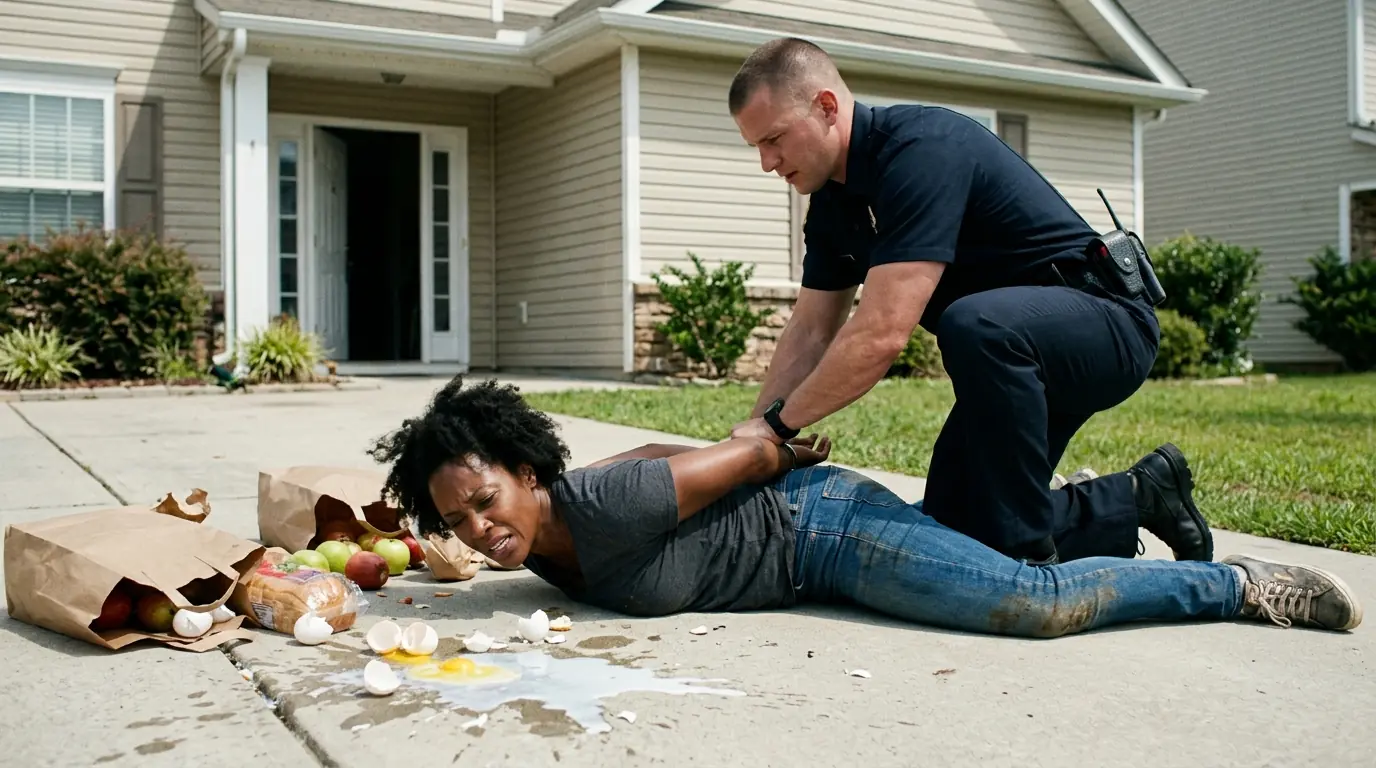
Vaughn hauls Olivia up. Her uniform is dirt-streaked, blood-streaked, her cheeks scraped raw. She says nothing, jaw clenched, breathing through her nose. Count to four. Kandahar training.
He walks her to his patrol car. No rights read. No charges stated. Opens the back door, pushes her head down. Emma screams. Mr. Garrison records on his phone. The Ring doorbell captures everything. Timestamp 14:51 and 22 seconds. Cloud-backed, permanent.
Olivia sits in the back seat with no idea she’ll spend the next four hours in a cell with no charge, no phone call, no explanation. The grocery bags still sit in her driveway, milk warming, ice cream melting, eggs cracked and leaking.
Vaughn gets in the driver’s seat. His partner, Officer Kent Morrison, rides shotgun. Neither speaks to her. The radio crackles with dispatch code she doesn’t understand.
They drive three miles to Ridgemont Precinct. The building is squat brick from the ’70s with bars on windows and a parking lot that smells like motor oil and something burnt. Vaughn parks in back, away from public view. He opens her door.
“Let’s go.”
She walks because she has no choice. Handcuffs cutting circulation. Head held high because that’s all she has left.
They process her in silence. No fingerprints, no booking photo, no paperwork she can see, just a cell at the end of a hallway that smells like disinfectant and desperation. The door closes. The lock clicks. Olivia sits on a metal bench bolted to the wall and waits.
Outside, Emma’s phone is already uploading.
Emma’s video hits the internet at 2:14 p.m. Uploaded to TikTok first because that’s where her generation lives, then cross-posted to Twitter and Instagram and Facebook within minutes because her hands are shaking so badly she can barely hold the phone. But she knows this matters, knows people need to see what just happened in broad daylight on a Tuesday afternoon in a neighborhood where nothing ever happens.
The video is shaky, and the audio catches Emma’s breathing, ragged and panicked, but the content is crystal clear. A Black woman face down on concrete, an officer’s knee between her shoulder blades, handcuffs glinting in Georgia sun, grocery bags scattered and leaking across the driveway.
The caption Emma types is simple. They arrested my mom for coming home. No explanation, no crime, just existing while Black in Ridgemont.
Within 30 minutes, the video has 12,000 views. Within an hour, 60,000. By 4:00 p.m., it’s crossed half a million. And the comments are a river of rage and recognition, people sharing their own stories, their own encounters, their own moments of being treated like criminals for the crime of breathing in the wrong ZIP code.
The Atlanta subreddit picks it up first. Then the local news stations monitoring social media for content start making calls. By 5:00 p.m., a news van is parked outside Olivia’s house, and a reporter with perfect hair and a microphone is doing a standup in front of the driveway where it happened, carefully stepping around the groceries that nobody’s cleaned up yet because Emma doesn’t know what to do, and Mr. Garrison doesn’t want to disturb what might be evidence.
Mr. Garrison gives an interview standing in his driveway with his hose still running in the background, water flooding his lawn.
“I’ve known Olivia Hawkins for six years,” he tells the camera. “She’s a good neighbor, quiet, respectful, career military. Her daughter’s a good kid. There was no reason for what happened today. No reason except the obvious one. And we all know what that is, even if we’re not supposed to say it out loud.”
By 6:00 p.m., three other neighbors have come forward with their own stories about Ridgemont Precinct. A Black man two streets over talks about being pulled over five times in eight months, always at dusk, always asked the same questions about where he’s going and whether the car is really his. A Latina woman describes officers following her home from the grocery store, parking outside until she went inside, making her feel watched in her own neighborhood. A white couple with adopted Black children talks about the sudden increase in police presence on their street after they moved in, the way patrol cars slow down when their kids play basketball in the driveway.
The pattern emerges like a photograph developing. This isn’t one bad interaction. This is policy masquerading as protection.
At Ridgemont Precinct, Olivia sits in her cell and has no idea any of this is happening. No phone, no information, just four walls and a metal bench and the sound of officers talking and laughing somewhere down the hall like this is just another Tuesday, just another shift, just another person who doesn’t matter enough to explain things to.
At 7:18 p.m., a desk sergeant she’s never seen before opens her cell door and says, “You’re free to go.”
No apology, no explanation, no charges filed, no booking record. Just, “You’re free to go.” Like the last four hours didn’t happen, like she wasn’t tackled in her own driveway and held without cause or communication.
“Why was I detained?” Olivia asks, her voice level despite the rage building in her chest.
“You’ll have to talk to the officers involved.”
“I’m talking to you. Why was I brought here?”
The sergeant’s face is blank, bureaucratic, the expression of someone who’s said these words so many times they’ve lost all meaning.
“If you have a complaint about your treatment, you can file a formal grievance with Internal Affairs. The forms are available online.”
Olivia walks out through the precinct’s front door into evening heat that feels like a slap after the air-conditioned cell. Her wrists are ringed with bruises from handcuffs that were tightened past necessary. Her cheek throbs where it hit asphalt. Her uniform is ruined with dirt and blood and the particular humiliation of being made powerless by people who swore an oath to serve.
Emma is waiting in the parking lot because Mr. Garrison called her, gave her a ride, stayed with her because he’s a decent human being who knows a sixteen-year-old shouldn’t be alone when her mother’s been arrested for no reason.
Emma hugs Olivia so hard they both almost fall over. And Olivia can feel her daughter shaking, can hear her trying not to cry, can smell the fear that’s been building for four hours.
“I recorded it,” Emma whispers. “Everything. It’s everywhere now, Mom. Everyone’s seeing it.”
Olivia doesn’t know yet what everywhere means in the context of viral social media. She doesn’t know that by midnight tonight, her face will be on news broadcasts across the country. She doesn’t know that the video has been viewed 2.88 million times and counting. She doesn’t know that #Justice4Olivia is trending in Atlanta.
All she knows right now is that her daughter is safe and they’re going home, and tomorrow she’ll figure out what comes next.
But the internet has already figured out what comes next.
Someone has recognized her uniform in the video. Someone has done a reverse image search. Someone has found her LinkedIn profile. And tomorrow morning, the whole world will know exactly who Ridgemont police just put in handcuffs.
Wednesday morning at 6:32 a.m., someone on Reddit posts a screenshot that changes everything. It’s Olivia’s LinkedIn profile, publicly available, professionally maintained, showing a career that spans 26 years and three continents.
The title beneath her name reads: Brigadier General, United States Army. Current assignment: Logistics Command, Fort Stewart, Georgia.
The Reddit thread explodes.
They tackled a general, reads the top comment with 44,000 upvotes.
They put a one-star on the ground like she’s a common criminal, says another comment, gilded three times.
She commands 3,200 troops, and they treated her like a threat for holding groceries.
By 7:00 a.m., Twitter has the story. By 8:00, CNN. By 9:00, every major news outlet in the country is running variations of the same headline: Army general detained by Atlanta police in her own driveway.
Her service record goes public next, pulled from Department of Defense databases that are technically restricted, but apparently not restricted enough when the internet decides it wants information. Twenty-six years of service. Four deployments. Iraq twice, Afghanistan, Germany. Bronze Star for meritorious service during combat operations. Logistics specialist who coordinates equipment and personnel movements for an entire brigade, the kind of officer who makes sure soldiers have what they need when they need it, which sounds boring until you realize that failure means people die.
At 9:43 a.m., someone at the Pentagon makes a phone call. Not a low-level staffer, not a public affairs officer doing damage control. Someone with stars on their shoulders and decades of institutional authority calls Atlanta Police Department Chief directly. The conversation lasts six minutes. Nobody records it, but the fallout is immediate.
At 10:15 a.m., Ridgemont Precinct Captain Dennis Caldwell calls Olivia’s cell phone.
She doesn’t answer. She’s sitting at her kitchen table with Emma, drinking coffee and trying to process what happened yesterday, trying to figure out next steps, trying to decide whether to file a complaint that will probably go nowhere or just try to move on with her life.
Caldwell leaves a voicemail. His voice is different from Vaughn’s, smoother, more practiced, with the carefully modulated tone of someone who’s used to managing problems.
“General Hawkins, this is Captain Dennis Caldwell from Ridgemont Precinct. I’d like to discuss yesterday’s incident and extend our regrets for any misunderstanding. Please call me back at your earliest convenience.”
Olivia listens to the voicemail twice. Regrets for any misunderstanding is not an apology. Incident is not the same as wrongful arrest. At your earliest convenience is not the same as accountability. She deletes the voicemail and doesn’t return the call.
At 11:00 a.m., Atlanta Police Department issues a statement to the press.
We are aware of the incident involving General Hawkins and are conducting a thorough review of the circumstances. Officer Bradley Vaughn has been placed on administrative leave pending the outcome of our investigation. The Atlanta Police Department takes all complaints seriously and is committed to serving our community with professionalism and respect.
Administrative leave with pay, which means Vaughn gets a vacation while Olivia’s face is still scraped and her wrists are still bruised and Emma still flinches every time she hears a siren.
Sarah Ramsay, investigative journalist for the Atlanta Chronicle, reads the police statement three times. She’s been covering Atlanta PD for nine years. She knows exactly what administrative leave means in practice. It means wait until the news cycle moves on. It means hope everyone forgets. It means protect the officer and blame the system and change nothing.
She picks up her phone and starts making calls. Because if there’s one general getting tackled in Ridgemont, there are probably others who weren’t generals, who didn’t have Pentagon backing, who disappeared into the system without viral videos or national headlines.
Sarah’s going to find them.
Sarah Ramsay has a process. Twenty years of investigative journalism taught her that patterns hide in paperwork and truth lives in gaps between official statements.
She starts with public records requests under Georgia’s Open Records Act. All Internal Affairs complaints against Officer Bradley Vaughn for five years. All disciplinary actions, all outcomes.
Three business days to comply.
The response comes in 72 hours, heavily redacted but damning. Vaughn’s IA file shows eight formal complaints in four years. Five allege excessive force, chokeholds, takedowns, injuries requiring medical attention. Two cite racial profiling, stops without probable cause, degrading treatment. One alleges false arrest, charges dropped when body camera footage contradicted his report.
Eight complaints, zero sustained.
Every investigation concluded insufficient evidence or within department guidelines. Every investigation signed off by Captain Dennis Caldwell.
Sarah creates a spreadsheet. She charts dates, complaint types, investigation lengths, outcomes. The pattern is protection. No matter what Vaughn does, the system finds him blameless and returns him to the street.
But Vaughn’s file was misdirection. What Sarah wanted was in the background, names of other officers, case numbers cross-referencing other incidents.
One name appears in three complaints: Officer James Fletcher, Internal Affairs investigator.
Sarah looks for the crack in the wall.
She finds Fletcher at a coffee shop in East Atlanta, far from Ridgemont. He’s 42, 20 years on force, exhausted beyond sleep.
“Off the record only,” Fletcher says, stirring coffee he won’t drink. “Vaughn’s not an anomaly. He’s a symptom. The precinct runs on numbers. Arrest quotas we don’t call quotas. Productivity metrics tied to overtime, promotions based on bodies brought in, whether arrests stick or not.”
Sarah takes shorthand notes. Documentation.
Fletcher slides a thumb drive across the table. “I didn’t give you this. CAD logs, internal emails, equipment reports, all public record eventually. I’m accelerating the timeline.”
“Why now?”
“Because I’m tired of investigating guilty officers and writing insufficient evidence. I have daughters. My oath meant something once.”
That evening, Sarah plugs the drive into an air-gapped laptop.
First file: CAD dispatch logs for July 14.
The log shows Vaughn called in the stop himself at 14:48, four minutes before Olivia reached her driveway. Coded language: suspicious person, Black female, late-model sedan, residential area. No neighbor called. No crime reported. Vaughn was parked two blocks away and radioed dispatch when he saw her car. He manufactured probable cause from her existence.
Second file: equipment maintenance logs for body cameras.
Sarah cross-references Vaughn’s badge number with failure reports. His camera malfunctioned 11 times in 18 months, specifically during incidents generating complaints. Department average malfunction rate: 2% annually. Vaughn’s rate during complaint incidents: 73%. Either cosmic bad luck or someone ensures no video evidence exists.
Third file: email thread from June. Captain Caldwell to his squad. Subject: July performance targets.
Never uses quota, illegal in Georgia, but language is clear. Fifteen arrests per officer minimum for July. We’re trending below district average affecting OT budget. Hit numbers. See hours. Union signed off.
Arrest quotas have been illegal in Georgia since 2018 because they incentivize arrests whether crimes occurred. Caldwell’s email violates state law while avoiding prosecutable terminology. Sophisticated corruption.
Fourth file: overtime records, Ridgemont Precinct, Q2 2024.
Sarah sorts by hours claimed. Seven officers are outliers. Vaughn claimed 89 overtime hours in June alone. Precinct average: 12.
She cross-references Vaughn’s OT with arrest logs. Most arrests happen 18:45 to 19:15, last 30 minutes of shift. Arrests then trigger overtime because processing extends into the next shift, a loophole corrupt officers exploit.
The fraud.
Sarah checks court records for those arrests. Sixty-two percent resulted in dropped charges or failure to appear, suggesting weak or fabricated arrests. You can’t claim overtime for work manufactured through false arrests.
The math.
Seven officers claiming excessive overtime for questionable arrests. Average 80 hours monthly beyond 40-hour weeks. At $48 hourly, that’s roughly $340,000 annually paid for arrests not leading to convictions.
$340,000 gets district attorneys interested. Makes city council hold hearings. Transforms individual complaints into systemic investigations.
Sarah writes.
Story goes live 6:00 a.m. Thursday. The Ridgemont pattern: how arrest quotas and overtime fraud built a system of abuse.
Everything included. Vaughn’s complaints, body camera failures, quota email, overtime numbers, court dismissals. She names names. Everything documented. Olivia’s arrest as visible example of years-long pattern.
By 8:00 a.m., shared 40,000 times. By noon, Fulton County DA issues statement.
We are reviewing allegations of systematic misconduct at Ridgemont Precinct and will determine appropriate action based on evidence.
By 3:00 p.m., grand jury convened.
Criminal investigations take months, but accountability machinery started moving.
Sarah’s phone rings. Fletcher. Blocked number, tight voice.
“They transferred me effective immediately. Night shift patrol, Zone 6. Captain says routine rotation. We both know what it really is.”
“I’m sorry,” Sarah says.
“Don’t be sorry. Keep digging. There’s more. Ridgemont’s not the only precinct running this scheme. Look at overtime patterns across the district. Follow the money. It goes higher than Caldwell. Way higher.”
He hangs up before she can ask what he means.
Sarah looks at her laptop screen, at files still unread on Fletcher’s thumb drive, and realizes she’s only scratched the surface. If Ridgemont Precinct is running a $340,000-per-year overtime fraud scheme, and Fletcher says other precincts are doing the same, then the problem isn’t one bad captain or seven corrupt officers.
The problem is institutional.
The problem goes all the way up.
She opens a new file on the thumb drive. This one’s labeled district-wide OT comparisons 2023 to 2024. The spreadsheet shows overtime data for all 12 precincts in the Atlanta metro area.
She sorts by total OT expenditure and feels her stomach drop.
Ridgemont isn’t an outlier. Ridgemont is average.
Three precincts are spending more on questionable overtime than Ridgemont. Two precincts show the same body camera malfunction patterns. Five precincts have similar arrest quota emails from their respective captains, all carefully worded to avoid the word quota while making the policy crystal clear.
Sarah does quick math on the district-wide numbers. If seven officers per precinct are running the same scheme and 12 precincts show similar patterns, that’s 84 officers potentially involved in systematic fraud. At $340,000 per precinct annually, that’s over $4 million being stolen from Atlanta taxpayers to fund a system that incentivizes false arrests.
$4 million.
That number doesn’t just get district attorneys interested. That number gets federal prosecutors interested. That number triggers FBI public corruption investigations. That number means RICO charges if the conspiracy is organized enough.
Sarah starts a new document. This story is bigger than Vaughn, bigger than Caldwell, bigger than Ridgemont. This story is about how an entire police district created a financial incentive structure that rewards officers for arresting innocent people. And Olivia Hawkins, Brigadier General, Bronze Star recipient, 26 years of service, was just the one who had enough visibility to make people pay attention.
Sarah keeps writing. The follow-up story will publish Monday. By then, she’ll have contacted every person who filed a complaint in the past two years across all 12 precincts. By then, she’ll have mapped the network. By then, she’ll have built a case so airtight that even the blue wall of silence can’t protect them.
Outside her apartment window, Atlanta sleeps, but Sarah’s just getting started.
The Atlanta Police Benevolent Association issues a statement Friday morning, 48 hours after Sarah’s article breaks. The union represents 4,300 officers and has a political war chest that makes city council members nervous during elections.
Officer Bradley Vaughn is a dedicated member of law enforcement with nine years of exemplary service. He has received commendations for bravery and has put his life on the line to protect our community. This rush to judgment by media outlets undermines the difficult work that officers perform every day. Officer Vaughn followed department protocols, and we are confident any fair investigation will clear him. The association stands firmly behind Officer Vaughn and all officers who face false accusations while doing their jobs.
No mention of eight prior complaints. No acknowledgement of body camera malfunctions or quota emails or overtime fraud. Just the standard playbook. Wrap the officer in the flag. Invoke sacrifice. Portray accountability as an attack on all police.
Union Vice President Greg Sullivan does a live interview that evening, sitting in full uniform even though he’s off duty. The interviewer asks about Sarah’s article.
Sullivan’s response is smooth, practiced. “Look, I wasn’t there. I don’t know what General Hawkins did before the cameras started rolling. Officers make split-second decisions with incomplete information and their lives potentially at risk. Armchair quarterbacking from journalists who’ve never worn a badge doesn’t help anyone.”
The host follows up. “But the CAD logs show Officer Vaughn called in the stop before General Hawkins arrived home. There was no reported crime.”
Sullivan shakes his head with patient disappointment.
“I’m not going to litigate evidence on television. That’s what investigations are for. Officers develop instincts based on years of experience. We should let the process work instead of convicting people in the court of public opinion.”
It’s masterful deflection. He sounds reasonable. And for viewers who want to believe the system basically works, it’s enough.
By Saturday, the counter-narrative builds. Anonymous sources tell friendly outlets that Olivia has a history of being difficult. There have been complaints about noise, they say, disputes about property lines. One claims she was confrontational at HOA meetings, though no one provides documentation.
Mr. Garrison, who actually attends HOA meetings, calls these claims complete fabrication when reporters contact him. “Olivia is the quietest neighbor on the block. She’s deployed half the time.”
This is character assassination, but damage is done. Comment sections fill with people who now see the incident as ambiguous. Maybe she provoked them. We don’t know the whole story. She should have just complied, as if she didn’t. As if the video doesn’t show exactly what happened.
Sunday afternoon, Olivia receives a voicemail from a blocked number. Male voice, gravelly, deliberately slow.
“General Hawkins, you’ve made a lot of noise. Got people asking questions that don’t need answers. Accidents happen to heroes. Think about your daughter’s safety. Think about whether this crusade is worth what it might cost.”
Fourteen seconds.
Olivia listens once, then saves it to three different cloud accounts because she knows how evidence disappears. She doesn’t call police. Who would she call?
That evening, Emma comes home from a friend’s house with red eyes and won’t talk for an hour. Finally, it spills out. Kids at school whose parents are cops. They’re saying her mom is a liar. They’re saying she attacked officers first and the video doesn’t show it. They’re saying Emma’s trying to get attention, get money from a lawsuit, ruin good men’s careers.
“They called me a race-baiter,” Emma says, voice small. “Said I’m making everything about race when it was just a normal stop.”
Olivia holds her daughter and feels rage harden into something cold and permanent.
Monday morning, Olivia gets a call from a Pentagon colonel she’s known 15 years. His tone is careful, diplomatic.
“Olivia, you know I respect you, but there are concerns at senior levels about this becoming politicized, the military getting dragged into civilian law enforcement controversies. Some people are suggesting it might be better to resolve this quietly. Take the department’s apology, accept a settlement, move on. Your promotion to major general is coming up for review. It would be unfortunate if external controversies complicated that process.”
The threat is polite but unmistakable. Drop it or risk your career.
Olivia thanks him and hangs up. She sits at her kitchen table. The house is quiet. Emma’s at school. The voicemail threat is on her phone. The smear campaign is on television. Her career is hostage. Her daughter is harassed.
This is how they win.
Not by being right, but by making the cost of fighting too high. By isolating you. By making you choose between justice and everything else you value.
Olivia thinks about giving up. It would be easy. Just let it go. Vaughn gets his vacation. She keeps her stars. Emma stops getting bullied. And life returns to normal.
She almost does it.
Her hand hovers over her laptop, ready to email Sarah saying she’s withdrawing cooperation.
Then Emma comes home early from school.
Emma’s face is blotchy from crying. Her backpack hits the floor. She stands in the doorway like she’s trying to decide whether to fall apart or hold it together.
“What happened?” Olivia asks, though she already knows.
“Mr. Patterson, my history teacher. He showed the news clip in class. The union guy saying you probably did something we didn’t see on camera. Then he asked if anyone had thoughts.”
Emma laughs bitterly.
“Brandon’s dad is a cop. He said, ‘You’re making it harder for good officers to do their jobs.’ Said people like you are why cops get killed. People like me. He didn’t say Black. He didn’t have to.”
Emma sits at the kitchen table where Olivia’s been drafting her withdrawal email.
“Mr. Patterson didn’t stop him. Just nodded like Brandon made a good point, like it was legitimate debate whether my mom deserved to be tackled in our driveway.”
Olivia closes her laptop. The cursor’s been blinking on that email for an hour.
Dear Miss Ramsay, after careful consideration, I have decided to withdraw my cooperation.
“I’m sorry, baby.”
“Why are you sorry?” Emma looks up, eyes red but sharp. “You didn’t do anything wrong. You came home with groceries. That’s it. That’s the whole crime.”
“I know, but—”
“But what? But we should just accept it? But we should let them lie about you and threaten us?”
Emma’s voice rises.
“Mom, you always said follow the rules and you’ll be fine. I believed that, and they still put you on the ground.”
The words hit like physical force. Olivia hears her own voice in her daughter’s mouth. All those years of teaching Emma to respect authority, to comply with police, to believe the system works. All those lessons now ashes.
“If you stop now,” Emma says quietly, “what do I tell myself next time? That the rules don’t work, or that you have to be a general for them to matter?”
Olivia doesn’t have an answer.
“When did you get so smart?”
“I have a good teacher.”
Emma manages a small smile. “So, what are we doing? Fighting or giving up?”
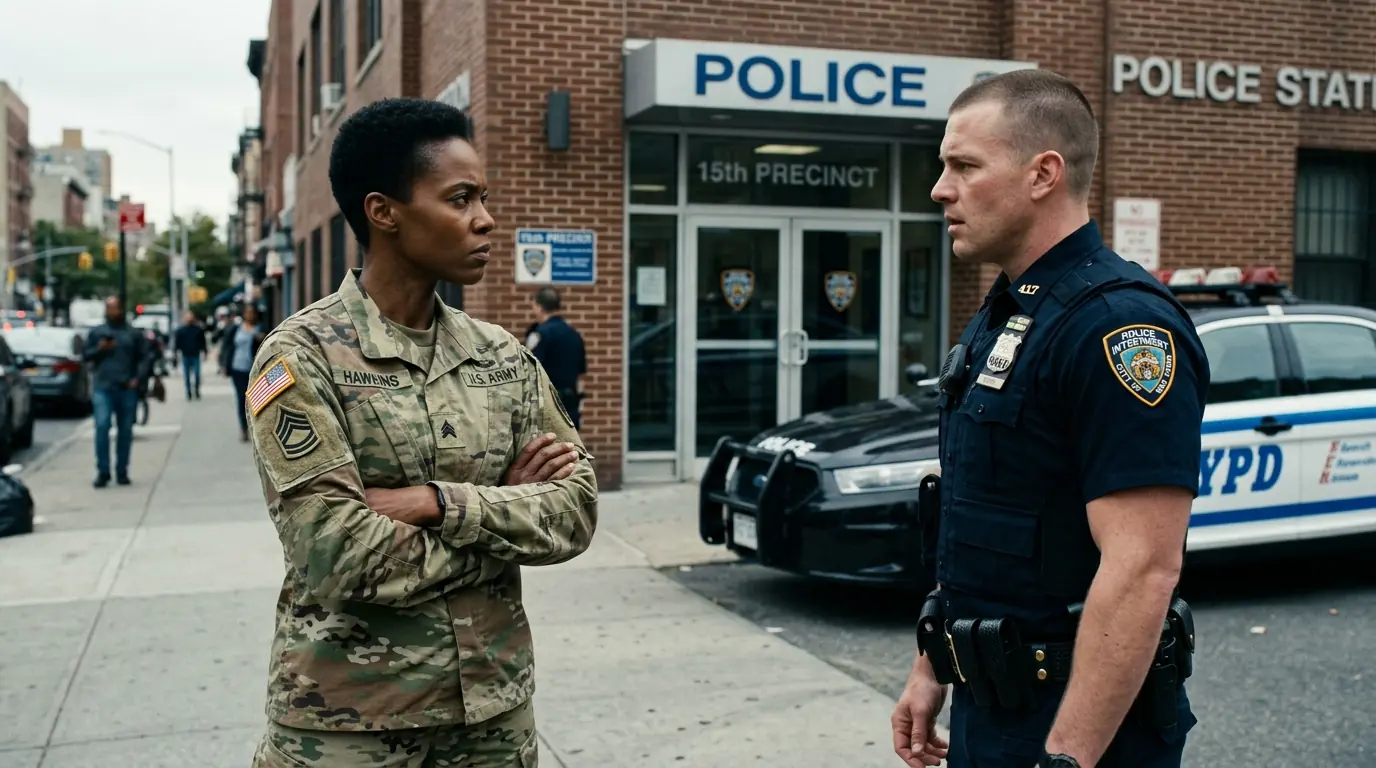
Olivia looks at her daughter and sees herself at 22, standing in the military entrance processing station with her right hand raised and her father’s words in her head. He died when she was 19, heart attack at the mechanic shop where he worked 60-hour weeks without complaint. But before he died, he told her something. Summer evening on the porch, Olivia complaining about unfair treatment.
“Do the right thing even when it costs you,” he said. “Especially when it costs you. That’s the only time it matters.”
She joined the Army three years later, took the oath at MEPS with 40 other recruits.
I will support and defend the Constitution of the United States against all enemies, foreign and domestic.
That oath didn’t have an expiration date. Didn’t say unless it’s inconvenient, or unless they threaten your career, or unless your daughter gets harassed.
Olivia deletes the email, types a new one.
Dear Miss Ramsay, I’m ready to move forward. Tell me what you need.
She clicks send.
Emma watches. “So, we’re fighting.”
“We’re fighting.”
“Good. I’m going to do homework. Let me know if you need me to testify or whatever.”
She heads upstairs like they just decided what to have for dinner instead of whether to go to war.
Olivia sits alone in the kitchen and feels something she hasn’t felt in days. Not hope exactly, not confidence, just clarity. The kind that comes when you stop looking for the easy way out and accept the hard way forward.
Her phone buzzes. Text from Sarah Ramsay.
Just got your email. Thank you. We’re going to win this.
Olivia doesn’t know if that’s true, but she knows they’re going to try.
Tuesday morning, Mr. Garrison starts a petition on Change.org. His grandson helps him set it up. The title: Justice for General Hawkins and accountability for Ridgemont Police. He includes links to Sarah’s articles, Ring doorbell timestamps, CAD log quotes, no inflammatory language. The facts are inflammatory enough.
This isn’t about one incident, he writes. This is about a pattern of abuse unchecked for years. If a decorated general can be treated this way in broad daylight, what happens to people without cameras, without visibility, without Pentagon backing?
Within six hours, 800 signatures. Within 24 hours, 3,000. By Thursday evening, 5,200 and climbing. The comment section becomes testimony.
A Black man two streets over describes being pulled over five times in eight months, always at dusk, always asked where he’s going and whether the car is really his. A Latina woman talks about officers following her home, parking outside, making her feel watched. A white couple with adopted Black children describes sudden police presence after they moved in, patrol cars slowing when their kids play basketball.
The pattern Sarah documented in arrest records is now visible in lived experience.
Wednesday afternoon, Veterans of Foreign Wars Post 254 issues a statement. The commander is a retired Army colonel who served with Olivia in Iraq.
“When we don’t protect our own, who will? General Hawkins has served with distinction for 26 years. She deserves better.”
The VFW organizes a motorcade to city hall for Monday. One hundred motorcycles, American flags, veterans in uniform, the kind of visual that makes politicians pay attention.
Thursday morning, attorney Rachel Wittmann from ACLU of Georgia calls Olivia. They want to file a federal civil rights lawsuit, not just against Vaughn, against Caldwell, against the city, against the policies that made Olivia’s arrest inevitable.
“This is bigger than one officer,” Rachel says. “This is Fourth Amendment violations, Fourteenth Amendment violations, a system that incentivizes false arrests and protects the officers who make them. We file in federal court. We demand policy changes, independent monitoring, real reform.”
Olivia asks, “What are the chances we win?”
“With Sarah’s evidence, CAD logs, quota emails, overtime fraud, 70 percent, maybe higher. But win or lose, we force them to defend their actions under oath. We create public record. We make change harder to avoid.”
Friday afternoon, Rachel files in United States District Court for the Northern District of Georgia. Case number 1:24-CV-03156. Ninety-three pages, meticulously sourced, devastating in detail.
Page 1, paragraph 3: This is not an isolated incident. This is policy.
By evening, every major outlet covers the story, not just the arrest anymore. The lawsuit, the petition, the veterans, the pattern.
Olivia watches the news with Emma and feels something she hasn’t felt since this started. Not vindication, solidarity, the knowledge she’s not fighting alone.
The system bet on her exhaustion.
The system lost.
Sunday night, Sarah receives an encrypted email from an unrecognized address. No subject line, no message, just an attachment. Audio file, four minutes 18 seconds, labeled precinct briefing 06-12-2024.mp3.
She downloads it to her air-gapped laptop and hits play.
The audio quality is poor, recorded on a phone, muffled by fabric, competing with scraping chairs and coughing officers. But the voice is clear. Captain Caldwell’s voice.
“Listen up. July targets, 15 arrests per officer minimum. I don’t care if it’s jaywalking or loitering or suspicious behavior. Hit the numbers or lose your OT. Union approved it. Questions?”
A pause. Then another voice, younger, uncertain.
“Cap, isn’t there a state law against—”
Caldwell cuts him off. “There’s no law against productivity. You want to work 40 hours and go home? That’s your choice. You want to make real money, you bring me arrests. Clear?”
Murmurs of agreement. Meeting over.
Sarah listens three times.
This isn’t coded language requiring interpretation. This is a captain explicitly ordering illegal arrest quotas tied directly to overtime pay. This is a smoking gun.
She calls Fletcher. Voicemail. Tries again. Nothing.
Monday morning, text from blocked number.
Use it. I’m done protecting them.
If Sarah transcribes the audio, gets forensic analysis confirming it’s unmanipulated, then publishes at 6:00 a.m., secret audio reveals captain ordering illegal arrest quotas.
By 8:00 a.m., national news. By 10:00 a.m., Atlanta City Council calls emergency session.
But Sarah’s not done. She’s been following Fletcher’s last advice.
Follow the money district-wide.
She filed a records request with Atlanta Finance two weeks ago. Full overtime audit for all 12 precincts, fiscal year 2024.
The response is 230 pages. By page 12, she understands why they delayed.
Ridgemont’s $340,000 in questionable overtime isn’t an outlier. It’s average. Three precincts spend more. District-wide total for arrests in the last 30 minutes of shifts, the overtime trigger window, is 1.2 million arrests. Sixty-eight percent resulted in dropped charges or failures to appear. Eighty-four officers running the same scheme. Roughly $4 million annually in fraudulent overtime from city budget. $4 million stolen from taxpayers to fund a system incentivizing false arrests.
Sarah publishes the follow-up with charts, graphs, district-wide comparisons. She names top overtime earners. She maps correlation between quota pressure and false arrest rates.
Tuesday afternoon, Atlanta finance director issues statement.
Based on preliminary review, we are referring this matter to the FBI Public Corruption Unit.
Wednesday morning, Fulton County DA convenes a grand jury, not just for Vaughn, for the system.
Federal prosecutors don’t mess around with $4 million in fraud.
By Thursday, three captains have lawyered up. By Friday, Greg Sullivan, union VP who did smooth TV interviews, resigns, citing health reasons.
Sarah gets another encrypted email, not audio this time, a spreadsheet. Union meeting minutes from 18 months earlier showing Sullivan personally approved the overtime scheme, lobbied captains to increase quotas to boost member earnings. The union wasn’t just protecting bad officers. The union engineered the corruption.
Sarah publishes Saturday morning.
Police union VP orchestrated district-wide fraud scheme.
By afternoon, Sullivan’s lawyer issues statement.
Mr. Sullivan denies wrongdoing and looks forward to clearing his name.
By evening, federal prosecutors issue seven subpoenas.
Olivia watches the news from her kitchen table. Each revelation, each indictment, each crack in the blue wall. Emma sits beside her.
“Is it over?”
“Not yet, but it’s close.”
July 28, 9:00 a.m., Fulton County Courthouse.
The grand jury room is sealed by law. No cameras, no public gallery. Twenty-three citizens, a prosecutor, a court reporter.
Olivia enters in Army service uniform, ribbons on her chest, Bronze Star, four deployment bars. She raises her right hand and swears truth.
The prosecutor is Patricia Moore, 50s, career built on public corruption, her voice measured, professional.
“General Hawkins, describe July 14.”
Olivia’s voice is calm, precise.
“I pulled into my driveway at 13:53. Four patrol cars arrived within two minutes. Officer Vaughn ordered me from my vehicle. I complied immediately. I asked what the stop was regarding. He did not answer. He grabbed my wrist and initiated physical force. I did not resist. I was tackled, handcuffed, detained four hours without being charged.”
“Were you informed why?”
“No. Not at the scene. Not at the precinct. Not when released.”
“Do you believe race was a factor?”
Olivia pauses.
“I believe Officer Vaughn saw a Black woman in a nice car and assumed criminality. The CAD logs support this. His history supports this. The fact that my military ID was in my hand and he never looked at it supports this.”
Moore introduces evidence. Ring doorbell footage. CAD log showing Vaughn called the stop before Olivia arrived. His IA file with eight complaints. Body camera malfunction pattern. Caldwell’s quota email.
The grand jury watches in silence.
Bradley Vaughn arrives next with his union lawyer in an expensive suit. Moore advises him of his rights.
“Officer Vaughn, why did you initiate the stop?”
Vaughn glances at his lawyer. “I invoke my Fifth Amendment right.”
“Did you check General Hawkins’s identification before using force?”
“I invoke the Fifth.”
“Did you follow department protocols?”
“I invoke the Fifth.”
Seventeen questions, seventeen invocations. Vaughn says nothing else.
Captain Dennis Caldwell is defiant, back straight, jaw set like he’s the wronged party.
“Captain Caldwell, did you send an email on June 12 instructing officers to make 15 arrests minimum?”
“That email has been taken out of context. We have performance standards.”
Moore plays the audio. Caldwell’s voice fills the room.
“Hit the numbers or lose your OT.”
The grand jury foreman, a Black woman in her 60s, leans forward. Caldwell shifts.
“That was motivational language, not literal policy.”
“Motivational fraud, Captain.”
His lawyer objects, but there’s no judge here. This is investigation, not trial.
After six hours of testimony, the grand jury deliberates 90 minutes. They return with indictments.
Bradley Vaughn: assault under color of law, official misconduct, theft by deception.
Dennis Caldwell: conspiracy to commit fraud, official misconduct, violation of Georgia arrest quota statute.
Greg Sullivan: conspiracy facilitating fraud, racketeering.
The indictments are read aloud. Bond set. Trial dates pending.
Olivia sits in the hallway and listens through the door, Emma beside her.
“They’re really going to trial.”
“They’re really going to trial.”
Not a verdict. Not yet. But accountability, finally.
August 15. Pentagon announces promotions.
Olivia Hawkins, Major General. Two stars.
The citation: exemplary service and grace under extraordinary circumstances.
Ceremony at Fort Stewart. Emma pins the second star on her mother’s uniform, hands shaking, smile steady.
That week, Atlanta PD issues General Order 248. Mandatory body cameras, all officers, all shifts, automatic cloud upload. Malfunction means suspension. Ridgemont leadership replaced. Independent monitor appointed.
September 3. Emma speaks at Ridgemont community meeting. Sixteen at a podium, 200 people watching.
“My mom taught me to follow the rules. I still believe that. But rules have to apply to everyone or they mean nothing. Thank you for listening.”
Finally, a standing ovation. Forty-three seconds of applause.
Olivia stands in back, watches her daughter become who she raised her to be.
Later, Sarah calls. “How do you feel?”
Olivia thinks about July. Face on asphalt, handcuffs too tight. Four officers who saw a threat.
“They looked at me and saw a threat,” Olivia says. “Turns out I was just not the kind they expected.”
Trials set for spring. Vaughn, Caldwell, Sullivan, all pleading not guilty, all facing years. Justice isn’t a moment. It’s a process. But today, a general stands. That matters.