She thought the woman sitting in the corner was just another customer until one strange question made her freeze where she stood. No one in the diner knew that Rosalind was being tested or that her quiet answer would make the elegant woman stare at her in surprise. By the end of the night, that one choice would start a secret that would change many lives, including her own. Rosalind’s hands burned as she carried the heavy tray across the diner floor. The plates were hot, too hot, but she couldn’t put them down yet. Table six was waiting. She pushed through the pain and set the plates down carefully, forcing her face into something that looked like a smile. The man at the table didn’t even look at her. He just pulled out his phone and started eating. She walked back to the counter and pressed her palms flat against the cool surface for just a moment. Her whole body hurt. Her feet felt like they were walking on broken glass. Her back was a knot of pain that never loosened no matter how much she stretched. She was 41 years old and her body was giving up on her. The worst part was knowing it would never get better. This was her life now. This was all it would ever be. Her daughter was waiting at home. Imagin was 8 years old and she still believed her mother could fix anything. But Rosalind couldn’t fix anything. She couldn’t even afford to buy her daughter new shoes. The ones Imagin wore to school had tape on the bottom because the sole was coming off. Rosalind had watched her try to hide it from the other kids. And that memory felt like a knife in her chest every single day. The rent was due in 4 days. She was short. She always was. No matter how many shifts she worked, no matter how many hours she stood on her feet, it was never enough.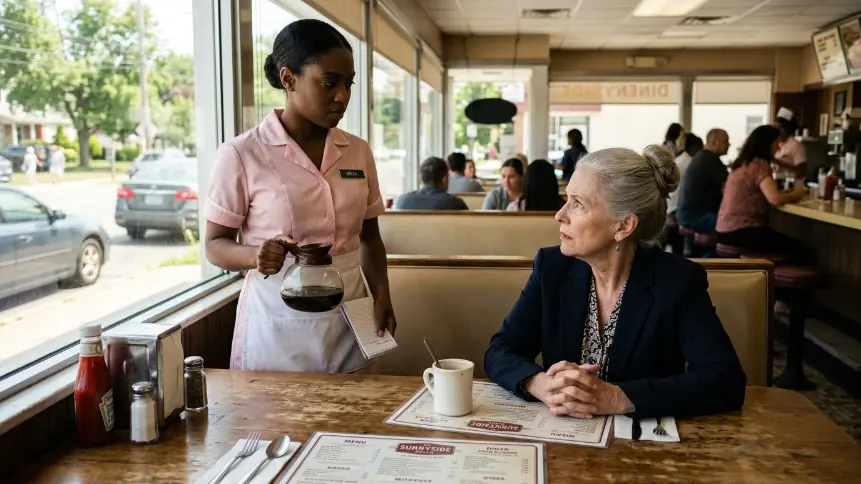
“Rosalind,” her manager called from the kitchen window. His voice was sharp. “Table three needs a refill.”
She grabbed the coffee pot and walked over to table three. Her hand shook a little as she poured, and she prayed she wouldn’t spill. If she spilled, Derek would write her up. If she got written up one more time, she’d lose this job. And if she lost this job, she didn’t know what would happen to her and Imagin. The bell above the door rang. Rosalind looked up out of habit and saw an old woman walking in. The woman was different from everyone else. She wore a long dark coat that looked expensive, like something you’d see in a fancy store window. Her silver hair was pulled back perfectly, and she moved slowly like she had all the time in the world. The woman sat down in Rosalind’s section, right in the corner booth by the window. Rosalind grabbed a menu and walked over. She pulled her smile back out, the one she kept buried somewhere deep inside.
“Good morning. Can I start you with some coffee?”
The woman looked up at her. Her eyes were gray and sharp, and when she looked at Rosalind, it felt like she could see everything, every bruise, every worry, every unpaid bill.
“Yes, coffee, please,” the woman said. Her voice was calm and rich like honey. “And I’ll have the fruit bowl with yogurt.”
Rosalind wrote it down.
“I’ll get that in for you right away.”
She turned to walk away, but the woman spoke again.
“What’s your name?”
Rosalind stopped. Customers almost never asked her name.
“Rosalind,” she said.
“Beautiful,” the woman said, and she smiled. “My name is Vivien.”
Rosalind nodded and walked away quickly. Something about the woman made her uncomfortable. Not in a bad way, just in a way that made her feel too seen. She put the order in and poured the coffee. When she brought it back to the table, Vivien was looking out the window. The morning light made her face look softer, but there was still something powerful about her. Rosalind set the coffee down.
“Your food will be out in just a few minutes.”
“You look tired,” Vivien said. She didn’t look at Rosalind when she said it. She kept staring out the window.
Rosalind’s chest tightened.
“I’m okay,” she said quietly.
“No, you’re not,” Vivien said. This time she did look at her. “I can see it. You’re carrying too much.”
Rosalind felt tears start to push at her eyes, but she blinked them back hard. She couldn’t cry at work. She couldn’t cry anywhere.
“I have to get back,” she said, and she walked away before Vivien could say anything else.
The morning dragged on. Every table wanted something. Coffee, ketchup, extra napkins. Rosalind’s body screamed at her to sit down, but she couldn’t. She had to keep moving. When Vivien’s food came up, Rosalind brought it over. The old woman thanked her softly, and Rosalind walked away. But when she came back later to clear the plate, there was something sitting on the table next to a $100 bill. An envelope. Rosalind stared at it. The $100 bill alone was more than she usually made in tips all day.
“That’s for you,” Vivien said.
“I can’t take this,” Rosalind said. Her voice came out shaky.
“Yes, you can,” Vivien said. She stood up slowly. “And there’s more. Much more, if you’re willing.”
Rosalind felt her heart start to pound.
“What do you mean?”
Vivien looked at her for a long moment. Then she said,
“I’m very wealthy, Rosalind. A billionaire, actually. I made my money in technology and investments, and now I spend my time finding people who deserve a second chance.”
Rosalind couldn’t breathe. This didn’t make sense. Things like this didn’t happen to people like her.
“I want to give you three wishes,” Vivien said. Her voice was steady and serious. “Anything you want. Money, a new home, a future for your daughter. But there’s a test.”
“A test?” Rosalind whispered.
“Your first wish cannot be for yourself or your daughter,” Vivien said. “It has to be for someone else, a stranger, someone you have no connection to.”
The words hit Rosalind like cold water. She felt her stomach drop.
“Why?”
“Because I need to know you haven’t been destroyed by your suffering,” Vivien said. “I’ve given money to desperate people before, people who only saw their own pain. They used the money badly. They hurt themselves and everyone around them. I won’t make that mistake again.”
Rosalind’s hands started to shake.
“I don’t understand.”
“You will,” Vivien said. She reached into her coat and pulled out a card. “You have until tomorrow morning. If you want to accept, meet me at this address at 9:00. If you don’t come, I’ll know you’re not ready.”
She put the card on the table next to the money and walked out of the diner. Rosalind stood there staring at the card and the $100 bill. Her mind was spinning. Her whole body felt like it was buzzing.
That night, she couldn’t sleep. She lay in the dark next to Imagin, who was curled up under an old blanket, breathing softly. Rosalind stared at the ceiling and thought about everything, the rent, the shoes, the pain in her body that never went away, the look on Imagin’s face when she tried to hide her broken shoes from the other kids. And she thought about Vivien’s test. Why would someone make her wish for a stranger first? It felt cruel. It felt impossible. She didn’t know any strangers who needed help. And even if she did, why should she put them before her own daughter?
But then she thought about something else. She thought about the woman who lived two floors down in her building. Her name was Kalista. Rosalind had seen her in the hallway a few times. Kalista was young, maybe 25, and she had a baby, a tiny baby who cried sometimes late at night. Rosalind had heard through the building manager that Kalista was in trouble. Her boyfriend had left her. She had no family. She’d been evicted from her last place and was about to be evicted again. The baby had medical problems, something with his lungs, and the hospital bills were crushing her. Rosalind had never spoken to Kalista. They weren’t friends. They were just two people who lived in the same broken-down building. But Rosalind knew what it felt like to be that alone.
The next morning, Rosalind took Imagin to school. She kissed her daughter’s forehead and watched her run inside, her taped shoes flapping a little with each step. Then Rosalind got on the bus and rode across the city to the address on the card. It was a tall building made of glass, the kind of place that seemed like it belonged in a different world. Rosalind walked inside, and the woman at the front desk smiled at her like she was expected. A few minutes later, Vivien appeared. She looked the same as yesterday, powerful, in control.
“You came,” Vivien said.
“I came,” Rosalind said.
Vivien led her to an office on the top floor. The windows showed the whole city spread out below them. Rosalind felt small and out of place. Vivien sat down behind a big desk.
“What is your first wish?”
Rosalind’s throat was dry. Her hands were shaking. She had thought about this all night. She had cried about it. She had hated it. But she had made her choice.
“There’s a woman in my building,” Rosalind said. Her voice was quiet but steady. “Her name is Kalista. She has a baby. She’s about to be evicted and her baby is sick. She has no one.”
Rosalind swallowed hard.
“I want you to pay off her debt, her rent, her hospital bills, everything, and I want you to set up a fund so she can take care of her baby without drowning.”
The room went silent. Vivien stared at her. Her expression didn’t change, but something shifted in her eyes.
“You don’t even know this woman,” Vivien said slowly.
“No,” Rosalind said, “but I know what it’s like to be her.”
Vivien leaned back in her chair. For a long moment, she didn’t say anything. Then Vivien smiled.
“You pass.”
Rosalind felt like the room was spinning. She gripped the edge of the desk to steady herself.
“You pass,” Vivien said again.
She stood up and walked to the window, looking out over the city.
“Most people fail that test, Rosalind. Most people sit in that chair and think about it for a few seconds, then they make up some story about a neighbor or coworker. But you’re different.”
Rosalind’s heart pounded.
“How do you know I’m telling the truth?”
“Because I had someone visit your building last night,” Vivien said. “I know about Kalista. I know her situation, and I know you’ve never spoken to her.”
Vivien walked back to the desk.
“That’s what makes your wish real.”
Tears slid down Rosalind’s face.
“I just kept thinking about her baby.”
“And that,” Vivien said softly, “is exactly why you deserve what comes next.”
Vivien opened a drawer and pulled out a folder.
“Kalista’s debts will be paid by the end of today. And I’m setting up a trust fund for her.”
Rosalind sobbed. She couldn’t hold it in. Years of pain poured out. Vivien let her cry. When she finally calmed down, Vivien spoke again.
“Now you have two more wishes.”
Rosalind wiped her face.
“I need time to think.”
“That’s wise,” Vivien said. Then she wrote a check and handed it to her.
Rosalind looked down. $50,000.
“That’s a gift,” Vivien said. “To give you space.”
“Why are you doing this?”
Vivien looked sad.
“Because no one did it for me.”
Rosalind whispered,
“Thank you.”
Two weeks later, Rosalind came back.
“I know what I want,” she said.
“Tell me,” Vivien said.
“For my second wish, I want to start a care service business for people who are struggling.”
Vivien smiled.
“And your third?”
“I want a scholarship fund for kids like my daughter.”
Vivien stood up and shook her hand.
“You wished for a future,” Vivien said.
“Then let’s build it together.”
Six months later, Rosalind stood outside her office.
“Imagin’s Promise Care Services.”
Inside, women worked, helping families. Rosalind ran everything. Her daughter was thriving. The scholarship had helped children already. Vivien visited one day.
“You did it right,” Vivien said.
Rosalind smiled.
“I didn’t want to waste it.”
Vivien nodded.
“That’s how it’s supposed to work.”
Rosalind looked at her life, at what she had built, at the hope she finally felt. She had been broken once. But now, she was whole.
And for the first time in years, Rosalind didn’t feel like she was barely surviving anymore. She felt like she was building something real, something that would last long after her struggles were gone, something that would keep giving even when she no longer had to fight just to breathe.