The old man stumbled, collapsing toward the floor, and Birdie caught him just in time. His eyes held a lifetime of secrets, and his trembling hands slid a plain white card across the table. One word was written on it. Keys. She didn’t understand what it meant or what it promised, but in that instant, she felt the weight of a life about to be unlocked, something waiting for her, hidden just beyond reach, ready to change everything.
The lunch rush hit like a wave, and Birdie Holloway was already drowning. Table seven needed refills, table three was complaining about cold fries, and the couple by the window kept snapping their fingers at her like she was a dog. Her feet ached and her shoes were held together with duct tape. Birdie, order up. She grabbed the plates from the kitchen window, balancing them along her arms the way she’d done for twenty years.
Twenty years in this same diner, wearing the same ugly brown uniform, serving the same people who never remembered her name. Her daughter’s tuition bill sat unpaid in her purse, third notice in red letters. About time, the man at table seven muttered when she finally reached him, not even looking up from his phone, his wife sighing like Birdie’s existence was a personal insult. Sorry for the wait, folks, we’re short staffed today.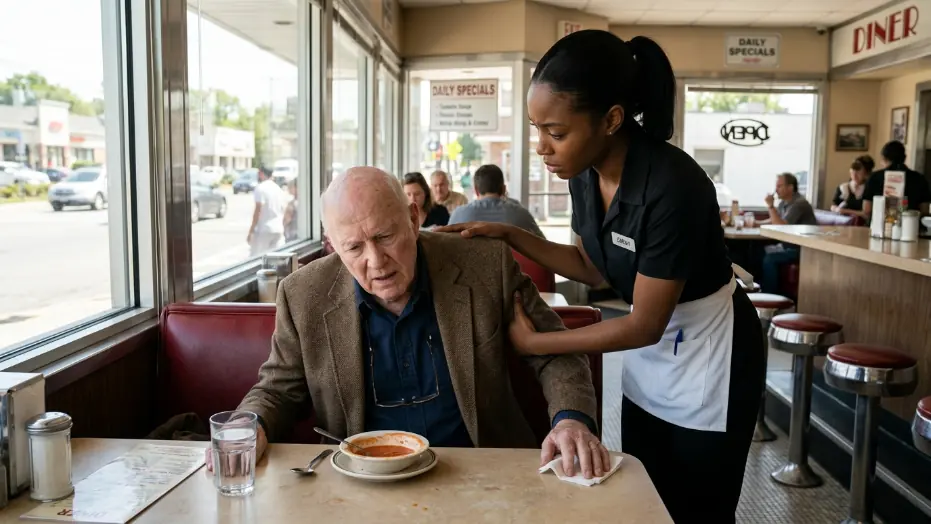
“You’re always short staffed.”
The woman pushed her plate away.
“This isn’t even what I ordered. I said no onions.”
Birdie’s throat tightened, she’d written it down, she was sure she had, but her notepad was back in her apron and her hands were shaking too hard to check.
“I’ll get you a new one right away, ma’am.”
“Forget it, just take it off the bill.”
Mr. Garrett appeared behind her like a shadow, his cologne too strong, masking the smell of old grease and regret.
“Is there a problem here?”
“Your waitress can’t get a simple order right,” the man said, finally looking up. “We’ve been coming here for years and the service gets worse every time.”
“I apologize for that.”
Mr. Garrett’s hand clamped down on Birdie’s shoulder, fingers digging in hard enough to bruise.
“Birdie here is usually more careful, aren’t you, Birdie?”
She wanted to defend herself, to show she’d written it correctly, but the words stuck like glass in her throat.
“Yes, sir.”
The couple left without tipping. Mr. Garrett waited until they were gone before turning on her, his face red, a vein pulsing.
“That’s the Hendersons, they come every Tuesday and Thursday and you just cost me two loyal customers.”
“I wrote down no onions, I don’t know what happened in the kitchen.”
“I don’t want to hear excuses.”
He stepped closer, whiskey leaking through his breath.
“You’ve been distracted for weeks, forgetting orders, moving slow, giving me attitude.”
“I’m not giving you attitude, I’m doing my best.”
“Your best isn’t good enough anymore.”
His voice dropped lower.
“Maybe it’s time we discuss whether you still have a place here.”
The diner went quiet, everyone watching. Birdie felt something crack, not her heart, but the shell she’d built to keep going.
“I need this job,” she whispered.
“Then act like it.”
He walked away. Nobody looked at her. She worked the rest of the shift on autopilot, ignoring missed calls from her daughter Stella, because she couldn’t answer the question she knew was coming. By four, the diner emptied. Birdie wiped tables with a rag that smelled like bleach and broken dreams. That’s when the old man by the window tried to stand and collapsed. She caught him before he hit the floor. He was lighter than expected, fragile.
“I’ve got you, just sit down.”
His eyes were cloudy, then focused again.
“I’m all right, just stood up too fast.”
“When’s the last time you really ate?”
He didn’t answer. She brought him fresh soup, crackers, juice, ignoring the risk.
“On the house.”
“I can pay.”
“I know, but you don’t have to.”
She sat with him.
“What’s your name?”
“Bernard Whitmore.”
“I’m Birdie.”
“Nice name.”
He smiled. They talked. He admitted he used to be somebody. She told him he still was. Then he slid her a card. One word. Keys.
“I don’t understand.”
“You will. Go to 1247 Riverside Avenue tomorrow at nine. Don’t ask questions.”
He left. She kept the card. That night, she stared at it while worrying about Stella’s tuition. The next morning, she went. The house was beautiful. A real estate attorney, Patricia Morris, greeted her. Bernard was dying, no family, changing his will.
“He’s leaving you this house.”
“No, I can’t.”
“There’s also a trust fund.”
Birdie couldn’t breathe. She went to see him. In hospice, he was weaker, but clear.
“You gave me a house, why?”
“Because you saw me.”
He told her about his loneliness, his regrets, his mother who had been a waitress like her.
“So why are you letting yourself disappear?”
She broke.
“I have a daughter.”
“And you?”
No one had asked that before.
“I don’t know.”
He gave her more. Money for Stella. A chance to live.
“Promise me you’ll stop disappearing.”
“I promise.”
She stayed until he slept.
“Thank you for seeing me.”
“Thank you for seeing me back.”
He died that evening. She quit her job.
“I’m done disappearing.”
She moved into the house. Stella came home.
“This is incredible.”
“This is ours.”
They ate dinner together, real food, real life.
“I think I want to go back to school,” Birdie said.
“Really?”
“I’m going to live my life.”
Later, she sat outside thinking about Bernard, about kindness, about how everything changed in a moment. She wasn’t invisible anymore. She was Birdie Holloway, and she was finally home.
The old man stumbled, collapsing toward the floor, and Birdie caught him just in time. His eyes held a lifetime of secrets, and his trembling hands slid a plain white card across the table. One word was written on it. Keys. She didn’t understand what it meant or what it promised, but in that instant, she felt the weight of a life about to be unlocked, something waiting for her, hidden just beyond reach, ready to change everything. The lunch rush hit like a wave, and Birdie Holloway was already drowning. Table seven needed refills, table three was complaining about cold fries, and the couple by the window kept snapping their fingers at her like she was a dog. Her feet ached and her shoes were held together with duct tape. Birdie, order up. She grabbed the plates from the kitchen window, balancing them along her arms the way she’d done for twenty years. Twenty years in this same diner, wearing the same ugly brown uniform, serving the same people who never remembered her name. Her daughter’s tuition bill sat unpaid in her purse, third notice in red letters. About time, the man at table seven muttered when she finally reached him, not even looking up from his phone, his wife sighing like Birdie’s existence was a personal insult. Sorry for the wait, folks, we’re short staffed today.“You’re always short staffed.”
The woman pushed her plate away.
“This isn’t even what I ordered. I said no onions.”
Birdie’s throat tightened, she’d written it down, she was sure she had, but her notepad was back in her apron and her hands were shaking too hard to check.
“I’ll get you a new one right away, ma’am.”
“Forget it, just take it off the bill.”
Mr. Garrett appeared behind her like a shadow, his cologne too strong, masking the smell of old grease and regret.
“Is there a problem here?”
“Your waitress can’t get a simple order right,” the man said, finally looking up. “We’ve been coming here for years and the service gets worse every time.”
“I apologize for that.”
Mr. Garrett’s hand clamped down on Birdie’s shoulder, fingers digging in hard enough to bruise.
“Birdie here is usually more careful, aren’t you, Birdie?”
She wanted to defend herself, wanted to show she’d written it correctly, but the words stuck like glass in her throat.
“Yes, sir.”
The couple left without tipping. Mr. Garrett waited until they were gone before turning on her, his face red, a vein pulsing in his temple.
“That’s the Hendersons. They come every Tuesday and Thursday, and you just cost me two loyal customers.”
“I wrote down no onions. I don’t know what happened in the kitchen.”
“I don’t want to hear excuses.”
He stepped closer, and she could smell the whiskey under the cologne.
“You’ve been distracted for weeks, forgetting orders, moving slow, giving me attitude.”
“I’m not giving you attitude. I’m doing my best.”
“Your best isn’t good enough anymore.”
His voice dropped low, meant only for her.
“Maybe it’s time we discussed whether you still have a place here.”
The diner went quiet. Everyone was watching now. Forks suspended halfway to mouths. Birdie felt something crack inside her chest, not her heart exactly, more like the shell she’d built around it to keep working, keep moving, keep pretending everything was fine.
“I need this job,” she whispered.
“Then act like it.”
He walked away, leaving her standing in the middle of the floor. The other customers went back to their meals. Nobody met her eyes. She made it through the rest of her shift on autopilot. Smile, take orders, deliver food, clear tables. Her daughter called twice, but she let it go to voicemail. She couldn’t talk to Stella right now. Couldn’t hear the question she knew was coming. Mom, did you pay the tuition yet. By four o’clock, the diner had emptied out. Just a few stragglers nursing coffee and pie. Birdie wiped down tables with a rag that smelled like bleach and broken dreams.
That’s when the old man by the window started to stand. He’d been sitting there for an hour, barely touching his soup. Thin as a rail with liver-spotted hands and a jacket too big for his frame. He pushed himself up from the booth and his legs buckled. Birdie moved without thinking. She caught him before he hit the floor, her arms wrapping around his chest as his weight fell against her. He was lighter than she expected, all bones and loose skin. His breath came in shallow gasps.
“I’ve got you,” she said, lowering him back into the booth. “Just sit down, okay, take it slow.”
His eyes were cloudy, unfocused. For a moment, she thought he might be having a stroke. Then he blinked and seemed to come back to himself.
“I’m all right,” he said, but his voice shook. “Just stood up too fast.”
“When’s the last time you ate something? Really ate, I mean?”
He didn’t answer. His hands trembled on the table. She noticed how threadbare his jacket was, how his shoes were worn through at the toes.
“Wait here.”
She went back to the kitchen and made him a fresh bowl of soup, added extra crackers, brought out a glass of juice. Mr. Garrett was in the office. If he came out and saw her giving away food, she’d probably get fired on the spot. But looking at this old man, she couldn’t bring herself to care.
“Here.” She set it down in front of him. “On the house.”
“I can pay.” He reached for his wallet with shaking hands.
“I know you can, but you don’t have to.”
She slid into the booth across from him, ignoring the ache in her feet.
“Eat first, then we’ll worry about the bill.”
He ate slowly, like he’d forgotten how food was supposed to taste. She watched him, this stranger who could be anybody’s grandfather, could be nobody’s grandfather, just another invisible person trying to survive.
“What’s your name?” she asked.
“Bernard.” He swallowed a spoonful of soup. “Bernard Whitmore.”
“I’m Birdie. Birdie Holloway.”
“That’s a nice name.” He smiled, and it transformed his face. “You’ve been working here long?”
“Twenty years.”
“That’s a long time to be in one place.”
“Yeah.” She looked around the diner at the cracked vinyl booths and water-stained ceiling tiles. “Sometimes I think I’ve been here so long I’ve started to disappear, like I’m becoming part of the furniture.”
“I know that feeling.” He finished his soup and set down the spoon carefully. “I used to be somebody. Had a business. Had a family. Now I’m just an old man who nearly fell on his face in a diner.”
“You’re not just anything,” Birdie said. “You’re Bernard Whitmore, and you’re somebody to someone.”
He looked at her for a long moment. Then he reached into his jacket and pulled out a business card. He slid it across the table.
“I want you to have this.”
She picked it up. It was plain white, no logo or phone number, just one word printed in black letters. Keys.
“I don’t understand.”
“You will.” He stood up again, steadier this time. “Go to 1247 Riverside Avenue tomorrow morning. Nine o’clock. Bring that card.”
“Mr. Whitmore, I—”
“Bernard. And don’t ask questions. Just trust me.”
He put a $20 bill on the table, way more than the soup cost.
“You saved me today, Birdie Holloway. Now let me return the favor.”
He walked out before she could respond. She sat there holding the card, the word keys staring up at her. The bell above the door chimed as he disappeared into the afternoon. Mr. Garrett came out of the office. He looked at the empty booth, at the twenty on the table, at Birdie sitting there like she’d seen a ghost. His eyes narrowed.
“Why aren’t you working?”
She stood up slowly, slipping the card into her apron pocket. Something had shifted in the last five minutes, though she couldn’t name what, like the air pressure before a storm.
“I am working,” she said. “I’m always working.”
That night, she lay in her cramped studio apartment and stared at the card under the lamp light. 1247 Riverside Avenue. She knew that street. It was in the nice part of town, where houses had driveways and yards and doors that didn’t stick. Her phone buzzed. Another text from Stella. Mom, the deadline is Friday. If we don’t pay, I lose my spot. Birdie closed her eyes. She had three hundred dollars in her account. Tuition was four thousand. She looked at the card again. What did she have to lose? She was already at the bottom, already invisible, already disappearing.
At eight-thirty the next morning, she called in sick to work. Mr. Garrett sounded almost happy, like he’d been waiting for an excuse. She hung up before he could say anything else. She took the bus across town, watching the neighborhoods change through the grimy window. The buildings got nicer, the lawns greener. The people walking dogs looked like they’d never worried about rent. 1247 Riverside Avenue was a two-story brick house with white shutters and a porch that wrapped around the front. A For Sale sign stood in the yard, but there was another sign beneath it. Sold. Birdie stood on the sidewalk, the card clutched in her hand. This had to be a mistake or a joke or something worse.
A car pulled into the driveway. A woman in a business suit got out carrying a leather briefcase. She smiled when she saw Birdie.
“You must be Birdie Holloway.”
“How did you—”
“Bernard called me last night. Said you’d be here at nine.” She walked up the porch steps and unlocked the front door. “I’m Patricia Morris. I’m a real estate attorney. Why don’t you come inside?”
Birdie’s legs felt numb as she climbed the steps. The house was even more beautiful up close, with stained glass windows and original hardwood floors. This was the kind of place she’d cleaned as a teenager, dreaming about the people who lived in houses like this. Patricia led her into the living room. Sunlight streamed through tall windows. The space smelled like fresh paint and possibility.
“I don’t understand what I’m doing here,” Birdie said.
“Bernard Whitmore owned this house for forty years.” Patricia opened her briefcase and pulled out a stack of papers. “He also owned the building your diner is in, and three other properties in town. He never married, never had children. Last week he was diagnosed with stage four cancer.”
The room tilted. Birdie sat down hard on the couch, her hands shaking again.
“Is he—”
“He’s at St. Mary’s Hospice. He has maybe a month left.” Patricia’s voice was gentle but professional. “Yesterday afternoon he called me from the diner. Said he’d met an angel who caught him when he fell. Said he wanted to change his will.”
“No.” Birdie stood up. “No, I can’t.”
“He’s leaving you this house.” Patricia held up the papers. “Along with a trust fund to cover taxes and maintenance for the next ten years. He said you reminded him of his mother. Said you saw him when everyone else looked away.”
The card fell from Birdie’s hand. It landed face up on the hardwood floor, that single word staring at the ceiling.
“He said to tell you that everyone deserves to stop disappearing,” Patricia continued. “Everyone deserves a place to rest.”
She held out an envelope.
“These are yours. The keys to your new home.”
Birdie couldn’t breathe, couldn’t think, couldn’t process what was happening.
“I was just doing my job,” she whispered. “I just didn’t want him to fall.”
“Sometimes that’s all it takes.” Patricia pressed the envelope into her hands. “Sometimes one moment of kindness changes everything.”
Outside, a bird sang in the oak tree. Sunlight filled the empty room, and for the first time in twenty years, Birdie Holloway felt like she was waking up. The envelope was heavier than it should have been. Birdie stood in the center of the living room, surrounded by space she’d never dreamed she could own. The keys pressed against her palm through the paper.
“I need to see him,” she said suddenly. “Bernard. I need to talk to him.”
Patricia checked her watch.
“Visiting hours at St. Mary’s start at ten. I can give you the room number.”
“Please.”
Twenty minutes later, Birdie was on another bus heading back across town toward the hospital. The envelope sat in her lap like a live thing. She couldn’t stop touching it, making sure it was real. Her phone rang. Mr. Garrett’s name flashed on the screen. She declined the call. Then she turned off her phone entirely.
St. Mary’s Hospice was attached to the main hospital, a quiet wing with soft lighting and nurses who spoke in whispers. The smell of antiseptic couldn’t quite cover the underlying scent of decay, of people letting go. Room 304. Birdie knocked softly before pushing open the door. Bernard lay in the hospital bed, smaller than he’d been yesterday. An oxygen tube ran under his nose. IV bags hung like translucent fruit above his head. But his eyes were clear when he saw her.
“You came,” he said. His voice was stronger than she expected.
“You gave me a house.” She pulled a chair close to his bed. “Why would you do that?”
“Because I could.” He shifted slightly, wincing. “Because I’m dying and I have no one to leave it to. And because you’re the first person in five years to look at me like I mattered.”
“Of course you matter.”
“Do I?” He smiled, sad and knowing. “I spent forty years building a real estate empire. Made more money than I could spend. And when I got sick, you know how many people visited me?”
He didn’t wait for her answer.
“Not one former business partner. Not one tenant. Not one person whose life I touched.”
Birdie thought about the diner. About twenty years of serving people who never learned her name. She understood exactly what he meant.
“I’ve been eating at that diner every Tuesday for six months,” Bernard continued. “Testing myself, I guess. Seeing if anyone would notice me. See me. And yesterday, when I felt my legs giving out, I thought, this is it. I’m going to die on the floor of a diner and no one will care.”
He reached out and took her hand. His skin was paper-thin, cool to the touch.
“But you caught me. You didn’t just stop me from falling. You sat with me. Fed me. Talked to me like I was human.”
“You are human.”
“So are you.” His grip tightened slightly. “So why are you working yourself to death in a place that treats you like you’re invisible?”
The question hit her like a physical blow. She thought about Mr. Garrett’s hand on her shoulder, his fingers digging in. About the Hendersons who never tipped. About twenty years of disappearing.
“Because I have a daughter,” she said quietly. “Stella. She’s twenty, in college. And I’m all she has. Her father left when she was three. I’ve been working two jobs since she was born, trying to give her a better life than I had.”
“And what about your life?”
No one had ever asked her that before. Not in twenty years. The question opened something inside her, something she’d kept locked away.
“I don’t know,” she whispered. “I don’t think I have one anymore. I’m just Stella’s mom. Just the waitress who brings your coffee.”
Bernard was quiet for a moment. Machines beeped softly around them. Somewhere down the hall, someone was crying.
“I never had children,” he said. “Never married. I told myself I was too busy building my business. Truth is, I was scared. Scared of letting anyone in. Scared of being vulnerable.” He looked at the ceiling. “Now I’m seventy-eight years old and I’m dying alone. And all that money, all those properties, they don’t mean a damn thing.”
“They mean something to me,” Birdie said. “That house, what you’re giving me, it’s more than I ever thought I’d have.”
“It’s not just the house.” He pulled his hand back and pointed to the bedside table. “Open that drawer.”
She did. Inside was another envelope, thicker than the first. She took it out and opened it. Inside were documents, bank statements, legal papers she didn’t fully understand.
“The house is yours free and clear,” Bernard said. “But there’s also a trust fund. Two hundred thousand dollars. Use it for your daughter’s education. Use it to take care of yourself. Use it to stop disappearing.”
The papers blurred. Birdie realized she was crying, silent tears that tracked down her cheeks and fell onto the documents in her lap.
“Why me?” she asked. “You could have given this to anyone.”
“No, I couldn’t.” Bernard’s voice was firm despite his weakness. “I’ve met a lot of people in my life, Birdie. Most of them only saw what I could do for them. But you, you saw me. Just me. A scared old man who needed help.”
He paused, breathing carefully.
“My mother was a waitress. Worked herself to death in a diner just like the one you’re in. She was forty-five when her heart gave out. Left me and my sister with nothing but her uniform and a shoebox full of unpaid bills.”
“I’m sorry.”
“Don’t be sorry. Be alive.” He looked at her intently. “Don’t let them grind you down until there’s nothing left. Don’t disappear. My mother did, and I never forgave myself for not helping her sooner.”
Birdie wiped her eyes. The enormity of it was crushing and liberating at the same time. Her whole life changed by one moment of kindness.
“I don’t know what to say.”
“Say you’ll quit that diner. Say you’ll take care of yourself. Say you’ll be the person you were before the world made you invisible.”
She thought about Mr. Garrett. About the ugly brown uniform she’d worn for two decades. About the duct tape on her shoes. About her daughter’s tuition bill and all the nights she’d lain awake calculating numbers that would never add up.
“I’ll quit,” she said.
“Today?”
“Good.” Bernard settled back against his pillows. He looked exhausted, like the conversation had drained what little energy he had left. “Promise me one more thing.”
“Anything.”
“Live in that house. Really live in it. Don’t just exist. Fill it with laughter and music and your daughter’s voice. Make it a home.”
“I promise.”
She stayed with him for another hour, holding his hand while he drifted in and out of sleep. When a nurse came in to check his vitals, Birdie reluctantly stood to leave. But Bernard’s eyes opened one more time.
“Thank you,” he said, “for seeing me.”
“Thank you for seeing me back,” she whispered.
She left the hospice with both envelopes clutched to her chest. The sun was high now, warming the parking lot. Birds sang in the trees that lined the street. Everything looked different, sharper, more real. She turned her phone back on. Seven missed calls from Mr. Garrett. Three texts from Stella. She called her daughter first.
“Mom, where have you been? I’ve been trying to reach you all morning.”
“I know, baby. I’m sorry.”
Birdie leaned against the bus stop sign.
“Listen, I need to tell you something, and I need you to sit down first.”
“You’re scaring me.”
“Don’t be scared. For once, don’t be scared.” She took a deep breath. “Your tuition is paid. Not just this semester. All four years.”
Silence on the other end. Then—
“What? Mom, what did you do?”
“I caught someone when they fell,” Birdie said, and started laughing. She couldn’t help it, the absurdity and beauty of it all. “I caught someone and he gave me keys.”
She told Stella everything, about Bernard, about the house, about the trust fund. Her daughter cried and laughed and kept asking if this was real, if her mom was okay, if this was actually happening.
“It’s happening,” Birdie said. “And I need you to come home this weekend. I want you to see the house. Our house.”
“Our house,” Stella repeated like she was testing how the words felt. “Mom, I can’t believe this.”
“Neither can I.”
After she hung up, Birdie called Mr. Garrett. He answered on the first ring. His voice was sharp with irritation.
“Where the hell are you? You called in sick, but Tasha said she saw you getting on the bus this morning.”
“I quit.”
Birdie said it simply.
“What?”
“I quit. I’m not coming back.”
The words felt like flying.
“Send my last paycheck to my address. I’ll pick up my things tomorrow.”
“You can’t just quit without notice.”
“Yes, I can. I can do whatever I want now.” She smiled at the sky. “Thank you for the job, Mr. Garrett, but I’m done disappearing.”
She hung up before he could respond. Her hands were shaking again, but this time it wasn’t from fear. It was from adrenaline, from possibility. That evening, she went back to 1247 Riverside Avenue. Patricia had left the keys in the mailbox as promised. Birdie unlocked the front door and stepped inside. The house was empty, but it didn’t feel lonely. It felt like potential, like a blank page waiting for her story. She walked through every room, running her hands along the walls. The kitchen had new appliances and granite countertops. The bedrooms had big closets and windows that let in oceans of light. Upstairs, the master bedroom had a balcony overlooking the backyard. She stood on that balcony as the sun set, painting the sky in shades of orange and pink. Tomorrow she would figure out the logistics, movers, utilities, all the practical things. But tonight, she just wanted to breathe.
Her phone buzzed. A text from Patricia. Bernard passed away this evening at 7:15 p.m. He was peaceful. He wanted you to know he was grateful. Birdie read the message three times. Then she looked up at the darkening sky and she said goodbye to a man who’d given her everything by seeing her when she was invisible. Three weeks later, Stella came home for Thanksgiving break. She walked through the front door and stopped in the entrance hall, her mouth open. Birdie had furnished it simply. Nothing fancy, just comfortable furniture and warm colors. Photos on the walls. Books on shelves. A home.
“Mom,” Stella breathed. “This is incredible.”
“This is ours,” Birdie corrected. “Yours and mine.”
They cooked dinner together that night in the big kitchen. Real dinner, not ramen or takeout. Roast chicken and vegetables and pie for dessert. They ate at the dining room table using plates that weren’t chipped.
“I’ve been thinking,” Stella said, pushing food around her plate. “Maybe I should take a semester off. Help you adjust. Get a job.”
“Absolutely not.” Birdie’s voice was firm. “You stay in school. You graduate. That’s the whole point of this. You get to have the life I didn’t.”
“But what about you? What are you going to do?”
Birdie had been thinking about that question for three weeks. She’d paid off her debts, bought new clothes, gotten her teeth fixed, all the practical things. But what came next?
“I think I’m going to go back to school,” she said slowly. “Maybe take some classes at the community college. I always wanted to be a teacher.”
Stella’s eyes lit up.
“Really?”
“Really. I’m forty-two years old and I’m going to stop disappearing.” She reached across the table and took her daughter’s hand. “I’m going to live a real life. Bernard gave me that gift.”
Later, after Stella had gone to bed, Birdie sat on the front porch in the cool November air. The neighborhood was quiet, just the sound of wind in the trees. She thought about Bernard dying alone in a hospice room, about how one moment of kindness had rippled out to change everything. She thought about all the years she’d spent being invisible, convinced that her only value was in serving others, in sacrificing herself until there was nothing left. But she wasn’t invisible anymore. She was Birdie Holloway, and she lived in a house with her name on the deed. And she was going to fill that house with laughter and life and all the things she’d been too afraid to want. A shooting star traced across the sky. She watched it burn bright and then fade. And she made a wish, not for more money or more luck, but for the courage to keep being seen. Inside, in the living room, the business card sat framed on the mantle, just one word. Keys. The key to a house, but also the key to herself, to the person she’d almost lost to years of being invisible. She’d caught a falling man, and he’d caught her right back. And now, finally, she was home.
Birdie caught a falling man, and in return, he handed her a single word that would change everything. Keys. What would you do if one act of kindness unlocked a life you never imagined? Could you recognize the moments that change your fate?