Darius Harper has one warm shift meal in his hand and barely enough money in his pocket to survive the week. That money is meant for rent, utilities, and the inhaler his little brother has only three puffs left in. If he keeps walking, his family eats tonight. If he gives this meal away, they don’t. Then he sees her.
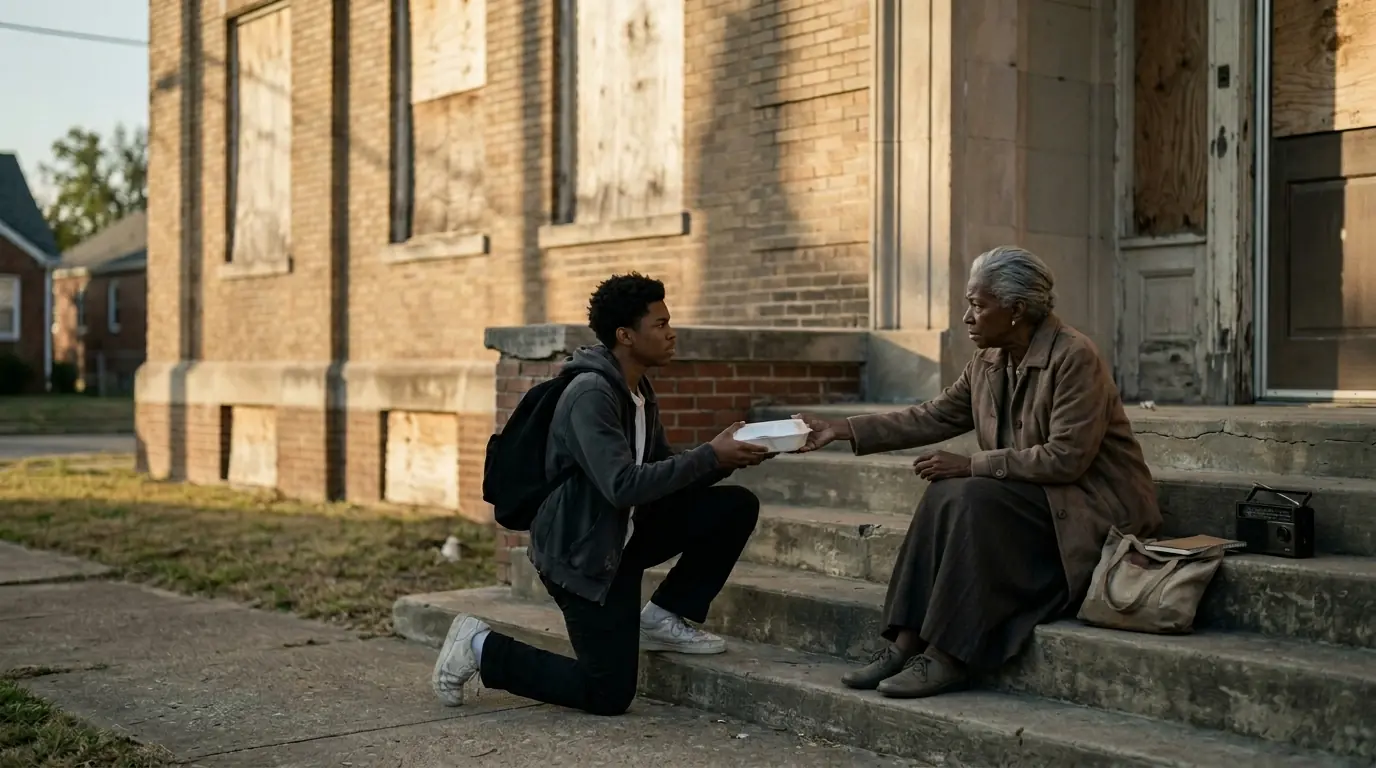
An elderly woman sits on the locked library steps. Back straight like pride is the only thing holding her up. No one asks if she’s okay. A worn notebook and a broken radio rest beside her on the concrete. She just glances at the food in his hands and looks away like she’d rather go hungry than ask.
One meal, three hungry mouths at home. Darius feels his stomach twist. Then he kneels and holds the container out to her.
He has no idea that by tomorrow 50 United States Marines will surround his house because of this choice.
The kitchen was dim in the pre-dawn light as Darius Harper moved quietly through their small rental home. The cabinets creaked softly as he opened them, taking inventory of what remained. Half a box of cereal, two eggs, a heel of bread, and some nearly expired milk. He’d make it work. He always did.
Behind him, his mother, Patrice, shuffled in, still in her nurse’s aid uniform after working the night shift. Dark circles shadowed her eyes.
“Baby, you should be sleeping,” she whispered.
“I’m good, Mama. Sit down. I’ll fix you something before bed.”
Darius pulled out their last clean pan, carefully cracking an egg while stretching the cereal portion into two bowls. Ten-year-old Jalen appeared in his Pokémon pajamas, hair tousled from sleep.
“Morning, D.”
He climbed onto a kitchen chair, watching his brother work his usual morning magic.
Darius ruffled Jalen’s hair. “Hey, buddy. Let me check that inhaler first.”
He retrieved the asthma medication from the window sill, frowning at how light it felt. Three doses left, maybe four. The refill would have to wait until next payday. While Jalen took his morning puff, Darius spotted the corner of an envelope peeking out from under yesterday’s mail. His heart sank as he recognized the final eviction notice. In one smooth motion, he slid it under an empty cereal box before his mother could see it. She had enough to worry about.
“Here we go,” Darius announced, setting down their meager breakfast with as much ceremony as he could muster. He’d given Jalen the larger portion of cereal and his mother the whole egg, keeping just a piece of dry toast for himself.
“You need more than that,” Patrice protested.
But Darius shook his head. “I’ve got my shift meal later at the restaurant. I’m good, Mama. Eat.”
The walk to school was long, but Darius preferred it to wasting bus fare they couldn’t spare. Halfway there, he spotted something on the ground: a worn leather wallet. Inside he found ID belonging to Mr. Peterson, one of the school janitors.
“Mr. Peterson!”
Darius jogged to catch up with the elderly man who was trudging toward the school entrance.
“Found your wallet, sir.”
The janitor’s weathered face creased with relief. “Lord, thank you, son. My whole week’s pay is in there.”
“No problem, sir. Have a good one.”
Darius continued on, ignoring the growl in his stomach. Near the school, he noticed Mrs. Williams, their elderly neighbor, struggling with her walker at the bus stop. Her hands shook as she tried to check the schedule.
“Mrs. Williams, you heading to the clinic?”
She nodded, squinting at the bus times. “Can’t make out these numbers anymore.”
Darius reached into his pocket, feeling his last bus transfer, the one he’d been saving for his ride to work. Without hesitation, he pressed it into her hand.
“Here, this will get you there and back.”
“But don’t you need—”
“I like walking,” he assured her with a smile. “Stay safe, Mrs. Williams.”
The morning assembly was already underway when Darius slipped into the auditorium. Principal Ward stood at the podium, his expensive suit a stark contrast to the worn school surroundings.
“Exciting changes are coming to our community,” Ward announced, his polished voice echoing. “The revitalization initiative will bring new opportunities.”
Darius listened with growing unease. Revitalization meant rising rents. Opportunities meant pricing out families like his. His hand brushed against the folded apprenticeship application in his pocket, his secret hope for getting them ahead. But it needed Principal Ward’s recommendation, and Ward had made it clear what he thought of students from certain backgrounds.
The school day dragged by, each class punctuated by the hollow feeling in Darius’s stomach. Finally, the last bell rang, and he headed straight to his dishwashing job at Marina’s family restaurant. Steam and the clatter of dishes filled the hot kitchen as Darius worked, his arms submerged in soapy water. The shift meal was what kept him going, not just for himself, but for who needed it most.
Today’s special was meatloaf with mashed potatoes and green beans. His mouth watered at the thought, but his mind was already working through the math. Mama needed energy for her night shift. Jalen was a growing kid, and he’d seen Miss Lou huddled on the library steps, looking thinner than ever.
As his shift ended, Darius stood at the back door of the restaurant, holding the single foam container of food. The weight of it felt like gold in his hands. His stomach cramped with hunger, but he thought of his mother’s exhausted face, his brother’s growing frame, Miss Lou’s dignity even in desperation. One meal, three hungry people.
Darius gripped the container tighter, weighing his choice.
The evening sun cast long shadows across the cracked sidewalk as Darius hurried past the old library building. Its boarded windows and faded “Closed for Renovation” sign had become a permanent fixture in the neighborhood. His legs ached from standing all day at the dishwashing station, but he couldn’t slow down. The last bus home would leave in twenty minutes, and he needed to get this food to his family.
That’s when he saw her.
An elderly woman sat on the library steps, her back straight, despite the cold concrete beneath her. Her clothes were worn but clean, and her gray hair was neatly combed back from her face. A broken radio sat beside her, its antenna bent at an odd angle. But it was the way she stared at the restaurant’s dumpsters across the street that made Darius’s steps falter, like looking at them physically hurt her.
He recognized that look. It was the same one his mother wore when she thought no one was watching. The silent calculation of need versus pride.
The woman’s eyes snapped to him as he hesitated. They were sharp and alert, missing nothing. Her gaze flickered to the foam container in his hands, then away again, her jaw tightening.
Darius glanced down at his watch. Eighteen minutes until the bus. If he missed it, it meant a forty-five-minute walk home. Jalen would be waiting, probably already doing homework at the kitchen table. Their mother needed to sleep before her night shift.
The foam container felt heavy in his hands. Inside was half a meatloaf, mashed potatoes, and green beans, still warm from the kitchen. He’d planned to split it between Jalen and his mother, with maybe a few bites left for himself.
Before he could talk himself out of it, Darius approached the steps. Up close, he noticed more details: a well-worn tote bag kept carefully clean, a small notebook with neat handwriting visible on its open pages, and shoes that had been recently polished despite their age.
“Evening, ma’am,” he said softly, kneeling down to her level. “I work at Marina’s back there. Would you like to share some dinner?”
The woman’s eyes narrowed. “I don’t take handouts, boy.”
“It’s not a handout,” Darius said. “It’s my shift meal. Too much for just me.”
She studied him for a long moment, her gaze taking in his school ID badge, his dishwashing uniform, the careful way he handled the container. Her eyes lingered on his hands, clean but rough from hot water and industrial soap.
“What’s your name?” she asked finally.
“Darius Harper, ma’am.”
“Lahi Grayson,” she replied. “Miss Lou to most folks.” She paused, then added with unexpected fierceness, “Don’t you dare offer me money. Food is kindness. Cash is control. There’s a difference.”
Darius nodded, understanding completely. He opened the container and carefully tore the napkin in half, making each piece neat and presentable. With practiced movements, he divided the food evenly, arranging it so each portion looked full.
Miss Lou watched this process with unwavering attention.
“You’ve done this before,” she observed. It wasn’t a question.
“Yes, ma’am.”
She accepted her half of the napkin and food with dignity. “You’ll miss your bus?” she noted, nodding toward the stop down the street.
Darius stood, brushing off his knees. “Yes, ma’am. That’s all right. Somebody waiting on this food at home.” He hesitated. “They’ll understand.”
Miss Lou’s expression softened almost imperceptibly. “Better get walking then, Mr. Harper.”
Darius turned to go, but her voice stopped him.
“You season this yourself?”
“No, ma’am. Marina’s kitchen.”
She took a small bite of meatloaf. “Needs pepper. And somebody ought to teach their cook about proper gravy consistency.”
A smile tugged at Darius’s lips. “Yes, ma’am. I’ll pass that along.”
The walk home felt longer than usual. Darius rehearsed different versions of an apology in his head. “I’m sorry, Jay. Something came up.” No, too vague. “There was someone who needed it more,” but that might make Jalen feel less important. “I’ll make it up to you tomorrow.” But promises were dangerous when you weren’t sure you could keep them.
Street lights flickered on as he walked, casting pools of yellow light on the sidewalk. His stomach growled, reminding him that he hadn’t eaten since that piece of dry toast at breakfast. But when he thought of Miss Lou sitting alone on those cold steps, he couldn’t regret his choice.
The stairs to their second-floor apartment creaked under his feet as he climbed them slowly, his empty hands feeling heavier than when they’d held the food. Through the thin walls, he could hear the TV playing Jalen’s favorite cartoon. His brother’s homework would be spread across their wobbly kitchen table, waiting for help with math problems.
Darius stood at the door, key in hand, gathering his courage. Then he turned the lock and stepped inside to face his family.
Darius stood at the stove, stirring the pot of cheap noodles. The blue-orange flame flickered beneath, casting dancing shadows on the kitchen wall. Behind him, Jalen sat at their wobbly table, chin propped on his hands, watching the steam rise with hungry eyes. Their mother’s soft snores drifted from the living room couch where she’d collapsed, still wearing her waitress uniform. Dark circles painted shadows under her eyes, and her shoes were still on her feet.
Darius kept his movements quiet, not wanting to wake her before her next shift.
“I’m sorry about dinner, Jay,” Darius said softly, testing the noodles with a fork. “I know you were counting on that meatloaf.”
Jalen’s shoulders slumped slightly, but he tried to smile. “It’s okay, D. Were you hungry, too?”
The question twisted something in Darius’s chest. “Tomorrow will be better,” he promised. Even as his mind raced through their dwindling groceries and empty wallet, he divided the noodles into two bowls, making sure Jalen’s portion was larger.
“Did you finish your math homework?” Darius asked, setting the bowls down.
“Most of it. Can you check number seven? I got stuck.”
They worked through the problem together while eating, Darius explaining fractions between bites. When Jalen’s eyes started drooping, Darius sent him to brush his teeth and tucked him into bed.
The next morning, Darius woke early as usual. He stretched their last eggs and toast into breakfast for three, secretly setting aside a small portion wrapped in paper towels. His mother noticed him packing it, but didn’t ask questions. They’d all learned to trust each other’s reasons for doing things.
After school, his feet carried him back to the library steps. Miss Lou sat in the same spot as yesterday, her posture still proud despite the chill in the air. Her tote bag rested beside her, and the broken radio remained silent sentinel.
“Brought you something, Miss Lou,” Darius said, offering the wrapped breakfast.
She examined the simple meal with critical eyes. “Cold eggs and toast. Boy, you need to learn about proper food storage.” But she ate it anyway, and Darius noticed how she made each bite last.
This became their routine. Each day, Darius would appear with whatever food he could manage. Sometimes part of his shift meal, other times something cobbled together from home. He started walking longer routes to save bus fare, memorizing shortcuts between neighborhoods.
On Wednesday, she commented on his wrinkled uniform. “Your mama works nights at that diner on Parker Street, doesn’t she? Hard schedule, those graveyard shifts.”
Darius blinked in surprise. “How did you—”
“I notice things,” she cut him off. “Speaking of noticing, never sign a lease without reading the fine print about maintenance responsibilities. Landlords love to hide their duties in paragraph 6.”
Thursday, she critiqued his sandwich-making technique while scribbling in her notebook. “Diagonal cuts taste better than straight ones. That’s just facts.”
But it was what she didn’t say that caught Darius’s attention. He began to notice how her eyes tracked certain cars that passed by, particularly the shiny black ones with tinted windows, how she’d write quickly in her notebook when men in expensive suits walked past, muttering numbers under her breath that sounded like license plates.
Friday evening found them sharing the last of his shift meal: a slightly dry chicken sandwich that she declared needed more mayonnaise, but at least it wasn’t yesterday’s tuna surprise. A group of suited men exited the building across the street, their shoes clicking importantly on the sidewalk. Miss Lou’s hand moved to her notebook with practiced speed, but this time it fell open facing Darius. He caught a glimpse of neat columns, dates, times, addresses, license plate numbers paired with location codes, names connected by arrows to what looked like property listings.
Before he could make sense of any of it, she snapped the notebook shut with surprising quickness. “Getting dark early these days,” she said casually. But her eyes were sharp as she tucked the notebook away. “Best head home before your mama worries.”
Darius stood slowly, brushing crumbs from his pants. “Same time Monday, Miss Lou.”
She nodded once, already turning her attention to a sleek car crawling past the library. “Mind how you go, Mr. Harper, and remember what I said about those leases.”
The kitchen hummed with the clatter of dishes and the hiss of industrial dishwashers. Darius’s arms were elbow-deep in soapy water when Mr. Peterson, the restaurant manager, burst through the swinging doors.
“Listen up, everyone.” Peterson’s voice cut through the noise. “The Anderson wedding party wrapped early. Double pay for anyone staying late to clean up.”
Darius’s hands stilled in the sink. Double pay. The words echoed in his head, mixing with the memory of Jalen’s wheezing that morning. The inhaler was almost empty. Three, maybe four puffs left. His mother’s next paycheck wouldn’t stretch far enough to cover a refill.
“And get those catering trays to the dumpster,” Peterson added, already turning away. “Health code says we can’t keep them.”
Darius dried his hands slowly, watching as servers wheeled in cart after cart of barely touched food: perfectly good sandwiches, fresh fruit, whole trays of grilled chicken and roasted vegetables that had never made it to the reception floor. His stomach churned, and not from hunger. He thought of Miss Lou on her library steps, of the old man who slept in the bus shelter on Fourth Street, the teenage girl who hung around the park with her little sister. Both of them too thin, too quiet.
The decision crystallized in his mind like frost on a window. He knew it was wrong. Technically, legally wrong. But there was a different kind of wrong pressing on his conscience, a heavier kind that came with watching good food die while good people went hungry.
Darius moved carefully, deliberately. He grabbed clean takeout containers from the stack by the prep station—containers meant for garbage anyway. His hands were steady as he transferred portions of food, making each container a proper meal. Not too much, not too little, just enough to keep someone’s dignity intact while filling their stomach.
“What are you doing back there, Harper?” one of the other dishwashers asked.
“Taking out trash,” Darius answered, which wasn’t exactly a lie. These containers were headed for the dumpster one way or another.
He worked quickly, efficiently, the way his mother had taught him to pack lunches when money was tight. One container for Miss Lou. She’d probably complain about the wedding chicken being too dry, but she’d eat it. Another for the bus shelter man. Two smaller ones for the park sisters.
The back door was so close. Just three more steps.
“What the hell is this?” Peterson’s voice cracked like a whip.
Darius froze, containers balanced in his arms as the manager stormed across the kitchen. Other workers stopped to stare, their faces a mix of pity and relief that it wasn’t them.
“Stealing from me?” Peterson grabbed one of the containers, popping it open. “After I gave you a job? This is how you repay.”
“It was going to the trash,” Darius said quietly.
“That’s not your call to make.” Peterson’s face had gone red. “This is my restaurant, my food, my reputation on the line if someone gets sick. You think I want headlines about my business feeding dumpster dinners to homeless people?”
The word “homeless” hit Darius like a slap. He thought of Miss Lou’s clean shoes, her careful handwriting, her dignified posture. She wasn’t just homeless. She was a person with a name and a story and a right to eat.
“I’ll call the police,” Peterson threatened, reaching for his phone. “Get them down here right now.”
“Go ahead.” Darius’s voice remained steady even as his hands shook. “Tell them I couldn’t watch food die while people are alive.”
The kitchen had gone silent. Even the dishwasher seemed to be holding its breath.
Peterson’s eyes narrowed. “You’re fired. Get out of my kitchen, and don’t expect a reference.”
Darius set down all but one container—Miss Lou’s portion. He untied his apron slowly, folded it with the same care he used for Jalen’s school clothes, and placed it on the prep counter. Then he walked out, spine straight, chin up, the way Miss Lou sat on her library steps.
The evening air hit his face like a wakeup call. No job, no reference, no way to help with Jalen’s inhaler or the rent or any of the other bills piling up at home. His hands were really shaking now, and his legs felt weak as he started walking toward the library. But the container in his hands was still warm, and he thought about what his mother always said: “We do what’s right because it’s right, not because it’s easy.”
The familiar path to the library stretched before him, six blocks. Each step felt heavier than the last, weighted down with consequences he’d have to face eventually. But for now, he had a promise to keep. Miss Lou would be waiting, ready with her sharp comments and sharper eyes. And somehow that thought steadied him even as his world crumbled around the edges.
Darius’s steps slowed as he approached the library. The familiar corner where Miss Lou always sat was empty. No flattened cardboard, no broken radio, no tote bag filled with her mysterious notebooks. Just bare concrete swept clean as if she’d never existed.
“Miss Lou,” his voice echoed off the building’s stone facade.
The evening shadows stretched long across the sidewalk, but they couldn’t hide what was missing. A knot formed in his stomach as he clutched the still-warm container. He set it down carefully where she usually sat, then began searching the surrounding blocks, the alley behind the library, the small park across the street, the covered bus stop where she sometimes took shelter during rain. Nothing.
The food was getting cold, but Darius couldn’t stop looking. He checked the convenience store where she’d occasionally buy coffee with carefully counted change. The cashier shook his head. Hadn’t seen her all day. The sandwich shop owner, who sometimes slipped her day-old bread, hadn’t noticed her either.
Darkness was settling in as Darius made his way to Saint Mark’s shelter six blocks over. The intake volunteer flipped through her log book, frowning. “No one by that name or description today. Sorry, honey.”
The underpass near the railroad tracks was next. Darius had seen outreach workers there before, talking to people who avoided the shelters. He picked his way carefully down the slope, shoes crunching on gravel.
“Miss Lou,” he called into the shadows.
A few people stirred in their makeshift camps, but none were her. One man wrapped in a tattered blanket looked up. “The lady with the radio? Haven’t seen her since morning. Something was different, though. She packed up real careful, not in a hurry.”
Darius’s chest tightened. He thanked the man and climbed back to street level, his mind racing. Miss Lou never left her spot before dark, never packed up her few possessions unless rain threatened, and she definitely never disappeared without warning.
There was one more person to ask. Darius jogged back to the library, hoping to catch Mrs. Sorrel before she finished locking up. The librarian had worked there for years. She had to know something about the woman who’d made the steps her home.
He found her at the side entrance, keys jangling as she secured the heavy door.
“Mrs. Sorrel, please. I need to ask you something.”
She turned, startled by his voice. “We’re closed, Darius. You need to go home.”
“It’s about Miss Lou, the woman who sits out front. Have you seen her? She’s gone, and I’m worried.”
The color drained from Mrs. Sorrel’s face. The keys slipped from her fingers, clattering on the concrete.
“Oh, God,” she whispered. “Not her.”
“What do you mean? Do you know where she is?”
Darius stepped closer. But Mrs. Sorrel backed away, hands trembling as she retrieved her keys.
“Please,” she said, voice barely audible. “Just go home. Don’t ask about her anymore. It’s not safe.”
“Not safe for who? Mrs. Sorrel, please.”
But she was already hurrying away, her heels clicking rapidly on the pavement.
Darius watched her disappear around the corner, leaving him alone with more questions than answers.
The walk home felt endless. The container of wedding food sat heavy in his hands, a reminder of everything he’d lost today. His job, his reference, and now Miss Lou, who’d become a strange sort of anchor in his daily routine, was gone, too.
Patrice was asleep on the couch when he got in, still in her work uniform. Jalen had left her a note in wobbly handwriting: “Finished homework. Took inhaler. Love you.”
Darius covered his mother with a blanket and put the untouched food in the fridge. He couldn’t bring himself to tell her about losing his job. Not yet.
Sleep came in fits and starts. Darius dozed in his clothes, listening to Jalen’s wheezing breaths from the next room. The weight of everything—the eviction notice, the empty inhaler, the lost job, Miss Lou’s disappearance—pressed down on his chest like concrete.
Just before dawn, a different sound cut through his troubled sleep. Heavy footsteps, dozens of them, moving in perfect unison. The low rumble of engines.
Darius sat up, heart pounding. He reached the front window just as Patrice stirred on the couch.
“Baby,” she called, voice thick with sleep. “What’s that noise?”
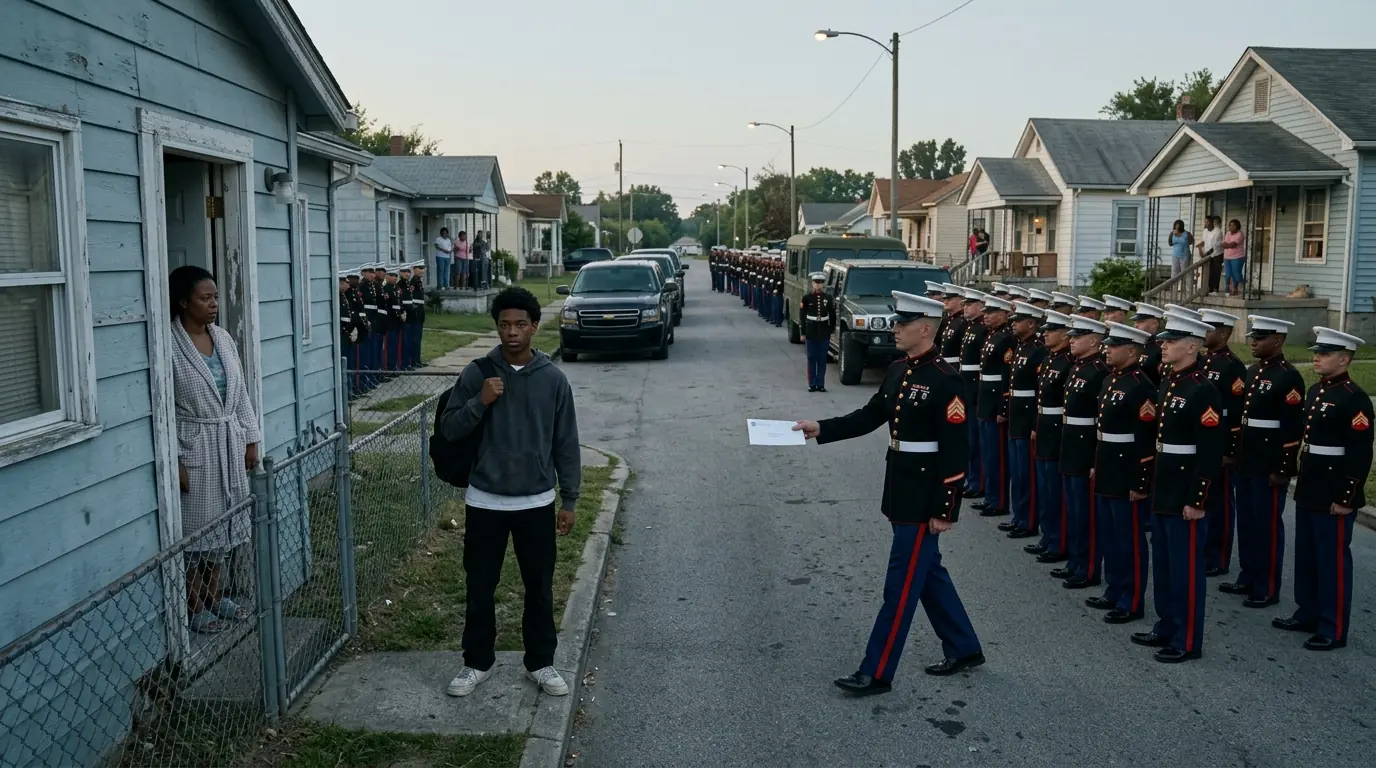
Through the thin curtains, Darius saw them. Marines, at least fifty of them, formed up in precise lines along both sides of their street. Their dress uniforms caught the first gray light of dawn. Behind them, military vehicles idled quietly.
“Mama,” he said, voice steady despite his racing pulse. “Something’s happening.”
Patrice joined him at the window, grabbing his arm.
A tall figure stepped forward from the formation. Even without the commanding presence of his uniform, Gunnery Sergeant Raphael Mendes would have drawn every eye on the street. He moved with contained power, purpose in every step.
Darius opened the front door before the knock came. Patrice’s fingers dug into his shoulder as Mendes’s voice rang out, clear and formal.
“Darius Harper.”
“Yes, sir.”
The gunnery sergeant’s expression was unreadable as he extended a crisp white envelope.
“We are here because of the woman you fed.”
Patrice pulled Darius closer as Mendes continued, his next words changing everything.
“She left instructions. If anything happened, we were to come to you.”
The Marines stood at perfect attention as Darius stepped onto the front stoop, his mother’s presence warm behind him. The morning air felt electric, charged with possibility and uncertainty. Gunnery Sergeant Mendes’s presence commanded respect without demanding it, his bearing both formal and reassuring.
“May we speak inside, Mr. Harper?” Mendes asked, noting the growing crowd of neighbors peering from windows and porches. “I assure you, we’re not here to cause trouble.”
Darius glanced at his mother. Patrice’s hand trembled slightly as she nodded, stepping back to let them in.
The small living room seemed to shrink as Mendes entered, his crisp uniform a stark contrast to their worn furniture and patched walls.
“Please sit,” Patrice managed, her voice stronger than she looked. She positioned herself between Darius and the door, maternal instinct warring with Southern hospitality.
Mendes remained standing, holding the envelope with careful reverence.
“Ms. Grayson, the woman you knew as Miss Lou, entrusted this to us with specific instructions. She was very clear about who should receive it.”
Darius accepted the envelope, noting the weight of the paper, the precise creases. His name was written in familiar handwriting, the same neat script he’d glimpsed in Miss Lou’s notebook.
With steady hands, he broke the seal and unfolded the letter.
Dear Darius,
You stubborn, beautiful child. If you’re reading this, I’m gone. Don’t waste time looking. I knew when it was time to disappear. What matters is why I chose you. You brought me food like it was normal. No phone cameras, no speeches about salvation, no demands for my life story or performances of gratitude. Just food given freely, even when it cost you.
Listen carefully. The world will try to turn your kindness into a headline or a hustle. They’ll want to make it cute. Make it trend. Make it sell. Don’t let them. Kindness isn’t currency. It’s oxygen. It keeps people alive. You reminded me the world still has decent people. That’s rarer than gold these days.
Take care of what I left behind. It matters more than you know.
LG
P.S. Your seasoning needs work, but your heart is perfect.
Darius folded the letter carefully, aware of the weight of Mendes’s gaze. The room felt too small and too large at once.
“Ms. Grayson was more than she appeared,” Mendes explained, his voice softening. “She maintained a connection to a legacy project, one that several fallen Marines believed in deeply. It involves community support, educational opportunities, and what she called lifelines for neighborhoods like this one.”
Patrice sank onto the arm of their shabby couch. “Why my son?”
“Because he proved himself without knowing he was being tested,” Mendes replied. “Ms. Grayson watched this community for years, waiting for someone with the right character to trust. She was particularly impressed by how your son handled losing his job yesterday.”
Darius felt his mother stiffen. “You lost your job?”
“For feeding people,” Mendes interjected smoothly. “He chose dignity over compliance. That’s exactly what Miss Grayson was looking for.”
The formation outside maintained their respectful stance as sunrise painted the street gold. Through the window, Darius could see Mrs. Thompson from next door watching in her bathrobe, phone pressed to her ear.
“There’s more to discuss,” Mendes continued, producing a business card with the veterans’ center address. “We’d like you to meet us there this afternoon at 2. Everything will be explained in detail.” He paused, making eye contact with Patrice. “Ma’am, I give you my word as a Marine. This is an opportunity, not a trap.”
The Marines departed with the same precision they’d arrived with, each offering a crisp salute as they passed the front door. The rumble of their vehicles faded into the morning traffic, leaving the street eerily normal, as if the whole thing had been a dream.
Darius sat at their small kitchen table, turning the business card over in his hands. The embossed letters caught the light: “Veteran Service Center, Building 17.”
Patrice stood behind him, her hands gentle on his shoulders.
“Baby,” she whispered, her voice carrying years of hard-learned caution and desperate hope. “Whatever this is, we don’t mess it up.”
The morning sun streamed through their window, catching dust motes and making them dance like possibilities. Miss Lou’s letter sat between them, its edges sharp and clean, holding secrets neither of them could yet imagine. The kitchen clock ticked steadily. Outside, the neighborhood buzzed with speculation. But inside their small home, mother and son sat in waited silence, feeling the ground shift beneath their feet, waiting for 2:00 to arrive.
The veteran service center stood solid and square against the afternoon sky. Its red brick facade weathered but dignified. Darius tugged at his worn hoodie, suddenly conscious of the coffee stain on one sleeve. Beside him, Patrice clutched her purse like a shield, her work name tag still pinned to her collar from the night shift.
Inside, the fluorescent lights hummed steadily over cream-colored walls lined with service photos and resource posters. A desk sergeant directed them to Building 17, his eyes softening when Darius mentioned Gunnery Sergeant Mendes’s name.
The conference room felt both official and tired: standard government-issue furniture that had seen better days. Darius chose a plastic chair that didn’t wobble, while Patrice perched next to him, back straight, ready to protect her son at the first sign of trouble.
Mendes arrived precisely on time, accompanied by a woman in pressed civilian clothes, whose bearing marked her as military.
“Mr. Harper, Mrs. Harper,” Mendes nodded respectfully. “This is Sergeant First Class Angela Price, retired. She oversees our community outreach programs.”
Price’s handshake was firm but warm. “Thank you for coming,” she said, settling into a chair across from them. Her movements were efficient, practiced, but her eyes held genuine kindness. “I understand this morning was quite a surprise.”
“That’s putting it mildly,” Patrice murmured, her fingers still tight around her purse strap.
Price smiled, acknowledging the understatement. She opened a folder marked with Darius’s name.
“Let me be direct about why you’re here. Ms. Grayson—Lahi—was connected to several programs designed to create opportunities for young people in this community. Real opportunities, not photo ops.”
She laid out documents one by one: apprenticeship listings, tutoring schedules, legal aid, contact information.
“We offer structured support, job placement, educational assistance, housing advocacy. There’s also a scholarship fund that’s been dormant for years. Lahi helped establish it originally.”
“Why haven’t we heard about this before?” Patrice asked, leaning forward to study a brochure.
“The programs exist quietly,” Mendes explained. “We’re not here to create feel-good stories or recruitment propaganda. This is about honoring promises made by Marines who believed in building community lifelines.”
Price nodded. “Lahi was our eyes and ears. She watched for young people who showed real character, not just good grades or clean records, but genuine integrity—people who would use these opportunities to lift others up.”
Darius thought about the library steps, about sharing his last meal. “She was testing people.”
“Observing,” Price corrected gently. “She kept detailed notes: dates, names, patterns of behavior. When she saw someone worth investing in, she documented everything.”
She slid an application form across the table. “We’d like to offer you an interview slot for the apprenticeship program. It includes technical training and union certification options. Additionally,” she glanced at Patrice, “we can help with immediate needs through our emergency assistance fund, like replacing an inhaler.”
Patrice’s breath caught. “How did you—”
“Lahi noticed everything,” Mendes said quietly. “She mentioned your younger son’s health concerns in her notes.”
Price produced another form. “This is preliminary paperwork just to start the process. Take your time reading it. We honor Lahi’s principles here.”
Darius remembered Lahi’s stern voice: never sign anything you didn’t read twice. He studied each page carefully while Price continued explaining programs and possibilities. His mother’s tension gradually eased as Price answered questions about timelines and requirements.
“There’s one more thing,” Price said, her tone shifting slightly. “Lahi’s notebook contained information about the library property: dates, meetings, certain individuals who kept appearing. We believe it’s relevant to current development plans.”
“We received an eviction notice,” Patrice admitted, finally opening her purse to retrieve the crumpled paper. “The whole block is being revitalized.”
Price examined the notice, her expression hardening. “This timing isn’t coincidental. I can connect you with a housing attorney this evening. The Marines take care of their own, and Lahi made it clear you’re now part of this family.”
Darius sat straighter, feeling the weight of that inclusion. On the wall behind Price, a faded photograph showed Marines building a school somewhere dusty and far away. Their faces were tired but determined, focused on creating something lasting.
An hour later, they emerged into the late afternoon sun. Darius held a folder labeled “Harper Next Steps,” its contents promising more than just his future. His mother walked beside him, her shoulders lighter despite exhaustion.
The bus stop bench offered a moment to breathe, to process. The folder felt solid in his hands. Not a dream, not a trick, but something real. Something earned through small acts of kindness that hadn’t seemed significant at the time.
A transit authority worker passed by, sweeping cigarette butts from the sidewalk. Without hesitation, Darius reached into his backpack and offered the man his last granola bar. Some habits, he realized, were already permanent.
The kitchen seemed brighter somehow, despite the flickering overhead light that needed fixing. Jalen sat at the worn Formica table. His shoulders relaxed as he took steady breaths from the new inhaler. The old wheezing sound that had haunted his chest for weeks was finally quiet.
“Better?” Darius asked, watching his brother’s face carefully.
Jalen nodded, managing a small smile. “Way better. It doesn’t hurt anymore.”
Patrice moved between the stove and sink, stirring a pot of rice. The familiar smell of butter and salt filled their small kitchen. For once, she wasn’t counting portions or stretching meals. The veteran center had also provided grocery assistance along with the medical aid.
“Did you see how fast they got this to us?” she marveled, shaking her head. “Same day. I’ve never seen paperwork move that quick before.”
Darius picked up his phone, scrolling to find the apprenticeship program number. His hands weren’t shaking anymore when he dialed.
A friendly voice answered on the second ring. “Veterans Workforce Development, this is Tracy.”
“Hello, this is Darius Harper. I’m calling to confirm my interview time for tomorrow morning.”
“Of course, Mr. Harper. You’re scheduled for 9:00 a.m. with Mr. Rodriguez in Building 17. Do you need directions or bus route information?”
“No, ma’am. I remember how to get there. Thank you.”
Patrice watched him end the call, pride mixing with lingering worry on her face. “9:00 a.m. That’s good timing. I’ll be back from my shift to watch Jalen.”
“I pressed my good shirt,” Darius said, trying to sound confident. “The blue one from Aunt Ruby.”
The rice started to simmer, filling the kitchen with steam. Jalen took another clean breath, tucking the inhaler safely in his pocket. For just a moment, everything felt possible. Like the morning’s Marine formation had opened a door to a different future.
The letter carrier’s heavy knock shattered their peace. Two hours later, Darius signed for the certified envelope, his stomach dropping at the sight of their landlord’s return address. Inside, legal language marched across the page in cold black type: multiple code violations, immediate action required, accelerated timeline, 72-hour notice.
“Let me see that.”
Patrice’s hands trembled as she took the letter. “This is impossible. We just had an inspection last month. Everything passed.”
Darius read each line carefully, remembering Lahi’s warnings about paperwork. The violations seemed deliberately vague: improper storage in common areas, unauthorized modifications, safety hazards—nothing specific enough to challenge.
“It’s not random,” he said quietly. “The timing’s too perfect.”
His phone buzzed. An email notification from school. Principal Ward’s message landed like another blow: “Mr. Harper, due to concerning reports regarding your recent termination from employment, a disciplinary review has been scheduled for Monday morning. This may impact your eligibility for program recommendations and certain extracurricular opportunities. Please arrive at 7:30 a.m. to meet with the review board.”
Patrice read over his shoulder, her expression hardening. “They’re trying to block you. But why? What threat could you possibly be to them?”
Darius thought of Lahi’s notebook, her careful observation of suited men and license plates. He grabbed his jacket and the container of leftover rice.
“Where are you going?” Patrice called after him.
“To check something. I’ll be right back.”
The night air had turned cold, but Darius barely noticed as he walked the familiar route to the library. The street lights cast long shadows across the empty steps where Lahi used to sit. He placed the container carefully in her usual spot, hoping against logic that she might appear.
The scrape of tires made him look up. A black sedan rolled past, expensive and anonymous behind tinted windows. It slowed to a crawl, headlights sweeping across the library facade and pinning Darius in their glare. He forced himself to stand still, heart pounding but refusing to show fear. The car lingered, engine purring. Darius felt the weight of hidden eyes studying him, measuring his reaction. Just like Lahi used to watch others from these same steps, noting their patterns and choices in her mysterious notebook.
After what felt like hours, the sedan eased forward and disappeared around the corner without a sound.
The food container sat untouched on the cold concrete, steam slowly fading in the night air. Darius stood alone in the darkness, his breath visible in small clouds. The library’s boarded windows offered no answers, no hint of where Lahi had gone, or what she’d seen that made her such a threat.
“Where are you, Lahi Grayson?” he whispered to the empty street.
Only silence answered, broken by distant traffic and the hum of street lights. The night pressed close around him, full of shadows and unspoken warnings. Somewhere in this darkness, powerful people were moving against him, and his only ally was a vanished woman who’d left him nothing but cryptic advice and a Marine honor guard.
The morning sun cast long shadows across the school’s brick facade as Darius straightened his tie one final time. His pressed blue shirt felt stiff and formal. A shield of respectability borrowed from better days. He’d arrived thirty minutes early, determined to handle whatever Principal Ward threw at him without being late for the apprenticeship interview.
The school resource officer, Officer Matthews, stood with arms crossed near the office door. His face remained neutral, but his eyes followed Darius’s every move.
The empty hallway amplified each footstep as Darius approached.
“ID?” Matthews asked, though they both knew who Darius was.
Darius pulled out his student card, careful to move slowly and deliberately. The plastic felt slick against his nervous fingers.
“Go on in. Principal Ward is expecting you.”
The office smelled of coffee and copy paper. Principal Ward sat behind his imposing desk, a neat stack of documents arranged before him. His silver-framed glasses caught the fluorescent light as he looked up, lips pressed into what might have been meant as a smile.
“Mr. Harper, thank you for coming early. Please have a seat.”
Darius settled into one of the hard visitor chairs, keeping his back straight. His tie suddenly felt too tight, but he resisted the urge to adjust it.
“I understand you have an important interview this morning,” Ward began, his tone carefully measured. “Which makes this situation especially unfortunate.”
He slid a document across the desk. The letterhead bore an official seal. Darius didn’t recognize it. His eyes caught phrases like “exploitation of vulnerable persons” and “manipulation for personal gain.”
“A very serious complaint has been filed,” Ward continued, “regarding your interactions with an elderly homeless woman. One Lahi Grayson.”
Darius’s chest tightened. “I brought her food. That’s all.”
“Did you document these interactions? Post them online, perhaps?”
“No, sir. Never.” Darius met Ward’s gaze steadily. “I wouldn’t do that to someone.”
Ward’s fingers drummed against the desk. “And yet, we have Marines showing up at your house. Quite a spectacle. Quite convenient timing, with scholarship season approaching.”
The implication hung in the air like poison.
Darius felt heat rise in his neck, but kept his voice level. “I didn’t know anything about that. I just…” He paused, choosing his words carefully. “I saw someone hungry and shared what I had.”
“Noble intentions.” Ward’s tone suggested otherwise. “Unfortunately, given the severity of these allegations, we’ll need to implement an immediate suspension pending investigation.”
“But my interview—”
“Will need to be postponed.” Ward began filling out a form. “We can’t have students representing our school while under ethics investigation. I’m sure you understand.”
Darius watched Ward’s pen move across the paper. Each stroke another bar in the cage being built around him. The clock on the wall ticked loudly. 8:15 a.m. His interview was scheduled for 9.
“The complaint suggests you may have pressured Ms. Grayson,” Ward continued, “exploited her vulnerable position for personal advancement. Very concerning behavior.”
“That’s not true.” Darius’s hands gripped the chair arms. “I never asked her for anything. Not once.”
“And yet, here you are, suddenly connected to Marine programs and scholarship opportunities.” Ward pushed his glasses up. “Quite a coincidence.”
The unfairness of it burned in Darius’s throat. Every meal he’d shared, every long walk home after missing the bus, every quiet moment on those library steps reduced to cold suspicion on official letterhead.
“With your record,” Ward added, “the best course would be accepting responsibility. Sign this statement of apology and we can work toward a resolution that doesn’t permanently impact your future.”
Darius stood up, nearly knocking over his chair. “Excuse me, sir. I need to go.”
“Mr. Harper—”
But Darius was already moving past Officer Matthews’s startled face, through the heavy doors, and into the morning air. His dress shoes slapped against pavement as he ran to the bus stop, praying he hadn’t missed the downtown route.
Forty minutes later, he burst into the veteran center lobby, tie askew and shirt damp with sweat. The receptionist recognized him and immediately called Sergeant Price.
Price took one look at his face and ushered him into her office. She read the complaint quickly, her expression darkening.
“I know this signature,” she said, tapping the bottom of the page. “Robert Witmore. He’s been trying to buy that library property for years. Claims he’ll build luxury apartments.”
“Principal Ward wants me to sign an apology,” Darius explained. “Says it’s the only way to avoid suspension.”
Price’s eyes narrowed. “Don’t sign anything. This is a trap. If you admit to exploiting her, they can use it to invalidate anything she left you. Her documents, her testimony about the property deals—all of it becomes worthless.”
Darius looked at his watch. 8:55 a.m. His interview would start in five minutes across town.
“I should call them,” he said quietly. “Explain why I can’t make it.”
Price reached for her phone. “I can help reschedule, but Darius, this fight might cost you the position. Are you sure?”
Darius thought of Lahi’s proud posture on those library steps, how she’d refuse to beg or perform gratitude for kindness. He straightened his tie one final time.
“I will not lie about Lahi Grayson,” he said firmly. “Even if it costs me everything.”
The legal aid office was smaller than Darius expected, with Manila folders stacked high on every surface and a window unit fighting the afternoon heat. Noah Kendrick, the housing attorney, sat behind a desk that had seen better days, his tie loosened and sleeves rolled up as he examined their paperwork.
“This eviction notice timing is no coincidence,” Kendrick said, spreading out the documents. “They’re moving unusually fast, citing violations that weren’t issues during previous inspections.”
Patrice shifted in her chair, her work uniform wrinkled from an overnight shift. “Can they really throw us out that quick?”
“Not legally, no. But they’re counting on you not knowing that.” Kendrick pulled out a highlighter. “See these dates? They’re trying to bypass standard notice periods.”
The speakerphone crackled with Gunnery Sergeant Mendes’s voice. “Similar pattern to other properties near the library. Push people out fast. Minimal paper trail.”
Patrice’s hands twisted in her lap. “What if we just take whatever deal they offer? At least we’d have somewhere to live.”
“Mama, no.” Darius leaned forward. “If we sign their papers, we help them bury the truth about Lahi.”
“The truth won’t keep us warm, baby.” Patrice’s voice cracked. “Sometimes you have to bend to survive.”
Kendrick held up a hand. “Before anyone signs anything, we need to find Miss Grayson. Her testimony could stop both the eviction and the complaint against Darius.”
“Our networks are checking VA facilities,” Mendes said through the phone. “But she’s smart. Probably used an alias. Makes it harder to track her.”
Darius closed his eyes, remembering Mrs. Sorrel’s face at the library. The fear, but also something else. Guilt. Maybe.
“I need to try something,” he said. “The librarian knows more than she’s saying.”
Twenty minutes later, Darius stood at the library’s side entrance, knocking softly. Mrs. Sorrel’s face appeared in the narrow window, pale and drawn. She cracked the door just enough to whisper, “Please go away. I can’t help you.”
“You saw what happened to her, didn’t you?” Darius kept his voice gentle. “The night she disappeared.”
Mrs. Sorrel glanced over her shoulder, though the library was empty. “I shouldn’t.” She slipped through the door, hugging herself in the afternoon heat. “I was leaving through the back when I saw the ambulance. No sirens, just lights.” Her voice dropped lower. “She was conscious, arguing with them about her bag, but they took her anyway.”
“Did you hear where?”
Mrs. Sorrel reached into her cardigan pocket with trembling fingers. “I found this by the curb after they left. I should have said something sooner, but…” She pressed a torn paper into his hand. “I was scared. People who ask too many questions about Lahi tend to have problems.”
Darius examined the scrap: a medical intake sticker partially smeared but still legible, an unfamiliar last name, and what looked like a facility code.
“Thank you,” he said quietly. “You’re doing the right thing.”
Mrs. Sorrel’s eyes filled with tears. “She used to work here, you know, years ago. Before they started pushing people out. She knew every book, every child’s name.” She squeezed Darius’s arm. “Find her, please.”
The drive to the facility was tense. Patrice sat in the back seat of Mendes’s car, still in her work uniform, while Darius held the torn sticker like it might dissolve if he gripped it too hard. Street lights began flickering on as evening approached.
“The facility is about twenty minutes ahead,” Mendes said, checking his GPS. “It’s a hospice center, but they have a VA wing. If she’s there, we’ll find her.”
“What if we’re too late?” Patrice asked softly.
Darius touched the sticker again, tracing the smeared letters. He thought of Lahi’s fierce dignity on those library steps. How she’d turned simple meals into lessons about integrity. How she’d watched and measured and chosen him to carry something important.
“She’s alive,” he said, more prayer than certainty. “She has to be.”
The facility’s lights appeared ahead, warm windows dotting a long brick building. Darius clutched the torn sticker, his heart pounding against his ribs. He could almost hear Lahi’s voice, sharp, proud, hiding wisdom behind criticism. All those meals, all those conversations on the steps, they had to lead somewhere. They had to mean something.
“Please still be alive,” he whispered as they pulled into the parking lot.
The sticker trembled in his fingers, a fragile map to whatever truth Lahi had been protecting all along.
The fluorescent lights of the hospice center hummed overhead as Darius approached the reception desk, his mother and Gunnery Sergeant Mendes close behind. The evening shift nurse, her name tag reading Tanya Lewis, looked up from her computer with practiced politeness.
“May I help you?” she asked, eyes moving cautiously between Darius’s worn hoodie and Mendes’s crisp uniform.
“We’re looking for a patient who may be registered under an alias,” Mendes said, stepping forward. “It’s a sensitive matter involving veteran affairs.”
Nurse Lewis’s expression tightened. “I’m sorry, but patient privacy protocols.”
“Ma’am,” Mendes interrupted gently, pulling out a folder. “We have documentation. Emergency contact protocols authorized by the patient herself.”
He slid several official-looking papers across the desk.
Darius held his breath as the nurse examined each page, her forehead creasing.
“These appear to be in order,” Nurse Lewis finally said, though uncertainty lingered in her voice. “Room 214. But please understand if the patient is sleeping or doesn’t wish to see visitors.”
“We understand,” Mendes assured her. “We’ll follow all protocols.”
They followed the nurse down sterile hallways, their footsteps echoing against linoleum floors. Each room they passed held stories of endings, of lives winding down beneath thin blankets and beeping monitors. Darius’s heart hammered against his ribs.
Room 214’s door stood half open. Nurse Lewis knocked softly before entering.
“Miss Thompson, you have visitors.”
Darius stepped into the room and his breath caught. Lahi lay in the hospital bed, smaller than he remembered, tubes running from her arms to clicking machines. But her eyes—those sharp, measuring eyes—opened and found him immediately.
“Well,” she said, voice rough but strong. “Took you long enough.”
Relief flooded through Darius as he moved to her bedside. Before he could speak, her hand shot out and gripped his wrist with surprising strength.
“You still feeding people?” she demanded.
Tears pricked at Darius’s eyes. “Yes, ma’am. Every chance I get.”
“Good boy.” Her fingers tightened. “They tried to stop you yet?”
“The restaurant fired me,” Darius admitted. “And now there’s some complaint.”
“Of course there is.” Lahi’s laugh turned into a cough. “They’re scared, baby. Scared because I chose right.”
She shifted in the bed, eyes moving to Mendes. “You brought the papers?”
“Yes, ma’am.” Mendes produced another folder. “Everything’s secure.”
Lahi nodded, then turned back to Darius. “Listen close because I’m only saying this once. Those men in suits I used to watch—developer types—thinking they could steal the library, quiet-like, push out anyone who needed it most. But I kept records: dates, names, every dirty deal and broken law. That’s why you stayed on those steps. Darius realized you were watching them, documenting them, waiting for someone worthy to pass it to.”
Her grip softened slightly. “Someone who’d give without trying to own my story. Someone who’d remember what that library meant to the community.”
Patrice stepped closer. “But why target Darius with a complaint?”
“Simple,” Lahi said. “If they can paint him as a manipulator, someone who exploited a confused old woman for attention, then anything he reveals from my documents becomes suspicious. They’re trying to discredit him before he can even speak.”
She turned those fierce eyes back to Darius. “That’s why I had to test you first. See if you’d post about helping me. Try to make yourself look good. But you just kept bringing food quiet-like, even when it cost you.”
Darius swallowed hard. “I never knew that was the point.”
“Baby, real kindness doesn’t need to know why.”
She shifted again, grimacing. “One more thing I need before this body gives out.”
“Anything,” Darius said immediately.
“Take me to those library steps. One last time.” Her eyes blazed with determination. “Let them see me tell the truth in the open air with proper witnesses.”
Mendes stepped forward. “Ms. Grayson, in your condition—”
“My condition is dying, Sergeant. We both know it.” She fixed him with that measuring stare. “But I’m not dead yet, and I mean to make this count.”
Silence filled the room. Darius looked at the machines, the tubes, the frailty in Lahi’s frame, and the unshakable will in her eyes.
Mendes straightened, coming to attention. “We will escort you, ma’am, with full honors.”
“Good man.” Lahi’s fingers squeezed Darius’s wrist once more. “You ready for this, baby? Because once we start, there’s no hiding anymore. The truth needs daylight and backbone.”
Darius looked at his mother’s worried face, at Mendes’s solemn nod, at the fierce determination in Lahi’s eyes. He thought of all the meals shared on those steps, all the quiet conversations that had been building to this moment.
Morning light filtered through the threadbare curtains of the Harper living room, casting long shadows across the worn carpet. Darius sat on the edge of the sofa. His mother perched nervously beside him. Attorney Noah Kendrick stood near the window, his briefcase open on the coffee table.
The knock at the door was precise, measured. Three sharp taps that made Patrice flinch.
Calvin Rusk entered with the smooth confidence of someone used to getting his way. His suit was perfectly pressed, his smile practiced and pleasant. He carried a leather portfolio that probably cost more than three months of their rent.
“Thank you for agreeing to meet,” Rusk said, settling into the armchair like he owned it. “I believe we can resolve this situation to everyone’s benefit.”
Darius watched him carefully, remembering Lahi’s words about people who smiled too hard when offering papers to sign.
Rusk opened his portfolio with a flourish. “We’ve prepared a very generous settlement package.” He laid out several documents on the coffee table. “First, immediate coverage of your outstanding rent and utilities. Second, a substantial donation to your school’s scholarship fund. Third, your current landlord has agreed to withdraw the eviction notice entirely.”
Patrice’s breath caught. Darius felt her trembling beside him.
“All we need,” Rusk continued, “is your signature on a simple statement clarifying recent events.” He slid a paper forward. “Just acknowledging that Ms. Grayson was understandably confused about certain matters and that you may have misinterpreted her needs during your interactions.”
Kendrick stepped closer, eyes narrowing. “And the gag order?”
“A standard confidentiality agreement,” Rusk said smoothly. “Along with transfer of custody for any related materials—personal effects, documents, that sort of thing. For proper archiving, of course.”
Darius picked up the document, forcing himself to read every word twice. The language was dense, but the trap was exactly where Lahi had warned it would be. They wanted her notebook, her evidence, her truth—all buried under legal words that would make him help them hide it.
“Baby,” Patrice whispered, her voice cracking. “Think about Jalen. Think about having a real home again.”
Darius looked at his mother’s exhausted face, seeing all the years of struggle etched there. The money would solve so many problems. One signature and they could breathe again.
But Lahi’s voice echoed in his mind: Food is kindness. Cash is control.
“No,” Darius said quietly, setting the paper down.
Rusk’s smile flickered. “I’m sorry?”
“I said no.” Darius’s voice grew stronger. “I won’t sign that.”
“Perhaps you don’t understand the opportunity.”
“I understand exactly what you’re offering,” Darius interrupted. “You want me to help you bury the truth. Make it look like Lahi was just some confused old woman. So nobody believes what she documented about your deals.”
Kendrick stepped forward. “In fact, we’ll be filing a protective motion today regarding Ms. Grayson’s documents and requesting an emergency hearing about witness intimidation.”
The pleasant mask slipped from Rusk’s face. “You’re making a serious mistake, young man. This community needs progress, development. We can’t let one stubborn boy and a homeless woman’s delusions stand in the way.” His voice hardened. “You’ll be made an example of. Is that what you want?”
“What I want,” Darius said, standing up, “is to honor the truth.”
“Mr. Kendrick, can you drive me to the veteran center?”
“Of course.”
“You’re throwing away your future,” Rusk warned, gathering his papers.
“No,” Darius replied. “I’m choosing it.”
He turned to Kendrick. “I want to request a formal Marine escort to the library. Public. Official. In broad daylight. Let’s bring everything into the open.”
Rusk’s jaw tightened. Without another word, he strode to the door, his expensive shoes clicking against the floor.
When he was gone, Patrice buried her face in her hands. “Darius, what have you done?”
“What Lahi taught me to do, Mama. Read twice. See the trap. Choose dignity.”
An hour later, Darius sat in Kendrick’s office signing different papers—documents placing Lahi’s evidence under formal protective custody. His hand was steady as he wrote his name.
“This won’t be easy,” Kendrick warned. “They’ll fight hard to discredit both you and Lahi.”
“I know,” Darius said. “But some things matter more than easy.”
He thought of Lahi’s fierce eyes in that hospital room, of all the meals shared on those library steps. Sometimes you have to stand in the open and let the truth speak for itself.
Late afternoon sunlight slanted across the hospice parking lot as automatic doors whispered open. Nurse Tanya Lewis wheeled Lahi Grayson out carefully, adjusting the thin blanket across her lap. Though frail, Lahi sat straight-backed in the wheelchair, her dignity intact. Gunnery Sergeant Raphael Mendes stood at parade rest beside the entrance, his presence both protective and respectful. Six Marines in dress uniforms formed a small honor detail behind him, their bearing crisp and formal.
Darius walked next to Lahi, his hands gentle on the worn canvas tote bag she’d entrusted to him. The bag felt lighter than air, yet he knew its contents carried the weight of years of careful observation and truth.
Patrice followed a few steps behind, one hand on Jalen’s shoulder. The boy’s fingers twisted in the sleeve of Darius’s jacket, his eyes wide as he watched the Marines.
“You nervous, baby?” Lahi asked, glancing up at Darius.
“No, ma’am,” he answered softly. “Just ready.”
She nodded, satisfied. “Good boy. Truth walks better with steady legs.”
They moved as a group through the streets of town, the Marines maintaining perfect formation around them. The unusual procession drew attention. Neighbors emerged from porches and shops. First curious, then subdued as they recognized the military presence. Some removed their hats, others simply watched in respectful silence.
At each intersection, Mendes coordinated with his detail to ensure safe passage. The Marines moved with practiced precision, their boots striking the pavement in perfect rhythm. The sound echoed off buildings like a heartbeat.
Jalen whispered, “D, why are they all watching?”
“Because sometimes,” Darius answered quietly, “doing the right thing needs witnesses.”
As they approached the library, more people gathered. Mrs. Sorrel stood nervously near the steps, wringing her hands. Sergeant First Class Angela Price arrived with Noah Kendrick, accompanied by a small group of veterans in civilian clothes. Community members who’d seen the Marines pass through town began to collect at a respectful distance.
“There,” Lahi said firmly, pointing to a spot facing the library’s main entrance. “Position me there.”
Nurse Lewis carefully maneuvered the wheelchair into place. The afternoon sun caught the library’s weathered facade, highlighting years of neglect, but also its underlying dignity. Like Lahi herself, it remained proud despite hardship.
The Marines adjusted their formation to create a protective semicircle. Mendes stood at parade rest slightly behind Lahi’s right shoulder, a silent guardian.
Lahi’s voice, though aged, carried clearly across the gathered crowd.
“I speak now as witness and guardian. For years, I’ve documented the systematic pressure placed on property owners in this neighborhood—threats disguised as opportunities, buyouts masked as charity.” She gestured to her tote bag in Darius’s hands. “Every meeting, every false promise, every coerced signature—it’s all recorded here along with proof of how the library’s closure was engineered to devalue the area.”
Movement at the edge of the crowd drew attention. Calvin Rusk appeared, his usual polish cracking as he realized what was happening. He started forward, face flushed with anger.
“This is outrageous,” he began. “This woman is clearly—”
Mendes took one step forward, his presence alone forming an invisible wall. He didn’t speak or touch Rusk. He simply stood, steady and immovable. The developer’s words died in his throat.
Lahi continued as if there had been no interruption. “I chose my position carefully, watched from these steps as they tried to empty our community, waited for someone who understood that kindness isn’t weakness, it’s strength.”
Her eyes found Darius. “This young man fed me without asking for praise or payment. When they fired him for sharing food, he didn’t blame me. When they threatened him, he didn’t break. That’s why I named him in my instructions. Character isn’t what you claim in daylight. It’s what you do in shadows when no one’s watching.”
She nodded to Kendrick and Price. “The notebook and supporting documents are to be released to them publicly and officially. Let every page see sunlight.”
The crowd had grown larger, phones recording, witnesses gathering. Mrs. Sorrel stepped forward, shoulders straightening as she added her own quiet voice. “I’ll testify about what I saw. No more hiding.”
The setting sun painted the library steps in deep gold as Lahi reached for Darius’s hand. Her fingers were thin but warm as she covered his palm with hers.
“Now they cannot bury it,” she said firmly as Kendrick approached with an evidence bag, its numbered tag catching the light.
The porch light cast weak shadows across their small front yard as Darius helped Patrice up the steps. Jalen clung to his brother’s free hand, unusually quiet after the day’s events.
Inside, the apartment felt different somehow, like the walls held their breath, waiting.
“I’ll make some tea,” Darius offered, helping his mother sink into their worn armchair. Her uniform was wrinkled from sitting through the afternoon’s confrontation.
Before he could reach the kitchen, red and blue lights washed through the front windows. A patrol car crept past their house, moving slower than a walking pace. The officer inside made a point of writing something down, his dome light illuminating his stern face.
“They’re trying to scare us,” Jalen whispered, pressing closer to Darius’s side.
“Just watching,” Darius corrected gently, though his jaw tightened. “Let them watch. We didn’t do anything wrong.”
His phone buzzed with an email notification. Principal Ward’s message was carefully worded, but clear in its threat: “Due to recent concerning behavior and pending investigation of community complaints, you are temporarily removed from regular attendance.”
Darius set the phone down before finishing the message. He’d expected this. Ward trying to control the story before it controlled him.
The kettle whistled, its familiar sound somehow sharp in the tense quiet. As he poured three cups of chamomile tea, heavy footsteps approached their front door. Through the window, he watched the landlord tape another notice next to yesterday’s warning. The red “Final Notice” header was visible even in the dim light.
The sound of paper tearing made him turn. Patrice stood with the eviction notice crumpled in her trembling hands, tears streaming down her face.
“Why?” she choked out. “Why couldn’t you just sign their paper? Take their money? We could have been safe, D. Jalen could have been safe.”
The words hit him like physical blows, but there was no anger in them. Only a mother’s raw fear for her children.
“Mama,” Darius said softly, crossing to her.
She let him pull her into his arms, her tears soaking his shirt.
“I’m scared, too,” he admitted, his voice rough. “Every minute. But if I sold Lahi’s truth, if I helped them bury what she fought to protect, that safety would poison us from inside. Some things cost more than money to keep.”
“But where will we go?” she whispered against his shoulder.
Jalen wrapped his arms around both of them, pressing his face against their sides.
The three Harpers stood together, swaying slightly, when Darius’s phone rang.
Sergeant First Class Angela Price’s voice crackled with urgency. “Darius, the evidence is solid. State investigators are reviewing the library property deals right now. The developer’s legal team just requested an emergency meeting. They’re scrambling.”
Before Darius could respond, she continued, “And Noah Kendrick got your eviction stayed. Emergency injunction. The landlord can’t touch you while this plays out.”
Relief made Darius’s knees weak. “Thank you.”
“One more thing,” Price added. “The apprenticeship coordinator called. They want you in tomorrow morning at 9. Said something about demonstrated integrity under pressure being exactly what they’re looking for.”
After the call ended, Darius relayed everything to Patrice. She sank back into her chair, hands pressed to her mouth.
“Baby,” she said finally, voice breaking, “I’m so sorry. I forgot what courage looks like.” She reached for his hand. “Your daddy would be so proud. We’re going to be okay, Mama.” Darius promised. “The right way.”
Later, when Jalen was finally asleep and Patrice had taken her evening pills, Darius stood in the quiet kitchen. He carefully packed a plate with leftover rice and beans, adding a clean paper napkin like he always had for Lahi. The window sill overlooked the street where he’d first learned to watch for need in others’ eyes. He placed the plate there like an offering to memory, to principle, to the strength it takes to feed someone else when you’re hungry, too.
His interview folder sat on the kitchen table, pages neat and ready. Darius pulled out a chair, smoothed his palm over the cover, and began reviewing every document with the careful attention Lahi had taught him. Tomorrow would come with its own challenges, but he would meet them honestly, standing upright in his truth.
The apprenticeship center lobby smelled of coffee and fresh paint. Darius smoothed his borrowed tie, a veteran’s donation that Sergeant First Class Price had helped him knot properly. She sat beside him now, reviewing his paperwork one final time before the interview.
“Remember,” Price said quietly, “just tell the truth. Your actions speak for themselves.”
Marla Whitaker emerged from her office exactly on time. She had steel-gray hair and eyes that missed nothing, reminding Darius of Lahi’s sharp gaze. Her handshake was firm, but not aggressive.
“Come in, Mr. Harper,” she said, gesturing to the chair across from her desk. The office was orderly but lived-in, with technical manuals lining the shelves and detailed shipyard drawings pinned to a corkboard.
“Your application is strong,” Whitaker began. “But I’d like to discuss the incident at your previous job.” She held up the restaurant termination notice. “Tell me what happened.”
Darius took a deep breath. “They were throwing away untouched catering trays. I packed portions for people who needed food, including Ms. Grayson at the library steps. I knew it might cost me my job, but I couldn’t watch good food go to waste while folks went hungry.”
“And you were offered a settlement recently.” Whitaker’s pen hovered over her notepad.
“Yes, ma’am. Money for rent, school support, and the eviction dropped.” Darius met her eyes. “But I would have had to lie about Miss Grayson and give up documents that proved wrongdoing. I couldn’t do that—even though it put my family at risk.”
“Some things matter more than short-term safety,” Darius said. “My mama taught me that—even if she was scared when I had to prove it.”
Price smiled slightly beside him.
Whitaker sat down her pen and leaned back, studying him. “Mr. Harper, do you know what we value most in our apprenticeship program?”
“Skill and dedication, ma’am.”
“Character,” Whitaker corrected. “We can teach technical skills. We can’t teach integrity.”
She pulled out a fresh form. “You’ll start Monday at 7 a.m. The pay is better than your restaurant job, and we provide all safety equipment.”
Darius blinked, his heart pounding. “You’re hiring me?”
“I’m investing in you,” Whitaker said. “Someone who chooses right over easy, who thinks about others’ needs. That’s who I want learning our trade.”
She started writing. “Sergeant Price will help with the paperwork. Welcome aboard.”
The rest of the morning passed in a blur of forms and safety regulations. By afternoon, Darius had a start date, a uniform allowance, and hope burning bright in his chest.
He went straight to the hospice after orientation. The halls were hushed and Nurse Lewis met him with gentle eyes.
“She’s been asking for you,” she said softly. “But she’s very tired today.”
Lahi lay against white pillows, her fierce spirit still visible, but fading like sunset. Her eyes opened when Darius took her hand.
“Tell me,” she whispered.
“I got the apprenticeship,” he said, “and the investigation is moving forward. Your documents are safe. The truth is coming out.”
Lahi’s thin fingers tightened once around his. A small smile touched her lips and her eyes drifted closed. Her breathing was peaceful.
“Rest now,” Darius murmured. “We’ll keep watch.”
Weeks flowed past like water. The investigation expanded, revealing layers of corruption around the library property deals. The emergency injunction became permanent protection for the Harper family’s housing. Principal Ward resigned ahead of a discrimination inquiry.
Then came the day Darius had dreamed of: the library’s reopening ceremony. The building gleamed with fresh paint, its steps swept clean. A new sign declared the Grayson Corner Community Resource Center in bold letters.
Inside, the transformation was complete. One wing housed tutoring spaces and job search computers. The main room balanced books with food pantry shelves. A quiet room offered safety for kids who needed escape. And at the center, a meal table stood ready.
Jalen proudly helped Darius arrange containers of hot food, wearing a small apron with “Volunteer” printed across the front. Patrice had signed up for evening shifts, saying she wanted to be part of the change.
As dusk approached, Darius noticed a teenager lingering near the steps, trying to look invisible despite his obvious hunger. The boy reminded him of himself, pride warring with need.
Darius filled a fresh plate and carried it outside. A new bench stood where Lahi had once sat, her name carved in simple, dignified letters. He set the plate down gently.
The teenager hesitated, shoulders tight with shame.
“You don’t have to thank me,” Darius said quietly, echoing words that had changed his own life. “Just eat.”