The courtroom was silent except for the hum of fluorescent lights overhead.
Jerome Carter's hands would not stop shaking. He gripped the edge of the defendant's table, knuckles pale, trying to steady himself. His one good shirt felt too tight around his collar. Or maybe that was just the fear.
“All rise.”
He stood. The room tilted slightly.
The judge's door opened. Black robes, measured steps, professional, powerful.
Jerome looked up. His heart stopped.
It was her.
The woman from last night. The woman on the highway. The woman whose tire he'd changed in the pouring rain.
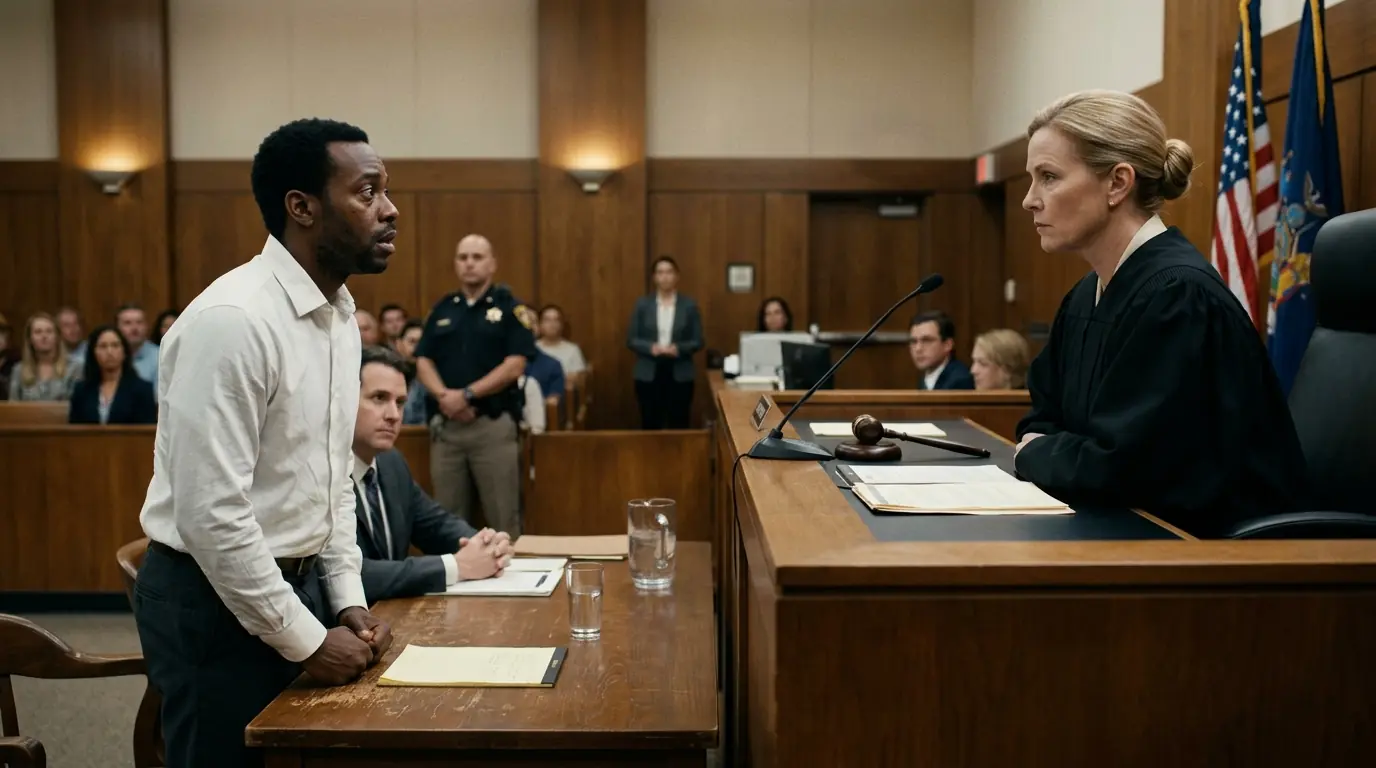
Their eyes met across the courtroom. Her face was composed, unreadable, official. His face was pure shock, disbelief, terror.
What he'd done 12 hours ago, the simple act of kindness, was about to collide with this moment in ways he couldn't have imagined.
Most people saw Jerome Carter as just another face in the crowd, a tired smile in the corner store, a quiet nod at the bus stop, someone passing through their day without leaving a mark. But behind that smile was a man carrying weight most people couldn't see.
The alarm went off at 5:30 a.m., but Jerome had been awake since 4:00, lying in the dark, staring at his phone, scrolling through job listings that all said the same thing: bachelor's degree required, or 5 years' experience preferred.
He didn't have either.
What he had was a daughter sleeping in the next room, and that was enough to get him out of bed every single morning.
Jerome shuffled to the kitchen of their small two-bedroom apartment. The paint was peeling near the window. The linoleum had a crack running from the sink to the hallway, but it was clean. The walls were covered in Amara's drawings, bright crayon rainbows, stick-figure families, a purple elephant she'd been obsessed with since she was five.
He pulled out the oatmeal, added cinnamon. It was cheap, and she loved it, so that's what they had most mornings.
“Morning, baby girl,” he called softly toward her room.
A muffled groan answered back.
Jerome smiled. Eight years old and already not a morning person.
At 7:20, they walked to the bus stop three blocks away. Jerome always left early, always watched until the yellow bus pulled away and disappeared around the corner. Only then would he exhale.
“As long as she's safe, fed, and smiling,” he whispered to himself, “I'm doing okay.”
But it was okay.
Jerome stopped at the corner store on his way back. Mr. Kim, behind the counter, gave him a small nod, the kind reserved for regulars who always count their change carefully.
“Just milk today, Jerome?”
“Yeah, just milk.”
He pulled out a handful of coins and a few crumpled bills. Counted twice. $3.47. The milk was $3.29.
Mr. Kim rang it up without comment, but Jerome saw the sympathy in his eyes. He hated that look, not because it wasn't kind, but because it reminded him how visible his struggle was.
Walking home, Jerome checked his phone.
Bank balance: $147.82.
Rent due in 9 days: $950.
He had a handyman gig scheduled for Saturday. If the client didn't cancel, they'd cancelled twice before, he'd make maybe $80. That still left him $700 short.
He'd figure it out. He always did.
But there was something else, something heavier than rent.
Tomorrow morning, 9:00 a.m., Courtroom 4B.
His stomach twisted every time he thought about it.
Six months ago, Jerome had made a choice he wasn't proud of. Amara needed school supplies, notebooks, pencils, a scientific calculator for her math class. And she'd woken up one morning with her ear burning, crying from the pain. The clinic wanted a $50 co-pay for the appointment and another $35 for antibiotics. Jerome had $23 in his account, so he wrote a check, knowing it would bounce, telling himself he'd cover it in two weeks when he got paid from both jobs.
And he did.
Fourteen days later, he walked into that store and paid back every cent, plus the bounce fee. But the store owner pressed charges anyway.
“It's about principle,” the man had said.
Jerome couldn't argue. What he'd done was illegal, stupid, desperate.
Now he might lose everything.
Not the apartment. Not the money. Her.
If he went to jail, even for 30 days, Child Protective Services could take Amara, put her in foster care. He'd seen it happen to other single parents in the neighborhood.
Jerome kept a journal hidden in his nightstand, letters to Amara just in case something happened to him, just in case she needed to know how much he loved her, how hard he'd tried, how she was the only thing that made sense in his life. He couldn't let her read those letters. Not yet. Not ever, if he could help it.
His phone buzzed.
A text from the community center.
Still good for Saturday workshop? Kids are excited to see you.
Jerome smiled despite everything.
Every Sunday, his one day off, he volunteered teaching basic home repairs to teenagers. How to patch drywall, fix a leaky faucet, change a tire. Skills he'd learned from YouTube and necessity.
He texted back, “I'll be there.”
Jerome walked back into the apartment, set the milk in the fridge, and stared at his reflection in the microwave door.
“Thirty-four years old, tired eyes, calloused hands, but still standing.”
“Bitterness is expensive,” he muttered. “Can't afford it.”
In his truck, a 1998 Ford F-150 held together with duct tape and hope, he kept a toolbox meticulously organized, wrenches arranged by size, tire iron, jumper cables, emergency flares, first aid kit.
Amara once asked him why he kept so much stuff in there.
“You never know when someone might need help,” he'd told her.
He taught her that helping people wasn't about having extra. It was about using what you had.
“We help people when we can, baby girl. That's what makes us rich.”
She'd smiled at that, drew him a picture of the two of them with a giant toolbox between them. He kept it tucked in his sun visor.
Tomorrow morning, he'd put on this same shirt, walk into that courtroom, and hope that someone, somewhere, would see him the way he saw himself. Not as a criminal. As a father who'd made one mistake.
The rain that night wasn't just heavy. It was the kind that makes people disappear into their own cars and forget the world outside.
But Jerome couldn't ignore what he saw.
Interstate 85. The rural stretch between towns where streetlights disappeared and darkness swallowed everything except what your headlights could reach.
The rain hammered his windshield. Wipers on full speed, barely keeping up. Visibility maybe 20 feet.
The radio crackled.
“Flash flood warning in effect until 3:00 a.m. Drivers are advised to avoid unnecessary travel.”
Jerome gripped the steering wheel tighter. He had court in less than 10 hours. He should have been home an hour ago. Should have been sleeping.
But $80 was $80.
Then his headlights caught something ahead.
Hazard lights blinking weakly through the rain. Orange pulses in the darkness. A car pulled over on the narrow shoulder. Hood up. Steam rising despite the downpour.
Jerome's first instinct was to keep driving. It was late. He was exhausted. Tomorrow could change everything.
But then he saw her.
A woman standing beside a black Mercedes-Benz S-Class. No umbrella, no rain gear. The business suit soaked through, clinging to her frame. She was holding her phone up, searching for a signal. Her other hand braced against the car, and she was limping.
Jerome's foot moved from the gas to the brake before his brain caught up.
He pulled over 20 feet ahead, hazards on, and sat there for just a moment.
“You don't have time for this,” he told himself.
But he could see her in his side mirror. Alone, desperate, the kind of aloneness that makes people invisible.
He knew that feeling.
Jerome grabbed his jacket from the passenger seat and stepped out into the storm. The rain hit him like a wall, cold, relentless.
“Ma'am,” he called out, walking toward her. “You okay?”
The woman turned. Mid-50s, maybe, professional, the kind of face that belonged in boardrooms, not on the side of a highway at midnight.
Eleanor Whitfield looked at him with exhaustion and something close to relief.
“My tire,” she said, voice tight. “It's completely shredded. And my phone. I finally got signal, but the battery just died.”
Jerome looked down. The front passenger tire was destroyed. Not just flat. The rubber was torn apart, the rim visibly damaged.
“How long have you been out here?”
“Over an hour,” Eleanor said. “No one stopped. I tried changing it myself, but...” She gestured to her ankle. “I slipped on the wet ground. Can barely put weight on it.”
Jerome noticed her slight lean to the left, favoring her right leg. He glanced into the car. The back seat had legal document boxes stacked neatly. A garment bag hung from the hook. Through the clear plastic, he could see black fabric, formal, official looking. On the passenger seat, a briefcase, expensive leather with embossed gold lettering. But from this angle, and in this rain, he couldn't read it.
“I have to be somewhere critical tomorrow morning,” Eleanor continued. “This can't be happening.”
There was urgency in her voice, not entitlement. Genuine panic.
Jerome understood that panic, the kind that comes when everything depends on showing up.
“Let me take a look,” he said.
He walked around the car, crouched by the tire. Water pooled around his knees instantly. The damage was worse up close. The tire was blown. The rim was bent. And when he checked the spare in the trunk, he found it completely flat.
“Can you fix it?” Eleanor asked, standing over him with her arms wrapped around herself, shivering.
Jerome stood, rain streaming down his face.
“Not the way it should be fixed, but I can get you somewhere safe.”
She studied him. Her eyes were sharp even through exhaustion, used to reading people, assessing risk. But something in his face, maybe the honesty, maybe the kindness, made her nod.
“Okay,” she said quietly. “Thank you. I... thank you.”
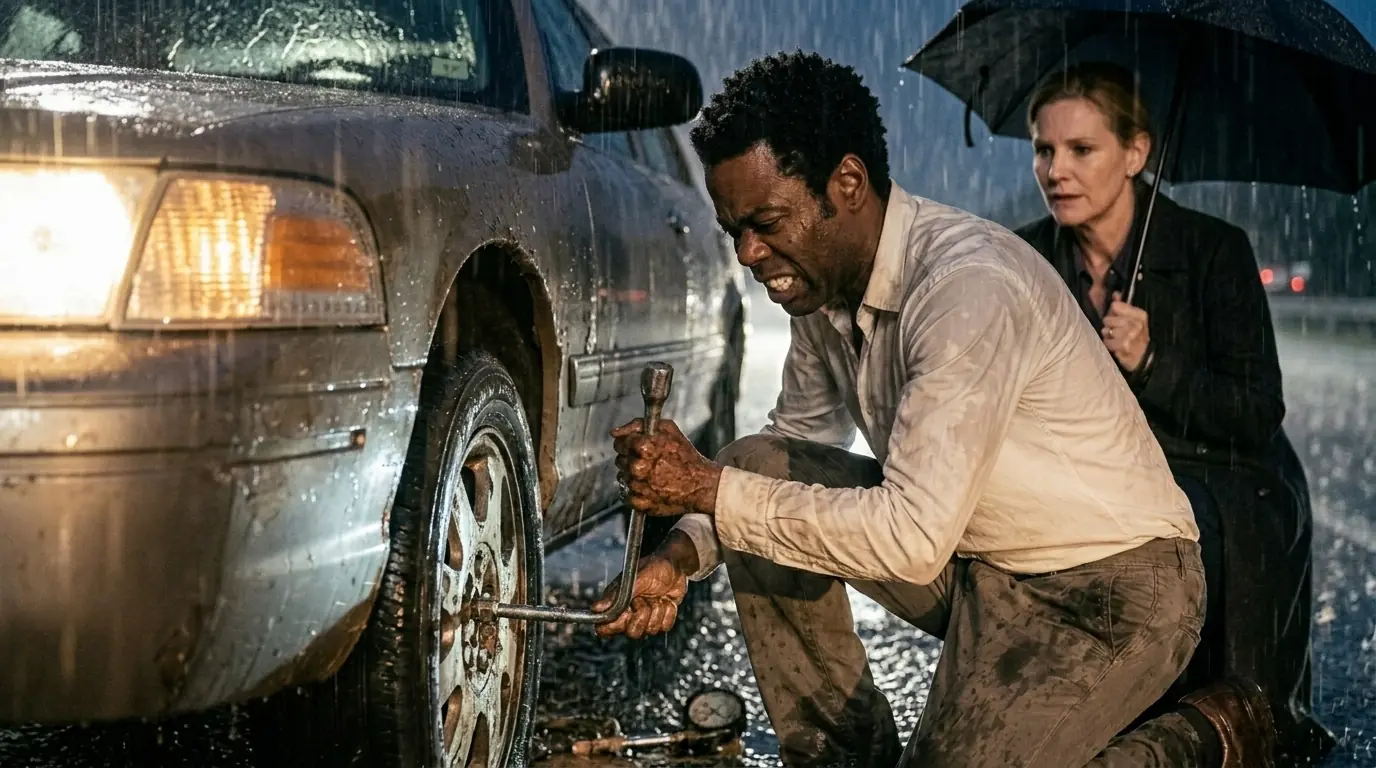
As Eleanor gathered her belongings from the car, a piece of paper slipped from her briefcase and fell into a puddle. Jerome bent to pick it up. Letterhead at the top, partially visible through the water damage: Superior Court. The rest was illegible.
Eleanor quickly retrieved it from his hand, tucked it back into her case. She didn't explain. He didn't ask.
But in that moment, as lightning lit up the sky behind her, Jerome saw something in her posture, the way she held herself despite being soaked and injured. Authority. Control. Someone used to making decisions that mattered.
He didn't know what those decisions were. He didn't know that tomorrow she'd be making one about him.
Jerome walked back to his truck and pulled out his toolbox.
“I've got what we need,” he called over the rain. “This is going to take some time, but I'll get you to safety.”
Eleanor nodded, holding a flashlight from her phone, trying to help however she could.
Neither of them knew this moment would change everything.
What should have been a simple tire change became something else entirely, a test of character when no one was watching.
Jerome opened his toolbox in the bed of his truck. Even in the rain, everything was exactly where it should be. Wrenches organized by size. Tire iron. Hydraulic jack. Jumper cables coiled neatly. Emergency air compressor.
He'd learned a long time ago that being prepared wasn't about having money. It was about respecting the tools you had.
“The spare's flat,” he told Eleanor. “And your rim's too damaged to hold anything properly. But I've got a compressor. If I can get air in that spare and patch it temporarily, it'll get you maybe 15 miles. There's a 24-hour gas station about 8 miles north. They've got a tow service.”
Eleanor's face showed cautious hope.
“You can do that?”
“I can try.”
Jerome pulled the spare from her trunk, rolled it through the ankle-deep water to his truck, and connected the portable compressor to his battery. The machine hummed to life. While the tire inflated, he grabbed his plug kit, found the slow leak.
The rain made everything harder. His hands were numb, the rubber slippery. But he'd done this before, in parking lots at 2:00 a.m., for neighbors who couldn't afford a shop.
Eleanor stood nearby, holding her phone to provide light, even though the battery was nearly dead.
“You do this often?” she asked. “Rescue stranded people?”
Jerome worked the plug into the tire, sealing the leak.
“When I can. Nobody should be alone when things fall apart.”
The compressor wheezed. The tire held pressure.
He glanced up at her.
“Do you have a family? Is someone expecting you?”
Eleanor hesitated.
“A son. He's in college now. Doesn't worry about me as much as he used to.”
“They never stop worrying,” Jerome said, tightening the valve. “Just get better at hiding it.”
She smiled slightly.
“Do you have a family?”
“A daughter. Eight years old. She's everything.”
Eleanor watched him work, something shifting in her expression.
“She's lucky to have you.”
Jerome's hands paused for just a second.
“I'm the lucky one.”
The tire was ready. He rolled it back to the Mercedes, positioned the jack, and started lifting the car. His muscles burned. The rain kept coming. Cars occasionally roared past, splashing them both with highway spray. Nobody else stopped. Nobody else cared.
But Jerome kept working.
He removed the destroyed tire, the damaged rim scraping his knuckles, blood mixed with rainwater running down his hands.
Eleanor saw.
“You're hurt.”
“I'm fine,” Jerome said. “Almost done.”
He mounted the spare, hand-tightened the lug nuts, then used the tire iron to secure them properly.
His father's voice echoed in his head from years ago.
“Tight enough to hold, not tight enough to strip. Feel the resistance.”
He'd never met his father, but he'd learned that lesson from a YouTube video at 2:00 a.m. when his own tire blew out and he had $12 in his account.
The spare was on. The car was back on the ground.
But when Eleanor turned the key, nothing happened.
Click. Click. Click.
“The battery's dead,” Jerome said. “The hazard lights were on too long.”
Eleanor closed her eyes, took a breath.
“Of course they were.”
“It's okay,” Jerome said quickly. “I can jump it. Give me 2 minutes.”
He pulled his truck around, the headlights illuminating both vehicles in the downpour. Connected the jumper cables, red to positive, black to negative. The ritual was muscle memory now.
His own truck barely started. The battery was old, probably had 6 months left if he was lucky. But it caught. The engine coughed to life.
“Try it now,” he called.
Eleanor turned the key. The Mercedes roared.
She looked at him through the windshield, eyes wide with disbelief and gratitude.
Jerome disconnected the cables, coiled them back up, and walked to her window.
“That spare won't hold if you go over 40,” he said. “And honestly, I don't trust it to make it 8 miles in this weather.”
“What do you suggest?”
“I'll follow you. If it starts going flat, I'll see it before you feel it. We'll get you there safe.”
Eleanor shook her head.
“You've done enough. You need to get home.”
Jerome looked at the highway. Empty, dark, dangerous.
“Ma'am, with respect, I'm not leaving you out here. That tire could go any minute. I'll stay behind you. Flash my lights if there's a problem.”
She studied his face, saw the determination, the kindness that wasn't performative.
“Okay,” she said softly. “Thank you.”
The convoy started, her limping Mercedes in front, his sputtering F-150 behind, through the storm.
Jerome kept his distance, watched her taillights, checked the spare with every mile.
Four miles in, he saw it. The tire was deflating slowly, but definitely sinking. He flashed his high beams. Eleanor saw, slowed down, pulled under an overpass, the only shelter for miles.
Jerome parked behind her, grabbed the compressor and plug kit again, and jogged through the rain.
“Losing air,” he said. “But we're halfway there. I can patch it better this time.”
He worked faster now, found another leak, sealed it, reinflated.
His hands were shaking from cold and exhaustion. His back ached from crouching. His clothes were soaked through. But he didn't complain.
Eleanor crouched beside him, trying to help hold the flashlight steady despite her injured ankle.
“Why are you doing this?” she asked quietly.
Jerome didn't look up.
“Because I can, and because someone did it for me once.”
“When?”
“Three years ago. My wife left. I was alone with my daughter. Didn't know how I'd make it. A neighbor, Mrs. Lane, brought us dinner every Sunday for 6 months. Never asked for anything. Just showed up.”
He finished the patch, stood, wiped his hands on his soaked jeans.
“She told me, ‘You help when you can. You receive when you must. That's how we survive.’”
Eleanor nodded slowly.
“She sounds wise.”
“She was,” Jerome said. “Passed away last year. But I think about her every time I see someone who needs help.”
They stood there for a moment under the overpass, the rain a curtain around them. Two strangers brought together by circumstance.
“The tire should hold now,” Jerome said. “Let's get you to that station.”
Three miles later, they saw it. Bright lights cutting through the darkness. A 24-hour gas station with a tow truck parked out front. Safe Harbor.
Eleanor pulled in. Jerome pulled in behind her.
She stepped out of her car, limping but steady, and walked to his truck. Jerome rolled down his window.
“I don't know how to thank you,” Eleanor said. Her voice was thick with emotion. “You've... you've saved me tonight.”
Jerome shook his head.
“No thanks needed. Just be safe getting where you need to go.”
“I will,” she said. “Thanks to you.”
She looked at him for a long moment, seeing him. Really seeing him. A good man in a broken-down truck at midnight. Someone who stopped when everyone else kept driving.
“What's your name?” she asked.
“Jerome. Jerome Carter.”
She repeated it softly, committing it to memory.
“I'm Eleanor Whitfield.”
They shook hands. Hers were soft, manicured. His were calloused, bleeding from the torn rim.
She noticed his wounds.
“You should get those cleaned.”
“I will. You take care, ma'am.”
Eleanor walked toward the gas station office where a tow truck dispatcher was waiting. Jerome watched until she was safely inside.
Then he checked the time on his phone.
1:43 a.m.
Court in 7 hours and 17 minutes.
He put the truck in gear and drove home through the rain, thinking about Amara, about tomorrow, about hope.
What he didn't know was that Eleanor was already thinking about him, too.
Eleanor wanted to repay him. But what Jerome did next revealed everything about who he really was.
Inside the gas station, fluorescent lights hummed overhead. The dispatcher was making calls, arranging for Eleanor's car to be towed to a proper repair shop in the morning.
Eleanor walked back outside. Jerome was still there, leaning against his truck, making sure she was truly okay before he left.
She approached him, pulling out her wallet.
“Please,” she said, retrieving several bills. “Let me pay you for your time, for the materials you used.”
Jerome stepped back, palms up.
“Can't accept that, ma'am. Wasn't looking for payment.”
“But your time, the supplies, your gas.”
“I help because I can,” Jerome said firmly but kindly. “Not because I should get something for it.”
Eleanor looked at the cash in her hand. Two hundred dollars. Probably more than he made in a day, maybe two days.
She could see his truck, the duct tape holding the side mirror, the rust spots, the worn tires that probably needed replacing.
“At least let me cover what you spent tonight.”
Jerome shook his head.
“I appreciate it, really, but I'm okay.”
The irony wasn't lost on him. He had $147 in his account, court in the morning, rent due in 9 days. But accepting money would change what this was. It would make it a transaction.
And this wasn't that.
“Someday,” Jerome said, “when you see someone else who needs help, you help them. That's enough payment.”
Eleanor studied him. In her years as a judge, she'd seen thousands of people. She'd learned to read faces, detect lies, sense when someone was performing goodness versus living it.
This man wasn't performing.
“Then at least take this,” she said, reaching into her briefcase.
She pulled out a business card. Ivory card stock with embossed lettering.
Jerome took it to be polite, glanced at it in the dim light.
“Eleanor Whitfield,” he read aloud. The rest was too dark to see clearly, some official-looking text below her name. He assumed it was a company, maybe a law firm.
He pocketed the card without reading further.
“In case you ever need anything,” Eleanor said. “Anything at all.”
Jerome nodded.
“Thank you, ma'am. But I hope I won't need to call.”
Eleanor's expression softened.
“You're a good man, Jerome Carter. I hope you know that.”
Jerome deflected with a small smile.
“Just trying to do right by my daughter. Set an example.”
“She's lucky,” Eleanor said.
Then, with a weight he didn't quite understand, she added, “I hope people see that.”
There was something in her tone, something deliberate. But Jerome was too tired to catch it.
The tow truck pulled up. The driver stepped out, clipboard in hand, ready to load Eleanor's Mercedes.
“I should let you handle this,” Jerome said, backing toward his truck.
“Jerome,” Eleanor called.
He turned.
“Drive safe. And thank you. Really.”
He nodded, climbed into his truck, and started the engine.
Through his rearview mirror, he watched Eleanor speaking with the tow truck driver, watched her car being loaded onto the flatbed. Then he saw her pull out her phone.
She was looking at his truck, writing something down. His license plate.
Jerome didn't think much of it. Maybe she wanted to send a thank-you gift. Maybe it was just habit. She seemed like someone who kept detailed records.
He pulled out of the gas station and back onto the highway. The rain had finally started to ease. Just a drizzle now.
His hands ached. His back ached. His eyes burned with exhaustion. But he'd done something good tonight. That had to count for something.
Inside the gas station office, Eleanor finished writing down his license plate number. Then she made a phone call.
The voice on the other end answered immediately.
“I need you to look into someone for me,” Eleanor said quietly. “Name's Jerome Carter.”
She rattled off the license plate number.
“Nothing invasive, just public records. Background check. I need to know who he is.”
She paused, looking out the window at the empty highway where his taillights had disappeared.
“And I need it by morning.”
Jerome drove home thinking he'd never see her again. He had no idea she was already looking into him.
He arrived home at 2:37 a.m.
Inside, he checked on Amara first, always first. She was asleep, curled up with her stuffed elephant, breathing softly. Her nightlight cast purple stars across the ceiling.
Jerome kissed her forehead, whispered, “Love you, baby girl.”
In the bathroom, he cleaned his hands. Cuts across three knuckles. He bandaged them carefully.
He set three alarms.
6:30 a.m.
6:35 a.m.
6:40 a.m.
Jerome lay in bed staring at the ceiling.
“In 7 hours, I'll stand before a judge. Maybe they'll show mercy,” he whispered.
He had no idea.
Forty miles away, Eleanor Whitfield sat at a hotel desk with her laptop open. She'd showered, changed into dry clothes, but she couldn't sleep.
Her fingers moved across the keyboard.
Jerome Carter.
She typed into the public records database. She added his license plate number, hit Enter.
The results loaded.
Address. Employment history. Credit report.
Then she saw it.
Case docket. State v. Jerome Carter. Fraudulent check. Hearing date: tomorrow, 9:00 a.m. Assigned judge: Honorable Eleanor Whitfield.
Eleanor sat back. Her hand covered her mouth.
The man who saved her tonight was appearing before her in less than 7 hours.
She clicked on the case file.
Charge: writing a check with insufficient funds.
Amount: $347.
Restitution paid in full within 14 days.
She kept reading.
Character references from community center. Two jobs. Custodial parent of one minor child. Item description: school supplies. Medical co-pay for pediatric appointment.
Eleanor closed her eyes.
She knew this story. Had seen it a hundred times from the bench. But this time, she knew the man behind the case number.
She picked up her phone.
“It's Eleanor. I need everything you can find on Jerome Carter. Work history, references, community ties, everything that's legal.”
A pause.
“I need it before 9:00 a.m.”
She hung up, looked at the business card on the desk, the one she'd given Jerome.
Superior Court Judge Eleanor Whitfield, Fifth District.
Did he read it? Something told her he hadn't.
He'd helped her without knowing.
Meanwhile, Jerome slept restlessly, woke at 6:30 to all three alarms, made Amara breakfast, walked her to the bus stop, kissed her goodbye.
“I'll be home soon, baby girl.”
“Promise?” she asked.
“Promise.”
He watched the bus disappear, then drove to the courthouse.
At 8:45 a.m., he arrived, hands shaking, throat dry. His public defender met him in the hallway, overworked, exhausted.
“First offense. They might go easy.”
Jerome nodded.
“Might isn't good enough. I have a daughter.”
The lawyer squeezed his shoulder.
“I know. We'll do our best.”
They sat in the hallway, families, lawyers, the weight of the system pressing down.
At 8:58 a.m., the bailiff called, “All rise. The Honorable Eleanor Whitfield presiding.”
Jerome stood, head down, praying.
The judge's door opened.
He looked up.
Their eyes met across the courtroom.
His face: shock, disbelief, terror.
Her face: composed, unreadable, official.
The moment Jerome recognized her, everything he'd done the night before suddenly felt like it could work against him.
His world tilted.
The courtroom, the wooden benches, the American flag, the seal on the wall, all of it blurred. Only her face remained in focus.
Judge Eleanor Whitfield, the woman from the highway.
Jerome's mind raced, panic flooding every thought.
She's the judge. She's my judge.
What are the odds?
His hands gripped the table edge, knuckles white.
She'll think I knew. She'll think I helped her on purpose. She'll think I'm a con artist.
His lawyer leaned over, whispering, “You okay? You look like you've seen a ghost.”
Jerome couldn't respond, couldn't form words.
Eleanor took her seat at the bench. Her expression was perfectly neutral, professional, the face of authority.
She opened a file folder, adjusted her reading glasses.
“Case number 24-CR-8847,” she said, voice clear and measured. “State versus Jerome Carter. Charge: fraudulent check writing.”
Jerome's lawyer stood.
“Your Honor, the defense is present and ready.”
The prosecutor stood as well.
“The state is ready, Your Honor.”
Eleanor looked down at the file, then up at Jerome. Their eyes met again. For just a fraction of a second, something passed between them. Recognition. Acknowledgement.
Then her face returned to neutral.
“Before we proceed,” Eleanor said, “I need to address something on the record.”
The courtroom went quiet.
Jerome's heart stopped.
This is it. She's going to think I planned this.
Eleanor continued, tone even.
“Last night, I had a personal encounter with the defendant.”
Murmurs rippled through the courtroom.
The prosecutor's head snapped up.
“Your Honor—”
Jerome's lawyer looked confused, glancing between Eleanor and Jerome.
Eleanor held up a hand.
“Let me be clear. At approximately midnight, my vehicle broke down on Interstate 85 in severe weather. Mr. Carter stopped to assist me. He repaired my tire, ensured my safety, and refused any compensation.”
The prosecutor stood immediately.
“Your Honor, with all respect, this creates a clear conflict of interest. The state requests your recusal.”
Jerome's lawyer stood as well, slower, uncertain.
“Your Honor, the defense had no knowledge of this encounter.”
Jerome found his voice, small and desperate.
“I didn't know. I swear I didn't know.”
Eleanor looked directly at him.
“Mr. Carter, did you know who I was when you stopped to help me last night?”
Jerome stood trembling.
“No, Your Honor. I swear on my daughter's life, I had no idea. You gave me a business card, but I couldn't read it in the rain. I just... you needed help.”
His voice cracked.
“I would never... I'm not that kind of person.”
Eleanor nodded slowly.
“I believe you, Mr. Carter. The weather made reading difficult. I didn't identify myself as a judge, and your actions were consistent with someone who had no knowledge of my position or this case.”
She turned to the prosecutor.
“Nevertheless, I recognize that my impartiality could be questioned. I'm prepared to recuse myself if either party formally requests it.”
The courtroom held its breath.
The prosecutor sat back, calculating. He looked at his notes, looked at Eleanor.
Judge Whitfield had a reputation. Tough on crime. By the book. Fair, but not soft. If she stayed, it might work in the state's favor. She'd probably go harder on Jerome to avoid appearing biased.
“The state has no objection to Your Honor presiding,” the prosecutor said.
All eyes turned to the defense table.
Jerome's lawyer leaned close.
“We should request recusal. She might come down harder to compensate for last night. It's safer to get a different judge.”
Jerome shook his head.
“No.”
“Jerome—”
“No,” Jerome said more firmly.
He looked at Eleanor. Really looked at her.
Last night in the rain, she'd been vulnerable, grateful, human. But more than that, she'd been fair. She'd listened. She'd seen him.
“She's fair,” Jerome whispered. “I could see it last night. Whatever she decides will be based on who I am, not politics.”
His lawyer hesitated.
“You sure?”
Jerome nodded.
“Let her decide.”
The lawyer stood.
“Your Honor, the defense has no objection. We're comfortable proceeding.”
Eleanor's expression didn't change, but something flickered in her eyes. Respect, maybe.
“Very well,” she said. “I will proceed with the understanding that my judgment will be based solely on the facts and the law.”
She opened Jerome's file fully.
“Mr. Carter, I've reviewed your case. On March 15th of this year, you wrote a check for $347 to Quickstop Pharmacy knowing you had insufficient funds. Is that correct?”
Jerome stood.
“Yes, Your Honor.”
“The check was for your daughter's school supplies and a medical co-pay. Correct?”
“Yes, ma'am.”
“You repaid the full amount plus fees within 2 weeks?”
“Yes, Your Honor. As soon as I got paid.”
Eleanor nodded, making notes.
The prosecutor stood.
“Your Honor, while the defendant made restitution, he still committed fraud. He knowingly wrote a bad check. The law is clear regardless of intent or subsequent repayment.”
He laid out his case methodically, cited statutes, referenced precedents, recommended sentence: 30 days jail, suspended, 6 months probation, $500 fine.
When he finished, Eleanor turned to Jerome.
“Mr. Carter, you have the right to speak on your own behalf. Would you like to?”
Jerome stood. His legs felt weak, but he steadied himself.
“Your Honor, I'm not going to make excuses. I made a choice I'm not proud of.”
He took a breath.
“My daughter needed school supplies. And she woke up crying with an ear infection. The clinic wanted $85 total. I had $23.”
His voice grew stronger.
“I thought I could float it for 2 weeks until payday. I was wrong. I should have asked for help. Should have borrowed money. Should have done anything else.”
Jerome looked directly at Eleanor.
“I paid it back as fast as I could. But I'm not asking you to forget what I did. I'm just asking you to let me keep being her dad.”
His voice broke.
“She's all I have, and I'm all she has.”
The courtroom was silent.
Eleanor's face remained composed, but her hands had stilled.
“The court will take a brief recess,” she said. “15 minutes.”
She stood. Everyone rose. Eleanor exited to her chambers.
Jerome sat down, head in his hands. His lawyer put a hand on his shoulder.
“That was good. You were honest. But I don't know which way she'll go.”
Jerome closed his eyes.
Fifteen minutes felt like 15 hours.
When Eleanor returned, Jerome braced for the worst. But what came next changed everything.
“All rise.”
The courtroom stood as one. Eleanor entered, her robes flowing behind her, and took her seat at the bench.
Jerome's heart hammered against his ribs. His mouth was dry. His hands trembled in his lap.
“Please be seated,” Eleanor said.
The room settled into tense silence.
Eleanor looked down at her notes, then up at Jerome.
“I've considered the facts presented, the law as it applies, and the character evidence in this case.”
She paused.
“Mr. Carter, what you did was illegal. The law exists to protect commerce and maintain trust in our financial systems. Writing a check knowing funds are insufficient is fraud, regardless of circumstance.”
Jerome's stomach dropped.
“However,” Eleanor continued, “the law also grants judges discretion in sentencing. Discretion based not just on the crime, but on the individual who committed it.”
She leaned forward slightly.
“I've presided over thousands of cases in my 12 years on this bench. I've seen defendants show remorse only after being caught. Apologies that ring hollow because they're strategic, not sincere.”
Eleanor's eyes met Jerome's.
“You showed remorse immediately. You repaid your debt without a court order. You didn't wait to be sued. You took responsibility the moment you could.”
She gestured to the file.
“More importantly, your actions last night demonstrated something this court rarely witnesses. Genuine character.”
The prosecutor shifted uncomfortably.
“You helped a stranger in need,” Eleanor said, her voice measured but warm. “You worked in dangerous conditions. You refused payment. You were kind simply because it was the right thing to do.”
She paused, letting her words settle.
“Character isn't what we do when people are watching. It's what we do when no one would ever know.”
Eleanor straightened in her chair.
“Therefore, I'm sentencing you to time served, which is none. I'm ordering supervised probation for 6 months, and I'm waiving all court fees and fines.”
Jerome's eyes went wide. His lawyer grabbed his arm.
Eleanor wasn't finished.
“Additionally, upon successful completion of your probation, I'm ordering this charge expunged from your record. It will be as if this case never existed.”
Jerome couldn't speak. Tears streamed down his face. He tried to say thank you, but the words caught in his throat.
Eleanor's expression softened.
“Mr. Carter, you made one mistake during an impossible situation. That doesn't define you. Your actions since then, those define you.”
The gavel came down softly.
“This case is adjourned.”
“All rise.”
Eleanor stood. But before leaving, she said, “Mr. Carter, please remain. I'd like to speak with you briefly in my chambers.”
The courtroom buzzed with whispers.
Jerome's lawyer looked confused.
“That's unusual.”
Five minutes later, Jerome and his lawyer sat across from Eleanor in her chambers. She'd removed her robe.
“What I'm about to discuss is separate from my judicial capacity,” Eleanor began. “I want to be absolutely clear about that. This has nothing to do with your case, which is now concluded.”
Jerome nodded, confused.
Eleanor opened her laptop, turned it toward him.
“Last night, you told me you do handyman work. You clearly have skills: mechanical, problem solving, teaching.”
She pulled up a website.
“I sit on the board of directors for a nonprofit called Second Chance Construction. We renovate homes for low-income families and train people in skilled trades.”
Jerome leaned forward. Photos of people in hard hats, houses being rebuilt, families smiling.
“We have an opening,” Eleanor said. “Lead training coordinator, teaching home repair, managing small crews, mentoring people coming out of difficult circumstances.”
She pulled up a job description.
“Salary is $52,000 annually. Full benefits. Weekday hours, 8 to 5. No nights, no weekends.”
Jerome stared at the screen. The numbers seemed impossible.
“Your Honor, I... why would you—”
“Because last night you showed me exactly who you are,” Eleanor said. “And because I know what it's like to struggle and have someone give you a chance.”
She leaned back.
“Twenty years ago, I was a single mother working as a legal clerk for $28,000 a year, paycheck to paycheck, trying to raise my son alone.”
Jerome listened, seeing her differently.
“A senior partner saw something in me, paid for my LSAT prep, mentored me through law school while I worked full-time, believed in me when I didn't believe in myself.”
Eleanor's voice was steady but emotional.
“I wouldn't be here without that chance. I've spent my career trying to pay it forward.”
She slid a folder across the desk.
“This isn't charity, Mr. Carter. This is an investment in someone who's already proven their worth. We need people who understand struggle, who have integrity, who can teach not just skills, but character.”
Jerome opened the folder. Application forms, benefits package, training schedule. His hands shook.
“I don't know what to say,” he whispered. “This is more than I could have dreamed.”
“Say you'll think about it,” Eleanor said. “Talk to your daughter. The position is yours if you want it. No strings attached.”
Jerome looked up at her, tears falling.
“Judge Whitfield, I thought I was going to lose everything today. I thought I was going to lose her.”
Eleanor's eyes were bright.
“You didn't lose her because you're a good father who made one mistake. That's not who you are. It's just something that happened.”
Jerome wiped his eyes.
“I'll take the job. If you'll have me, I'll take it.”
Eleanor smiled, warm and genuine.
“Then welcome to Second Chance Construction. I think you'll be excellent.”
She pulled out another document.
“We also partner with a subsidized child care program. After-school care for Amara, safe environment, homework help. It's included in your benefits.”
Jerome put his head in his hands and wept, not from despair, from hope.
Eleanor walked around the desk, placed a gentle hand on his shoulder.
“You helped me when I needed it most,” she said quietly. “Let me do the same for you.”
Jerome looked up.
“How do I thank you for this?”
Eleanor smiled.
“The same way you thanked me last night. By helping the next person who needs it.”
As Jerome left, Eleanor called after him.
“Mr. Carter, that business card I gave you. You should actually read it sometime.”
Jerome pulled it from his wallet. Really looked at it.
Superior Court Judge Eleanor Whitfield, Fifth District.
He looked back, stunned.
“I really had no idea.”
“I know,” Eleanor said. “That's exactly why I could trust you.”
Jerome's transformation didn't just change his life. It rippled outward, touching dozens of others.
Six months later, everything looked different.
Before: Jerome's alarm going off at 4:00 a.m., exhausted eyes counting change at the corner store.
After: Jerome walking into Second Chance Construction at 8:00 a.m., company polo shirt, tool belt, confident posture.
Before: Amara eating oatmeal in a dim kitchen, Jerome rushing her to the bus stop, always worried.
After: Amara in the after-school program, laughing with friends, Jerome picking her up at 5:30, relaxed and present.
Before: their cramped apartment, peeling paint, stress in every corner.
After: a modest but brighter two-bedroom, Amara's own room, walls painted lavender, her choice.
Jerome stood in front of a classroom at the training center. Five trainees sat before him. Different ages, different backgrounds, same look in their eyes: hope mixed with doubt.
“Today we're framing a wall,” Jerome said, holding up a measuring tape. “Seems simple, right? But if your measurements are off by even a quarter inch, nothing else will fit.”
He demonstrated, patient, thorough, clear.
A woman in her early 40s, Maria, raised her hand.
“I've never used power tools. What if I mess up?”
Jerome smiled.
“Then you'll learn. That's why we're here. I didn't know any of this 6 months ago either.”
“Really?”
“Really. Someone gave me a chance. Now I'm giving you one.”
The trainees watched as Jerome guided them through cutting studs, checking levels, and securing plates. He was patient when they struggled, encouraging when they doubted, firm when they needed direction.
He saw himself in every one of them.
Outside, another crew was working on a renovation. The Morrison family's house.
Mrs. Morrison, a single mother with three kids, stood watching the transformation. Her house had been falling apart, roof leaking, windows broken, porch rotting. Now Jerome's crew was installing new windows, replacing boards, repainting.
“You're giving us more than a house,” Mrs. Morrison said, tears streaming. “You're giving us hope.”
Jerome secured a window frame, climbed down the ladder.
“We're just doing what we can, ma'am. Your kids deserve a safe place.”
Her youngest daughter ran up.
“Are you a builder?”
Jerome crouched down.
“I'm learning to be, just like you're learning in school.”
The girl smiled, then ran back to her mother.
That evening, a local news crew arrived.
“This is Sarah Lane, Channel 7 News, at a Second Chance Construction site where lives are being transformed.”
The camera panned across the work site. Jerome and his trainees installing a porch railing.
“Jerome Carter, the lead coordinator here, was himself given a second chance 6 months ago. Now he's paying it forward.”
The reporter approached Jerome.
“Mr. Carter, what does this program mean to you?”
Jerome set down his drill.
“It means people aren't defined by their worst moments. Everyone deserves a chance to build something better, not just houses, lives.”
The segment aired that weekend. The response was immediate. Phone calls flooded in, donations, volunteer applications, families requesting help.
A construction company owner called Eleanor directly.
“I saw your guy on the news. We hired two of his trainees last month. Best workers we've had in years. Whatever you're doing, it's working.”
Eleanor smiled.
“It's not me. It's him.”
The numbers told the story.
Twelve people trained in 6 months.
Seven homes renovated.
Four permanent job placements.
One trainee, David, started his own handyman business.
Another, Maria, was pursuing contractor licensing.
Total wages earned by graduates: $280,000.
Twenty-three family members now living in safe, renovated homes.
But the real impact couldn't be measured in numbers.
It was in Mrs. Morrison's daughter doing homework at a sturdy desk instead of a wobbly card table.
It was in David's pride, showing Jerome his first business card.
It was in Maria's hands, once hesitant, now confidently wielding a circular saw.
It was in Amara's face when she visited a job site and Jerome let her hand him tools.
“What does this say, Dad?” she asked, pointing to the company motto on the truck.
Jerome read it aloud.
“We help people when we can. That's what makes us rich.”
She looked up at him.
“That's what you always say.”
“That's right, baby girl. And now it's what we all say.”
One evening, the city council member visited a completed project.
“I'm recommending expanded funding,” she announced. “What you've built here is a model for the entire state.”
Jerome stood with his team, watching families move into renovated homes.
This was what second chances looked like, not just for him, for everyone willing to reach out and grab them.
One year after that rainy night, Jerome found himself on the same stretch of highway.
But this time, everything was different.
It was Sunday afternoon, same date, anniversary. Jerome was driving his newer truck, still used, but reliable, a company vehicle from Second Chance Construction. The engine purred smoothly.
Amara sat in the passenger seat, wearing her own mini tool belt that Jerome had made for her birthday.
“Dad, look,” she said, pointing ahead. “Hazard lights.”
A car pulled over on the shoulder. Hood up.
Jerome smiled.
“Someone needs help.”
“Can we stop?” Amara asked.
“Always.”
He pulled over, hazards blinking. A young couple stood beside their car, early 20s, stressed.
Jerome approached.
“Hey folks, looks like you could use a hand.”
The young man looked relieved.
“Our car overheated. We're on our way to a job interview. Can't miss it.”
“Let's take a look,” Jerome said.
Amara followed, carrying the water jug from the truck.
Jerome checked the radiator. Low coolant. He refilled it, checked the hoses, let the engine cool.
“Should get you where you need to go,” he said. “But get this looked at soon.”
The couple pulled out their wallets.
“How much do we owe you?”
Jerome shook his head.
“Nothing. Just help someone else when you get the chance.”
Amara smiled up at them.
“That's what makes us rich.”
The couple thanked them profusely, then drove off carefully.
As Jerome and Amara walked back to the truck, another car pulled up behind them. A familiar black sedan.
Eleanor Whitfield stepped out, dressed casually, weekend clothes.
“Jerome, is that you?”
Jerome turned, breaking into a wide smile.
“Judge Whitfield. What are the odds?”
Eleanor laughed.
“On this highway, maybe better than we think.”
And she walked over, saw Amara.
“And this must be the famous daughter.”
Amara shook her hand properly.
“I'm Amara. My dad says you changed our life.”
Eleanor knelt down.
“Actually, your dad changed his own life. I just opened a door.”
Jerome smiled.
“Sometimes that's all someone needs, an open door.”
Eleanor stood.
“I heard about the expansion. The mayor's allocating funds to double the program.”
“Twenty-four trainees next year,” Jerome said. “It's incredible.”
“It's deserved. You've built something remarkable.”
“We built it,” Jerome corrected. “You, me, the team. That's how this works.”
Eleanor checked her watch.
“I'm heading to a conference. You?”
“Job site visit. Never stop.”
They hugged, genuine friendship forged from that rainy night.
“Same time next year?” Eleanor asked. “See who needs help.”
Jerome laughed.
“It's a date.”
As they drove away in opposite directions, another car passed with a visible flat tire. Someone else pulled over to help. Not Jerome, a different stranger.
The cycle continued.
Jerome glanced at Amara.
“You know what today is?”
“The day everything changed.”
“The day everything began,” he corrected.
In the rearview mirror, he watched the stranger helping the stranded driver. Kindness multiplying one person at a time.