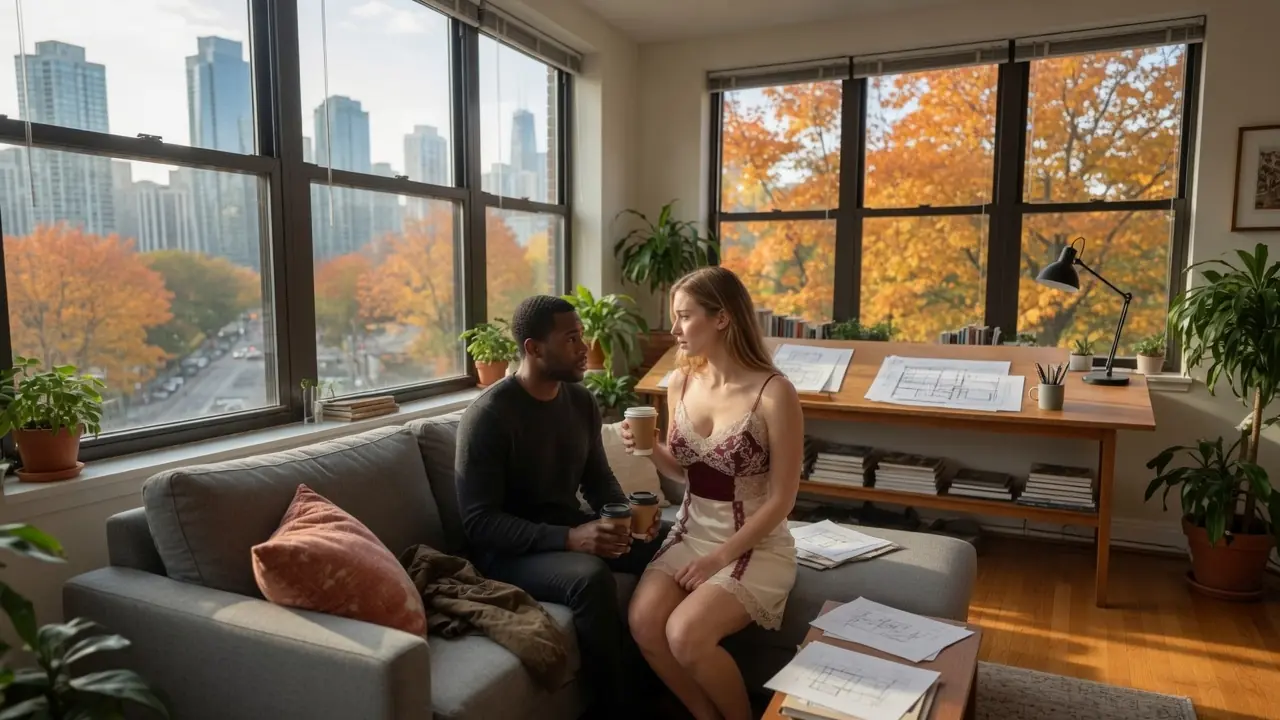
The thing about Chicago in October was that it never asked permission before it changed. One morning, you walked out of your building and the air still carried the faint warmth of September. The trees still holding their green like a promise. Then 3 days later, the whole avenue had gone amber and rust and deep arterial red and the wind came off the lake with a particular kind of coldness that made you feel in your chest that something was ending. Darnell Harper had lived in the city for 11 years and he still wasn't used to it.
He stood on the sidewalk outside his building on North Clark Street at 7:43 in the morning, travel mug in hand, his dark brown fingers wrapped around the heat of it, watching a single maple leaf spiral down from the tree planted in the small square of dirt beside the entrance. It landed on the toe of his shoe. He looked at it for just a moment, veined, brilliant orange, already beginning to curl at the edges, and then he stepped over it and walked towards the L stop. He was 33 years old. He had a 6-year-old daughter named Layla, a black little girl with warm brown skin and tight curls that never stayed in the same arrangement for more than a day, who called him Daddy when she wanted something and Dan when she was testing limits and who had 2 weeks ago declared that her favorite color was now the color of fall leaves, which had delighted him in a way he hadn't expected.
He had been divorced for 2 years. The divorce itself had been finalized on a Tuesday in December in a courtroom that smelled faintly of industrial cleaner before a judge who had looked tired and kind in equal measure. He and his ex-wife Kiara had been civil, thoughtful, even in the way that two people could be thoughtful when they had already spent months in therapy learning to speak to each other without the old wounds bleeding through. They had agreed on the important things. Layla would live with Darnell.
Kiara would have generous visitation every other weekend, 2 weeks in the summer. Kiara was moving to Portland where her sister lived and where she said she felt like she could breathe. Darnell had not said, "I understand." He had not said, "I think I made you feel like you couldn't breathe here." He had signed the papers and driven home through the first snow of the season.
And when he'd gotten back to the apartment, Layla had been asleep in her room with her arms flung wide. The way she always slept, as though she were falling and didn't mind. He'd stood in her doorway for a long time. The years since then had arranged themselves into a rhythm, the way water finds its level. He dropped Layla at her school, Sunnyside Elementary, two blocks from his building at 8:15 every morning.
He caught the red line to the Loop. He arrived at the offices of Hawthorne Consulting Group on the 32nd floor of a glass tower on Wacker Drive by 8:55. Coffee in hand, he worked. He was good at his work, which was the analytical variety, data modeling, financial forecasting, strategic scenario planning for mid-size companies who needed someone to tell them what the numbers meant. And what the numbers were likely to mean 6 months from now.
He was, his manager Claudia Prescott had once told him, the most methodical person she had ever employed, which she meant as a compliment and which he had accepted as one. He left at 5:15. He picked up Layla by 5:30. He made dinner, usually something from the three recipes he'd genuinely mastered, or one of the frozen things Layla liked, and supervised the homework that first-graders apparently had now, which still astonished him, and read two chapters of whatever book they were working through together, and got her to bed by 8:30. Then he worked again, usually until 11:00, sometimes later.
He did not date. He had in the 18 months following the divorce gone on four first dates, all of which had been perfectly fine, none of which had led to second dates. He told himself this was because he was busy. He told himself it was because Layla needed stability. Both of these things were true.
Neither of them was the whole truth. The whole truth was that Darnell Harper was afraid. Not in any dramatic way. He was not a man prone to dramatic self-assessments. It was a quiet fear, the kind you carry so long it starts to feel like just another part of your personality.
He was afraid of starting something and watching it fall apart again. He was afraid of letting someone into his life and into Layla's life and then having to explain at some later date, in some gentler version of that December courtroom, why it hadn't worked. He was afraid of causing that particular kind of damage twice. So, he worked. He was organized.
He kept the apartment clean and the fridge stocked and the bills paid. A framed photo of him and Layla, two matching smiles, two brown faces pressed close, sat on the shelf by the door where he could see it every time he left. He coached Layla's soccer team every Saturday morning. Badly, but with great enthusiasm. He called his mother in Indianapolis every Sunday.
He was, he told himself, fine, and he was in the way of people who are not fine. Very convincing about it. Three years ago, on his second week at Hawthorne, Darnell had been assigned a workspace adjacent to a woman named Sophie Carter. The assignment had been logistical. They were on the same project team, a 12-month engagement with a regional manufacturing firm, and the adjacency had been practical, a function of floor space and desk arrangement.
She was a senior analyst, one level above him at the time, and she was, he'd learned within about 3 weeks, extraordinarily good at her job. She was also, and this was the part that had crept up on him slowly, the way most important things do, the easiest person he had ever worked alongside. It wasn't that she was agreeable, she wasn't particularly. She pushed back on conclusions she thought were soft, asked the second and third questions when everyone else had accepted the first answer, and had a precise, dry sense of humor that caught you off guard when you were least expecting it. She once described a client's 5-year plan as optimistic in the way that a paper umbrella is optimistic in a hurricane, and Darnell had laughed for approximately 45 seconds, which was a personal record for him during working hours.
What she was, what she had become quietly and without announcement, was someone who understood how he thought. She knew without being told when he needed silence to work through a problem, and when he needed someone to talk it through with. She'd learned his coffee order within a month, black, half a teaspoon of sugar, and she brought him one every Thursday morning for reasons she never explained. He brought her one on Tuesdays, a ritual unmarked and unannounced, the way the best kinds of things become rituals. Their colleagues called them work spouses sometime in year two, a teasing joke.
Both of them laughed. Neither mentioned it again. From the 32nd floor, through the north-facing windows of the open-plan office, you could see a stretch of the river, and in the fall, the trees along the river walk turning. Sophie's desk sat closest to those windows. On early mornings before the rest of the team arrived, Darnell would sometimes come in to find her standing at the glass with her coffee, watching the leaves.
He would set his bag down, boot up his laptop, and say nothing. She would hear him arrive, turn, raise her mug in greeting, and go back to watching. Those were, he would later understand, some of the best moments of his adult life. He had not understood that at the time. The concert was on a Thursday in October of last year.
A week after Layla's school had sent home the notice about the first grade fall performance. Darnell had mentioned it at lunch, in the passing way he mentioned most things about Layla at work, briefly, with the slight self-consciousness of a man who was aware that not everyone found the details of his child's school schedule inherently interesting. He'd been reaching for the communal stapler at the time and had not been looking at Sophie. She had come to the performance. He'd seen her slipping into the school gymnasium 10 minutes before it started, scanning the rows of folding chairs, finding him near the back.
She'd been wearing a navy coat he'd seen before and carrying a small bouquet of orange and yellow flowers. Layla's colors, he registered, without knowing when he'd mentioned them, or if he had. She'd sat beside him. They'd watched 17 six-year-olds perform an interpretive piece about the life cycle of a pumpkin, which had been as chaotic as it sounds. Layla had been wearing a cardboard pumpkin hat and had waved from the stage with both hands when she spotted her father.
And Sophie had laughed and clapped and afterward had crouched to Layla's level and said the flowers were for her. Layla had stared at the bouquet with the solemn intensity she reserved for things she found deeply pleasing. "Orange is almost my favorite color," she had said. "Fall leaves are my actual favorite," Sophie had said. "Then I got pretty close."
In the car on the way home, Layla had asked, "Is Sophie your friend from work or your regular friend?" Darnell had said, "Both, I think." Layla had considered this. "Good," she said. He had not let himself think about what the bouquet meant.
He had not let himself think about why she'd shown up, why she'd known the colors, why seeing her there had produced, somewhere behind his sternum, a warmth that was not entirely professional in nature. He filed it away. He was good at filing things away. Three months later, in January, Sophie had mentioned that she was seeing someone, Marcus Webb from the accounting division 42 floors below them, handling the firm's internal finances. Unremarkable in the particular way that people outside your department often seem unremarkable until they aren't.
Darnell had nodded. He had said, "That's great." He had spent the next 20 minutes staring at a column of numbers that meant nothing. Marcus had lasted about 6 weeks. Sophie had mentioned its end the same way she'd mentioned its beginning, briefly, without theatrics, over coffee.
Darnell had nodded again and had not asked why. What he had felt both at the beginning and the end of Marcus Webb's brief presence in Sophie Carter's life, he did not examine directly. He looked at it sideways, the way you look at something bright, something like relief. Something that made him slightly ashamed of himself because feeling relieved that a person you cared about was available was not the behavior of a man who was just friends with that person, and he knew it. And he filed that away, too.
The October before the night that everything changed, Sophie had driven him to pick up his car from a garage in Lincoln Park. He dropped it off that morning for a brake replacement, the service taking longer than promised, and by the time he'd received the call that it was ready, the rain had arrived. A cold, hard October rain that flooded the gutters and sent commuters jogging for the nearest overhang. Sophie had been in the office late, as she often was on deadline evenings. She'd looked up from her screen when he'd started pulling on his jacket, seen his expression, and said, "Where do you need to go?"
He told her it was fine, he'd take a ride share. She'd put on her own coat. In the car, wipers working hard against the downpour, she'd played a low-key playlist. He recognized he'd heard it from her speakers during three separate late nights in the office. And he'd sat in the passenger seat watching rain slide down the window, thinking that there was something unbearably comfortable about being in this particular car with this particular woman at this particular moment.
Comfortable in a way that went somewhere past friendship and sat closer to home. He had not said this. He had thanked her. She had waved it off. He had walked into the rain to retrieve his car, and she had driven away, and he had stood in the garage for a moment in the fluorescent light watching her tail lights disappear.
"Just a friend," he'd said to no one. The garage attendant who had heard this had handed him his keys without comment. The night before, the night that changed everything, which was a Wednesday, technically, and Darnell would later mark this as the last night of before Sophie had said something that he kept turning over without meaning to. They'd been deep into a deck for a client presentation, the kind of late stage crunch where the slide count had expanded beyond reason, and the client had sent three separate emails with just one more thought in the subject line. Sophie had pushed back from her desk at around 9:30 and stretched her arms overhead and said to the ceiling, "Sometimes the safest choice isn't safe at all."
He'd looked up. "Is that about the risk framework on slide 14?" She turned to look at him. Her expression had been something he couldn't quite name. "Could be."
She'd said. He'd frowned. "The quantitative approach is more defensible. The qualitative, I... "I know."
She'd looked back at her screen. "I know." He hadn't understood it then. He understood it later. In the way that you understand things once they've already happened.
Retrospectively, completely, with that particular flavor of embarrassed clarity. Darnell approached his emotional life the way he approached financial modeling. He gathered data. He stress tested scenarios. He looked for downside risk.
The problem with this approach applied to love was that downside risk was always more vivid than potential upside, which was abstract and couldn't be expressed in a column of numbers. He had a habit, Claudia had mentioned it in a performance review, of building his models around what could go wrong. He'd improved it at work. He hadn't improved it at home. What he felt when he thought about Sophie, and he had increasingly caught himself thinking about Sophie in moments that had nothing to do with work, when he was making coffee at 7:00 in the morning, when he was coaching Layla's soccer, and a woman with dark blonde hair jogged past the adjacent field, when he was lying awake at midnight waiting for sleep, what he felt was something he had very successfully categorized as comfortable friendship for approximately 2 years running.
The categorization required maintenance. It was like a sandcastle above the tideline, technically stable, requiring constant small repairs, and fundamentally at the mercy of something larger than itself. Outside the north-facing windows, the trees along the river walk were fully gold now. The leaves at the stage just before falling. The city in October preparing to let something go.
It was 10:32 when Darnell Harper said the thing that changed everything. He would know the time exactly because he looked at his watch immediately afterward. The way you sometimes look at a clock when something happens that you want to have recorded somewhere, even if only in your own memory. The presentation was due Monday morning. They had been working on it since 8:00 that evening, which meant they had been in the office for what was, including his original arrival at 8:55 that morning, approximately 14 hours.
The floor was empty. The administrative staff had gone home by 6:00, the other project teams by 8:00, the last senior partner at 9:15 with a wave in their direction that communicated without words. "You two again?" The overhead lights had dimmed to their after-hours setting, leaving only the pool of desk lamps and monitor glow. There were three coffee cups on Darnell's desk, two of them empty, one half-finished and long cold.
His jacket had been on the back of his chair since noon. His tie was loosened. Sophie was across the workstation from him, laptop open, editing slide 17 with the focused attention she gave to everything. She was wearing a dark green sweater, and her hair, which had been pulled back at 8:00 a. m., had mostly escaped its elastic and was now doing approximately whatever it wanted. Through the window, the city was still lit and moving, but the riverside trees were invisible in the dark, except when a wind moved them, and you could see from this height the mass of leaves shifting.
Darnell had been staring at the executive summary slide for what felt like a long time. His brain had passed through to the phase of active engagement and come out the other side into a territory that was closer to exhaustion than to thought. His cursor blinked. The headline read, "Strategic realignment, a path towards sustainable growth." He laughed.
It was a short, tired sound, more breath than voice. Sophie looked up. "Forget this project," he said. He leaned back in his chair, pressing his fists into his eye sockets for a moment, the way you do when you have been staring at screens too long. Just marry me."
The room held the joke for about 1 second, then it didn't. He dropped his hands and looked across the desk. Sophie had not laughed. She was looking at him with an expression he had never seen on her face in 3 years, which was notable because he had in 3 years seen most of her expressions. This one was open in a way she never was at work.
Unguarded, like something had been said that had hit a surface she thought was protected and had gone straight through. Her eyes were bright with something he didn't know how to read. The silence was not the comfortable silence of late-night work. This one had weight, she said very quietly, in a voice that was not her usual voice. "I thought you'd never ask."
And he understood in the way that you understand when you've been looking at a picture that resolves into something completely different, that she was not joking. He stared at her. She looked back at him, and her jaw was slightly set, and her eyes were shining, and she was fighting something. He could see that, fighting the fact that it had come out at all. "Sophie," he said, "don't."
She shook her head once. "Don't explain it away. Don't make a joke out of the joke." He opened his mouth. He closed it.
Outside, a gust of wind pushed through the riverside trees and through the glass. You could hear nothing, but you could see the leaves, hundreds of them, amber and gold, breaking loose in a sudden mass, spiraling upward before they fell. She told him later he would think about what it must have cost her, not the words themselves, but the act of saying them. The crossing of a line she had clearly decided more than once not to cross. She told him with the directness of someone who has decided that continued silence is worse than the alternative, which is its own kind of bravery.
"Two years," she said, "she had known for two years." It had started, she thought, not with a single moment, but with an accumulation of them. The ones he didn't know she'd noticed, and the ones she hadn't known to watch for until they were already part of her. The Tuesday coffees. The way he talked about Layla, not with the performance of a proud parent, but with the specific, wondering attentiveness of a man genuinely astonished by his child.
The fact that he listened, actually listened, which was rarer than it should have been. The way he'd looked at her once across a conference table when she'd said something he hadn't expected and had smiled, not the polite smile of professional acknowledgement, but something slower and more real. She had told herself it was the wrong time. He was newly divorced. He was exhausted.
He was careful. She had told herself it wasn't what it felt like. They were colleagues. They were friends. The distinction was important and she was going to respect it.
She had watched him go on dates she'd heard about second hand and felt in the pit of her stomach something she'd done her best to rationalize as concern for a friend. She had dated Marcus briefly and half-heartedly because someone had pointed out gently her roommate Vivian, who knew too much, that she was doing the romantic equivalent of leaving a seat empty for someone who hadn't bought a ticket. She had come to Layla's school concert because she had wanted to be there, and because she had told herself it was the kind of thing friends did, and because she had known, even as she told herself this, that it wasn't quite true. Every time he made a joke about marriage, "Just marry me, Sophie. We'd save so much time in the mornings."
She had laughed, and the laugh had cost something, and she had paid it. "Tonight," she said, "she had paid it for the last time. I'm not asking you for anything," she said. Her voice was steady now, the steadiness of someone who has committed. "I'm not.
This doesn't have to change anything if you don't want it to. I know that might be easier. I know you have Layla, and I know how careful you are, and I know" She stopped, drew a breath. "I know this isn't what you meant, but you asked, and I can't keep pretending I didn't hear it." He said her name again.
She stood up. "I'm going to go," she said, picking up her jacket from the back of her chair. Her movements were calm, contained, the movements of someone who has decided that whatever happens next, she has already done the harder thing. "I'll be in on Monday. This doesn't have to be.
We can be fine. I just needed you to know." "Sophie." "Good night, Darnell." She walked to the elevator.
He watched her go. The doors opened. She stepped inside. He sat alone in the quiet of the 32nd floor with the coffee cups and the open laptops and the presentation about sustainable growth, and he listened to the silence after she left. He stayed until midnight.
He did not work on the presentation. He sat in his chair, and he did what he was trained to do, which was to look at data and work out what it meant. He was a methodical man, and in the absence of any other tools, he was going to apply his methodology to this. He thought about the 48 hours after Sophie had mentioned Marcus. He had been, he now recognized, useless for the better part of 2 days, distracted, irritable in a quiet way, making errors in calculations that he'd had to go back and correct.
He had attributed this at the time to a difficult week. He was now willing to reconsider. He thought about Layla's birthday in August, the small party at the apartment. Just a few people, and Sophie had come with a present wrapped in leaf pattern paper because she'd said, "I know she likes fall things." He thought about the way Layla had climbed into Sophie's lap 20 minutes into the party and stayed there for the better part of an hour with the complete unselfconsciousness of a child who is comfortable in someone's presence.
And he thought about how he had registered this and felt something warm and stayed very carefully on the other side of the room. He thought about the dreams. He was not going to catalog the dreams. He thought about the concert, the navy coat, the orange flowers. Then I got pretty close.
He thought about the night in the garage in Lincoln Park, standing in the fluorescent light, watching her tail lights, having said, "Just a friend." To an empty parking structure. He thought, "Data point one, you think about her every day." Not consuming, just woven into the texture of the day so deeply you can't separate it. Data point two, you were jealous of Marcus Webb, an accountant you've met twice for 6 weeks.
That is not friendship. Data point three, Layla chose her lap without hesitation. Layla is a better judge of people than you are. Data point four, you are sitting in an empty office at midnight because you are afraid to go home and face the fact that what she said is true and you know it. And knowing it means making a choice.
He sat with this. He thought about what she'd said the night before. Sometimes the safest choice isn't safe at all. He had built a life around managing risk. He had kept the world small and controlled.
He had also, he now understood, been standing outside something warm for 2 years looking through the glass. As a black single dad in his 30s, he was used to being the one who stayed composed, who didn't take up extra space, who made sure everything in the room could be explained and defended. It had worked for boardrooms and client calls and performance reviews. It had not worked for this. He turned off his desk lamp.
He put on his jacket. He took the elevator down 32 floors and walked out into the October night, and the air was cold and the leaves were everywhere on the ground, and the city was still and brilliant. And he walked home with his hands in his pockets and the feeling, which he hadn't felt in a long time, of someone about to do something that couldn't be undone. He was, he thought, terrified. He was also, and he allowed himself to feel this, relieved.
He had never been inside Sophie's apartment. This struck him, standing at her door on Saturday morning at 9:15 with two coffees from the place on Halsted that she'd mentioned once and he'd remembered without meaning to, struck him as something telling. Three years of working alongside her, two years of whatever he was now calling the thing he felt for her, and he had never once stood in front of this door. He knocked. He heard movement inside.
A moment's pause and then the door opened. She was in weekend clothes, a heathered gray sweater, jeans, hair down. She looked at him and then at the coffees, and her expression cycled through several things in quick succession. "Yours," as he began, "half and half and one sugar." She looked at the cups.
"I know which one's mine. The sleeve is on the left." Right, a beat. She stepped back and opened the door wider. Her apartment was not what he'd expected and also exactly what he'd expected, which was its own kind of revelation.
Books everywhere, not decoratively, but actually in stacks and on shelves and on the kitchen counter. A drafting table near the window with papers spread across it. A print on the wall that he recognized. A map of a city neither of them had been to. Purchased, he somehow knew, because she liked the typography.
Plants in every window, all of them thriving, which says something about consistency and attention. She handed him coffee back. She'd taken hers from his left hand and went to the kitchen and he followed. And she set both cups on the counter and turned to face him. "I... you didn't have to."
She started. "I'm in love with you." The kitchen held this. Sophie's hands were flat on the counter behind her. She was looking at him with the careful attention of someone deciding whether to believe what they're hearing.
"I've been in love with you." He said, "for some period of time that I'm going to decline to specify because it's embarrassing in retrospect. And I have been for that same period very successfully refusing to think about it, which I recognize is not my best work." Her mouth was doing something complicated, almost a smile, not quite. "Why?"
He said he knew what she was asking. "Because I was scared." He didn't look away from her. "Because I thought if I let myself know, then I'd have to do something about it. And doing something about it meant that it could go wrong.
And if it went wrong," he stopped. "I didn't want to lose you. I thought keeping things exactly as they were was the way to keep you, which is" He almost laughed. "That's not how any of this works." "No."
She said, "I know." She picked up her coffee and didn't drink it and said, "Then why are you still scared?" "I'm terrified." He said. "Honestly, I have a 6-year-old daughter who has already had one significant disruption in her life.
I have a I have a tendency to overthink to the point of paralysis. I have He exhaled. I have been standing outside something good for a long time because I was afraid of what happened if I went in and then it didn't work. Sophie looked at him. "Darnell," she said, "You think I don't know about your tendency to overthink?
Fair. You think I haven't thought about all of this, too?" Her voice was quieter now. "You think I don't know what's at stake? I was at Layla's school concert.
I have been at your daughter's birthday. I know who she is. I know what this means." A pause. "I'm not suggesting something casual here.
I never was." The morning light came through her kitchen window, October, pale and clean. A leaf pressed against the glass from the outside, carried there by the wind, holding for a moment before it gave way. He said, "I know." She said, "So, I think I've spent 2 years doing a risk analysis that only accounted for the downside."
She looked at him for a long moment. Then she picked up her coffee again, properly this time, and took a sip. "I you should probably come in," she said. "We have a lot to talk about." They talked for 3 hours.
He had expected, he would later admit he'd half expected, some version of the cinematic reconciliation, the grand gesture resolving into an embrace and a kiss and the music rising. That was not what happened. What happened was coffee and her drafting table between them at one point and a conversation that circled and doubled back and went somewhere real. She asked him about Kiara, not jealously. She knew the shape of that story, its beginning and its end, but because she needed to understand what it had cost him and what he'd carried.
He told her more than he'd told most people. He told her about the last year of the marriage, the slow erosion that neither of them had been willing to name until it was too late to name the particular grief of a thing failing not from drama or betrayal but from simple incompatibility, the wrong fit quietly wearing through. He told her about the December courtroom and the drive home in the snow. She listened with both hands wrapped around her mug and her eyes on his face and said nothing until he was finished. Then she said, "You're not the same person you were then."
He thought about this. "No," he said, "I'm not. I need you to know something." She said, "This can't just be about momentum. It can't be.
You figured out that you have feelings and I already told you I have feelings. So now here we are. That's not enough for me." She set down her mug. "I don't want to be the next experiment.
I don't want Layla to watch us figure out whether this works. I want" She looked for the word. "I want a foundation. I want to build something. I want to go slowly enough that we're building it right."
He felt listening to this something that was not disappointment but its opposite. This was the thing about Sophie Carter that had made him feel from very early on that she was someone to be reckoned with. The ability to say clearly what she needed without apology, without performance. "I want that, too," he said. "I want" He stopped.
"I want Layla to know you as a person before she knows what this is. Not because I'm hedging, because you matter too much to rush." Sophie looked at him. "Okay," she said finally. "Okay, yes."
The complicated expression on her face was settling into something simpler and warmer. "Okay," she said, "let's be careful. Let's go slow. Let's be honest when something isn't working instead of just absorbing it." "I can do honest," he said.
"I need some lead time on the not overthinking." "I'll allow it," she said provisionally. The morning was fully up now, the light bright and direct, and the window had released the leaf that had pressed against it. It had gone somewhere, turned loose by the wind, continuing wherever it was going. He reached across the table and put his hand over hers, and she turned her hand over and held it.
And that was that. Not a gesture of arrival, but of beginning, which is its own kind of thing. When he stood to leave an hour later, she walked him to the door, and in the doorway, she stood up on her toes. She was not actually shorter than him. This was stylistic and kissed him.
It was brief, warm, unhurried. He walked down the stairs of her building into the October street, and the air was cold and clean, and the trees were brilliant and past their peak, beginning to lose their leaves in earnest now. And he stood on the sidewalk and tilted his head back and felt in his chest the particular spaciousness of having said a true thing and survived it. He told her that Sunday evening he had thought carefully about how to do this. Layla was six, which meant she was too old to be managed and too young to be given a full accounting, and had arrived at no perfect solution.
There was no script for this. He sat with her on the living room floor, where she was assembling a train set she'd received for her birthday, and he helped her with the curved track sections. And he said, "You know Sophie, from my work?" Layla lined up a piece of track with the careful concentration of a surgeon. "Sophie, who brings flowers?"
She said. "That's her and comes to my concerts. Also her." Layla looked up. "Is she okay?"
He paused. "Yes, she's Yes. I wanted to talk to you about her because he found himself at the loss, and in the absence of a script, said the honest thing. "I like her more than just as a friend from work, and I wanted you to know." Layla considered this with the gravity she brought to most things.
"You smile more when she's around," she said. He stared at his six-year-old. "I do, yeah." She returned to the track. I noticed you make different jokes.
What kind of jokes? Better ones. She slotted two pieces of track together with a satisfying click. Is she going to come over more? "I hope so," he said slowly.
We're going to be We're figuring it out. Layla nodded as though this was both sufficient and expected. Okay, she said. Can she come to my soccer game? He laughed.
I can ask. Tell her I scored last week. I'll tell her. Layla went back to her train set. He helped with the curved sections and the engine and the small station platform that never quite assembled correctly.
And the October evening darkened around them and the lamps came on and the apartment was warm. At 7:15 Sophie sent him a text. A photo of her kitchen window which she had opened a crack through which a single orange leaf had drifted in. Below it she'd written, "Found its way inside, I think." He typed back, "That happens sometimes."
"Seems like a good sign," she replied. "I think so, too." "Good night, Darnell." He set the phone down. Layla looked up from her train set.
"Was that Sophie?" He looked at his daughter, her serious eyes, her absolute assurance, her orange fall leaf colored enthusiasm for everything that was good in the world. "Yeah," he said. She nodded satisfied and went back to her train. The first date was the following Saturday.
He had made a reservation at a small Italian restaurant on North Wells. 16 tables, candles, and old wine bottles. The kind of place that had been there for 20 years and would be there for 20 more. He had not mentioned the reservation to anyone, which was itself a departure for a man who narrated his scheduling to his co-workers with the diligence of a public broadcaster. She was there when he arrived, already seated, already with a glass of water and the bread basket and a slightly amused expression.
"You're 4 minutes early," she said. "I'm always 4 minutes early." "I know." She passed him the bread. "I was 8 minutes early."
Outside the restaurant window, North Wells Street was lit and busy, and the trees along the sidewalk were past full color now, the leaves coming down in earnest, catching in the light of the street lamps as they fell. October turning into November, the city shifting the way it always did without asking. He sat across from her in the candlelight, and she was wearing something dark and simple, and she had ordered the wine already because she knew what he'd pick, and the room was warm and full of quiet conversation from other tables. "Before we start," she said. He waited.
"If you say anything tonight that sounds like an analyst's risk assessment, I'm not going to." "Good." She lifted her glass. "Then here's to poor slide design and late Thursdays." He laughed.
He lifted his glass and touched it to hers. "And better judgment," he said. "Eventually." "Eventually," she agreed. Outside the leaves kept falling.
Not ending. Nothing ends in a moment, not really, not when you're paying attention. This was not an ending. The trees were letting go of what they'd been holding all season because the season had changed. Because it always changes.
Because letting go was not loss but preparation. He reached across the table, and she gave him her hand without looking down at it, the easy certainty of someone who has already decided. Later that night, walking back along the river, their breath visible in the cold air, she leaned into his side, and he put his arm around her, and the city was lit and moving and indifferent and beautiful, and the last of the leaves were coming down around them. Her phone buzzed. She looked at it, smiled, and held it up for him to see.
A text from Layla's babysitter. "She wanted me to let you know she scored twice at practice today." He looked at the screen. He looked at Sophie. "You texted her?"
He said. "She texted me first." She tucked the phone away. "Last Tuesday, said I should come to more concerts." He was quiet for a moment.
"She's going to run your life, you know," he said. "I know," Sophie said. She squeezed his arm. "I'm counting on it." They walked along this river and the city turned around them and the leaves fell into the water and were carried away and above them the sky was the deep blue of an October night in Chicago, luminous at the edges, holding the light of 10,000 windows.
He said quietly, "Thank you for saying it." She didn't ask what he meant. "Thank you for coming to find me," she said. The river moved, turned, and from that night forward, not without difficulty, not without the slow, careful work of two people building something real from the inside out, they went forward together.