Do you know who my father is?
Britney Caldwell snapped her fingers at the black waitress like calling a dog. This soup is cold. Taste it. Grace Sullivan kept steady. I can bring a fresh one, right? I said, Taste it. On your knees, like the help you are. Grace didn't move. No. Britney stood slowly. Let me warm you up, then. She lifted the bowl and poured it over Grace's head. Hot bisque streamed down her face, her neck, burning through her uniform into her skin. My father runs this city. Who's going to stop me? No one moved. Every phone just recorded. But that night, Grace's mother made one phone call, just one. And the name Caldwell would never carry power in this town again.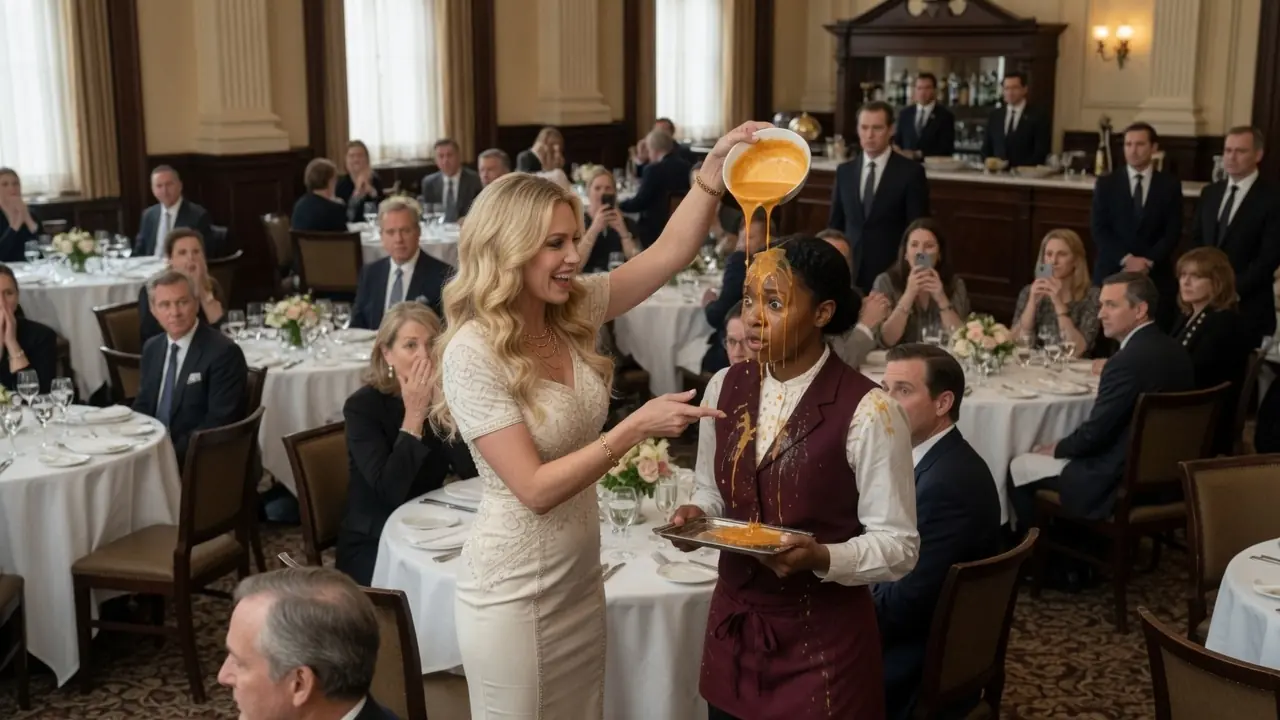
Three hours before that bowl of soup changed everything, Grace Sullivan was ironing her uniform in the kitchen of a two-bedroom apartment on the East side of Ashford, Virginia. The iron hissed against the white cotton. She pressed each crease with the kind of care most people reserved for things they owned, not things they borrowed. The uniform belonged to the Langford. Grace just wore it. She was 22, a recent graduate from Howard University with a degree in hospitality management, a 4.0 GPA, and exactly zero job offers in her field. The economy had tightened. Doors that should have opened stayed shut. So, when the Langford, the most prestigious fine dining restaurant in Ashford, offered her a paid internship, she took it without hesitation. It wasn't her dream, but it was a start. Her mother, Denise Sullivan, sat at the kitchen table behind her reading something on her laptop. She wore a plain gray cardigan and reading glasses. Her hair was pulled back in a simple bun. She looked like a school teacher. She looked like someone who clipped coupons and drove a 10-year-old Honda Civic. Because she did. What she did not look like was the Deputy Attorney General of the United States.
The Langford sat on a corner lot downtown wrapped in ivy and old money. White tablecloths, crystal stemware, a wine list longer than most novels. The kind of place where a single appetizer cost more than Grace made in a shift. She entered through the back, clocked in, and tied her apron. The kitchen was already loud. The clatter of prep, the bark of the head chef, the sweet sting of shallots hitting hot butter. Theodore Walsh, the general manager, caught her at the service station. Sullivan, you're on the main floor today, section four. Grace's stomach dropped. Section four was the VIP section reserved for donors, politicians, and the families who kept the Langford's name in the society pages. Mr. Walsh, I usually cover section two. Not today. Chelsea called in sick. You're up. He walked away before she could respond. Grace straightened her apron, picked up her notepad, and stepped onto the floor. The dining room was already filling. Sunlight poured through tall windows catching the dust motes that floated above the white tablecloths. Soft jazz played from hidden speakers. The air smelled of rosemary and seared duck. At the center table of section four a reservation card read, Caldwell, party of four, 12:00 p.m. Grace stared at the name. She took a breath. Then she picked up the water pitcher and began filling glasses. She had no idea that in less than two hours, she would be standing in this same spot, covered in soup, fired from her job, and dialing the one number that would tear this city apart.
Britney Caldwell arrived at 12:05, 5 minutes late. She never apologized for being late. She never apologized for anything. She walked through the Langford like she held the deed to the building, which, in a way, her father did. Mayor Harold Caldwell had quietly funneled city renovation grants into the Langford's last two remodels. The restaurant owed him. Everyone in it knew that. Britney was 24, blonde hair blown out to perfection, a Chanel bag that cost more than Grace's semester at Howard. She wore sunglasses indoors and didn't take them off when she sat down. Three friends followed her, two women and a man, all dressed like they'd walked off a catalog shoot. They laughed too loudly and sat without waiting to be seated. Grace saw them from the service station. Her chest tightened. She had served Britney twice before. The first time, Britney sent back her steak three times and called Grace slow. The second time, she left a 1-cent tip on a $300 bill and wrote on the receipt, Get a real job. Grace picked up four leather-bound menus, straightened her shoulders, and walked to the table. Good afternoon. Welcome to the Langford. Can I start you off with something to drink? Britney pulled her sunglasses down just enough to look Grace up and down. They put you on our section? Yes, ma'am. I'll be taking care of you today. Britney turned to her friend. Unbelievable. I specifically told them last time. She looked back at Grace. Where's the other girl? The blonde one. Chelsea is off today, but I'm happy to You're happy? Britney laughed. That's cute. You're happy. Her friends joined in. The man at the table didn't even look up from his phone. Grace kept her expression neutral. Would you like to start with drinks? Sparkling water. San Pellegrino. And make sure the glass is clean this time. Last time there was a smudge, and I don't even want to think about whose fingers were on it. Grace nodded and walked away. Her hands were steady. Her jaw was not.
She returned with four sparkling waters, each glass polished twice. She set them down without a word. Britney picked hers up, held it to the light, and squinted. Is this a water spot? It wasn't. I can get you a new one. Forget it. Just take our order before you ruin anything else. Britney rattled off her order without looking at Grace. Truffle risotto, the lobster bisque, a side of grilled asparagus. Her friends ordered one by one, each more demanding than the last. Substitutions, allergies, temperatures. Grace wrote everything down, repeated it back perfectly, and retreated to the kitchen. The head chef, a stocky man named Patterson, glanced at her ticket. Section four? Caldwell? Yeah. He shook his head. Good luck. Grace didn't need luck. She needed patience, and she had spent 22 years learning it from a mother who never raised her voice, never lost control, and never let anyone see her sweat. The appetizers came out flawless. Seared scallops with lemon foam, a charcuterie board arranged like a painting. Grace set each plate down with precision, describing every dish the way she'd been trained. Britney didn't acknowledge her. Not a nod, not a glance. She talked over Grace like she was a piece of furniture delivering food. One of her friends, a woman in a red dress, looked at Grace and mouthed, Thank you. It was the only human moment at that table. The entrees followed. Grace carried the tray herself. Four plates balanced across her arm and hand the way Theodore had taught her during her first week. She served from the left, cleared from the right. Textbook. Britney cut into her risotto, took one bite, and pushed the plate away. This is disgusting. It tastes like cardboard. I'm sorry to hear that. Would you like me to have the kitchen prepare a new one? Why? So you can mess that up, too? Britney's voice was rising. Other tables were starting to notice. Every time I come here, the service gets worse, and I know exactly why. She let the sentence hang. The implication landed like a stone in still water. Grace said nothing. She reached for the plate. Don't touch it. Britney pulled the plate back. I want to speak to your manager. Of course. I'll get Mr. Walsh.
Grace walked to the back. Her pulse was hammering, but her stride was even. She found Theodore Walsh at his desk reviewing reservations. Mr. Walsh, Ms. Caldwell is requesting to speak with you. Theodore sighed. Not with frustration at Britney, but with the tired resignation of a man who had made his peace with cowardice long ago. What now? She's unhappy with the risotto. The risotto is fine. Patterson's risotto is always fine. He stood up anyway. Stay here. Let me handle it. Grace waited by the kitchen door. Through the round window, she watched Theodore approach the table. She watched him lean in. She watched him nod. And nod. And nod again. She watched Britney gesture toward the kitchen, toward Grace, with a look of pure disgust. Theodore walked back. She wants you to personally bring her a new bowl of the lobster bisque. And she wants you to apologize. Apologize for what? For the overall experience. He paused. Grace, just do it. Please. Her father has his annual fundraiser here next month. We can't afford to lose that booking. Grace stared at him. For a moment, something flickered behind her eyes. Not anger, not sadness, but the quiet recognition of a pattern she had seen her entire life. The pattern where power excused cruelty, and silence was the price of survival. I'll bring the soup, she said. She walked to the kitchen. Patterson ladled a fresh bowl of lobster bisque, rich, orange, steaming. Grace set it on a small tray, carried it through the swinging door, and crossed the dining room. Every step felt longer than the last. She reached the table. She set the bowl down gently in front of Britney. Your lobster bisque, ma'am. And I apologize for any inconvenience. Britney looked at the bowl, then she looked at Grace, then she smiled. The kind of smile that had nothing to do with happiness. You know what? I changed my mind. She pushed back her chair and stood up. She was 3 inches taller than Grace in her heels. I don't want the soup anymore. She picked up the bowl with both hands. The bisque was still steaming. Grace saw it coming. She saw the shift in Britney's shoulders, the tightening of her fingers around the porcelain rim, the flicker of something cruel and certain in her eyes. She saw it, and she didn't move. Because where would she go? Who in this room would stop it? Britney lifted the bowl and poured it over Grace's head. The bisque hit her scalp first. A shock of heat that turned sharp, then searing. It ran down her forehead in thick orange streaks, pooling in her eyebrows, dripping off her chin. It soaked through the collar of her white shirt and spread across her chest like a burn map. The smell of lobster and cream filled her nostrils, mixing with something metallic. Her own skin reacting to the heat. Grace stood perfectly still. The empty tray hung at her side. Her fingers had gone white around its edge. The dining room went silent. Not the comfortable silence of a pause between courses, the suffocating silence of 40 people watching something terrible and choosing to do nothing. Britney set the bowl back on the table. She wiped her hands on her napkin.