Clara Whitmore had not eaten in two days when she heard boots on her porch. She didn't move. She lay on the cold floor of the only room she had left. One hand pressed flat against the floorboard her father had nailed down the winter before he died, and she told herself she was not afraid. She told herself she was not finished.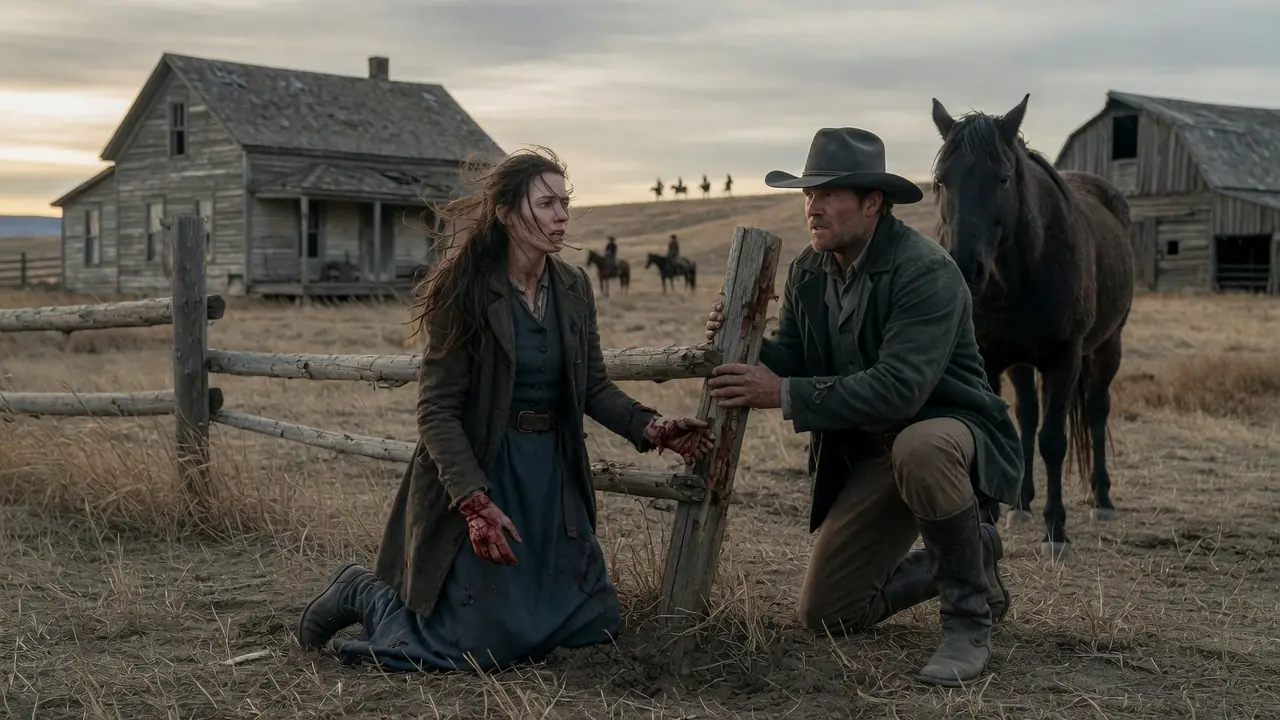
She told herself the land was still hers. She was still telling herself those things when the door opened and a stranger stepped inside. The morning Ethan Walker rode onto the Whitmore property he wasn't looking for trouble. He wasn't looking for anything really. He'd been out since before dawn checking the eastern fence line where three of his steers had pushed through the night before, and the wind had been cutting across his face hard enough to make his eyes water the whole ride.
He was cold, irritated, and ready to turn back toward home. But then he saw the smoke. It was thin, barely a thread rising above the tree line coming from the direction of the old Whitmore spread. He hadn't thought much about that place in months. Hadn't needed to.
Everybody in Millbrook County knew the Whitmore ranch was done. Margaret Whitmore had passed in the spring, and before that, Thomas Whitmore had died owing the First Territorial Bank more money than the land would ever be worth. The daughter, Clara, had stayed on, but nobody expected it to last. You couldn't run a cattle operation alone. You couldn't fight the bank alone.
You couldn't fight Victor Caldwell alone. Ethan told himself he was only riding over to make sure no vagrant had taken up in an empty house. He told himself it had nothing to do with the rumor he'd heard at Haggerty's store two weeks ago, that Clara Whitmore was still there, still working, still refusing every offer Caldwell sent her way. He told himself a lot of things that morning. He stopped telling himself things the moment he came through the tree line and saw her.
She was on her knees in the dirt beside the east fence, her bare hands wrapped around a fence post that had been half rotted out of the frozen ground. Her coat was too thin. Her gloves were gone. The wind was pulling at her hair, and she wasn't paying it any attention because she was working. Really working, shoulders straining, jaw set, pulling at that post with everything she had.
Her hands were bleeding. Ethan sat on his horse for a moment and just watched her. He didn't know why. Something about the sight of her stopped him cold in a way the wind hadn't managed all morning. She didn't look up when he rode closer.
Didn't look up when his horse snorted and stamped. She didn't look up until his shadow fell across the ground in front of her. And then she sat back on her heels, pushed the hair out of her face with her wrist, careful not to touch her face with her bloody palms, and looked up at him with eyes that were brown and level and entirely without fear. Unless you're here to buy my land, she said, you've got no reason to be standing there. Her voice was flat, not rude, just done with something.
Done with softness, maybe. Done with pretending things were different than they were. Ethan took off his hat. He didn't know why he did that, either. My name's Ethan Walker, he said.
My spread's about 4 miles east. I know who you are, Clara said. She looked back at the fence post and set her hands around it again. Doesn't change what I said. He climbed down off his horse anyway.
She shot him a look over her shoulder that could have cured leather. I don't recall inviting you down. No, ma'am. He crouched beside her and set both hands on the post just below hers. But this post is going to tear your palms open to the bone before it comes loose.
So, let's get it out and then I'll go. She stared at him. He stared at the post. On three, he said. A long pause.
Then, I'm pulling on two, she said. They pulled. The post came out of the ground on two with a sound like something finally giving up and the force of it sent them both back her sitting hard in the dirt, him catching himself on one knee. He looked over at her. She was already checking the post, running her fingers along the base to see how far the rot had gone.
It's too far gone, she said mostly to herself. I need a new post. I've got lumber, he said. She looked at him, then really looked at him, and whatever she was searching for in his face, she didn't seem to find it. Or maybe she found too much of it.
Something shifted behind her eyes. She stood up and brushed the dirt from her knees. I don't take charity, she said. I didn't offer any. He stood, too, and put his hat back on.
I said I've got lumber. I didn't say I'd give it to you for free. She crossed her arms. What do you want for it? He looked out at her fence line, what was left of it.
Six posts down that he could count from where he stood and the wire between them sagging toward the ground. She'd been out here alone fixing this by hand in November with no gloves. I want to know, he said slowly, how long you've been out here doing this by yourself. That's none of your business, Mr. Walker. Fair enough.
He turned back to his horse. I'll have the lumber sent over this afternoon. I told you I don't. It's a trade, he said without turning around. You let me send the lumber.
Come spring, if I need extra grazing land on the south side of your property, you'll consider leasing it. Silence. He gathered his reins and waited. That's a real funny kind of trade, Clara said finally. Where I get lumber now and you might get something later.
I've got lumber to spare, he said. And I've got cattle that are going to need more grazing come spring. Seems like a reasonable arrangement. Another silence. The wind moved between them.
Fine, she said. Send the lumber. He nodded and rode out. He didn't look back. But he thought about her the whole 4 miles home, the set of her jaw, the steadiness in her eyes, the blood on her hands that she'd ignored like it was nothing.
Like pain was just one more thing on a long list she didn't have time to tend to. He thought about what it took to be the last person standing on a piece of land that everyone else had already written off. And somewhere in the thinking, the something that had stopped him when he first saw her, that strange quiet stopping settled into something he didn't have a word for yet. The lumber arrived that afternoon just like he'd said. Clara watched the wagon come up the drive from the front window, and she watched the two ranch hands unload the posts and stack them neat by the barn without being asked.
And she felt something complicated and unwelcome move through her chest. She didn't like owing people things. She especially didn't like owing Ethan Walker things because she'd heard enough about Ethan Walker over the years to know that he wasn't the kind of man who forgot what he was owed. Except that wasn't exactly what she'd heard. What she'd heard was that he was fair, straight-dealing, that he'd never once bought a man's land out from under him during a bad season, even when every other rancher in the territory was snapping up desperate acres like they were going for nothing.
He'd offered fair prices when he bought, and he hadn't bought much. That was more than she could say for Victor Caldwell. She thought about Caldwell's last letter as she went back to the fence line with the first new post. She'd read it so many times, she had it memorized. She knew the polite language wrapped around the threat inside it.
The way he always wrote, Your difficult circumstances. Like he hadn't had a hand in creating them. Victor Caldwell had bought the mortgage on her father's loan eight months ago. She hadn't known, couldn't have known. The bank had sold it without a word to her, and by the time she figured out what had happened, the new terms had already been set.
The interest rate had doubled, the repayment window had shrunk, and every supplier in Millbrook County had quietly, carefully stopped extending her credit. She wasn't stupid. She knew who'd made those phone calls. She knew who'd told people that the Whitmore girl was a bad bet. She just couldn't prove it.
Not yet. She set the new post into the hole she'd dug, and packed the dirt around it with her boot heel, and she thought about proof. She thought about what her father had told her once when she was 12 and had come home furious because Billy Larson had stolen her arithmetic prize at the school fair, and everyone believed him instead of her. You don't fight a liar with anger, Clara girl, he'd said. You fight a liar with evidence.
You collect the evidence, and you wait, and then you let the truth do the shouting for you. She packed the dirt harder. She was still collecting. Ethan came back two days later. She was in the barn when she heard his horse, and she took a moment to finish what she was doing before she came out.
Not because she was making him wait on purpose, though she wasn't sorry if he read it that way. She just didn't believe in dropping what you were holding because someone showed up. He was standing by the fence when she came out, one boot up on the lower rail, studying her repair work with what looked like genuine attention. Posts are straight, he said when he heard her. I know how to set a post, she said.
I can see that. He turned around. He had a wrapped parcel in one hand that she hadn't noticed, and he held it out toward her. My housekeeper sends these to anyone she thinks isn't eating enough. I didn't ask her to.
She does it on her own. Clara looked at the parcel. She could smell what was inside it, bread and something savory underneath. Her stomach did something embarrassing. Tell her I appreciate the thought, Clara said, but I'm eating fine.
You told her that yourself, Ethan said. She'd hand it right back to you and tell you that eating fine and eating enough are two different things. He set it on the fence post between them. I'll leave it here. What you do with it is your business.
He turned back to the fence line. You've got about eight more posts that need replacing before the first hard freeze, he said. And your wire's wrong gauge for cattle. It'll hold sheep, maybe goats, but a steer hits that at a run and it'll go right through. I don't have cattle anymore, Clara said flatly.
He turned to look at her. I know, he said quietly. The word landed differently than she expected, not with pity, not with the careful, not quite sympathy people had been offering her for two years, the kind that kept a safe distance from actually meaning anything. He said it like a man acknowledging a hard fact, like he was used to hard facts and didn't see a point in dressing them up. What happened to them?
he asked. She considered not answering. Then she said, Caldwell happened. Not directly, he never does anything directly, but last spring two of my best breeding cows went missing from the south pasture. Then a disease went through the herd.
I've never seen it before or since, and I've talked to three other ranchers who've had dealings with Caldwell, and they say the same. Convenient diseases, lost cattle. One man woke up to find his water line had been cut. Ethan's expression didn't change much, but something in his eyes went still and careful in a way she recognized. It was the same thing that happened to her face when she was angry and didn't want anyone to know.
You report it? he asked. To who? She kept her voice level. Sheriff Poole takes every meal at Caldwell's table.
The county clerk is Caldwell's wife's cousin. The territorial court is eight days ride and won't hear a case under $500 in damages. She picked up the parcel from the fence post. She wasn't giving it back to whoever had made it. That would be rude, and tucked it under her arm.
I'm not reporting anything to anyone until I have enough that they can't look away from it. Ethan was quiet for a moment. Then he said, What do you have so far? She looked at him. Why?
Because he said, I've got a man who used to work as a recorder for the territorial land office before he came to work for me. If Caldwell's been doctoring claim papers or buying mortgages illegally, there's a way to see it in the records if you know what you're looking for. Clara stared at him. Why would you do that? she asked.
Because I've been watching Caldwell buy up this county piece by piece for 3 years, Ethan said. And every piece he buys a family leaves, and I'm tired of watching families leave. She studied his face. She'd learned to read people. Her father had taught her that, too, before the arithmetic lesson and after it, and she was looking for what was underneath his words, what he wanted, what he was angling for.
Men always wanted something. She found nothing or nothing she could name. He looked back at her with those straight blue eyes and waited, and she couldn't find the angle, and that bothered her more than an angle would have. I'll think about it, she said. He nodded, put his hat on, climbed back onto his horse.
You'll want to eat that bread warm, he said, nodding at the parcel under her arm. Mrs. Briggs makes it with bacon fat, and it doesn't keep well past a day. He rode off. Clara stood there holding the parcel and watched him go, and the complicated, unwelcome thing in her chest got a little more complicated and a little less unwelcome, and she didn't know what to do with that at all. She went inside and ate the bread warm standing at the kitchen counter in the last of the afternoon light, and it was the best thing she'd tasted in four months.
She didn't let herself think too hard about that, either. Victor Caldwell came on a Thursday. He always came on Thursdays. She didn't know why, some habit of his, some sense that Thursday was a good day for doing the kinds of things he did. He came with his man, Greer, who was large and quiet and stood slightly behind Caldwell's left shoulder, like a shadow that had learned to take orders.
She did not open the door wider. She did not invite him in. Caldwell smiled. And? And my answer is the same as it was to your last three letters, she said.
No. Caldwell's smile didn't falter. That was one of the things she most hated about him. The smile never faltered because he didn't believe no was a real answer. He thought no was just a position you held before you ran out of other options. Clara.
He said he always used her first name, like familiarity was something he could put on her without permission. I've been more than patient. Your mortgage comes due in February. You don't have the cattle to generate the income you need. You don't have the credit to buy more cattle.
You are, and I say this with genuine sympathy, in an impossible position. Genuine sympathy, she repeated. Genuine, he said. She looked at him for a long moment. My father built this property from bare ground, she said.
He dug the first well himself. He built the barn with his own hands and three neighbors who came to help because that's what neighbors did. He ran cattle on this land for 31 years. She kept her voice perfectly even. I have no interest in your sympathy, Mr. Caldwell.
Genuine or otherwise. Caldwell studied her. The smile went slightly thinner. No woman, he said, keeps land in this territory without a man to protect her. He said it the way he said everything pleasantly, reasonably, like he was offering her an obvious truth that she was being foolish to resist.
You have no husband, no brothers, no father. You have a broken-down fence and a barn that won't last another winter and a mortgage you cannot pay. He tilted his head slightly. I'm offering you a way out, Clara. A fair price.
More than the land is worth in its current condition, frankly. Then why do you want it so badly? She asked. The smile went thinner still. Because I believe in this territory, he said.
I believe in its future. And I want to be part of building it. With other people's land, she said. With underutilized land, he said and smiled. behind his eyes went flat and cold for just a moment before the pleasantness came back.
Think about it, Clara, before February. He turned and walked back to his horse. Greer followed without a word. Clara stood in the doorway and watched them ride out, and she didn't move until they were gone from sight. And then she leaned against the door frame and pressed the back of her hand against her mouth because she was shaking.
Not from fear, or at least not only from fear, and she breathed until the shaking stopped. Then she went inside and got out the ledger she kept locked in the chest under her bed, and she sat at the kitchen table, and she opened it to the last page. She had 63 days until February. She had $37.04 in cash. She had three pages of notes, names, dates, discrepancies she'd found in county records, accounts from other ranchers she'd written down word for word.
She had one letter from Silas Greer Caldwell's man that she'd found blowing loose along her south fence line after one of his visits that she had not yet figured out if she could use. She had 63 days and $37.04 and three pages of notes and one loose letter. And she thought with a feeling she didn't entirely trust she might have Ethan Walker. She sat with that for a long time. Then she got up, put on her coat, and walked the 4 miles to the Walker ranch in the dark.
He answered the door himself, which surprised her. She'd expected a housekeeper or a ranch hand or someone who wasn't him. Instead, it was him in his shirt sleeves holding a coffee cup, and he looked at her standing on his porch in the dark for a moment without saying anything. Then he stepped back and held the door open. Come in, he said.
She came in. The house was warm, warmer than anywhere she'd been in weeks, and it smelled like coffee and wood smoke, and something that reminded her, before she could stop it, of her father's house when her father had been alive. She sat at his kitchen table without being asked to sit, and he set a cup of coffee in front of her without being asked. And then he sat across from her and waited. She pulled the letter from her coat pocket and laid it on the table between them.
Silas Greer wrote this to someone named R. Townsend, she said. I don't know who Townsend is. I found it on my property line 4 months ago. I think it's about the disease that killed my cattle, but it's written careful enough that I can't prove it. She paused.
You said you have a man who knows land records. James Aldridge, Ethan said. He worked for the territorial recorder's office for 6 years. Can he find a man named R. Townsend in the county records? Ethan picked up the letter.
He read it carefully, not skimming, reading the way a man reads something he intends to do something with. He can try, Ethan said. I need more than try, Clara said. He looked up at her. I have 63 days, she said.
I need to prove that Caldwell has been illegally manipulating mortgages in this county, and I need to prove it to someone who can actually do something about it, and I need to do all of that before he takes my land in February. She pressed her hands flat on the table. Her palms had scabbed over from the fence post work, and the scabs pulled when she pressed down, and she didn't move her hands. I'm not asking you to do this for me. I'm asking if you'll do it with me.
Ethan set the letter down. He looked at her for a moment, and there was that stillness again, that careful thing behind his eyes, except this time it wasn't anger. She didn't know what it was. She didn't know what to do with not knowing. Yes, he said.
Just that. No conditions. No angle she could find. Okay, she said. She picked up the coffee cup and drank it, and it was the best coffee she'd tasted in 4 months, and she was getting tired of things tasting like the best thing she'd had in months because it meant she'd been doing without more than she'd let herself notice.
Outside, the wind pushed against the house. Somewhere in the dark, her fence stood with its new posts holding. She thought 63 days. She thought it's enough. She made herself believe it.
James Aldridge was a small man with ink-stained fingers and the kind of eyes that had spent years looking for things other people missed. He arrived at Clara's kitchen table the following morning with a leather satchel so full of papers it wouldn't close properly, and he sat down, looked at the letter Clara had found on her fence line, and said nothing for 4 full minutes. Clara watched him read. Ethan stood with his shoulder against the kitchen wall, coffee in hand, watching Aldridge the same way Clara was watching him, waiting, not pushing. Clara had decided sometime in the last 12 hours that she liked that about Ethan Walker.
He didn't push. He let things take the time they needed to take. R. Townsend, Aldridge said finally without looking up. Robert Townsend. He's a veterinarian, licensed in two counties, Millbrook and Hargrove.
Runs a practice out of Hargrove, which is why you've never seen him here. He set the letter down carefully like it was something that might break. He's also the man who signs off on livestock disease certificates in Hargrove County. The room went quiet. Meaning, Clara said slowly, that if cattle on someone's property were officially declared diseased, the owner would have to destroy the herd, Aldridge said, or surrender them to county authority.
Yes. He finally looked up. And the county authority in Hargrove is Judge Miles Carey, who is, as it happens, Victor Caldwell's brother-in-law. Ethan set his coffee cup down. How long has Townsend been licensed in Millbrook County?
he asked. He's not, Aldridge said. His license covers Hargrove only, which means anything he certified on your property He looked at Clara. Wasn't legal. The certification was fraudulent.
Clara sat very still. She thought about the morning she'd found her cattle. 14 animals that had been fine at sundown and by dawn were staggering and foaming and had to be put down before noon. She thought about the county man who'd come out, a man she'd never seen before and hadn't seen since, who'd walked through her barn for 20 minutes and handed her a paper and told her she was lucky it hadn't spread further. She thought about how she'd filed the paper away because you filed papers.
That was what you did. And she hadn't looked at it closely because she'd been too grief-stricken and too angry and too exhausted to look at anything closely. I have the certification paper, she said. It's in my chest with my other documents. I'd like to see it, Aldridge said.
She got up and went to the bedroom and came back with the locked chest and she opened it on the kitchen table and found the paper near the bottom. Aldridge took it between two careful fingers, read it, and held it up toward the window. Townsend's signature, he said. And look here. He pointed to the bottom corner.
This county seal. It's Hargrove County seal, not Millbrook's. Someone stamped this in a hurry and didn't notice they had the wrong seal. Or they knew, Ethan said quietly, and figured she'd never check. She?
Clara said, and her voice came out harder than she intended, is sitting right here. Ethan looked at her. I know, he said. I'm talking about Caldwell. A beat.
It was an apology without being an apology, and he accepted it the same way. Aldridge was already writing in his notebook. This is one piece, he said. One fraudulent certification, one unlicensed veterinarian, one wrong county seal. In a territorial court, that's enough to contest the cattle loss, but probably not enough to take down Caldwell himself.
He looked at Clara over his glasses. What else do you have? She opened the ledger. She spread her three pages of notes on the table, and Aldridge leaned forward, and for the next hour, they went through everything she'd collected, every name, every date, every discrepancy she'd spotted in the records she'd managed to obtain from the county clerk's office. She'd gotten those records by going in on a Tuesday morning when the clerk's regular assistant was off sick, and a temporary girl she didn't know was filling in, a girl who hadn't gotten Caldwell's message yet about what Clara Whitmore was and wasn't allowed to see.
Aldridge read everything twice. Then he said, Ms. Whitmore, these mortgage transfer records, where did you get these? County clerk's office, she said. Is there a problem with them? No, he said slowly.
No, the problem is with what they show. He tapped one page. This mortgage, the one Caldwell bought from First Territorial Bank, the transfer was recorded on March 4th, but this second document, the one adjusting the interest rate and repayment terms, is dated February 28th. He looked up. The bank sold the mortgage on March 4th, but Caldwell changed the terms on February 28th, 6 days before the sale was recorded.
The kitchen went completely silent. He changed the terms, Clara said carefully, before he legally owned the mortgage. Before the transfer was officially recorded, Aldridge said. Yes. Which means either the bank clerk recorded the date wrong, possible.
But these clerks are usually precise. Or Caldwell had a private arrangement with the bank before the public transaction went through. He took his glasses off and cleaned them on his shirt. If it's the second, and if we can show the bank clerk was paid to delay recording the date, that's fraud. Not just against you.
Against the territorial recording law. Clara put both her hands flat on the table again. She thought about 63 days. She thought about $37.04. She thought about the way Caldwell had stood on her porch and said, No woman keeps land in this territory without a man to protect her.
As if that were gravity, as if it were weather, as if it were just the way things were, and there was no point discussing it. Then we need to find the bank clerk, she said. Aldridge nodded. A man named Horace Bell. He left First Territorial about 4 months after the transfer and opened a dry goods store in Hargrove.
Hargrove again, he said it with the dry tone of a man who had stopped believing in coincidences. I can ride to Hargrove. We both can, Ethan said. Aldridge looked at him, then at Clara, then back at Ethan. I'll go alone, Aldridge said carefully.
A man with a dry goods store is going to be more comfortable talking to one quiet former land clerk than to me and you. He paused. No offense, Mr. Walker. None taken, Ethan said. I agree with him, Clara said.
Ethan looked at her. You're recognizable, she said. Everybody in two counties knows who you are. If you ride into Hargrove asking questions about Victor Caldwell, someone's going to have a message on Caldwell's desk before you're back across the county line. He was quiet for a moment.
You're right, he said. She hadn't expected him to agree that fast. It caught her off guard, and she looked away first, which annoyed her. Aldridge goes to Hargrove, she said. How long?
Three days if the roads hold, Aldridge said. Go tomorrow morning, Clara said. I'll keep working the county records while you're gone. He nodded and started gathering his papers. Ethan walked him to the door, and Clara heard them talking in low voices on the porch, for a moment too low to make out words, and then the door closed, and Ethan came back.
He sat back down at her kitchen table like it was a thing he'd been doing for years. You know, she said without looking up from the ledger, you don't have to stay. I know, he said. I'm capable of sitting at my own table by myself. Never said you weren't.
She looked up. He was looking at the letter from Silas Greer, which was still lying on the table between them, and his expression had the careful stillness she'd started to recognize. What is it? she asked. Greer, he said.
He's been with Caldwell for 12 years. He's not just a hired hand. He's the one who actually does things. He tapped the letter lightly. Caldwell would never have written something like this.
Too careful. He lets Greer be careless for him. He looked up. Which means Greer knows things Caldwell doesn't want written down anywhere. And Greer is going to tell us those things because we asked nicely, Clara said.
No, Ethan said. But there might be a reason Greer was careless enough to write this letter, and there might be a reason it ended up on your fence line. She stared at him. She hadn't thought about that. She'd found the letter and been so focused on what it meant that she hadn't stopped to ask why it existed.
Who Greer had been writing it to and why he'd been writing it anywhere near her property. You think Greer was meeting someone on my land? she said. I think it's possible, Ethan said. Someone he didn't want seen coming to him.
Someone who might be he paused less comfortable with what Caldwell's been doing than Greer is. An informant, she said. He looked at her. Or someone who's scared, he said. That's different.
Three days was a long time to wait when you had 59 of them left. Clara worked. It was the only thing she knew how to do with time that felt like it was running out. Fill it with work so hard that there was no space left in it for fear. She finished the east fence line by herself over two days, setting each new post and stringing new wire with the methodical focus of someone who understood that the fence didn't care about Caldwell's letter or Aldridge's road to Hargrove or the complicated thing in her chest that happened whenever Ethan Walker sat at her kitchen table.
The fence needed to be right. So she made it right. Ethan came by on the second day. He didn't make an announcement of it. He rode up, tied his horse to the post nearest where she was working, and picked up the wire stretcher without a word.
I don't need she started. I know, he said and began stretching the wire to the next post. She watched him for a moment. You're stubborn, she said. Probably, he said.
Hold the wire. She held the wire. They worked in silence for a long time, and it wasn't the uncomfortable kind. That surprised her. Silence with most people made her aware of all the things they weren't saying, all the pity or the judgment, or the opinions they were being polite enough to keep to themselves.
Silence with Ethan was just silence. He worked and she worked and the fence got done and that was the whole thing. Then he said without stopping work, Tell me about your father. She looked at him sideways. Why?
Because you've mentioned him three times, he said, and you talk about this land like it's still partly his. I'd like to know who he was. She was quiet for a moment. Thomas Whitmore, she said. He came out here from Ohio in 1851.
Nothing but $20 and a mule. He spent 3 years just figuring out the land before he put in a single fence post. He said, She paused, hearing her father's voice in her head, the way she still did sometimes suddenly and without warning. He said that a man who builds before he understands is just making a fancier kind of mistake. She pulled a wire taut.
He was patient. More patient than me. What happened? Ethan asked. He got sick the winter of '74, pneumonia.
He fought it for 6 months, but it came back, she said it straight the way she'd learned to say it, not with the awful hollow feeling behind the words, but over the top of it. He left me the land and the cattle and the debt in that order. The land was always what mattered. The cattle and the debt were just what came with being here. And your mother?
Went back to her sister in Columbus when I was 16. She loved my father and she loved the land when he was alive, but she couldn't Clara stopped. She couldn't do it alone. She didn't know how. But you did, he said.
It wasn't a question and she didn't answer it like one. I learned, she said. He was quiet for a moment. Then, My father lost our first spread when I was nine. Bad season and a worse loan.
He spent 2 years working other men's land before he put enough together to start again. He worked the wire onto the staple. I was 17 when we got the Walker property. He let me drive in the first fence post because he said I'd understand land better if my hands were in it from the beginning. He paused.
He was right. Clara looked at him. There was something about the way he'd said it, matter-of-fact, no particular weight on it, no invitation for sympathy that made it land differently than she expected. Like he'd given her something and wasn't waiting to see if she'd take it. She took it.
How old were you when he died? she asked. 22, he said. He didn't die, actually. He's in California, retired.
A brief pause. We don't talk much. Why not? He looked at her. Because, he said, he sold the property twice more after I left.
Twice more he let himself get pushed off land that was his. And I couldn't He stopped. I couldn't keep watching and not be able to stop it. She understood that. She understood it all the way down.
So you built yours, she said. So I built mine, he said. And I've never sold a single acre, not to anyone. She turned back to the fence. Must be nice, she said, to have enough that no one can make you.
That's not why, he said quietly. She glanced at him. It's not about enough, he said. There's always someone with more who could come for it if they wanted. I've just decided He tapped the fence post.
I'm not leaving, whatever happens. The wire hummed in the wind between them. Neither am I, Clara said. He looked at her, then really looked for a moment longer than usual, and she felt it somewhere she didn't want to examine too closely. I know, he said.
That's why I'm here. Aldridge came back on the evening of the third day. Clara heard his horse before she saw him, and something in the rhythm of the hoofbeats, slower than a man coming back with nothing told her before she opened the door that he'd found something. Ethan was there already, which meant Aldridge had stopped at the Walker Ranch first, which meant whatever he had was significant enough that he'd brought Ethan along. She put water on for coffee and waited.
Aldridge sat down and opened his satchel, and for a moment the only sound was the creak of leather, and the pop of the stove, and the wind outside. And then he laid three documents on the table. Horace Bell talked, he said. He talked for two hours, and I wrote down everything he said, and then he read it back and signed it. Clara looked at the signature at the bottom of the last page.
The handwriting was shaky, a frightened man's handwriting, but it was there. What did he say? Ethan asked. That the mortgage transfer was deliberately backdated, Aldridge said. That Caldwell had an arrangement with a senior officer at First Territorial, a man named Prentice, who has since retired and moved to his daughter's place in New Mexico, where Caldwell would be given private advance knowledge of distressed mortgages before they went to public sale.
He'd negotiate the purchase privately. The formal recording was done after the fact, but the terms, the changed interest rate, the shortened repayment window were set in the private agreement. He paused. Bell recorded at least 14 mortgages this way over 4 years. Yours was one of them.
14. Clara heard that number and felt something she hadn't expected. Not vindication, not even anger, but something deeper and colder. 14 families. 14 properties.
14 people who'd been standing exactly where she was standing now, alone, with a debt that had been secretly tilted against them before they'd had any chance to respond. And Bell will testify to that? Ethan asked. He will. Aldridge took his glasses off.
He's terrified. Has been for 2 years. When Caldwell dismissed Prentice and Prentice left the territory, Bell was certain he'd be next, that Caldwell would find a way to implicate him in the fraud to protect himself. He said he's been waiting for someone to ask the right questions. He should have come forward himself, Clara said.
Aldridge looked at her. Yes, he said. He should have, but frightened people don't always do the thing they should. He paused. He did it now.
She pressed her mouth together and looked at the signed statement. 14 families, she said. At least, Aldridge said. Bell only had direct knowledge of the ones that came through First Territorial. There are likely others, different banks, different counties.
Ethan looked at the documents for a long moment. How many of those 14 properties does Caldwell still own? 11, Aldridge said. Three were resold. The other 11 he's holding.
Waiting, Bell thinks, for the railroad. That landed in the room like something thrown. The railroad, Clara said. There's been talk, Aldridge said carefully, for about 2 years now, that the Northern Pacific line may extend south. If it comes through this valley he spread his hands.
Land that's worth $500 an acre now is worth 5, 000. Maybe more. Clara looked at Ethan. Ethan looked at the map. That's why he wants it.
She said. Not a question this time. That's why he wants all of it. Ethan said. Your land sits right in the middle of the most direct route a southern extension would take.
He traced a line across the table that wasn't a map, but she understood what he meant. He doesn't want a ranch. He wants to sell to the railroad company and he wants every acre on that route before the survey teams make the line official. 14 families, 11 properties and hers. How much time Clara said until the railroad decision gets made public?
Aldridge looked at her steadily. Bell thinks 6 months, maybe 8. She has 60 days. Clara said. I know.
Aldridge said. Then we go to the territorial court. She said. Bell's statement, the fraudulent certification, the wrong county seal on the livestock paper, the backdated mortgage records. We take all of it.
It's not enough. Aldridge said quietly. She stared at him. Bell's testimony about the mortgage fraud is significant. He said.
But Caldwell's lawyers will argue that Bell had motive to fabricate that Caldwell dismissed him, that he holds a grudge. The livestock certification is a paperwork error that Caldwell's people will claim was clerical. The mortgage date discrepancy, Caldwell will say, Prentice acted independently, that he had no knowledge of the private arrangement. He folded his hands on the table. We need Greer.
That night Clara lay awake on her cot and stared at the ceiling and thought about Silas Greer. 12 years with Caldwell. The man who made things happen while Caldwell kept his hands clean. The man who'd written a letter he shouldn't have written to a man on Clara's fence line about cattle that had died on Clara's property. A letter written to someone who'd met him there.
Someone who'd walked onto her land and hadn't wanted to be seen. She sat up. She thought about the Whitmore land south pasture, the part that butted up against what used to be the McKinnon spread before Caldwell bought it 18 months ago. The fence between them was down in two places. Had been down since before Clara could fix it, which she'd always assumed was just neglect.
But McKinnon's old land bordered her land, and McKinnon's old land bordered something else. She got up, lit the lamp, and found the county survey map she kept folded in the back of the ledger. She spread it on the table and looked at it in the lamplight, tracing the property lines with her finger the way Ethan had traced the railroad route across the air. McKinnon's land. Hers.
The Henderson property to the north, which Caldwell had tried and failed to buy Henderson, was stubborn enough to make her look accommodating, and the old parson's place to the west. She looked at it for a long time. Greer had been on her land. Between her property and McKinnon's old land. The land Caldwell now owned.
Which meant Greer had been moving between Caldwell's property and hers without going through any town, any road, any place where he might be observed. Which meant whoever he'd been meeting on her fence line had been someone who didn't want Caldwell to know they were talking to Greer. Greer wasn't loyal, she realized. Or wasn't only loyal. Greer was protecting himself.
She folded the map and put on her coat and went next door to knock on her own barn door, which was where she'd been sleeping since she'd given up the second bedroom to stay warm, and she thought about how to get to a man who had 12 years of Caldwell's secrets inside him and didn't know yet whether it was safer to stay silent or to speak. She thought about it until dawn when the answer came to her not like a solution, but like a thing she'd known and hadn't wanted to look at directly. She couldn't go to Greer, but she knew someone who could. She was at Ethan's door before breakfast. He opened it in his shirt sleeves again.
She decided she was going to stop noticing things like that. Greer, she said. He was meeting someone on my property. Someone from Caldwell's operation who's scared. The only person on Caldwell's property who makes decisions and isn't Caldwell or Greer is the foreman, Ethan said.
She blinked. Daniel Marsh, he said. He's been Caldwell's ranch foreman for 7 years. He came to me 6 weeks ago looking for work. He stepped back from the door.
I told him to come back in the spring. I didn't know why he was looking. Clara stared at him. You didn't think to mention that, she said. I didn't know it mattered, he said, until right now.
He looked at her. Come in. She came in and sat at the table that she was spending more time at than her own, and Ethan sat across from her, and between them lay 6 weeks of an accidental piece of information that had just become the most important thing either of them had. Marsh came to you, she said. Which means he's trying to leave.
Which means he's either uncomfortable enough or scared enough that he's looking for a way out before something lands on him. And if Greer was writing letters he shouldn't have been writing, Ethan said, Marsh may know what's in them. Can you get him here? Ethan looked at her. You mean without Caldwell knowing?
he said. I mean, she said, can you do it in a way that feels like an accident to anyone who might be watching? He thought about it for a moment. There's a cattle auction in Dalton on Saturday, he said. Caldwell never goes to small for him, but Marsh goes to buy for the operation.
I go every year. He paused. It wouldn't be strange for me to talk to a foreman at a cattle auction. No, she said. It wouldn't.
He looked at her steadily. If Marsh talks, he said, this gets much bigger than one woman's ranch and one fraudulent mortgage. I know, she said. You understand what that means. Caldwell has money and lawyers and Greer, and he's had 12 years to put pieces in place.
If this goes to the territorial court and Marsh is a witness, Caldwell will try to stop it, she said. I know. Clara, he said her name the way you said a name when you wanted someone to hear it. He might try to stop it in ways that aren't legal. She looked at him across the table.
Ethan, she said, and it was the first time she'd used his name, and she didn't miss the way he went slightly still when she did. He already has. He destroyed my herd. He backdated my mortgage. He's been pressuring my neighbors for years.
I'm not new to what Victor Caldwell is willing to do. She leaned forward. What I'm new to is having enough to fight back with. He held her gaze. Something passed between them.
Not soft, not like the things in books she'd read when she was young and believed in things being soft. Something harder than that. Something that had been tested and had held. Saturday, he said. Saturday, she agreed.
She stood up. You should bring your ledger, he said. The notes, everything you have. When Marsh talks, and I think he will, we'll want it all in front of us. She gathered her coat.
Ethan. He looked at her. Thank you, she said. Not the way you said it to someone who'd done you a favor. The way you said it to someone who'd changed the direction of her life.
She went out into the morning, and the cold came at her from every direction, and she walked toward her land with the map in her head and Aldridge's documents in her memory and 57 days on the clock. Somewhere in Dalton, Daniel Marsh was going to walk into a cattle auction on Saturday, and he didn't know yet that everything was about to change. Daniel Marsh was a big man who moved like someone trying not to be noticed, which was the first thing Ethan clocked when he spotted him across the auction yard on Saturday morning. Marsh had his hat pulled low and his collar up, and he was standing slightly apart from the other foreman, nursing a coffee that had probably gone cold an hour ago, watching the cattle in the pen with the focused attention of a man who was watching the cattle because it was better than watching the people watching him. Ethan didn't go to him immediately.
He bought a coffee of his own, talked to three men he knew about nothing important, looked at two lots of Hereford steers he had no intention of bidding on, and let 40 minutes pass before he drifted to the far end of the yard and stopped beside Marsh at the fence rail. Those short horns in lot seven, Ethan said, nodding toward the pen. They look thin to you? Marsh glanced at him, recognized him. Something moved behind his eyes.
Not surprise, or not just surprise. Little thin, Marsh said carefully. Been a hard fall. Has been. Ethan agreed.
They stood there for a moment, two men looking at cattle, and the auctioneer's voice rolled across the yard from somewhere distant. Then Marsh said very quietly, I heard you have work come spring. I said I might, Ethan said, I'm a good foreman. I know you are. Ethan kept his eyes on the cattle.
I also know you've been running Caldwell's operation for 7 years, and you're looking for work in November, which is a strange time to look. He paused. Unless you have a reason to want to be gone before February. A long silence. I don't know what you mean, Marsh said.
Dan. Ethan turned to look at him, then straight and level. A woman named Clara Whitmore has 60 days before Victor Caldwell takes her land on a mortgage that was fraudulently structured before she ever had a chance to know what she was dealing with. She has a signed statement from Horace Bell about the backdated recording. She has a livestock certification paper with the wrong county seal.
She has three pages of documented discrepancies. He paused. And she has a letter from Silas Greer to a man named Townsend that she found on her own fence line. He watched Marsh's face carefully. She thinks Greer was meeting someone on her property, someone who walked from your side of the line.
Marsh's jaw tightened. I don't know anything about that, he said. Then you won't mind telling me what you were doing on the south end of Caldwell's property on the evening of August 14th, Ethan said, Because that's when Clara found the letter. And there's only one path from that property line back to Caldwell's bunkhouse. The auctioneer called lot seven.
Around them men began moving. Marsh didn't move. If Caldwell finds out I talked to you, he said very quietly. I won't just lose the job. You understand what I'm saying?
I understand, Ethan said. I also understand that you've been working for a man who has destroyed 14 families' livelihoods in 4 years to position himself for a railroad windfall that's worth $10 million. And you've been a part of that. He let that land for a moment. What happens when the territorial court opens an investigation, and they will open one, Dan?
We have enough to force it. What happens to the men who were just following orders when someone starts asking who followed which one? Marsh stared at the cattle pen. His hands on the fence rail were white at the knuckles. I didn't know about the cattle, he said.
Not at first. I found out after. He stopped. I told Greer it was wrong. He told me to keep my mouth shut and do my job.
And you did, Ethan said. And I did. The words came out like something he'd been holding at arm's length for a long time. I needed the work. I have a wife and two kids in Dalton, and I needed the work, and I told myself it wasn't my business what Caldwell did with papers and banks.
He finally turned to look at Ethan. I told myself that for 3 years. Come to Clara Whitmore's tonight, Ethan said. Bring whatever you have. Letters, receipts, anything you've kept.
Why would I have kept anything? Ethan looked at him steadily. Because you're not a stupid man. And a man who isn't stupid working for someone like Caldwell keeps things. A long beat.
8:00, Marsh said. And I come in through the south field. Nobody sees me. Nobody sees you, Ethan said. He walked away from the fence rail without looking back, finished his cold coffee, and bid on a lot of fencing wire.
He didn't strictly need, just so the morning looked like what it was supposed to look like. On the ride home, he thought about Clara. He thought about the way she'd said, Thank you, that morning. Not the polite, automatic kind, but the other kind. The kind that cost something.
He thought about what she was doing right now alone at her kitchen table with her ledger and her 57 days, and the thought of it made something in his chest pull in a direction he didn't examine too closely. He rode faster. Clara was not at her kitchen table. She was at the county clerk's office, which was what she'd decided to do with her morning while Ethan was in Dalton, because waiting was not something she was built for, and because she had a question that had been keeping her up for two nights now. The temporary clerk was not there that day.
Today, it was a man named Gerald Fitch who'd been the county clerk's assistant for 11 years and who was on Caldwell's list of people who did what they were told. He looked up when Clara walked in, and his face went through three expressions in fast succession: surprise, discomfort, and then a practiced blankness that told her everything she needed to know about his instructions. Miss Whitmore, he said. What can I do for you? I need to see the survey records for the Parsons property, she said.
The western plot, filed 1871. He looked at her for a moment. Those records are public record, she said. Filed with the county in 1871. I have the right to review them.
Of course, he said, but they may take some time to locate. I'll wait, Clara said, and sat down in the chair across from his desk with her hands folded in her lap and the particular quality of stillness that she had developed specifically for situations where someone wanted her to go away. He went to find the records. She waited. He was gone for twenty minutes, twice as long as it should have taken, which meant he'd done something in the back room besides looking for files.
When he came back, he set a folder in front of her with the careful casualness of a man who just made a decision he wasn't sure about. 1871 Parson's Survey, he said. Thank you, Clara said. She opened the folder. She'd been looking for one thing, specifically the survey marker for the east boundary of the Parson's property, which should have aligned with a specific point on her father's original 1851 filing.
She'd noticed a discrepancy 2 weeks ago when she'd been comparing documents, a discrepancy small enough to look like a drafting error, but large enough if it was intentional to shift the official boundary line by approximately 40 ft. 40 ft didn't sound like much, but 40 ft in this right direction put the most direct path of a potential railroad survey line across Caldwell's property instead of hers. She read the survey file carefully, and what she found in it made her hands go very still on the paper. The 1871 survey markers matched her father's original filing exactly, but there was a second document in the folder filed in 1876, 5 years later, that she'd never seen before. A supplementary survey supposedly correcting a drafting error in the original. The correction was small, 41 ft, and the supplementary survey had been filed by a surveyor named Arthur Coles.
Clara wrote the name down and closed the folder and handed it back to Gerald Fitch with a pleasant expression. Thank you, she said again. I appreciate your help. She was outside and three blocks away before she allowed herself to move faster. Arthur Coles.
She'd heard that name before, somewhere in the three pages of notes she'd collected over 18 months, and she was already turning through her memory like pages as she walked, and she found it before she reached the end of the second block. Arthur Coles. A surveyor. Mentioned in a conversation she'd had with old Pete Henderson, whose property bordered hers to the north about 6 months ago. Henderson had complained about a man coming to re-survey his property without his knowledge or permission.
A man Henderson had eventually run off with a shotgun and a quantity of language that Clara had pretended not to hear. Henderson had gotten the man's name because the man had had the misfortune of dropping his license card in Henderson's yard while running. Arthur Coles. Working for Victor Caldwell. Henderson had believed, though he couldn't prove it.
And now, Arthur Coles had filed a supplementary survey in 1876 that quietly moved a boundary line 41 ft. A survey that was on file at the county clerk's office in a folder that Gerald Fitch had taken 20 minutes to produce. 20 minutes was enough time to make a copy. It was also enough time to send a message. Clara walked faster. She got home 20 minutes before Ethan did, which gave her just enough time to open her notes and write down Arthur Coles before he came through the door with the look of a man who'd had a productive morning.
She told him about the survey before he got his coat off. He sat down and listened without interrupting something she'd noted he was good at the listening without interrupting, which was rarer than it should have been. And when she finished, he said, Marsh is coming tonight, 8: 00. She looked at him. He talked.
He confirmed he was on your fence line in August. He's scared. He'll bring whatever he has. Clara sat back. 41 ft. A fraudulent surveyor.
A foreman with a conscience that was 3 years late and coming in through the South field after dark. She thought, this is enough. And then immediately, it has to be enough. We need to go to the territorial court, she said. Before February, before Caldwell knows what we have.
Filing a case in territorial court takes time, Ethan said. The nearest circuit judge is Judge Harlan in Fort Benton. He comes to Millbrook twice a year. Next session is January 19th, Clara said. I checked.
He looked at her. 3 weeks from now, he said. 22 days, she said. A pause. That's tight, he said.
Everything about this is tight, she said. But Harlan has a reputation for straight dealing. I've talked to men who've had cases before him. He doesn't take money, and he doesn't like land fraud. She met Ethan's eyes.
If we can get everything in front of him, Bell's statement, Aldridge's records, the survey discrepancy, Marsh's testimony, Caldwell's lawyers will file to delay, Ethan said. Let them try, she said. A delay gets us past February. Past February, I'm not in default. Past February, I have time.
He was quiet, thinking it through the way he thought through everything completely before he said it. Aldridge can file the initial complaint, he said. He knows the forms. I can put my name on it as a supporting complainant. It carries more weight in front of Harlan if there's a second party.
You'd do that, she said. Not a question, but not a statement, either. Somewhere in between. I already told you I would, he said simply. She looked at him for a moment.
She had developed over the past week a way of managing the complicated thing in her chest. When it got too loud, she'd made herself a rule that she was not going to think about Ethan Walker and what he was to her until this was over, until she was standing on the other side of it with her land still in her name and her mortgage resolved because she couldn't afford to have her thinking muddied. Her thinking was the only weapon she had that she could entirely trust. The rule was getting harder to follow. Tonight, she said, when Marsh comes, I need you to let me lead.
He raised an eyebrow. Not because I don't trust you, she said. Because it's my case, my land, and because I need to be the one sitting across from that man asking those questions so that when I sit in front of Judge Harlan in 22 days, I know exactly what I have and I know it in my own words. He held her gaze. All right, he said.
All right. It's your case, he said. Clara, it has always been your case. I'm not here to run it. I'm here because you asked me to stand beside you.
A pause. And because I want to. She looked away first again. She really was going to have to do something about that. Marsh came at 8:00 through the South Field the way he'd said.
He knocked once at the back door and Clara opened it and he came in with his hat in his hands and the look of a man who had made a decision and was now living in the 30 seconds after it. She sat him at the table and put coffee in front of him without asking. And she sat across from him and Ethan sat against the wall where Marsh could see him, but he wasn't between them. You have something to say, Clara said, not a question. Marsh looked down at his coffee.
I was there, he said, on your property line in August. I was meeting Greer. He stopped. Greer and I have had an arrangement different from what you might think. I've been passing him information about what I've seen, what I know.
Not to protect Caldwell, to protect myself. If it ever came to court, I wanted to be able to say I'd told someone what I knew. You told Greer, Clara said. Greer works for Caldwell. Greer works for Greer, Marsh said.
He always has. The difference between Greer and me is he's not scared enough yet, but he will be. When this comes down, and I always believed it would come down eventually, Greer is going to want a deal, and so am I. Clara looked at him steadily. What do you know? she asked.
He reached into his coat and pulled out an envelope and laid it on the table. Everything, he said. Clara opened the envelope. Inside were 11 pages in a careful hand, dates, amounts, names, properties. Instructions from Caldwell to Greer copied out word for word.
Records of payments to Townsend. A payment to Arthur Coles in 1876 described as a surveying fee. A letter not from Greer this time, but from Caldwell himself, written in the careful language of a careful man, but unmistakable in what it authorized. She read each page slowly. Ethan watched her face.
When she finished, she set the pages down and looked at Marsh. You've been keeping these for how long? she asked. Three years, he said. I made copies every time something came across my desk that I thought I might need.
He stopped. I thought I might need them. You thought right, she said. Miss Whitmore. Marsh met her eyes.
I didn't know what he was doing to the cattle. I want you to understand that. The order came through Greer, and it was kept away from me deliberately. When I found out afterward, I confronted Greer. He told me I was welcome to leave if I didn't like how the operation was run.
He paused. I had two kids and a wife and I didn't leave. I understand, Clara said. I don't expect you to forgive it. I don't, she said.
But I'm not a judge. Judge Harlan is. She gathered the pages. If you testify to these documents in court, to what you know, to what you witnessed, your cooperation will matter. Not to me, to the court.
And to Caldwell, Ethan said from the wall. Marsh flinched slightly. If Caldwell knows I testified, Caldwell is going to know everything the moment we file, Ethan said. That's the reality. There's no version of this where he doesn't find out.
He pushed off the wall and came to stand beside Clara's chair, not in front of her, beside her. But there's a version where he's facing a territorial fraud investigation and you're a cooperative witness. And there's a version where he's facing that investigation and you're the foreman who helped him. Those are different versions. Marsh stared at the table.
I'll testify, he said. Then he looked at Clara. I'm sorry, he said. About the cattle, about all of it. I know that doesn't change anything.
No, Clara said. It doesn't. She stood up and extended her hand across the table. But you're here now, so let's make it count for something. He shook it.
His hand was steady, which surprised her. She thought he'd expected it not to be offered. Caldwell found out in 4 days. Clara had expected two, maybe three, so four was almost a relief. She was at the county clerk's office with Aldridge filing the first documents of the complaint when Gerald Fitch looked over her shoulder and went pale, and she turned to find one of Caldwell's legal men, a polished man from Helena named Whitfield, who wore a suit that cost more than her fence line standing in the doorway.
Miss Whitmore, Whitfield said pleasantly. I wonder if I might have a word. I'm busy, Clara said and turned back to the desk. Mr. Caldwell is prepared to be generous, Whitfield said. Given the stress of your situation, he understands that people sometimes make claims that are fully documented and will be heard before Judge Harlan on January 19th, Aldridge said without looking up from the form he was completing.
A pause. Judge Harlan, Whitfield said in a different tone. January 19th. Aldridge confirmed. The complaint has been filed.
The date is set. The supporting documents have been submitted to the court record. He finally looked up. Is there something else? Whitfield looked at Clara.
The pleasantness was still there, but something had shifted underneath it. The same thing that happened to Caldwell's smile when things didn't go as expected. Mr. Caldwell takes this very seriously, Whitfield said. So do I, Clara said. She walked past him and out the door, and Aldridge followed, and she didn't allow herself to breathe properly until they were half a block away.
He's going to move fast now, Aldridge said quietly. I know, Clara said. How solid is the filing? Solid, Aldridge said. Harlan has to hear it.
There's enough here that he has no legal basis to dismiss without a hearing. Can Whitfield delay it? He'll try to file a counter motion claiming the complaint lacks standing. Harlan will deny it. It'll cost three or four days.
We have 22, Clara said. Can you handle the counter motion? I can, Aldridge said. But Clara Caldwell is going to do more than file counter motions. She looked at him.
I know, she said again. She walked home. That evening someone cut her fence line in three places on the south field. She found it at dusk when she went to check the stock. Not that she had much stock to check anymore, but she'd kept two horses and six chickens and the habit of checking.
And she stood in the cold looking at the clean cuts in the wire and felt the particular kind of anger that was made of clarity rather than heat. Clean cuts meant tools. Tools meant intention. Intention meant a message. She repaired the cuts herself.
All three of them in the dark by lantern light because she was not going to ride to Ethan Walker's house every time something went wrong. She was not going to be a woman who needed rescuing every time Caldwell pushed back. She fixed the fence and went inside and wrote in her ledger, November 19th. South fence cut. Three locations.
Message received. Noted for court record. Then she went to bed. At 2:00 in the morning, she heard a horse on the road and she lay still and listened until it passed and then she slept. Ethan found out about the fence the next morning when he came by and saw the new wire she'd used to patch the cuts.
He stood at the south fence for a long moment without saying anything. And when he came inside his face had the careful stillness that she knew now meant he was angry. When? he said. Last night, she said.
I fixed it. Clara. I fixed it, she said. I documented it. It's in the ledger with a date and description, which means it's evidence of intimidation and I will hand that ledger to Judge Harlan on January 19th.
She looked at him. Ethan. He's trying to scare me. If I ride to your house every time he does something to scare me, he wins. He has accomplished exactly what he intended.
Ethan looked at her for a long moment. You're right, he said. I know, but I'm going to have two of my men ride the perimeter of your property at night, not because you need protecting. He met her eyes. Because what he's doing now will escalate, and I want witnesses who can be in that courtroom.
She considered it. That's practical, she said. That's all it is, he said. And then quietly, Clara, he will escalate. You know that.
Yes, she said. I know. He was standing close enough that she could see the concern in his face as plainly as she'd have seen it if he'd said it out loud, and the rule she'd made herself about not thinking about Ethan Walker until this was over strained considerably in that moment. I'm not afraid of him, she said. I know you're not, Ethan said.
That's what worries me. She almost smiled at that, almost. 18 days, she said. 18 days, he said. The escalation came on day 14.
She'd known it would come. She'd told herself she was ready for it. She had walked through every version of it in her head. In the small hours when sleep didn't come, she had prepared herself for another fence cut or a threat delivered by Greer or Whitfield appearing again with a more aggressive counteroffer. She was not prepared for what she found on her kitchen table on the morning of December 8th.
She'd gone to Aldridge's office the afternoon before to review the final case documents. She'd been gone for 4 hours. When she came home, her back door, which she'd locked, was unlocked, and on her kitchen table was a single folded paper. She opened it. It was a copy of a land deed.
Not her land deed, a deed for a property in Columbus, Ohio. A small house that had been purchased in May of 1875 in the name of Margaret Whitmore. Her mother's name. Her mother's house. With a note in Caldwell's handwriting, she recognized it from his letters.
Your mother's property can be as much at risk as yours. Think carefully about what you're doing. Clara stood in her kitchen and held the paper and did not move for a long time. Her mother had nothing. Her mother had gone back to Columbus with $40 and her sister's address and had spent the last four years building something small and quiet and hers.
A house. A garden, Clara imagined. Some kind of peace. Her hands were not shaking. She wanted them to be shaking, actually, because shaking would have felt like a release.
Instead, she was completely still and completely cold and completely clear. She folded the paper. She put it in her coat pocket. She walked out of her house and she walked 4 miles to Ethan Walker's door and this time she did not think about rules or what she was or wasn't supposed to be thinking about. She knocked and he opened the door and she held up the folded paper and said, He went after my mother.
Ethan took the paper, read it. His face went very still and this time the stillness was not the careful controlled kind. This time it was something older and harder. Is she safe? he asked.
He's threatening her property, Clara said. Not her person, not yet. Not yet. he repeated and the way he said it made something in Clara's chest shift. She hadn't meant to cry.
She'd been specifically not crying for 3 years and she was not about to start now. And she didn't, but something in her face must have moved because Ethan stepped forward and put his hand on her arm just above the elbow, just resting there and said, Listen to me. She looked at him. He did this because he's scared, Ethan said. He filed the deed.
He sent his man into your house to put it on your table. He didn't do that because he's winning. He did it because he's looking at that court date and he knows what Marsh's testimony means and he is scared. He looked her straight in the eyes. 14 days, Clara.
14 days and you are standing in front of the one judge in this territory who cannot be bought. She breathed. If he goes near my mother, he won't, Ethan said. Because we are going to add that note to your case documentation tonight and tomorrow morning Aldridge is going to file it as evidence of witness intimidation. And that means Harlan is going to walk into that hearing room already knowing that Victor Caldwell is so frightened of what Clara Whitmore has built that he broke into her house and threatened an old woman in Ohio.
He held her arm steady. That is not the position of a man who's winning. That is the position of a man who is desperate. She held his gaze. You sound very sure, she said.
I am sure, he said. Why? He looked at her and this time the careful stillness was gone entirely and what was underneath it was something she hadn't let herself look for before. Something that had been building from the first morning she'd told him he had no reason to be standing on her land. Because I've been watching you for 5 weeks, he said quietly.
And I have never once seen you build something that didn't hold. She stood there and let that land. Then she said, I need to write a letter to my mother tonight. We'll write it together, he said. Ethan.
Clara. She looked at him for one long moment. 14 days, she said. 14 days, he said. And then it's over.
She believed him. That was the most surprising thing about Ethan Walker, she thought, not his land, not his steadiness, not even the way he stood beside her without trying to stand in front of her. The most surprising thing was that she believed him. After 3 years of standing alone and trusting nothing she couldn't document with her own hands, she believed him. She went inside.
She sat at his table. And they wrote the letter together. The letter to Margaret Whitmore went out on the morning stage to Columbus, and Clara stood at the post office window and watched it go with the particular feeling of a person who has done the only thing they can do and must now live with the uncertainty of whether it was enough. She'd kept the letter practical. She hadn't told her mother everything, not the fraud, not the investigation, not the fourteen days.
She'd told her that some men in Montana might try to contact her about the Whitmore property and that her mother should not speak to anyone about it and that if anyone came to her door claiming any kind of legal authority, she should send word to Clara immediately and do nothing until she heard back. She'd told her she was handling it. She'd told her not to worry. She hadn't told her that Victor Caldwell had broken into her house and left a threat on her kitchen table. Some things a mother didn't need to carry.
Ethan was waiting outside the post office with both horses and when she came out he handed her the reins without comment and they rode toward the courthouse together because Aldridge had asked them both to come and review the final case filing before it was locked. She'll be all right, Ethan said after they'd ridden a block in silence. You don't know that, Clara said. No, he said. But Caldwell's threat was aimed at you.
Your mother is leverage, not a target. He goes after her directly, he creates a witness intimidation case that follows him into every courtroom he sets foot in for the rest of his life. A pause. He's not stupid enough to do that. He was stupid enough to put it in writing, Clara said.
That wasn't stupid, Ethan said. That was arrogance. Those are different things. Arrogant men make mistakes in writing. Stupid men don't know they've made them.
He glanced at her. Caldwell knows exactly what he wrote. He just didn't believe you'd be standing in front of a judge 13 days later. She thought about that. He still might win, she said.
It wasn't defeat, it was the thing she made herself say out loud once a day, so it didn't build up inside her into something unmanageable. The possibility had to be named. Named things were smaller than unnamed ones. He might, Ethan said. But he won't.
You keep saying that. Because I keep meaning it. She looked at him sideways. He was watching the road ahead. His profile steady against the cold morning, and she thought not for the first time and with less resistance than before, that Ethan Walker was the most consistently stubbornly certain person she had ever met.
Not certain the way arrogant men were certain, the way Caldwell was certain, which was the certainty of someone who'd never been seriously challenged. Certain the way a man was certain who'd been uncertain before and had decided very deliberately what he believed. She looked away before he could catch her looking. Aldridge's office smelled like paper and lamp oil and the particular concentrated focus of a man who'd been working for 16 hours. He had every document spread across three tables in a sequence that only made sense to him.
But that he walked them through with the methodical precision of someone who understood that in 13 days a judge was going to hold all of this in his hands, and it needed to be unassailable. Bell's statement, Aldridge said moving to the first table. Signed, witnessed, notarized. The fraudulent mortgage transfer documented with the date discrepancy, and Bell's direct testimony that the arrangement was prearranged between Caldwell and Prentice. He moved to the second table.
Townsend's veterinary license, Hargrove County only proving his certification on your property was unauthorized. The livestock paper with the wrong county seal. Greer's letter connecting Townsend to Caldwell's operation. He paused. And Marsh's 11 pages, dates, names, payment records, the copied instructions.
Marsh has agreed to appear in person and testify. Clara looked at the 11 pages. She'd read them five times, but they still made her chest tighten. Not from grief this time, but from the clean, hard satisfaction of seeing 3 years of collected evidence laid out in front of her like something solid that couldn't be taken back. Third table.
Aldridge said moving again. The Arthur Coles survey filing from 1876. The payment record from Marsh's documents connecting Coles to a fee paid by Caldwell in that year. And a deposition from Pete Henderson. I wrote out to see him yesterday confirming that Coles attempted an unauthorized survey of his property and fled when confronted.
Henderson gave a deposition. Clara said. She hadn't asked Henderson. She hadn't wanted to involve him without asking. He came to me, Aldridge said with a faint satisfaction.
Apparently, he'd heard something was happening. He said. Aldridge checked his notes. He said, If that girl is finally taking Caldwell to court, I'm not going to sit home and miss it. Clara stared at the deposition.
He's 72 years old, she said. He's also an original settler who's been in this county for 30 years and whose word carries considerable weight with Harlan, Aldridge said. I wasn't going to say no. And the note? Ethan said. From Caldwell.
Here. Aldridge produced it, the folded paper from Clara's kitchen table, now in a protective sleeve. The handwriting has been compared to three other letters Caldwell has sent to county offices over the years. It's a match. And the content?
He looked at Clara, constitutes a direct threat against a third party for the purpose of influencing an active legal proceeding. That is, in this territory, a criminal offense. Clara looked at the paper in its sleeve. She thought about her mother's small house in Columbus, her mother's garden, whatever peace her mother had built out of what was left after everything else. What does Whitfield have?
she asked. Aldridge sat down. He filed a motion to dismiss on grounds of insufficient standing. Harlan denied it in 4 hours. He filed a second motion claiming the mortgage transfer documents had been obtained improperly.
Harlan requested documentation of that claim and Whitfield has not produced it, which tells me he has nothing to support it. And this morning, Aldridge paused. This morning, Ethan said, this morning Whitfield filed a motion claiming that Daniel Marsh's documents were stolen from private correspondence and should be inadmissible. The room went quiet. Were they?
Clara asked. Marsh retained copies of documents that passed through his own hands in the course of his employment, Aldridge said carefully. Whether those documents constitute private correspondence is debatable. Harlan will make that call. He looked at Clara.
It's the strongest move Whitfield has. If Harlan rules the Marsh documents inadmissible, we lose the direct connection between Caldwell and the specific instructions to Greer and Townsend. We still have Bell, the survey, and Henderson, but it weakens the center. How likely is Harlan to rule them inadmissible? Ethan asked.
60/40 against, Aldridge said. Harlan doesn't like technicality arguments, but he follows the law. Clara looked at the 11 pages on the table. There has to be another way to put Caldwell in those documents without Marsh's copies, she said. There is, Aldridge said, but it requires someone who has access to Caldwell's original files, his office in Helena, his private correspondence, which is Greer.
Ethan said. The word landed in the room. Aldridge looked at him, then at Clara. You said Greer is protecting himself. Clara said slowly.
That he'd want a deal when it came to court. I think he would. Ethan said. The question is whether he knows it yet. It's been two weeks since Caldwell found out about the filing, Clara said.
Greer is smart enough to understand what that means for him. He spent 12 years being the man who does the things Caldwell doesn't want to put his name on. She looked at Ethan. When the investigation opens, and it will open whatever Harlan rules on the Marsh documents, Greer is not just a witness. He's potentially a co-conspirator.
He needs a lawyer, Aldridge said. He probably already has one, Ethan said. Then we need to talk to his lawyer, Clara said. Before January 19th. If Greer's attorney understands that Greer's cooperation is worth more to the court than his silence.
That's not something we can offer, Aldridge said. We're not the prosecutor, we're a civil complaint. We don't need to offer anything, Clara said. We just need to make it known that the complaint is solid enough to force a criminal investigation. The moment a territorial prosecutor gets involved, Greer's calculations change entirely.
She looked at Aldridge. Can you reach the territorial prosecutor's office? Aldridge looked at her over his glasses for a long moment. I can send a letter, he said, outlining the evidence and suggesting that the civil complaint likely points to criminal violations that fall under territorial jurisdiction. Do it today, Clara said.
Aldridge picked up his pen. She was almost to the door when Ethan said her name. She stopped. You all right? He asked.
She considered the question. It was the kind of question she'd been answering automatically for 3 years. Fine, managing, getting on the answers. She'd learn to give so that people stopped asking and she could keep moving. She turned around.
I'm scared, she said. It came out plainly, the way the truth came out when you stopped fighting it. Not of the hearing, not of Caldwell. I'm scared that we've done everything right and built everything right and in 13 days it won't be enough. She held his gaze.
That's the thing I wake up at 2:00 in the morning thinking about. That you can do everything correctly and still lose. Ethan was quiet for a moment. That's true, he said. You can.
She'd expected something else, reassurance, the same certainty he always offered. The fact that he didn't offer it this time, that he looked at her and told her the true thing instead of the comforting thing, was the thing that steadied her. But you've built something that's real, he said. Three tables of something real and whatever happens in that courtroom, what you've built doesn't disappear. The fraud doesn't become not fraud because a judge doesn't rule on it today.
The evidence doesn't stop existing. He took a step toward her. You've been fighting this for 3 years alone. You fought it correctly. Whatever comes on the 19th, you did that.
She looked at him. You helped, she said. A little, he said. More than a little. He almost smiled.
A little more than a little. She turned back to the door. Ethan. Yeah. After this is over.
She stopped. She didn't know how to finish that sentence, and she didn't have the luxury right now of figuring out how, so she just said, Never mind. After this is over, he said quietly. You can finish that sentence. She went out.
Then, the prosecutor's letter was delivered the following morning. Clara didn't know it had made a difference until Aldridge appeared at her door on the afternoon of the second day out of breath, in the way a man who walked everywhere got out of breath when he moved faster than usual, and told her that a man named Silas Greer had contacted the territorial prosecutor's office and expressed a willingness to discuss what he knew about Victor Caldwell's land acquisition practices in exchange for immunity consideration. Clara sat down. He broke, she said. He came to his lawyer, Aldridge said, and his lawyer looked at the shape of the case and told him the same thing you calculated, that his silence protects Caldwell and costs Greer, that his cooperation protects Greer and costs Caldwell.
Aldridge sat down across from her. The prosecutor's office is sending a man. He arrives in Millbrook in 3 days. Before the hearing, Clara said. 6 days before.
She pressed both hands flat on the table. If Greer's testimony supports the criminal referral, she said, Harlan walks into that hearing room with the prosecutor's office already investigating. Caldwell can't settle this with counter motions at that point. He cannot, Aldridge said, and Whitfield knows it. I'd expect an offer before the hearing.
A settlement offer? Clara said. Almost certainly. She looked at the window. She thought about what a settlement meant.
Her mortgage, perhaps the debt restructured to honest terms. Money for the lost cattle, maybe. Her land protected. On paper, everything she'd set out to get. He doesn't get to just write a check, she said.
Aldridge looked at her carefully. Clara, he said, a settlement would secure your property. It would resolve your debt. It would give you the practical outcomes. There are 14 families, she said.
11 properties still in his hands. 12 people who lost their land and their herds and their credit and didn't have Bell's statement or Marsh's documents or a man who knew the land records. She looked at Aldridge. If Caldwell settles with me and the criminal investigation loses its anchor, those people get nothing. Aldridge was quiet.
That's not a small thing you're choosing to carry, he said. No, she said, it's not. She stood up. Tell Whitfield we're not interested in settlement, she said. We go to the hearing.
Ethan found out about Greer before she could tell him because Aldridge had stopped at the Walker Ranch on his way from her place and told him and Ethan arrived at her door 20 minutes after Aldridge left with the specific expression of a man who had something to say and was deciding how to say it. She opened the door before he knocked. I know, she said. He came in. Aldridge told me about the settlement.
There isn't one, she said. I turned it down. He sat at the table. She sat across from him. You turned it down, he said, neutral, not approving or disapproving, just placing it.
Because of the other families, she said. You know why? I know why, he said. I also know that the hearing is 9 days away, and Caldwell is scared, and scared men do things that careful men don't. He looked at her.
I need you to promise me something. She raised an eyebrow. I need you to promise me that if something happens before January 19th, if Caldwell tries something that puts you at risk, not your property, you, that you'll come to me, immediately. Not after you've fixed the fence and documented it in the ledger. Immediately.
She looked at him. He's not going to Clara, he said her name with a weight that stopped her. He put a threat on your kitchen table. He went into your house. I need to know that you understand the difference between what he's done so far and what he might do when he's looking at losing everything.
He held her gaze. Please. She held the gaze back. All right, she said. All right.
I'll come to you, she said, immediately, if it becomes something other than property. She paused. But I'm not going to let him make me afraid to be in my own house. I'm not asking you to be afraid, he said. I'm asking you to not be alone.
The room was very quiet. There's a difference, he said. I know, she said. She looked at him, and the rule she'd made herself was simply gone. Now dissolved somewhere in the last 9 days of ledgers and court documents and letters to her mother and 2: 00 in the morning and the particular way he said her name.
She wasn't going to examine it right now. She wasn't going to do anything about it right now because there were nine days left and she needed every piece of her thinking intact. But she stopped trying to look away first. Nine days, she said. Nine days, he said.
On day seven, Greer testified to the territorial prosecutor. Clara wasn't there. Aldridge was there as a legal observer, and he came back that evening and sat at her table and told her what Greer had said, and she listened to all of it without interrupting. And when Aldridge finished, she sat for a long time without speaking. Greer had given them everything.
Not just the Millbrook County properties. Not just the 14 families. He'd given them six years of Caldwell's land acquisition operation across three territories. Methods, payments, names, properties. He'd given them the name of the bank officer in Helena who'd facilitated transactions across county lines.
He'd given them the name of the judge in Hargrove who'd approved livestock seizures he knew were fraudulent. He'd given them correspondence, the originals not copies, which meant Whitfield's motion about Marsh's documents was now essentially moot. He'd given them Victor Caldwell completely and without reservation because Silas Greer had looked at the shape of what was coming and had decided very practically that 12 years of loyalty to a man who'd never once given him a guarantee was not worth his freedom. The criminal investigation is now formally open, Aldridge said. The prosecutor filed this morning.
Caldwell's assets have been temporarily frozen pending the investigation. He paused. He cannot pay off the hearing or delay it. His financial leverage in this territory is for the moment, suspended, Clara said, The other families. The prosecutor is compiling a full list of affected properties, Aldridge said.
It's likely that the fraudulent mortgages will be voided as part of the criminal proceedings. The 11 properties Caldwell holds may be subject to reversal. He looked at her steadily. I can't promise that. But it's possible.
She thought about 11 families who'd walked away from land they'd built. She thought about how many of them had spent the last few years somewhere else starting over telling themselves they'd had no choice. She thought about the fact that some of them might be able to come back. Two days, she said. Two days.
Aldridge said. He closed his satchel. Clara, whatever happens in that room you built this. You need to know that. I found records and Ethan brought Marsh and Greer made his own calculation, but you started this three years ago with a ledger and three pages of notes and $37 and you never stopped.
He stood up. That matters regardless of outcome. She nodded. He went home. She sat alone in her kitchen and allowed herself for the first time in nine days to think about what it would feel like on the other side of January 19th.
She tried to imagine her land with the mortgage resolved. She tried to imagine spring without the weight of February sitting on it. She tried to imagine waking up one morning and not having the first thought be the number of days remaining. She found she had a hard time picturing it. She found that what kept appearing in the picture instead was the kitchen table and a coffee cup and the particular quality of silence that happened when Ethan Walker sat across from her and the whole room felt like it was working in the same direction.
She let herself look at that for a moment. Then she went to bed. January 19th arrived the way important things always did quietly while you were in the middle of something else. Clara was braiding her hair in the small mirror above the washstand when she realized it was the morning and the realization came with a drop in her stomach that she breathed through until it passed. She put on her best dress.
It wasn't very good. She'd made it herself 4 years ago and the hem was slightly uneven, but it was clean and pressed and the dark wool held itself properly. Her father had always said that how you presented yourself in a room told people what you thought of your own case before you opened your mouth. She was thinking about her father when she heard the knock at the front door. Ethan.
He stood on her porch with his hat in his hands. She noticed. He always took his hat off at her door. She'd noticed it from the very first morning and he was wearing his good coat and his expression was the steady certain one that she had come to understand was not performance. Ready?
he said. Yes, she said. He offered his arm. She took it. They walked into town together and people saw them coming.
And Clara noticed from the corner of her eye through the windows on the boardwalk the way people stopped and looked. Not the way they'd looked at her before, the careful pitying looks, the looks that slid away because they didn't want to catch her desperation. These were different looks. Something had changed in the 12 days since the investigation opened and she felt it as they walked a shift in the air of Millbrook County, a reorientation. Pete Henderson was standing outside the courthouse.
He was wearing his good coat, too, and his wife was beside him. And when he saw Clara, he straightened up and took his hat off and said, Morning, Miss Whitmore. Morning, Mr. Henderson, she said. You don't have to be here. Reckon I do, he said.
Reckon most of this town does. She looked past him. There were people on the steps, not a crowd. This was a county hearing, not a spectacle, but there were more people there than should have had any particular reason to be, and she recognized most of them. The Garrity family, who'd sold their land and left, and somehow had come back.
The widow Morris, whose husband had lost his cattle operation 3 years ago. Gerald Fitch, the county clerk's assistant, standing slightly apart with an expression that suggested a man who had decided something. Ethan's hand pressed briefly against her arm. She walked up the steps. Judge Harlan was 61 years old and had the face of a man who had been told too many lies and was no longer particularly interested in being told any more.
He looked at the courtroom over his glasses when Clara walked in. And then he looked at the stack of documents Aldridge set on the table. And then he looked at Whitfield, who was sitting at the opposing table with a composure that was three parts professional and one part something that looked to Clara's trained eye like a man managing controlled alarm. She sat down. Aldridge sat beside her.
Ethan sat in the first row behind the bar directly in her line of sight if she turned her head. She didn't turn her head. Harlan called the hearing to order. Whitfield stood immediately. Your honor, before we proceed, I want to place on record that my client disputes Mr. Whitfield, Harlan said in a tone that was not raised and did not need to be.
I have reviewed the documentation submitted by the complainant. I have also been informed by the territorial prosecutor's office that a criminal investigation is open into your client's land acquisition activities across three territories. Before you place anything on record, I'd like you to consider whether the argument you're about to make is the one you want attached to your name for the next 20 years. A pause. Sit down.
Whitfield sat down. Clara breathed. Harlan looked at Aldridge. Mr. Aldridge, your client wishes to address the court before we proceed to the documents. Aldridge looked at Clara.
She stood up. She had not planned to speak. She'd prepared for this as a document proceeding a legal argument, the evidence laid out and Aldridge's voice presenting it. But Harlan had asked, which meant he wanted to hear her. And she thought about her father saying that you let the truth do the shouting for you.
And she thought that the truth needed a voice to shout with. Your honor, she said. My name is Clara Whitmore. My father built the Whitmore property in 1851 from bare ground. He ran cattle on that land for 31 years.
When he died, he left me the land and a mortgage that had already been sold without my knowledge to Victor Caldwell under terms that were structured before the sale was officially recorded. She kept her voice even. I've spent 3 years collecting evidence of what Mr. Caldwell has done not only to my property, but to 14 families in this county who were pushed off their land through fraudulent mortgages, unauthorized livestock certifications, and manipulated survey records. She looked at Harlan directly. I'm not here because I want to win something.
I'm here because what was done to me and to those families was wrong, and the evidence proves it, and I believe this court exists precisely for the moment when a person has done everything right and needs the law to be what it says it is. Harlan looked at her for a moment. Sit down, Ms. Whitmore, he said. She sat. Ethan behind her said nothing.
But she felt the weight of his stillness, the way you could feel someone standing steady beside you, even when they were a row back and not touching you at all. Harlan picked up the first document. Let's begin, he said. It took four hours. Whitfield objected 11 times.
Harlan sustained two of the objections, small ones, procedural. Nothing that touched the center. Bell's statement went in without challenge. The livestock certification paper went in. Henderson's deposition drew a reaction from Whitfield that Harlan silenced with a look.
The Coles survey filing went in, and the payment record from Marsh's documents, and Harlan asked three questions about the Marsh documents and listened to Aldridge's explanation and ruled them admissible. The note from Clara's kitchen table went in last. Harlan read it. He read it twice. He set it down.
Mr. Whitfield, he said, does your client have a response to this document? Whitfield was quiet for a moment. My client denies. Does your client, Harlan said with a careful precision, deny that this is his handwriting? A longer pause.
My client declines to comment on the document at this time, Whitfield said. I see, Harlan said. He wrote something down. He wrote for a long time. Then, he set his pen down and looked at the courtroom and said, I am ruling in favor of the complainant on all primary counts.
The mortgage transfer on the Whitmore property is declared fraudulent and void. The original mortgage terms as negotiated between Thomas Whitmore and First Territorial Bank are hereby reinstated. The livestock certification that resulted in the destruction of Ms. Whitmore's herd is declared unauthorized and invalid, and the damages resulting from that certification will be calculated and ordered within 30 days. He looked at the documents. I am also referring this matter in its entirety to the territorial prosecutor's office with my recommendation that the fraudulent mortgage practices documented here constitute criminal fraud under territorial law and should be prosecuted accordingly.
He looked up. This hearing is closed. He brought the gavel down. The sound of it moved through the room. Clara sat very still.
She thought it held. She thought it was enough. She thought about $37.04 and three pages of notes and the morning she'd been on her knees in the frozen dirt pulling a fence post out of the ground with her bare hands and she thought about her father saying you fight a liar with evidence and she thought about 11 families and what Harlan's referral might mean for them. Aldridge put his hand on her arm. Clara, he said quietly.
She turned to look at him. His eyes were bright behind his glasses in the way of a man who was extremely controlled and extremely moved. You did it, he said. She nodded. She couldn't speak yet.
She turned around. Ethan was standing and the people in the room were moving around him and he was looking at her with an expression she had not seen on his face before. Not the careful stillness, not the contained anger, not the steady certainty. Something that had been underneath all of those things all along that hadn't needed to come to the surface because there'd been too much else going on. She got up and walked through the bar and stopped in front of him.
Well, he said. Well, she said. There was a moment, the particular suspended kind, and then Pete Henderson clapped his hand on Ethan's shoulder and said something loudly approving and Aldridge appeared with papers that needed signatures and the room came back around them in a rush of ordinary noise. But Clara had seen his face. She didn't forget it.
Outside the courthouse in the cold January air, people were stopping to speak to her, people who'd looked away from her for 3 years, people who'd believed Caldwell's version of her, simply because his version was easier and safer to believe. She accepted what they said with the genuine composure of a woman who understood that people were more complicated than their worst moments, and who did not intend to keep score. Henderson pumped her hand and told her she was the stubbornest woman in Montana territory, which from Pete Henderson was the same as a medal. Mrs. Morris cried briefly and then apologized for it, and Clara told her not to. Gerald Fitch appeared at her elbow and said quietly that if she ever needed access to county records in the future, she should come by on a Tuesday, and she looked at him for a moment and said, Thank you.
And meant it. And then the people thinned out, and it was cold and the street was mostly empty, and Ethan was beside her as he had been for 6 weeks, as naturally as if he'd always been there. Your land, he said. My land, she said. He nodded once, like that was the whole thing, and it was.
They stood on the street in the cold for a moment. I said something to you a few nights ago, Clara said. I said after this is over, and then I stopped. He looked at her. I remember, he said.
I think I know how to finish it now, she said. All right, he said. She looked at him straight, the way she looked at everything, the way her father had taught her, and the years had reinforced, and nothing in the last 6 weeks had changed. After this is over, she said. I'd like you to come to dinner, at my table.
Not because we have something to plan or documents to review or a case to build. She held his gaze. Just dinner. He was quiet for a moment. Just dinner.
He said. Just dinner, she said. And whatever comes after that. The cold moved between them and neither of them moved against it. Tonight.
He said. She felt something in her chest open up that had been closed for a very long time. Not dramatically. Not with any particular announcement. Just quietly, the way a window opened when you finally decided the room had been shut long enough.
Tonight, she said. He put his hat back on. I'll bring the coffee, he said. She turned toward home. She walked with her back straight and her hands at her sides and the January cold against her face and for the first time in 3 years, the first thought in her head was not a number, not a deadline, not the weight of February.
It was the thought of her table set for two and the thought of that was enough to carry her all the way home. He brought the coffee. He also brought a covered pot of something that smelled like beef stew, which he set on her stove without asking and a loaf of bread wrapped in cloth that was still warm from his housekeeper's oven and he stood in her kitchen in his good coat that he hadn't changed out of and looked at her table set for two, the way she'd imagined it while walking home, and something moved across his face that was quiet and certain and entirely without performance. Sit down, Clara said, before you stand there looking at my table any longer. He sat.
She served the stew and she didn't say anything about the fact that it was his food on her table because there was no version of that sentence that didn't sound either ungrateful or pointed and she was neither. She was just here. In her kitchen at her table on the evening of the day her land had been confirmed as hers with a man who had driven in fence posts and reviewed court documents and said, I'm here because I want to be without ever once making it about him. They ate. For a long time that was enough, just the eating, just the sound of the stove and the wind outside, and the ordinary human comfort of food that someone else had thought to bring.
Then Ethan said, What are you going to do first? She looked at him. What do you mean? With the land, he said. Now that it's yours, without the weight on it, what's the first thing?
She thought about it. She'd been so focused on the before that she hadn't let herself think much about the after. It had felt like tempting something, letting herself imagine the other side before she'd gotten there. Cattle, she said. I need to rebuild the herd.
Start small, six, maybe eight breeding pairs. Do it right this time, slowly. She turned her coffee cup in her hands. And I need to repair the barn roof before spring. The east section has been going soft since last winter.
I know a man, Ethan said. Good with roofs, fair price. I know men, she said, and the edge in her voice wasn't directed at him, and he heard that. I know you do, he said. I'm just saying I know one, too.
She almost smiled. I might borrow that man, she said. After I've looked at what I can do myself. He nodded. Fair enough.
They ate in silence for another moment. What about you? she asked. What do you do now? You've spent six weeks riding back and forth across four miles of territory and sitting in other people's kitchens reviewing other people's court documents.
I sitting in your kitchen, he said. She looked at him steadily. Ethan. I'm serious, he said. He set his fork down.
I've been running that spread alone for 11 years. I eat at my own table every night, and there's nothing wrong with it. It's a good table, but it's one plate and one cup, and whatever's left at the end of the day is just mine. And that used to feel like enough. He looked at her.
Six weeks of this didn't feel like enough. The stove popped. Outside the wind shifted. Clara set her own fork down. What are you saying?
she asked. Plainly. Because she didn't believe in making people be indirect about important things. He looked back at her with the same plainness. I'm saying I'd like to keep coming to your kitchen, he said.
I'm saying I'd like to be the man that your table is set for two for on a regular basis, and not just when there's a case to build. He paused. I'm saying I know this isn't a simple thing, and you've been alone a long time, and so have I, and I'm not asking you to decide anything tonight. I'm just naming it, the way you name things so they're smaller. She stared at him.
You've been listening to me, she said. I always listen to you, he said. She picked her fork back up. She ate the rest of her stew. He watched her in the particular way he had of waiting without pressure, without filling the silence with things that didn't need to be there, and she appreciated it more than she could have said, which was exactly why she didn't try to say it yet.
Ask me again in the spring, she said finally. When the herd is started and the barn roof is done, and I've had enough mornings to wake up and feel what it feels like without something chasing me. She looked at him. Ask me when I know what regular looks like. He nodded once.
Spring, he said. Spring, she said. He picked his fork back up. They finished dinner. The territorial prosecutor's investigation moved faster than anyone had expected.
By the end of January, 3 weeks after the hearing, formal charges had been filed against Victor Caldwell on 11 counts of mortgage fraud, two counts of fraudulent land survey manipulation, and one count of unlicensed veterinary practice facilitation, resulting in property damage. Arthur Coles was charged separately. Robert Townsend surrendered himself to the prosecutor's office in Hargrove on a Wednesday morning and provided a statement that added four additional counts to Caldwell's case. Silas Greer received a reduced sentence arrangement in exchange for his complete cooperation. He testified for 9 hours across 2 days, and by the end of it, the prosecutor had a case that legal observers said was among the most thoroughly documented land fraud cases in territorial history.
Clara heard about each development from Aldridge, who came by her property once a week with updates and stayed for coffee and sometimes for the better part of an afternoon, because he was, she'd realized a man who'd spent a professional lifetime in service of other people's justice, and had found something in this particular case that mattered to him personally. The McKinnon property, he said on the second week of February, sitting at her kitchen table with his third cup of coffee. The prosecutor's office has confirmed it's among the properties being reviewed for reversal. The original McKinnon family has been contacted. Clara looked up from the fence diagram she'd been working on.
Do they want it back? she asked. The son does, Aldridge said. He's been in Wyoming. He's coming back in the spring to see what's left.
She thought about the fence between the McKinnon property and hers, the fence that had been down in two places that she'd always assumed was neglect and had turned out to be something deliberate. She thought about the fact that if things went as the prosecutor believed they would go, she was going to have a neighbor again for the first time in 3 years. Good, she said. Aldridge looked at her over his glasses. 11 properties, Clara.
If the reversals hold, and Harlan's ruling makes them very likely to hold, 11 families could be coming back. She held that. My father used to say, she said slowly, that a community isn't a place. It's the people who decide to stay in it. She looked back at her diagram.
We've been a place without a community for too long. Aldridge was quiet. You sound like a woman who's planning to be here for a while, he said. I've always been planning to be here, she said. February passed without the weight it had carried for 3 years.
Clara noticed its passing in the ordinary way, the cold beginning to ease, the light beginning to return, the mud that came before the ground hardened itself into spring. She fixed the barn roof with the man Ethan knew, and one of her own hands, and 4 days of work that left her exhausted in the clean way that honest work left you. She put in six fence posts on the north line. She negotiated the purchase of eight Hereford breeding pairs from a rancher two counties over who gave her a fair price because word had gotten around about what she'd done, and fair prices were one of the ways people in this part of the world expressed a certain kind of respect. Ethan came by twice a week.
Sometimes there was a reason he brought lumber, or he needed to discuss the grazing arrangement they'd formalized in writing with Aldridge's help, or he had something to pass along from town. Mostly the reason was thinner than that. Mostly it was just the riding over and the coffee on the table, and the particular quality of those evenings that Clara had started to structure her weeks around without examining the structuring too closely. She did not ask herself what it meant yet. She'd said spring and spring was coming, and she intended to keep her word to herself about knowing what regular felt like before she said anything about what she wanted regular to look like.
But she noticed the twice a week. She noticed that when he left the kitchen felt different than it had before he arrived. She noticed that the first thought on most mornings was no longer a number. The letter from her mother arrived on the 14th of February, which Clara only noted because the timing was the kind of thing her mother would have considered meaningful and she considered coincidental. Her mother's handwriting was rounder than Clara's and more careful, and the letter was three pages long, which was unusual.
Her mother was not a long letter writer. Clara sat at the kitchen table and read it with her coffee going cold beside her. Her mother said she had received no visits, no threats, no man at her door with legal papers. She said she'd been confused by Clara's warning letter and then relieved when the next letter came explaining that things had resolved. She said she'd read about the territorial investigation in the Columbus paper, a small item, but it had mentioned Clara's name and she had cried and then she had been angry and then she had been proud and then she had cried again.
She said your father would have been so pleased with you. Not because you won. Because you fought correctly. Clara put the letter down. She sat for a moment.
Then she picked it up and read it again slower. And when she got to the last page, she found the thing that was the real reason it was three pages instead of one. Her mother said, The man you mentioned in your second letter, the rancher who helped you, you mentioned him three times without seeming to notice that you'd mentioned him three times. I noticed. Your father mentioned me three times without seeming to notice in the third letter he wrote to his sister the summer we met.
I'm just telling you what I observed. Do with it what you like. Clara folded the letter. She put it in the chest with the other documents that mattered. She drank her cold coffee.
She thought spring is close. It was March when Caldwell's preliminary hearing happened and Clara was not required to attend and did not intend to. And then Aldridge appeared at 7:00 in the morning on the day of it and said that Harlan had agreed to allow affected property owners to submit written statements to the record and did she want to submit one? She sat down and wrote it in 40 minutes. She wrote it plainly, the way she wrote everything, the dates, the damages, the cattle, the mortgage, the threat on her kitchen table.
She wrote about her father's fence post and the morning she'd been on her knees in the frozen dirt with bleeding hands. She wrote about what it cost to fight something alone when every institution around you had been quietly bent in the wrong direction. She wrote about $37.04 and 63 days. She did not write about anger. She wrote about the 14 families.
She wrote, The measure of what Victor Caldwell did is not in the money he stole or the land he manipulated. It is in the number of people who were made to believe they had no recourse. A legal system that allows that belief to stand unchallenged is failing its purpose. This court's willingness to hear this case is the only answer to that failure that means anything. She gave it to Aldridge.
He read it standing in her doorway. He looked up. You should have been a lawyer, he said. I'm a rancher, she said. Go file it.
He went. The twist came on a Thursday, which Clara noted was Caldwell's day. She was in the barn checking on the new cattle. She'd had them for 3 weeks and was still in the early stage of learning each animal's particular temperament, which was one of the parts of ranching she'd always found genuinely absorbing, when she heard a horse on the road and then the sound of it stopping at her gate. And she came out of the barn to find a man she didn't recognize standing at the fence.
He was perhaps 40, thin, with the particular bearing of someone who'd been carrying something heavy for a long time. Miss Whitmore, he said. That's right, she said. My name is James McKinnon, he said. My father was Robert McKinnon.
This was our land. He stopped and looked past her at the land that abutted hers to the south, the land that had been his father's and was now technically in the process of being returned. This was our land. Clara walked to the gate. She looked at him.
His face had the particular quality of a man who had prepared himself for something and was discovering that no preparation was quite sufficient for actually arriving at the place you'd imagined. Come in, she said. He came in. She put water on and they sat at her kitchen table, the table that was getting a great deal of use these days, and James McKinnon told her about Wyoming. He'd gone there because there'd been nothing to stay for, because by the time Caldwell was done, the property was gone and his father was broken in a way he'd never recovered from.
And Robert McKinnon had died 2 years ago in a rented room in Cheyenne with nothing to his name and no land to leave. He died believing he'd failed, James McKinnon said, believing he'd let the land go because he wasn't strong enough to hold it. He looked at the table. He didn't know it had been taken from him deliberately. Clara was quiet for a moment.
Now you know, she said. Now I know. He looked up. The prosecutor's office says the reversal will likely be finalized within 60 days, that the fraud voids the original transfer, and the land returns to the McKinnon estate. He paused.
I'm the estate. I know, she said. I want to come back, he said. I want to rebuild it. I don't have much.
I've been working cattle in Wyoming for 3 years, but I've saved some. I don't know what's left of the structures. The barn's mostly standing, Clara said. The house needs work. The fence between your property and mine has been down in two places since before I knew what you know now.
She looked at him. I'd have fixed it myself, but I wanted to wait until I knew who'd be on the other side. He stared at her. You knew someone was coming back, he said. I hoped, she said.
There's a difference. She stood up and got the coffee. When the reversal finalizes, come back. We'll fix the fence together. He looked at her across the table with the expression of a man who had arrived somewhere he'd given up believing existed.
Thank you, he said, for what you did. I did it for my land, she said. Your land came with it. That's how it works when things are connected. He nodded.
He drank his coffee. When he left, he shook her hand with both of his, which was more than she'd expected, and she stood at the gate and watched him ride back toward what was coming back to him, and she thought about what Aldridge had said. 11 families. 11 pieces of something that had been broken that might slowly put itself back together. She went back inside.
She picked up her father's ledger, the original one from 1851 that she kept in the chest under the bed and had never written in because it was his, and she opened it to the first page. His handwriting. The careful accounting of a man who knew that what you built was only as solid as the record you kept of building it. The date and the cost of the first fence posts. The first $20 spent and what it bought.
She closed it. She put it back. She picked up her own ledger and opened it to a fresh page and wrote, March. Herd established. Barn repaired.
McKinnon returning. First fence posts of year two. She closed it. Ethan came on a Thursday evening, 3 weeks into March, and it was the first warm evening of the year. The kind of warmth that was still thin and would probably not hold, but that was their present, real.
And Clara was sitting on the porch steps when he rode up. He tied his horse at the post and came and sat beside her on the steps, which was where she was instead of going inside, which was what they usually did. And they sat for a moment with the evening around them. McKinnon came by, she said. I heard, he said.
He came to see me after he left you. Wanted to know if I had any lumber to sell. A pause. I gave it to him. She looked at him sideways.
Gave it, she said. He's rebuilding his father's property, Ethan said. I've got lumber. She looked back at the evening. You're going to have to stop doing that, she said.
Giving away lumber. Doing things like that and acting like they're ordinary. He was quiet for a moment. They are ordinary, he said. They're just the ordinary things I do.
She turned to look at him fully the way she hadn't let herself look for 6 weeks, the way she'd been disciplined about not looking because she'd known that once she really looked, she was going to have to say something true, and she hadn't been ready. She was ready. You asked me to ask you again in the spring, he said. You're about to ask me in the spring, she said. The snow's been melting for 2 weeks, he said.
That's spring enough. She held his gaze. The evening was around them, and the first stars were coming out. And somewhere down the line, the McKinnon property was waiting to be rebuilt, and the 11 families were in various stages of coming back, and her herd was in the barn, and the fence was straight, and the ledger was full of clean new dates. Yes, she said.
He looked at her. I haven't asked yet, he said. Then ask, she said. He looked at her for a long moment. The steady, certain look that was the most consistent thing she'd found in the last 4 months.
The look that had been there every time she'd needed something steady and certain. The look that had never once faltered. Clara Whitmore, he said. Would you be willing to let me be the man that your table is set for two for? Not just on the evenings when there's something to plan.
Every evening, or as close to every evening as this land allows. She didn't look away. I'm not easy to live alongside, she said. I know, he said. I have opinions about fence post depth.
I'm aware. And I won't be told what to do on my own land. I'd never try, he said. Clara, I spent 11 years building something on my own because I believed that was the only way to make sure it was built right. And then I watched you fight for 6 weeks with everything you had, and I understood that the thing I'd been building toward the reason I kept all of it, never sold an acre, it wasn't the land.
It was having a reason for the land that was bigger than just mine. She held that. She held it for a long time. Yes, she said. Just that.
Just the word, the way she said the true things, plainly without decoration, without hedging. He looked at her. She looked back. Then he reached over and took her hand. Not dramatically, not with any particular announcement, just his hand around hers in the way of something that had been waiting to be the natural thing and had finally been allowed to be.
And they sat on the porch steps in the first warm evening of the year and watched the stars come out over the land that was hers and would be theirs. The criminal trial of Victor Caldwell concluded in August. He was convicted on nine of 11 counts. The sentence was seven years in a territorial prison and a fine large enough to require the liquidation of most of his remaining holdings. The 11 properties were formally returned to their original owners or their heirs.
Horace Bell received a suspended sentence for his cooperation. Arthur Coles paid a fine and lost his surveying license. Robert Townsend's license was permanently revoked. Silas Greer served 18 months and came out of it a different kind of quiet than he'd gone in. Not the dangerous kind.
Not the kind that was holding something back. Just the quiet of a man who had used up everything he had to protect himself and found that what was left was not very much and not very interesting. He left Montana Territory and was not heard from again. Sheriff Poole retired at the end of his term and was not replaced by anyone who took meals at a rich man's table. Gerald Fitch, the county clerk's assistant, kept his job.
On Tuesdays, he was particularly helpful to anyone who needed access to public records. Clara thought about the Tuesday when the temporary girl had been in and she'd gotten what she needed. And she thought about how many times a thing that looked like an accident was actually a person making a quiet decision, and she thought she'd probably never know for certain which it had been with Fitch. She decided it didn't matter. She nodded at him in the street, and he nodded back, and that was its own kind of accounting.
James McKinnon rebuilt the house and the barn over the summer with his own hands and the help of half a dozen people who showed up on the first Saturday because word had gotten around, which was also the way things worked when a community started remembering it was one. He ran 20 head of cattle by fall, and the fence between his property and Clara's was the straightest fence in Millbrook County because they'd built it together. Pete Henderson turned 73 and showed no signs of slowing down. He told anyone who asked that he'd always known Clara Whitmore would win, and that he'd said so from the beginning, which was not precisely true, but was true enough in spirit that nobody corrected him. Aldridge closed his small practice at the end of the year and took a position with the territorial prosecutor's office where he spent the next 12 years finding things that other people had missed.
He sent Clara a letter every few months. She answered every one. On a morning in October, Clara stood at the kitchen window with her coffee and listened to the sounds of the ranch coming awake. The cattle moving in the pasture, the horses in the barn, the sound of boots on the porch steps that she knew without looking. Ethan came in and hung his hat, and poured his own coffee, and stood beside her at the window shoulder to shoulder looking at the land.
The south fence needs a new post, he said. Third one in from the gate. I saw it yesterday, she said. I was going to do it today. I'll come with you.
I know, she said. They drank their coffee. Letter from your mother, he said, nodding at the envelope on the table. Arrived yesterday, she said. She's coming in the spring.
She wants to see the property. He looked at her. The property, he said. That's what she said, Clara said. Though I think what she wants to see is whether the man I married is as good as I seem to think he is.
She glanced at him sideways. I told her she should form her own opinion. What if her opinion is unfavorable? he said. Then you'll have to work on it, she said.
She's a fair woman. She comes around. He smiled the real one, the full one that he didn't give often, and that she'd come to consider the thing she worked hardest for without trying. She finished her coffee. She set the cup down.
She thought about her father's first fence post, the one he'd driven into bare ground in 1851, when this land was nothing but possibility and work. She thought about her own hands on the frozen post that November morning, bleeding and cold, and absolutely certain she was not going to let go. She thought about everything that had been built since then. The obvious things, the herd and the barn and the fences, and the less obvious things, the community coming back together piece by piece, the legal record that would make it harder for the next Caldwell to believe he could act unseen. The letter from her mother and the envelope from Aldridge and the neighbor's fence running straight along the south line, and the man beside her shoulder to shoulder looking at the same piece of ground.
She took his hand. He held it without making anything of it because that was what you did with things that were simply true. Post won't fix itself, she said. No, he said. It won't.
They put on their coats. They went out to the land together. A woman does not keep what she builds by luck, by waiting, or by hoping that someone stronger will come along and hold it for her. She keeps it the way Clara Whitmore kept it with evidence and patience and the bone-deep refusal to let go.
And what she builds in the keeping is not just a piece of ground with a fence around it. It is the proof written in her own name on the county record that she was here, that she stood, that the land is hers because she was exactly the kind of woman who deserved to hold it. And no one, not a banker, not a fraudster, not a man with a polished suit and a practiced smile and a letter designed to make her afraid, no one takes that from a woman who already knows what it cost her to earn it. The Whitmore Walker ranch stood for 40 years after that morning, and every fence post in it was straight.