The millionaire didn’t look nervous when she made the offer. She looked desperate. “I need a boyfriend,” she said, sliding a single sheet of paper across the polished conference table as if it were a routine contract amendment. “Just for one weekend. Meet my parents.” Jake Carter stared at her the way a man stares at something that is almost certainly a trap. He was a single father with a leaking roof, overdue bills, and a seven-year-old daughter who needed an asthma inhaler he’d been putting on the credit card for three months straight.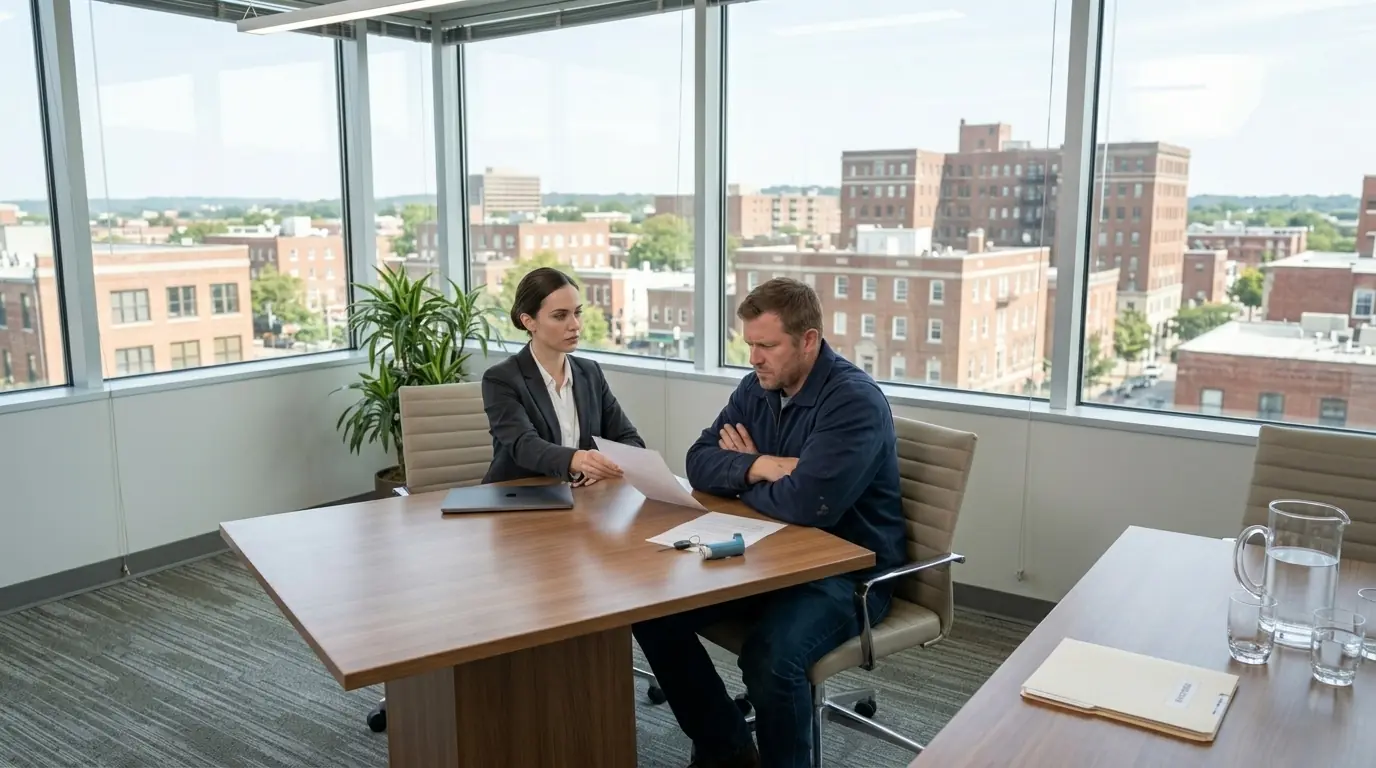
Pretending to be a millionaire's boyfriend was not, in any version of his imagination, part of his life plan. “How much?” he asked carefully. “$10,000.” Jake leaned back in the chair, which probably cost more than his truck, crossed his arms, and let out a slow breath through his nose. “Fine,” he said. Then he looked her directly in the eye and added the one thing she clearly didn’t expect. “But I’m not sleeping on the sofa.” She laughed, a real laugh, brief and surprised, like something that escaped before she could stop it. Neither of them knew that by Monday morning nothing about the weekend would feel like pretend.
The town of Claremont, Virginia, was the kind of place where everybody knew what everybody drove. Jake Carter drove a 2009 Ford pickup with a cracked side mirror and a tailgate that only closed if you lifted it at a specific angle while pressing your hip into the left corner. His daughter, Lily, age seven, had named the truck Gerald. Jake had been running his one-man repair operation out of a converted barn at the edge of town for four years. He could fix anything with an engine, a circuit board, or a carburetor that had seen better decades.
He was, by any reasonable measurement, good at what he did. He was not good at charging people enough for what he did, which was the source of most of his financial problems and all of his mother’s frustration with him.
The job that brought him to Richmond on that particular Thursday afternoon was a specialty delivery. A restored 1968 Pontiac GTO that a client named Douglas Harrington had commissioned and paid for in full. Jake had spent eleven weeks on it. It was the most beautiful car he had ever touched, and handing it over felt the way he imagined it felt to give a child up for adoption. Right in theory, hollow in practice. The Harrington building was all glass and steel and a front desk staffed by a young man in a suit that probably cost more than Jake’s monthly mortgage.
Jake signed a delivery form, handed over the keys, and was prepared to walk back to the parking garage and drive the three hours home in Gerald when he heard someone say his name. Not his name, exactly, just his last name. “Carter.” He turned. She was standing by the elevator in a charcoal blazer and white dress shirt, dark hair pulled back, holding a phone in one hand and watching him the way a person watches something they've already decided to approach. She was younger than he expected, in her late twenties, maybe thirty. Sharp eyes.
Composed in the specific way that people get when composure has become a professional skill. “Emma Lawson,” she said. It was not an introduction. It was an identification. “Jake Carter,” he said, which was equally obvious. “I know.” She tilted her head slightly.
“Douglas told me about you. He says you’re the only person in the state who could have brought that car back to what it was.” Jake said nothing. He waited. Emma Lawson was the CEO of Lawson Digital Solutions, a software and infrastructure company that had tripled its valuation in three years and was currently in discussions for a major acquisition that would push it into the top tier of its industry. Jake knew none of this at the time. He knew only that she was watching him with the kind of focused attention that made him feel like he was being evaluated for something that hadn’t been explained yet.
“I have an unusual request,” she said. “Most unusual requests start with, ‘I know this is strange, but…’” Jake said. The corner of her mouth moved. “I know this is strange.” “Then go ahead.” She didn’t do it in the lobby. She walked him to a small conference room off the main hall, closed the door, and set a single document on the table between them. It was four paragraphs long and written in the clipped, precise language of someone who had drafted it themselves and was not embarrassed by the fact that they’d reduced a human relationship to a bullet-pointed agreement.
The proposal was this. Her parents, Martin and Carol Lawson, were visiting their family estate on Lake Coventry the following weekend. They had been, in Emma’s words, aggressively persistent about wanting to see her settled. There had been two arranged introductions in the past year, both of which Emma had terminated before the second meeting. Her mother had recently escalated to leaving voicemails about a family friend’s son who had, as Carol put it, real warmth. Emma did not want real warmth from a man her mother had selected.
He thought about the inhaler, about the credit card balance, about the quote he’d gotten last month for the roof, which had caused him to sit at the kitchen table for an hour after Lily went to bed, running numbers that refused to cooperate. “$10,000,” he said. “Correct. For two days, Friday afternoon through Sunday evening.” Jake stood up and pushed his chair back. “Fine.” He picked up the document. “But I’m not sleeping on the sofa.” Emma blinked. “There are four guest rooms.” “Good.” He folded the document and put it in his jacket pocket.
“I’ll need the details by Wednesday. I have to make arrangements for my daughter.” It was the first time he’d said it. He watched her absorb it. “You have a daughter,” she said. “Seven years old. Her name is Lily.” He looked at Emma steadily.
“Is that a problem?” “No,” Emma said after a pause that lasted exactly long enough to be honest. “It isn’t.” They met again on Wednesday evening at a restaurant in Richmond, Emma’s choice, which Jake suspected cost approximately the same per entree as a week of Lily’s school lunches. He came in his cleanest clothes, which Emma politely declined to evaluate out loud. The purpose of the dinner was preparation. Emma had a list. She went through it methodically.
Her parents’ expectations, her father’s conversational tendencies, her mother’s most likely lines of interrogation, what to say if asked about their first meeting, how long they had supposedly been together, why Emma had not mentioned him sooner. Jake listened. He asked good questions. Emma noted this. “How did we meet?” he asked. “I’ve been thinking about that. Douglas Harrington. I can say I was at his office when you delivered the car. My father knows Douglas. It’s verifiable, simple, and gives us a natural story.” “How long have we been together?” “Three months. Long enough to be meaningful. Short enough that they can’t demand to know why they haven’t heard about you.” Jake nodded.
He was halfway through writing something on the back of a napkin. Emma frowned. “What are you doing?” “Making notes.” He turned the napkin so she could see. He had written: Dad—chess, hunting, Douglas connection. Mom—traditional, cooking angle. First meeting story—Harrington delivery.
“If I’m going to do this, I’m going to do it right,” he said. Emma stared at the napkin for a moment. “You take this seriously.” “You’re paying me $10,000. I take everything I’m paid for seriously,” Jake said. They spent an hour covering background. At some point Jake looked at his watch, not subtly.
Emma noticed. “Do you have somewhere to be?” “School pickup. Forty-five minutes.” He set down his fork. “Lily’s aftercare ends at 6:00.” “Can someone else?” “No,” Jake said simply. Not defensively, just as a fact. Emma absorbed this.
She signaled for the check. They walked out to the parking lot together. Jake’s truck was parked next to Emma’s black company car, and the contrast was, if nothing else, efficient storytelling. He was unlocking the door when Emma said, almost despite herself, “What’s her name?” “Your daughter.” “Lily.” He looked back at her. “She’ll be with her grandmother this weekend. She’s fine with it. She thinks I’m going to fix somebody’s house.” Emma said nothing.
“Is that a problem?” Jake asked again. “No,” Emma said, and this time the pause was shorter. He was backing out of the space when he heard her call after him. “Carter.” He rolled down the window. Emma stood in the lot with her arms folded. For just a second, she looked less like a CEO and more like a person who wasn’t sure what she was doing.
“Thank you,” she said, “for taking this seriously.” Jake looked at her. “You’re paying me to.” He drove away. In his rearview mirror, he saw her standing there a moment longer before she got in her car.
The Lawson family estate at Lake Coventry was the kind of property that didn’t announce itself. There was no gate with a name. No gold lettering on stone pillars. It was simply a long gravel drive through old-growth trees that opened without warning into a view that made Jake’s chest do something unexpected. Not envy, exactly. More like recognition.
The kind of beauty you see and simply believe. The house was timber and stone, two stories set close to the water. There were kayaks on a dock, flower boxes in the windows, which, even in late October, still had a few stubborn blooms in them. Martin Lawson was waiting on the porch. He was a tall man, mid-60s, silver-haired, with the square jaw of someone who once been physically imposing and had since become merely commanding. He looked at Jake the way a man looks at a stranger who has arrived at his home in a borrowed blazer and a pair of boots that had clearly seen field work.
“Dad,” Emma said, coming around the car. She kissed her father’s cheek. “This is Jake Carter.” Martin Lawson extended his hand. His grip was firm and deliberate. Jake matched it.
“Carter,” Martin said after a beat. Then he added, “Douglas Harrington mentioned you. Said you rebuilt his GTO from the frame up.” “From the floor pan,” Jake corrected without thinking. “The frame was sound.” Martin’s expression shifted by about four degrees—not a smile, but an opening.
“Come inside.” Carol Lawson was in the kitchen when they entered, and she was exactly as Emma had described. Warm, thorough, and possessed of the kind of hospitality that functioned simultaneously as interrogation. She hugged Emma, assessed Jake in approximately three seconds, and then immediately handed him a bowl of something to carry to the dining table. Jake carried it without comment. That evening, he did three things that were not in the agreement.
The first was the pump. After dinner, Martin mentioned that the pressure in the garden hose had been off for a week. Jake asked if he could look at it. Within twenty minutes, he had found the problem, a cracked fitting near the basement junction, and fixed it with a part from his truck kit that happened to fit. Martin watched from the doorway without saying much. The second was the chess.
Martin had a board set up in the study. Jake noticed it. They played after the dishes were cleared, Emma’s mother watching from an armchair with her reading glasses pushed up on her forehead, Emma watching from the hallway because she didn’t want to appear to be watching. Jake lost the first game in twenty moves, which told Martin that Jake was not a chess player who pretended to lose. He lost the second game in thirty-eight moves, which told Martin that Jake was a fast learner. Martin won both, but he filled their glasses a second time, which was its own kind of assessment.
The third was the video call. Lily called at 8:30 to say goodnight. Jake took the phone into the hallway. He didn’t try to hide it. He sat on the bottom step of the staircase and talked to his daughter for ten minutes about whether Grandma had let her stay up for the nature documentary and whether Gerald had made any strange noises on the drive over. Carol Lawson passed through the hallway twice.
The second time, she paused. “Is that your little girl?” she asked, quietly enough not to intrude. “Yes, ma’am. She wanted to say goodnight.” Carol looked at him for a long moment.
Then she said, equally quietly, “Tell her goodnight from us.” Jake did.
Later, Emma found her mother standing at the kitchen window after everyone else had gone to bed. Carol turned. She had her tea. She looked at her daughter for a moment with the expression Emma had spent her entire adult life interpreting and still couldn’t quite read. “That little girl,” Carol said, “needs a family that’s actually present.” Emma opened her mouth and closed it again.
“I’m just saying,” Carol added, turning back to the window, “that a man who talks to his child like that before she goes to sleep is a particular kind of man.” Emma went to bed without responding. She lay in the dark for a long time, listening to the lake.
She found him at 11:50 p.m., sitting on the back deck with a glass of water and the far-off look of someone running calculations that wouldn’t come out even. Emma wrapped a blanket around her shoulders and sat in the other chair. Neither of them spoke for a while. The lake reflected the last of the autumn moon in pieces, broken by the small current at the shallow end of the dock. “You’re good at this,” Emma said eventually. Jake looked at her.
“The chess. The pump. My mother.” She paused. “My father.” “I’m just being a person,” Jake said.
“That’s exactly what I mean.” He didn’t answer that. He looked back out at the water. Emma pulled the blanket tighter. “Can I tell you something that has nothing to do with the agreement?” “Sure,” he told her.
She had never told anyone outside her immediate circle, and even there, she told it in the abbreviated version, the one where she had been engaged. Her fiance had died in a car accident, and she had subsequently dedicated herself to her company. That version was true and sufficient and contained nothing that could be used against her. This version was different. She told him about the morning of the accident, how she had been running late to meet him and had texted him to change the meeting point, and he had been reading the text, they believed, when the light changed.
She had never told the investigators that. She had never told her parents. She had told exactly no one. She stopped. The silence after was very specific. Jake sat with it for a while.
“What was his name?” he asked. “Nicholas.” “You’ve been carrying that for a long time.” “Seven years,” Emma said. “Give or take.” Another silence.
The lake moved. “Can I tell you something?” Jake said. He told her about Rachel. Not about the diagnosis or the treatment or the specific mechanics of how you lose a person to illness over fourteen months. Those were facts, and he’d said those facts enough times that they had worn down to smooth stones.
No edges left. He told her about the Tuesday morning six weeks before she died, when Rachel had insisted on making pancakes from scratch, and they had stood in the kitchen together, and she had burned the first batch and laughed, and Jake had known, with the kind of knowing that bypasses logic entirely, that he was watching the last good morning. He stopped. Emma was looking at him. “Lily was three,” he said. “She doesn’t remember much of it.”
“Which is… I don’t know.” Emma nodded. She understood both things at once. They sat there for another hour. The conversation moved slowly, without agenda, through the kind of territory that people usually only cover after years, and which they covered now because the dark and the water and the specific honesty of exhaustion made it possible. He was no longer sure what he was.
Martin Lawson had a twenty-foot wooden day cruiser in the boathouse that had not run properly in two seasons. He hadn’t asked Jake to look at it. He had simply mentioned at breakfast that it had been giving him trouble. Jake asked what kind of trouble. By noon, they were both in the boathouse. Jake had the engine cowling off.
Martin was handing him tools with the methodical efficiency of a man who was accustomed to being useful and had not been for several hours. They worked mostly in silence, the comfortable kind, occasionally punctuated by Martin asking a question and Jake answering it without making the answer complicated. Emma stood on the dock and watched them through the boathouse window. She had grown up watching her father operate in rooms full of people, boardrooms, charity galas, city council meetings with the brisk authority of a man who expected to be the most competent person present.
She had never, in thirty-one years, seen him hand someone tools. Carol appeared beside her. “Your father took apart a lawnmower engine with the neighbor’s boy once,” Carol said. “Nineteen years ago. I had nearly forgotten.” Emma said nothing.
“He’s been looking for someone to do that with again.” Carol tucked her hands into her cardigan pockets. “Not the engine. Just that. The working side by side.” Emma watched her father laugh at something Jake said.
It was not the polished social laugh she had grown up hearing at dinner parties. It was the other one, the one that surfaced only when Martin Lawson was briefly entirely off duty. She had not seen that laugh in years.
That evening, there was a bonfire. Martin had gotten the cruiser running by 4:00 and had taken it out on the lake for twenty minutes with an expression of unguarded satisfaction. Carol made her pulled pork that took six hours and was worth every one. There were folding chairs and the specific scent of wood smoke that attached itself to everything and did not apologize. Afterward, when the fire had settled to coals and Carol and Martin had gone inside, Jake and Emma walked along the waterline. Their footsteps crunched on the gravel shore.
The stars were the kind that only appeared this far from a city. “Your parents are different from how you described them,” Jake said. “How did I describe them?” “Pressure. Expectation.” “The impression that they were a problem to be managed.” Emma was quiet for a moment. “They are those things. They’re also just two people who miss having you around.” She stopped walking.
Jake stopped a step later and turned to look at her. “Don't,” she said, but without heat. “Don't what?” “Don't make it simple.” “It isn’t simple.” “I know it isn’t,” Jake said. “I’m not making it simple. I’m just saying what I see.” Emma looked at him for a long time. The moon had come up fully by now and the lake was silver and still.
“Do you ever think about it?” she asked. “What?” “Being with someone again.” “Actually with someone.” Jake looked out at the water. “I think about whether Lily needs it. Whether she needs someone to be there in the way I can’t be sometimes. Whether I’m enough.” “That’s not what I asked.” A pause. “No,” he said.
“I don’t think about it. Or I didn’t.” She kissed him. It was not dramatic. It was quiet and brief, and it happened the way things happen when two people have been standing next to the edge of something for long enough not to fall. It was exactly that: a step. Jake was still for a moment.
Then he kissed her back. They stood there in the gravel at the edge of the lake and there was nothing performed about it. No audience. No agreement. Just two people who had found, without planning to, that the distance between them had been closing all weekend and was now gone. “This isn’t in the contract,” Emma said when they stepped back.
“No,” Jake agreed. “We should probably be careful.” “Yes.” They walked back to the house in a silence that had changed entirely.
They returned to the city on Sunday evening. The drive mostly quiet in the way that comfortable silences are quiet. The agreement was technically complete. Emma signed a transfer for the $10,000 Monday morning and sent it to the account he’d given her. Jake thanked her by text. Emma replied, “You were very good at it.” He replied, “So were you.” Then nothing for three days.
The specific suspended silence of two people who are not sure what the rules are anymore.
On Thursday, Emma was in back-to-back acquisition meetings from 7:00 in the morning until 6:00 in the evening. On Friday morning, she was reviewing a due diligence report when her phone rang with a Claremont area code she didn’t recognize. She almost didn’t answer. “Miss Lawson?” The voice was a woman, elderly, slightly breathless. “This is Diane Carter, Jake’s mother. I’m sorry to call you. I found your number in Jake’s phone, and I…” A pause.
“Lily had an episode. They’re at Claremont Memorial. Jake asked me not to call you, but I thought you’d want to know.” Emma was out of her office in under a minute. She drove the three hours to Claremont without stopping. She arrived at the hospital at 10:02 a.m. and found Jake in the waiting area outside the pediatric unit, sitting forward in a plastic chair, elbows on knees, hands clasped, staring at the floor. He was still in work clothes.
There was engine grease on his left forearm that he hadn’t noticed. He looked up when she came through the doors. The expression on his face, the brief involuntary relief of it, was not something Emma was prepared for. “You didn’t have to come,” he said. “I know,” Emma said. She sat down in the chair beside him.
He told her what had happened. Lily had come home from school complaining of tightness in her chest, not unusual. They’d managed it before, but this time the inhaler hadn’t brought it under control the way it normally did. He’d been under a car when his mother called. He’d driven to the school in eleven minutes. “She’s stable now,” he said.
“They've got her on a nebulizer. The doctor says she’s going to be fine. It’s just it went faster than it usually does.” Emma nodded. She didn’t offer reassurances or cheerful reframings. She sat with him in the way the situation actually required steadily, without performing comfort. After forty minutes, a nurse came out and said that Lily was awake and had asked for her father.
Jake stood. He looked at Emma with a question in his face that he didn’t ask aloud. “Go,” she said. “I’ll be here.” He was inside for twenty minutes. When he came back out, he had Lily with him, small and pale and wrapped in a hospital blanket, clutching a stuffed rabbit that Emma suspected had been through several medical emergencies. Lily looked at Emma with the frank, direct gaze of children who have not yet learned to approach strangers at an angle.
“Dad said you came,” Lily said. “I did.” “He said you drove a long way.” “Three hours, roughly.” Lily considered this. “That’s a lot of driving.” “It is.” “Dad doesn’t like driving long distances. He says highways are psychologically corrosive.” Emma looked at Jake. “Does he?” Jake had the expression of a man whose seven-year-old was accurately quoting him in circumstances he hadn’t anticipated. “He says a lot of things,” he said.
Lily held out one arm, the one without the IV line, and Emma, after a second's hesitation that Lily did not seem to notice, sat down beside her. The child leaned against her shoulder and closed her eyes. Jake watched his daughter settle against Emma Lawson in a hospital waiting room and felt something happen in his chest that was not the grief he’d carried for four years and not the careful blankness he’d built around it. It was something else. Something quieter. Something that felt strangely like a door left open that he hadn’t known was closed.
Two weeks passed.
Jake drove to Richmond on a Tuesday to return a set of tools he’d borrowed from a supplier whose warehouse was near Emma’s office building. He had not planned to contact her. He was walking back to his truck when his phone buzzed. A message from an unsaved number. “I’m looking at the parking garage across from my building and I’m fairly sure I can see Gerald.” He looked up. He couldn’t see the building from where he was.
He texted back, “How do you know it’s Gerald?” Her reply was immediate. “Cracked left mirror and a tailgate held together by optimism.” He was still standing in the parking structure, smiling at his phone when she appeared at the far end of the row in a coat and scarf holding a paper bag. “I had my assistant get sandwiches,” she said. “I don’t know if you’ve eaten.” “I haven’t.” “Then this works out.” They sat on the open-air third level of the garage with the city spread below them and ate sandwiches that had been assembled by someone who took sandwiches more seriously than most people took professional decisions.
They talked about Lily’s recovery, which was full and complete. They talked about a conversation Jake had with Martin Lawson, who had apparently called to say that the cruiser had run fine for two weeks straight and that he was expecting Jake to come back in the spring when the striped bass started running. “He doesn’t invite people fishing,” Emma said. Her voice was careful. “He invited me.” “I know.” She was looking at the city. Jake was looking at her.
“Emma, don’t,” she said. But it was different from the night by the lake, softer, less certain of itself. “I wasn’t going to say anything difficult,” Jake said. “What were you going to say?” “That I’ve thought about you every day since Sunday, and that I’m aware that this is inconvenient and makes no logical sense and that we don’t fit together in any category that people have names for.” He paused. “And that none of that changes it.” Emma looked at him. “Lily asked about you four times in the past two weeks,” Jake added.
“That’s not a fair thing to include.” “No,” he agreed. “But it’s true.” She looked back at the city for a long time. Jake waited. “I don’t know how to do this,” Emma said finally. “I don’t either,” Jake said. “I haven’t in a long time.” She turned to look at him directly.
“What if I’m very bad at it?” “Then we’ll figure it out.” “What if I get afraid and build walls?” “Then I’ll knock on them until you open up.” He said it lightly but meant it entirely. Emma looked at him for another moment. Then she said, “Jake.” “Yeah.” “I’ve been thinking about you every day since Sunday, too.”
It arrived on a Monday. Emma had been working on the acquisition for four months. Lawson Digital was positioned to absorb a mid-size cybersecurity firm called Praxis Technologies, which would give Emma’s company a set of proprietary encryption tools that no competitor currently possessed.
The deal was worth approximately $230 million and had been in the quiet phase of due diligence for six weeks. The message came through an anonymous route to her company’s general contact portal and it would have been filtered as spam except that it contained the correct internal code for the acquisition. A code that existed in exactly eleven documents, all stored in secured systems. Someone inside had passed information. The message itself was brief: “Walk away from Praxis. You won’t like what happens if you don’t.” Emma read it twice. She forwarded it to her head of security. She did not, initially, tell Jake. She told him four days later when a second message arrived. They were at her apartment, a habit that had developed gradually and without formal announcement, the way real habits do.
She showed him her phone. He read both messages without comment. Then he set the phone down on the counter and looked at her. “You have to tell the police,” he said. “My security team is handling it.” “Your security team isn’t the police.” “In situations like this, involving law enforcement too early can—” Emma stopped. “Someone with access to your internal documents is threatening you. That’s not a negotiation to manage. That’s a crime.” Emma was quiet.
She knew he was right. She also knew that stepping back from the Praxis acquisition would remove the pressure, and the quiet, efficient part of her mind had already run that calculation. “I’m not walking away from the deal,” she said. “I didn’t say you should,” Jake said. “I said tell the police.” She did.
The next morning, she spoke with a detective in Richmond’s financial crimes unit. They opened a case. Her security team began cross-referencing access logs against the eleven documents. Jake drove to Richmond that Friday and took Lily with him under the pretense of a city adventure that involved the Natural History Museum and a particular pasta place Lily had been requesting for three weeks. While Lily asked the museum’s docent extremely detailed questions about prehistoric fish, Jake stood by the window and thought about the weight of a threat that hadn’t materialized yet and about the particular helplessness of being concerned about someone who had spent ten years being competent in the face of things that should have broken her.
The call came on a Wednesday afternoon. Emma had a meeting with the majority shareholder of Praxis Technologies, a man named Victor Aldrich, who had quietly opposed the acquisition from its earliest stages and who had agreed, through intermediaries, to a direct conversation. Emma’s security team had run Aldrich’s background. He was aggressive in negotiations but had no criminal record and no history of threats. The meeting seemed straightforward. She didn’t tell Jake about it.
She told herself this was because she didn’t want to worry him unnecessarily. She was aware, on some level, that this was not the only reason. The location was an office building on Ferro Street where Aldrich’s firm was renovating a mid-sized commercial space on the third floor, half the interior stripped to studs and bare concrete. Aldrich had chosen it, he said, for privacy. The acquisition was market sensitive. Emma arrived with one member of her security team, a man named Paul Reeves, who waited in the hall.
Aldrich was already inside. He was shorter than Emma had expected, in his fifties, with the careful grooming of a man who understood presentation. He offered her water. She declined. They stood across a temporary table in a room that smelled of sawdust and new drywall. “I’ll be direct,” Emma said.
“I know you’ve been blocking this acquisition internally. I know the messages my company received this month came from someone with access to our documents, and I believe you know who that person is. I’m willing to restructure the acquisition terms to address your specific concerns about board representation. I’m not willing to walk away.” Aldrich looked at her for a long moment. “Ms. Lawson,” he said, “you’re considerably less cautious than your reputation.” “That’s not usually how I’m described.” “Then your reputation is wrong.” He set his hands flat on the table.
“The offer is final. Remove yourself from this acquisition or the consequences will not be limited to your company.” Emma held his gaze. “Are you threatening me personally?” What happened next was fast. He moved around the table. She stepped back. Her foot caught the edge of a pallet of construction materials that should not have been in the walkway and was there because someone had placed it deliberately or carelessly or both.
She went down, not fully, she caught the edge of the table but the momentum took her backward and to the left. And when she came down on the exposed concrete landing, her head caught the edge of a lower step at the base of a short interior staircase. Paul Reeves was through the door in three seconds. Aldrich was backing away with the specific body language of someone who had not intended the outcome but intended the confrontation. Emma did not lose consciousness. She lost clarity.
There was a ceiling. There was Paul’s voice. There was a door. Then there was the ambulance.
Jake received the call from Paul at 4:47 p.m. He was under a car. He heard Paul say, “Ms. Lawson… hospital… she’s conscious,” and was out from under the car, wiping his hands on a rag, and moving toward his truck before Paul had finished the sentence. He drove to Richmond in just over two hours. He did not think about the speed limit in any meaningful way.
Emma was in a monitored room in the neurological unit when he arrived, awake with a bandaged contusion above her right ear and the specific, sharp-edged coherence of a person running on adrenaline and refusing to acknowledge it. She looked at Jake when he came through the door and said, with a voice that was steadier than it had any right to be, “I’m fine.” “You’re not fine,” Jake said. “But you will be.” He sat in the chair beside the bed. He didn’t do anything in particular. He was simply there the way he had been in the hospital parking lot when Lily was being treated, present without performance, taking up the specific weight of the room with a person who needed something to push against.
“I should have told you,” Emma said. “I didn’t want you to try to stop me.” “I probably would have.” “That’s why.” Jake looked at her. “Next time, tell me anyway.” Emma looked at the ceiling. “There won’t be a next time.” “Emma.” “There won’t,” she said, and it sounded like something she was deciding as she said it rather than something she had already decided. “I mean, the going alone. Walking into things without telling you. I won’t do that again.” Jake was quiet for a moment.
“Okay,” he said. She fell asleep an hour later. Jake stayed until morning.
Victor Aldrich was arrested on Thursday. The financial crimes unit, acting in coordination with the city police, had enough on the record between the threatening messages and two witnesses, Paul Reeves and a contractor who had been on the building’s second floor during the confrontation, to move quickly. Aldrich’s inside contact was a junior analyst who had been passed the documents through a secondary channel and had been, it turned out, under financial pressure of his own.
The acquisition of Praxis Technologies closed six weeks later. Emma spent three days in the hospital. She spent the following week at her apartment, where Jake and Lily appeared on the second day with a pot of soup Lily had supervised and a library book Lily had selected because it featured a lady who does business on the cover and who Lily had determined was Emma. “She doesn’t look like me,” Emma said, examining the cover. “She has the same hair,” Lily said, with complete confidence. Jake said nothing but Emma caught the expression on his face, the slight widening at the corner of his mouth that she had learned, over the past weeks, was his equivalent of laughing out loud.
They stayed for dinner. They stayed for three hours after dinner. Lily fell asleep on Emma’s sofa, which was not a foldout and was not uncomfortable, wrapped in the throw blanket that Emma had stopped thinking of as hers and started thinking of as the one she kept for when Lily visited. Jake carried Lily to the car at 9:30 p.m. When he came back up for the pot, Emma was standing in the kitchen doorway. “She left something on your refrigerator,” Jake said.
Emma looked. There was a drawing held with a magnet. It showed three figures of varying heights in what appeared to be the front of a house. Below them, in the large, uneven letters of a child who had recently mastered printing, were three names: Jake, Lily, Emma. She stood there looking at it. “She does that,” Jake said.
“She draws the family. She started doing it after Rachel died.” He paused. “For a while, it was just the two of us. Then she started adding Gerald.” Emma looked at him. “You’re the first person she’s drawn since Gerald.” Emma turned back to the refrigerator. She pressed her fingertip to the edge of the drawing, gently, as if it might move.
“Jake,” she said. “Yeah?” “I want this.” He was quiet for a moment. When he spoke, his voice was careful and unguarded, which was the way Jake Carter spoke when he meant something absolutely. “I know,” he said. “I do, too.” Martin Lawson had been right about the striped bass. They came out in numbers in the second week of April, when the lake shook off its winter temperament and the water turned the green-gold color that Martin had described on the phone in February, with a specificity that suggested he had been thinking about it for months.
Jake and Martin spent six hours on the cruiser. They caught four fish between them and released three. Martin kept the fourth because Carol had asked him to, and because Martin Lawson was not a man who declined requests from his wife when she used her particular tone. Lily was on the dock with a junior rod that Jake had picked up secondhand and refurbished. Learning, under Carol’s supervision, the fundamental principle that fishing required patience, and that patience was a skill, and that skills took practice. Carol was an excellent teacher.
Lily was a student who asked questions at fifteen-second intervals, which Carol handled with the calm of a woman who had raised two children and understood that this was simply how learning worked. Emma stood on the shore and watched all of it, her father laughing on the boat, her mother bending down to adjust Lily’s grip on the rod, Jake in the stern of the cruiser moving with the ease of a man who had found his footing and felt something she hadn’t felt in so many years that it took her a moment to identify it. She felt like she was home. Not this place, specifically, though she had grown up here and it had always been home in the technical sense.
She meant the state of it, the specific gravity of people around you that you would choose, and who would choose you, and who knew that and did not make it complicated.
After dinner, when Martin had gone to his study with a book, and Carol and Lily had disappeared into a project involving the cookie tin and a recipe Carol had apparently been saving for a seven-year-old with opinions, Emma found Jake on the dock. He was sitting at the end of it with his feet just above the water, looking out at the lake in the last of the evening light. She sat down beside him. They were quiet for a while. “The first time we were here,” Emma said, “I spent most of the weekend watching the clock.” “I know,” Jake said.
“I was counting down to when I could go back to my apartment, my work, and the version of my life I understood.” Jake looked at her. “And now?” he said. She reached into the pocket of her jacket. She had put it there that morning, before they drove out, after standing at her kitchen counter for a long time with it in her hand, deciding. She held it out. It was a key, a simple, ordinary key on a small wooden key chain that Lily had painted pale yellow with uneven flowers as a gift to Emma the week before, under the apparent assumption that the key already existed and that Emma would know what to do with it.
This being Lily, it turned out, had known several things before anyone had said them out loud. “I know it’s not a ring,” Emma said. “And I know we’re not there yet. But I want…” She stopped. She was not a person who stumbled over words. Jake watched her find them.
“I want you to be able to walk in. I want you not to have to knock.” Jake took the key. He looked at it for a moment, the yellow paint, the small, imprecise flowers, the complete sincerity of a child’s understanding of what home meant. “Lily painted this,” he said. “She wanted to.” He closed his hand around it. From the house behind them, they heard the kitchen window open and Lily’s voice carrying across the evening air.
“Emma, Grandma Carol says you have to come inside because we need to know if you like your cookies soft or crunchy, because that changes everything.” Jake turned to look at the house. Then he turned back to Emma. She was smiling, not the composed, measured smile she had given him in the conference room the first day, but the real one, the one that had surprised her as much as him the first time it appeared. “Soft,” she called back. “Always soft.” Lily’s response, audible even at this distance, was one word. “Correct.” Jake stood.
He held out his hand. Emma took it. They walked back up the dock toward the lit kitchen window, toward the sound of Carol Lawson explaining to a seven-year-old with a wooden spoon that there was a proper ratio of brown sugar to white and that this was non-negotiable, toward the warm and specific noise of an evening that did not need to be managed or planned or performed for anyone. The lake settled behind them, still and silver in the last light, and the family that had not known it was forming, not in any boardroom, not in any contract, not in any arrangement made across a conference table on a day that had seemed, at the time, entirely ordinary, found itself, at last, exactly where it was meant to be.