"Filthy boy. Don't touch my piano." That's what he said. A sixty-year-old billionaire standing over a fifteen-year-old busboy in a wrinkled uniform in front of three hundred people.
But he wasn't done. "Did nobody teach you where you belong? The trash goes out the back door, not onto my stage." Then he grabbed a cloth napkin off the nearest table and threw it at the boy's chest.
"Wipe it down. Your fingerprints are all over a piano worth more than every house on your block combined." The boy didn't speak, didn't flinch, just stood there, jaw locked, eyes on the floor, hands trembling at his sides. Three hundred adults watched. Not one said a word.
But what nobody in that room knew, not yet, was that this boy was about to sit down at that piano and break every assumption in the building. Byron Davis woke up the same way he had every morning for the past 14 months. In the dark, alone, to the sound of a radiator that barely worked and a wind that cut right through the window seal. 5:45 a.m. South Side, Chicago.
The apartment was small, one bedroom, a kitchen that doubled as a living room, and a bathroom door that didn't close all the way. Paint peeling off the ceiling, cold creeping through cracks in the walls like it owned the place. But one wall told a different story. Floor-to-ceiling sheet music, pages torn from old books, photocopied from the library, handwritten in pencil on notebook paper, taped edge-to-edge, overlapping, yellowed with age.
Chopin, Debussy, Rachmaninoff. And between them, pages of something else, melodies Byron had written himself late at night on the battered upright piano pushed against the opposite wall. That piano was missing two keys. Byron had learned to play around them the way a river moves around rocks.
It didn't stop the music, it just made it his. He got dressed in the dark. Jeans, plain white T-shirt, the only sneakers without holes. He moved quietly, careful not to wake his grandmother, Lorraine Davis, 74, wheelchair-bound since a stroke 3 years ago.
She was the reason Byron woke up at 5:45, the reason he did everything. He set a thermos of oatmeal on her nightstand, pulled the blanket to her chin, watched her breathe for a second. "I'll be back tonight, Grandma." he whispered. Her hand twitched on the blanket, the same hand that played piano at Mount Olive Baptist Church for 40 years, the same hand that placed 4-year-old Byron's fingers on a keyboard and said, "Listen, then play."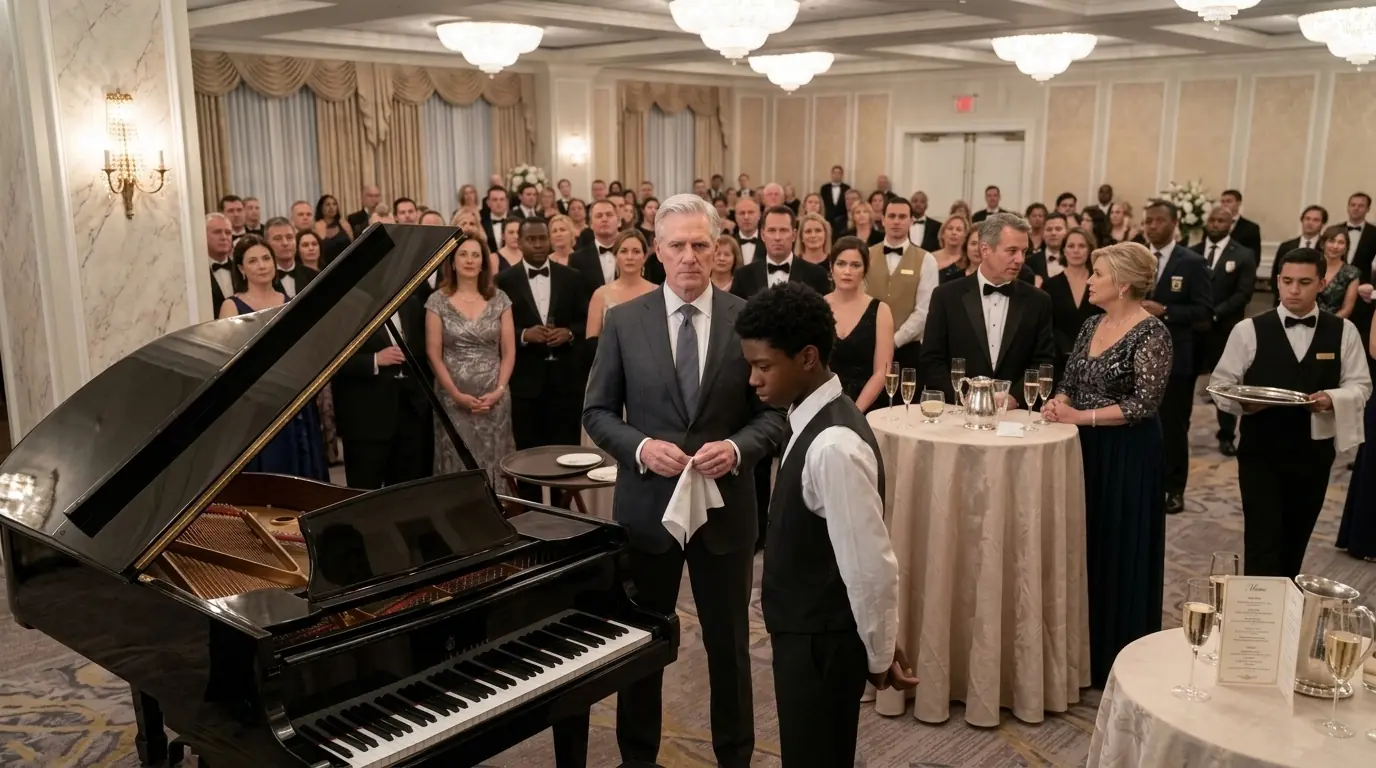
Lorraine raised Byron alone. His mother died of an overdose when he was five. His father was never in the picture, not even a name on the birth certificate, just a blank line where a man should have been. So Lorraine became everything, mother, father, teacher, audience, and piano was their language.
By seven, Byron played hymns by ear. By nine, Chopin nocturnes. By 11, he performed Debussy's Clair de Lune and Chopin's Ballade No. 1 from memory. Not just playing notes, but the spaces between them, the silences, the breath.
A school teacher heard him once, arranged an audition at a conservatory downtown. Full scholarship, a way out. Three days before, Lorraine collapsed in the kitchen. Stroke.
Byron found her on the floor, called 911 with shaking hands, rode the ambulance holding hers, and sat in a hospital hallway for 6 hours while doctors decided how much of his grandmother he'd get to keep. He never went to that audition. The scholarship vanished, the teacher transferred, and Byron learned something no 11-year-old should. Talent doesn't pay the electric bill.
He started working at 14, bussing tables, washing dishes, mopping floors, whatever kept the lights on. School fit between shifts. Sleep became luxury. Piano became stolen moments, church basements after hours, the broken upright at midnight, a cracked screen phone app during 15-minute lunch breaks, fingers tapping a cafeteria table like a concert grand.
Nobody knew. Byron kept his music the way some people keep prayers, private, sacred, untouchable. Now, at 15, he worked weekends as a busboy at the Lakeshore Grand, five-star hotel on Michigan Avenue, a place where one bottle of wine cost more than his monthly rent, where people like Byron entered through the service door, wore someone else's logo, and followed one unspoken rule, be invisible. Byron was good at it.
He moved through marble hallways like a ghost. Guests looked through him. Managers looked past him. He existed only between their needs.
Bring this, clean that, disappear. But today was different. The hotel was preparing for its biggest event, the Winter Arts Gala, black-tie fundraiser for the Chicago Arts Council. 300 of the city's wealthiest donors gathered in the grand ballroom for music, champagne, and self-congratulation.
Byron clocked in at 3:00 p.m., changed into his uniform, walked the back corridors toward the ballroom, and then he saw it. The ballroom doors were open. Inside, on a raised stage under warm spotlights, sat a Steinway Model D concert grand. nine feet of polished ebony, lid propped open like a wing, keys catching light like they were breathing. Byron stopped.
His tray balanced on one hand, his other hand hung at his side, fingers moving slightly, involuntary, the way a dog's legs twitch when it dreams of running. He stared at that piano the way a starving boy stares through a restaurant window. "Beautiful, isn't it?" He flinched.
Byron said nothing, looked one more second, then turned and walked away, tray steady, face blank, invisible again. But what Nina didn't know, what nobody knew, was that 3 weeks ago Byron had played that exact piano. On a Tuesday night, the ballroom was empty after a private event. Byron was the last person cleaning.
The lights had dimmed to amber. The Steinway sat with its lid open like it was waiting. He told himself he wouldn't. He told himself every time.
Every time the piano won. He sat down, placed his hands on the keys, and for 20 minutes played Rachmaninoff's Piano Concerto No. 2 from memory. The opening chords like a cathedral collapsing and rebuilding itself. The second movement was like falling in love with someone you'll never see again.
Music that a fifteen-year-old busboy had no business knowing, let alone playing. But the ballroom wasn't empty. Two floors up on the mezzanine balcony, a seventy-three-year-old man sat in a leather armchair, a book open on his lap. He had been reading.
He was not reading anymore. Philip Hollander, a retired concert pianist, former chair of the Berlin Philharmonic's piano residency, a man who had performed at Carnegie Hall, La Scala, and the Sydney Opera House. He sat frozen, book forgotten, mouth open, listening to a ghost. When the last note faded, Hollander removed his glasses and whispered to the empty mezzanine, "Who is this kid?"
The next morning, he asked Nina about the pianist. She had no idea. No performance was scheduled. The ballroom had been empty.
Hollander let it go, but he didn't forget. He started staying up later, sitting in the mezzanine, watching, waiting. He never said a word to Byron, not yet, but he had heard him. And in music, being heard by the right person at the right moment is everything.
A black Maybach pulled up to the front entrance of the Lakeshore Grand at exactly 6:45 p.m. The valet didn't need to check the plates. Everyone knew this car.
The rear door opened and Gerald Ashworth III stepped out like he was stepping onto a stage he'd paid for. Because he had. Early 60s, silver hair combed back so tight it looked painted on. He wore a charcoal Tom Ford suit.
Monogrammed platinum cufflinks, GA3, catching the last light of the winter sun. His shoes alone cost more than most people's rent. Gerald didn't wait for the door to be held. He expected it to be already open.
He didn't greet the doorman. He walked past him the way you walk past furniture. Behind him, a personal assistant trailed two steps back. Phone pressed to her ear, whispering logistics to someone on the other end.
Beside her, two business associates in matching navy suits laughed at something Gerald had said in the car. Probably still laughing because they hadn't been told to stop. And then there was Stewart. Gerald's son.
Early 30s, tall, soft-spoken, with the look of a man who had spent his entire life apologizing for someone else. He walked slightly behind his father. Always slightly behind. Gerald Ashworth was Chicago real estate royalty.
Third generation money. His grandfather had built the first Ashworth Tower during the steel boom. His father tripled the empire. Gerald inherited it all and spent the next 30 years making sure everyone knew.
He sat on the board of the Chicago Arts Council. He funded galleries, concert halls, museum wings. Not because he loved art, but because he loved seeing his name on the wall beside it. Donor plaques, foundation credits.
The brass nameplate on tonight's Steinway read, "Donated by the Ashworth Foundation." That piano was his. The gala was his. This room, this night, these people all orbiting around his money like planets around a sun that gave no warmth.
Gerald entered the ballroom and paused at the threshold. Not to admire the room. To let the room admire him. three hundred guests in evening gowns and tailored suits. Champagne towers.
A string quartet playing something soft and expensive in the corner. And in the center of it all the Steinway. Gleaming under the spotlight on its raised stage. Gerald walked toward it.
Slowly. Possessively. He ran his fingers along the curved lid the way a man strokes a trophy. He had played piano as a child.
Badly. Briefly. Before quitting at 12 because his instructor told him he lacked feeling. Gerald fired the instructor.
He never played again. But he never stopped believing he understood music better than the people who made it. "Music is discipline," he said to one of his associates while still touching the piano. "Breeding. Heritage." You can't hand an instrument like this to just anyone and expect something beautiful. His associate nodded. They always nodded.
A young black waiter approached with a tray of champagne. Gerald took a glass without looking at him. No eye contact. No acknowledgement.
The waiter might as well have been a mechanical arm extending from the wall. Then a second interaction. A young black valet, maybe 19, brought Gerald's claim ticket to confirm the Maybach was secured. Gerald didn't take the ticket.
He looked the kid up and down slowly and snapped his fingers twice. "Just put it in my pocket," Gerald said, gesturing at his jacket without turning his body. Like he couldn't be bothered to move his own hand. The valet hesitated.
Stewart stepped forward. "Dad, just take the—" Stewart began. "Did I ask you?" Gerald said, still not looking at his son.
The valet placed the ticket in Gerald's breast pocket. Quickly, eyes down, then walked away fast. Stewart watched him go. His jaw tightened.
But he said nothing. He never said anything. That was the arrangement. Gerald paid for Stewart's apartment, Stewart's car, Stewart's life.
And in return Stewart stood slightly behind and kept his mouth shut. This was Gerald Ashworth. A man who had confused wealth with wisdom his entire life. Who measured people by what they could give him and discarded them when they couldn't.
Who believed truly believed that money was the purest proof of superiority. And that anyone without it existed only to serve those who had it. He stood in the center of that ballroom like a king surveying his court. Champagne in hand.
Entourage at his back. three hundred people who needed his money more than they needed their dignity. And somewhere on the other side of the wall, separated by a service corridor and a lifetime of inequality a fifteen-year-old boy in a busboy uniform was clearing plates. Moving quietly. Staying invisible.
Doing everything right. Fifty feet apart. A door between them. Neither knew the other existed.
Not yet. But that door was about to open. The hired pianist finished his second set to polite applause. Glasses clinking.
The Steinway sat empty on its stage, lid open, spotlights warm on the keys. Byron was clearing glasses near the side entrance. Busboys don't enter the main floor during events. But the catering manager sent him to grab abandoned glasses near the stage.
He had been told to move fast, stay quiet, and remain invisible. He moved through the edge of the crowd with a tray, eyes down. Nobody noticed him. That was the job.
Then he looked up. The Steinway was fifteen feet away. The same piano he had played three weeks ago in the dark. The same piano that made Philip Hollander forget his book.
Byron's feet slowed. Stopped. His left hand hung at his side. Fingers moving.
That involuntary reflex. A melody running through his nerves like electricity looking for ground. He set the tray on the edge of the stage, reached out, one finger. One key.
Middle C. The note rang out clean and pure, cutting through cocktail chatter like a bell through fog. Heads turned. Not many, but enough.
Gerald Ashworth was mid-conversation, back to the stage. When the note hit, he turned. What he saw, a black teenager in a wrinkled busboy uniform touching his piano, landed on his face like a slap. He set his glass down.
The crowd parted. Four strides, dress shoes clicking on marble like a countdown. He stopped two feet from Byron. Close enough that his six-foot-two frame blocked the spotlight entirely, casting a shadow over the boy like an eclipse.
Gerald spoke loudly and slowly, each word a blade. "Filthy boy. Don't touch my piano." The room went silent. Three hundred conversations stopped at once.
Every eye found the same spot. A billionaire standing over a child. Gerald wasn't finished. Did nobody teach you where you belong?
The trash goes out the back door, not onto my stage. He grabbed a napkin from the nearest table and threw it at Byron's chest. It hit him and dropped to the marble between his shoes. "Pick it up. Wipe every key you touched." "That instrument is worth more than every house on your block combined." Byron didn't move. Didn't speak.
Then Gerald did something that made the room stop breathing. He looked down at the boy with pure disgust. And spat. Thick.
Deliberate. A glob of saliva hit the polished marble directly in front of Byron's right shoe. It sat there. Glistening under chandelier light.
On white stone. In a five-star hotel. In front of three hundred people. A woman gasped and turned away.
A man near the bar shook his head but didn't move. Stewart Ashworth closed his eyes. Fist clenched white. But his feet stayed planted.
A young waitress along the wall bit her lip until it bled. three hundred adults, not one voice. Byron stood still, jaw locked, eyes on the floor, not on the spit, not on Gerald, somewhere in between. Breath shallow, hands shaking, not from fear, from something more dangerous. His fingers at his sides where nobody was looking, tapped against his thigh.
A rhythm, the opening bars of something only he could hear. Nina Callaway stood frozen near the service entrance, hands over her mouth. Up on the mezzanine, Philip Hollander had risen from his chair. He saw everything.
The words, the napkin, the spit, and now he was watching the boy's hands, those trembling tapping hands, and his expression changed because Hollander knew those hands. He had heard what they could do. Byron's eyes were still on the floor. The spit glistened three inches from his shoe.
The napkin lay crumpled between his feet. three hundred people waited for him to pick it up, apologize, and leave through the back door like he was supposed to. That's what the smart move was. Walk away, keep the job, keep the apartment, keep Grandma out of a nursing home. Swallow it like he'd swallowed everything else.
He could feel Gerald's shadow still over him, could smell the champagne on his breath, could hear the silence of three hundred people who had already decided this was over. And then, somewhere underneath all of that, he heard something else. His grandmother's voice, not here, not now, but years ago, sitting on the bench at Mount Olive Baptist, her hand over his, showing him where Middle C lived. He was nine.
A kid at school had told him, "Black people don't play classical music." He came home and told Lorraine he wanted to quit. She didn't argue, didn't raise her voice. She just put his fingers back on the keys and said, "Baby, the piano doesn't know what color your hands are. It only knows if they're telling the truth." Byron looked at the spit on the floor, looked at the Steinway, $200,000 of polished ebony and ivory sitting under a spotlight, waiting. Then he looked up, straight at Gerald Ashworth for the first time since the man had opened his mouth. Gerald flinched, just barely, because whatever he expected to see in that boy's eyes, fear, shame, submission, wasn't there.
From the mezzanine above, a voice cut through the silence like a knife. "Let the boy play." Every head turned. Philip Hollander stood at the balcony railing, both hands gripping the edge, looking down at the ballroom floor with the expression of a man who had waited long enough. Gerald squinted up. "And who are you?" "Someone who has heard more pianists than you have foreclosed homes, Mr. Ashworth. Let the boy play." A murmur rippled through the crowd.
Near the front, Ruth Ellen Coleman, music critic, Juilliard board member, leaned forward in her chair. Gerald's jaw tightened. He was trapped. To refuse now in front of three hundred donors and a man who clearly carried weight would make him look afraid.
So he did what arrogant men always do when they're cornered. He doubled down. "Fine." Gerald made a showman's wave toward the piano.
"Let's see your little performance, boy. Go ahead. Play." Byron didn't look at Gerald again.
He looked up at Hollander. The old man gave a single steady nod.
Byron stepped forward, over the spit, not around it, through it, like it was nothing, like it had never been there. He pulled back the bench, sat down, adjusted the height, placed his hands above the keys, and said, quiet, steady, loud enough for the room, "I don't play for people like you, but I'll play for everyone else in this room." A fifteen-year-old boy who had just been spat on said that to a billionaire, and the room held its breath. Silence. His fingers hovered.
The keys waited. The first note was almost nothing, a whisper, a single tone from the upper register, so soft it could have been a mistake. A few people in the back row leaned forward, unsure if the boy had actually started or if the piano had simply exhaled on its own. Then a second note, a third.
The opening of Chopin's Ballade No. 1 in G minor, one of the most demanding pieces in the classical piano repertoire, written for concert halls, performed by virtuosos who had trained for decades, being played now by a fifteen-year-old busboy in a wrinkled uniform with sauce stains on his sleeve. Byron's fingers found the keys the way a man lost in the dark finds a wall, carefully, gratefully, like touching something he'd been afraid he'd never reach again. The first phrase was fragile, tentative. His right hand carried the melody while his left hand trembled slightly on the lower keys.
There was a shake in his wrist, a hesitation between the second and third measure. Gerald Ashworth folded his arms, smirked, turned to his associate and raised one eyebrow as if to say, "See? This is what I expected." A few guests shifted uncomfortably.
Someone coughed. The moment felt precarious, like watching a tightrope walker wobble on the first step. But Byron didn't stop. He closed his eyes, and something shifted.
It was subtle at first. The hesitation between notes began to close. The trembling in his left wrist steadied. His shoulders, which had been hunched up near his ears, the posture of a boy bracing for a blow, slowly dropped.
His spine straightened. His chin lifted half an inch. The melody deepened. The notes stopped asking permission and started making demands.
Chopin's Ballade is a conversation between beauty and violence. It begins as a question, lyrical, searching, almost shy. Then it builds, layer upon layer. The left hand rolls through arpeggios that feel like waves gathering before a storm.
The right hand sings a melody so achingly human, it doesn't sound like it comes from a piano at all. Byron played it like he'd been born inside it. The room began to change, not all at once, person by person, breath by breath. A woman in a red gown who had been whispering to her husband stopped mid-sentence.
Her hand found his arm and gripped it. A waiter carrying a tray of champagne flutes slowed, then stopped completely. The tray still balanced on his palm, but forgotten. A man near the bar who had shaken his head during the spit, but hadn't spoken, now stood motionless, his drink untouched, his eyes wet.
The sound was everywhere. It filled the ballroom the way water fills a glass, completely, without effort. The Steinway's voice reached into corners, bounced off marble, vibrated in the crystal of three hundred champagne glasses sitting on three hundred tables. And still, Byron played with his eyes closed.
His face showed nothing, no performance, no showmanship, just stillness, the kind of stillness that comes when a person stops pretending and starts telling the truth. Gerald's smirk faded. He didn't notice it happen. His arms unfolded slowly, like something inside his chest had loosened without his consent.
His mouth, the same mouth that had formed the words "filthy boy", the same lips that had spat on marble, opened slightly. Not to speak, just to breathe. Because the air in the room had changed, and his lungs hadn't caught up yet. Then the Ballade reached its quiet passage, the lyrical section, the prayer.
Byron's right hand slowed to almost nothing. The notes became so soft, the audience strained to hear them. People leaned forward in their chairs. A woman held her breath.
The silence between the notes became as powerful as the notes themselves. Each pause, a held heartbeat. Each space, a question the piano asked, and then refused to answer. Up on the mezzanine, Hollander closed his eyes.
His lips moved. One word, barely audible. Yes. And then, on the stage, under the spotlight, in a uniform that smelled like kitchen grease and dish soap, Byron Davis began to cry.
Not sobbing, not shaking, just tears rolling quietly from the corners of his closed eyes, sliding down his cheeks, one catching the light before it dropped onto the keys. He didn't wipe them. He didn't open his eyes. He was somewhere else entirely.
He was in a small apartment on the South Side. He was sitting on a church bench with his grandmother's hand over his. He was 4 years old, hearing a piano for the first time. He was 11, riding in an ambulance, holding Lorraine's hand, not knowing if she'd wake up.
He was playing for her. For all of it. For every morning at 5:45. For every plate he'd cleared.
For every time he'd been invisible. A tear landed on the B-flat key. He played right through it. The room was not breathing.
3 seconds of almost silence. The softest note Byron had played all night hung in the air like smoke. Nobody moved. Nobody coughed.
Nobody reached for a glass. three hundred people sat in absolute stillness, afraid that the slightest sound would shatter something sacred. Then the storm came. The final section of Chopin's Ballade No. 1, the Presto con fuoco—"with fire." And Byron unleashed it.
His hands exploded across the keyboard. The left hand drove through bass runs that hit the chest like a second heartbeat. The right hand flew through passages so fast, the notes blurred together into something that wasn't music anymore. It was fury.
It was joy. It was 11 years of silence breaking apart all at once. The Steinway roared. The sound pressure in the room changed physically.
Champagne glasses trembled on tables. The chandelier crystals swayed. You could feel the bass notes in your teeth. A woman in the front row grabbed her husband's arm with both hands.
The waiter, who had frozen mid-step earlier, slowly lowered his tray to the floor and just stood there, mouth open. Stewart Ashworth took one step backward, away from his father, as if some invisible cord between them had finally snapped. Ruth Ellen Coleman pulled a notebook from her clutch and started writing. Fast, furious, the pen barely keeping up with her thoughts.
And Gerald Ashworth stood absolutely still. His face had gone white. His arms hung at his sides. The smirk was long gone.
The superiority was long gone. What was left was something he hadn't felt in so long, he almost didn't recognize it. Smallness. Byron drove the Ballade to its final crashing chords.
Fortissimo. Both hands slamming the keys in octaves that echoed off every surface in the room. The Steinway shook. The floor shook.
The air shook. And then, without a pause, without a breath, without a single break, he changed. The Chopin vanished. Something new took its place.
Something no one in the room had ever heard before. Because Byron wasn't playing someone else's music anymore. He was playing his own. The composition started low.
A deep, rolling bassline that sounded like a gospel hymn played in a minor key. Then a melody entered. Simple, raw, built on intervals that didn't come from any European conservatory. They came from Mount Olive Baptist Church.
From Lorraine's hands on a Sunday morning. From the way the congregation hummed when the sermon was over and the spirit hadn't left the room yet. It was classical in structure, blues in its bones, gospel in its soul. And something else.
Something that belonged only to Byron Davis, fifteen years old, South Side of Chicago, apartment with peeling paint and a piano missing two keys. The melody climbed slowly. Each phrase building on the last, the way dawn builds. Not all at once, but in layers of light.
The left hand kept that gospel bass rolling underneath while the right hand sang something so beautiful and so broken that it didn't sound like a performance at all. It sounded like a confession. The room understood instantly. This wasn't a boy playing back what someone else had written.
This was creation. This was something being born right now in front of them. Hollander opened his eyes. He leaned forward, gripping the mezzanine railing.
His face had changed. During the Chopin, he had looked proud. Now, he looked stunned. Because what he was hearing from this 15-year-old was something he hadn't expected.
Not technique, not memorization, not talent. Genius. Byron built the composition to its peak. The melody soared into the upper register, high, clear, luminous, while the bass swelled underneath like an ocean rising.
The two hands were having a conversation. One voice asking, the other answering. Pain and hope. Loss and survival.
A boy and his grandmother. A church and a city. Everything Byron had ever been pressed into 88 keys. And he brought it home.
The final passage slowed. The melody descended, note by note, back to where it started. That deep, low gospel hum. The bass settled.
The treble faded. The last chord, wide, open, resonant, rang through the ballroom like a bell at the end of a long, long night. Byron held the sustain pedal. The chord decayed slowly.
Layers of sound peeling away one by one until only the fundamental remained. It became a single low vibration that the audience felt more than heard. Then he lifted his hands from the keys, placed them in his lap, and sat perfectly still. The Steinway's last breath faded into nothing.
Silence. One second. Two seconds. Three seconds.
Three hundred people sat without making a sound. The silence lasted 3 full seconds. It felt like 30. Then it broke.
Not with polite applause. Not with the careful clapping of people who appreciated a performance. It broke with a sound that came from somewhere deeper. A roar that started in the front row and swept backward through the ballroom like a wave that couldn't be stopped.
A woman in the second row stood first. Then the man beside her. Then the entire front table. Then the row behind them.
Then the next. And the next. Within five seconds, all three hundred guests were on their feet. And the sound coming from their hands and their throats was something the Lakeshore Grand had never heard in its history.
It wasn't applause. It was release. A woman in a red gown was crying openly, mascara running. And she didn't care.
A man near the bar, the same man who had shaken his head during the spit, but hadn't moved, was now shouting, "Bravo!" with a voice that cracked on the second syllable. Two waiters, standing along the wall, had abandoned their trays entirely and were clapping with their hands above their heads. The young waitress who had bitten her lip until it bled was sobbing into her palms. Nina Callaway collapsed against the service doorframe, both hands still over her mouth, shaking so hard she couldn't stand straight.
Ruth Ellen Coleman closed her notebook, slowly, deliberately. She didn't need it anymore. She already knew what her review would say. She already knew it would be the most important thing she'd ever write.
And somewhere near the back of the room, unnoticed by anyone, a busboy from the catering staff walked quietly to the spot on the marble floor where Gerald Ashworth's spit had landed. He knelt down with a cloth napkin, not the one Gerald had thrown, a clean one, and wiped it away. Nobody asked him to. He just did it, as if erasing the last physical trace of what had happened.
The stain was gone, but three hundred people would remember exactly where it had been. Then there was Gerald. Gerald Ashworth III had not moved since the Chopin began. He stood in the same spot, two feet from the piano bench, exactly where he had been standing when he spat on the floor.
But the man standing there now was not the same man. His face had gone through every stage, the smirk, the confusion, the disbelief, and now something worse than all of them. Recognition. Not of Byron, of himself, of what he had done, of what he had spat at, of what he had tried to destroy, and couldn't.
His knees buckled, not dramatically, not like a movie, just gave way. He reached for the nearest chair and collapsed into it. His hand came up and covered his face. His shoulders began to shake.
Gerald Ashworth, $200 million, three generations of empire, a man who hadn't cried since he was a child, was weeping in front of three hundred people, in front of the boy he had spat at. Stewart watched his father. For the first time in his life, he saw Gerald Ashworth look small, smaller than the boy in the busboy uniform, smaller than the spit he'd left on the floor. Byron stood from the bench.
He didn't bow. He turned to face the room, and his eyes found Gerald. The man was crumpled in a chair, face hidden, shoulders shaking. Byron looked at him, not with anger, not with triumph, just stillness.
"That piano didn't care who sat down. It only cared what came out." He said it quiet, steady, like he was saying it to himself as much as to the room. His grandmother's words, reshaped, sharpened, delivered without hatred, just truth, from a fifteen-year-old boy with spit drying on the floor behind him.
Then he stepped off the stage, walked to the service entrance, picked up the busboy tray he had set down what felt like a lifetime ago. The crowd was still standing, still roaring. three hundred people who had watched in silence were now trying to make up for it with sound. Byron held the tray at his side and walked toward the kitchen door. Footsteps behind him, fast, the crowd noise dimming as someone moved against the current.
Philip Hollander had come down from the mezzanine. The crowd parted for him. Many recognized his face. He crossed the ballroom in long strides, reached Byron just before the service door, and stopped.
He extended his hand, not down to a child, across to an equal. "I've performed at Carnegie Hall, La Scala, and the Sydney Opera House. That is the most honest piano I've heard in forty years." He paused, looked Byron in the eyes, "And you're fifteen." The room heard it.
Every word. And the weight of those three words, "And you're 15," landed on three hundred people like a verdict. The applause didn't stop for a long time. Even after Byron disappeared through the service door, the sound followed him, muffled by the walls, but still there, still real.
He stood in the service corridor, fluorescent lights, gray walls, the smell of industrial cleaner and leftover dinner rolls. Five minutes earlier he had been on a stage under spotlights. Now he was back where he belonged, or where they said he belonged. His hands were shaking again, but different this time.
Not anger, not fear, something he didn't have a name for yet. He leaned against the wall, closed his eyes, breathed. Footsteps. Heels on tile, quick and purposeful.
Ruth Ellen Coleman appeared at the end of the corridor. She looked out of place. Floor-length black dress, pearl earrings, a clutch bag that probably cost more than Byron's rent. She walked straight to him and stopped.
"Byron Davis?" He blinked. Nobody here knew his name. He was a busboy.
Busboys don't have names. "Yes, ma'am." She studied him the way a jeweler studies a stone, not casually, not kindly, but with the precision of someone who had spent a lifetime separating the real from the fake. "My name is Ruth Ellen Coleman. I sit on the board of admissions at Juilliard. I've been a music critic for the Chicago Tribune for 22 years. I've heard thousands of pianists." She reached into her clutch and pulled out a business card, held it out between two fingers.
"I'm not offering you charity. I'm offering you an audition. There's a difference." Byron looked at the card, didn't take it.
Not because he didn't want it, because his hands were trembling too much, and he didn't want her to see. She saw anyway. She placed the card gently into his palm and closed his fingers around it. "How old are you?"
"15, ma'am." Coleman inhaled, held it, then shook her head, slow, not in disappointment, but in the kind of disbelief that borders on reverence. "15." She said it like she was trying to make the number fit inside what she'd just heard.
It wouldn't fit. "You'll hear from my office within the week." She turned and walked back toward the ballroom. Her heels echoed down the corridor. Then, silence. Byron looked at the card in his hand.
Thick stock, embossed lettering, a phone number to a world he'd only ever seen through windows and service doors. He put it in his pocket, carefully, the way you carry something you're afraid might disappear. More footsteps, softer this time, hesitant. Stewart Ashworth appeared around the corner, tie loosened, eyes red.
He looked like a man who had just watched something inside himself break, and wasn't sure yet whether that was a good thing. He stopped a few feet from Byron, didn't come closer, like he wasn't sure he'd earned the right. "I watched him do that to you, and I didn't move. I'm sorry." Byron said nothing, just looked at him. "I'm not asking you to forgive me, or him. I just" Stewart paused, swallowed. "I'm setting up a scholarship fund, independent, separate from my father's foundation, separate from his name, for young artists who don't have access. I want you to be the first." Byron still didn't speak, but something shifted in his face, a softening around the eyes, the faintest unclinching of his jaw.
Not forgiveness, but acknowledgement. The recognition that sometimes the first honest thing a person does in their life is apologize. Stewart nodded, left a card on the windowsill beside him, and walked away. The ballroom was emptying now, guests filing out to valets and black cars.
The service corridor grew quiet. In the grand ballroom, one person remained. Gerald Ashworth sat alone. The chairs around him were empty.
The Steinway stood silent on its stage, lid still open. The chandelier lights had been dimmed to half. The room that had held three hundred voices now held only one man's breathing. He was staring at the floor, at the spot where his spit had been.
It was clean now. Someone had wiped it away. But Gerald was looking at it as though it was still there. As though it would always be there.
Then he looked at his hands resting on his knees. Manicured. Expensive. Hands that had signed deals worth hundreds of millions.
Hands that had never built anything. Never created anything. Never made a sound that anyone would remember. He didn't apologize.
Not that night. Maybe not ever. The narrator won't pretend otherwise. Some men carry their shame quietly.
And it eats them from the inside. And that's its own kind of justice. But Gerald Ashworth sat in that empty room for a very long time. And when he finally stood to leave, he didn't look at the piano.
He couldn't. Byron caught the L train home. At 11:47 p.m., The car was almost empty. He sat by the window, forehead against the cold glass, watching the city lights blur past.
In his pocket, two business cards and a future he hadn't owned when he woke up that morning. The apartment was dark when he got home. But the bedroom light was on. Lorraine was awake.
She was always awake when he came home late. She pretended she wasn't, but she always was. Byron sat on the edge of her bed. She reached for his hand.
He let her take it. "Something happened tonight, Grandma." "Tell me." So he told her.
All of it. The piano, the crowd, the man in the suit. When he got to the part about the spit, the word itself, Lorraine's grip on his hand tightened. Her jaw set.
Her eyes burned with something old and deep and familiar. The look of a black woman in America who had heard this story before in a thousand different versions her entire life. She didn't interrupt. She let him finish.
When he told her about the composition, the piece he'd written from her church playing, from the sound of her hands on Sunday mornings, Lorraine's expression changed. The anger drained away. Something warmer took its place. She lifted both hands and wrapped them around his.
"I always told you those hands were meant for more than clearing plates." Byron laughed. Then the laugh broke. And he cried.
Not the silent tears from the piano bench. Real crying. The kind that shakes your whole body. The kind you can only do in front of someone who has loved you since before you could speak.
He was fifteen. He was allowed. Lorraine held his hands and let him cry. The apartment was cold.
The radiator barely worked. The piano against the wall was still missing two keys. But in that room, in that moment, nothing was missing at all. Six months later, Byron Davis walked through the front door of a music conservatory on a full preparatory scholarship.
Not the service entrance, the front door. The scholarship was funded by Stewart Ashworth's Independent Foundation, endorsed by Philip Hollander personally, and approved by Ruth Ellen Coleman, who gave the admissions board one sentence. "If you don't take this kid, you'll spend the rest of your careers explaining why." They took him.
Byron still went back to the South Side every Sunday. Still sat on the bench at Mount Olive Baptist and played for the congregation. On a new piano that appeared one morning with no name on the donation card. The pastor called it a miracle.
Byron looked at the piano, looked at the card, and said nothing. He had a feeling he knew who sent it. Lorraine didn't worry about medication anymore. The scholarship included family support.
For the first time in 3 years, Byron didn't check the mailbox with dread. The composition he played that night, the one built from gospel bass lines and Sunday mornings and the sound of a grandmother's hands, he gave it a title. "5:45 A.M."
It was the time his alarm went off every morning. The time he woke up in the dark to take care of someone he loved. The time the world was quiet enough to hear the music inside his own head. He submitted it to a national composition competition for young artists.
Results hadn't come back yet. But that wasn't the point. The point was that it existed. Something true out in the world.
And nobody, not Gerald Ashworth, not anyone, could take it back. He never spoke to Gerald again. Didn't need to. The piano said everything.
And that spit on the marble floor, wiped clean a long time ago. But three hundred people who were in that room will carry it for the rest of their lives. Not because of what Gerald did. Because of what they didn't do.