The sign had been painted in 1953 and repainted every spring since, always by the same hand, always in the same yellow: DOT'S FLOATING LEMONADE. Underneath, in smaller letters that had once been red and were now the pink of a worn eraser: Fresh Squeezed. Watch It Fly.
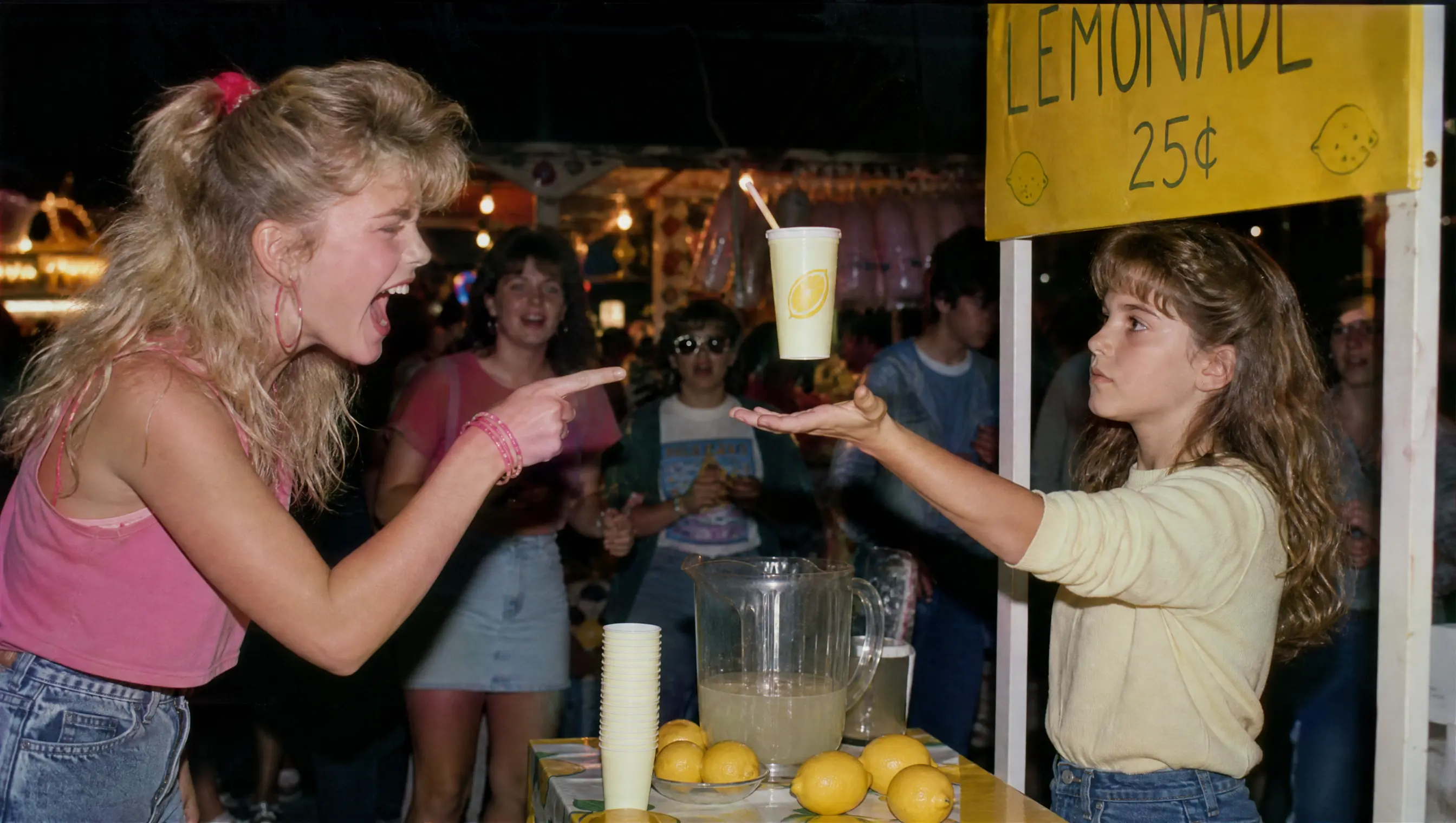
June Halvorsen was twelve years old the August she stood under that sign alone for the first time, and she hated every letter of it.
It was the opening morning of the 1985 Iowa State Fair, a Thursday, the fifteenth, and the sky over Des Moines was the flat white of skim milk. The gates hadn't opened yet. Somewhere behind the Agriculture Building a tractor was backing up, beep, beep, beep, as patient as a heart monitor. The air smelled of hot oil and sawdust and the faint, sweet rot of last night's rain on straw. June stood on an upturned milk crate behind the counter of her grandmother's stand and pressed lemon halves onto the steel reamer, one after another, and tried not to look up at the awning.
The awning was the strangest thing about Dot's. Every other stand on the concourse had a plain canopy, solid red or solid blue, or the green-and-white of the Pork Producers' tent. Dot's had stripes: narrow, uneven stripes of yellow and white and pale gray, painted by hand on heavy canvas, crowded so tight together that if you stared at them too long they seemed to shiver. When June was little she had asked why, and Grandma Dot had said, "So people can find me," and winked, and that had been the end of it.
"You're squeezing those like they owe you money," her mother said.
Carol Halvorsen was at the back of the stand, cutting sugar into the big stainless pitchers with a long wooden paddle. She was forty-one and looked older that summer. She had driven up from the farm outside Chariton at four in the morning in the Buick with the bad muffler, June asleep against the window and forty pounds of lemons in the back seat, and she had not stopped moving since.
"They do owe us money," June said. "Everybody does."
Her mother didn't answer, which was an answer.
The letter was on the refrigerator at home, held up by a magnet shaped like a Holstein. June had read it so many times she could recite it. Farmers Home Administration. Delinquent installment. Payment of $2,340.00 must be received no later than September 1, 1985, or the Agency will proceed with... The words after that were the kind of words that made her father go out to the machine shed after supper and not come back in until it was dark. Proceed with. As if it were a parade.
Three hundred and twenty acres of Lucas County clay, a red barn with a sway in its spine, forty head of Angus, a kitchen with a linoleum floor worn through to the black in front of the sink. Her great-grandfather's farm. Half the farms on their road had sale bills nailed to the feed store bulletin board that year. Everybody knew someone. Mrs. Engstrom's son had driven his pickup into the Chariton River in March and nobody said whether it was an accident. Willie Nelson was on the radio talking about a concert to help farmers, and June's father had snapped the radio off and said he didn't want help from a man with braids.
The stand was the plan. Every August for thirty-two years, Grandma Dot had worked the eleven days of the fair and gone home with enough money to matter. In the good years it was a new roof or a used combine. In the bad years it was the difference. And this year, everyone had agreed in the careful voices of people who had run out of other plans, Dot's would make the payment.
Then in May, Grandma Dot had stood up from her kitchen table in Albia to get the coffee pot and her right side had simply stopped belonging to her.
She was in the rehabilitation wing at Iowa Methodist now, a mile and a half from the fairgrounds, learning to hold a spoon. She could understand everything. She could say almost nothing. The words were in there, the doctor said, but the road to them had washed out. Some days she found a few. Most days she found the wrong ones, and her face would go red with fury, and she would hit the arm of her wheelchair with her good hand until the nurse came.