The curator’s palm struck Samuel Carver high in the chest and sent the eighty-two-year-old man backward toward the marble staircase. Samuel’s cane hit the brass banister with a sharp metallic crack, his left shoe slid half an inch across the polished floor, and for one sickening second his weight shifted toward the first step. He caught the railing before he fell. Around them, the Ashcroft Museum of American Art continued pretending to be elegant: a string quartet played beneath the rotunda, champagne glasses touched softly, and donors in evening clothes stood beneath enormous banners announcing the museum’s newest exhibition. Then the room noticed the old Black man gripping the rail and the younger white curator standing over him with one hand still raised.
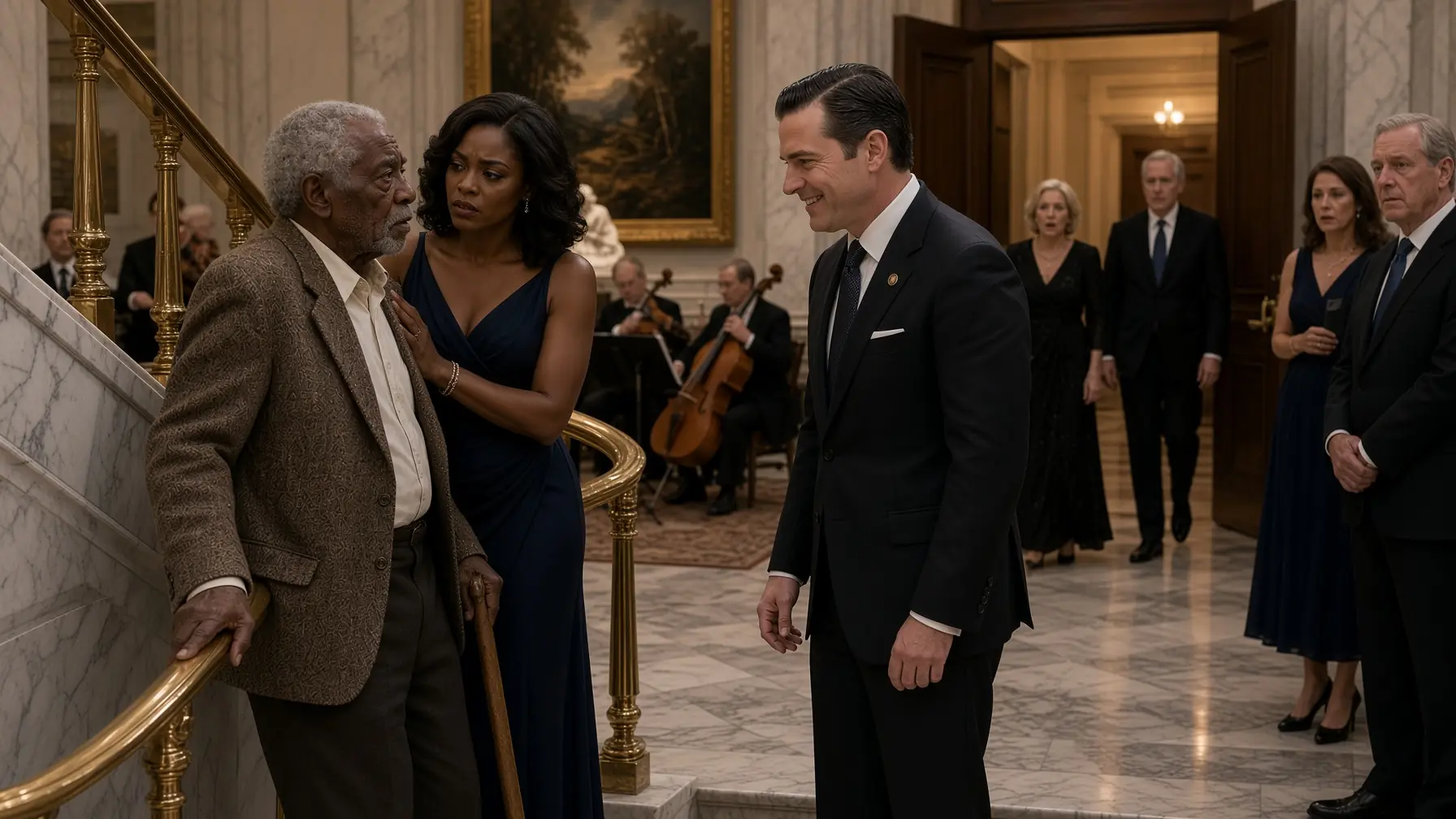
“Retired guards do not climb onto the donor floor,” Adrian Vale said through a thin smile. His tailored midnight-blue suit fit perfectly, his silver curator’s badge gleamed beneath the gallery lights, and his voice was quiet enough to sound civilized while carrying far enough for the nearest guests to hear. “You were told the staff route is downstairs. Go back to the basement before I have security remove you.”
Samuel steadied himself.
He wore a faded brown tweed jacket with leather patches at the elbows, dark trousers, old polished shoes, and a narrow burgundy tie that had probably been fashionable before Adrian was born. His cane was thick walnut, worn smooth at the handle by years of use. Nothing about his clothes announced money. Nothing about his posture suggested he wanted attention. The only visible credential was a small black access card clipped inside his jacket, mostly hidden by the lapel.
Samuel looked at Adrian.
“You pushed me.”
Adrian’s jaw tightened. “I stopped you from entering a restricted reception.”
“You pushed me toward stairs.”
“You were refusing instructions.”
Samuel’s fingers tightened around the cane.
“I asked you to check my invitation.”
Several people nearby turned more openly now. A woman in a silver gown lowered her champagne glass. A young waiter carrying a tray stopped near the wall, uncertain whether to intervene. At the velvet rope, a museum security officer named Evan Brooks had seen enough to become uncomfortable, but Adrian was the senior curator responsible for the evening’s donor preview, and Brooks had spent the last six months learning that disagreeing with Adrian in front of guests rarely ended well.
Adrian looked toward the old man’s jacket.
“You came up from the conservation level.”
“Yes.”
“You told my staff you used to work here.”
“I did.”
“As security.”
“Among other things.”
Adrian gave a short, contemptuous laugh. “Exactly.”
Samuel studied him.
There was something almost weary in the expression.
Not surprise.
Recognition.
He had seen men like Adrian before, though their suits and vocabulary changed from decade to decade.
Adrian stepped closer. “Tonight is invitation-only. Major donors, trustees, lenders, government guests. This is not an employee reunion.”
Samuel looked toward the banners hanging from the balcony above them.
Twenty feet high.
Cream-colored fabric.
Deep burgundy lettering.
THE CARVER COLLECTION: FIFTY YEARS OF AMERICAN VISION
Beneath it, in smaller type:
Presented through the Samuel L. Carver Foundation for Art and Civic Memory
Samuel’s eyes remained there for a moment.
Then he looked back at Adrian.
“I know what tonight is.”
Adrian followed his gaze but misunderstood the reason.
“Then you understand why I cannot have people wandering in from staff areas.”
Samuel’s mouth moved slightly.
“People.”
Adrian heard the emphasis.
His expression cooled.
“Do not make this into something it isn’t.”
Samuel said nothing.
That silence irritated Adrian more than an accusation would have.
He had expected embarrassment. A mumbled apology. Perhaps resentment hidden behind obedience. Instead the old man seemed to be studying him with the calm attention of someone watching an object reveal its construction.
Adrian pointed his index finger toward the staircase.
“Basement.”
Samuel did not move.
“I was invited upstairs.”
“By whom?”
“The board.”
Adrian smiled again.
“Which board member?”
Samuel looked at him.
“All of them, indirectly.”
A man near the champagne table coughed to hide a laugh.
Adrian heard it.
His cheeks colored.
This was the most important museum event of his career. He had spent fourteen months planning it, six months courting lenders, three months arguing over wall placement, and most of that afternoon correcting details nobody else would notice. National press would arrive for the public opening the next morning. Tonight, however, belonged to wealthy patrons, foundation directors, cultural officials, and trustees—the people whose impressions decided appointments, endowed chairs, and future exhibitions.
Adrian intended to be remembered as the man who delivered the Carver show flawlessly.
Instead an elderly former security guard was defying him beside the donor entrance.
“Show me your invitation,” Adrian said.
Samuel reached slowly inside his tweed jacket.
Brooks, the security officer, stepped closer.
Samuel noticed.
So did Adrian.
“Slowly,” Adrian said.
Samuel stopped with two fingers inside the pocket. “It is an envelope.”
“Take it out.”
Samuel did.
Cream cardstock.
Museum seal.
His name embossed across the front.
MR. SAMUEL L. CARVER
Adrian looked at it.
For the first time, uncertainty appeared.
Then he decided against it.
“Anyone can pick up an envelope.”
Samuel stared.
“You asked for my invitation.”
“I asked for proof.”
“That has my name.”
“So would an envelope you found downstairs.”
A murmur moved through the nearest donors.
Samuel’s expression changed now.
Not anger.
Something quieter.
Disappointment.
He offered the envelope to Brooks. “Would you scan the code inside?”
Adrian reached first and took it.
He opened the flap.
Inside was a black invitation card bearing a gold QR code and the same full name.
Adrian turned it over.
Samuel said, “Scan it.”
Adrian did not.
Instead he looked from the formal invitation to the old man in the worn jacket.
The conflict inside his face lasted less than a second.
Then the assumption won.
“There is clearly some mistake.”
Samuel exhaled.
“You haven’t checked.”
“I don't need a scanner to recognize an access problem.”
“You have a credential, a guest list, and a scanner within ten feet.”
Adrian’s voice sharpened. “And I have eyes.”
The words landed harder than he realized.
Samuel looked directly into them.
Nearby, the young waiter stopped pretending not to listen.
Brooks shifted his weight.
A Black couple standing beside a display case exchanged a glance.
Samuel asked, “What do your eyes tell you?”
Adrian knew he had walked into something.
He stepped around it.
“They tell me you entered from an employee level wearing no donor badge, carrying a staff-style access card, and claiming to be connected to an invitation-only event.”
“My donor badge is at registration.”
“Convenient.”
“My access card opened conservation because I was asked to inspect the final installation.”
Adrian laughed softly. “You inspected it?”
“Yes.”
“You?”
Samuel’s eyes narrowed.
“Yes.”
Adrian glanced toward the banners again.
“I suppose next you’ll tell me the collection belongs to you.”
Samuel remained silent.
That should have warned him.
Instead Adrian mistook silence for defeat.
He handed the invitation back with two fingers, as though returning counterfeit currency.
“You need to leave this floor.”
Samuel placed the card inside his jacket.
“No.”
Adrian looked startled.
“No?”
“I am going into that gallery.”
“No, you are not.”
“I was asked to arrive before seven.”
“And I am telling you access has been denied.”
Samuel looked toward Brooks.
“Is he authorized to revoke a board invitation without verifying it?”
Brooks opened his mouth.
Adrian turned sharply.
“Evan.”
Brooks stopped.
Adrian faced Samuel again. “You are now interfering with an event.”
Samuel’s voice stayed level.
“I am standing beside a rope.”
“You are refusing lawful museum instructions.”
“This is a private museum, Adrian. Not a police station.”
Adrian’s eyebrows rose.
“How do you know my name?”
Samuel glanced toward his badge.
“It’s printed on your chest.”
Someone nearby laughed before catching themselves.
Adrian heard that too.
The embarrassment became something else.
Control had always been Adrian’s strongest professional instinct. At forty-one, he had risen quickly through institutions where confidence was often mistaken for competence until the two became nearly indistinguishable. He was educated, articulate, politically cautious, and excellent in rooms where everyone already agreed who mattered. Trustees liked his ambition. Journalists liked his quotes. Junior staff were less enthusiastic.
Three complaints had reached human resources during the previous two years.
None involved physical violence.
One Black museum educator said Adrian repeatedly introduced her as “community outreach staff” despite her title as associate curator.
A Latino conservator complained that Adrian assumed he was a facilities technician during a lender visit.
A white junior researcher said Adrian routinely treated employees without elite academic pedigrees as “support people who should know their place.”
The complaints produced coaching.
Nothing more.
Adrian considered them evidence that leadership made people resentful.
Now an audience was watching him lose authority to an elderly man wearing an old jacket.
He stepped forward.
“Last chance.”
Samuel stood his ground.
“Check the name.”
“I said last chance.”
“Scan the invitation.”