The boy only said one sentence.
"Excuse me, ma'am. I think I can read that 500-year-old contract."
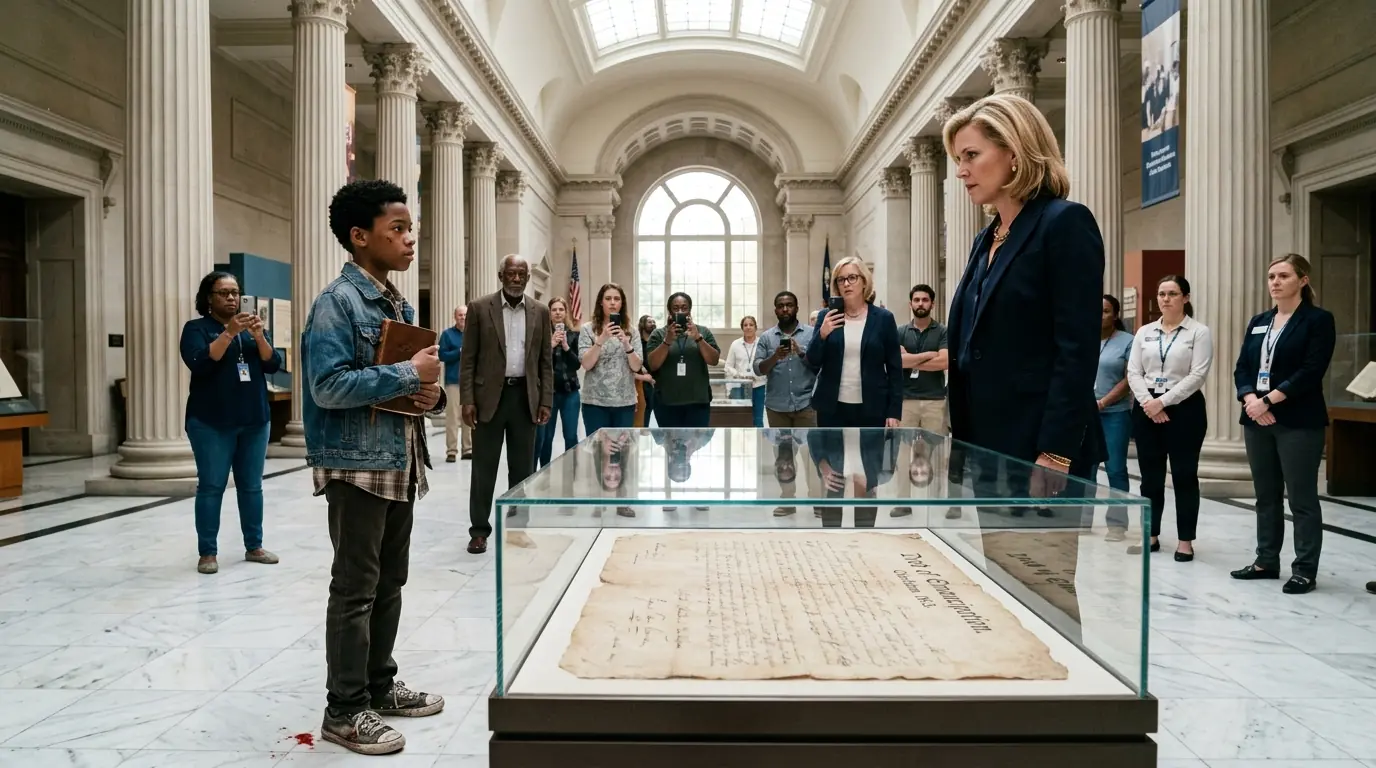
White marble floor, forty-foot ceiling, a twelve-year-old Black boy, torn shoes exposing his toes, standing before the contract that Harvard, Oxford, and the Sorbonne couldn't crack in three years.
Dr. Vivian Hargrove, museum director, granddaughter of the founder, turned. Eyes dragging from his torn shoes up past his Black skin.
"Fourteen experts, $200 million, and some street kid reeking of the gutter says he can read it?"
She stepped closer.
"Someone like you doesn't deserve to breathe the air in this building."
The boy opened his mouth. Hargrove's hand swung, slapped him across the face.
Blood hit white marble. His knee cracked against the floor. He pushed himself back up, shaking, and stared straight at her.
Hargrove wiped her hand on her blazer.
"Get him out. Temple of scholarship, not a shelter for street rats."
Phones up, live streams—not one person spoke up. But no one knew the boy they just threw out was the only person on Earth who could read that contract.
And when the truth came out, the one who slapped would be the one bowing.
---
Blood on white marble. A twelve-year-old's blood. That image doesn't leave you.
The door of the Hargrove Museum closed behind him with the sound of something final. Not a slam—worse, a slow, heavy click. The kind that says, "You were never meant to be here."
Amos Crawford stood on the front steps, the Charleston sun pressing down on his thin shoulders. Blood was still drying on his chin. His hand was still shaking, but he didn't cry.
He hadn't cried since he was seven, the day a school told him his brain was too big for a boy his color and his zip code.
That year, a teacher had spotted his gift. A kid who could pick up languages like other kids picked up colds. She got him into a gifted program. On the first day, a parent complained about "that boy from the barbershop" being in the class. The school quietly removed him. No explanation. No appeal. Just a note in his file and a seat that was empty on Monday.
He learned that day that being brilliant wasn't enough if you were brilliant in the wrong skin.
He pressed the leather journal against his ribs and started walking.
---
Twelve blocks east, past the boutique coffee shops and the real estate signs eating his neighborhood alive, Amos pushed open the glass door of Desmond's barbershop. The bell jingled.
Three men in chairs looked up. Desmond Taylor, fifty-two, Navy veteran, built like a man who had carried things heavier than furniture, saw the boy's face and put down his clippers.
"Who?"
One word. That was all Desmond needed.
Amos shook his head. "Nobody."
Desmond looked at the blood on the boy's chin. He wet a clean towel with warm water, knelt down on one knee—this big man, this veteran, kneeling on a barbershop floor—and wiped the blood off a child's face without a word.
Then he went back to cutting hair because Desmond had learned a long time ago that a boy will talk when a boy is ready.
---
Upstairs in the apartment that smelled like lavender soap and old books, Della Crawford sat in her chair by the window. She was eighty-one. Some days, she knew exactly where she was. Some days, she thought Amos was his father. Today was somewhere in between.
"Baby," she said, not turning from the window. "Did you go to the house of glass?"
Amos stopped in the doorway. "Yes, Grandma."
"Did they listen?"
He looked at her. This tiny woman in a cotton dress, the woman who had spent fourteen years sitting at a kitchen table teaching him a language that no university on Earth had in its database.
She called it Fala Kreyol. She'd learned it from her mother, who learned it from hers, who learned it from hers. All the way back to a people who once traded as equals with Portuguese kings and signed contracts in their own tongue.
Ten generations, kitchen to kitchen, mother to child, a chain of voices stretching back five hundred years, held together by nothing but love and stubbornness, and the absolute refusal to let a language die.
"Not yet, Grandma."
She nodded slowly, her fingers resting on the leather journal's twin—her own copy, older, the pages yellowed and soft as cloth.
"They will. The words don't die because the ears aren't ready."
That night, Amos sat on the floor beside her chair and read to her from the journal. Fala Kreyol filled the small apartment—rolling, tonal, beautiful. A language the world believed had been dead for three hundred years, alive in a kitchen above a barbershop, carried in the mouth of a twelve-year-old boy who had nowhere else to carry it.
This was his life. School when he could make it, the library when he couldn't, cooking for Della—rice and beans, the only thing he knew how to make that she'd always eat—bathing her on bad days, reminding her what year it was, what city they lived in, what her name was. Reading to her every night in the old tongue so the language would not die when her memory finally did.
He wasn't trying to be a genius. He wasn't trying to prove anything. He was trying to keep a promise he'd made when he was eight years old and she had sat him down and said:
"When I forget, you remember. That's your job. You remember for both of us."