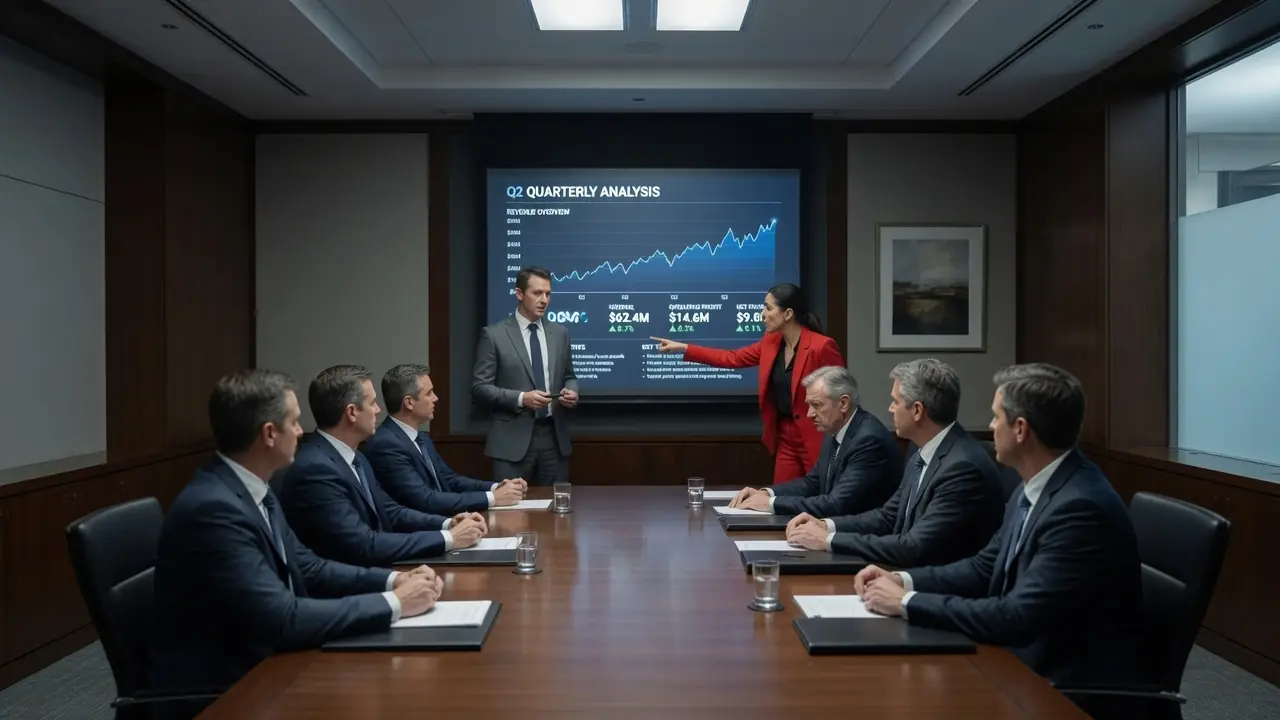
I stared at the presentation screen, my pulse quickening as Tazia confidently clicked to the next slide. There it was, my quarterly market analysis displayed for the entire executive team to see, but with angry red circles highlighting supposed errors in my calculations. As you can clearly observe, Tazia announced, her voice dripping with professional concern, these projections deviate significantly from standard forecasting models.
She gestured to a side-by-side comparison where my data visualizations appeared wildly different from textbook examples. The boardroom felt suffocating as 12 pairs of senior executives leaned forward in their chairs. I remained completely still, my face carefully blank, despite the knife twisting in my chest. Three months of meticulous work was being systematically dismantled before my eyes.
The volatility patterns shown here, she continued, pointing to my custom-designed charts, completely misrepresent actual market conditions. When plotted against traditional indicators, you can see the dramatic inconsistencies. Director Paxton removed his glasses, rubbing the bridge of his nose. And you're certain about this assessment?
Absolutely, Tazia replied without hesitation. I've run the numbers myself using industry-standard methodologies. The discrepancies are substantial and frankly concerning. I watched silently as she flipped to the next slide, a complex visualization I'd created after weeks of research and late nights.
Most troubling is this risk assessment model, she said. It employs an unconventional mathematical approach that generates projections completely out of alignment with peer-reviewed financial forecasting principles. The CEO crossed his arms, frowning deeply. I could practically see my promotion chances evaporating with each nod around the table.
When applied retroactively to last year's market, Tazia explained, displaying a new comparison slide, this model would have completely missed the February correction. Our clients would have been caught entirely unprepared, potentially losing millions. Director Paxton shook his head slowly.
This is deeply troubling. I've already begun implementing standard methodologies, Tazia assured him with practiced confidence. With immediate intervention, we can still present accurate projections to the Wellington Group next week. The message couldn't have been clearer.
She should lead the Wellington account, our biggest client. The promotion we'd both been competing for would be hers. And you're certain these analytical methods are fundamentally incorrect? the CEO asked her directly. Without question, she replied, they violate basic principles of financial forecasting.
After enduring 60 excruciating minutes of watching my professional reputation being methodically destroyed, Director Paxton finally turned to me. Do you have anything to say in response? Every head in the room swiveled toward me.
Throughout the entire presentation, I hadn't uttered a single sound. My heart pounded as I carefully considered my next words. Just one question, I said calmly, meeting Tazia's eyes directly. Can you explain why the client specifically requested this exact visualization approach in their initial brief?
My name is Arya, and until that moment, I'd spent four years building a reputation as a brilliant but quiet analyst at Keystone Investments. I wasn't the type to dominate meetings or promote myself aggressively. Instead, I let my work speak for itself, innovative approaches to data that consistently delivered superior results for our clients.
I grew up as the middle child in a household where speaking up meant being interrupted. So, I learned early to observe, analyze, and wait for the perfect moment to make my point. This patience had served me well in my career, allowing me to see patterns others missed while my louder colleagues rushed to judgment.
When I joined Keystone after completing my master's degree, I was determined to succeed on merit alone. For years, I'd watched my mother, a talented programmer, get passed over for promotions because she wasn't assertive enough in a male-dominated tech company. I promised myself I wouldn't let that happen to me.
At Keystone, I slowly built my reputation by taking on challenging accounts others avoided and turning them into successes. My analytical approach wasn't conventional. I developed my own models that spotted market trends weeks before standard indicators. My clients appreciated the edge this gave them, even if some of my colleagues questioned my methods.
Tazia joined the company two years after me. From day one, she was everything I wasn't, outspoken, politically savvy, and determined to climb the corporate ladder at any cost. Where I spent evenings perfecting analyses, she spent them networking with executives at industry events. Where I focused on client results, she focused on visibility.
We were opposites in every way, yet strangely, we developed an uneasy friendship over shared lunches and late nights at the office. I admired her confidence and she seemed impressed by my technical abilities. When she asked about my methods, I'd share my thinking, believing we were supporting each other as women in a competitive field.
I wanted that promotion desperately, not just for the money, though that would finally let me pay off my student loans. It represented validation, proof that quiet competence could triumph over self-promotion. When Paxton assigned both Tazia and me to the initial client meeting, I knew we were being evaluated head-to-head.
Wellington's representatives were unlike typical clients. Their head of research, Dr. Nari, spent an hour discussing cutting-edge forecasting methodologies. He explained that traditional models had failed to predict several recent market shifts that cost them dearly. We're looking for fresh approaches, Dr. Nari had said.
Our internal research suggests non-linear volatility patterns contain predictive signals that conventional models miss entirely. I felt a thrill of recognition. This was exactly what my personal research had focused on for years. When I shared some preliminary thoughts, Dr. Nari leaned forward with genuine interest.
Tazia, meanwhile, looked increasingly uncomfortable as the conversation ventured beyond standard financial theory. After the meeting, Paxton pulled me aside. Wellington was impressed with your ideas. They want you to lead the analysis phase.
Tazia's smile tightened when she heard the news, but she congratulated me warmly. I'll handle client communications while you focus on the numbers, she offered. We'll make a great team. For 3 months, I poured everything into developing custom visualization tools that could capture the patterns Wellington wanted to track.
I tested my models against historical data, refining them until they successfully predicted 84% of significant market movements from the previous year, far exceeding the 61% accuracy of traditional approaches. When Tazia asked about my progress, I shared everything openly. She seemed fascinated, asking detailed questions about my methodology.
I explained each innovation proudly, believing she was helping bridge communications with the client while I focused on the technical work. What I didn't know was that she'd stopped sharing my updates with Wellington weeks ago. Instead, she'd been meeting privately with Director Paxton, expressing concerns about my unconventional approach.
She carefully built a case that I was veering dangerously off course from accepted financial practices. The presentation ambush had been her masterstroke, positioning herself as the responsible professional saving the company from my reckless methods. And it had worked perfectly until my single question changed everything.
The boardroom remained silent after I asked Tazia to explain why Wellington had specifically requested my visualization approach. Her confident expression faltered momentarily. I'm not aware of any such request, she replied, recovering quickly. The client expected industry standard analysis.
I reached into my bag and retrieved a bound document, sliding it across the table toward the CEO. This is Wellington's initial project brief. Page 17 outlines their requirements for non-linear volatility tracking, exactly the methodology I implemented and that you just spent an hour criticizing.
The CEO opened the document, scanning the pages with increasing interest. Wellington's quantitative team has been researching these patterns for 2 years, I continued, my voice steady despite my racing heart. What looks like analytical errors to someone using traditional models are actually pattern recognition innovations they specifically requested.
Director Paxton reached for the document. Is this accurate? Wellington's chief strategist can confirm everything, I replied. I've been in weekly strategy meetings with their team throughout this project. I assumed everyone at leadership level was aware of their specialized requirements.
Tazia started to speak, but the CEO raised his hand to silence her. Her usually composed face betrayed the first flickers of panic. You've just spent an hour explaining how you've fixed analytical methods that Wellington specifically commissioned, I said, looking directly at her.
I'm curious. Have you informed them that you've replaced their proprietary approach with standard models they explicitly rejected? The tension in the room was palpable. Director Paxton flipped through the brief, his expression darkening with each page.
There must be some misunderstanding, Tazia attempted, her voice slightly higher than normal. These methods are untested. No serious investment firm would. Page 12, I interrupted calmly, pointing to the document.
It shows Wellington's backtesting results comparing traditional models with their experimental approach. Standard forecasting caught 61% of significant market movements. Their method identified 84% and provided earlier warning signals. The CEO looked up sharply.
Is this accurate? Dr. Nari can verify everything, I said, mentioning Wellington's head of research. I've documented all our discussions about their methodology requirements. Director Paxton closed the brief, his face unreadable.
I think we need to pause here and verify some information. Tazia, Arya, thank you both for your input. The executive team will need to discuss this privately. As we filed out of the boardroom, Tazia gripped my arm, pulling me into an empty conference room.
Her carefully constructed poise had vanished entirely. What are you playing at? she hissed. You made me look like a fool in there. I gently removed her hand from my arm.
I simply clarified the client's actual requirements. We both know Wellington would never approve those bizarre models. You're just trying to save face. I studied her for a moment, wondering how I'd missed the depth of her duplicity.
Dr. Nari personally requested that approach. You were in the initial meeting when he explained why. That's not how I remember it, she said, smoothing her expression back to professional concern.
And it won't be how Director Paxton remembers it, either. We've discussed your creative interpretations extensively. A chill ran through me as I realized how thoroughly she'd worked to undermine me.
For weeks, she'd been laying groundwork, positioning herself as the voice of reason while painting me as dangerously unorthodox. You should prepare yourself, she added with artificial sympathy. Even if they don't fire you outright, your reputation here is finished.
No one trusts an analyst who can't follow basic financial principles. She left me standing alone, her confident stride suggesting she still believed victory was inevitable. And perhaps, she was right to be confident.
In a straight battle between her political connections and my technical work, history suggested I would lose. That evening, I sat on my apartment balcony watching the city lights flicker on as twilight deepened. My phone buzzed with a message from Director Paxton.
Meeting tomorrow, 9:00 a.m. with Wellington representatives present. No further explanation. I barely slept that night, replaying every interaction with Tazia over the past months. How many times had she asked detailed questions about my methodology, only to use that information against me?
How many private meetings had she arranged with leadership while I worked late, perfecting analyses? The betrayal cut deeper because I genuinely believed we were supporting each other. The next morning, I arrived early to find the conference room already filling with executives.
Director Paxton nodded tersely as I entered. Tazia arrived moments later, impeccably dressed and seemingly untroubled. She took a seat across from me, avoiding eye contact. At precisely 9:00, Dr. Nari from Wellington entered with two colleagues.
The atmosphere immediately tensed. Thank you all for convening on short notice, Director Paxton began. We have a situation that requires immediate clarification regarding the Wellington quarterly forecasting project. Dr. Nari has agreed to provide his perspective.
Dr. Nari placed his tablet on the table, his expression serious. I was disturbed to receive standard market projections yesterday from Ms. Tazia, particularly after the promising custom analytics Ms. Arya had been developing for us. Tazia's head snapped up.
I believe the alternative approach needed revision to meet industry standards. Industry standards are precisely what we hired Keystone to move beyond, Dr. Nari interrupted. As I made explicitly clear in our initial brief and subsequent communications, traditional forecasting models have consistently failed to identify the market anomalies most critical to our investment strategy.
Director Paxton leaned forward. Dr. Nari, to be absolutely clear, you specifically requested the non-linear volatility modeling approach that Arya implemented? Not only requested it, we insisted on it as a condition for awarding Keystone this contract, he confirmed.
Ms. Arya's methodology aligns perfectly with our research directives. When Ms. Tazia sent standard projections yesterday claiming they represented Keystone's official analysis, I was concerned there had been a serious miscommunication. The room fell silent.
Tazia's face had gone completely pale. There seems to have been a significant internal communication failure, the CEO said carefully. Rest assured, Wellington will receive the custom analytics you commissioned, delivered by Arya, who developed them.
After the meeting dispersed, Director Paxton asked me to remain behind. Tazia attempted to stay as well, but he dismissed her with a curt, we'll speak later. When we were alone, he sighed heavily.
This situation is unprecedented, Arya. Had Wellington gone with the standard analysis Tazia proposed, we would have lost our largest client. I nodded, saying nothing. I owe you an apology.
I should have verified the client requirements directly instead of accepting second-hand information. He paused, studying me. Why didn't you speak up sooner about Tazia's interference?
I didn't know she was interfering, I admitted. I thought we were collaborating. She had access to all my work while claiming to handle client communications. He grimaced.
A carefully orchestrated deception. What happens now? I asked. The senior analyst position will be yours, effective immediately, he said.
As for Tazia, HR will be having discussions with her about her future at Keystone. It should have felt like victory. The promotion was mine, my methods vindicated, my chief rival exposed.
Yet, as I returned to my desk, I felt hollow. The trust I'd placed in a colleague, someone I'd considered a friend, had been weaponized against me. Throughout the day, colleagues stopped by my desk with congratulations tinged with curiosity.
The story had spread rapidly through office channels. Tazia remained conspicuously absent, having left the building immediately after the meeting. At 5:00, as I was preparing to leave, my phone lit up with a text from an unknown number.
This isn't over. You got lucky today. I stared at the message, a knot forming in my stomach. The tension I'd been carrying all day crystallized into something sharper.
This wasn't just professional rivalry, it was personal now. The following days brought an uneasy transition. I moved into my new office and began building my team for the Wellington account.
Tazia hadn't been fired, merely reassigned to internal analytics, where client contact was minimal. Each time we passed in hallways, her eyes followed me with undisguised resentment. Two weeks after my promotion, strange things began happening.
Small at first, files missing from my desktop, meeting invitations that disappeared from my calendar. Then more significant, a crucial email to Wellington contained calculation errors I knew I hadn't made. A presentation deck was altered overnight with slides rearranged and key data points changed.
I began staying later, triple-checking everything before sending it. I kept backup copies of all files on my personal drive. The constant vigilance was exhausting, but necessary.
You look terrible, my colleague Jen remarked over coffee. Everything okay with the new position? I hesitated, then admitted, Someone's sabotaging my work.
Small things, but enough to undermine me if I don't catch them. Jen raised an eyebrow. Tazia? I can't prove it, I said.
But who else would have both the motivation and the technical knowledge? Be careful, Jen warned. She's still close with Director Paxton's assistant, and she's been having lunch with several board members recently.
This news sent a chill through me. While I'd been focused on delivering results, Tazia had been networking, spinning narratives, laying groundwork, again. That afternoon, I discovered my access to certain data systems had been mysteriously revoked.
When I contacted IT, they claimed to have received authorization from leadership to modify my permissions. It took hours to resolve, forcing me to miss a deadline for Dr. Nari. When I finally delivered the analysis late that evening, he was understanding but concerned.
Is everything all right at Keystone? This is the second delay this week. Just some internal system issues, I assured him, unwilling to air company problems to a client.
I see, he replied, not entirely convinced. Just so you're aware, we've received an interesting proposal from another firm claiming they can implement our methodology more efficiently. Normally, I wouldn't mention it, but given these recent hiccups.
My blood ran cold. Another firm? May I ask which one? Criterion Analytics, he said.
Apparently, they've just hired a specialist in non-linear volatility modeling who's familiar with our approach. I maintained my professional composure through the end of the call, but inside, panic bloomed.
Criterion was our main competitor, and this specialist could only be one person. That night, I searched online and found it immediately. A press release announcing Tazia's hiring at Criterion Analytics as their new director of strategic forecasting.
The position was several levels above what she'd held at Keystone. How had she managed this? Then it hit me.
She hadn't just been studying my methods to sabotage me internally, she'd been learning them to sell herself as an expert to our competitor, positioning herself to steal Wellington's account. The next morning, I requested an urgent meeting with Director Paxton and our legal team.
I explained my suspicions, showing them evidence of the systematic interference with my work and the Criterion announcement. This is troubling, the legal director acknowledged, but difficult to prove as deliberate sabotage rather than system glitches.
As for her new position, unless we can demonstrate she's sharing proprietary information, she's marketing herself as an expert in the exact methodology I developed for Wellington, I insisted, methodology she publicly criticized as incorrect just weeks ago.
Director Paxton looked unconvinced. People change their professional opinions all the time. I realized with sinking certainty that I was losing this battle.
Without irrefutable proof, it would be my word against Tazia's, and she had always been better at office politics. That evening, I received an invitation to attend an industry conference where Tazia would be giving a keynote presentation titled Innovations in non-linear volatility forecasting.
My methodology, presented as her expertise. I sat motionless at my desk, fury and helplessness washing over me in alternating waves. Everything I'd worked for was being systematically dismantled by someone willing to cross lines I wouldn't.
In the battle between quiet competence and ruthless ambition, the latter was winning. But as I stared at the conference invitation, something shifted inside me. I had played by the rules while Tazia broke them repeatedly.
I had trusted the system to recognize merit while she manipulated perceptions. I had been honest while she lied without hesitation. Perhaps it was time to change tactics.
I opened my laptop and began typing, a plan forming that would require me to operate as Tazia did, strategically, politically, and without mercy. For once, I would fight not just with better data, but with better strategy.
The industry conference was scheduled for 3 weeks away, giving me limited time to prepare. As I examined the event details, I discovered Tazia would be presenting to senior executives from major investment firms, including Wellington. Her session description promised to reveal groundbreaking approaches to market volatility forecasting that sounded eerily familiar.
The audacity was breathtaking. She hadn't just stolen my methods, she was positioning herself to poach our largest client by presenting my work as her own innovation. If she succeeded, my career at Keystone would be effectively over, regardless of my title.
I needed to act, but confronting her directly would only lead to denials and counter-accusations. Taking my concerns to leadership again would likely be dismissed as professional jealousy. I needed irrefutable evidence of what she was doing, and I needed to present it in a way that couldn't be ignored.
The next morning, I called Dr. Nari at Wellington, keeping my tone casual as I inquired about the conference. Yes, we're sending several team members, he confirmed.
The session on volatility forecasting caught our attention. Have you seen the preview materials? I have, I replied carefully.
I'm interested in how their approach compares to what we've developed for Wellington. As are we, he said.
Innovation is valuable, but consistency is essential for our strategy. We need partners whose methodologies align with our research direction. The message was clear.
Wellington was actively considering alternatives to Keystone. The ground beneath my feet was even less stable than I'd feared. That afternoon, I contacted Jin, who had connections throughout the industry.
I need to know exactly what Tazia is planning to present at the conference, I explained. Any chance your contact at Criterion could help? Jin hesitated.
That's sensitive information, Arya. What are you planning? Just professional due diligence, I assured her.
If a competitor is presenting similar methodologies to what we've developed, we need to understand how they're positioning it. Two days later, Jin forwarded me a draft of Tazia's presentation deck.
My hands shook as I scrolled through slides containing my exact visualizations, simply recolored with Criterion's branding. The mathematical formulas I'd developed over years were presented with minor cosmetic changes. Even my original testing results appeared, the numbers slightly altered but unmistakably mine.
What's more, the presentation included client testimonials from firms that had never actually used her methods. She had fabricated success stories to bolster her claims. I immediately backed up the files to multiple secure locations.
This was the evidence I needed, but using it effectively required strategic thinking. If I simply accused Tazia of theft, she would claim the methodologies were basic industry knowledge or that she'd developed them independently. I needed a trap that would force her to reveal her deception.
For the next week, I worked on two tracks simultaneously. During days, I focused on delivering exceptional results for Wellington, ensuring they had no legitimate reason to consider switching providers. During nights, I meticulously developed my counter-strategy against Tazia.
The conference was being held at Meridian Hotel, a venue I knew well from previous industry events. I contacted the event coordinator, Reagan, whom I'd worked with before. I'm presenting at a different session, I explained, but I'm having technical concerns about the projection system.
Would it be possible to test my presentation in the main hall beforehand? Reagan agreed to give me access the evening before the conference. Just let security know you're here for setup testing.
They'll let you in. Next, I reached out to several industry colleagues who would be attending Tazia's session, people whose opinions carried weight.
Without revealing my full concerns, I mentioned that I'd heard the presentation would cover methodology similar to what I'd developed for Wellington. Really? That's interesting timing, remarked Anton, a respected quantitative analyst.
I'd be curious to hear your thoughts afterward on how it compares. Actually, I suggested, I think the comparison would be more valuable if you went in with some background.
Could we meet briefly before her session? I can show you the key elements of what we've implemented. One by one, I arranged similar conversations with influential attendees.
Not enough to seem like orchestrated sabotage, but sufficient to ensure knowledgeable eyes would be watching Tazia's presentation critically. Two days before the conference, I received a message from Dr. Nari that sent a surge of panic through me.
Looking forward to seeing comprehensive applications of your volatility methodology at the conference. If successful, this could significantly influence our provider decisions moving forward. He hadn't specified whether he meant my methodology as presented by Keystone or by Tazia at Criterion.
The stakes had just risen dramatically. Wellington wasn't just curious about alternatives. They were actively evaluating whether to switch providers.
The evening before the conference, I arrived at the Meridian Hotel with a small backpack containing my laptop. Security checked my credentials and directed me to the main presentation hall where Reagan waited. You have about an hour before the technical team needs to run final checks, she informed me.
Perfect. Thank you, I replied, setting up my equipment at the presentation console while Reagan busied herself with other preparations. I connected my laptop and accessed the system settings.
What I did next wasn't technically illegal, but it certainly operated in an ethical gray area. I created a hidden presentation file that would remain dormant in the system, accessible only through a specific command sequence.
The next morning, I arrived early and stationed myself in the hotel lobby, where I could observe attendees without being immediately noticed. When Tazia entered, she looked confident, dressed impeccably, greeting industry leaders with practiced charm.
She showed no sign of concern that I might be present. 30 minutes before her session, I met with Anton and several other analysts as planned, giving them a brief overview of the methodology I'd developed for Wellington.
The key innovation is how it handles non-linear relationships between seemingly unrelated market indicators, I explained, showing simplified versions of my models. Traditional approaches miss these connections entirely.
When we entered the presentation hall, it was already filling with attendees. I chose a seat near the back, partially obscured by a column. Dr. Nari and his Wellington team were seated prominently in the second row, their presence confirming this was more than an academic exercise.
It was an audition. Tazia took the stage precisely on time, her opening remarks smooth and engaging. Today, I'll be sharing a revolutionary approach to volatility forecasting that challenges conventional market assumptions, she began.
This methodology represents months of intensive research and testing. As she progressed through her presentation, see recognition dawning on Anton's face and those of the other analysts I'd briefed.
The similarities to what I'd shown them were impossible to miss. Meanwhile, Dr. Nari was taking detailed notes, his expression inscrutable. Tazia advanced to a slide showing impressive backtesting results, my results with numbers slightly adjusted.
When applied to last year's market conditions, this model successfully predicted 82% of significant volatility events compared to just 60% using standard methods. From my seat, I quietly opened my tablet and entered the command sequence I'd programmed the previous evening.
On stage, Tazia continued confidently, unaware of what was about to happen. The proprietary algorithms driving these predictions analyze correlations that traditional models ignore entirely, she stated, clicking to advance to her next slide.
Instead of the expected chart, the screen suddenly displayed a split image. On the left, Tazia's slide. On the right, my original Wellington presentation with identical formulas created 3 months earlier.
Above both images appeared the text, Original Development Timeline. Tazia froze momentarily, then quickly clicked to advance past the unexpected slide.
But the next slide showed the same split-screen comparison with different content. She clicked again and again, but each slide now displayed her version alongside my original, with timestamps clearly visible.
Murmurs spread through the audience. Dr. Nari leaned forward in his seat, eyes narrowed. Tazia attempted to regain control.
There seems to be a technical issue. If we could have IT assistance. I don't think it's a technical issue, Anton called out from his seat.
These appear to be comparative slides showing original development dates of the methodology you're presenting. I don't think it's a technical issue you're presenting.
That's absurd, Tazia responded, her voice tight. This is proprietary Criterion analysis. Then why does it match exactly what Keystone presented to Wellington 3 months ago? Dr. Nari asked, standing now.
Down to the formula notation and visualization color schemes. The room had gone completely silent. There must be some mistake, Tazia insisted, desperately trying to exit the presentation, but each click only advanced to another comparison slide.
Then came the final slide I'd prepared, showing Tazia's email to me from months earlier, where she had asked questions about my methodology, timestamped weeks before she criticized it as fundamentally flawed in the boardroom. I stood up slowly, finally allowing myself to be seen.
There's no technical glitch, Tazia, just documented evidence of how you studied my work, publicly criticized it, then attempted to present it as your own innovation after joining a competitor. The room erupted in whispers as I walked calmly to the front of the hall.
Tazia's face had gone completely white. You planted these slides, she accused, voice barely audible. You hacked the system.
The slides simply show factual information, timestamped development materials from both companies, I replied. If the methodology is truly your original work, you should be able to explain the identical mathematical notation, testing parameters, and even the identical typo on slide 17.
Dr. Nari and the Wellington team had gathered at the side of the stage, expressions grave. Other attendees were photographing the comparison slides with their phones. This session is clearly compromised, Dr. Nari announced.
I suggest we adjourn while this situation is addressed. Ms. Arya, the Wellington team would appreciate a private conversation at your convenience. As the room emptied, Tazia remained frozen on stage, her carefully constructed professional facade completely shattered.
When only a few people remained, she approached me, voice trembling with fury. You planned this ambush. You deliberately humiliated me.
I regarded her calmly. I simply presented factual evidence of what you did. The methodology you criticized as dangerously flawed in front of our entire leadership team, the same methodology you then studied in detail, stole, and attempted to sell as your own innovation.
You'll regret this, she whispered. Perhaps, I acknowledged.
But right now, industry leaders have just witnessed you presenting stolen intellectual property. I suspect that's a greater professional concern than any personal vendetta between us.
An hour later, in a private meeting room, Dr. Nari confirmed that Wellington would be expanding their relationship with Keystone, and with me specifically. Integrity matters as much as innovation in our partnerships, he explained.
Today made clear which provider embodies both. 3 days later, Criterion Analytics issued a terse press release announcing Tazia's departure by mutual agreement.
No financial firm would risk hiring her after video clips of the presentation debacle circulated throughout the industry. I didn't feel the savage triumph I'd expected.
Instead, I felt a quiet satisfaction that truth had prevailed where office politics had failed. I hadn't destroyed Tazia. She had destroyed herself through her own actions.
I had simply ensured that those actions became visible at precisely the right moment, to precisely the right audience. The following week, Director Paxton called me into his office.
The board has approved a new position, Chief Methodology Officer. They'd like you to take it, with a substantial compensation increase. I smiled.
I'd be honored. And Arya, he added, that was impressive work at the conference.
Unorthodox, but effective. Sometimes, I replied, the most powerful response to deception isn't confrontation.
It's simply ensuring the truth is visible to everyone who needs to see it.