My daughter-in-law Dana stood in my kitchen on a Thursday evening in April and delivered the news the way a person delivers news they have been rehearsing for a while with a specific careful warmth that is designed to make the announcement feel like kindness rather than what it actually was. She said, "Victor, Gregory and I have been talking, and we've made a decision. We think it's time for you to move into a care facility. We've actually already looked at a few places. There's a very nice one on Garners Ferry Road. We've scheduled a tour for Saturday morning. We've already decided. We've already looked. We've already scheduled."
My son Gregory sat at my kitchen table three feet to her left with his hands around a cup of coffee and said absolutely nothing. He looked at the table. He looked at the coffee. He produced the specific silence of a man who has agreed to something before it happened and is now finding the execution slightly harder than the agreement was. I looked at Dana.
I looked at Gregory. I looked at Dana again. I said, "That's a lot of thinking you've both been doing." She said, "We just want what's best for you. The house is a lot to manage on your own. You're 70 years old, and we worry. We worry."
The two of them had been living in my house for 3 years, occupying the two bedrooms on the second floor that had belonged to my children until they grew up and left, rent-free, utilities included, with dinners provided four nights a week from the kitchen where Dana was now standing and telling me she had already scheduled a tour of a care facility where I would be relocated so that they could have the house to themselves. I nodded. I smiled. I said I appreciated them thinking about it. I said I would need to process it.
I said I was going upstairs to rest. I went upstairs. I sat on the edge of the bed where Miriam and I had slept for 23 years. I picked up my phone from the nightstand. I scrolled to a contact I had added 18 months ago and that I had not yet needed to call for this specific purpose, though I had called it twice for other preparations in the preceding year and a half.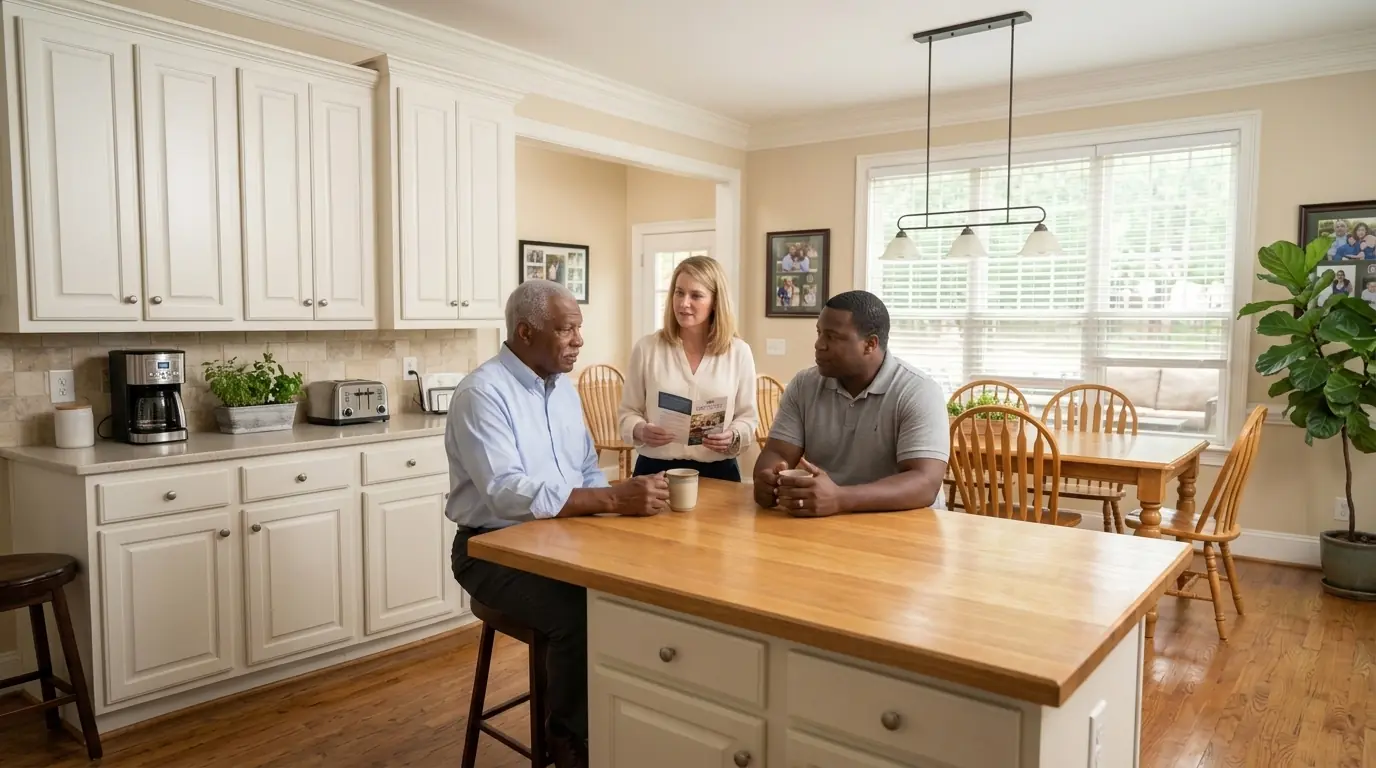
The contact was Robert Stanhope, a property and estate attorney with an office on Gervais Street in Columbia, South Carolina. He answered on the second ring. I said, "Robert, it's Victor Holloway. They said it this evening." "Tonight?" he asked. "Tonight. I need you to start the process first thing tomorrow morning." There was a brief pause, the pause of a man checking a file he has been keeping current for 18 months. He said, "I'll have the notices prepared by nine. Victor, are you all right?"
I said, "I'm clear. That's what I am right now." He said, "Then let's get this done." I set the phone down. I looked at the bedroom ceiling, the same ceiling I had looked at for 23 years with Miriam beside me, and I thought about the word decided.
We've already decided. As if the house where I had lived for 26 years, the house I had paid for and built a life in and owned in full, was a matter for other people to decide about. I thought about what Robert was going to prepare in the morning. About what Dana was going to find when she came downstairs on Friday, about the specific face my son was going to make when he understood what he had sat silently beside for the last 3 years, while his wife positioned herself in my kitchen and made decisions about my life. I had been waiting for this evening for 18 months.
I live in Columbia, South Carolina. And what my son and his wife did not know, standing in my kitchen and talking about the Garners Ferry Road Care Facility, was that the house they were planning their future in had not been an ordinary piece of real estate for 18 months. They thought they were managing my exit. They were about to discover what I had already arranged for theirs. I spent 34 years as a licensed electrical contractor in Columbia, South Carolina.
I built Holloway Electrical Services in 1984, starting with a used van, a commercial license, and a client list of four small businesses in the Five Points area who had trusted me with their wiring because I had done work for two of them as a journeyman, and they had found no reason to be dissatisfied. By the time I retired in 2018, Holloway Electrical had a crew of 19 electricians, a commercial and residential portfolio that covered most of Richland and Lexington counties, and a reputation in the Columbia building trades that I had earned one correctly wired circuit at a time over three decades. I say that not for pride, but for precision. An electrician understands one thing above all others which is that the system is either wired correctly or it is not and that incorrect wiring does not usually fail at the moment you make the error.
It fails later under load when the draw exceeds what the inadequate connection can carry. You do not find the mistake when you make it. You find it when it matters. I had been finding mistakes in the situation with Gregory and Dana for 3 years. I had been finding them quietly, one at a time, and I had been doing what an electrician does when he finds a wiring fault in a system he is responsible for.
I had been correcting the circuit before the load arrived. Miriam Joan Holloway, born Miriam Joan Pettigrew in Orangeburg, South Carolina in 1953, was the person who made Holloway Electrical Services possible in the specific way that the person at home makes the person in the field possible. She ran the business accounts for 12 years before we had office staff. She kept the records. She managed the scheduling calendar before we had software for it.
She was a kindergarten teacher for 19 years, and she brought to that work the same quality she brought to everything in her life, which was the conviction that patience and consistency produced results that urgency and noise never could. She had a garden in the backyard of the house on Sycamore Drive that she tended from March through October with a specific devotion that I had always found moving and had never fully understood because I am a person who understands systems and Miriam understood growing things and the two are different in ways that I spent 27 years of marriage appreciating without being able to bridge. Miriam died of a pulmonary embolism in September of 2021. Suddenly, without warning, which is the form of loss I have already described and will not describe again, except to say that the house on Sycamore Drive was different after she was gone in every room and at every hour, and that what I had to learn was not how to manage grief, but how to manage the specific aloneness of a house that had been built for two people and was now occupied by one.
I had two children. Elaine was 38, lived in Charlotte where she worked as a commercial interior designer, called me on Tuesday and Thursday evenings without variation, and drove down from Charlotte the first and third weekend of every month because she had decided that was the rhythm that made sense, and had been maintaining it without being asked for 2 years. She was her mother's daughter in the way that matters most, which is not in appearance, but in the quality of presence she brought to whatever room she was in. She made things better simply by being there, and she did not require the room to acknowledge it. Gregory was 44.
He had spent most of his adult life in various iterations of the same general professional difficulty, which is to say he had started several things and finished none of them, and had over the years developed a fluency in describing his current situation as temporary, that was itself a kind of permanent condition. He was not a bad person. He was a person who had learned early and thoroughly that the proximity to something stable was a reasonable substitute for building something of his own. And what he had been proximate to for most of his life was me. He had moved into the Sycamore Drive house in September of 2021.
I want to be precise about the timing because the timing is important. Miriam died on a Tuesday morning. Gregory and Dana arrived the following Friday with four carloads of their belongings. They had been living in a rental in the Shandon neighborhood, a three-bedroom they had rented since 2018. I know the rental history precisely because I had been paying $600 of the monthly rent since 2019, a contribution that Gregory had described as temporary and that had not been temporary.
When Miriam died, they arrived with four carloads and the explanation that they wanted to be there for me to help me through it, to make sure I wasn't alone. I was not in a position in the immediate aftermath of Miriam's death to evaluate that explanation clearly. I was in a position of acute grief, and the house felt empty in the way I have described and two people arriving even these two people had a quality of filling the space that I had allowed because grief will make you allow things that clarity would examine more carefully. Clarity arrived over the following months. It arrived in the specific way that clarity arrives.
Not all at once, but in increments, each one a small observable fact that I added to the pattern I was building. Increment one. Within six weeks of moving in, Dana had rearranged three rooms of the house without asking. Not dramatically. A furniture arrangement here, a shelf reorganized there.
Each change was small enough to be unremarkable on its own, and collectively they added up to the subtle repositioning of a house, from the configuration of the person who built the life in it, toward the configuration of the person who was planning to stay. Miriam's reading chair, which had been in the southeast corner of the living room for 11 years, because that was the corner that caught the afternoon light, was moved to the opposite wall. The guest bathroom cabinet was reorganized in a way that replaced Miriam's things with Dana's things without a conversation about the replacement. Increment two. Gregory had on four separate occasions between October of 2021 and February of 2022 mentioned the Sycamore Drive property value in the context of conversations about the current real estate market.
Each mention was casual and came attached to a different context. The first was about a neighbor's house selling. The second was about a news segment on housing prices. The third was genuinely incidental, and I might have let it go if there had not been a first and a second. The fourth was a direct question framed as curiosity about whether I had updated my homeowner's insurance to reflect current market values.
Four times in 4 months, I noted all four. Increment three. In March of 2022, Dana made a comment at dinner about how the upstairs bedroom situation might work better if the rooms were allocated differently. She said it casually looking at her plate. The way you say something you have been holding for a while and are now testing to see how it lands.
The upstairs bedroom situation in my house. Two of the three upstairs bedrooms were Gregory and Dana's. The third was the room that had been Elaine's growing up, which I used as a study. What Dana was describing without quite saying it was a reallocation that would give them the study as well. I said I liked the study where it was.
She said, "Of course, just a thought." She had been having that thought for a while. Increment 4. In August of 2022, I came home from a supply run to find Dana on the phone in the living room. She did not hear me come in.
I was not trying to listen, but I heard enough. She was describing the house to someone. The square footage, the lot size, the neighborhood in the particular language of someone who has been researching comparables. She said the location was very desirable. She said the bones were excellent.
She said she thought the timing would depend on a few things falling into place. She heard me in the hallway and ended the call. She said she had been talking to a friend about the friend's house search in the area. I said that was helpful of her. I went to the kitchen and wrote it down.
61 pages, dated entries, 3 years of observable data. I called Elaine on a Thursday evening in April of 2022, 6 months after Gregory and Dana had arrived, and I told her what I had been noting. When I finished, she said, "Dad, I've been watching this from a distance, and I didn't know how to bring it up. I'm glad you brought it up first." I said, "I need to know what you think."
She said, "I think Gregory has always used proximity to you the way some people use credit as a substitute for having the real thing, and I think Dana is the person who made a plan out of what Gregory would have left as a vague intention." I said, "That matches what I'm seeing." She said, "What are you going to do?" I said, "I'm going to talk to Robert Stanhope. Have you heard that name?"
She said, "The attorney on Gervais? Mom mentioned him once." I said, "Your mother was always ahead of me on the human things." She said, "She knew about Gregory." I said, "She knew about Gregory. I'm a little slower, but I get there."
Robert Stanhope was 57 years old, had been practicing property and estate law in Columbia for 29 years, and had the specific quality I valued in attorneys, which was that he did not perform gravity. He was matter-of-fact about difficult things in the way that a licensed electrician is matter-of-fact about fire hazards. The hazard is what it is. You address it or you do not. Robert addressed things.
I had first met him in 2019 when Miriam and I had updated our estate documents. He had drafted the trust and the updated will and the beneficiary designations with the thoroughness that a good estate attorney brings to a client who has been specific about what they want protected. After Miriam died, I had called him in November of 2021, 2 months after Gregory and Dana arrived for a different reason. I had said, "Robert, I have two people living in my house whom I did not formally invite and who I suspect are not going to leave voluntarily when the time comes. I need to understand what my options are."
He had asked me several questions about the arrangement. Was there a lease? No. Were they paying rent? No.
Was there a written or verbal agreement about duration? No. He said, "Victor, what you're describing is a tenancy-at-will arrangement, which means they are occupying your property at your discretion and can be asked to leave with proper notice. The notice period in South Carolina for a tenancy at will is 30 days." He said, "The question is what you want to do proactively to protect the property itself."
I said, "I want to put it in a trust." He said, "That's the right instinct. A revocable living trust with you as trustee and Elaine as successor trustee would accomplish two things. It would remove the property from your individual estate for purposes of any future legal challenge, and it would make very clear that the property's disposition was a decision of the trust rather than a decision that could be influenced by the people living in it." I said, "How long does that take?"
He said, "Six to eight weeks for the documentation and transfer. We should also update the deed." I said, "Let's do it." The Victor M. Holloway Family Trust was established in January of 2022. The Sycamore Drive property was transferred into the trust in February.
Elaine was named successor trustee. Robert had the documentation. I had a copy in a fireproof lockbox in the workshop and another copy in a safe-deposit box at First Reliance Bank on Main Street that Gregory and Dana did not know existed. Over the following 18 months, I had also noted every observable action by Gregory and Dana that was relevant to the situation. I had documented it in the way I documented job site discrepancies, dated, specific, without editorialization.
I had a notebook that ran to 61 pages by the Thursday evening in April when Dana stood in my kitchen and told me they had already decided. 61 pages of dated entries, 3 years of observable data. I had been preparing for this conversation for 18 months. They had been preparing for it too in their own way with their own timeline and their own attorney and their own Garners Ferry Road care facility tour scheduled for Saturday morning. The difference was that their preparation was based on an assumption about what I was and what I owned and what could be decided without me.
Every assumption was wrong. Robert had the notice prepared by 9:15 Friday morning. I know the time because I was in his office on Gervais Street at 9:00 with the 61-page notebook and the trust documentation and the copy of the property deed showing the Holloway Family Trust as the titleholder and he reviewed everything with the specific efficiency of a man who has been briefed on this situation across 18 months of preparation and is ready to move. The notice was a formal 30-day notice to vacate addressed to Gregory Allen Holloway and Dana Marie Holloway, tenants at will, at the Sycamore Drive property, informing them that their tenancy was terminated effective 30 days from the date of service and requiring them to remove themselves and all personal property from the premises by that date.
Robert also prepared a second document, a formal accounting of the $600 monthly rental assistance I had been providing Gregory since 2019, which totaled $14,400 over the relevant period, and included it in the record as documentation of the financial relationship between us in the event that Gregory attempted to characterize the Sycamore Drive arrangement as something other than what it was. I signed what needed signing. Robert said the process server would have the documents at Sycamore Drive by noon. I drove home from Gervais Street at 10:30. I made coffee.
I sat at the kitchen table with my coffee and the notebook and I waited. The process server arrived at 11:48. I know because I was in the kitchen and I heard the knock and I stayed where I was because it was not my door to answer in this instance. I heard Dana answer it. I heard the brief exchange that happens when someone is served with legal documents, which does not take long because it does not require conversation.
I heard the door close and then I heard the specific quality of silence that fills a house when someone has just received information that reorganizes everything they thought they understood. Dana came into the kitchen at 11:51. She was holding the envelope. She was a composed person in most circumstances, and she was working at composure now and partially achieving it. She said, "Victor, what is this?"
I said, "It's a notice to vacate. You have 30 days to remove your belongings from the property." She said, "You can't do this." I said, "The notice is from the trustee of the Holloway Family Trust, which has owned this property since February of 2022. The trust attorney prepared and filed it this morning. I can absolutely do this."
She looked at the envelope. She looked at me. She said, "The trust?" I said, "The property is not in my name, Dana. It hasn't been for 18 months. It's in a revocable living trust with me as trustee and Elaine as successor trustee. The trust owns the house, and the trust has exercised its right to terminate the tenancy-at-will arrangement that you and Gregory have been operating under for three years."
She said, "We've been living here. We've been here for three years." I said, "You've been living here at my discretion, without a lease and without paying rent, for three years. That is a tenancy at will under South Carolina law, and it ended this morning." She said, "We've been helping you. We cook, we clean, we manage things."
I said, "Dana, I want to be specific. In the 37 months you and Gregory have lived in this house, I have paid every utility bill. I have paid every property tax installment. I have maintained the roof, the HVAC system, the plumbing, and the electrical panel, which I am qualified to do, and which I did twice this past year. I have also over a longer period paid $600 monthly toward the rental you were in before you moved here. What I have received in exchange is the dinner arrangements you have described and the incremental repositioning of my home toward a configuration that serves your comfort rather than mine. That is not a help arrangement. That is a residence arrangement, and it is now ended."
Her voice shifted into something sharper. " You can't just throw us out." I said, "The notice has been served. You have 30 days. I would encourage you to use them productively."
She left the kitchen. I heard her go upstairs. I heard the low, urgent sound of a conversation that was moving too fast for the walls to fully muffle. I finished my coffee. I refilled the cup.
I sat at the table with the notebook open to the last page of entries. The entry from the previous evening began: "Thursday, April 11th. Dana delivered the care home announcement in the kitchen at 6:22 p.m. Gregory was present and silent throughout." I wrote down the date, the time, and what had just happened, and I closed the notebook. Gregory came downstairs 11 minutes after Dana had gone up.
He came into the kitchen with the notice in his hand and the expression of a man who had been talking with someone who was more alarmed than he was, and had absorbed some of the alarm without yet fully knowing what to do with it. He said, "Dad." I said, "Gregory." He said, "You're evicting me." I said, "The trust has terminated your tenancy at will. Yes."
He said, "This is because of last night." I said, "This is because of 18 months of preparation for last night. Last night was the confirmation, not the cause." He sat down at the table. He set the notice on the table between us.
He looked at it the way you look at a document when you are hoping the words will rearrange themselves into something more manageable than what they currently say. He said, "Dad, we were trying to help you." I said, "Gregory, I am going to be very direct with you. What you and Dana said last night in this kitchen was that you had already decided I was moving to a care home. You had already scheduled a tour. You did not ask me. You did not consult me. You announced a decision about my life and my residence as though the decision was yours to make, in my house, at my kitchen table."
He said, "We're worried about you." I said, "I know you think that's what it is. I want to tell you something about this house. In February of 2022, I transferred this property into a revocable living trust. Do you know why I did that in February of 2022?"
He didn't answer. I said, "Because of a conversation I overheard you having in November of 2021, 2 months after you moved in. You were on the phone in the upstairs hallway, and you said something about the long-term picture for the property. I don't know who you were talking to. I know what you said, and I know that the pattern of behavior in the 3 years since that conversation has been consistent with what you were describing."
He said, "Dad, that's not what that was." I said, "Gregory, I spent 34 years as an electrical contractor. An electrician doesn't argue with the reading on the voltmeter. The reading is the reading. I have 61 pages of dated observations that are the reading on this situation. I'm not interested in a different interpretation of them."
He was quiet for a long time. Long enough for the kitchen to be the particular kind of quiet it becomes when two people have said the things that have needed saying and the air is still settling around them. He said, "Where are we supposed to go?" I said, "That is a question I am glad you're asking because it's the right question and it's the first right question you've asked in about 3 years. You have 30 days. Elaine knows what she's going to need to do with the trust after I'm gone and it doesn't include this arrangement. What you do with those 30 days is your decision to make, which is how decisions about where adults live are supposed to work."
He said, "You called Elaine about this." I said, "Elaine is the successor trustee. She has been briefed throughout." He looked at the table. He said, "She knew."
I said, "She knew because I trusted her with the information. I want you to sit with that for a moment." The silence that followed that sentence was a different kind of silence. It was the silence of a man understanding something about the relationship between trustworthiness and trust that he had not fully understood before. I called Elaine from the back porch that afternoon while standing in Miriam's garden in the April light, the roses along the south fence beginning to show the early green that came before the blooms.
She answered on the first ring. She said, "How did it go?" I said, "Robert served the notice at noon. I talked to Gregory this afternoon." She said, "And?"
I said, "He's absorbing it. Dana is less absorbing and more reacting, but that's consistent with what I've observed." She was quiet for a moment. Then, "Are you okay, Dad?" I said, "I think so. I think the thing I'm feeling is not anger. It's closer to what you feel when you've been carrying something for a long time and you finally set it down in the right place."
She said, "Mom would have set it down 18 months earlier." I said, "I know." She was always faster on the human things. I get there eventually. She said, "You got there?"
I said, "I got there." She asked about the roses. I told her they were starting. She asked if I was going to try the new fertilizer blend her mother had left notes about. I said I was going to try it in May.
We talked for another 30 minutes about things that had nothing to do with Gregory or Dana or 30-day notices. And when we hung up, I stood in the garden for a while longer in the April afternoon and watched a cardinal settle on the fence post at the far end of the south row. Miriam had loved cardinals with the specific enthusiasm she brought to things she found genuinely beautiful. Not the performed appreciation of someone demonstrating taste, but the real kind that stops a person mid-sentence and makes them point. We had a feeder on the back porch for 20 years because of her relationship to cardinals.
I had kept it full since she died. The bird on the fence post was a male, red in the particular way that April light shows red, and it sat on the post for almost a minute before it flew. I went back inside. I made dinner for one, which was the thing I had been doing since September of 2021, and which Gregory and Dana's presence had not changed because they had been eating their own dinners separately in the kitchen they had been treating as theirs for three years. I made what Miriam used to make on Thursday evenings, which was a chicken dish with lemon and rosemary that I had learned to make by watching her make it enough times that I knew the proportions without needing to measure them.
I ate at the kitchen table. I read. I went to bed at 10:15. Gregory and Dana were gone in 22 days, which was 8 days ahead of the 30-day notice. I believe the shortened timeline was the result of a conversation with an attorney of their own who confirmed what Robert's notice said and who advised them that the trust structure was solid and that their position as tenants at will was exactly what the notice described.
Whatever the reason, 22 days after the Thursday evening in April, when Dana had stood in my kitchen and told me she had already decided, she and Gregory were loading the last of their things into a moving truck on a Saturday morning in early May. I was in the workshop when they left. I did not orchestrate my absence as a statement. I was in the workshop because there was work to do in the workshop and because my presence at the front of the house during the departure would not have served anyone. Gregory knocked on the workshop door at about 11 in the morning.
He came in, looked around the workshop, the way people look at a space they have been adjacent to for years and have never really seen. And he said, "I wanted to say something before we left." I said, "Go ahead." He said, "I know that what we were doing wasn't right. I'm not sure when I knew it, but I knew it before last Thursday. I think I knew it for a while, and I let Dana carry it because it was easier than stopping it."
I said, "That's an honest thing to say." He said, "I'm sorry, Dad." I said, "I know you are. What comes next for both of us is something we'll have to figure out as we go. I'm not closing a door. I'm closing an arrangement that wasn't working."
He said, "That's a very you way to put it." I said, "I'm a very me person." He almost smiled. He put his hand out and I shook it, which was not nothing and was not everything and was what the moment could hold. He walked back to the front of the house.
I heard the moving truck doors close. I heard the engine. I heard it go. I stood in the workshop for a while in the smell of sawdust and machine oil and the particular quiet of a space where I had spent 34 years doing the work of a man who understood systems and how to build them to last. I repainted the kitchen in June, not because anything was wrong with the paint, but because I wanted the kitchen to feel like mine again in every specific way, and paint was one way to accomplish that.
Elaine chose a color that was close to what Miriam had originally chosen in 2008, a warm yellow that the morning light turned almost golden on clear days. We stood back and looked at the finished kitchen on a Sunday afternoon in June, and Elaine said, "Mom would have approved." I said, "She picked something close to this when we moved in." She said, "I know. I looked it up in her decorating notebook."
The decorating notebook. Miriam had kept notebooks for everything. The garden, the kitchen, the house projects, the family, the things she wanted to remember. Elaine had been going through them in the months since the trust had been formalized and had found in the kitchen notebook dated 2019, an entry that she had photographed and sent to me in March. The entry said, "If Gregory ever pushes Victor out of this house, the paint is the first thing that should change back. It's the room that feels most like us."
She had known. She had written it in a notebook in 2019, 2 years before she died, and she had been right about the timing and right about the kitchen and right about what needed to come back. I put the photograph of the notebook entry in the frame on the kitchen counter that had previously held a photograph of Gregory and Dana's daughter from a school recital. The photograph of Miriam's handwriting sits there now in the warm yellow kitchen in the morning light that turns it almost golden. Gregory has called twice since May.
The calls are short and careful and do not have the particular texture of the Sunday calls that used to arrive when he needed something. They are different from those calls in a way I am choosing to understand as the beginning of something rather than the remainder of something else. What it becomes is still forming. I am a patient man and I have learned from the best patient woman I ever knew that some growing things take more than one season. Dana has not called.
I expect that to continue. What I want to say at the end of this story is something about the decision I made on the Thursday evening in April when Dana stood in my kitchen and announced what she and Gregory had already decided. I want to say something about the nodding and the smiling and the going upstairs and making the phone call I had been saving for that exact moment. I want to say that the decision to prepare rather than react was not made on that Thursday. It was made in November of 2021 when I first understood what I was seeing.
It was made in February of 2022 when the trust document was signed and the deed was transferred. It was made in every dated entry in the 61-page notebook, in every conversation with Robert Stanhope, in every phone call with Elaine where I updated her on what I was watching. The Thursday in April was not when I decided anything. The Thursday in April was when the preparation arrived at the moment it had been built for. An electrician wires the circuit before the load arrives.
You do not wait for the failure to understand that the connection was inadequate. You test the system. You correct what needs correcting. You build it to carry what it needs to carry. The system held.
The house is mine. The kitchen is yellow. And Miriam's handwriting is on the counter. And the cardinal comes to the feeder on the back porch in the mornings at about the same time every day. That is the circuit I was protecting.
Everything else was just load management.