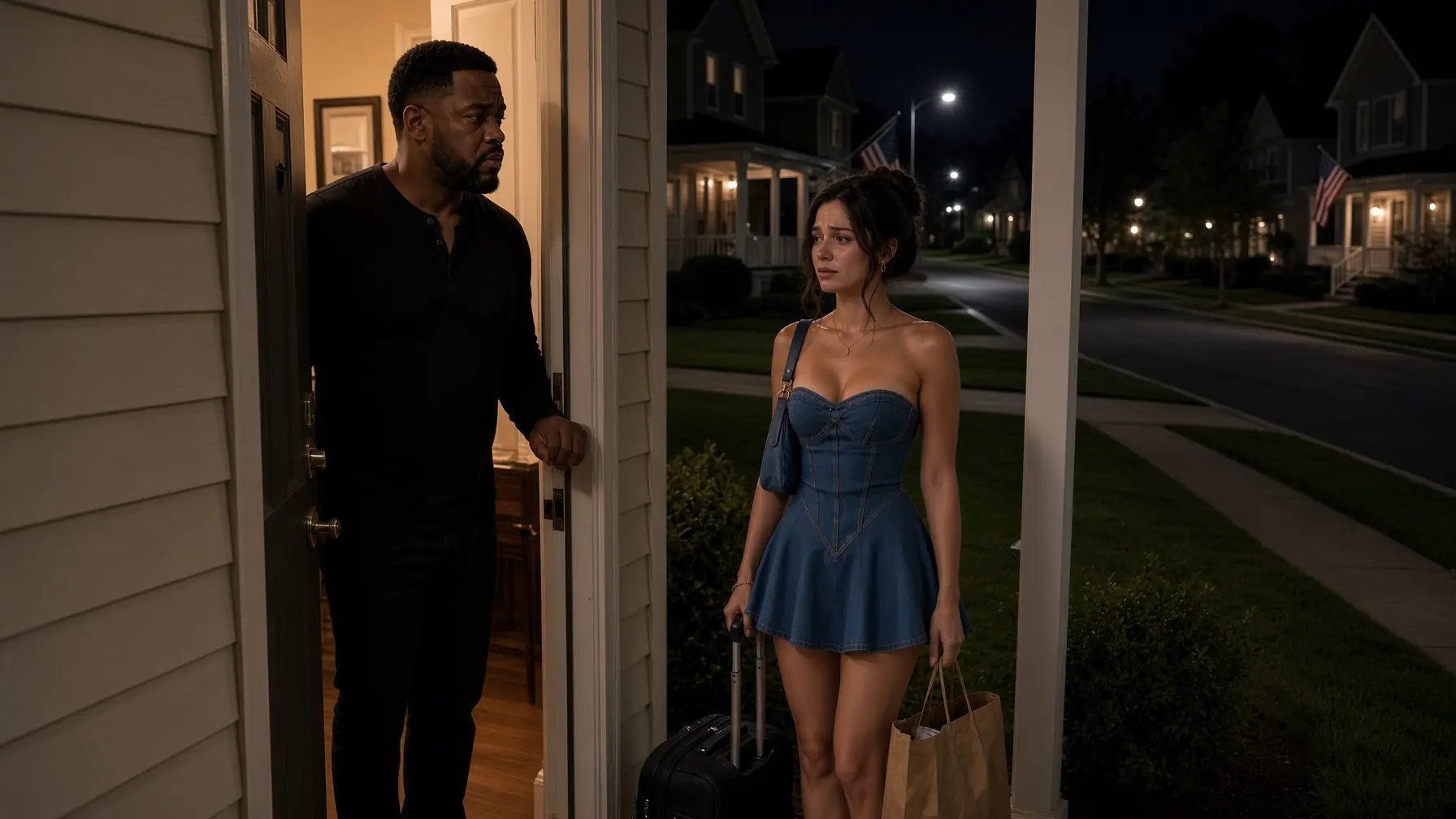
The knock came at exactly 11:47 on a Thursday night, just as Andre Holloway had finally convinced himself the most complicated years of his life were behind him. He had already checked the locks, packed his nine-year-old daughter’s lunch for school, and was halfway through turning off the downstairs lights when somebody knocked again. Nobody visited their quiet suburban street that late unless something had gone seriously wrong. Andre opened the door and forgot everything he had been about to say.
Paige Lawson stood beneath the porch light holding a suitcase in one hand and a torn paper shopping bag in the other. Her engagement ring was gone, mascara had dried in uneven streaks beneath her eyes, and the confident woman Andre remembered from family Christmases looked as though she had spent hours trying not to fall apart. For nearly three years, Paige had barely spoken to him except when family circumstances involving his daughter made it unavoidable. Now she swallowed hard and whispered, “Andre, I know I have no right to ask this, but I have nowhere else to go.”
Andre said nothing immediately. He was forty-two, Black, divorced, and the primary parent of a nine-year-old daughter who had already lived through enough adult disappointment for one childhood. The woman on his porch was his ex-wife’s younger sister, which meant she was also his daughter’s aunt and part of a family Andre had deliberately kept at a careful distance since the divorce. Of all the doors Paige could have knocked on that night, his was the one that made the least sense.
Andre looked past her toward the street. There was no car at the curb, no parent waiting with an engine running, and no fiancé standing twenty feet away regretting whatever argument had taken place. Only empty pavement, wet grass shining beneath streetlights, and the distant sound of traffic beyond the subdivision. Paige’s fingers trembled around the suitcase handle.
“You walked here?” Andre asked. Paige shook her head and explained that a rideshare had dropped her off several minutes earlier. She had originally entered her parents’ address, changed her mind halfway there, and then sat in the back seat for almost ten minutes trying to decide whether she was actually desperate enough to come to Andre. “Apparently I was,” she said, and the attempt at humor collapsed before it reached her eyes.
Andre should have asked what happened. He should have reminded her that they had barely spoken since his marriage to her sister ended and that opening this particular door could reopen years of trouble he had spent enormous effort putting away. Instead, he remembered how many nights after his divorce he had sat alone at the kitchen table after his daughter fell asleep, wishing there had been one place where he did not need to explain himself before being allowed to breathe. He stepped aside.
“Come in,” he said. Paige began crying before she crossed the threshold. She immediately covered her face and apologized, which somehow made Andre more certain he had made the right choice for that night even if he had no idea what tomorrow would require. He closed the door behind her and took the suitcase.
The house was quiet except for the hum of the refrigerator and the soft sound of the furnace. Family photographs filled the wall beside the staircase, most of them showing Andre with his daughter, Amara, at school concerts, soccer games, birthdays, and one disastrous camping trip that had ended with both of them sleeping inside his truck because he had forgotten the tent poles. Paige stopped at one photograph of Amara holding a science-fair ribbon. “She got so big,” she whispered.
Andre looked toward the stairs. “She’ll be ten in February.” Paige nodded, and another kind of sadness passed through her face. She had once been the aunt who brought Amara ridiculous birthday gifts and taught her how to make friendship bracelets, but after the divorce, every relationship connected to the marriage had become awkward. Children often lost people they had never agreed to stop loving because adults did not know how to manage their own pain.
Andre made tea. Paige sat at the kitchen table gripping the warm mug between both hands while he remained across from her. Neither mentioned his ex-wife. Andre decided the history could wait until the immediate problem had a name.
“Trevor ended the engagement tonight,” Paige finally said. Trevor Mills was a successful commercial broker Andre had met once at a family event and forgotten almost immediately. Paige explained that they had been living together for nearly eighteen months and were supposed to marry in October. That evening, she discovered the wedding had apparently existed far more securely in her mind than in Trevor’s.
He had been seeing another woman for months. Paige found messages on an old tablet he left connected to their shared account, and when she confronted him, Trevor did not deny anything. Instead, he told her their relationship had become exhausting, accused her of becoming suspicious and difficult, and said he had already decided the engagement was over. Then he asked her to leave the apartment that night.
Andre’s jaw tightened. “You paid rent there?” Paige gave a bitter laugh. She had paid half the rent, purchased most of the living-room furniture, and contributed toward the security deposit, yet Trevor had changed the digital entry code while she was downstairs waiting for her rideshare. Everything she managed to take fit inside the suitcase now sitting beside Andre’s kitchen wall.
“Where are Mom and Dad?” Andre asked carefully. He had once called Paige’s parents Mom and Dad too, but divorce had changed even vocabulary. Paige stared into her tea.
Her mother told her she should give Trevor time to calm down. Her father did not answer the phone, though Paige suspected her mother had already told him what happened. She called several friends, but one was traveling, another had small children asleep, and Paige admitted pride kept her from explaining the situation to the people who did answer. Then she called Vanessa.
Andre’s shoulders tightened at the name. Vanessa Holloway had been his wife for seven years and was Amara’s mother. Three years earlier, their marriage had ended after two increasingly miserable years in which almost every disagreement somehow became evidence that Andre was cold, difficult, unambitious, emotionally unavailable, or insufficiently grateful for whatever Vanessa believed she was sacrificing.
Vanessa had moved two hours away after the divorce. Amara lived primarily with Andre because her school, friends, and entire routine were near his house, while Vanessa saw her most alternate weekends and several weeks each summer. Co-parenting had become civil, though “civil” often meant they discussed schedules, medical appointments, and school forms with the emotional warmth of two attorneys exchanging documents. Andre had learned to accept that as peace.
“Vanessa’s in London,” Paige said. She was there for a week-long corporate event, and every call went directly to voicemail. Paige looked embarrassed when she admitted she still knew Andre’s number from memory. “I kept thinking there had to be someone else.”
Andre looked at her. “But there wasn’t.”
She shook her head.
The sentence could have been insulting. Somehow it was not. Andre understood what it meant to reach the bottom of a contact list and discover which relationships remained after pride, history, and convenience had been removed. He stood and opened the hall closet.
“You can use the guest room,” he said. Paige immediately started protesting. Andre held up one hand and explained that they would figure out the rest after everybody slept, including what she planned to do about her apartment and whether she needed legal advice about her belongings. For tonight, he was offering a locked door, clean sheets, and nothing more complicated.
Paige cried again. “Why are you being nice to me?” Andre looked toward the stairs. It was the kind of question people asked when life had treated basic kindness like something that required motive.
“Because my daughter is asleep upstairs,” he said. Paige waited, confused. Andre continued, “And I want her growing up in a house where somebody needing help is not automatically treated like a problem.”
Paige lowered her eyes.
Andre gave her a blanket and showed her the guest room. Before closing the door, she thanked him three times. He told her twice that once was enough.
Andre barely slept.
He sat at the kitchen table until almost two, staring at the same untouched tea Paige had left behind. Helping her felt correct, but correct decisions can still create complicated consequences. Vanessa could easily interpret her sister staying under Andre’s roof as something inappropriate, and her parents had spent years accepting a version of the divorce that made Andre responsible for almost everything that went wrong.
He had never fought the story publicly. Andre had been too busy keeping his company job, taking Amara to school, learning a new custody schedule, and figuring out how to turn a house built for a family into a home that did not feel abandoned. There was only so much energy a person could spend defending himself to people who had already chosen which explanation made them most comfortable. So he stopped.
That silence had cost him relationships. Some mutual friends gradually disappeared. Vanessa’s parents became polite but distant, and Paige herself went from occasionally defending Andre during family arguments to almost no contact after the divorce. He assumed blood had eventually mattered more than fairness.
At 6:38 the next morning, Andre heard kitchen cabinets opening. He walked downstairs and found Paige trying to make coffee while Amara stood across from her in pink pajamas staring as if she had discovered a celebrity inside the house. Paige froze.
“Aunt Paige?” Amara asked.
Paige immediately started crying again.
Children are mercifully impatient with complicated adult history. Amara crossed the kitchen in three steps and wrapped both arms around her aunt. Paige crouched and held her so tightly Andre eventually had to look away.
“Why are you here?” Amara asked. Paige wiped her face. “I needed somewhere to stay for a little while.”
Amara accepted that answer instantly. “Okay.” Then she asked whether Paige still knew how to make pancakes shaped like Mickey Mouse.
Andre laughed for the first time since opening the door.
Breakfast changed something.
Paige had arrived as a reminder of Andre’s divorce. By eight that morning, she was sitting beside his daughter arguing about whether whipped cream counted as breakfast food. Amara remembered far more about her aunt than Andre expected.
After school drop-off, Paige apologized again. Andre told her he was establishing a twenty-four-hour ban on apologies unless she actually broke something. She smiled faintly.
Then she became serious.
“There’s something I should have told you years ago.”
Andre stopped rinsing a coffee mug.
He knew immediately this was not about Trevor.
Paige sat at the kitchen table.
“Vanessa wasn’t completely honest with us about the divorce.”
Andre did not move.
There are sentences people spend years wanting to hear and then discover they are not prepared for once somebody finally says them. For three years, Andre had trained himself not to need validation from Vanessa’s family. Paige’s words found the part of him that had apparently never stopped waiting.
“What did she tell you?” he asked.
Paige looked ashamed.
“She said you stopped caring.”
Andre leaned against the counter.
“She said you became distant after Amara was born, that she had to carry the marriage by herself, and that you refused counseling until it was too late.”
Andre said nothing.
“She said you cared more about work than family.”
He looked toward the window.
That accusation had always been the easiest one to believe because Andre did work long hours. He had worked those hours because Vanessa left her job after Amara’s birth and their mortgage did not care how emotionally present he wanted to be. Later, when Vanessa returned to work, Andre adjusted his schedule, handled morning drop-offs, cooked most weeknight dinners, and still somehow remained “the man who only cared about work” in the story she told.
Paige continued.
“I believed some of it because she’s my sister.”
Andre nodded.
“That makes sense.”
“No, it doesn’t.”
“It does.”
“She was crying.”
Paige looked toward him.
“And you never defended yourself.”
Andre almost smiled.
“Against whom?”
“All of us.”
“You had already decided.”
Paige flinched because it was true.
Andre sat across from her.
“What changed your mind?”
Paige hesitated.
“I had eyes.”
That answer stayed with him.
She remembered family dinners where Andre cooked while Vanessa spent the evening answering messages. She remembered him leaving work early because Amara was sick while Vanessa still went to a networking event. She remembered sitting beside Andre at Christmas one year while Vanessa barely spoke to him because they had argued in the car.
At the time, Paige categorized each moment separately.
After the divorce, she started comparing them.
“I don’t think Vanessa lied about being unhappy,” Paige said. Andre nodded. “She was unhappy.”
“But she lied about why.”
Andre stared at the table.
That distinction mattered.
He had never believed Vanessa fabricated every feeling. Their marriage truly had become unhappy. Andre had made mistakes too, especially toward the end when exhaustion turned him into a man who sometimes withdrew instead of continuing arguments he believed would never resolve.
But that was different from being the husband Vanessa described.
“I saw you trying,” Paige said.
Andre looked up.
Those four words hurt more than he expected.
For years, one private fear had followed him everywhere: maybe Vanessa’s version had been correct. Maybe he had imagined his effort because admitting failure was too painful. Hearing somebody who had been inside the family say otherwise did not erase the divorce, but it loosened something Andre had been carrying alone.
“Why didn’t you say anything?”
Paige looked toward her hands.
“Because I was afraid.”
“Of Vanessa?”
“Of choosing wrong.”
Andre understood.
Family loyalty rarely asks people to become dishonest directly. It simply makes neutrality feel safer than saying something that might upset the person closest to you. Paige had chosen silence.
Andre had too.
“Maybe we both got good at that,” he said.
Paige looked up.
“What?”
“Staying quiet because speaking felt expensive.”
She nodded slowly.
The following week became strangely ordinary.
Paige stayed in the guest room while figuring out what to do about Trevor, and Andre helped her contact a tenant-rights attorney who explained that Trevor could not legally keep her belongings simply because the lease was primarily in his name. She recovered her clothes, personal documents, grandmother’s jewelry, laptop, and several boxes with a police standby present. Trevor avoided seeing her.
Paige found temporary work at a neighborhood café while applying for jobs in graphic design. She had worked for a small creative agency before moving in with Trevor, but she reduced her hours because his job required frequent travel and he complained their schedules never aligned. Eventually she stopped working almost entirely.
Andre recognized the pattern without saying so.
People sometimes disappear inside relationships gradually enough that even they do not notice which version of themselves is leaving.
Amara loved having Paige nearby.
They baked cookies, painted each other’s nails, and spent one Saturday assembling a bookshelf Paige ordered for the guest room even though Andre repeatedly reminded her she was not expected to live there permanently. Paige taught Amara how to use a simple drawing program on her tablet. Andre watched his daughter regain a family relationship the divorce had taken from her.
That made everything more complicated.
He did not want Paige’s presence to become an emotional substitute for Vanessa. Amara loved her mother despite the distance between them, and Andre protected that relationship carefully. Whatever happened between adults, he refused to make his daughter responsible for choosing winners.
Vanessa called one Tuesday evening.
She was back from London and wanted to speak with Amara.
Andre handed over the phone.
Amara immediately said, “Aunt Paige is staying here.”
Andre closed his eyes.
Children.
The silence on the phone lasted three seconds.
Vanessa asked to speak with him.
Andre stepped onto the back porch.
“What is Paige doing in your house?”
“She needed somewhere to stay.”
“And she chose you?”
“Yes.”
Vanessa laughed once.
“This is unbelievable.”
Andre remained calm.