My name is Natalia Barnett. I'm 38 years old, and at 2:17 on a freezing Thursday morning, my younger sister stood in my entryway holding the keys to my SUV and asked me to confess to a crime she had committed.
One headlight was shattered, a dark scrape crossed the front bumper, and a thin red mark ran along the hood.
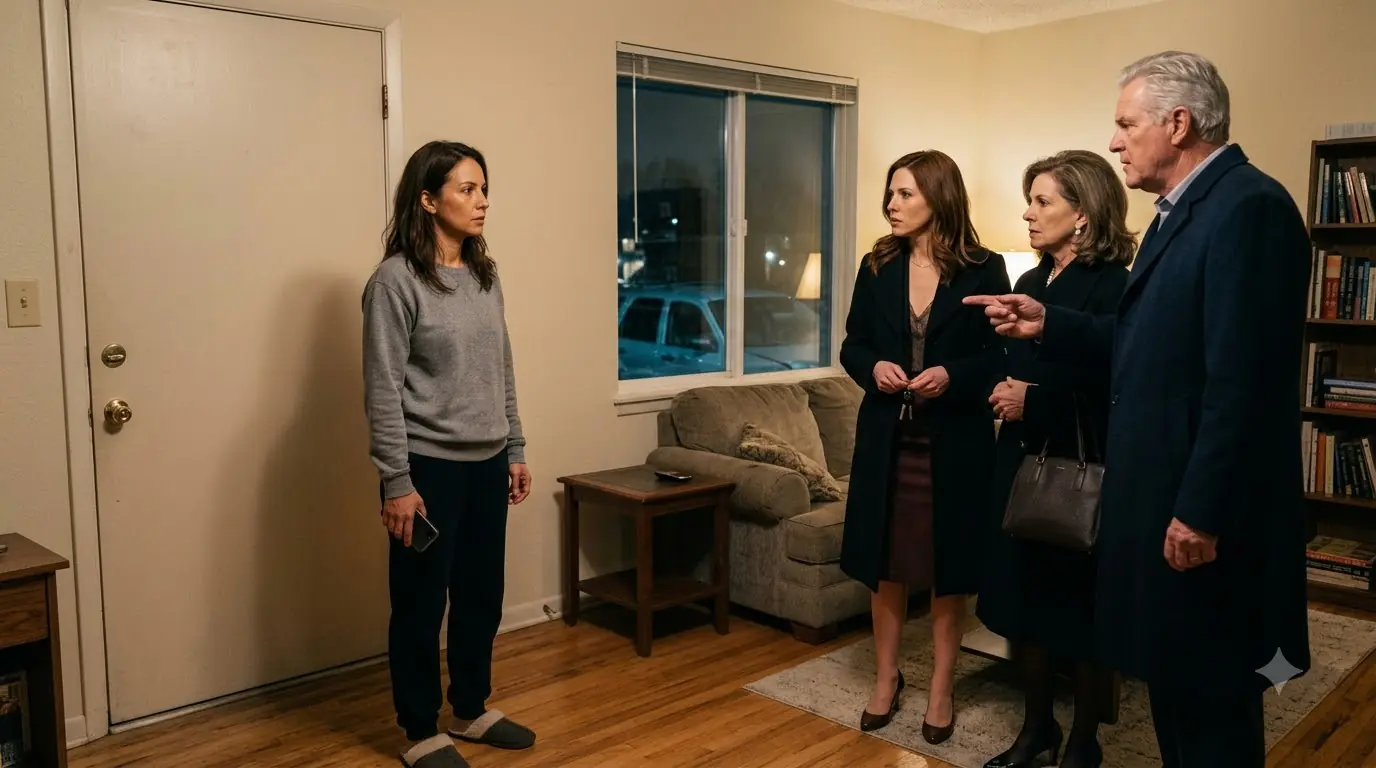
"He came out of nowhere," she whispered. "I barely touched him."
Then she admitted she had driven away.
Before I could answer, our mother pushed through the door, grabbed my shoulders, and said, "Just tell the police you were driving."
Our father arrived moments later, speaking with the calm authority he used whenever he wanted something unforgivable to sound practical. "Your sister has a campaign," he said. "You have nothing to lose."
They still believed I was the family dropout, the stubborn disappointment who had walked away from their plans, disappeared into government work, and refused to explain herself. They had no idea that three weeks earlier, inside a federal courthouse, I had taken an oath to administer justice without fear, favor, or family influence.
My sister looked around my modest apartment, glanced at my old sweatshirt, and smiled. "Who would believe you anyway?" she asked. She thought their contempt had erased everything I had built.
She did not know the SUV had already recorded the collision, the conversation inside the vehicle, and the route she had taken after leaving a wounded man in the street. Before sunrise, the lie my family wanted me to carry would reveal exactly who they were.
My sister's name was Caroline Barnett, and for most of our lives, our parents had treated her like a family investment. At 33, she was running for a seat on the Denver City Council with a campaign built around accountability, safer streets, and leadership with integrity.
Her face appeared on bus shelters, neighborhood flyers, and the campaign van she refused to drive that night because it was covered in logos. Our mother, Diane, chaired several community organizations and introduced Caroline as the future of public service. Our father, Richard, had spent 25 years advising political candidates and believed every crisis could be controlled if the right story reached the public first.
In their version of our family, Caroline was the future. I was the warning.
They told friends I had abandoned law school after arguing with Dad, although I had transferred, graduated, clerked for a federal judge, served as an Assistant United States Attorney, and built a career they had never bothered to understand. Whenever I tried to mention my work, Dad redirected the conversation toward Caroline. Eventually, I stopped explaining.
Caroline had borrowed my SUV because she claimed a photographer was following her after a donor reception. She said she needed an unmarked vehicle for the drive home. I agreed because she had used the same excuse before, and because some old part of me still responded whenever she said, "Please, Nat. I need my sister."
At 11:40, she texted that she would return the car in the morning. At 2:17, she appeared at my door smelling of perfume, peppermint, and wine.
"Tell me exactly what happened," I said.
"I already did."
"No, you gave me the version you want repeated."
Her frightened expression vanished, replaced by the controlled face she used during hostile interviews. "I was driving west on Colfax. A man stepped into the road. The pavement was icy and I couldn't stop."
"Did you call 911?"
"No."
"Did you stop?"
She looked toward our parents.
"Caroline."
"I slowed down. I saw him move."
"Then you drove away."
Our mother tightened her grip on her handbag. "This interrogation is not helping."
"It is not an interrogation. A man was struck by my vehicle, and she abandoned him."
Dad walked to the window and looked down at the street. "The SUV is registered to you. That gives us a simple path. You say you were driving, we hire an attorney, and we describe it as an accident caused by poor visibility."
I stared at him. "You have already prepared a story?"
"I have handled crises for decades."
"This is not a campaign crisis. Someone is injured."
Caroline folded her arms. "You always make everything dramatic."
"There is blood on my car."
Mom stepped closer. "Lower your voice. The neighbors do not need to hear this."
Her first concern was not the victim, my freedom, or Caroline's safety. It was being overheard.
My phone vibrated on the console table. A courthouse security notification appeared: Motion detected. Vehicle camera synchronization complete.
My SUV had a factory collision system, but after threats connected to a federal organized crime case, judicial security had added encrypted cameras and automatic cloud storage. The system activated after sudden impact or unusual deceleration. Caroline knew nothing about it.
I turned my phone face down.
Dad continued as though my confession had already been approved. "The police will see your registration and your history of conflict with us. Caroline will say she came here after you called. Diana and I will confirm you were upset."
"You are proposing coordinated false statements."
"We are protecting the family," Mom said.
"No. You are deciding which member of the family is disposable."
Caroline rolled her eyes.
I asked whether she had been drinking. Dad answered for her. "She was under the legal limit."
"You cannot know that."
"We know Caroline."
They knew her donor list and preferred camera angle. They did not know whether she had been intoxicated when she left a human being in the road.
Caroline stepped close. "You owe me."
"For what?"
"For leaving. I stayed here, attended their dinners, smiled for their friends, and carried this family while you disappeared."
"You think being praised was a burden I must repay?"
"You got freedom. I got expectations."
For a moment, I understood her resentment. Then she said, "Dad is right. You have no public reputation to protect."
Whatever sympathy I felt disappeared.
"If the man you struck were someone we loved," I asked, "would you still call this a small mistake?"
No one answered.
At 3:12, Dad moved everyone into my living room and began assigning roles. He told Mom to call Caroline's campaign manager and claim she had developed food poisoning after the donor reception. He instructed Caroline to delete any messages mentioning my SUV. Then he asked for my phone.
"No."
"We need to know what information is already out there."
"You want to conceal evidence."
His jaw tightened. "Do not use courtroom language with me."
For years, he had mocked my government career as meaningless paperwork. Now he was offended by legal terms he assumed I had no authority to use.
Caroline scrolled through social media. "There's nothing online yet."
"Scanner accounts can take time," Dad said. "The first report is what matters."
Mom looked at me. "Say you were tired. Say you thought you hit a trash container and kept going. That sounds believable."
"To whom?"
"To normal people," Caroline replied.
My phone vibrated again. The message came from Marcus Hale, the judicial security officer assigned to my courthouse.
Automated collision alert received from your registered vehicle at 1:41 a.m. Are you safe?
Marcus had helped install the system after a defendant's associate photographed my residence. I replied: I am safe. Vehicle was borrowed. Preserve all uploaded footage. Do not access unless authorized under protocol or requested by investigators.
His response arrived immediately: Confirmed. Preservation lock initiated.