In the late summer of 1883, a woman in a red dress walked alone toward the loneliest ranch in the Gallatin Valley.
She carried one battered suitcase. She had spent the last of her money on train fare and wagon rides west, and she carried a dying man's final message.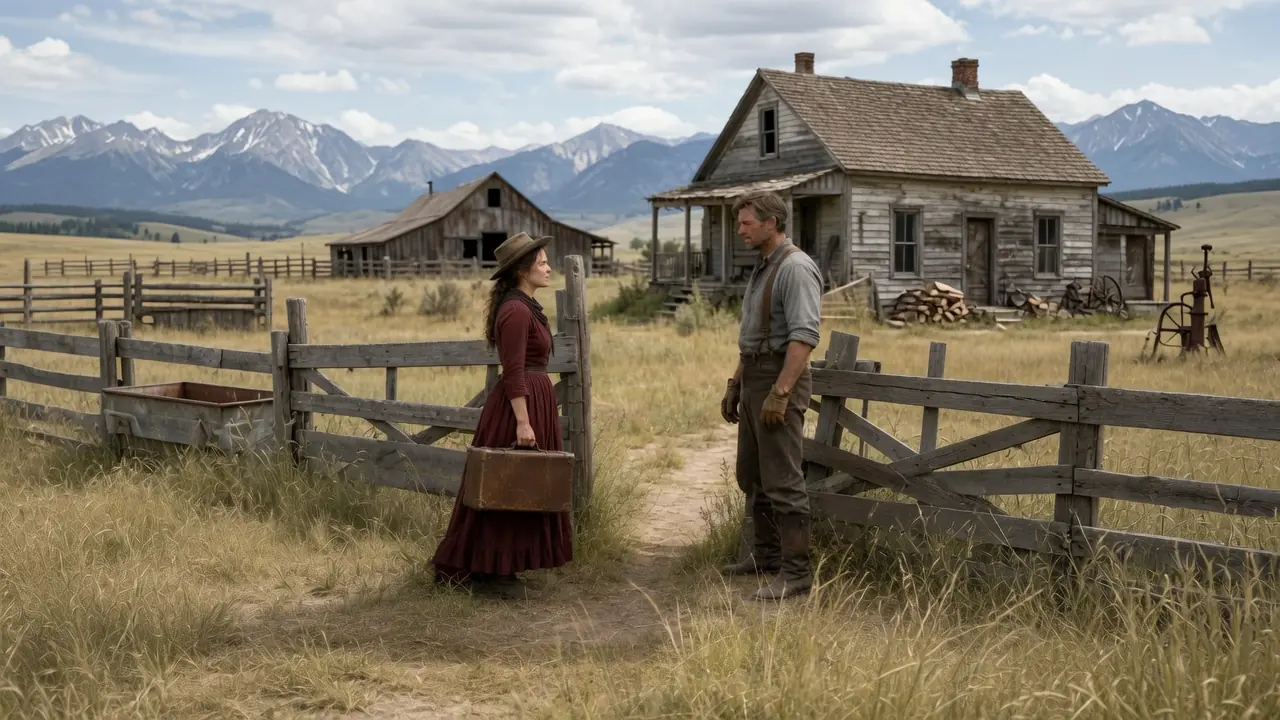
Silas Thorne saw her from beside the broken fence. He was 40 years old, scarred by war, and long past believing that anyone would ever come looking for him.
But the woman stopped at his gate, lifted her tired eyes, and said the one sentence that would change both their lives.
"My father said you needed a wife."
Silas did not answer at first. The Montana wind moved through the dry grass. The old barn creaked behind him. For the first time in 10 years, the silence of his ranch felt less like peace and more like a grave.
Silas stood perfectly still. His heart thumped against his ribs like a bird trapped in a cage. He had not expected visitors. He certainly had not expected a lady from the city.
She stopped exactly 10 feet away from the wooden fence. Her hair was the rich color of polished chestnut. Her eyes were a soft, startling gray. They reminded him of the mist that rolled over the Missouri River at dawn.
She looked at Silas, and for a long moment, the world stopped turning. Neither of them spoke. The wind whistled through the gaps in the barn.
Silas suddenly felt the roughness of his own sun-beaten skin. He felt the dark dirt packed under his fingernails. He felt like a wild animal cornered in his own yard.
"Are you Silas Thorne?" she finally asked.
Her voice was low. It carried a faint, musical hint of a southern lilt.
"I am," he grunted.
His voice sounded rusty and strange to his own ears.
She took a trembling breath and stepped closer to the wire.
"My name is Clara Vance," she said.
The name hit Silas like a physical blow to the chest. Elias Vance had been his captain in the Second Infantry. Elias had saved Silas's life in the tall grass of a bloody Pennsylvania farm.
Clara nodded slowly. Her eyes filled with a sudden, sharp grief that made Silas want to look away.
"He passed three months ago," she whispered.
Silas looked down at his boots. A hollow, familiar ache opened up in his chest. He remembered Elias talking about his girl back in St. Louis. He remembered the way Elias would polish a small tintype photo by the campfire light.
"I'm sorry for your loss, Miss Clara," Silas said.
He did not know what else to say. He was a man of the earth, not a man of elegant words.
Clara looked around at the lonely, windswept ranch. She looked at the empty, quiet house. She noticed the way the porch leaned toward the sun. She saw the garden overgrown with stubborn weeds.
She stepped right up to the fence. Her hand rested on the rough, splintered wood.
"Before he died, he told me to find you," she said.
She leaned in closer. Her voice was barely a breath against the Montana wind.
"My father said you needed a wife."
Silas froze in place. He looked at her bright red dress and her clean, pale skin. He looked at the suitcase that held her entire life. He looked at the mountains that had watched him grow old and bitter.
He thought of the freezing winters coming for him. He thought of the empty, cold bed in the corner of his cabin. He thought of how the nights felt longer and darker every year.
Silas wanted to say no. A careful man would have said no.
But Elias Vance had once dragged him out of the tall grass while bullets cut the air above them. Elias had never lied to him, not once. So if that dying man had sent his only daughter across half the country, Silas knew it was not foolishness.
It was trust.
"He was right," Silas said quietly.
For the first time in 10 years, Silas agreed to let someone into his life.
Clara's eyes went wide with genuine shock. She had clearly expected him to turn her away with a curse. She had expected him to laugh at the absurdity of her request. She thought he might offer her a coin for the train back home.
She had not prepared for the simple, devastating truth.
"I have no money to give you, Silas," she said quickly. "The bank took the house in St. Louis right after the funeral. I have only what is in this bag and the clothes on my back."
Silas opened the gate with a slow, deliberate motion.
"I don't need money," he said. "I need someone who remembers what it's like to be human."
He reached out and took the heavy suitcase from her small hand. His fingers brushed against hers for a second. It felt like a spark of lightning through his veins.
Clara shivered despite the heat of the Montana sun.
"Come inside," Silas said. "The floor is dusty and the stove is cold, but the roof doesn't leak."
As they walked toward the house, Silas felt a weight lifting. The crushing pressure of his loneliness was finally easing. He did not know this woman at all. He did not know if she could cook or if she could stand the silence.
But he knew that Elias Vance had been a man of iron honor. If Elias had sent her, she was exactly what Silas needed.
The house was small. It had only two rooms and a small loft. It smelled of old cedar wood and dried summer herbs.
Clara stood in the center of the kitchen. She looked at the sparse, dusty shelves.
"I can clean this," she said. Her voice was regaining its natural strength. "I can make this a home if you'll let me stay."
Silas nodded and set the suitcase by the heavy oak door.
"I'll fetch some fresh water from the well," he said. "And I'll bring in some wood for the evening fire."
The sun began to dip behind the jagged peaks. It painted the sky in bruises of deep purple and liquid gold.
It was the first day of a new life for both of them, but the world outside the ranch was not as kind as Silas's heart.
In the growing town of Bozeman, things were changing fast. The Northern Pacific Railway was pushing its tracks farther west every day. Men in fine wool suits were staring at maps of the Gallatin Valley.
They saw Silas Thorne's land as an obstacle to progress. They saw a lonely man with no family as an easy target. They wanted the land for the steam engines and the steel rails.
But they did not know about the woman in the red dress. They did not know that Silas Thorne was no longer alone.
Life on the ranch settled into a quiet, rhythmic pace. Clara spent her days scrubbing the floors and mending the lace curtains. She found Silas's mother's old linens in a cedar trunk and hung them in the window to catch the light.
She planted a small, brave patch of marigolds by the front step.
Silas watched her from the distant fields. He saw the way she moved with a quiet, natural grace. He heard her singing old hymns while she hung the white laundry.
The sound of a woman's voice made the ranch feel alive.
Weeks passed, and the valley slowly traded summer dust for autumn frost. The work remained backbreaking, but it felt lighter now. The cabin no longer seemed to hold its breath after sundown.
One evening, they sat on the porch together. The first frost of the season had touched the grass. Silas handed her a cup of steaming hot coffee.
"Why did you really come all this way, Clara?" he asked.
He wanted to know the truth behind her father's dying words.
Clara stared out at the darkened, infinite horizon.
"In St. Louis, people were talking," she said softly. "After my father died, a man tried to force me into a marriage. He was a debt collector with a cruel, greedy streak. He told the whole town I was a thief. He said I stole my mother's jewelry to pay the doctor. I had no one left to defend my name."
She swallowed hard, then continued.
"Only Mrs. Adelaide Whitmore knew the truth. She was my mother's dearest friend. She gave me the brooch herself, but I left St. Louis before her letter could reach me."
Silas felt a low growl rise in his throat. He knew what it was like to be judged by a town that did not know you. He knew the sting of being cast out by those you had served.
"You're safe here," he said firmly. "No one will call you a thief on this land."
Clara looked at him, and her eyes were wet with unshed tears.
"You don't even know if I'm telling the truth," she whispered.
Silas reached out and placed his large, scarred hand over hers.
"I know the blood of Elias Vance," he said. "And I see who you are, Clara."
That night, for the first time in years, Silas did not dream of the war. He did not smell the smoke or hear the screaming horses. He dreamed of the bright marigolds by the door.
He dreamed of the way Clara's hair smelled like rainwater.
The peace of the ranch was interrupted a week later. A black carriage pulled up to the front gate. It kicked up a thick cloud of gray, suffocating dust.
A man stepped out wearing a top hat and an expensive coat. His name was Julian Sterling. He was a representative of powerful railroad interests.
Sterling had friends in St. Louis, bankers, lawyers, and heirs who traded favors by letter and telegram. That was how he had found the old accusation against Clara.
Sterling looked at the fence and the barn with a sneer of contempt.
"Mr. Thorne," Sterling called out across the yard.
Silas stepped off the porch slowly. His hand rested near the heavy belt at his waist. He did not like the way Sterling's eyes wandered to Clara.
"What do you want, Sterling?" Silas asked.
"I'm here to offer you a very generous sum for this valley," the man said. "The railroad needs this specific pass for the winter route. A man like you has no use for so much dirt and rock."
Silas shook his head.
"This land isn't for sale at any price," he said. "It belonged to my father, and it will belong to my children."
Sterling laughed, a cold and hollow sound that chilled the air.
"Children? You're a hermit, Thorne. You're a scarred soldier with nothing but a crumbling shack."
Then Sterling's eyes landed on Clara. She was standing perfectly still in the doorway.
"And who is this?" he asked, his voice dripping with false politeness. "I heard a rumor that a woman from St. Louis was hiding out here. A woman wanted for questioning regarding certain missing items."
Silas felt hot blood rush to his face. He stepped forward, his eyes flashing like struck flint.
"She is my wife," Silas said. His voice was a low, rolling thunder. "And you will speak of her with respect, or you will leave this property wishing you had shown better manners."
Sterling paled and took a quick step back toward his carriage.
"This isn't over, Thorne," he hissed. "The law has a way of finding people who don't want to be found."
As the carriage sped away, Silas turned to Clara. She was white as a sheet, her hands trembling against the doorframe.
"Is it true?" she asked. "Will they really come for me?"
Silas walked up the steps and took her by the shoulders.
"Let them come," he said. "I've fought bigger armies than a few railroad lawyers."
But the threat lingered in the air like the smell of an approaching storm.
Winter arrived early that year. It covered the mountains in a thick, suffocating blanket of white. The Gallatin Valley became a world of ice and absolute silence.
Silas and Clara spent the long, dark nights by the hearth. They talked about their childhoods and their lost dreams. Silas told her about the farm in Ohio where he had grown up. Clara told him about the grand music halls of St. Louis.
The more they talked, the more the arrangement changed. It no longer felt like obligation. It no longer felt like a dying man's final arrangement between two wounded people.
It felt like a choice made by the soul. It felt like the beginning of love.
One evening, while the wind howled like a wolf outside, Clara reached for his hand.
"I never thought I could be happy again," she said. "I thought the world was just a cold place of loss."
Silas looked at the firelight dancing in her gray eyes.
"The world is what we make of it, Clara," he said. "I thought I was dead inside until you walked through that gate."
He leaned in and kissed her softly. It was not a kiss of necessity or social convenience. It was a sacred promise.
It was a promise to protect her with his last breath, a promise to build a future out of the ruins of the past.
The next morning, Silas woke to a strange rhythmic sound. It was the sound of many horses approaching through the deep snow.
He grabbed his rifle and ran to the frosted window. The sheriff of Bozeman was there. Julian Sterling stood beside him, looking smug and victorious.
"Silas Thorne, come out now!" the sheriff shouted.
Silas stepped onto the porch. The freezing air bit through his thin shirt. Clara stood right behind him, her face pale with terror.
"What's this about, Sheriff?" Silas asked.
"We have a warrant for the arrest of Clara Vance," the sheriff said. "She's accused of grand larceny in the state of Missouri."
Sterling stepped forward with a wide, mocking grin.
"I told you the law would find her, Thorne. Now step aside and let us do our jobs."
Silas leveled his rifle directly at Sterling's chest.
"She's my wife," Silas repeated, "and she hasn't stolen a single thing in her life."
"I have the papers right here from St. Louis," Sterling shouted.
He waved a thick official folder in the air.
"She stole a diamond brooch from the Whitmore estate."
Clara stepped out from behind Silas, her voice clear and brave.
"I didn't steal it," she cried into the wind. "Mrs. Whitmore gave it to me to pay for my father's medicine. She was my mother's dearest friend in the world."
"That's not what her son says," Sterling countered. "And he's the one who wants the brooch returned."
The sheriff looked uneasy. He knew Silas was a decorated war hero. He did not want a shootout in the middle of a Montana blizzard.
"Silas, put the gun down," the sheriff pleaded. "Let her come to town and clear her name properly. If she's innocent, the judge will see the truth."
Silas looked at Clara. He saw the incredible strength in her eyes. He saw that she was tired of running from shadows.
"I'll go with her," Silas said. "But if she is mistreated, every man here will answer for it before the law and before God."
The ride to Bozeman was long and freezing. Clara sat on her horse with her head held high. Silas rode right beside her. His hand never once left the stock of his rifle.
In town, the trial was held in the small, cramped wooden courthouse. The room was packed with people. They were curious to see the thief and the hermit.
Sterling presented his evidence. It was nothing more than a letter from a disgruntled, greedy heir.
Clara stood before the judge with both hands trembling, but her voice did not break.
"I did not steal that brooch," she said. "I accepted it because my father was dying and because one kind woman believed his life still mattered."
The room grew quiet. For the first time, the town was not looking at a thief. They were looking at a daughter who had tried to save her father.
Then Silas Thorne stood up.
He did not have a lawyer. He did not have a fancy suit or a silver tongue. He had only the simple, naked truth.
"I served with Elias Vance," Silas told the judge. "He was the man of the highest integrity I ever knew. He died with nothing because he gave everything to this country. This woman is his daughter. She didn't come here to hide in the dark. She came here because her father knew I would protect her."
Silas turned toward Julian Sterling.
"Julian Sterling doesn't care about a diamond brooch. He cares about the soil under my feet. He's using this girl to steal my ranch for the railroad."
The judge looked at Sterling. The man was sweating despite the bitter cold.
"Is this true, Mr. Sterling?" the judge asked. "Do you have a personal interest in the Thorne property?"
Sterling stammered and looked away from the judge's gaze.
"I am merely a representative of the company, Your Honor."
Then the courthouse door opened. A stage driver stepped inside carrying a sealed letter, and beside him stood an elderly woman wrapped in a dark traveling coat.
It was Mrs. Adelaide Whitmore.
She had received Clara's desperate letter after Sterling's first visit. Age had slowed her body, but it had not weakened her sense of justice. She had traveled hard from St. Louis after receiving Clara's message.
"The brooch was a gift of love," she said. Her voice was shaking with age and righteous anger. "My son is a greedy fool who never understood his father's debts. Clara Vance is as honest as the day is long. I gave her that jewelry because her father saved my husband's life years ago. She is a woman of dignity and sacrifice."
The courtroom fell into a shocked, heavy silence. Sterling's face turned a deep, ugly shade of purple.
The judge slammed his wooden gavel down with finality.
"Case dismissed," he shouted. "And Mr. Sterling, I suggest you leave this valley immediately before I charge you with harassment and fraud."
The townspeople cheered as Silas and Clara walked out. The thief was now a hero in their eyes. The hermit was revealed as a man of true honor.
They rode back to the ranch under a sky full of diamonds. The mountains seemed to lean in to welcome them home.
As they reached the front gate, Silas stopped his horse. He looked at Clara in her red dress. It was now stained with travel and melted snow.
"You're free now, Clara," he said. "You don't have to stay here in the silence anymore. You can go back to the city with Mrs. Whitmore. You can have a life of comfort and ease."
Clara looked at the old barn and the little house. She looked at the golden grass peeking through the white snow. She looked at the man who had stood between her and the world.
"I am already home, Silas," she said.
She reached out and took his hand in hers.
"My father said you needed a wife. And I think he knew I needed a husband just like you."
Silas smiled, a real smile that finally reached his tired eyes. The scars on his face did not seem to matter anymore.
The weight of the war was finally, truly gone.
Spring came to the Gallatin Valley with a burst of vibrant life. The snow melted into rushing crystal streams. The wild roses began to bloom along the old fence line.
Silas and Clara worked the land together. They planted wheat, corn, and more marigolds. They fixed the roof and painted the barn a bright, hopeful red.
The railroad eventually found another path. They avoided the Thorne Ranch altogether.
One warm afternoon in May, Silas found Clara in the garden. She was sitting on a bench he had built for her with his own hands. She was looking at the mountains with a soft, peaceful smile.
"Silas," she called out.
He walked over, wiping the sweat from his brow.
"What is it, Clara?"
She took his hand and placed it gently on her stomach.
"We're going to need a bigger house soon," she whispered.
Silas felt a surge of joy so great he thought his heart might burst. He picked her up and spun her around in the middle of the flowers.
The silence of the ranch was gone forever. In its place was the sound of laughter and the promise of a legacy.
The soldier had finally found his peace. The orphan had finally found her home, and the valley was full of life.
True courage is not always found on a battlefield. Sometimes it is found in a wounded man choosing hope again. Sometimes it is found in a woman refusing to let shame define her.
Silas and Clara kept their dignity, and together they built a home out of dust, grief, and second chances.