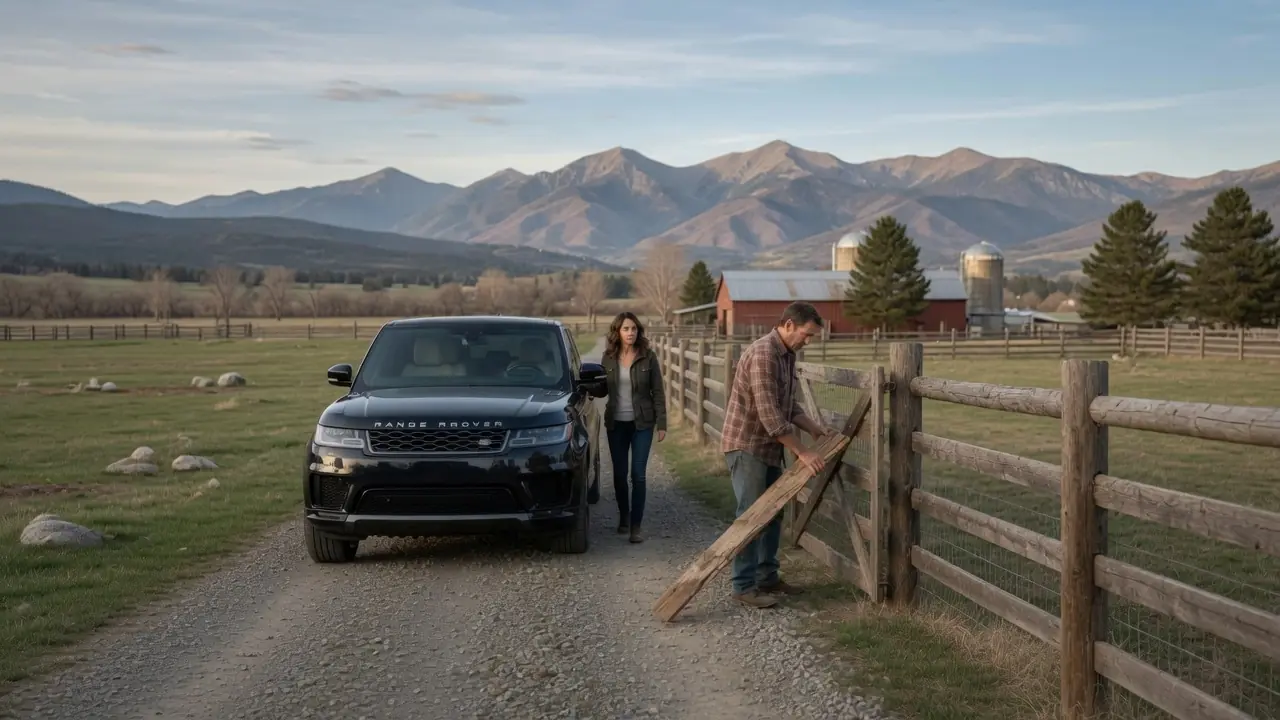
She had driven two hours from Denver to deliver a single sentence. The man standing at the fence didn’t look up when the Range Rover stopped. He kept working, pulling a warped board loose from the gate, checking the grain, setting it aside. His flannel was dusty. His hands were certain.
She stepped out. Gravel crunched under her shoes. “My father said you needed a wife.” He went still, set the board down, turned unhurried like a man who hadn’t been surprised by anything in years. Then he looked at her and said four words. She had no answer for them.
He had come to Ridgeway on a Thursday in October 2020 with everything that mattered loaded into the bed of a Ford Ranger. Willa was asleep in the passenger seat, her head against the window, one sock half off. Stellan hadn’t woken her when they crossed the county line. He hadn’t looked back at Denver, either. There was nothing behind him he needed to see again.
The farm had belonged to his late wife’s father, a man named Gus who had worked the land for thirty-one years and died of a stroke in the spring of 2017, leaving the property to his only daughter. She had never wanted to sell it. She had also never wanted to move back to Colorado. So it sat, the fence posts slowly leaning, the chufa going to seed, the barn roof patching itself with rust.
For three years it waited. And then Gus’s daughter died, too, and the farm passed to her husband who drove out on a Thursday in October with a nine-year-old asleep in the front seat and no particular plan beyond getting through the next season.
Stellan fixed the roof first. Then the fencing along the north edge, then the waterline to the barn which had cracked somewhere underground and required three days of digging by hand. He didn’t hire anyone. The work took most of the winter and he was grateful for that. Grateful for the cold, for the ache in his shoulders at the end of each day, for the fact that Ridgeway was a town where people nodded instead of asking questions.
Raymond Hart had moved in next door eleven months before Stellan arrived. He was seventy, recently retired, and had bought the adjacent property because he wanted to be somewhere the sky wasn’t blocked by buildings. He had built something once, something significant, and now he wanted to spend his mornings looking at mountains. He hadn’t expected a neighbor.
Their first meeting happened because one of Raymond’s two Angus cows walked through a gap in the fence on a Wednesday afternoon and found its way to the water trough behind Stellan’s barn. Stellan walked the animal back without saying much. Raymond said, “Thank you.” That was the extent of it.
The following Friday, Raymond showed up at the fence with two mugs of coffee. Stellan accepted one without comment. They stood there for about twenty minutes watching the light move across the Cimarons. Raymond left when the coffee was gone. He came back the next Friday and the one after that. By March, it had become a ritual neither of them had named.
Raymond brought the coffee. Stellan was always already at the fence. They didn’t talk about what they’d done before, who they’d been, where they were going. Raymond had noticed early on that Stellan never volunteered explanations for anything, not for the quality of his fencing, not for the precision of his drainage work, not for the way he read a topographic map the way other men read a newspaper.
Raymond recognized that kind of quiet. He had worn it himself years ago when he was becoming someone different than who he had been.
Camille came once a month, usually on a Saturday. She drove up from Denver in a black Range Rover, stayed two nights, helped her father with whatever he couldn’t manage alone, and drove back. She was thirty-seven years old and ran a company with fourteen locations and 460 employees, and she managed all of it with a precision that left very little room for the unexpected.
She had seen the man next door before she’d been formally told he existed. Third or fourth visit, standing at her father’s kitchen window while the coffee brewed, watching someone replace fence posts in the field across the way. Methodical, unhurried, not the pace of someone being paid by the hour.
In the morning, she got in her car and drove next door. She told herself she had a legitimate reason for being there. Heart Wellness Group owned a parcel of land, 3.4 acres, acquired in 2019 as part of a larger transaction that had since been restructured. The parcel sat directly adjacent to Raymond’s property, which put it adjacent to Stellan’s as well.
There were easement questions that had never been formally resolved. Access rights along the old irrigation ditch that ran through both properties. Maintenance responsibilities for the shared fence line on the eastern edge. She was a CEO. These were operational matters. It made sense to address them directly. That was what she told herself.
Stellan was on the porch when she came up the drive. He went inside, returned with two folding chairs and a flat wooden board, and set it all up as a table without being asked. Then he went back inside again and came out with a tube of rolled maps. He spread the topographic survey across the board and weighted the corners with stones from his pocket.
“The easement runs along this line,” he said, tracing it with a blunt finger. “Original filing was 1983. It’s been referenced in every subsequent transfer here, here, and here.” He indicated three points on the survey without hesitating. “The maintenance responsibility is split at the third post from the north marker. Your company’s side of the line, your company’s obligation.”
Camille looked at the map, then she looked at him. “You pulled the filing history.” “I looked it up.” “That’s not a county assessor search. That’s a title chain.” He didn’t answer. “You studied this,” she said. He picked up one of the cornerstones and turned it over in his hand. “Some things you don’t forget.”
Her phone buzzed on the board between them. She glanced at the screen. Priscilla Yuen, her company’s general counsel, calling from Denver. She picked up. “I’m in Ridgeway,” Camille said. “Can I call you back in—” There was a pause on the other end. Not long. Half a breath. “Ridgeway?” Priscilla said. And something shifted almost imperceptibly in her voice. Then, “Of course. Whenever you’re ready.”
She hung up. Camille set the phone down. She had not noticed the pause. She had not noticed the way Priscilla’s tone had flattened for just that half second. The way a person’s voice goes flat when they recognize something they weren’t expecting.
Across the table, Stellan was gathering the maps. He rolled them with the same efficiency he’d unrolled them, secured them with a rubber band, and handed Camille the annotated copy he’d made on a separate sheet, the boundary line highlighted, the easement flagged, the maintenance split marked with a small penciled arrow.
She took it. She read it. There was nothing on the page that required further explanation. He said, without looking at her, still focused on returning the maps to their tube, “Your father wasn’t wrong about me needing a wife. He was wrong about what that means.” He went inside. The screen door closed behind him without a sound.
Camille sat at the wooden board in the morning light with the annotated survey in her hands and the Cimarons at the edge of her vision. And she turned the sentence over in her mind the way he had turned that stone. She couldn’t find the loose edge of it. She couldn’t find where to pull. The man inside that house knew something she hadn’t thought to ask yet. She could feel the shape of it. She just couldn’t name it.
Doran Keswick found out about the second visit on a Tuesday. Rural towns talked. A Range Rover with Denver plates at the same farm twice in eight days was the kind of detail that moved through Ridgeway without anyone intending it to. Keswick called a private research firm in Colorado Springs he had used before and gave them a name. Stellan Vore.
What came back was a gap. The name appeared in Colorado records going back to birth and then after 2020, almost nothing. No business registrations. No professional filings. No civic board memberships. A property deed for the Ridgeway farm. A truck registration. A library card.
Keswick read the report twice. When a man that age had that kind of professional void, it meant one of two things. He had failed spectacularly and retreated or he had succeeded spectacularly and disappeared on purpose. The first type was harmless. He authorized a deeper pull and set the cost against the discretionary account he managed without board oversight.
Camille, meanwhile, drove back to Ridgeway on Friday with the annotated survey in her bag and a reason she had rehearsed twice. She’d had a copy made at the Denver office and noticed an error in the parcel boundary notation. Wanted to confirm it against the original. It was not a strong reason. She didn’t examine it closely.
Stellan was on the north fence when she arrived, a section that ran along the dry creek bed where the posts had been sinking for years on the soft bank. She parked and walked out to him. They went along the fence line together, her in heels that were wrong for the terrain, him not commenting on that.
He pointed out where the creek bed had shifted sixteen inches east over the past decade, taking a thin strip of soil with it and undercutting three posts. He’d staked the new line already. He would reset the posts before the ground froze. “Most people only see what’s flowering,” he said, crouching to press his thumb into the soft earth near a post base. “They miss what’s moving underneath.”
She wasn’t sure if he was talking about the fence. She asked about his wife without planning to. The question came out while she was looking at the mountains rather than at him, which was probably why she let herself ask it.
He didn’t break stride. “She was brilliant,” he said. “She made everything look easy, including leaving.” He said it without bitterness, the way a person states a fact about weather. It had happened. It was part of the landscape now.
Camille didn’t respond. There wasn’t anything to say that wouldn’t have been smaller than the silence he offered instead.
They were almost back at the truck when the back door of the farmhouse opened and Willa came out carrying a plate covered in a dish towel. She was nine years old and moved with the deliberate calm of a child who had learned to read rooms early. She saw Camille and stopped. Assessed her without expression for a full three seconds, then continued to her father and held out the plate. “Ham and cheddar,” she said. “I made two.”
Stellan took one half. He looked at Camille with a brief, neutral expression that was, if she was reading it correctly, an offer. She took the other half. Willa nodded once as if confirming something and went back inside.
Later, in the car with the engine off, Camille sat looking at the dark farmhouse windows. The light in the kitchen was the last to go out. She had eaten the sandwich. She hadn’t meant to stay that long. She didn’t start the engine for several minutes after the light went off and she could not have explained, if asked, what she was waiting for.
Raymond called her into his study that night, which he only did when something was on his mind. He was in the leather chair by the window, the one he’d brought from his Denver office when he’d retired. She sat across from him on the edge of the ottoman, which was the only place to sit that faced him directly.
“You’ve been over to Stellan’s twice,” he said. “There were easement questions.” He looked at her the way he used to look at legal briefs, patiently, waiting for the argument to find its own weakness. “What did you say to him?” she asked. “The other evening on the porch. What was the whole sentence?”
“I said what I said, Dad.” He was quiet for a moment, looking past her toward the window. Outside, the night was clear and very dark, the kind of dark you only got this far from a city. “I’ve been watching that man for almost a year,” he said. “You know what I’ve never heard him do? Explain himself. Not once. He fixed that whole barn roof without telling a soul what he’d done before that made him know how to do it. He does the math in his head that other people need three software programs for, and he never once said ‘back when I used to’ or ‘in my previous life’ or any of the things people say when they want credit for what they’ve given up.”
He settled back in the chair. “I left law when I was thirty-five years old,” he said. “Walked away from a partnership track in Denver to open a wellness center in a strip mall in Fort Collins with eighteen thousand dollars and no guarantee of anything. Your mother stood in that parking lot with me and didn’t ask a single question. She just said, ‘What do you need me to carry?’”
Camille remembered the story. She had heard it before, though usually with less specificity. “I recognized something in him,” Raymond said simply. “The way a person looks when they’ve chosen correctly.” “So why send me over there with a sentence you knew I’d misread?” He smiled, not unkindly. “Because you would have found a reason not to go if I’d explained it properly.”
She didn’t argue. He wasn’t wrong.
Back in her room, she picked up her phone and opened a new message to Stellan. She had his number from the easement exchange, a practical artifact of a practical reason for contact. She typed, “Are you free for coffee sometime this week?” She looked at it for a moment, deleted it, typed, “Would you want to have coffee sometime?” Deleted that, too. She typed, “Coffee? Saturday?” and sent it before she could think about it again.
His reply came fifteen minutes later. “Saturday morning. True Grit. I’ll be the one with the dirty boots.” No question mark. No request for explanation. Just the information. And the slight dry note at the end that was the closest he’d come to a joke.
She set the phone face down on the nightstand. She lay in the dark for a while thinking about the fact that she had texted a man without knowing what she wanted from the conversation. It had been a long time since that had happened. She wasn’t sure it had ever happened, actually. Not like this.
The board meeting happened on a Wednesday, ten days before the Saturday coffee. Keswick presented the VantageMed acquisition with clean slides and conservative projections. The offer valued Heart Wellness Group at $340 million, with VantageMed taking controlling interest after eighteen months, and Camille retained as a figurehead CEO for no less than three years. The language around that last part was careful. Keswick had chosen the words thoughtfully.
She didn’t say yes. She said she needed more time.
After the room cleared, Priscilla appeared at her elbow in the corridor. “There’s something you should look at before you form a position,” she said. “The trust provisions in the original charter, the ones your father included in 2003.” “I know what’s in the charter.” Priscilla looked at her for a moment. “Read them again,” she said. Then she walked away.
Camille spent an hour that evening with section nine of the charter on her screen. The language was dense and specific. She wasn’t sure she understood all of it. She wasn’t sure Keswick didn’t.
Saturday morning, True Grit Cafe was half full when she arrived. Stellan was already there, corner table, window facing Main Street, work boots that were, as promised, not clean, two cups of black coffee on the table. He had ordered without knowing what she drank, and he had been right, and he didn’t mention that.
They talked for over an hour, not about the company at first, about Willa’s fixation with agricultural engineering textbooks, about the silence of Ridgeway in December when the summer people left and the town went back to being itself, about Raymond’s three failed batches of goat cheese. Camille found herself laughing twice. Both times it surprised her.
Then Stellan asked, without preamble, “What keeps you up at night about the company?” She had been asked versions of this in board meetings, investor calls, the intake forms for executive coaching retreats she’d attended and found mostly useless. She had a practiced answer, careful and calibrated and true about nothing. She didn’t give it.
“Someone is trying to sell something my father built,” she said, “and calling it growth.” He didn’t nod along. He didn’t reframe it or offer a perspective. He just let the sentence be there, then reached for the coffee pot and refilled her cup. That was all. And somehow it was enough, enough to make her keep talking for the next several minutes about what her father had actually built, what it had cost him, and why she could not let it become a line item on someone else’s balance sheet.
She talked. Stellan listened. Outside the window, a dog crossed Main Street and disappeared between two parked trucks.
On the sidewalk afterward, she stood in the cold before getting into her car. Priscilla knew something about the charter she hadn’t read closely enough, and Stellan, who had never once explained himself, who read title chains the way other people read the news, had listened to her the way someone listens when they already understand the terrain. She drove back to Denver with both of those thoughts beside her, and she didn’t turn the radio on once.
The second investigative report on Stellan Vore arrived in Keswick’s inbox on a Monday and contained the same absence as the first. No professional association memberships. No conference appearances. No published commentary. No former colleagues who tagged him anywhere public. The firm in Colorado Springs noted that this level of deliberate profile reduction was unusual and typically required legal counsel to achieve.
Keswick had his lawyer draft a memo to the full board arguing that the trust provision Priscilla had referenced was legally dormant, that Colorado statute established a twenty-year activation window and a provision unreferenced in board minutes since 2003 had effectively lapsed. The memo cited three cases. Keswick circulated it the day before Camille was scheduled to review the charter with outside counsel.
She read it. Then she read the charter again. The language was ambiguous enough that she genuinely couldn’t tell who was right.
On Friday evening, she drove to Ridgeway, not for any stated reason. She told herself she was checking on her father, which was partly true. She stopped at the weekend farmers market on Main Street, which was winding down, the vendors packing their tables. She was looking at a bin of late season apples when someone appeared at her elbow. Small, calm, nine years old.
“Those are Fujis,” Willa said. “They’re okay. The Honeycrisps are better.” She pointed to the next table over. They moved together. Camille bought a bag. Willa told her that the best way to store them was stem side down in a cool, dark place, which her father had explained to her in September. “He explains a lot of things,” Camille said. Willa considered this. “He knows a lot of things,” she said, the distinction apparently important.
Across the market, Stellan had seen them. He stood in the middle of the aisle between two tables of winter squash, a canvas bag over one shoulder, and he did not close the distance. He watched his daughter standing comfortably beside Camille, pointing at apples, and he stayed where he was until they looked up and Willa waved him over.
That evening, alone at the kitchen table after Willa was in bed, he made a phone call. The number he dialed had a Denver area code, and it rang four times before the man on the other end picked up. “I need to ask you about something,” Stellan said. “I figured you’d call eventually,” the man said.
He asked about Heart Wellness Group, about the charter provisions from 2003, about the specific legal argument Keswick’s attorney had constructed, and about a name, Doran Keswick. The man on the other end knew two of these four things and took twenty minutes to work through the third. “The provision doesn’t lapse,” the man said finally. “The Colorado case Keswick was citing was reversed on appeal in 2016.” “The reversal is buried. You’d have to know to look for it.”
Stellan said nothing for a moment. “Are you going to tell her who you are?” the man asked. “Not tonight,” Stellan said.
On Saturday morning, before seven, he drove the two hours to Denver for the first time in four years. He parked two blocks from the Heart Wellness building on Seventeenth Street, went in through the main entrance, and left a manila envelope with the front desk attendant. Inside was a two-page analysis he’d written by hand the night before, the charter provision language broken down section by section, the Keswick memo addressed point by point, and the reversed Colorado case cited with its full docket number. No signature, no name, only a handwritten note at the top. “The provision doesn’t expire. Ask Keswick what year he joined the board.”
He drove back to Ridgeway. He did not call. He did not wait.
Camille read the envelope’s contents at her desk at 8:45 that morning. She read it twice. Then she sat back in her chair and looked out the window at Seventeenth Street, seventeen floors below, the taxis, the pedestrians, the ordinary motion of a city going about its business, and she thought about the man she had met at a fence three weeks ago who had said four words she still hadn’t entirely answered. He was already gone. She knew that without checking.
She confirmed Keswick’s board start date in the corporate records that afternoon, 2019, fourteen months after her father had quietly extended the charter provision during a routine annual filing without entering it into the board minutes because it was a protective measure he hoped he’d never need. Keswick had joined knowing the provision existed. He had built the entire VantageMed proposal around the assumption that Camille would never find it, and if she did, that his lawyer’s memo would be persuasive enough to make her doubt what she was reading.
She went to his office at four. She did not bring notes. “You knew about the trust provision when you joined the board,” she said. “Camille, the memo addresses the provision. It’s legally dormant.” “The Colorado case you cited was reversed on appeal, 2016.” A beat, very brief. Then, “You’ve been driving to a farm in Ridgeway to take advice from a man who shovels hay. Is that how we’re making board decisions now?”
She looked at him for a moment. “No,” she said. “We’re making them based on a document your own lawyer misrepresented to this board.”
She went directly to Priscilla’s office. Priscilla was waiting. On the desk, already laid out, the minutes from an internal leadership meeting in the spring of 2022, eight months before Camille had taken over as CEO. In the fifth paragraph, attributed to Doran Keswick with three co-signing signatures, a recommendation that the incoming CEO not be briefed on the charter provision as it would unnecessarily complicate the transition process. Three board members had signed it.
Camille read it twice. The room was quiet.
At 6:30 that evening, she got into her car and drove west, not toward Ridgeway’s downtown, not toward her father’s property, toward the farm. She didn’t stop for gas. She drove the full two hours and fifty minutes without the radio. The sky went from orange to purple to black.
When she turned onto the road that passed Stellan’s property, the only lights were the stars and the single lamp on his porch. He was on the porch steps, not waiting, not reading, just sitting in the dark, the way someone sits when the day has been long enough that the quiet outside matches the quiet inside.
She parked. She walked past the fence without looking for the gate. She crossed the yard and stopped in front of him. “Who are you?” she said.
He was still for a moment. The lamp above him hummed faintly. “Someone who read the same kind of agreement twelve years ago,” he said, “and didn’t catch it in time.”
He told her then. Not everything, not all at once, but enough. Hartwell Capital. The position he’d held, deputy CFO, one level below the people who made the final calls. A restructuring proposal that had been misrepresented to investors, that he had seen the edges of and not pressed hard enough to understand because he had been thirty years old and certain that the people above him were operating in good faith.
The merger had gone through. The structure had collapsed two years later. No one had gone to prison, but several people had lost everything they’d had in that company. His wife had been watching it happen from the inside at her own firm, had tried to flag it through channels, and had been quietly moved to a different division. She had been driving home late from a deposition when she died.
He did not draw a line between those things. He didn’t need to. The line was there.
“I left Denver because I didn’t want to be the person who saw things clearly and still let them happen,” he said. “I’d already been that person once.”
The Cimarons were invisible in the dark, just a suggestion of mass against the sky. The absence of stars where the peaks rose. Camille stood in the yard of his farm and said nothing for a long time. There was nothing to control here. No position to take. No argument to make. No outcome she could steer toward with preparation and precision. There was just the dark and the man sitting on the steps and the shape of the thing he had told her settling into the space between them.
She sat down on the bottom step, not close, just there. Neither of them said anything else for a while.
The emergency board meeting was called for a Thursday. Camille presented the 2022 internal document. First, the one with Keswick’s name at the top and three co-signing signatures at the bottom. She read the relevant paragraph aloud without commentary and then set the document in the center of the table.
The room was quiet. Two of the three board members who had signed it asked to speak with their attorneys before continuing. The third resigned on the spot, sliding her board credentials across the table and leaving without a word. The other two submitted their resignations by end of business.
That left seven voting members. The motion to reject the VantageMed acquisition was raised by the board’s longest-serving independent member, a woman named Frances Alcott who had been on the board since Raymond’s third year. The vote was seven to two in favor of rejection. Keswick’s allies were the two holdouts. They were outvoted and everyone in the room understood that their position on the board had become untenable.
Keswick was suspended from the COO role pending the independent audit that the remaining board voted to authorize before they adjourned. The auditors would have access to the discretionary accounts he’d managed without oversight for six years.
That evening, Camille called her father. She told him how the vote had gone, the document, Priscilla, the reversed case that had unraveled Keswick’s argument. Raymond listened without interrupting. When she finished, he was quiet for a moment. “I knew Priscilla would find the right moment.” “You knew about the document?” “I knew she’d been watching. She’s been watching for eleven years.” A pause. “Are you all right?” “I think so.” “Good. Come see me this weekend.”
She sat in her car outside the Denver office after she hung up. Then she drove west past the city into the corridor of dark mountains and found herself on the gravel road in front of Stellan’s farm without having made a deliberate decision to be there.
The porch light was on. Through the kitchen window, she could see the warm rectangle of indoor light, the silhouette of Stellan at the counter, and smaller, to the left, Willa sitting at the table with a book propped against a glass of water.
She stood at the gate for a moment. Then, the kitchen light shifted. Stellan had moved, had turned, had perhaps heard the crunch of tires on gravel, and he came out onto the porch. He looked at her across the yard. He didn’t say anything. He went back inside, and a moment later he came back out with a folding chair under his arm, and he set it open on the porch beside his own.
She walked up. She sat. Willa came out fifteen minutes later with her book and her glass of water and settled on the steps below them as if this were ordinary, as if there had always been three chairs.
The sky above Ridgeway was full of stars, more than she ever saw from Denver, more than she’d remembered from her childhood visits. The Cimarons were dark shapes to the south. The air was cold and clean and very still. No one explained anything. No one needed to.
For the first time in longer than she could measure, Camille Hart sat somewhere and did not feel the weight of what was expected of her. She was just a person sitting on a porch under a lot of stars, and that was enough.
The audit ran for three weeks. When it concluded, the findings were referred to the Colorado Attorney General’s Office, and Keswick’s attorneys began the quiet work of negotiating what came next. The civil complaint that followed named three parties. Keswick was the first.
Camille restructured the leadership team the week after the board meeting. She promoted the director of clinical operations to an expanded role. She asked Priscilla Yuen to serve as acting COO, a request Priscilla accepted with the brevity of a woman who had been waiting to be asked for some time.
She drove to Ridgeway on a Wednesday afternoon, not a weekend. She had a board call in the morning and cleared the afternoon deliberately for the first time in two years, creating a gap in her schedule without filling it with something.
She found her father in the side yard, not quite gardening, more watching what remained of the fall growth before the hard frost came. He had a cup of tea. He offered her one. She accepted. They sat on the low stone wall, the way they had when she was a teenager, and the wall was the boundary between his plans and the actual ground.
She asked him when he had known about Stellan and exactly when. “Month three,” Raymond said. “Old colleague of mine from Denver called to ask if I knew a man named Vore who’d moved somewhere in Ouray County. Said he’d heard through three mutual contacts.” He turned the teacup in his hands. “I didn’t tell anyone, including Stellan. He didn’t know you knew.” “No.” “Why didn’t you tell me when I started going over there?”
Raymond was quiet long enough that it wasn’t a hesitation, it was a considered answer. “Because you would have seen the resume instead of the man,” he said. “You would have done research. You would have formed a position before you’d had a single conversation.”
She thought about this. She thought about the first time she’d seen him at the fence and how she had categorized him instantly, laborer, rural, uncomplicated, and how every subsequent visit had been a quiet process of revising that. “You were right,” she said.
He didn’t say I know. He just nodded once, and they drank their tea.
That afternoon, she walked across to Stellan’s property. He was at the eastern corner of the farm planting bare-root stock fruit trees for next season. Three of them spaced in the methodical grid of someone who was making plans that extended beyond the next few months.
She watched him work for a while from the fence line, then she crossed over. She asked him, eventually because she had been wondering since the night on the porch steps, why he had never used what he knew. He had understood the VantageMed situation before she had. He could have told her outright. He could have leveraged the information for any number of things.
Stellan pressed a root ball into the soil, tamped the air around it with his palm. “Willa doesn’t need a father who’s important,” he said. “She needs one who’s present.” He kept working.
The sky was moving toward afternoon, the light going lower and more golden across the valley. A hawk crossed the open air above the eastern ridge and disappeared behind the tree line. She stood there watching him, the flat efficiency of his movements, the way he handled the trees with the same quiet care he brought to everything. The dirt packed under his fingernails. The calluses along his palms. Not the hands of someone who had lost something, the hands of someone who had made a deliberate choice about what things were worth and had been making it every day since.
Three months passed. The civil case moved through its early stages, and the whole affair became the kind of thing lawyers would work on for years. Camille stopped reading about it closely. She had done what needed doing. The rest was process.
Heart Wellness had its first quarter under new leadership, and the numbers reflected something she could be proud of, not the top line, though that held, but the culture underneath. The way clinical teams communicated. The reduced complaint rate in locations where Keswick’s style had created friction without anyone naming it. Priscilla was good at the COO role in the way people are good at things they’ve been informally doing for years.
Raymond’s health improved through the winter. He walked more. He eventually solved the goat cheese with help from a woman in town who’d been making it for thirty years. The third attempt was worth eating and he left a round on Stellan’s porch without a note.
Willa spent Wednesday afternoons in Raymond’s study where he had topographic maps of the San Juan Mountains going back to the 1940s. He taught her to read contours. She taught him to identify the grasses along his south fence. Both of them were learning faster than they admitted.
Camille came to Ridgeway more often now with less planning, sometimes midweek. She and Stellan did not arrange their time together formally. She would arrive and he would be doing something and she would help or watch or sit nearby and the hours passed without accounting for themselves.
On a Thursday morning she came into the Denver office early and found Priscilla already there with coffee made and a single piece of paper on her desk. Not a memo. Not a report. A real estate transfer document.
Stellan Vore had purchased the 3.4-acre Heart Wellness parcel, the one adjacent to Raymond’s property, the one with the unresolved easement questions. He had offered market rate. He had not negotiated. The transfer had completed the previous afternoon.
Camille looked at the document for a moment. Then she looked up at Priscilla. Priscilla picked up her coffee cup and walked back to her own office without comment.
On a Friday in late March, the sun was still an hour above the western ridgeline when Camille pulled onto the gravel road. She parked at the fence and walked out to the shared boundary line, the old fence that ran between what had been two properties and was now something slightly different.
Stellan was there. She didn’t know if he’d heard her car or if he’d been there already. He was looking out at the valley, the Cimarons pale orange in the lowering light, the shadows starting to pool in the creek bed below.
She stood beside him. They were quiet.
Behind them, at a distance, Willa came out of the farmhouse with a book under her arm and headed toward Raymond’s property at the easy trot of a child going somewhere familiar. She did not look back. Further back, Raymond appeared on his porch. He sat down. He looked out at the two people standing at the fence line, and he did not get up.
The light went lower. The mountains held their color for a while, then softened. No one said anything that needed to be said. There was nothing to announce, no declaration to make, no moment that required a name.
There were just two people standing at a fence they no longer needed to negotiate over. In the last of a Friday’s light, with nowhere else they were supposed to be, neither of them had been looking. That was the only reason they found each other.