The desert doesn't lie. It has no use for pretty words or comfortable stories. When the sun comes down hard on the red clay of New Mexico, everything that was ever soft burns away until all that's left is bone, dust, and the truth a man has been avoiding for years. Ethan Carter stood at the fence of his ranch, watching the last of his cattle disappear behind the ridge. He didn't chase them.
He hadn't chased anything in a long time. He was 41 years old. He had a roof, a mule, enough dried beans to last the winter, and a silence so thick it pressed against him like a second skin. There had been a woman once, Margaret. There had been a dream of children, a boy who would carry his name, a girl who would laugh the way her mother laughed.
There had been a future. Then the fever came through the valley like a whisper turned scream. Margaret was gone before the cottonwood bloomed. The children who never were became the children who would never be. And Ethan buried the dream right next to her in the red dirt east of the old oak.
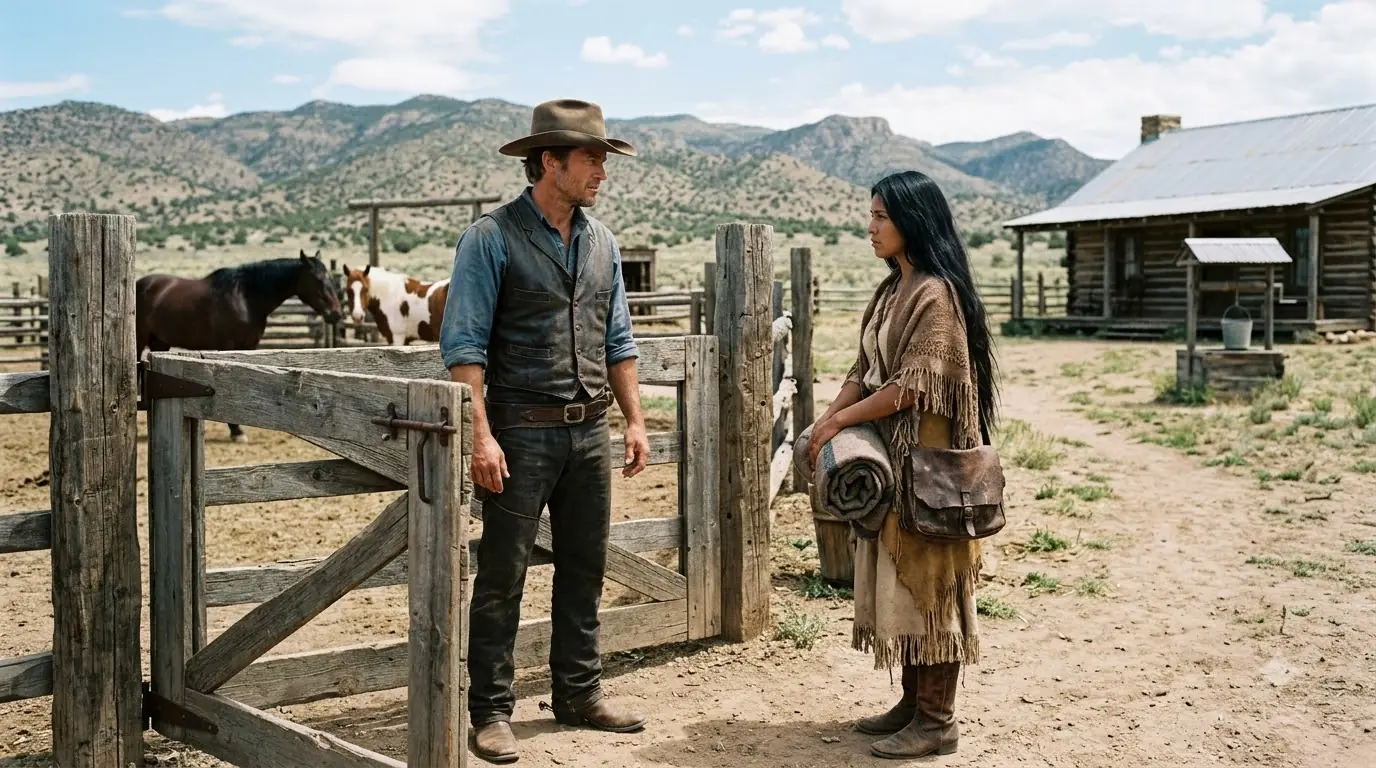
That was 7 years ago. Since then, the ranch had grown quieter and the man had grown harder. And everyone in Rio Blanco County had quietly decided that Ethan Carter was the kind of man who was done with living, even if he hadn't gotten around to dying yet. He was pulling water from the well that morning when he heard hooves on the road. He didn't look up at first.
Nobody came out this far without reason, and reason, in his experience, was rarely welcome. But the hooves stopped at his gate. And then a voice, low, careful, unmistakably young, said the six words that would change the rest of his life. My father said you wanted children. Ethan looked up slowly, the way a man does when he's learned not to trust sudden things.
She was young, 19, maybe 20, standing on the other side of the gate with the kind of stillness that doesn't come from calm, but from long practice with danger. Apache, clearly. Her hair was black and long, her clothing a mix of worn cotton and deerskin. She carried a battered leather satchel over one shoulder and a rolled blanket under her arm. Her boots were cracked at the seams.
She was looking at him the way you look at something you're not sure will hurt you. He came to the gate. He didn't open it. Who's your father? He said was, she corrected.
He died 3 months ago. His name was Cale. She paused. You knew him as Charlie. Charlie.
Ethan felt the name land somewhere old inside him. Charlie Running Horse. 12 years ago, before the dream and the fever and all of it, Ethan had ridden with Charlie for two seasons, driving cattle up through Arizona, sleeping under the same stars, splitting the last of the coffee. He hadn't seen him since. Charlie's dead, Ethan said.
It wasn't a question. Yes. He looked at her for a long moment, the satchel, the cracked boots, the careful eyes. He sent you here before he died, he said. She hesitated, then set it straight, the way she had been practicing it on the road.
He said you always wanted children, but you gave up on the idea. He said you were a good man and a stubborn one. He told me you would probably tell me to go away. He wasn't wrong, Ethan said. He also said, she continued without blinking, that if you said that, I should tell you that a man who stops wanting things is a man who stops living, and that you owed him a debt.
What kind of debt? Ethan asked slowly. She opened the satchel and pulled out a folded letter. The kind you can only repay with time, she said. He read the letter at the kitchen table while she stood just inside the door, not quite in the room and not quite out of it.
Charlie's handwriting was uneven and slow, the handwriting of a man who learned to write late and never trusted it fully. But the words were clear. Ethan, if you're reading this, my girl made it. Her name is Iyana. It means eternal bloom.
Her mother named her before she left us. Iyana is good and strong and too smart for her own safety, and she has nowhere to go. Her people won't take her back. She is too much her father's daughter, too much between worlds. The white towns won't keep her without a husband or a position, and both of those are just different kinds of cages.
I thought of you because I know you are honest and because I know you are alone. I am not asking you to love her like a daughter. I am asking you to give her a season, work, shelter, the chance to find her own way. After that, if she wants to go, let her go. If she wants to stay, let her choose.
You told me once, sitting east of the Brazos, that you wished you'd had a family. I told you it wasn't too late. You said it was. I'm asking you one last time, from wherever I am now, prove me right. Ethan folded the letter.
He looked at Iyana, who had not moved from the doorway. I have no right to do this, Ethan said quietly. No, she agreed. He didn't. I'm not looking for I know what you're not looking for," she said.
There was no anger in her voice, only patient precision. "I'm not looking for a father or a husband or charity. I'm looking for one season of work for honest pay. That's all. " Ethan looked at the folded letter in his hands. Outside, the wind moved through the dry grass with a long, low sound like a question.
He stood up slowly. "There's a cot in the back room," he said. "Supper's at sundown. " He walked toward the door, then stopped with his hand on the frame. "One thing," he said without turning around. "I don't talk about Margaret.
Not to anyone. Not ever. " A pause. "I just need you to know that. " He went outside. Ayanna looked at the folded letter still on the table, the letter that hadn't mentioned any Margaret at all, and understood for the first time exactly how much this man was carrying. The first 2 weeks were built entirely of silence and distance and small practical things.
Ayanna woke before dawn without being asked. She mended the fence along the south pasture, not the patching Ethan had been doing for years, but a real repair, post by post, until the line was clean and true. She learned the well's temperament, the way the rope stuck on cold mornings, the way the bucket had to be angled and fixed both. She cooked in the evenings, corn and dried meat, and occasionally something she'd found in the hills that Ethan didn't recognize but ate anyway because it was good. He watched her the way you watch weather carefully from a distance, waiting to see what kind of storm she'd turn out to be.
But she wasn't a storm. She was the opposite, the kind of stillness that follows one. They didn't talk much. He asked about the work. She answered in facts.