My name is Mason Reed, I was thirty years old when my girlfriend looked straight at me and told me she planned to keep sleeping with another man. She did not cry, apologize, or pretend she was confused about what she wanted. She simply leaned against our kitchen counter in Raleigh, folded her arms, and said, “I’m still seeing Derek, Mason, so you need to get used to it.” I looked at her for a few seconds and answered, 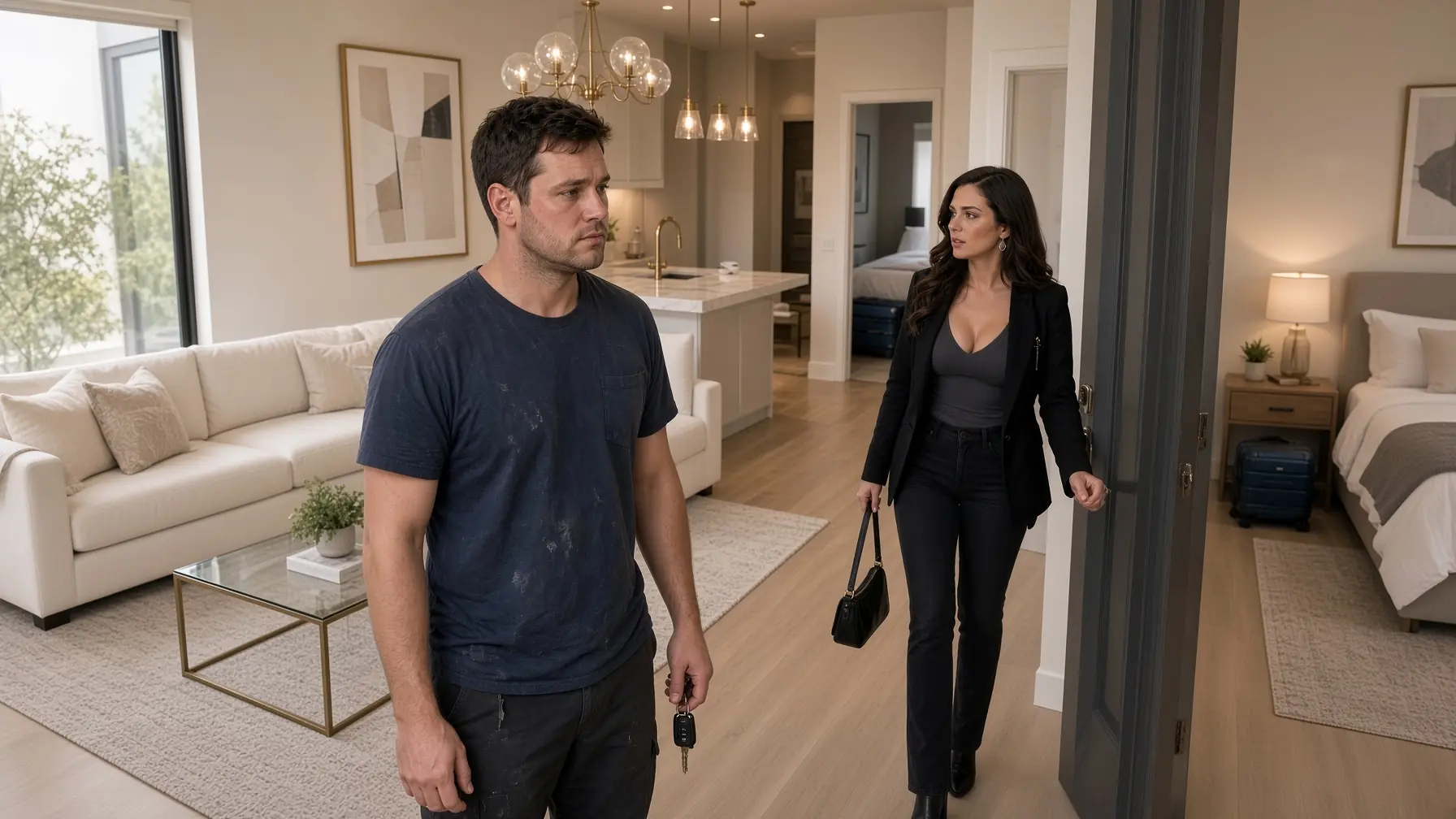
“Okay.”
Her name was Alyssa Grant, twenty-eight, and we had been together for a little over three and a half years. We had lived together for eleven months in a two-bedroom apartment near North Hills that she had chosen mostly because the kitchen photographed well and the building had a rooftop pool. If somebody had asked her about us, she probably would have said we were stable, mature, and comfortable. By the end, I would have said I had become an extra piece of furniture inside a life that was technically mine too.
Alyssa had not always treated me like that. The woman I fell in love with laughed at stupid jokes, stole my hoodies, and once drove forty minutes through a storm because I mentioned I had forgotten lunch at work. She used to fall asleep with her head on my chest and ask me questions about everything, even subjects she did not actually care about. Somewhere along the way, curiosity turned into irritation.
The way I loaded the dishwasher became wrong. The music I played while cooking became embarrassing. My old concert shirts were apparently evidence that I had stopped evolving as a human being sometime around twenty-four. Every small difference between us became something she could point to as proof that she was moving forward and I was standing still.
I worked in commercial refrigeration, supervising service crews for grocery stores and restaurants around central North Carolina. It was not glamorous, but it paid well, I liked the people I worked with, and I had spent years learning enough about the trade that problems usually became interesting before they became frustrating. Alyssa worked in event marketing for a regional hospitality company, which meant her world involved launch parties, hotel openings, networking dinners, and people who used phrases like brand activation without laughing. She slowly began treating my work like the thing that paid half the rent while hers represented some larger version of life.
At first, I laughed it off. Relationships require tolerance, and I had always believed one person usually cared about some differences more than the other. If she wanted nicer plates, fine. If she wanted the bedroom painted cream instead of dark blue, I did not consider that a threat to my masculinity.
The problem was not decorating. The problem was that compromise became directional. Alyssa selected the apartment, the furniture, the restaurants, the weekend plans, and eventually even which of my friends she considered worth seeing regularly. I became good at saying, “Whatever you want,” because it was easier than spending forty minutes defending something that did not feel worth a fight.
My older brother Connor noticed before I did. He helped us move into the apartment, stood in our living room staring at a white couch nobody was allowed to eat near, and asked, “Where’s your stuff?” I pointed toward my guitar against the wall. Connor laughed. “One guitar doesn’t make this your apartment.”
I told him Alyssa simply cared more about decorating than I did. Connor looked around again but let it go. That was something my family had learned with me. Once I decided a relationship was fine, criticism only made me defend it harder.
Two months before everything collapsed, Alyssa began going out more often. Not company dinners exactly and not girls’ nights either. She simply started appearing in the bedroom around seven-thirty wearing makeup she had stopped wearing around me, changing clothes twice, grabbing a small purse, and saying, “I’m heading out.”
“Where?” I asked the first few times. She would sigh. “Why does it matter?”
“Because you’re my girlfriend.” Alyssa usually rolled her eyes. “I’m meeting people.”
“What people?” That was when the irritation arrived. “Mason, do I need to submit an itinerary now?”
I backed off. I told myself independence was healthy. Couples who lived together did not need permission to leave the house, and I did not want to become the insecure guy who interrogated his girlfriend every time she wore eyeliner.
Then her phone changed. Alyssa had never been secretive about it before. Suddenly, the screen stayed facedown whenever we ate.
She started taking it into the bathroom. If I entered the room while she was texting, her thumb closed whatever conversation she had open almost automatically. It did not look planned. That was what bothered me most.
Secrecy had become muscle memory. I could see it happen before she realized she was doing it. One night, after watching her angle the screen away for the third time during a movie, I finally asked, “Is there somebody else?”
Alyssa laughed. Not nervous laughter. Actual amusement.
“You’re serious?” I nodded.
She shook her head. “Wow.” Then she looked at me almost pityingly. “This insecure thing is not attractive on you.”
I apologized. I wish I could say I am embarrassed by that now, but at the time the apology felt easier than holding the question in the room. She kissed my cheek afterward, and I treated the small affection like proof I had been wrong.
That became our pattern. I noticed. She dismissed.
I questioned. She reframed. I apologized.
Each time I surrendered my instincts, the next surrender became easier. You can train yourself to distrust your own perception surprisingly quickly when the alternative threatens something you are desperate to keep. I called it patience because that word sounded healthier.
Then I learned his name. Derek Sloan worked as a freelance photographer and videographer Alyssa’s company hired for hotel launches and promotional events. He was thirty-two, recently divorced, conventionally attractive, and apparently very good at telling women exactly what part of themselves deserved more appreciation.
His name appeared too often in Alyssa’s stories before it disappeared from them completely. That disappearance caught my attention. People rarely stop mentioning somebody because they suddenly become less relevant. Sometimes they stop because relevance has become dangerous.
One evening I walked into the kitchen while Alyssa was smiling at her phone. She locked the screen instantly. I looked at her.
“Derek?” Her face hardened. “Why would you ask that?”
“Because you were smiling.” The stupidity of my answer embarrassed me the second it left my mouth. Alyssa made sure I felt it.
“So I can only smile if I’m texting another man now?” I shook my head. “That isn’t what I meant.”
“You don’t trust me.” I said I did.
That was the lie I told her and myself. I did not trust her anymore. I simply had not admitted it because I thought admitting distrust meant the relationship was already broken.
The next Friday made denial impossible. I came home around six after spending the afternoon at a supermarket replacing a failed compressor rack controller. Alyssa was already dressed.
Black jeans, boots, fitted gray top, silver earrings. She smelled like the perfume she usually saved for weddings and work functions. I set my keys on the counter.
“Going somewhere?” She checked herself in the mirror by the door. “Yeah.”
“With who?” Alyssa sighed immediately. “Not tonight, Mason.”
That response made me stand still. “Not tonight what?”
“The twenty questions.” She grabbed her jacket. “I’m tired.”
I looked at her for several seconds. “Are you seeing Derek?”
She froze. Only for half a second.
Then something unexpected happened. Instead of denying it, she smiled.
Not happily. More like somebody finally deciding pretending was more effort than the truth. “Yes.”
I thought I had misheard. “What?”
“I’m seeing him.” She slipped one arm into her jacket. “And before you start freaking out, I’m not having this dramatic relationship conversation tonight.”
The room seemed to tilt. “You’re sleeping with him?”
Alyssa looked toward me. “Sometimes.”
There are moments you imagine would produce shouting if they ever happened. I had imagined infidelity as something that would turn me into a person throwing furniture, breaking phones, demanding explanations. Instead, I felt strangely cold.
“How long?” Alyssa shrugged.
“Mason.” She rolled her eyes again. “Does that honestly change anything?”
“Yes.” She gave a tired laugh.
“You make everything heavier than it has to be.” Then she said the sentence that ended us, even though she did not know it yet. “I’m still seeing him, so deal with it.”
I looked at her. Three and a half years.
Every birthday. Every trip.
Every stupid argument about dishes. Every Sunday morning eating breakfast together. All of it apparently sat behind a woman telling me her affair was now a condition I was expected to adapt to.
“Okay.” That was all I said.
Alyssa blinked. She had expected something bigger.
Then she smirked. “Okay?”
“Okay.” I repeated.
She studied me like she suspected a trick. Apparently satisfied I had folded again, she reached for her purse. “I’ll be back later.”
I nodded. Alyssa opened the door.
Before leaving, she turned. “And please don’t sit up angry all night.”
The door closed. I remained standing in the kitchen.
For several seconds, nothing happened. The refrigerator hummed. A car passed outside.
Someone’s dog barked in the courtyard. Ordinary life continued around the end of mine.
Then I understood what my “okay” meant. Not acceptance. Not forgiveness.
Permission. Permission for myself to stop negotiating with somebody who had already left the relationship emotionally and simply expected me to keep paying half the utilities. The clarity arrived so calmly that it almost frightened me.
I sat on the couch for maybe ten minutes. My eyes landed on everything around me differently. The white sofa.
The abstract prints Alyssa ordered online. The pale rug she selected because my darker choice looked “too bachelor.”
The little ceramic bowl by the entry where I was apparently allowed to keep my keys. I realized how little of myself remained visible in the apartment. Even my books had been moved into the spare room because she said they made the living area look cluttered.
I went into our bedroom and opened the closet. Her clothing occupied nearly three-quarters of it. Dresses, jackets, shoes stacked in clear boxes, handbags on shelves.
My side held twelve shirts, work pants, three pairs of jeans, two suits, a few hoodies, and the old denim jacket Alyssa hated because she said it made me look like somebody who played bass in a garage band. I touched the jacket. Then I took it down.
Packing began quietly. I pulled the large blue suitcase from beneath the bed and put it on the mattress.
There was no dramatic throwing of clothes. I folded everything carefully. Work shirts.
T-shirts. Jeans. Socks rolled into pairs.
The same way my father taught Connor and me before family road trips. Order gave my hands something to do while the rest of me tried to understand how life could change so completely in less than an hour.
I packed shoes next. Then chargers, documents, medications, my laptop, and the small wooden box containing my grandfather’s watch. I looked around the bedroom again.
Almost nothing else belonged specifically to me. That realization hurt in a way the affair had not yet managed to. I had not merely been betrayed inside our home.
I had gradually evacuated myself from it long before physically leaving. Alyssa had simply made the final arrangement obvious. I moved into the bathroom.
My toothbrush went into a plastic travel case. My cheap razor followed.
I left behind the expensive facial products she bought me because she disliked the drugstore brand I had used for years. I took the cedar cologne she once said smelled “too aggressively male” and almost laughed when I put it inside the bag. Apparently even my scent had needed revision.
My phone buzzed. Alyssa.
Don’t wait up.
I stared at the message. An hour earlier, she had openly admitted sleeping with another man. Still, she felt the need to provide me a household update.
I put the phone down. No answer.
I packed the living room next. Guitar. Small amplifier.
Toolbox from the hall closet. My father’s framed photograph. Two books from the side table.
Then I remembered the lamp. Connor gave me that lamp when I moved into my first apartment after college. Alyssa hated it because the base was black metal instead of brass.
I unplugged it. Petty, maybe. Mine, definitely.
By eleven, everything important fit inside my Tacoma. I stood inside the kitchen one last time. Alyssa’s wineglass from earlier remained beside the sink.
I opened the drawer where we kept batteries, takeout menus, tape, and random things neither of us wanted enough to organize. A yellow sticky-note pad sat near the back. I took one sheet.
The pen skipped on the first letter. Then the words came easily.
Good luck with Derek.
That was it. No accusation.
No speech. No list of things she had done.